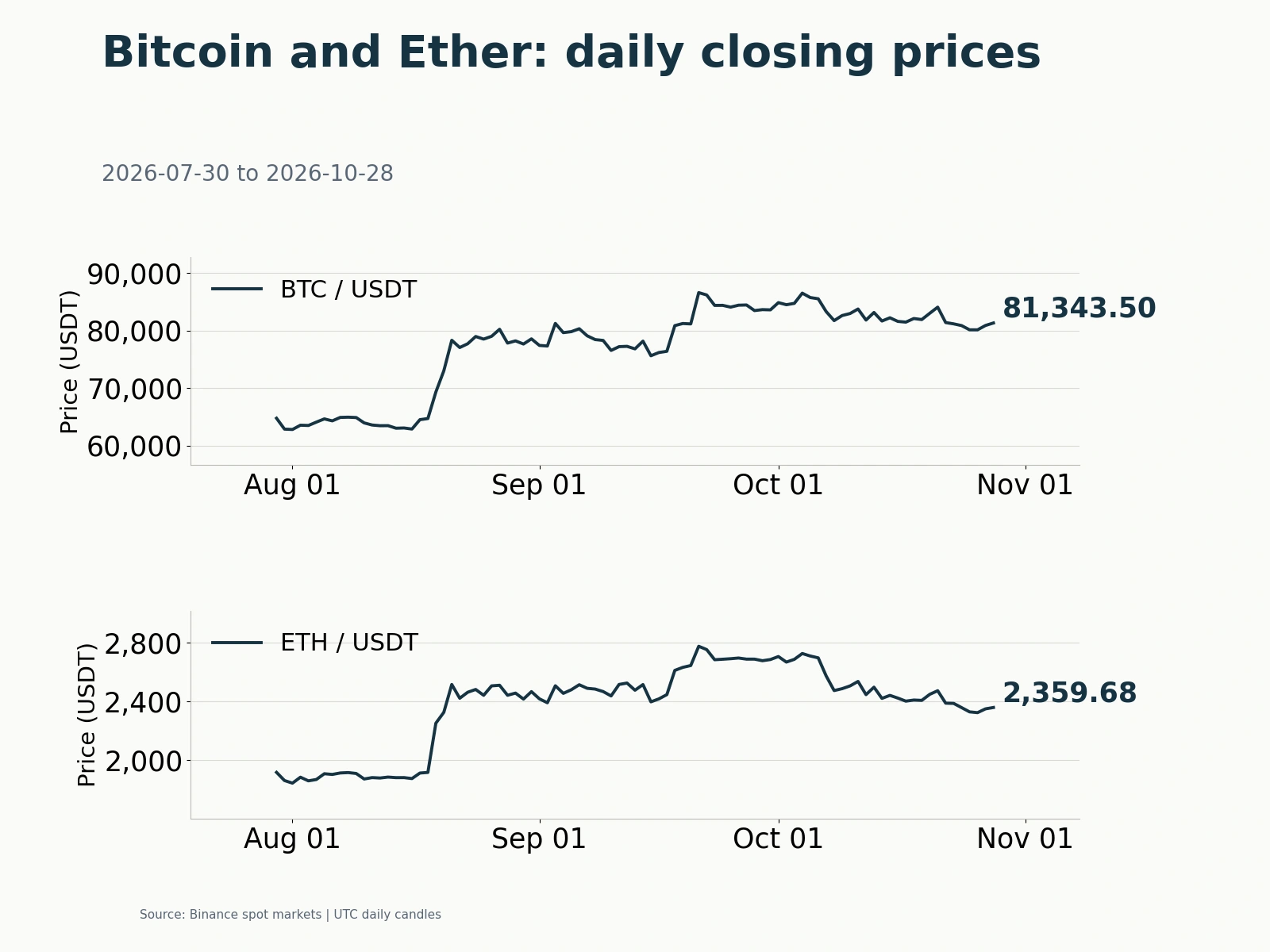
Based on Binance spot USDT prices and UTC daily candles, at the close recorded on the morning of October 22 Beijing time, Bitcoin had risen 1.28% on October 21 and Ethereum 1.00%. Although both major cryptocurrencies rebounded, exchange-based and off-exchange fund flows remained divergent: US spot Bitcoin ETFs recorded net inflows for a second consecutive day, while spot Ethereum ETFs continued to experience net redemptions. Meanwhile, the circulating supply of dollar stablecoins contracted from a week earlier, and longs continued to pay funding on Binance perpetual contracts. Allocation capital has begun returning to Bitcoin, but the broader funding base needed to sustain market expansion still needs to strengthen.
Bitcoin ETFs attract nearly $550 million in two days; Ethereum's October outflows exceed $1 billion

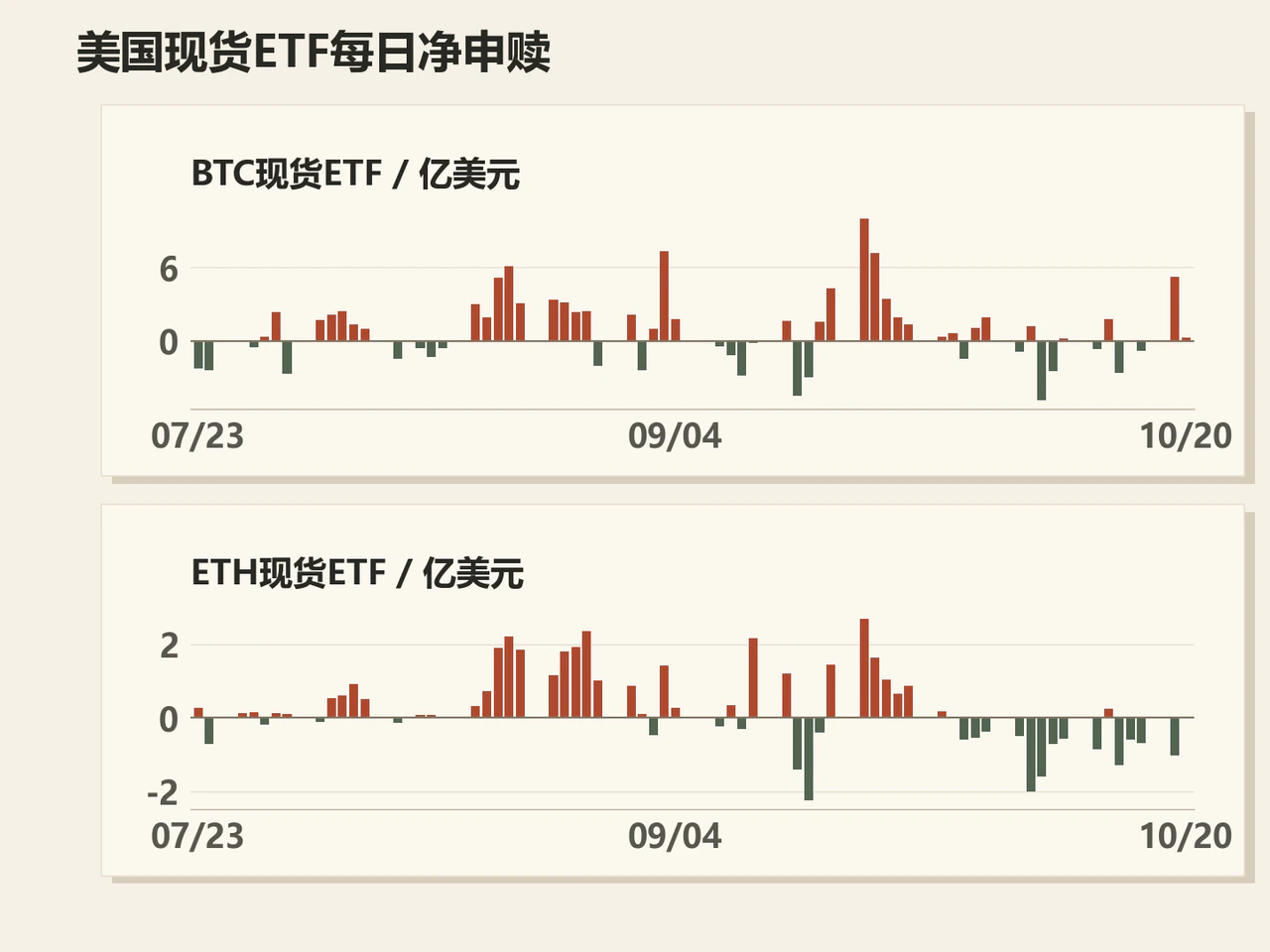
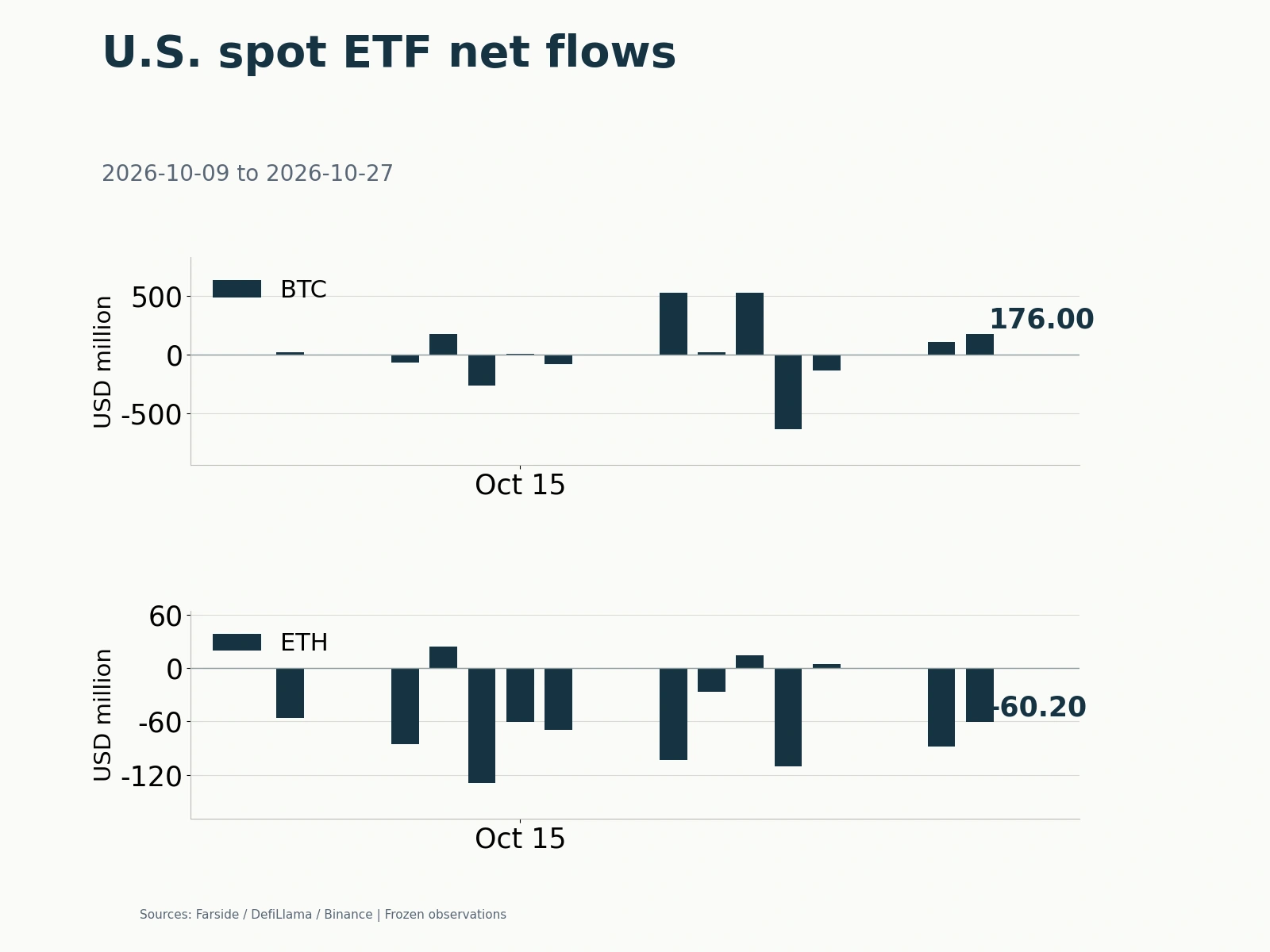
Farside data show that spot Bitcoin ETFs received net inflows of $23.2 million in the US trading session of October 20, a marked slowdown from $526.7 million on the 19th. The two-day total of $549.9 million reversed the preceding week's net outflows, although the pace of daily subscriptions had already weakened.
This round of inflows was heavily concentrated in BlackRock's IBIT. On October 19, IBIT received $665.2 million in a single day, offsetting redemption pressure at Fidelity's FBTC, which lost $83.6 million, and Grayscale's GBTC, which lost $54.9 million. On the 20th, IBIT attracted another $29.9 million and FBTC $3.6 million, while Bitwise's BITB saw $10.3 million leave. Even as aggregate flows returned to positive territory, holders of different products continued to rebalance in distinctly different directions.
Over the five US trading days from October 14 through 20, spot Bitcoin ETFs received cumulative net inflows of $211.2 million. Yet the October 1–20 total remained a net outflow of $64.8 million. The large subscriptions on the 19th materially improved recent funding conditions, but did not fully fill the withdrawal gap accumulated since the start of the month. Whether that recovery continues depends on sustained subscriptions in subsequent trading sessions.
By contrast, spot Ethereum ETF flows remained under pressure. On October 20, these funds recorded $26.1 million in net outflows. BlackRock's ETHA lost $33 million, while Fidelity's FETH and Grayscale's Ethereum Mini fund attracted $3.6 million and $3.3 million respectively, offsetting only part of the redemptions. Ethereum ETFs lost a cumulative $362.8 million from October 14 through 20, and $1.0584 billion from October 1 through 20.
Subscription and redemption data for the same period show a clear tilt toward Bitcoin in allocation demand through institutional products. Ethereum nevertheless posted a daily rebound on the 21st despite continuing ETF net redemptions through October 20. Its short-term price recovery therefore also needs to be assessed alongside other funding indicators, including on-chain activity and derivatives.
Stablecoin supply falls $2.6 billion in a week; derivatives longs continue to pay funding

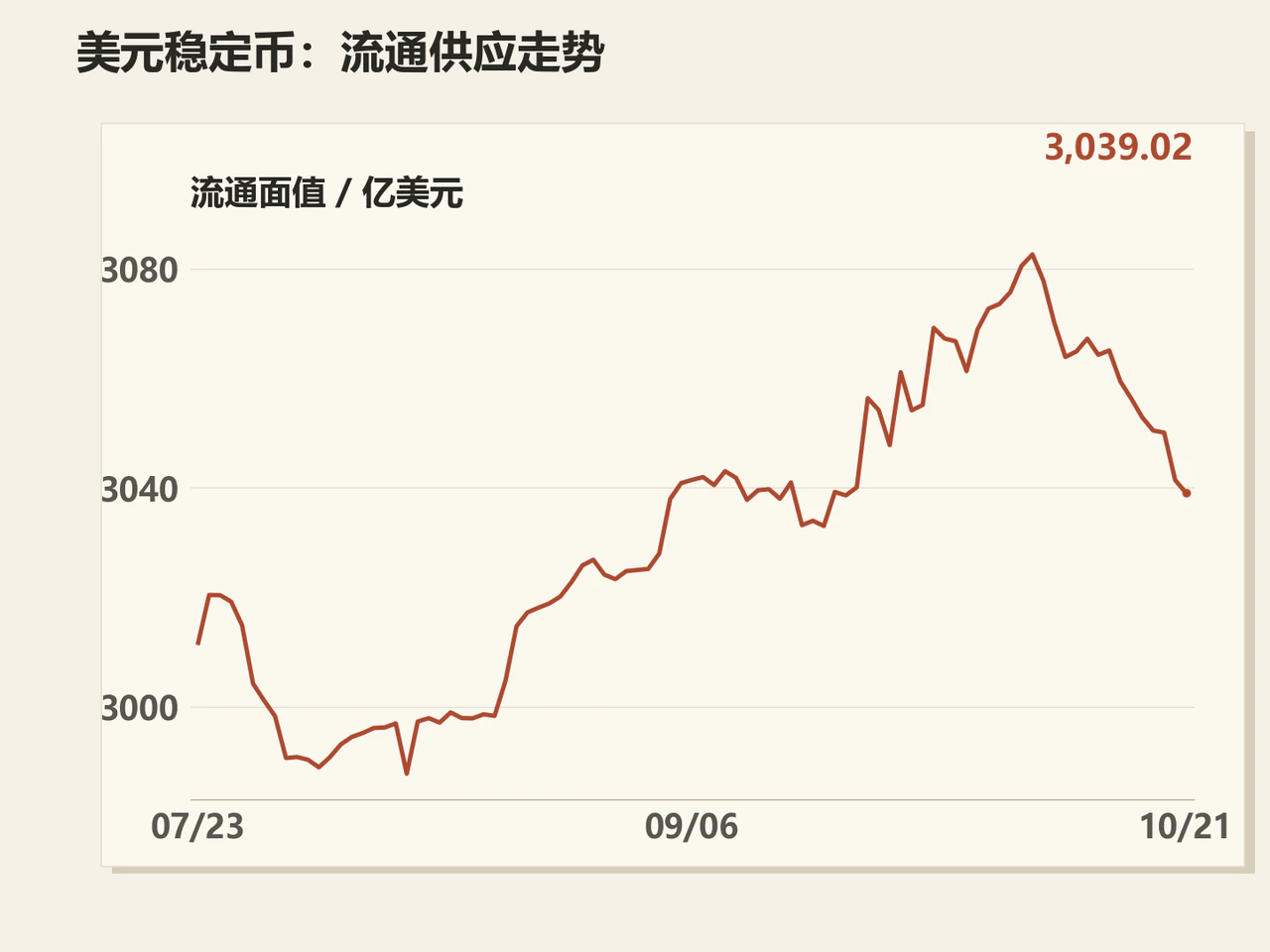
Changes in available on-chain capital also suggest caution. DefiLlama data put the circulating supply of dollar-pegged stablecoins at $303.902 billion on October 21, down from $304.137 billion on the 20th. It was $2.603 billion below the October 14 level of $306.505 billion, a weekly decline of approximately 0.85%, and broadly unchanged from $304.006 billion on September 21. The recent cryptocurrency rebound has thus not been accompanied by a corresponding expansion in aggregate stablecoin supply. Existing stablecoins can support buying through faster turnover or a shift from lending, payments and other uses into trading, but substantial new stablecoin issuance has yet to join the move.
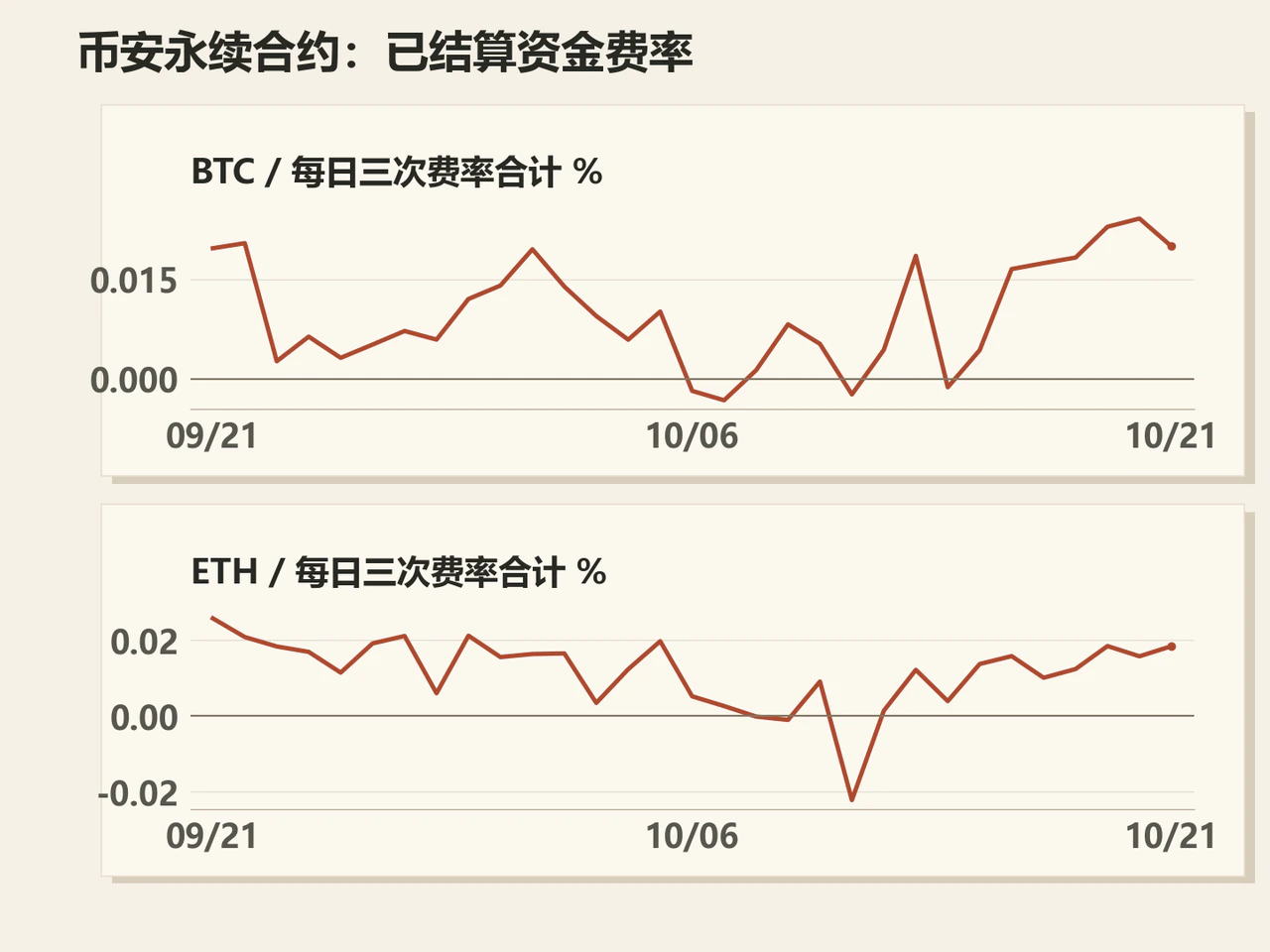
In derivatives, Binance USDT perpetual contracts continued to exhibit positive funding, with longs paying shorts. At the three settlements on October 21, at 00:00, 08:00 and 16:00 UTC, Binance BTCUSDT funding rates were 0.006542%, 0.008540% and 0.004896%, respectively. All were positive, summing to approximately 0.01998%, below the 20th's 0.02417%. During Bitcoin's rebound, longs in this market remained willing to bear holding costs, although the settled funding burden for the day eased from the previous session.
On the same day, Binance ETHUSDT perpetual funding settled at 0.004599%, 0.005314% and 0.008498%, for a combined approximately 0.01841%, up from 0.01574% the previous day. While spot Ethereum ETFs continued to experience net outflows, the funding paid by longs in Binance USDT perpetuals increased. This reveals a structural divergence between rising funding payments by contract longs and redemptions from off-exchange ETFs.
Approaching options expiries also create short-term rebalancing needs. In an October 21 report, crypto.news cited Bitfinex estimates of approximately $1.23 billion in notional open interest in Bitcoin options expiring October 23, and around $11.2 billion for the October 30 monthly expiry. Expiry and position rolls change hedging demand, with the specific effect depending on positioning and the price path. Notional expiry size, however, represents contract face value rather than an equivalent amount of cash entering or leaving the market.
Overall, crypto funding conditions combine returning Bitcoin ETF subscriptions, Ethereum ETF redemptions and contracting stablecoin supply. If ETF net subscriptions remain consistent and stablecoin supply resumes expanding, the rebound will gain support from a broader pool of spot capital. Conversely, if incremental spot and on-chain funds fail to follow and prices are sustained primarily by derivatives longs within exchanges, the market will become more sensitive to weakening spot buying.
Click “Read Original” for the full details.