By the morning of October 22, Beijing time, U.S.-Iranian diplomatic contacts were continuing, yet the Gulf's security situation showed no sign of easing. The United States expanded sanctions on Iran's shipping services network and ordered some government personnel and their families to leave Saudi Arabia. Successive attacks on a Saudi airport and around an oil field caused casualties. Negotiations have yet to improve transport and infrastructure security, while the conflict's economic effects continue to spread to civil aviation, shipping and energy facilities.
Washington and Tehran keep diplomatic channels open, but differences over negotiating terms remain

U.S. Secretary of State Marco Rubio said in India on October 21 that third parties, including Qatar, were still mediating. Washington welcomed mediation but would not accept an agreement that created a pathway for Iran to acquire nuclear weapons. Iranian Foreign Minister Abbas Araghchi said the same day that Iran remained willing to end the war through diplomacy if the United States demonstrated a willingness to build trust and resolve the conflict. Iranian President Masoud Pezeshkian called for the actual removal of threats and sanctions to create conditions for dialogue.
Both sides left room for contact, but clear differences remained over the sequence of negotiations. Iran wanted economic and security pressure reduced first, while Washington continued to place the nuclear issue at the heart of any agreement. How the lifting of the blockade, reopening of the strait and nuclear arrangements might be exchanged remained central to whether diplomatic contacts could reach the implementation stage.
Israel's public position was harder. At an officers' graduation ceremony on October 21, Benjamin Netanyahu said overthrowing Iran's government was the way to eliminate the threat and that he had issued related instructions to the military and intelligence agencies. He also accused Iran of renewing work on nuclear weapons; Iran has consistently denied seeking them. Near the reporting cutoff, media reported explosions in Sirik in Iran's Hormozgan province.
U.S. sanctions target shipping services as Iran threatens undersea communications cables
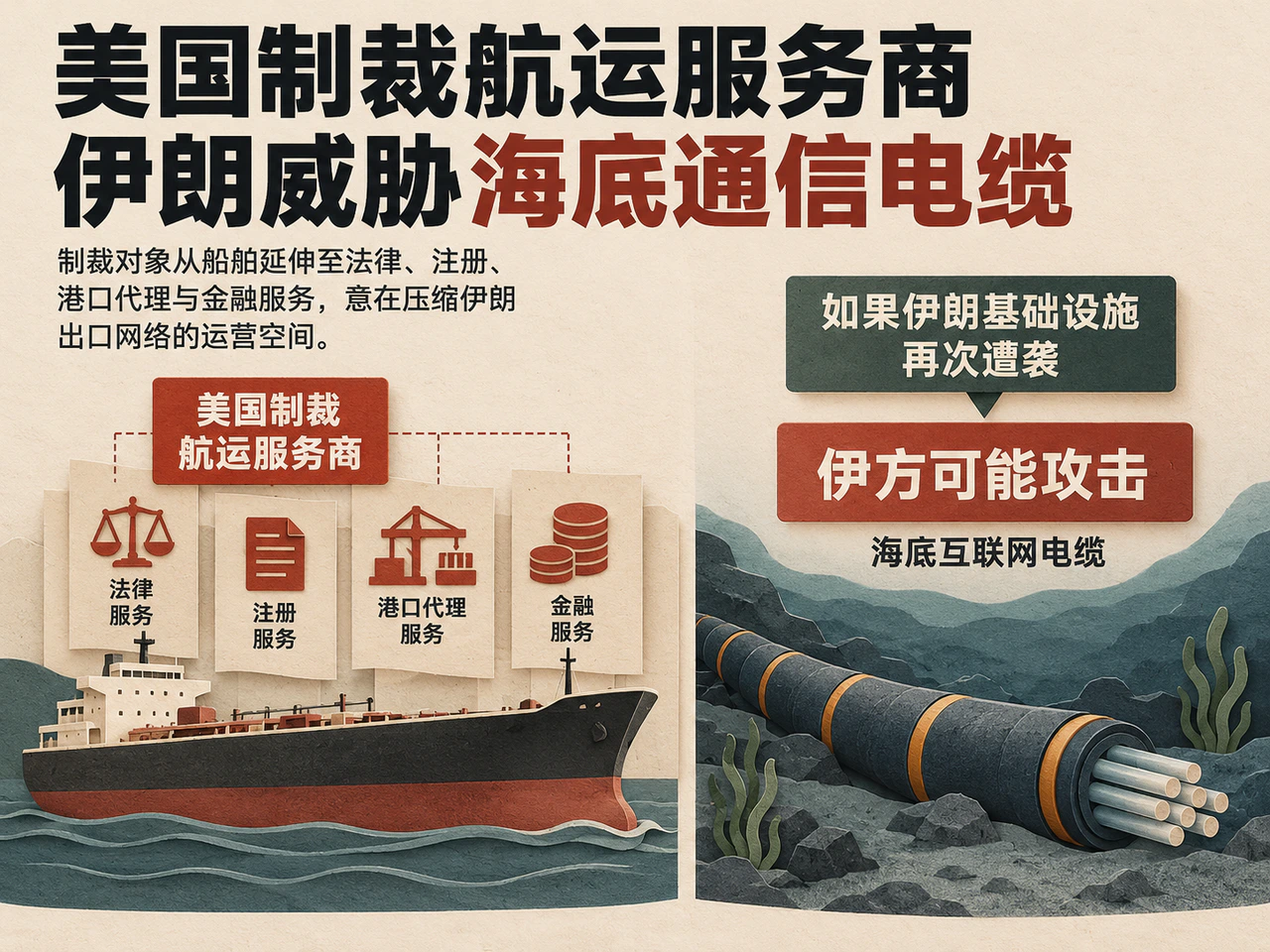
On October 21, the U.S. Treasury sanctioned the law firm Karnakis and Karnakis, operating in Panama and Greece, accusing it of helping conceal the true ownership of vessels transporting Iranian goods through company formation and other services. The targets also included ship management businesses, shipping agents in Singapore and the United Arab Emirates, and associated vessels. The U.S. Financial Crimes Enforcement Network separately issued an administrative subpoena to a Greek bank to investigate potential Iranian ties.
The expansion of sanctions from vessels to legal, registration, port agency and financial services was intended to constrain the operation of Iran's export network. The corporate structures, agency services and settlement relationships on which shipping businesses depend have all become channels through which sanctions pressure is transmitted.
Maritime security remained under pressure as well. The United Kingdom Maritime Trade Operations office reported on October 21 that an unidentified projectile had struck a tanker off Oman and started a fire. The fire was later extinguished and the crew were safe. Another tanker attack near Iraq's Al Faw was disclosed that day; the crew were safe and no damage or environmental impact was reported.
Revolutionary Guards official Yadollah Javani warned that Iran might attack undersea internet cables passing through the Strait of Hormuz if Iranian infrastructure came under attack again. This conditional threat of retaliation added communications connectivity to the range of regional infrastructure exposed to the conflict.
Saudi airport attack kills one and injures eight; U.S. orders some personnel to leave
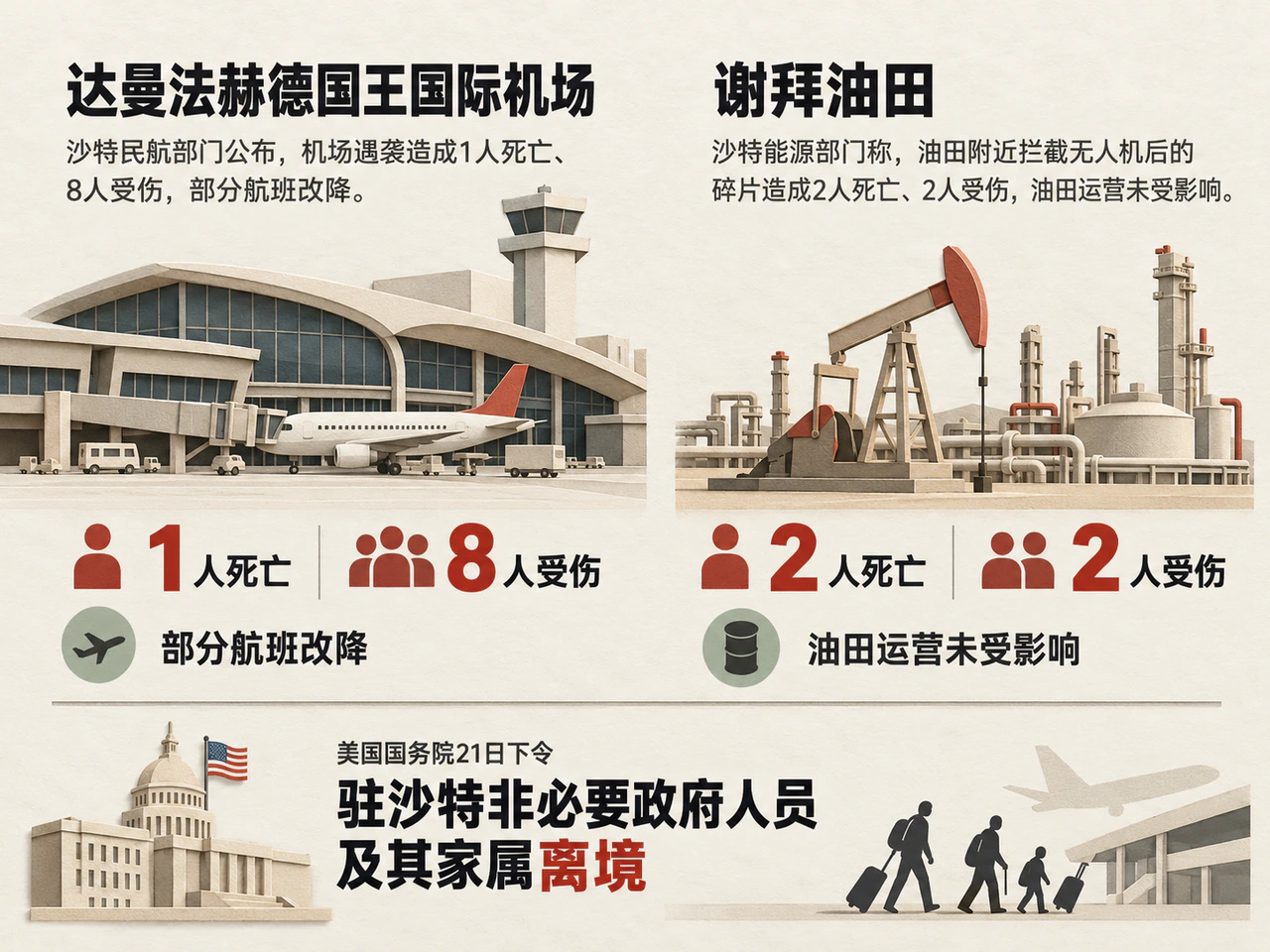
Saudi civil aviation authorities said an attack on King Fahd International Airport in Dammam killed one person and injured eight, with some flights diverted. Saudi energy authorities separately said debris from intercepted drones near the Shaybah oil field killed two people and injured two, without affecting field operations. The attacks have caused casualties, while the oil field continues to produce.
On October 21, the U.S. State Department ordered nonessential government personnel and their families in Saudi Arabia to leave. According to the Associated Press, the formal departure order applied to Saudi Arabia; other Gulf embassies were making temporary staffing adjustments. King Khalid International Airport in Riyadh, which had previously been attacked, resumed limited flights that day. As some transport services resumed, personnel departures and international flight cancellations continued, leaving normal operations constrained by security conditions.
The conflict's effects on movement and essential supplies were also widening. Iraq closed the Sheeb border crossing with Iran for security checks and equipment installation, temporarily halting passenger and truck traffic. Operations at Yemen's Aden airport were partly suspended following an attack nearby. On October 21, Oxfam aid workers warned that drinking water, fuel and food were increasingly scarce in Taiz and that the siege was obstructing the evacuation of wounded people and medical assistance. Whether diplomatic contacts translate into real de-escalation ultimately depends on the restoration of transport, personal travel and basic supplies.
Key developments
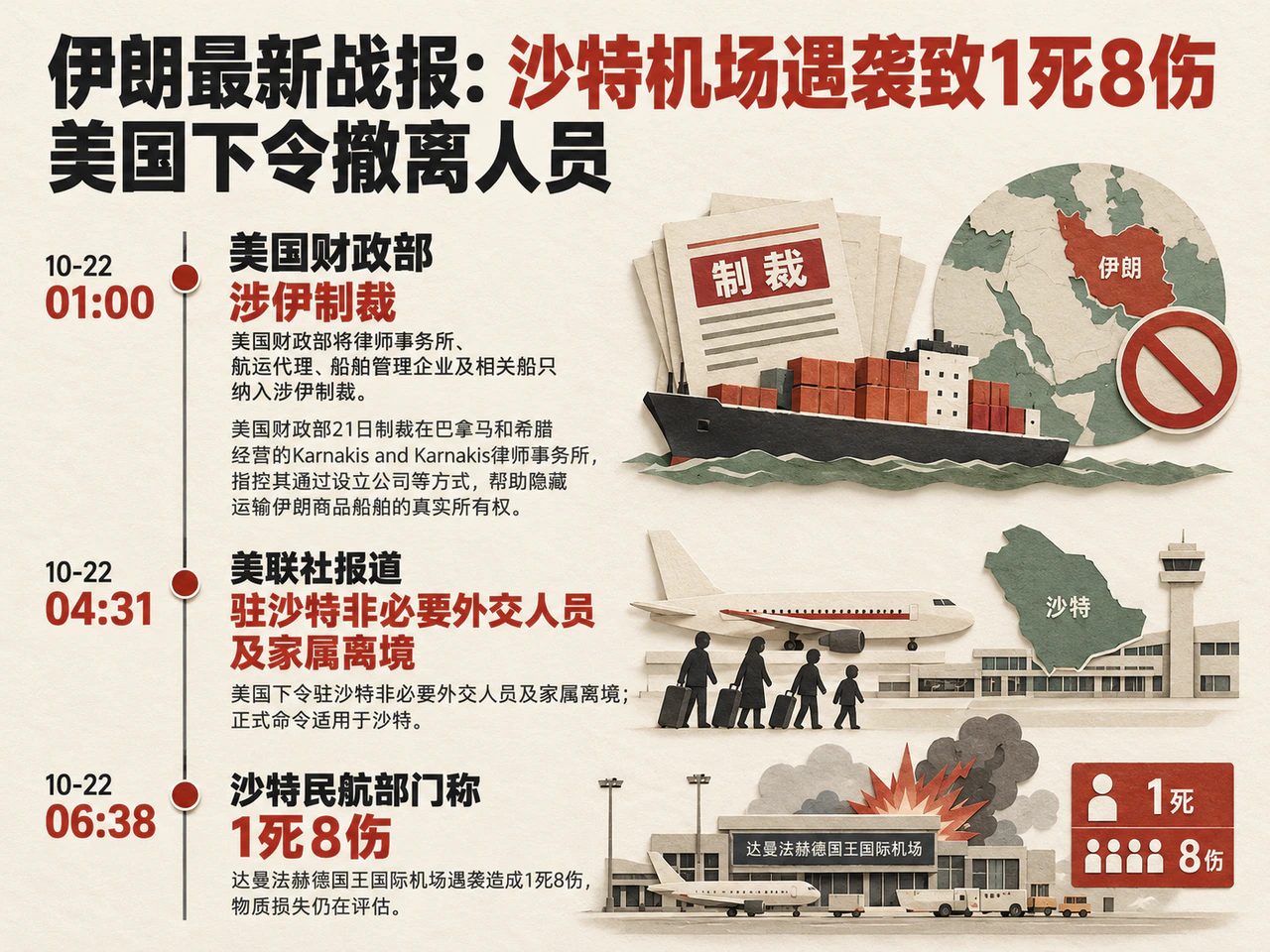
The following entries are ordered by the time of publication, all in Beijing time. Reports for which only a date is known retain that date.
| Key developments |
|---|
| 10-22 06:38Saudi civil aviation authorities said the attack on King Fahd International Airport in Dammam killed one person and injured eight; material damage was still being assessed. |
| 10-22 04:31The Associated Press reported that the United States had ordered nonessential diplomatic personnel and their families in Saudi Arabia to leave. The formal order applied to Saudi Arabia. |
| 10-22 04:05Media, citing Israeli and U.S. officials, reported that Israeli warplanes had conducted an exercise toward the Iranian border before turning back. The reports described it as a deterrent operation. |
| 10-22 03:17Saudi energy authorities said an attack associated with the Shaybah oil field killed two people but did not affect operations. |
| 10-22 02:35Media reported explosions in Sirik, Iran. The specific targets and those responsible remained unclear. |
| 10-22 01:00The U.S. Treasury added a law firm, shipping agents, ship management businesses and associated vessels to Iran-related sanctions. |
| 10-21 22:45Oxfam aid workers warned of shortages of drinking water, fuel and food in Taiz, Yemen, with the siege obstructing assistance. |
| 10-21 22:41Netanyahu said he had instructed the military and intelligence agencies to eliminate the threat by overthrowing Iran's government, and accused Iran of advancing nuclear weapons development. |
| 10-21 20:17A Revolutionary Guards official warned that Iran might attack undersea internet cables in the Strait of Hormuz if Iranian infrastructure was attacked again. |
| 10-21 20:06British authorities reported that an unidentified projectile hit a tanker off Oman, starting a fire that was extinguished. They also disclosed an attack on a tanker near Al Faw; the crew were safe. |
| 10-21 19:59Rubio said Qatar and other countries were continuing to mediate, and Washington would not support a deal allowing Iran a pathway to nuclear weapons. |
| 10-21 18:30Iraq closed the Sheeb border crossing with Iran for security checks and equipment installation, temporarily suspending passenger and truck traffic. |
| 10-21Araghchi said Iran remained willing to resolve the conflict diplomatically if the United States showed a willingness to build trust. Pezeshkian called for sanctions and threats to be lifted. |
| 10-21The Saudi-led coalition announced that it had intercepted drones. The Houthis denied launching drones toward Medina. |
| 10-21King Khalid International Airport in Riyadh resumed limited flights. Operations at Yemen's Aden airport were partly suspended following an attack nearby. |


