By the morning of October 23, Beijing time, regulatory developments across Europe, the United States and Asia showed digital-asset institutions shifting their compliance focus from securing market access to licensing transitions, tax coordination and internal-control execution. The US Office of the Comptroller of the Currency (OCC) finalized the effective timetable for its payment-stablecoin rules, while US industry groups and investment banks focused on tax reform and market-structure legislation still awaiting congressional action. Meanwhile, no institution had formally applied under Thailand's new spot crypto ETF rules, and the Central Bank of Ireland fined a Coinbase European entity approximately €3.25 million for safeguarding and outsourcing failures.
OCC stablecoin rules take effect in January 2027; tax and market-structure changes still require Congress
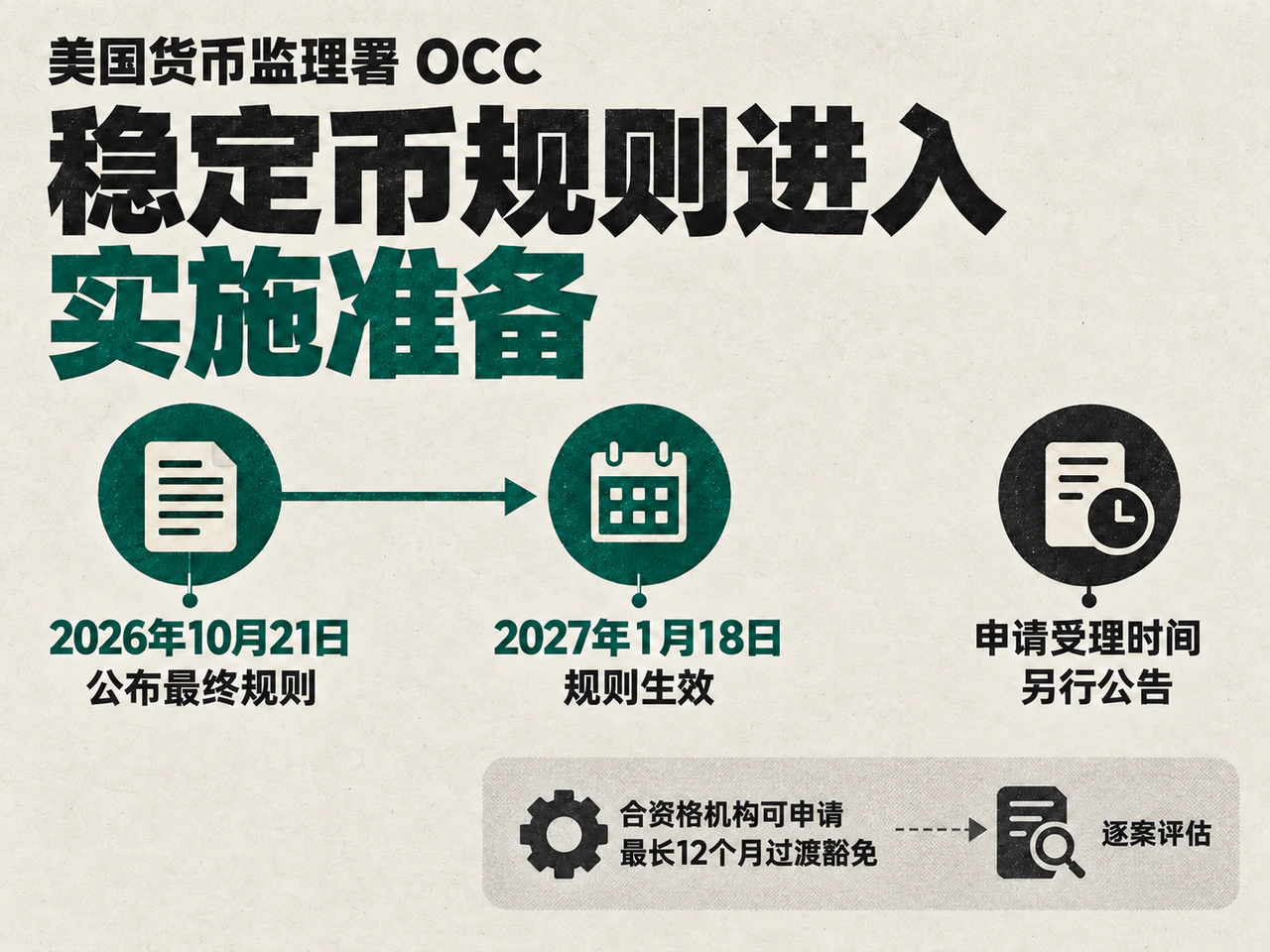
US stablecoin regulation now has a clear implementation countdown. On October 21, the OCC published final rules implementing the GENIUS Act, effective January 18, 2027, covering payment-stablecoin issuers under its jurisdiction and certain custody activities. Anti-money-laundering, Bank Secrecy Act and sanctions requirements will be addressed separately. For existing issuers, preparing license applications is the central transitional task: eligible institutions submitting substantially complete applications before the effective date may seek transitional exemptions of up to 12 months, assessed individually by regulators. The opening date for applications will be announced separately. Finalization allows institutions to plan systems and staffing investments in advance. The pace of application intake and approval will directly determine market-entry schedules, with stablecoin competition increasingly centered on reserve management, redemption procedures and compliance execution.
Beyond these specific rules, broader market structure and taxation still depend on Congress. In research disclosed on October 22, JPMorgan said recent administrative measures by US regulators could partly offset the stalled progress of the CLARITY Act, but more durable market-structure arrangements still required legislation. This captures the two sides of institutions' current expansion: regulators can open pathways for custody, trading and tokenization, while institutions committing long-term capital must still account for administrative rules being challenged in court or reversed by policy changes.
Tax rules are also prompting legislative demands. According to The Block, the Blockchain Association wrote to congressional leaders on October 22 calling for clearer digital-asset tax rules, including a small-transaction exemption, stronger taxpayer privacy protections and extension of wash-sale rules to cryptoassets. The aim is to reduce tax friction in everyday use and establish workable reporting standards. These remain industry proposals; specific tax changes await congressional action.
Coinbase Ireland fined €3.25 million for safeguarding failures; no applications yet for Thai spot ETFs
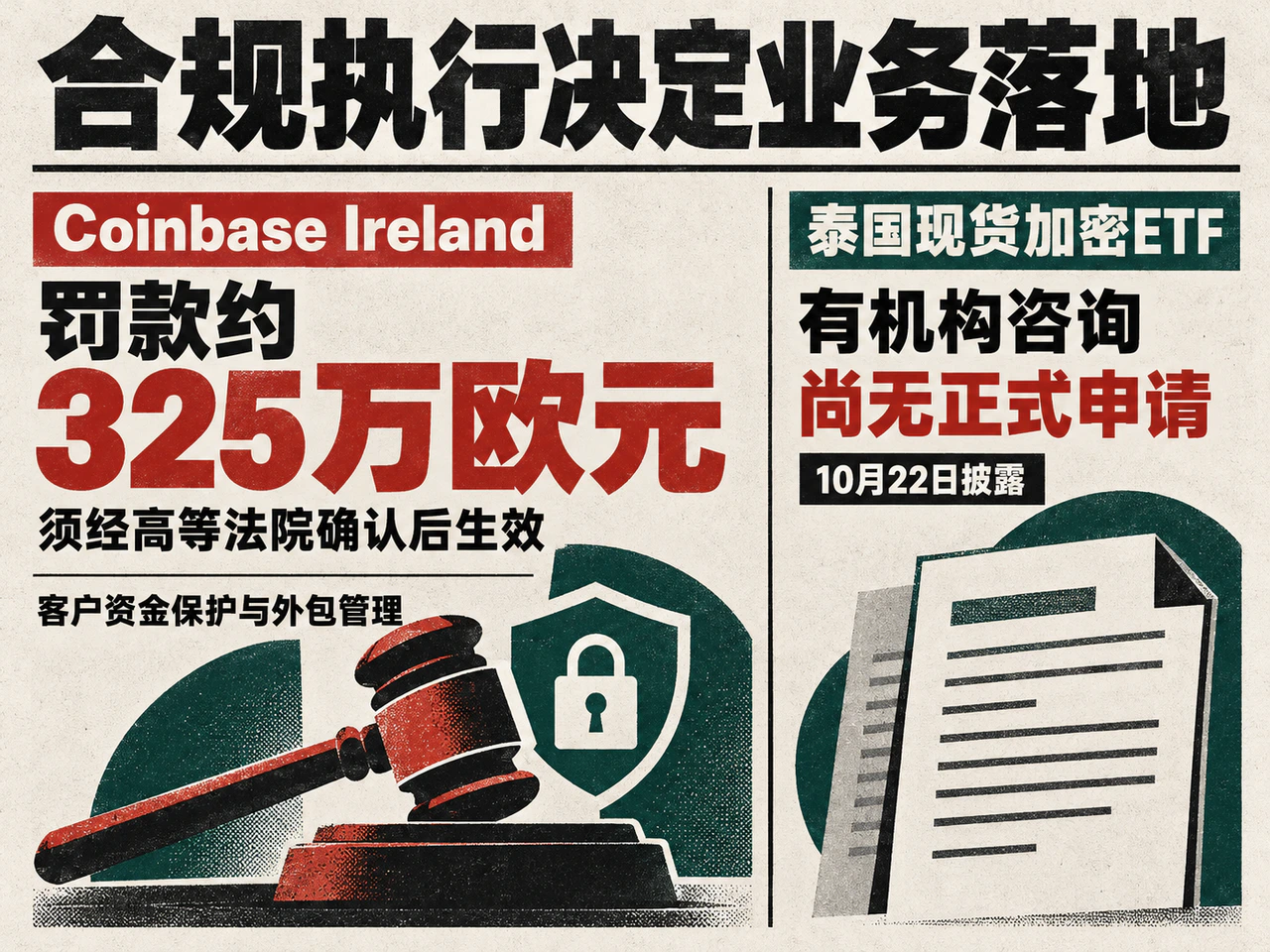
Even in markets where access rules have been liberalized, moving from permission to actual products depends on institutions' application preparations and regulatory review. Thailand's Securities and Exchange Commission told Cointelegraph on October 22 that, although rules already in force allowed locally listed spot Bitcoin and Ether ETFs and several asset managers had made inquiries, no institution had formally applied to establish one. Whether the first products receive approval before year-end, and whether expanded distribution translates into actual allocations, will depend on applicants' documentation, the pace of review and implementation of investor-protection requirements.
For licensed multinational platforms, local internal controls and segregation of funds face closer enforcement scrutiny. On October 22, the Central Bank of Ireland announced a settlement with Coinbase Ireland, imposing a fine of approximately €3.25 million after a settlement discount for safeguarding and outsourcing-management breaches between November 2020 and August 2025. The entity primarily provides electronic-money services, allowing customers to use its e-money to purchase cryptoassets on group platforms. The company accepted the penalty, which requires High Court confirmation before taking effect. The central bank said the company relied excessively on its US group for safeguarding functions, lacked adequate local oversight and had prolonged shortfalls in relevant accounts. The penalty shows that, although global platforms can share group technology and operating systems, responsibility for customer-fund segregation, balance reconciliation and outsourcing oversight must rest firmly with the local licensed entity. These capabilities also materially affect institutional customers' trust and the platform's ability to take on business.
Merger speculation in payment and custody infrastructure also attracted attention. On October 22, Axios reported that Visa was discussing an approximately $2.5 billion acquisition of Fireblocks. Fireblocks subsequently told The Block that no such talks were taking place at that time, while Visa declined to comment. With the transaction unconfirmed, substantive commercial agreements, regulatory approvals and payment-service launches remain the appropriate benchmarks for assessing integration between traditional payment networks and digital-asset infrastructure.
Click Read Original for further details.