As of the morning of October 23 Beijing time, Gulf shipping routes and facilities inside Saudi Arabia were both under pressure from the conflict. Iran's Revolutionary Guards said they had struck four ships and that three others had hit mines; Trump accused Iran of fabricating the attacks. The death toll from the attack on Dammam airport rose to two, before the airport reopened. Media reports said Saudi Aramco had told employees to evacuate its Dhahran headquarters and work remotely. Routine shipping, civil aviation and energy-company operations are becoming direct points of pressure in the regional military confrontation.
Iran claims seven vessels attacked; U.S. denies the account and maintains blockade
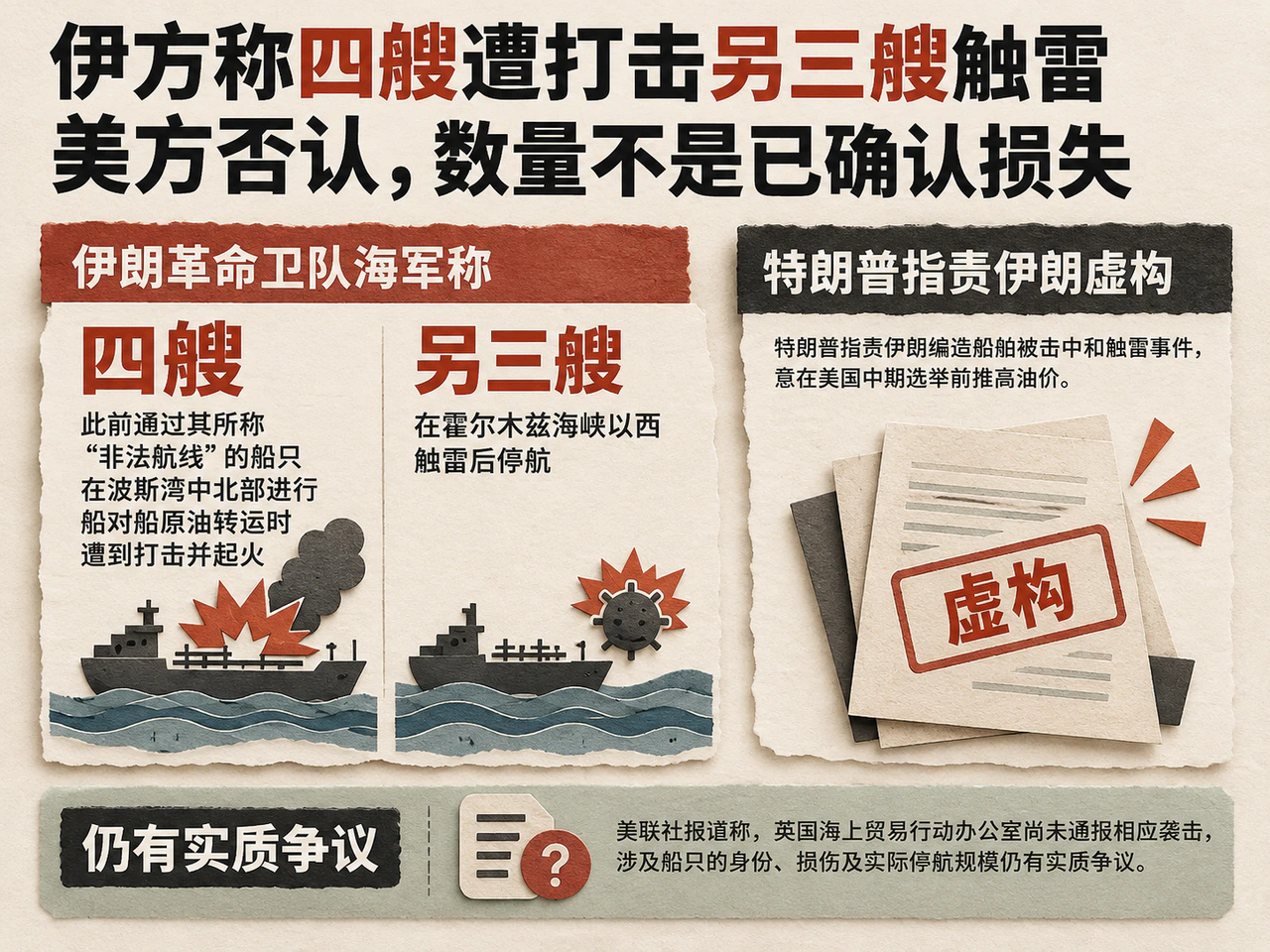
On October 22, the navy of Iran's Revolutionary Guards said four vessels that had previously taken what it called an 'illegal route' were struck and caught fire while conducting ship-to-ship crude transfers in the central-northern Persian Gulf. It said three more vessels stopped sailing after hitting mines west of the Strait of Hormuz. These routes lie near Oman's coast; the United States has encouraged ships to use them to bypass Iranian fees and controls.
The United States disputed Iran's account. Trump accused Iran of inventing reports of ships being hit or striking mines to drive up oil prices before the U.S. midterm elections. At the time of the Associated Press report, the UK Maritime Trade Operations office had not reported corresponding attacks. The identities of the vessels, their damage and the actual extent of shipping stoppages remained materially disputed. The Revolutionary Guards also warned that continued U.S. guidance of vessels along these routes would expand the confrontation to U.S. bases in the region.
The contest now extends beyond the entrance to the strait to how vessels choose routes and where they transfer crude. Washington is trying to maintain passage through alternative routes and escorts, while Iran has designated vessels that use those routes and then conduct offshore transfers as targets. Even if cargo continues moving, safety risks during navigation, transfers and port calls will affect transport efficiency and costs.
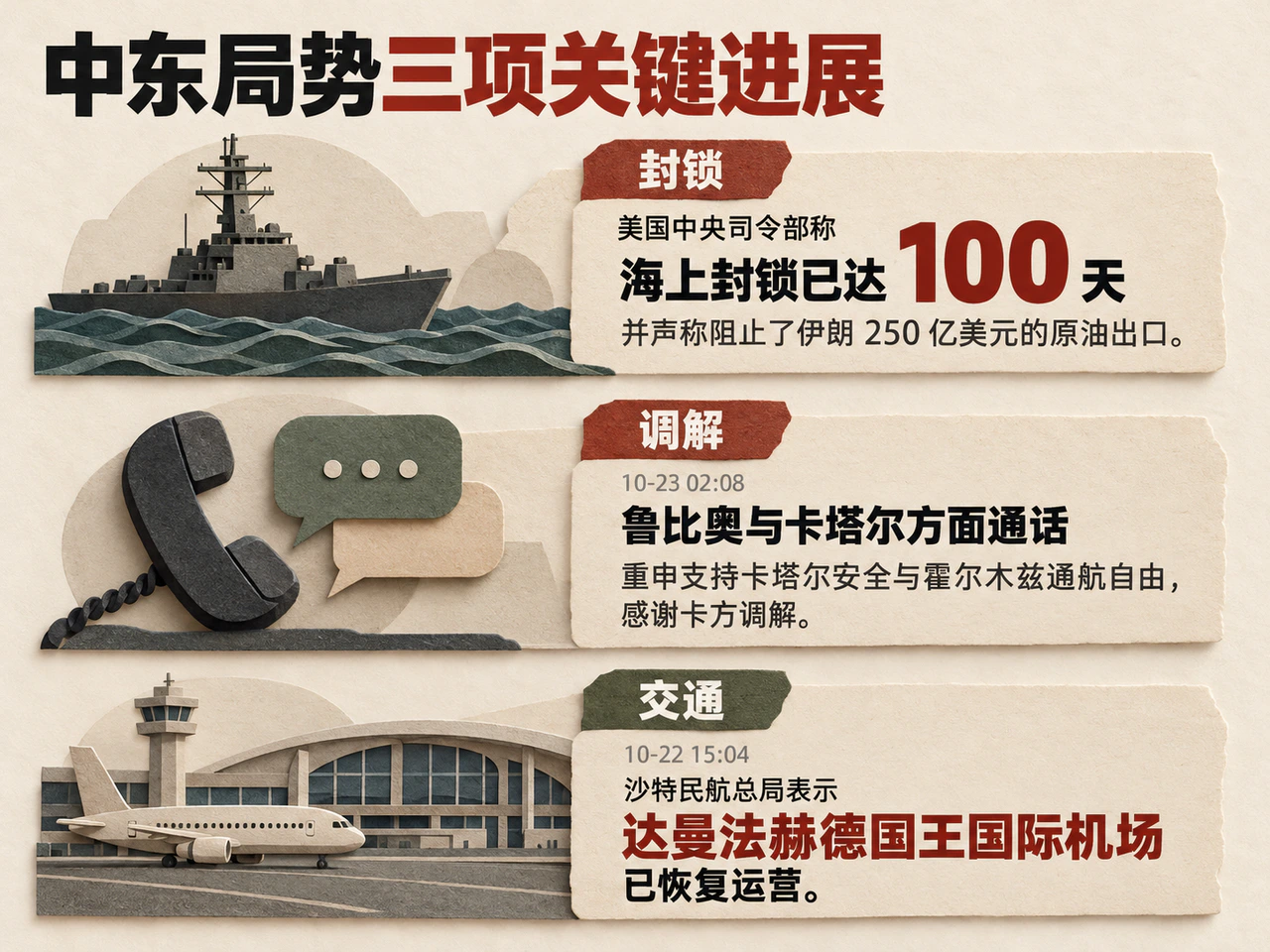
U.S. Central Command said early on October 23 Beijing time that the reinstated maritime blockade had lasted 100 days and claimed it had prevented $25 billion of Iranian crude exports. The blockade and efforts to counter it continue, with no mutually accepted navigation arrangements in place.
Dammam airport reopens; Aramco headquarters staff shift to remote work

On October 22, Saudi Arabia's General Authority of Civil Aviation raised the death toll from the attack on King Fahd International Airport in Dammam to two, with eight injured. The dead were a Saudi citizen and an Indian resident. The authority later said the airport had reopened and air traffic had returned to normal.
The same day, Reuters cited six people familiar with the matter as saying Saudi Aramco had told employees to evacuate its Dhahran headquarters and work remotely. The company had not responded to requests for comment when the report appeared, and the specific reason for the evacuation had not been explained. AFP cited a source as saying most employees had already been working from home and that the new instruction covered essential personnel still at headquarters. The airport reopening eased the immediate transport disruption, while Aramco's changed working arrangements showed that companies were still taking protective measures.
Houthi spokesperson Saree claimed on October 22 that ballistic missiles and drones had been used in four operations over the preceding 48 hours against the defense ministry in Riyadh, Dammam airport, Aramco facilities in Yanbu and Abha airport. The assertion that all targets were hit had not been independently verified. Saudi authorities reported intercepting drones in the Riyadh and Medina regions. The threats encompass Yanbu on the Red Sea and Dammam and Dhahran on the Gulf, leaving both Saudi coasts under security pressure.
U.S. says no attack before elections; seven foreign ministers plan Istanbul talks
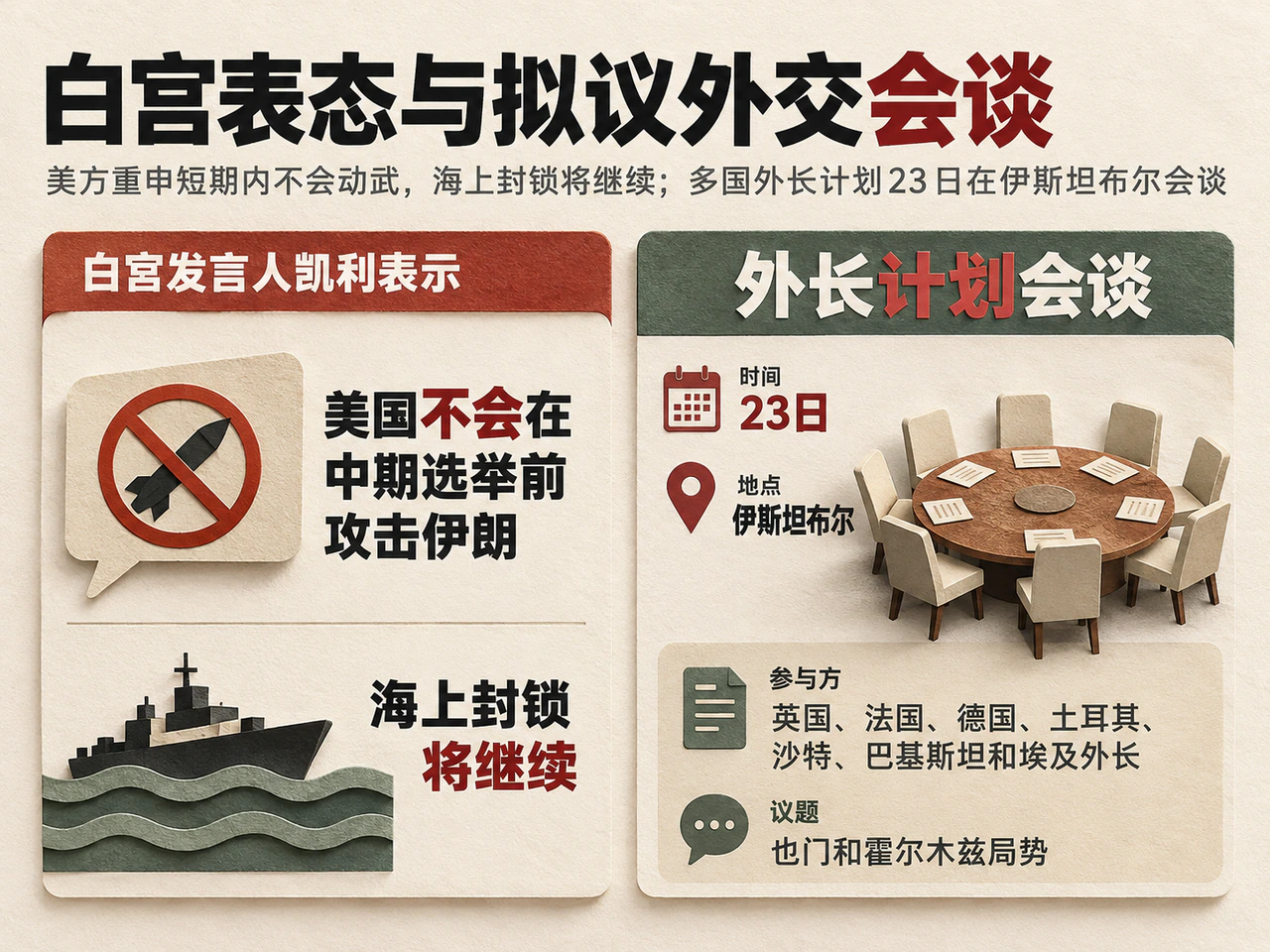
On October 22, ABC cited two Israeli sources as saying the United States and Israel had drawn up plans to resume joint strikes on Iran, potentially targeting petrochemical and nuclear facilities. The sources considered action likely after the U.S. midterm elections. White House spokesperson Kelly said the United States would not attack Iran before the elections and that the maritime blockade would continue. This set a time boundary for Washington's current public position; whether the strike plans would be implemented remained to be seen.
Diplomatic efforts also continued. U.S. Secretary of State Rubio spoke with Qatar on October 22, reaffirming support for Qatari security and freedom of navigation through Hormuz and thanking Qatar for its mediation. Qatar said they discussed de-escalation and efforts toward a comprehensive agreement. Separately, AFP cited Turkish foreign ministry sources as saying the foreign ministers of Britain, France, Germany, Turkey, Saudi Arabia, Pakistan and Egypt planned to meet in Istanbul on October 23 to discuss Yemen and Hormuz, among other matters.
The next test of diplomacy will be whether it produces concrete navigation-security arrangements. Confirmation of the Gulf vessel incidents, sustained normal operations at Saudi airports and energy facilities, and the U.S.-Iran contest over escorts and the blockade remain key indicators of the conflict's direction.
Key developments
| Key developments |
|---|
| October 23, 02:35 Beijing timeU.S. Central Command said the reinstated maritime blockade had lasted 100 days and claimed it had prevented $25 billion in Iranian crude exports. |
| October 23, 02:08 Beijing timeRubio spoke with Qatar, reaffirming support for Qatari security and freedom of navigation through Hormuz and thanking Qatar for its mediation. |
| October 23, 00:25 Beijing timeTrump accused Iran of fabricating ship hits and mine strikes to raise oil prices ahead of the U.S. midterm elections. |
| October 22, 23:30 Beijing timeThe Houthis claimed missile and drone attacks on four targets inside Saudi Arabia over the preceding 48 hours; the claimed hits had not been independently verified. |
| October 22, 23:11 Beijing timeThe European Parliament passed a resolution calling on the EU Council to designate the Houthis a terrorist organization and freeze related assets. |
| October 22, 22:03 Beijing timeThe Saudi-led coalition reported intercepting four drones in the Riyadh and Medina regions, after an earlier report of one interception in Riyadh. |
| October 22, 21:00 Beijing timeEgyptian Foreign Minister Abdelatty expressed support for Saudi Arabia and called for exploration of a political settlement between Saudi Arabia and the Houthis. |
| October 22, 20:39 Beijing timeAFP cited a source as saying Aramco had also told essential personnel still at its Dhahran headquarters to work remotely. |
| October 22, 19:37 Beijing timeIranian army commander Hatami said the military was prepared for asymmetric warfare and emphasized its unmanned-system capabilities. |
| October 22, 19:00 Beijing timeAFP cited Turkish foreign ministry sources as saying seven foreign ministers planned to discuss Yemen, Hormuz and other issues in Istanbul on October 23. |
| October 22, 16:11 Beijing timeIran's Revolutionary Guards claimed strikes on four vessels transferring oil and said three others had hit mines, threatening to expand confrontation to regional U.S. bases. |
| October 22, 15:04 Beijing timeSaudi Arabia's civil aviation authority said King Fahd International Airport in Dammam had reopened after the attack. |
| October 22, 15:02 Beijing timeSaudi Arabia's civil aviation authority raised the death toll from the Dammam airport attack to two, with eight injured. |
| October 22, 07:49 Beijing timeABC cited sources as saying the U.S. military had recently adjusted personnel deployments at Middle Eastern bases; Central Command said personnel and equipment were adjusted regularly. |


