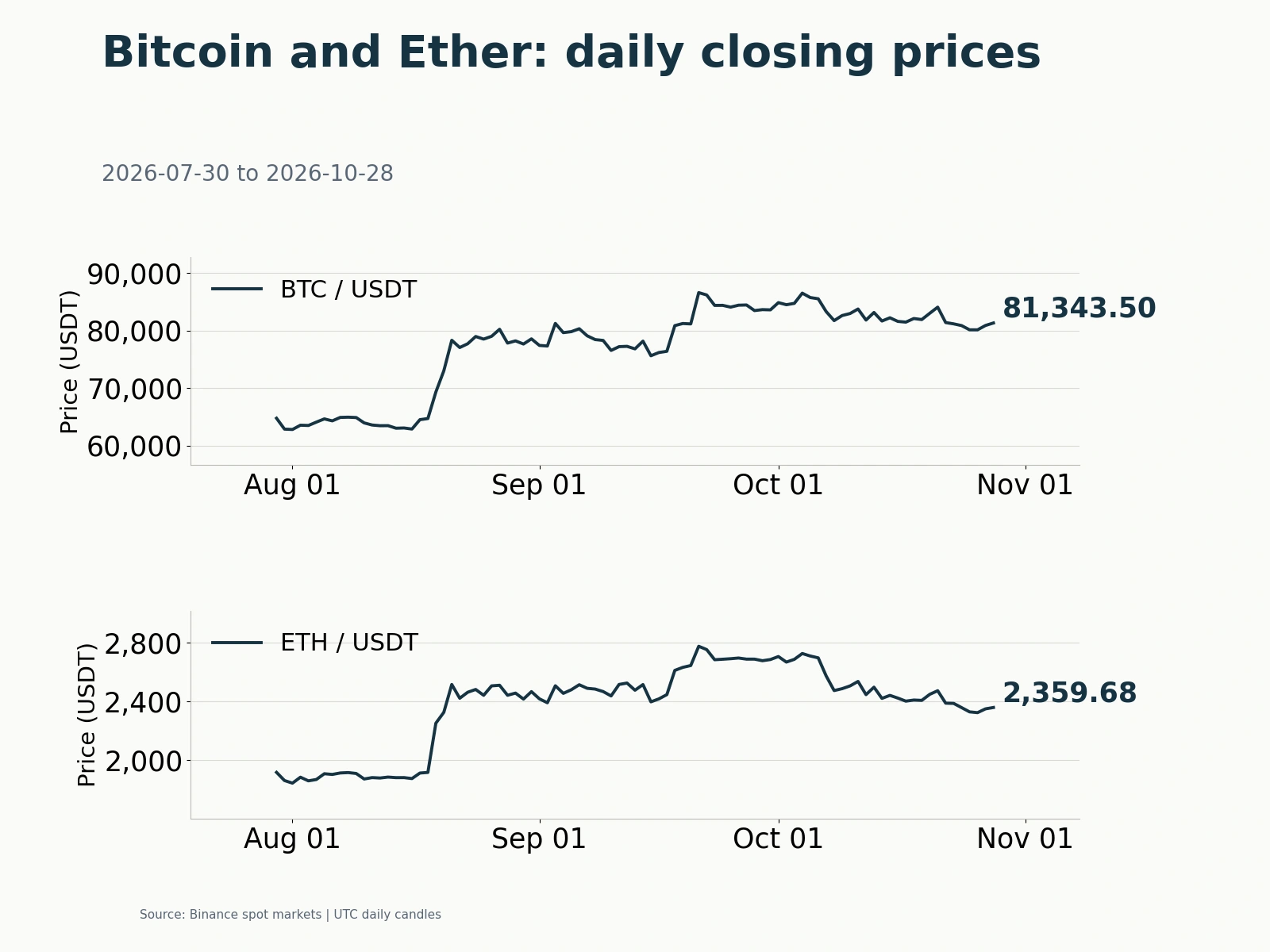
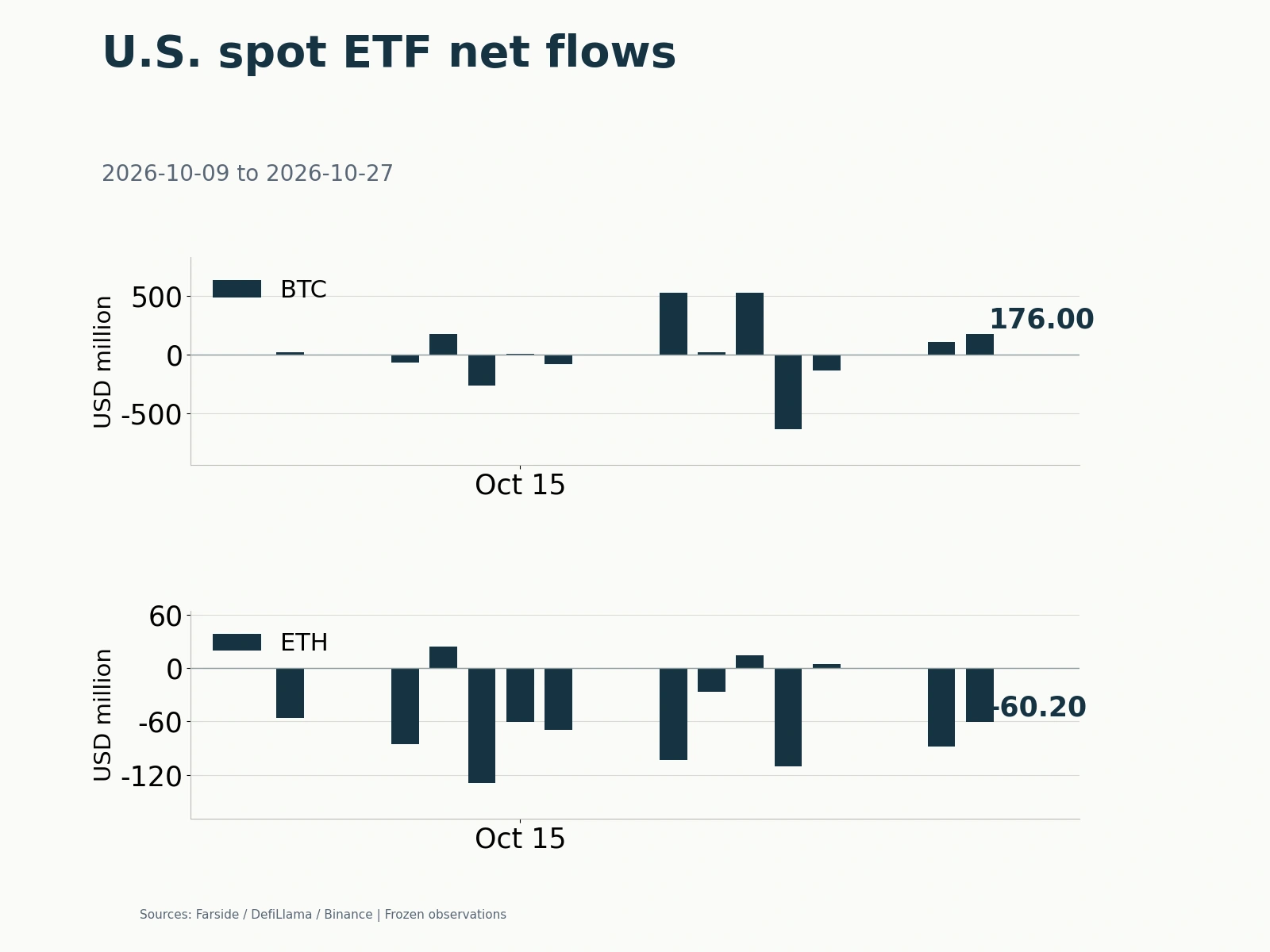
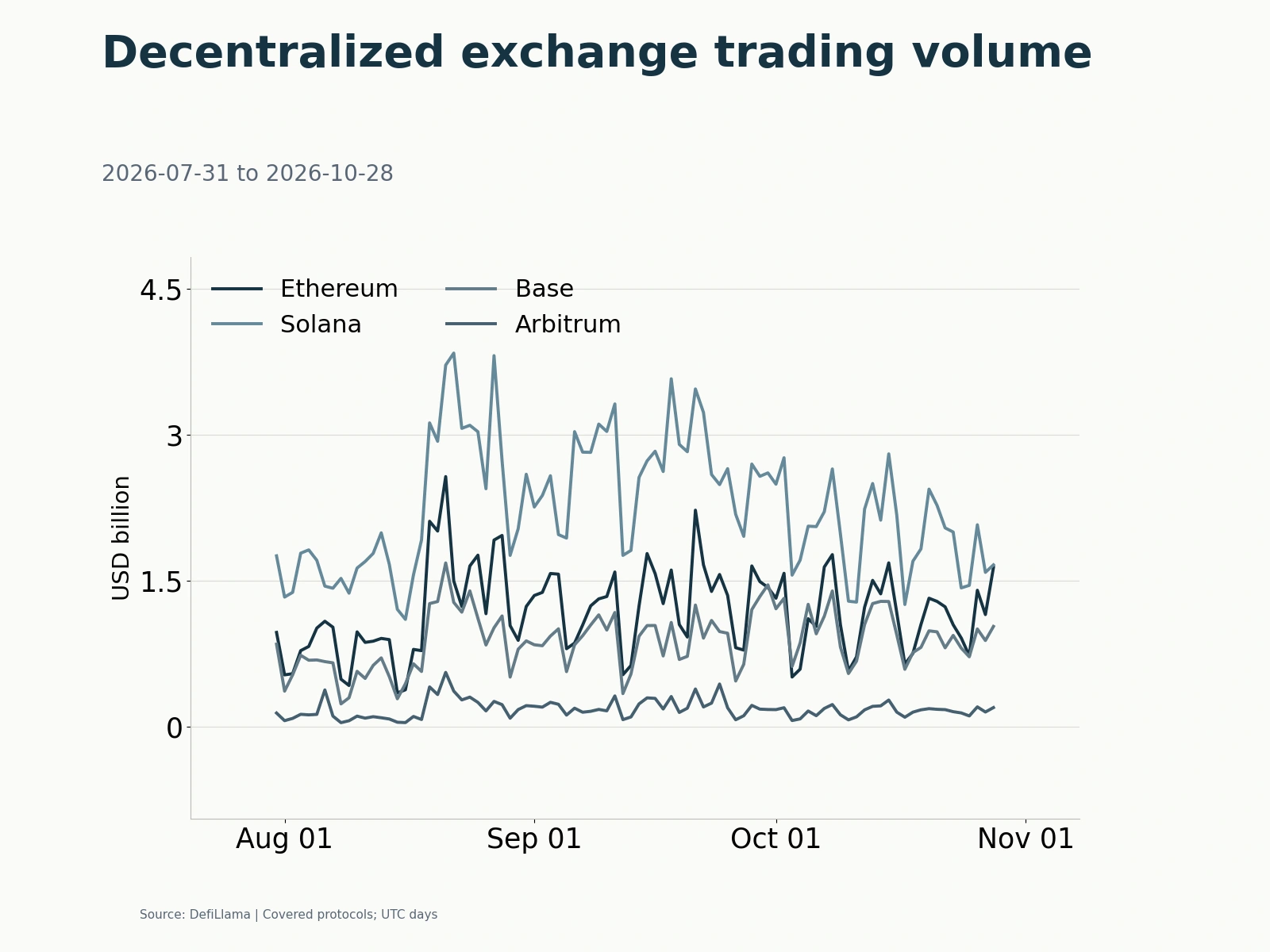
By the morning of October 24 Beijing time, incremental funding into crypto had slowed both outside and inside trading venues. Derivatives were deleveraging while retaining a premium for longs. U.S. spot Bitcoin ETFs faced large redemptions after three consecutive inflow sessions, and dollar stablecoin supply continued to decline. Neither external allocation flows nor on-market settlement funding was expanding persistently. Meanwhile, Binance Bitcoin open interest fell, but perpetual funding rates rose at successive settlements, showing that investors remaining in the market were still willing to pay to hold longs as some leveraged positions exited.
U.S. Bitcoin ETFs swing to US$635.6 million of outflows as stablecoin supply contracts further
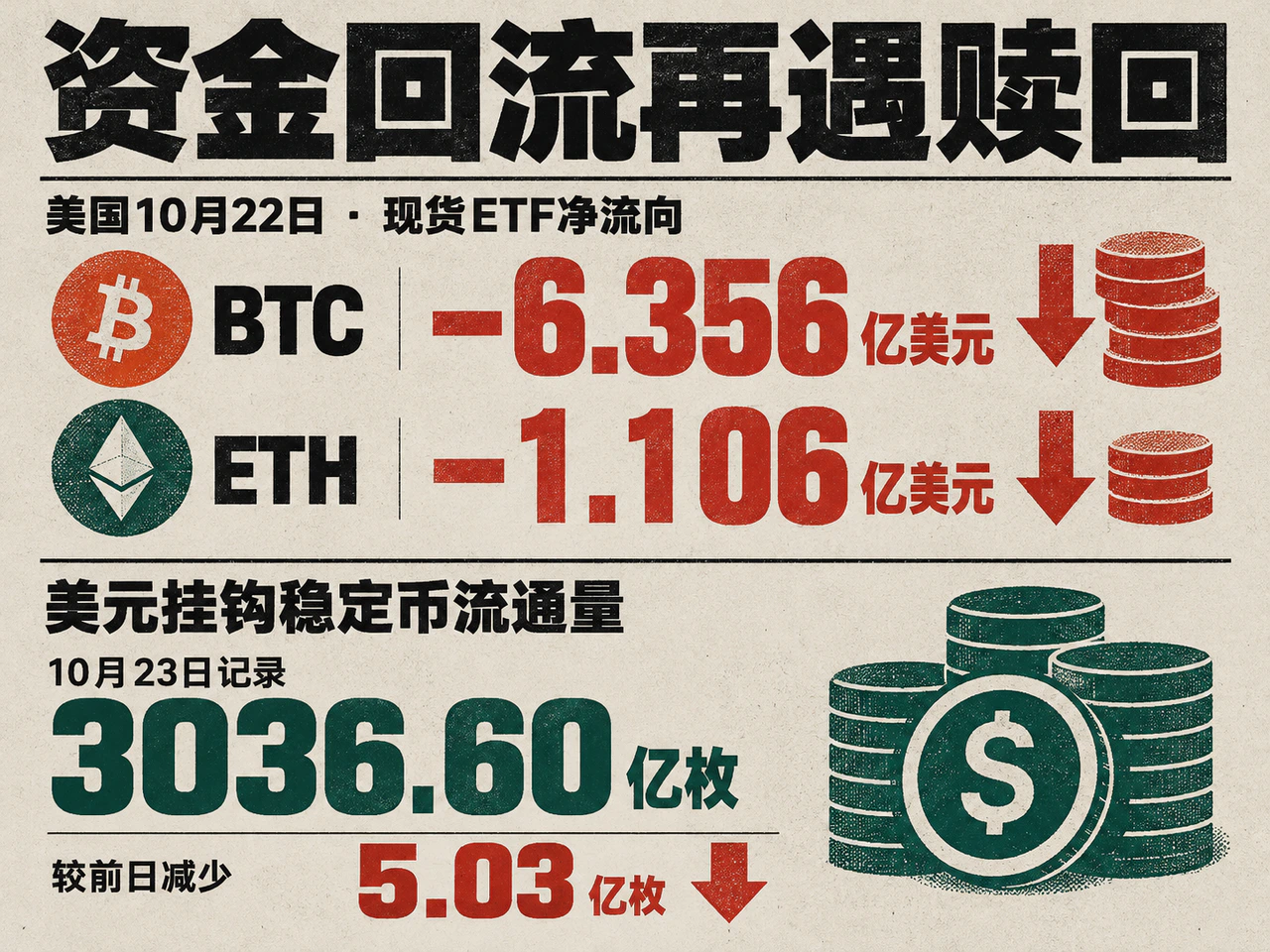
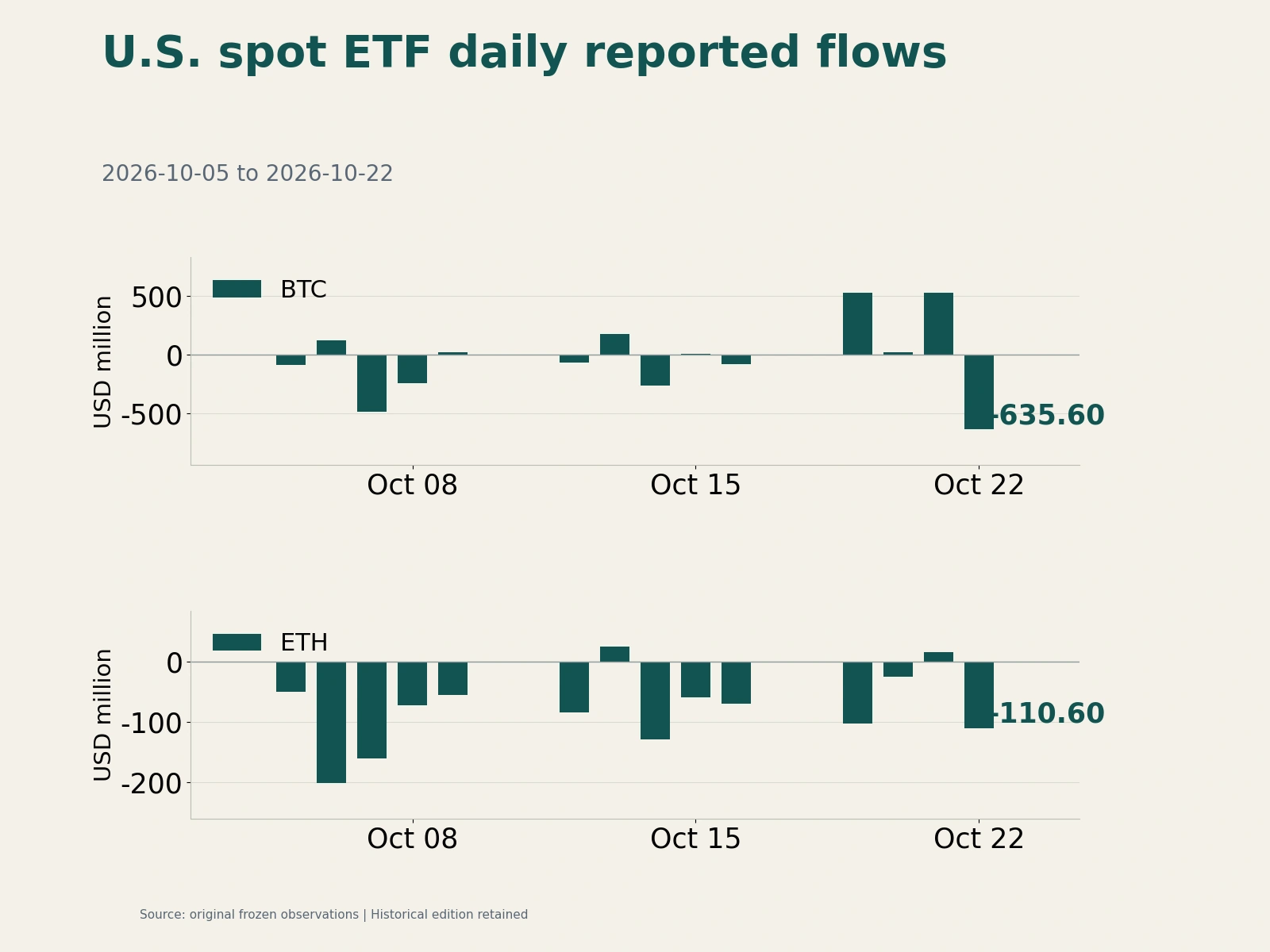
Complete Farside figures for the October 22 U.S. trading session showed US$635.6 million leaving spot Bitcoin ETFs. BlackRock’s IBIT lost US$254.1 million and Fidelity’s FBTC US$217.5 million, together approximately 74% of total net outflows. ARKB lost another US$109.4 million. Redemptions across several leading products suggested that institutional allocation reductions were relatively broad.
These redemptions interrupted an earlier recovery. Bitcoin ETFs had attracted US$1.0747 billion over three consecutive inflow sessions on October 19–21. October 22 reversed about 59% of that addition, although the four October 19–22 sessions still retained US$439.1 million of net inflows. Institutional products continued to attract allocations, but new money was sensitive to volatility and the recovery lacked continuity.
Ether ETF funding was weaker. U.S. spot Ether ETFs lost US$110.6 million on October 22, including US$75.5 million from ETHA and US$17.2 million from ETHB. Across October 19–22, only October 21 recorded a small net inflow, US$14.9 million, leaving four-day net outflows of US$225.1 million. Recent institutional buying had replenished Bitcoin exposure temporarily, while Ether continued to face net redemptions. Allocations had yet to recover broadly.
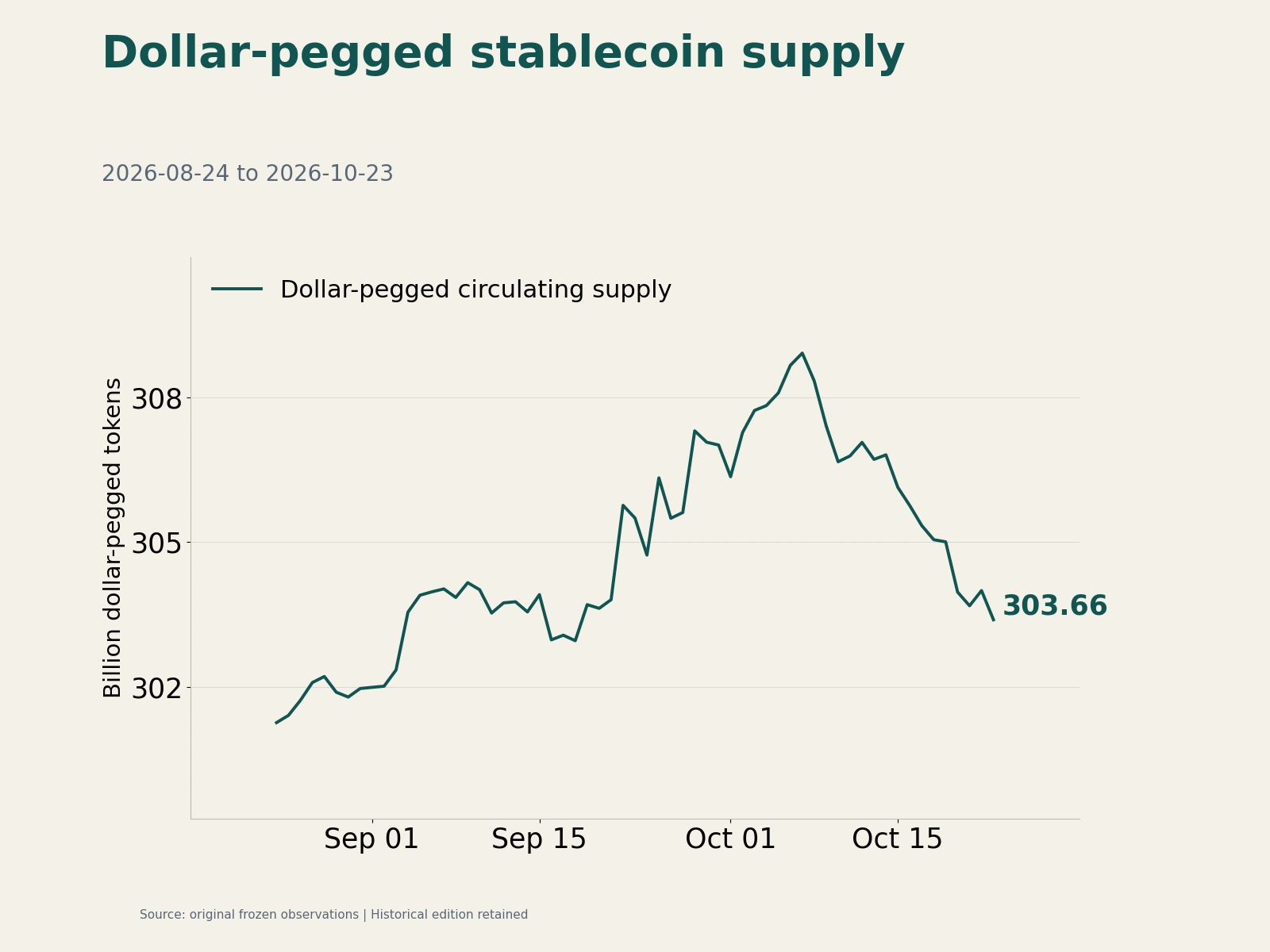
Settlement funding available inside the market was also shrinking. DefiLlama’s historical series measured at pegged face value put circulating dollar-linked stablecoins at 303.660 billion tokens on October 23. This was approximately 503 million below October 22, 1.967 billion below October 16, a decline near 0.64%, and 1.754 billion below September 23.
Stablecoins serve trading settlement, payments and on-chain treasury management. A decline in face-value circulation meant the dollar funding pool supporting risk-asset trading was still shrinking. ETF redemptions from traditional securities accounts and lower on-market stablecoin supply together left short-term prices more dependent on reallocating existing funds. Stronger incremental support would require renewed continuous ETF inflows to coincide with stablecoin expansion.
Binance BTC open interest falls about 3%, while long funding rises to 0.01%
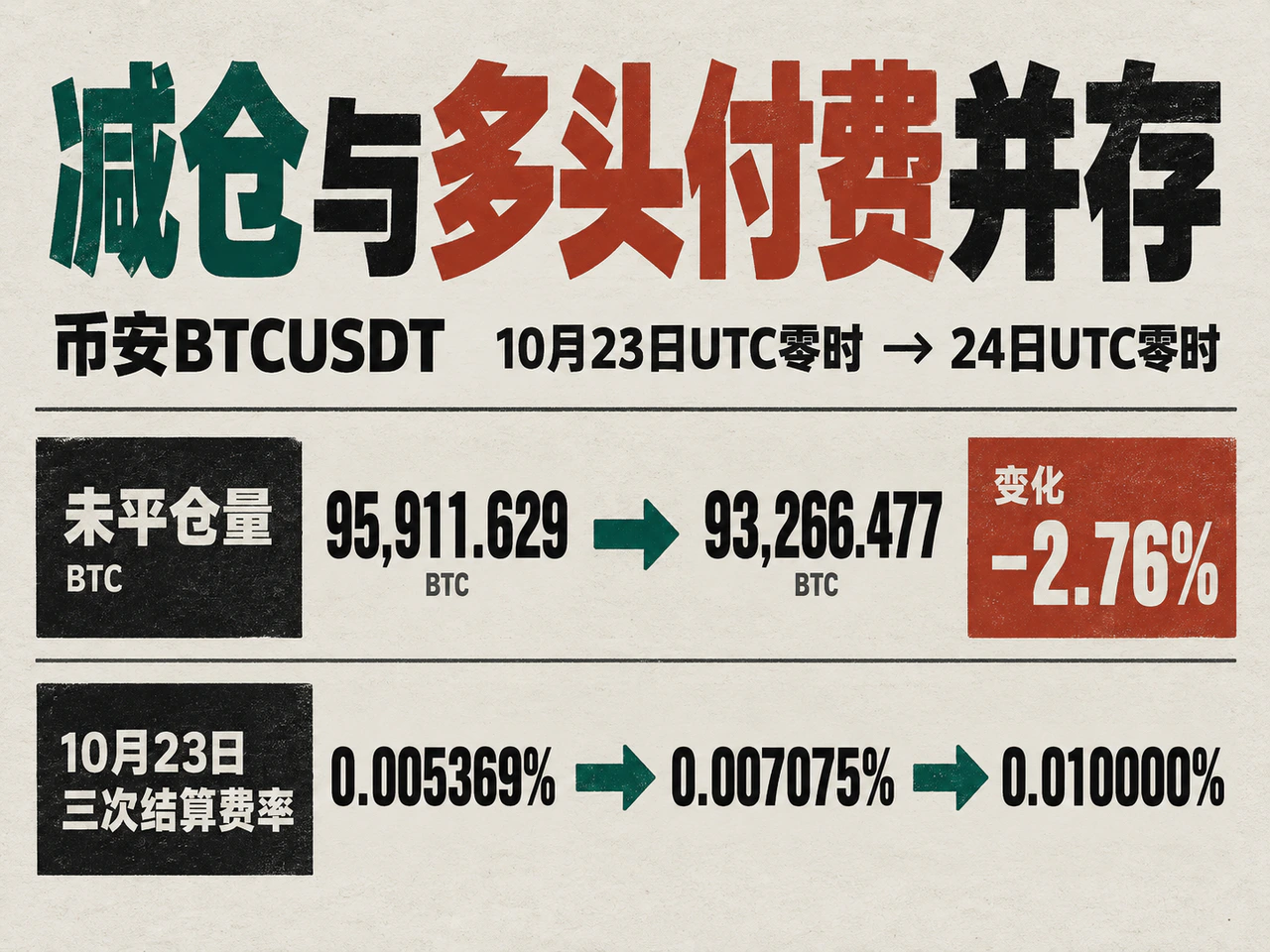
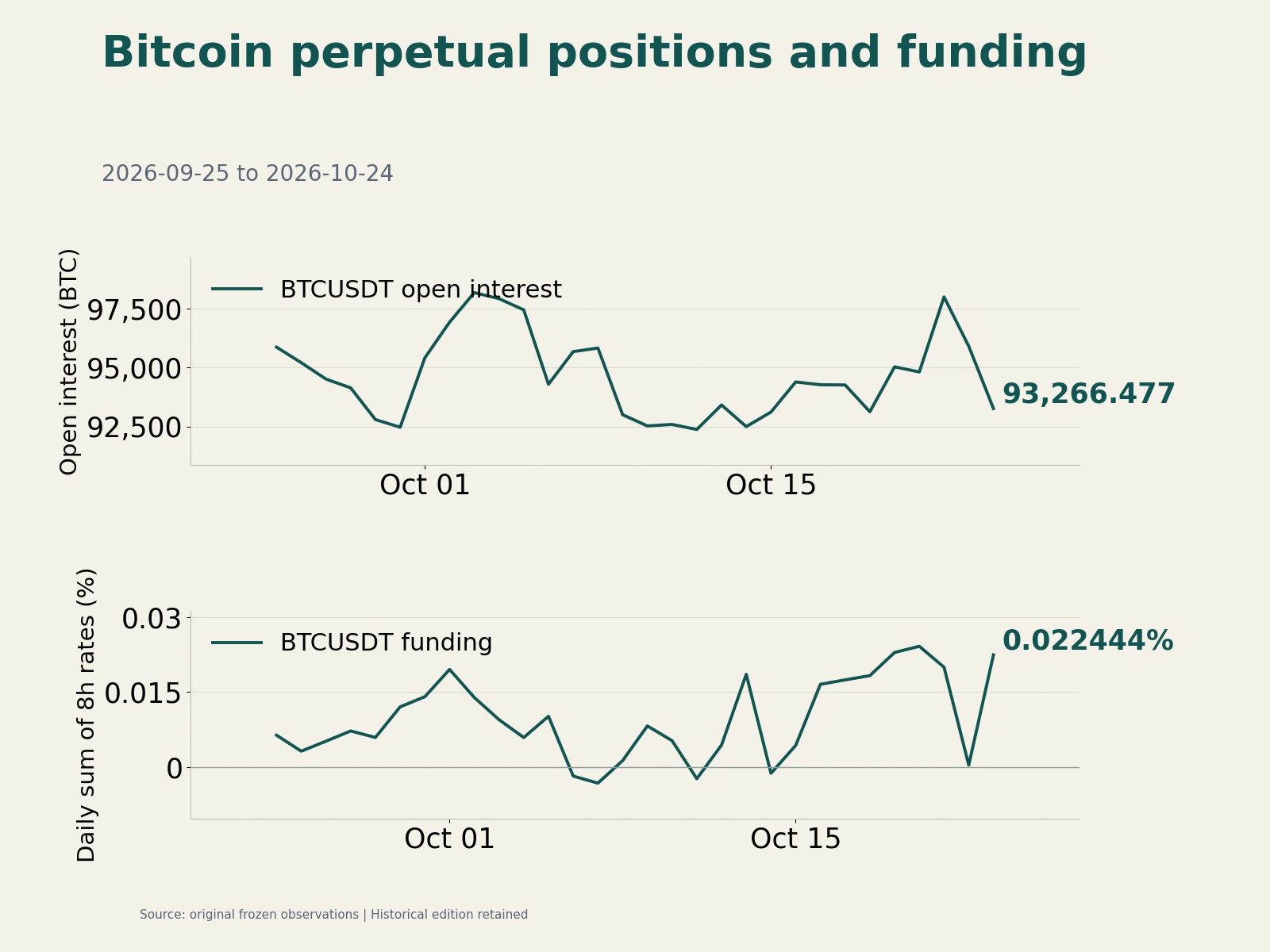
Binance BTCUSDT daily open interest fell from 95,911.629 BTC at 00:00 UTC on October 23 to 93,266.477 BTC at 00:00 on October 24, down approximately 2.76%. Its corresponding notional value declined about 3.03%, from 7.806 billion to 7.569 billion USDT. Coin quantities and USDT notional value both fell, confirming actual position reductions rather than a notional decline caused solely by token prices.
Although positions decreased overall, willingness to pay for perpetual longs strengthened. Binance BTCUSDT funding rates at 00:00, 08:00 and 16:00 UTC on October 23 were 0.005369%, 0.007075% and 0.010000%, respectively. Longs paid shorts at all three settlements, at successively higher rates, reversing the previous day’s occurrence of negative funding. ETHUSDT settlement funding rates also rose from 0.005563% to 0.007399% over the same period.
Lower open interest alongside higher funding suggested that some position closures reduced potential concentrated-liquidation risk, while remaining investors still wanted leveraged long exposure as prices stabilized. Until spot ETF allocations and stablecoin supply improved together, a rebound supported mainly by derivatives sentiment would remain constrained by insufficient new funding.
The market also faced a concentrated option expiry. An October 23 CoinGape report republished by Yahoo Finance, citing Deribit, put Bitcoin options expiring that day at approximately US$1.31 billion notional and Ether options at US$250 million. Their put/call ratios were 1.03 and 1.22. Expiry could create hedging and rolling demand, affecting short-term trading and position distribution. The subsequent medium-term direction would still depend on spot-market absorption and the rebuilding of derivatives positions.
Read the original article for full details.