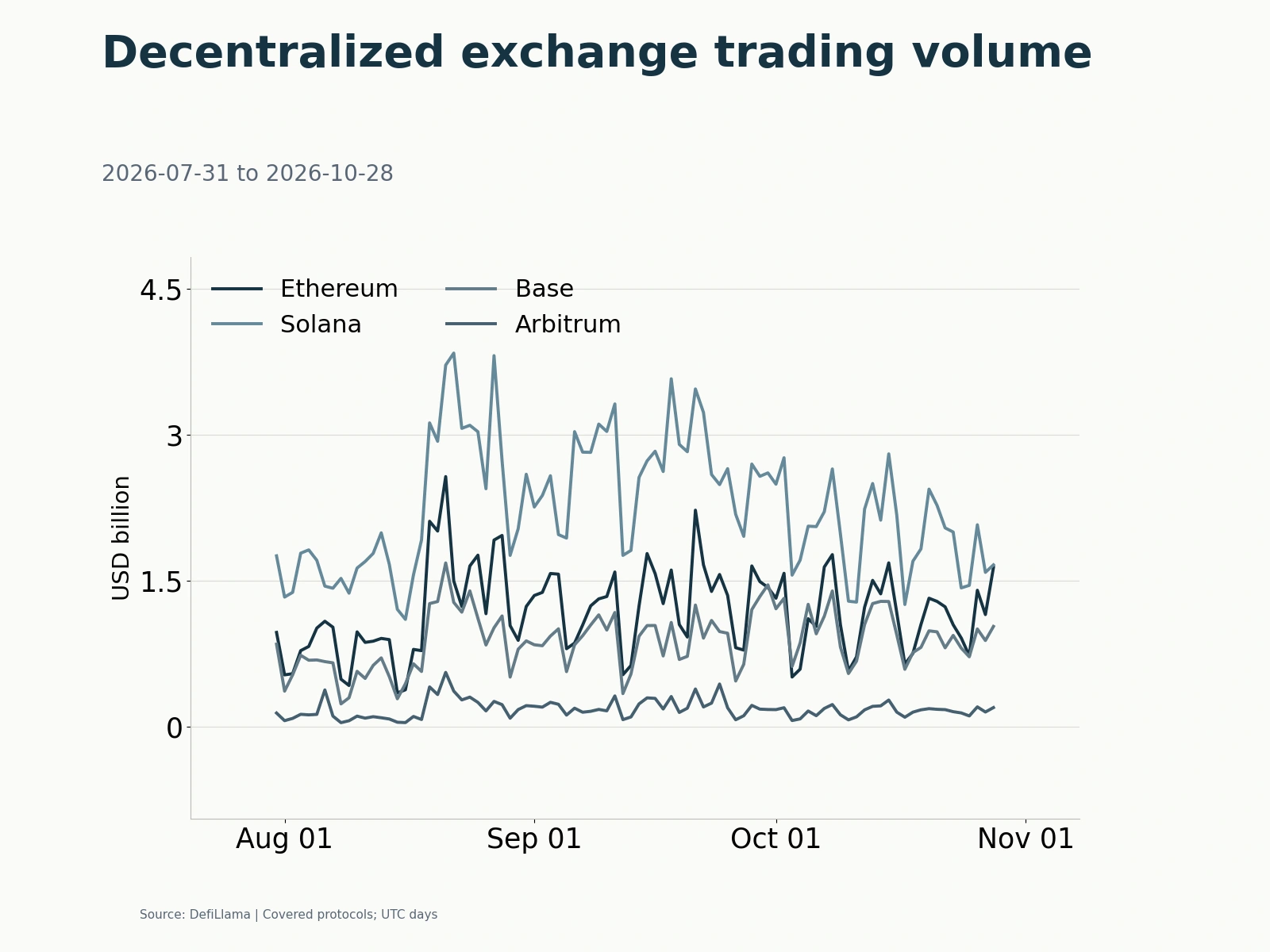
On October 23, on-chain trading continued to cool. DefiLlama’s covered decentralized-exchange (DEX) daily volume fell to US$7.477 billion, while dollar total value locked (TVL) declined across major public chains and layer-2 networks. Underlying settlement upgrades and on-chain financial tools kept advancing despite weaker secondary-market activity. Solana’s mainnet consensus upgrade was operating, and flows through stablecoin swap pools showed actual allocations to lending and yield strategies. Whether more settlement capacity would become recurring business, and how fees would be shared between protocols and token holders, were becoming central tests of on-chain fundamentals.
DEX turnover falls 14.7% below its monthly average; US$453 million in RLUSD/USDS swaps reveals treasury demand
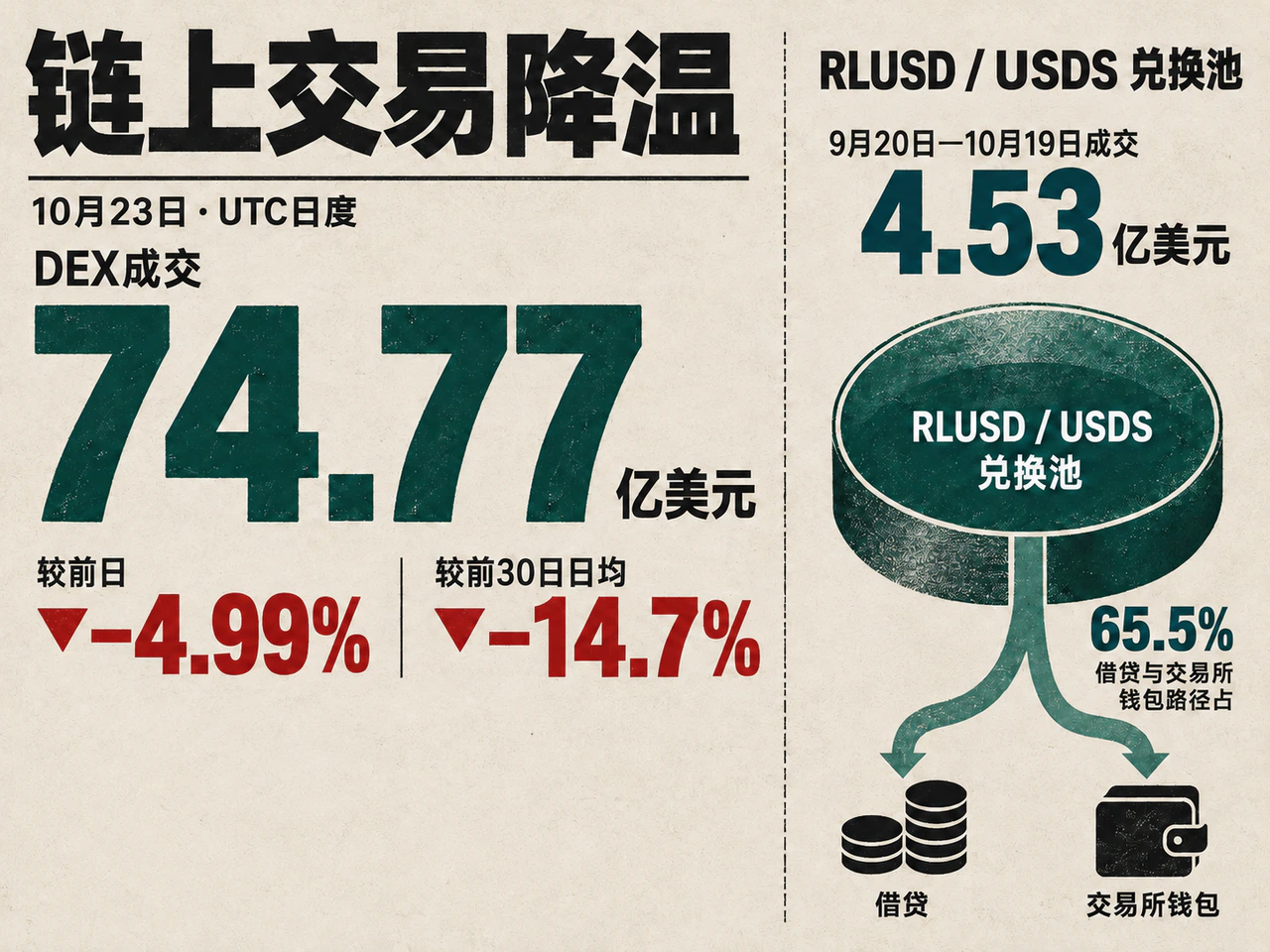
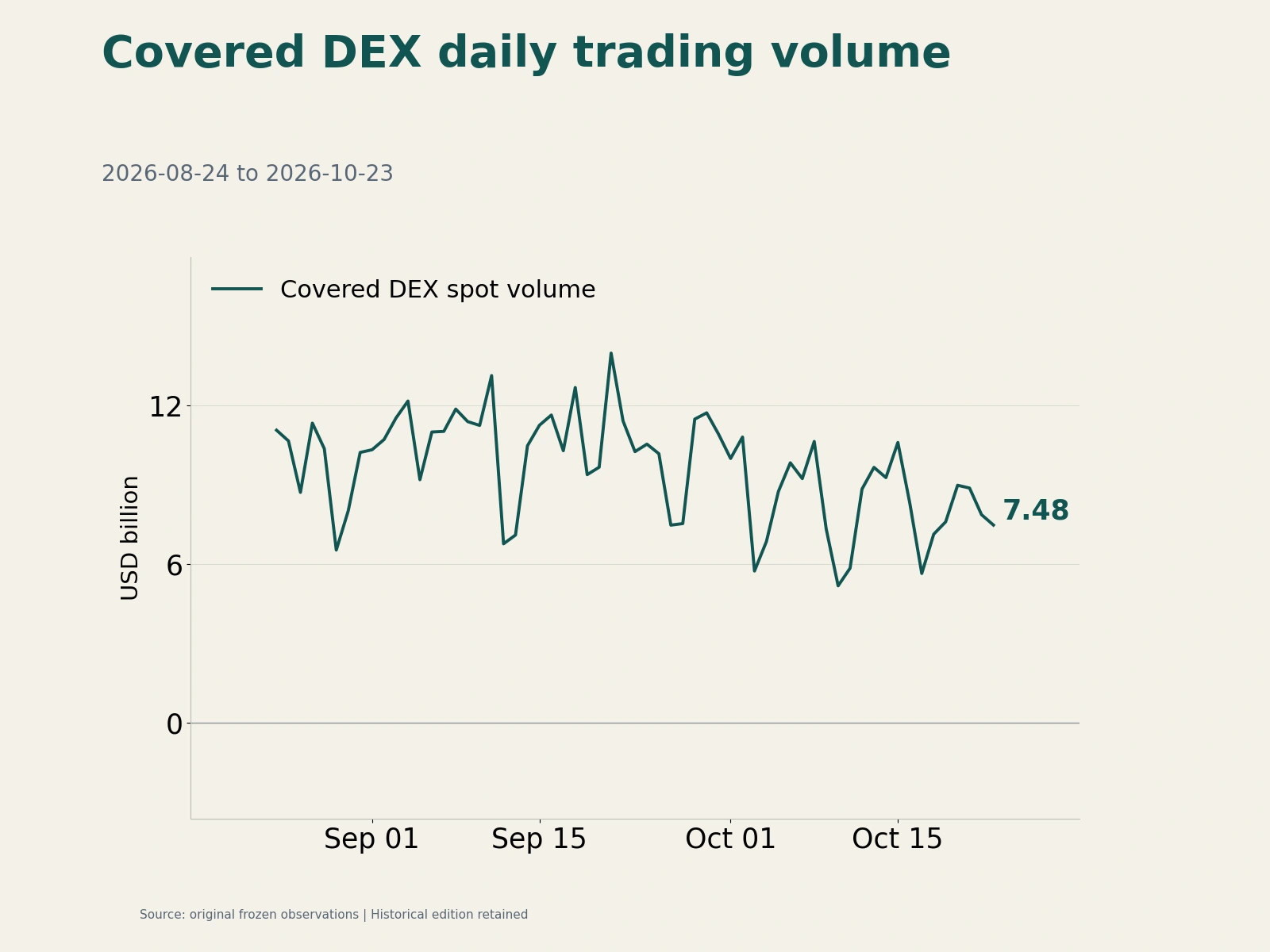
On a UTC daily basis, October 23 DEX volume fell 4.99% from the preceding day. It was about 14.7% below the US$8.770 billion daily average over the previous 30 complete calendar days and 27.1% below September 23, showing that on-chain trading had cooled over the month.
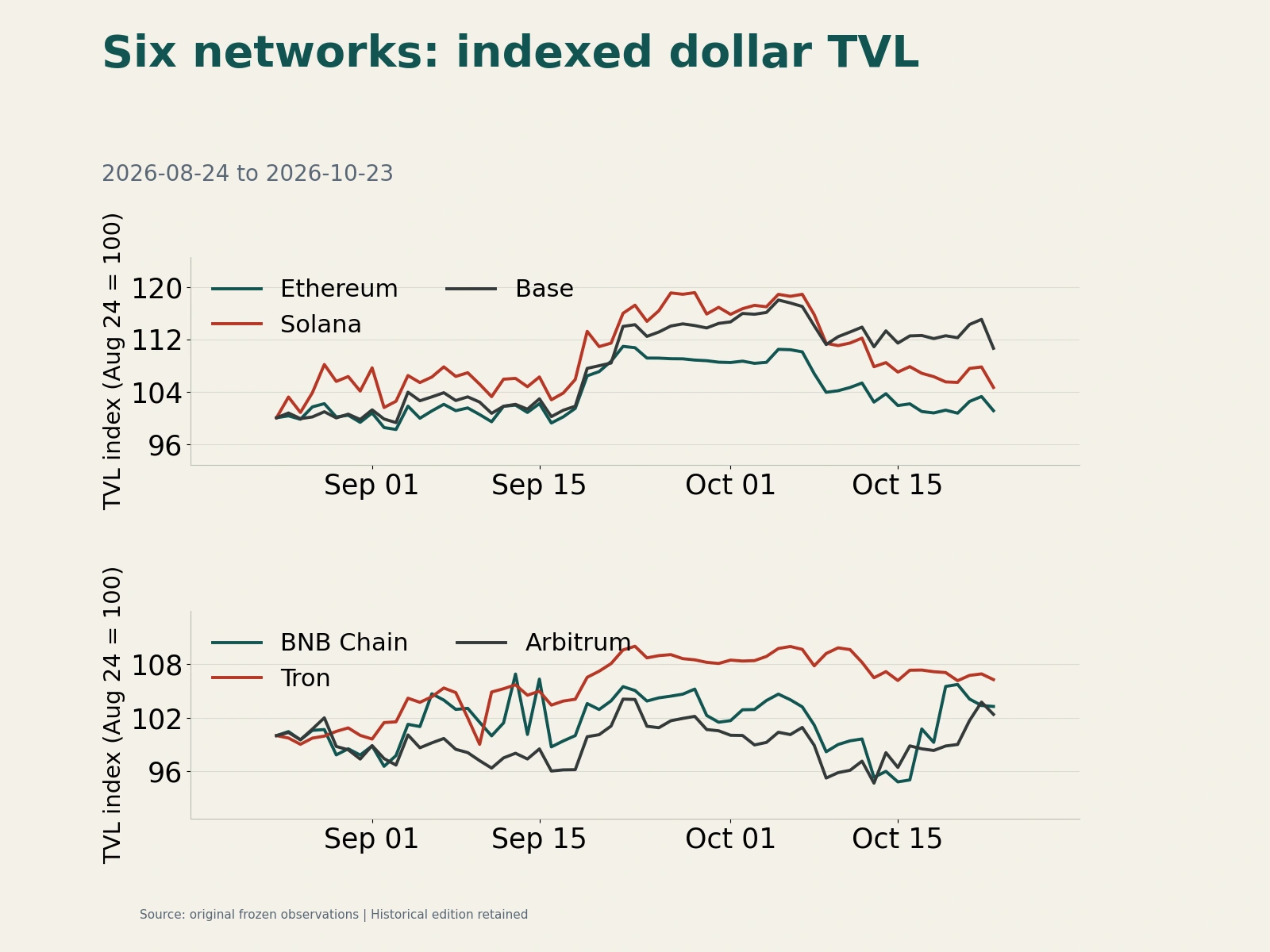
Locked value declined across all six major networks in DefiLlama’s October 23 data, with daily falls ranging from 0.10% on BSC to 3.85% on Base. Ethereum remained largest at US$49.529 billion. Base’s US$6.065 billion exceeded Solana’s US$5.804 billion, but Base also had the largest daily drawdown in the six-network sample. BSC, Tron and Arbitrum held US$5.796 billion, US$5.531 billion and US$1.457 billion, respectively.
Because underlying token prices affect dollar TVL, assessing actual on-chain operations also required examining how existing funds were used. Crypto Briefing reported on October 23 that the Uniswap v4 RLUSD/USDS pool generated approximately US$453 million across 2,410 swaps from September 20 through October 19. About US$167 million was associated with yield strategies and lending, and US$130 million passed through exchange-wallet routes. Together these represented approximately 65.5% of volume, while Spark’s own liquidity management accounted for only about 4%.
This structure showed stablecoin swaps supporting the movement of funds across financial products. Using USDS as a common trading pair allowed newly issued stablecoins to connect directly with existing liquidity, reducing the need to create isolated pools. Swap volume mainly measured capital turnover, however. Whether flows became recurring business still depended on repeated demand for lending, payments or asset allocation.
Real-world asset (RWA) tokenization was also moving toward applications. Market data reviewed by Crypto Briefing that day showed recent RWA flows mainly entering gold, credit and U.S. Treasury products. These assets brought traditional returns and risk exposures on-chain. Moving beyond static holdings into collateral, trading and settlement would be necessary to generate substantive operating activity.
Solana targets 150-millisecond finality, while a 10.74% monthly TVL decline highlights the need for applications
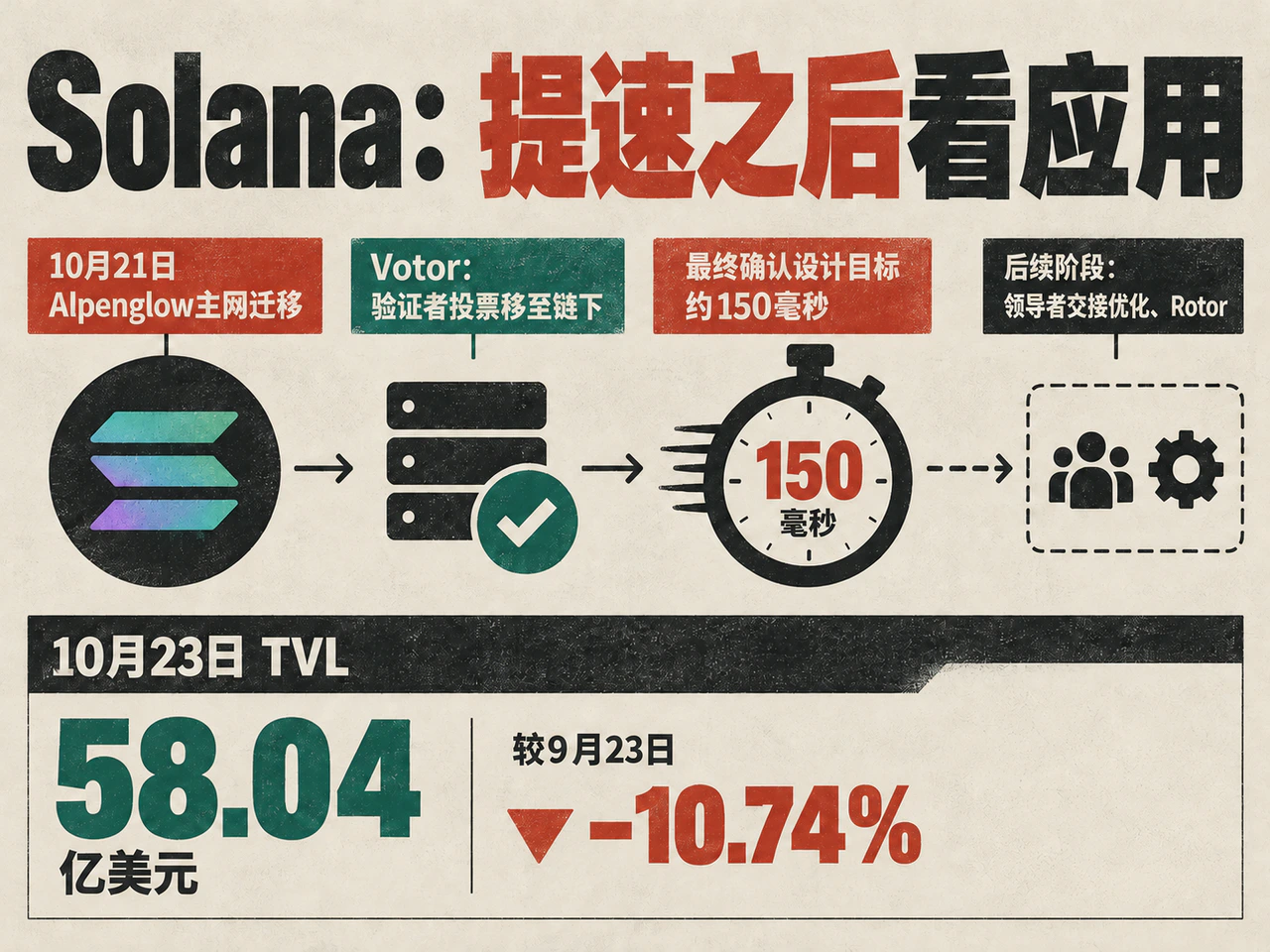
Solana’s Alpenglow upgrade provided a faster settlement base for connections between on-chain financial services. Developer Anza said mainnet migration had completed on October 21. Galaxy’s October 23 research said this initial stage activated Votor, moving validator voting off-chain and reducing the design target for transaction finality from about 12 seconds to roughly 150 milliseconds. Leader-handover improvements and the Rotor propagation mechanism belonged to a later stage.
Faster finality directly improved capital turnover efficiency. Exchanges, bridges and payment services depend on confirmation that a transaction is irreversible. Shorter waits could reduce delays and uncertainty when connecting services. Removing validator votes from on-chain records also freed block space for user transactions, with practical benefits for frequent settlement, small transfers and movement of funds between applications.
Improved infrastructure had not yet reversed asset contraction. Solana TVL fell 2.91% on October 23 and 10.74% from September 23, a materially larger monthly decline than Base’s 3.16% or Arbitrum’s 1.60%. Greater infrastructure capability still had to pass through product integration, capital usage and customer retention before appearing in stable operating data.
Fee allocation was the next central issue. Payments by users could be distributed among liquidity providers, validators, protocol treasuries or token holders, with different returns at each stage. Even with much faster settlement and lower per-transaction costs, an underlying network needed corresponding growth in business volume and willingness to pay to generate greater total fees. Growth in application revenue also had to be considered alongside its specific distribution rules when assessing the effect on tokens.
As trading cooled, the more informative tests were whether upgraded trading and payment applications could keep using added capacity, whether stablecoin swaps generated recurring borrowing and settlement, and whether fees covered incentives and operating costs. The transition from technical implementation to business growth depended on application demand willing to pay repeatedly.
Read the original article for full details.