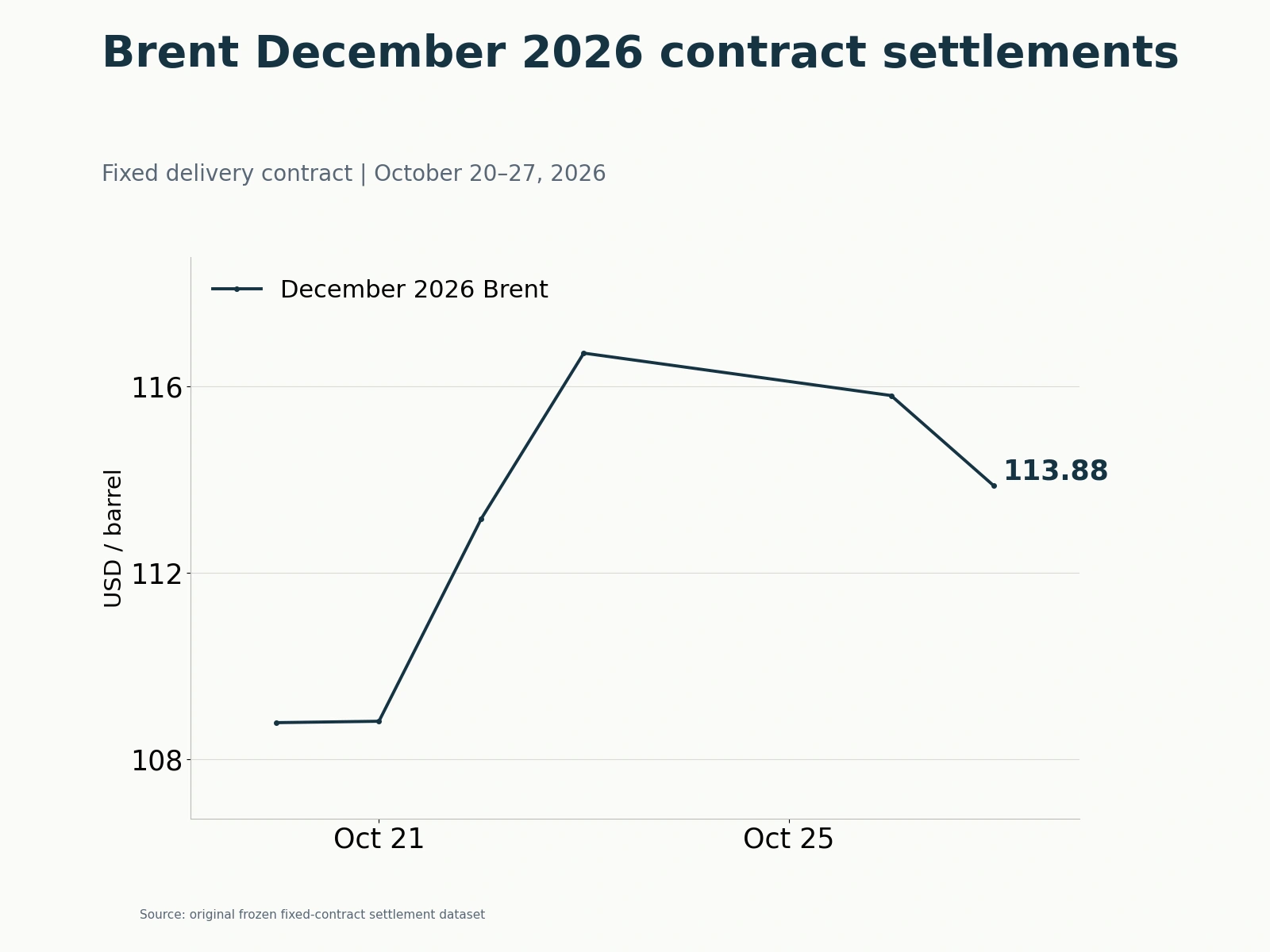
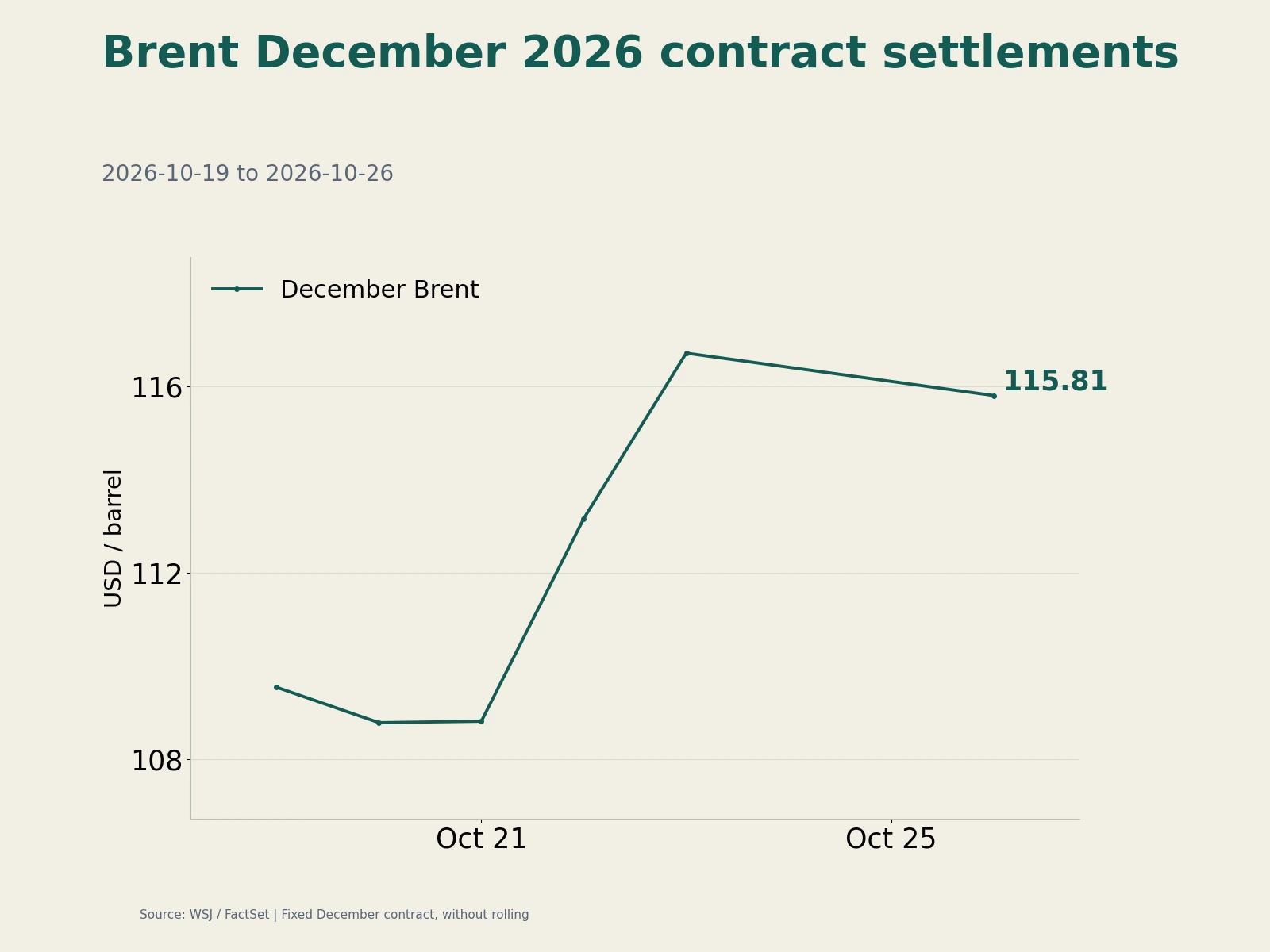
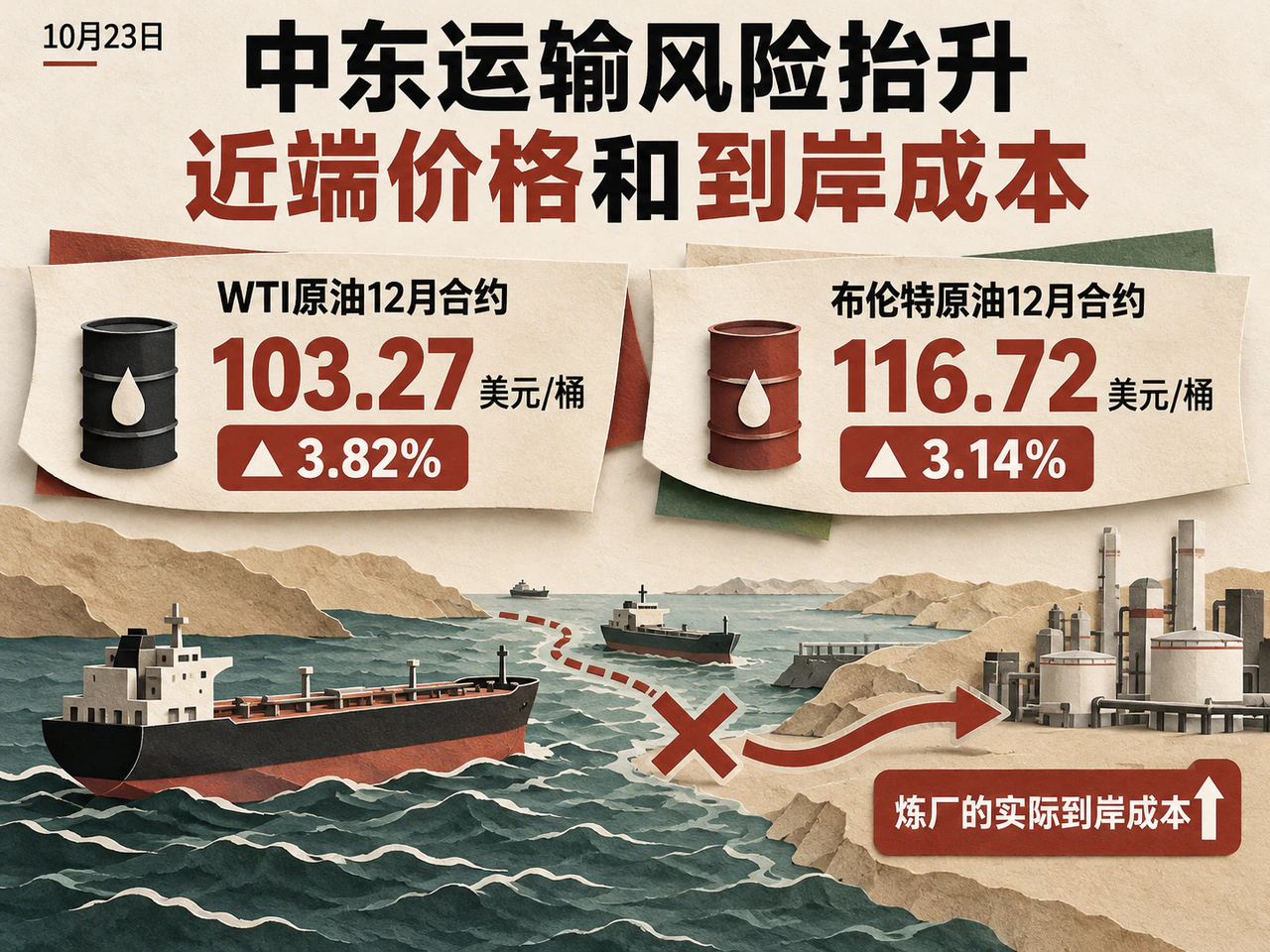
By the morning of October 24 Beijing time, oil markets were pricing in more Middle East supply-disruption risk. Xinhua reported that December WTI futures on NYMEX settled on October 23 at US$103.27 a barrel, up US$3.80, or 3.82%. December Brent on London’s ICE settled at US$116.72, up US$3.55, or 3.14%. CNBC reported that Brent had risen for a third consecutive week, gaining approximately 6.2% over the latest week.
The central driver was the renewed overlap of risks to Middle East oilfields, pipelines and maritime routes. As commercial inventories continued to be drawn down, new supply disturbances could pass more directly into buyers’ acquisition costs. Strategic reserve releases and export detours offered some relief, but the durability of that buffer still depended on crude reaching refineries reliably.
Saudi oilfield attacks and a UAE offshore spill raise refiners’ delivered costs through transport bottlenecks
Security risks to producing areas and shipping routes were rising together. CNBC, citing Saudi media, reported that Wednesday’s drone attack on the Shaybah oilfield killed two people and injured two. Saudi Aramco subsequently asked staff at its Dhahran headquarters to evacuate and work remotely. Changes to headquarters working arrangements did not directly establish an oilfield shutdown, but repeated attacks on energy facilities and surrounding areas increased the risk of disruption to production, scheduling and loading.
Maritime transport also faced a sudden disturbance. Reuters reported on Friday that the UAE Ministry of Climate Change and Environment had detected a tanker oil spill near Umm Al Quwain. The same report quoted the head of Lipow Oil Associates saying that more oil had recently been moving through Hormuz, but shipping still faced the possibility of abrupt disruption. Recovering export volumes alongside persistent route insecurity encouraged buyers to pay more for oil available for near-term delivery.
Logistics pressure had been accumulating since September. The EIA’s October energy outlook said attacks on Saudi Arabia’s East–West Pipeline in September had forced some exports back toward Hormuz, relying on ship-to-ship transfers to sustain supply. Higher insurance and freight costs and longer detours substantially increased refiners’ landed costs. Alternative routes could restore some volume but used more vessels and shipping time, limiting the efficiency of the broader supply recovery.
U.S. commercial crude falls for a third week; U.S. and German reserves fill gaps while OPEC+ holds output
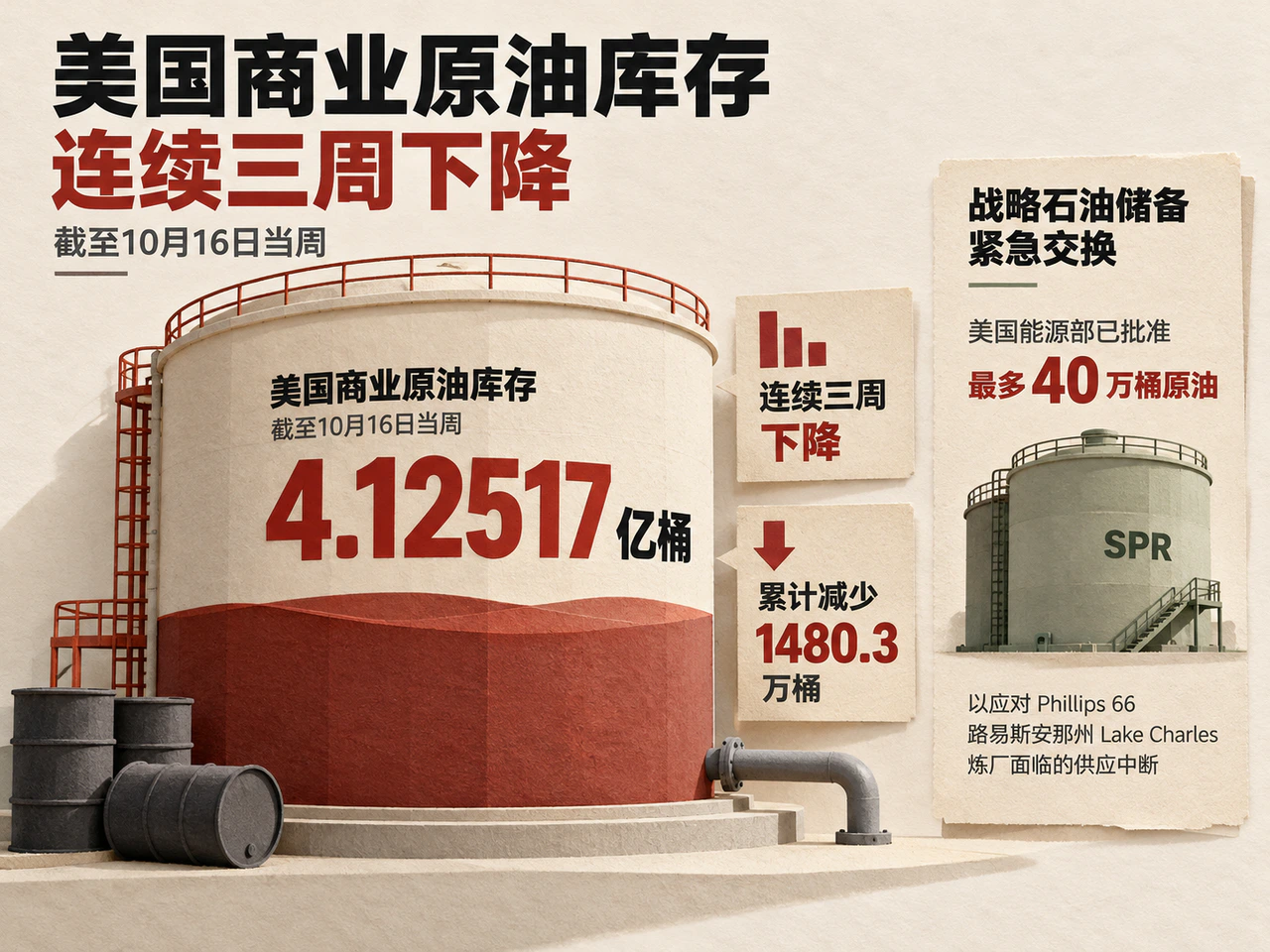

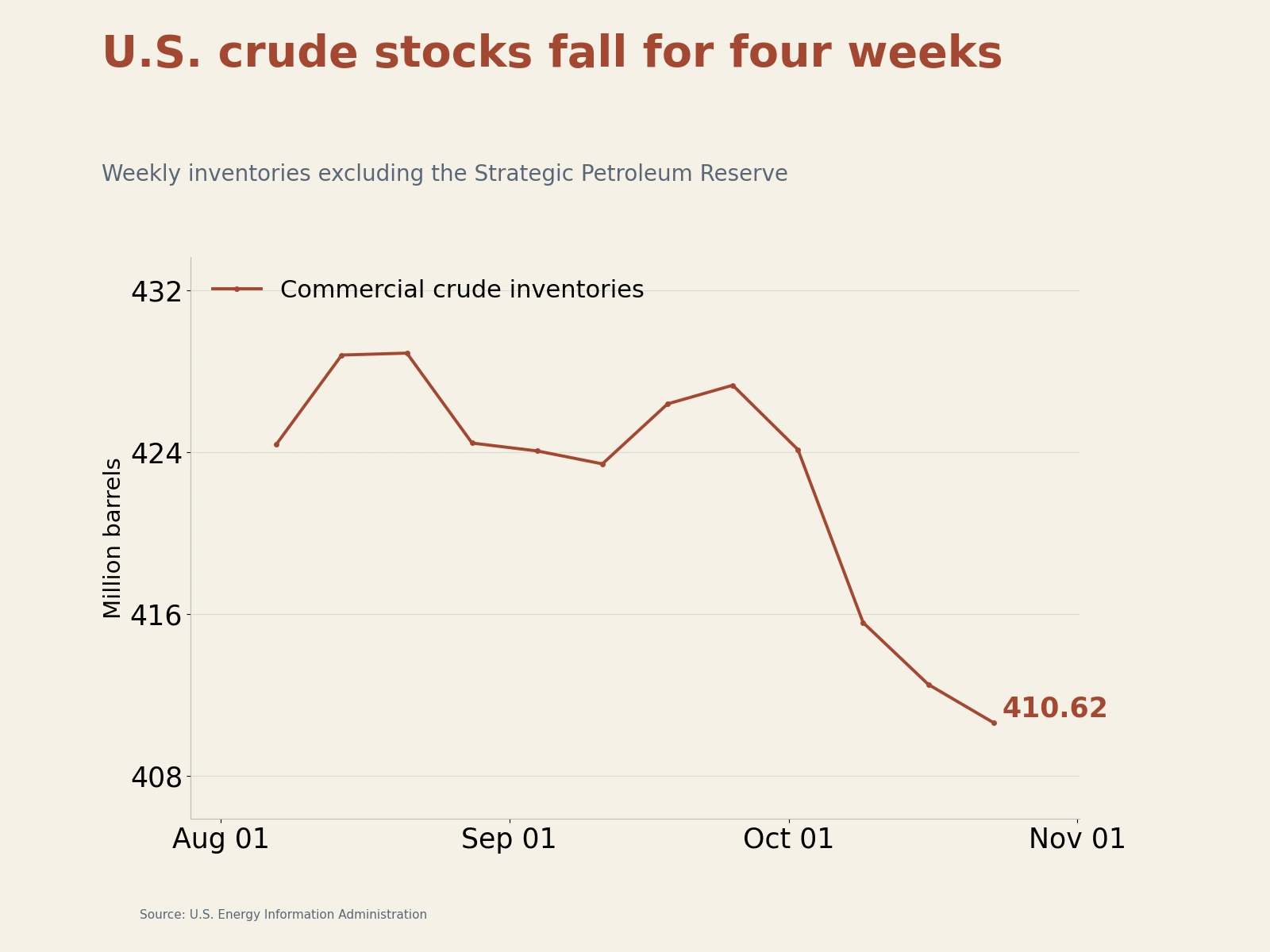
Continued U.S. inventory draws supported the picture of a tight physical balance. EIA data released on October 21 put commercial crude stocks for the week ended October 16 at 412.517 million barrels, down 3.06 million from the previous week. Stocks had fallen for three consecutive weeks from 427.320 million on September 25, a cumulative draw of 14.803 million barrels. Gasoline stocks fell 2.952 million barrels in the latest week. Products still diverged, however: distillates rose 1.675 million to 104.286 million barrels, ending several weeks of declines. Since products were not tightening uniformly, gasoline and diesel replenishment would help indicate how long refinery crude-purchasing pressure might persist.
European and U.S. policy reserves began filling localized supply gaps. Reuters reported that the U.S. Energy Department approved an emergency exchange of up to 400,000 barrels of Strategic Petroleum Reserve crude to address a disruption at Phillips 66’s Lake Charles refinery in Louisiana. Germany’s stockpiling agency EBV also issued tenders to sell diesel, heating oil and crude. The former targeted a specific refinery interruption, while the latter directly added marketable supplies. Both measures’ stabilizing effect depended on quantities delivered and execution speed.
Planned producer output offered no additional immediate buffer. Seven participating OPEC+ countries decided on October 4 to keep November output at the level required for September and would meet again on November 1. In the prevailing market, whether existing output could be exported smoothly through safe routes mattered more directly to actual near-term supply than targets on paper.
Supply disruption outweighs a firmer dollar and higher yields; next year’s stock rebuilding depends on restored routes
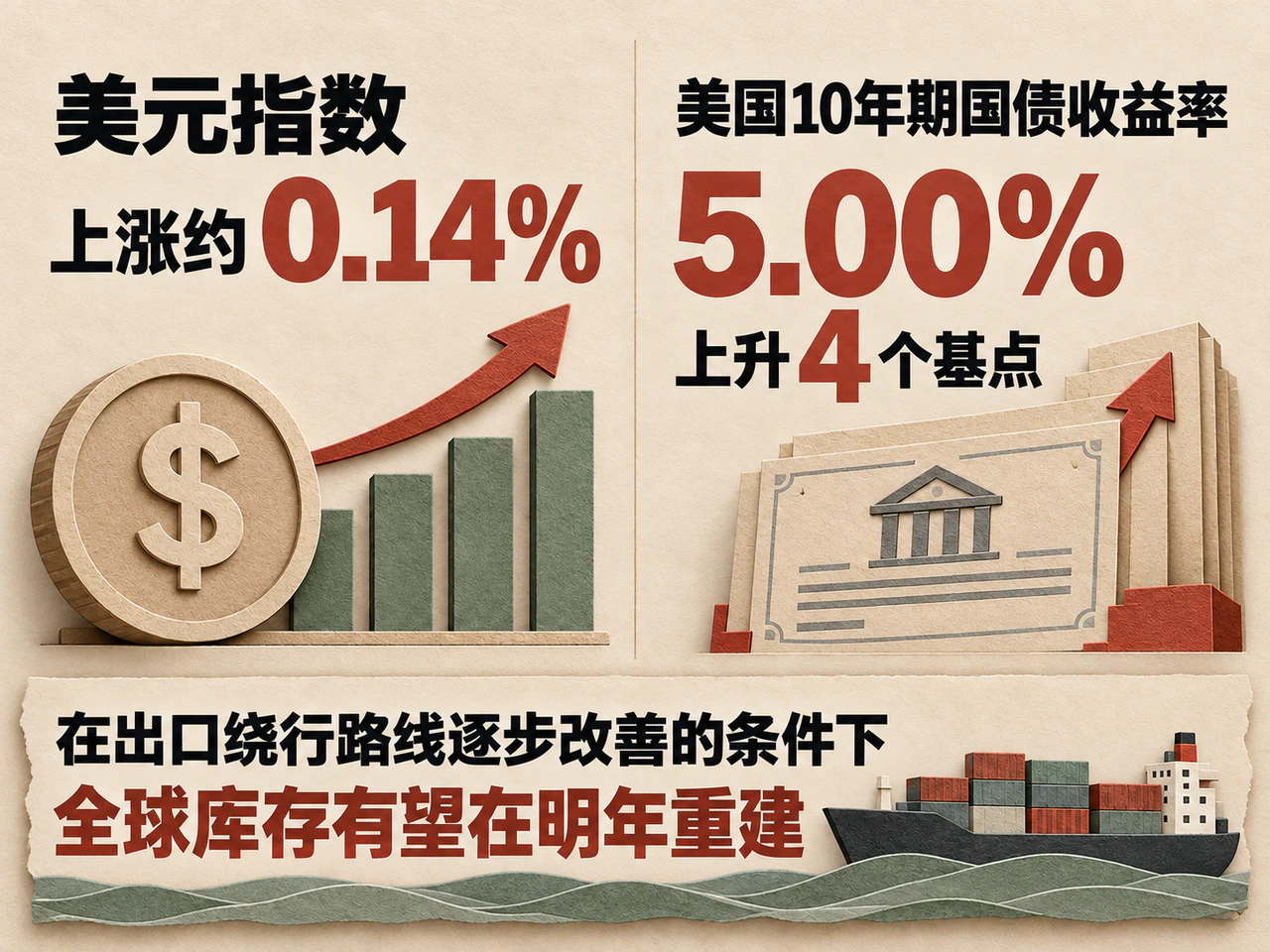
Tension remained between near-term procurement pressure and expectations of medium-term supply recovery. The EIA’s October outlook expected Middle East shut-in production to decline as alternative export routes improved, allowing global stocks to rebuild the following year. That path depended heavily on transport constraints easing. Repeated attacks on key routes would delay both replenishment and lower costs.
Tighter financial conditions did not reverse the rally. On October 23, the Dollar Index’s daily close rose about 0.14% and the 10-year U.S. Treasury yield increased four basis points to 5.00%. A stronger dollar normally raises costs for non-dollar buyers, while higher rates increase inventory financing costs. Oil’s substantial rise despite both forces showed the dominance of physical disruption in current pricing.
Four groups of signals would guide the next phase. First, actual reductions in Saudi production, pipeline flows or loading: stable exports could allow the additional geopolitical premium to ease. Second, whether Hormuz volumes, freight and insurance costs improved together, confirming that logistics recovery lowered landed costs. Third, actual European and U.S. strategic-reserve deliveries and the next commercial inventory figures, revealing whether supply buffers were expanding. Fourth, the nearby-versus-deferred crude spread: further widening would reinforce evidence of immediate tightness, while narrowing alongside supply recovery would indicate that procurement pressure was easing.