During October 19–25, diplomacy over a U.S.–Iran ceasefire and the nuclear issue continued, but differences over core conditions remained unresolved as regional military threats and spillover fighting intensified. Pakistan continued shuttle mediation. Iran insisted that lifting the maritime blockade, easing sanctions and unfreezing assets should be prerequisites for negotiations, while the United States focused on long-term, verifiable limits on Iran’s nuclear capabilities. As talks stalled, Iran claimed to have attacked several tankers in the Strait of Hormuz, and Yemen’s Houthis carried out successive attacks on Saudi airports and energy facilities.
By the morning of October 26 Beijing time, U.S. President Donald Trump had said there would be no attack on Iran on Sunday, October 25. Iranian Foreign Ministry spokesperson Esmaeil Baghaei also confirmed that the sides were still exchanging messages through intermediaries. Washington’s statement deferring an immediate strike left a window for diplomacy, but the week’s accumulated disputes over nuclear negotiations and pressure on Gulf infrastructure security remained unresolved.
Uranium custody and the sequencing of blockade relief hold up U.S.–Iran talks

Early in the week, Iranian Foreign Minister Abbas Araghchi called for a diplomatic solution to regional conflicts at a press conference following talks with Russian Foreign Minister Sergei Lavrov. He proposed security arrangements jointly established by regional countries. On October 20, Pakistan’s army chief, Asim Munir, visited Tehran to mediate over the conditions for restarting talks.
Differences centered on both the substance and the sequencing of reciprocal concessions. Al Jazeera reported on October 21 that Iran wanted the United States to lift the naval blockade of Iranian ports, ease sanctions and release frozen assets as part of an arrangement to end the war; in exchange, Iran would reopen the Strait of Hormuz. Iranian security official Rezaei also insisted that enriched uranium must remain inside Iran.
The central U.S. demand was a long-term, verifiable Iranian commitment ensuring that its nuclear program would not be rebuilt. U.S. Vice President JD Vance also focused in a television appearance that week on Iran’s ability to reconstitute the program several years later. This required immediate ceasefire arrangements and long-term nuclear restrictions to be coordinated. The former concerned lifting the port blockade and restoring passage through the strait; the latter involved uranium enrichment, the disposition of existing stocks and international verification.
The impasse carried forward technical and implementation problems left by earlier agreements. A memorandum in June had allowed scope for diluting enriched uranium under international supervision, but the final quantity, target enrichment level and implementation timetable had never been settled. Iran rejected sending enriched uranium abroad while demanding that the United States first deliver economic relief. Without a reciprocal package whose steps could be verified in sequence, mediators would struggle to turn indirect messages into a substantive agreement.
Hormuz tankers reroute for nighttime transfers as Iran threatens Gulf energy and digital infrastructure
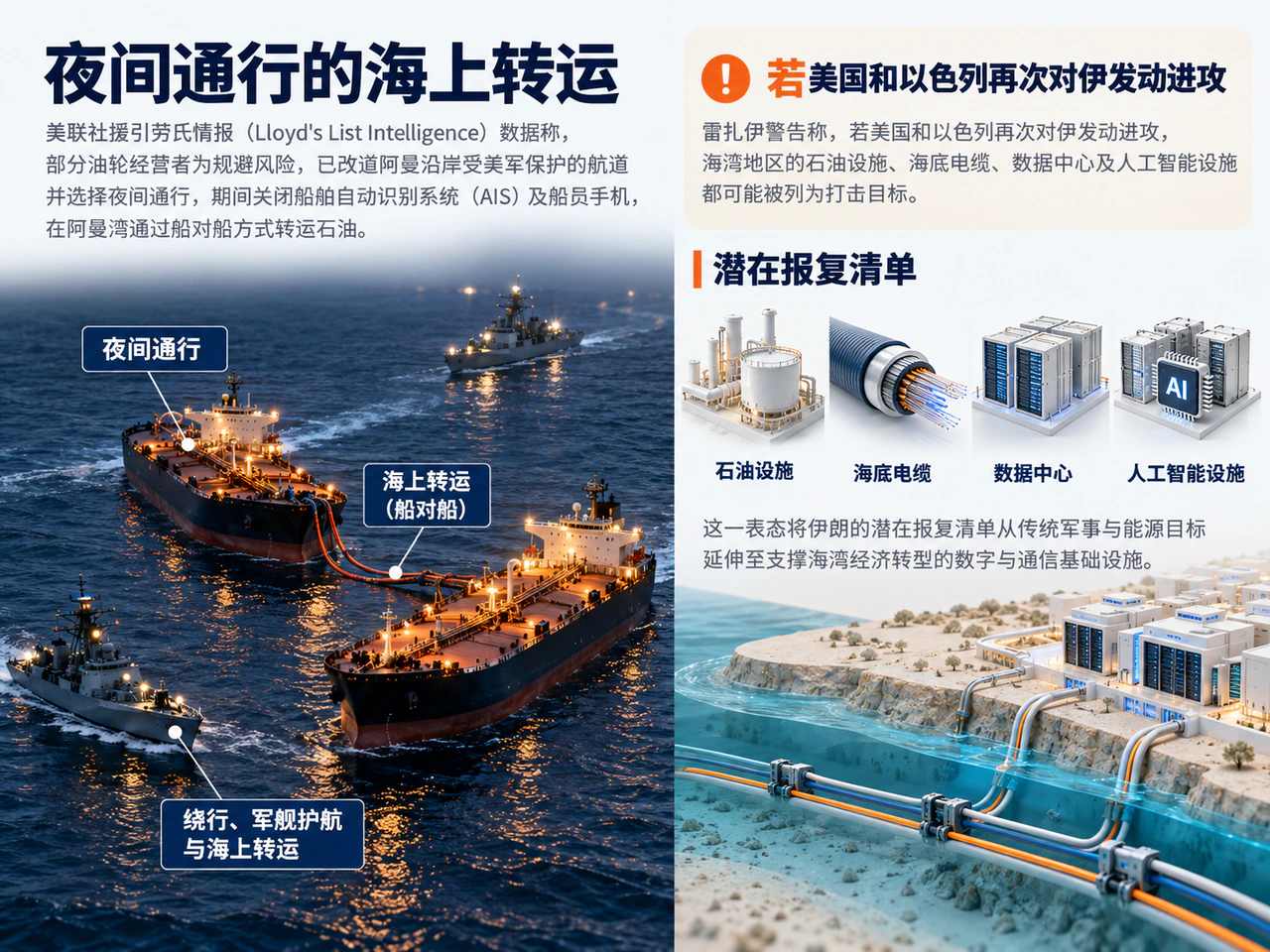
As negotiations stalled, Persian Gulf shipping risks continued to disrupt crude exports. On October 22, Iran’s Revolutionary Guard navy claimed it had attacked four vessels involved in oil transfers and that three other vessels had struck mines. The Associated Press, citing Lloyd’s List Intelligence data, reported that some tanker operators were rerouting along U.S.-protected lanes off Oman and transiting at night to reduce risk. They switched off automatic identification systems (AIS) and crew mobile phones and transferred oil between ships in the Gulf of Oman. Operations dependent on detours, naval escorts and offshore transfers continued to raise the organizational cost of Gulf crude exports and uncertainty over schedules.
Also on October 22, Iran broadened its threatened target set. Rezaei warned that if the United States and Israel attacked Iran again, Gulf oil facilities, submarine cables, data centers and artificial intelligence facilities could all become targets. The warning extended Iran’s potential retaliation list beyond conventional military and energy targets to the digital and communications infrastructure supporting the Gulf’s economic transformation.
U.S. public signals about military action shifted repeatedly during the week. Media had earlier cited Israeli sources describing plans for another joint U.S.–Israeli strike. White House spokesperson Kelly said on October 22 that the United States would not attack Iran before the midterm elections. At a Florida rally on October 23, however, Trump said another round of military action was possible, without disclosing a plan. On October 25, he again said no strike would occur that day. Israeli Prime Minister Benjamin Netanyahu warned that an attack by Iran or its allies before Israel’s election would draw a strong response. Washington’s frequent and changing statements kept military action on the table while leaving its timing uncertain.
Houthis attack Saudi airports and threaten the East–West Pipeline
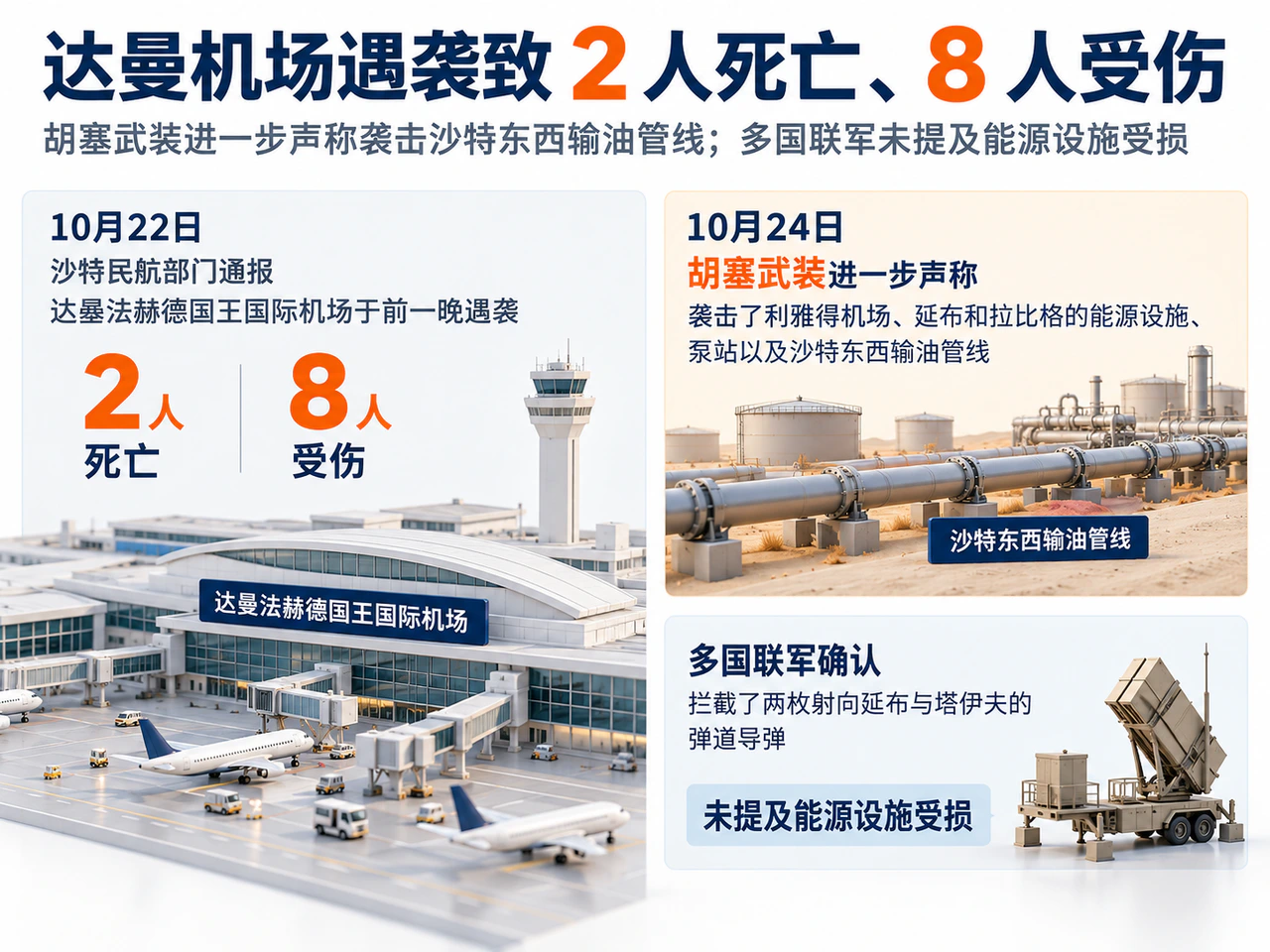
On the Yemen–Saudi front, cross-border Houthi attacks directly affected civilian aviation and personal safety. Saudi aviation authorities reported on October 22 that an attack the previous evening on Dammam’s King Fahd International Airport had killed two people and injured eight. The Houthis subsequently claimed responsibility. Media reported the same day that the U.S. military had adjusted personnel deployments at Middle East bases. The State Department had earlier ordered nonessential personnel and families out of Saudi Arabia, a move U.S. officials directly linked to the Houthi threat.
On October 24, the Houthis further claimed attacks on Riyadh airport, energy facilities in Yanbu and Rabigh, pumping stations and Saudi Arabia’s East–West Pipeline. The Saudi-led coalition confirmed intercepting two ballistic missiles aimed at Yanbu and Taif, without reporting damage to energy facilities. The East–West Pipeline has the strategic role of carrying crude directly to Red Sea ports while bypassing Hormuz. Its inclusion among Houthi targets meant that both the Gulf’s maritime route and Saudi Arabia’s overland alternative faced security threats at the same time.
By October 25, Terminals 1 and 2 at Riyadh’s King Khalid International Airport had resumed operations, but the Saudi military again intercepted a ballistic missile and a drone headed toward the capital that day. Saudi civil defense said falling interception debris had injured two people and damaged buildings and vehicles in the southern towns of Khamis Mushait and Ahad Rafidah. Fighting inside Yemen also continued. Yemen’s government said three Houthi ballistic missiles struck coast guard facilities in Aden; the Houthis said they targeted troop concentrations and a naval base. Pope Leo XIV publicly called for an end to the fighting, saying more than a million residents of Taiz faced shortages of food, water and medical supplies.
Across the week, indirect U.S.–Iran communication remained open, but fighting continued to erode the safety margin for Gulf shipping, energy pipelines and civilian infrastructure. A meaningful near-term de-escalation depended both on mediators building an executable, phased exchange between uranium arrangements and blockade relief and on a reduction in attacks along the Saudi and Yemeni fronts.
Key developments

| Key developments · Beijing time |
|---|
| 10-26 06:16Weekend news roundup: Iranian Foreign Ministry spokesperson Baghaei said Iran was still sending messages to the United States through intermediaries and that the diplomatic window remained open. |
| 10-26 06:16Trump said there would be no attack on Iran that day. Israeli Prime Minister Netanyahu warned of a strong response if Iran or its allies attacked before Israel’s election. |
| 10-26 06:16Riyadh’s King Khalid International Airport resumed operations at Terminals 1 and 2. Saudi forces reported another interception of a ballistic missile and a drone headed toward the capital. |
| 10-26 06:16Saudi civil defense said falling missile-interception debris injured two people and damaged buildings and vehicles in Khamis Mushait and Ahad Rafidah. |
| 10-26 06:16Pope Leo XIV called for an end to the Yemen fighting, saying more than a million residents of Taiz faced shortages of food, water and medical supplies. |
| 10-25 01:26Reuters reported Houthi claims of attacks on Saudi airports, oil and gas facilities at Yanbu and Rabigh, and the East–West Pipeline. The Saudi-led coalition confirmed intercepting two missiles aimed at Yanbu and Taif. |
| 10-25 01:26Yemen’s government said three Houthi ballistic missiles hit coast guard facilities in Aden. The Houthis said their targets were troop concentrations and a naval base. |
| 10-24 04:04At a Florida rally, Trump said the United States might take military action against Iran again, without announcing a specific plan. |
| 10-22 23:09White House spokesperson Kelly said the United States would not attack Iran before the midterm elections. Media had earlier cited Israeli sources describing another joint U.S.–Israeli strike plan. |
| 10-22 23:03Iranian security official Rezaei warned that renewed U.S. and Israeli attacks would put Gulf oil facilities, submarine cables, data centers and artificial intelligence facilities on Iran’s potential target list. |
| 10-22 16:35Iran’s Revolutionary Guard navy claimed attacks on four vessels transferring oil and said three other vessels had struck mines. |
| 10-22 07:49Media reported U.S. personnel redeployments at Middle East bases. The State Department had earlier ordered nonessential personnel and families out of Saudi Arabia, which U.S. officials linked to Houthi threats. |
| 10-21 20:18Al Jazeera reported that Pakistan’s army chief Munir visited Tehran on October 20. Iran insisted enriched uranium must not leave the country and demanded that the United States first lift the blockade, ease sanctions and release frozen assets. |
| 10-19 22:21After meeting Russian Foreign Minister Lavrov, Iranian Foreign Minister Araghchi called for diplomacy to resolve regional problems and proposed security arrangements established by regional countries. |


