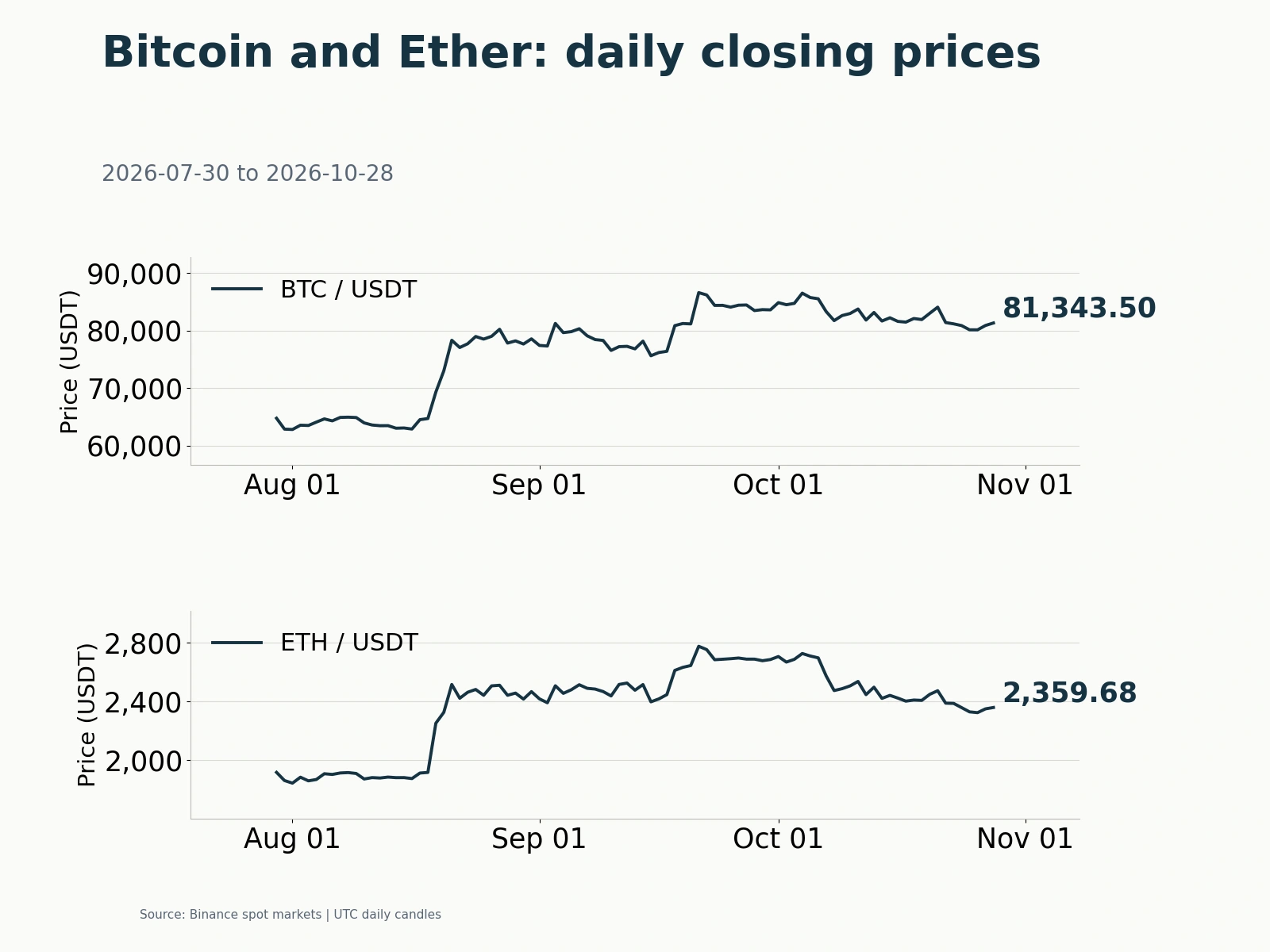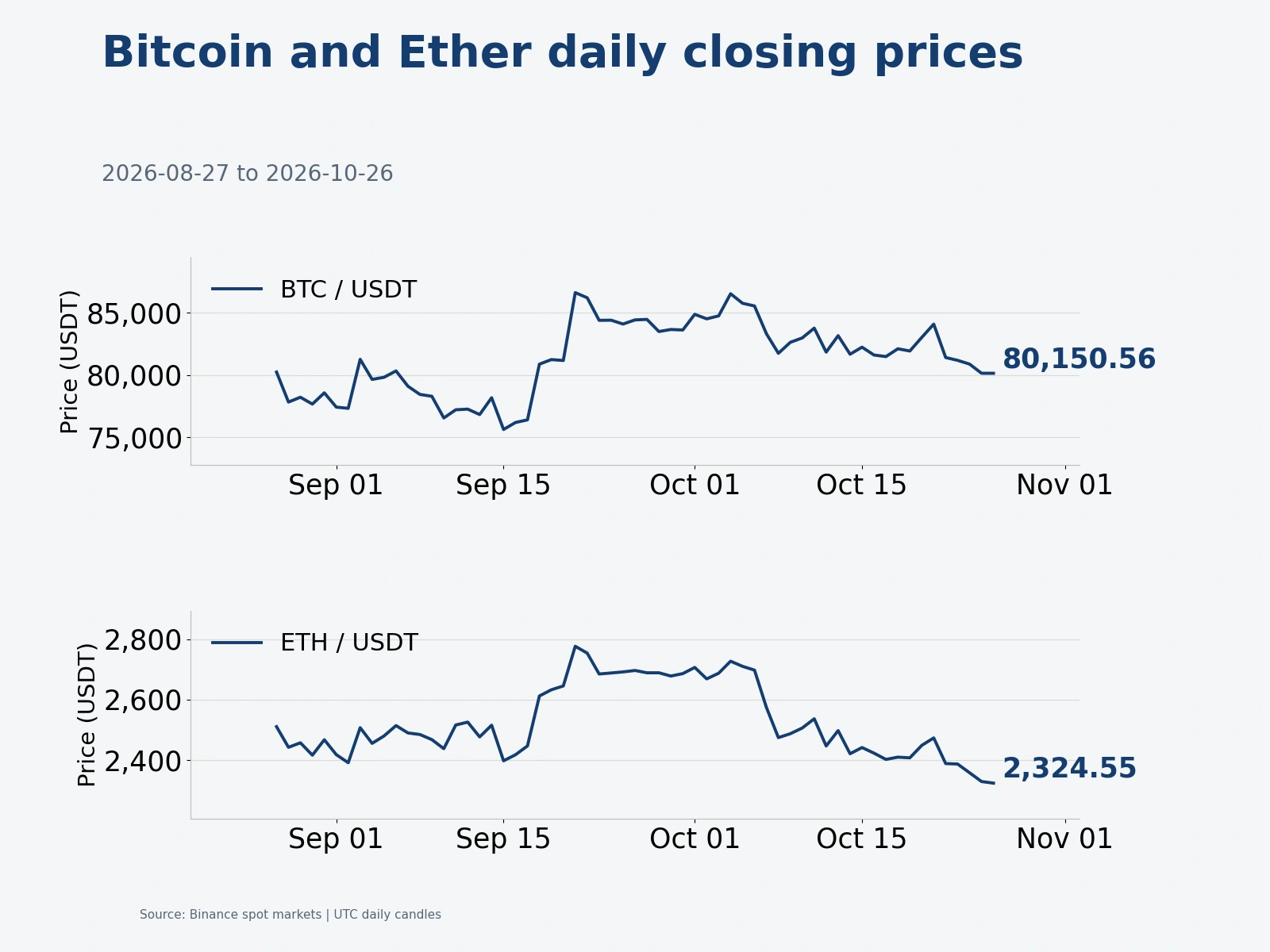
Binance spot UTC daily candles, closing at 08:00 Beijing time on October 27, showed Bitcoin ending October 26 at 80,150.56 USDT, down just 0.0044% from the preceding day and holding the 80,000 USDT threshold. Ether closed at 2,324.55 USDT, down 0.23%. Intraday risk aversion had not developed into sustained selling, but major coins were mixed and buying had yet to become broadly coordinated. Differences over the outlook were also extending from opinions into capital allocation: Galaxy publicly argued that Bitcoin had reached a medium-term bottom, some trading funds reduced exposure, and several listed crypto treasury companies directed more cash to share repurchases rather than spot accumulation.
Bitcoin holds 80,000 on higher turnover; ETH/BTC falls to 0.02900

During the session, Bitcoin recovered from 79,368.67 USDT, reached a high of 80,844.70 and finished close to unchanged. Ether traded between 2,293.09 and 2,344.72 USDT. It recovered from intraday lows alongside the broader market but still underperformed at the close, taking the ETH/BTC price ratio down further to 0.02900.
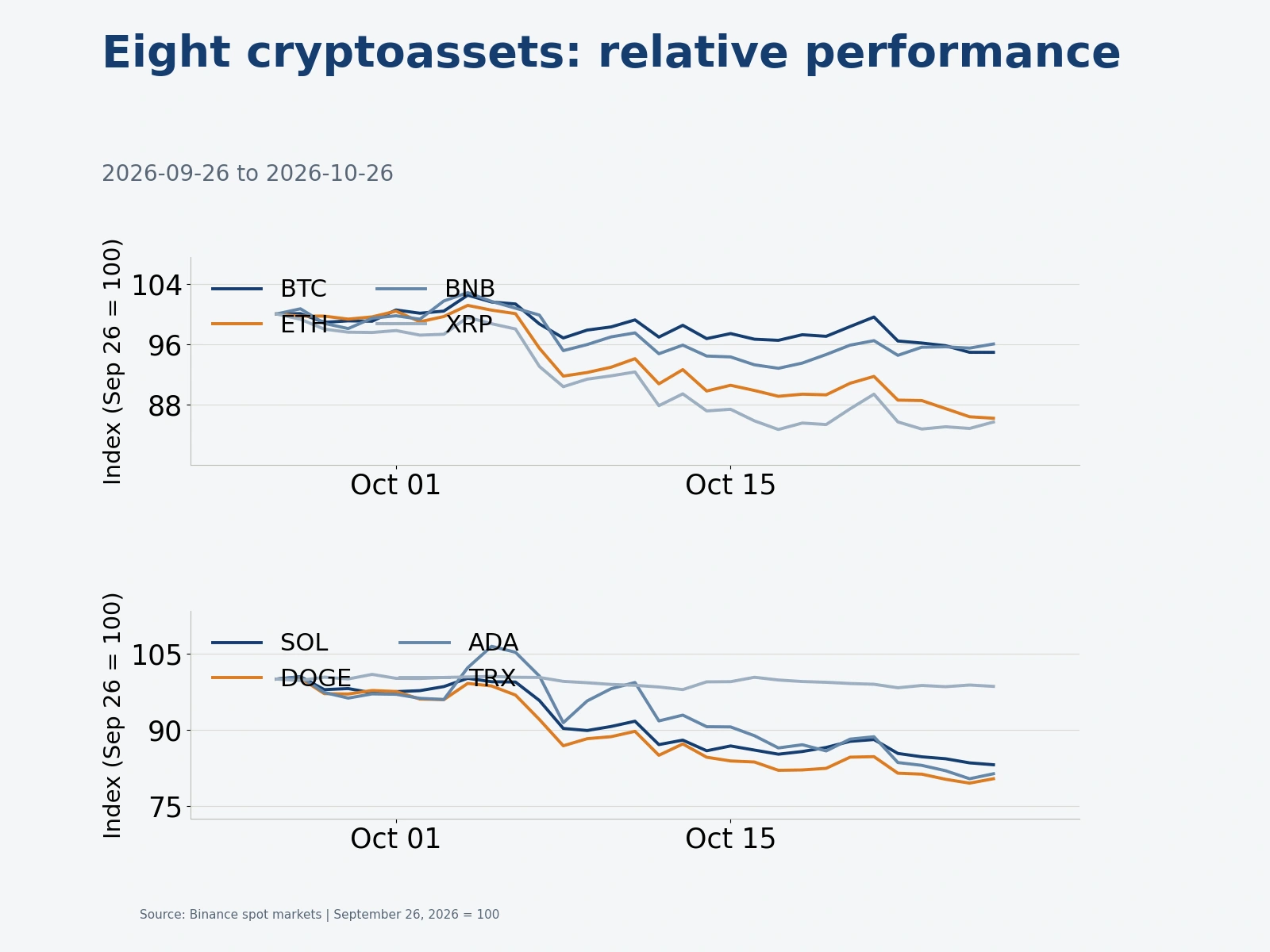
Ether’s relative weakness against Bitcoin had persisted for almost a month. From the September 26 close, Bitcoin had fallen 5.07% over 30 days, while Ether was down 13.79% and ETH/BTC had declined 9.18%. CoinGecko’s market-wide snapshot updated at 23:57 UTC on October 26 put Bitcoin’s market-cap share at approximately 59.41%, maintaining a weight close to three-fifths of the market.
Major coins also combined daily recovery with monthly pressure. In the fixed sample of eight Binance spot USDT pairs—Bitcoin, Ether, BNB, XRP, SOL, DOGE, ADA and TRX—four rose and four fell at the daily close. ADA gained 1.22%, DOGE 1.09%, XRP 1.00% and BNB 0.57%; alongside Bitcoin and Ether, SOL and TRX fell 0.44% and 0.27%, respectively. Over 30 days, all eight sample returns were negative. DOGE, ADA and SOL remained down approximately 19.60%, 18.62% and 16.85%, respectively. Many of the daily leaders were recovering after earlier steep falls; broad pressure over the monthly horizon had yet to ease.
Trading activity revived markedly as the market moved from the weekend into the working week. Daily Bitcoin spot turnover on Binance reached 1.231 billion USDT, up 144.35% from Sunday, while Ether turnover was 446 million USDT, up 62.88%. Bitcoin finished nearly flat despite turnover more than doubling, indicating substantial exchange between buyers and sellers around 80,000 USDT. Further trading was still needed to establish the short-term direction.
The external macro environment offered room for an intraday recovery. CoinDesk reported that lower international oil prices and a recovery in U.S. equity futures coincided with Bitcoin’s rebound from its Asian-session lows. However, uncertainty about the rate path ahead of the Fed’s October 28 decision continued to restrain buying at higher prices. Easing energy risks provided short-term support, while cautious position management remained dominant before the major policy event.
Galaxy and Hayes diverge; crypto treasury companies turn toward share repurchases
Behind the market’s tug-of-war were differing judgments across time horizons among major participants. In a client research note dated October 22 that drew widespread public discussion on October 26, Galaxy research head Alex Thorn argued that Bitcoin’s bear market had ended in June and that it had entered an accumulation phase. He pointed to changes in medium-term supply and positioning: Bitcoin had moved back above long-term moving averages, older coins were moving more slowly on-chain, and capital previously engaged in arbitrage and macro trading had already substantially reduced positions.
Arthur Hayes’s actions focused instead on avoiding near-term risk. According to CoinDesk, Hayes said over the weekend that the Maelstrom fund had sold directional positions, including 6,400 ETH, because of macroeconomic and geopolitical risks. That reduction formed part of the backdrop to Monday’s trading. The difference extended beyond bullish versus bearish direction to time horizon: diminished long-term selling pressure could support a medium-term bottom thesis, while concentrated near-term risk events still encouraged trading capital to reduce exposure. Bitcoin holding its threshold while Ether weakened reflected that distinction directly in the day’s trading.
Recent disclosures by listed crypto treasury companies provided further evidence of diverging capital flows. The Block, citing disclosures, reported that Strategy neither bought nor sold Bitcoin from October 19 through October 25 and instead spent approximately US$204.9 million repurchasing STRC preferred shares. Over a related period, October 17–23, Strive added 6,182 Bitcoin. Of these two Bitcoin-centered businesses, one prioritized its own capital instruments while the other continued to expand spot holdings.
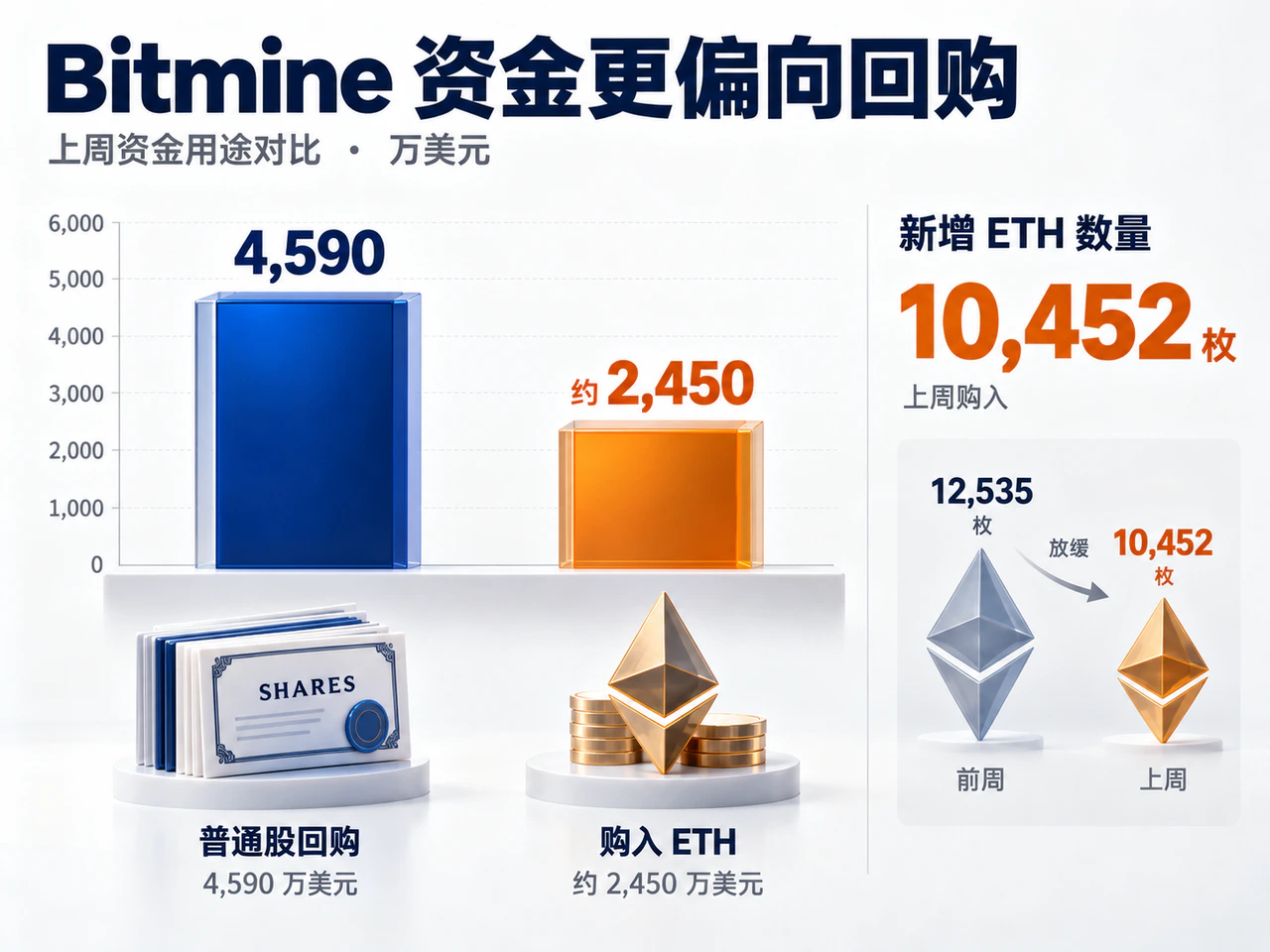
A similar allocation tradeoff appeared among Ether treasury companies. CoinDesk reported that Bitmine added 10,452 ETH the previous week, slowing from 12,535 ETH in the week before. It also spent approximately US$45.9 million buying back common shares, exceeding the roughly US$24.5 million spent buying coins during the same period.
These differences in capital allocation show that a company’s constructive medium-term crypto outlook does not imply continued coin purchases at an unchanged pace. A medium-term bullish view needs sustained spot demand, while listed companies must also weigh coin purchases against buybacks and cash retention. When common or preferred shares trade at a discount, management often prioritizes repairing the capital structure over expanding coin holdings. Cash allocated to buybacks does not simultaneously become new spot-market token orders, helping explain why more optimistic assessments had yet to produce broadly rising prices.
The outlook depended on more than Bitcoin’s ability to hold 80,000 USDT. It also required a broader recovery: whether Ether could stabilize against Bitcoin, whether gains among major coins could persist, and whether treasury companies’ incremental coin purchases would pick up. Closing prices showed that buying support remained below the market, but broader participation was still needed to confirm the strength of the recovery.
Follow the original-article link for further details.