On October 29, 2026, Binance said it was investigating a potential security incident and stated that user funds were safe. Tether and Circle subsequently disclosed that they had frozen stablecoins linked to the incident. Falling technology stocks and expectations of tight monetary policy had already put the crypto market under pressure. As uncertainty over platform security and the movement of funds increased, Bitcoin fell below 80,000 USDT, while Ether and most highly liquid tokens recorded larger declines.
Using Binance spot prices quoted in USDT and UTC daily candles, Bitcoin closed at 77,991.89 USDT, down 4.12%, over the full trading day from 8 a.m. Beijing time on October 29 to 8 a.m. on October 30. Ether closed at 2,253.13 USDT, down 4.52%. Bitcoin's closing price was only slightly above its daily low of 77,910 USDT, as its intraday rebound failed to hold through the close.
Macroeconomic pressure and Binance security concerns combine as Bitcoin closes near its daily low

The market did not fall in a straight line throughout the day. Binance hourly candles show that Bitcoin briefly dropped below 80,000 USDT during the Asian session before recovering, with the candle for 15:00–16:00 UTC closing at 81,777.74 USDT. During 20:00–21:00 UTC, the hourly close fell to 78,851.99 USDT from 80,848.64 USDT in the preceding hour; the final trading hour brought a further decline to the daily closing price. The pullback in risk assets in the first half of the day and industry security news in the second half created two overlapping sources of pressure.
Nexo's research that day linked the Asian-session decline to pressure on technology stocks following earnings reports from Alphabet and Samsung. The report noted slower growth in Alphabet's search advertising revenue and higher capital expenditure, alongside slightly weaker-than-expected profits in Samsung's chip business. The Federal Reserve had left interest rates unchanged the previous day, but two members favored a rate increase, and markets continued to price the risk of further tightening. Questions about the returns on technology investment can weaken risk appetite, while expectations of persistently high interest rates raise the opportunity cost of holding volatile assets. Both weigh on crypto assets.
Macroeconomic pressure had been building before that day, whereas the Binance news introduced a more direct source of industry risk. In its October 29 report, TechCrunch quoted a Binance spokesperson as saying that the platform had temporarily suspended withdrawals across multiple networks as a precaution. The Associated Press confirmed that Binance was investigating a potential security issue and reported that Tether and Circle had announced freezes of more than $1.5 billion and $800 million, respectively, in related stablecoins. BNO further cited the heads of the two companies, putting the respective amounts at more than $1.567 billion in USDT and more than $800 million in USDC.
The news shifted the market's focus from valuation pressure to whether funds could move normally. Exchanges connect spot trading, leverage, market-making and withdrawal channels, so suspending withdrawals on some networks increases uncertainty over fund transfers. Stablecoin issuers' freezes of related assets help restrict further transfers, but the amounts frozen do not equal the platform's ultimate losses, nor do they mean the funds have been returned. Although Binance said user funds were safe, the investigation was ongoing, and final losses and the outcome of the handling of funds had yet to be disclosed.
BNB stood out: it fell 8.08% over the day to close at 698.46 USDT, with turnover approximately 4.38 times the previous day's level. During 20:00–21:00 UTC, its hourly close fell from 744.89 USDT to 698 USDT, alongside Bitcoin's decline in the same period. BNB's substantially larger loss than Bitcoin's was consistent with the market pricing in additional platform-related risk. However, the investigation had not reached a complete conclusion, and transfer amounts circulating in market rumors could not be treated directly as confirmed losses.
TechCrunch also reported that day that Polymarket had briefly halted trading after a third-party service provider was compromised. Although this was a separate incident, the two events highlighted operational risks arising from trading platforms, front-end services and reliance on external software. When markets are under pressure, security incidents can affect more than the revenue outlook for an individual business: they may also prompt traders to reduce their overall exposure and increase their preference for cash and readily transferable assets.
Nine of ten trading pairs decline, while TRX bucks the trend with a 6.85% gain

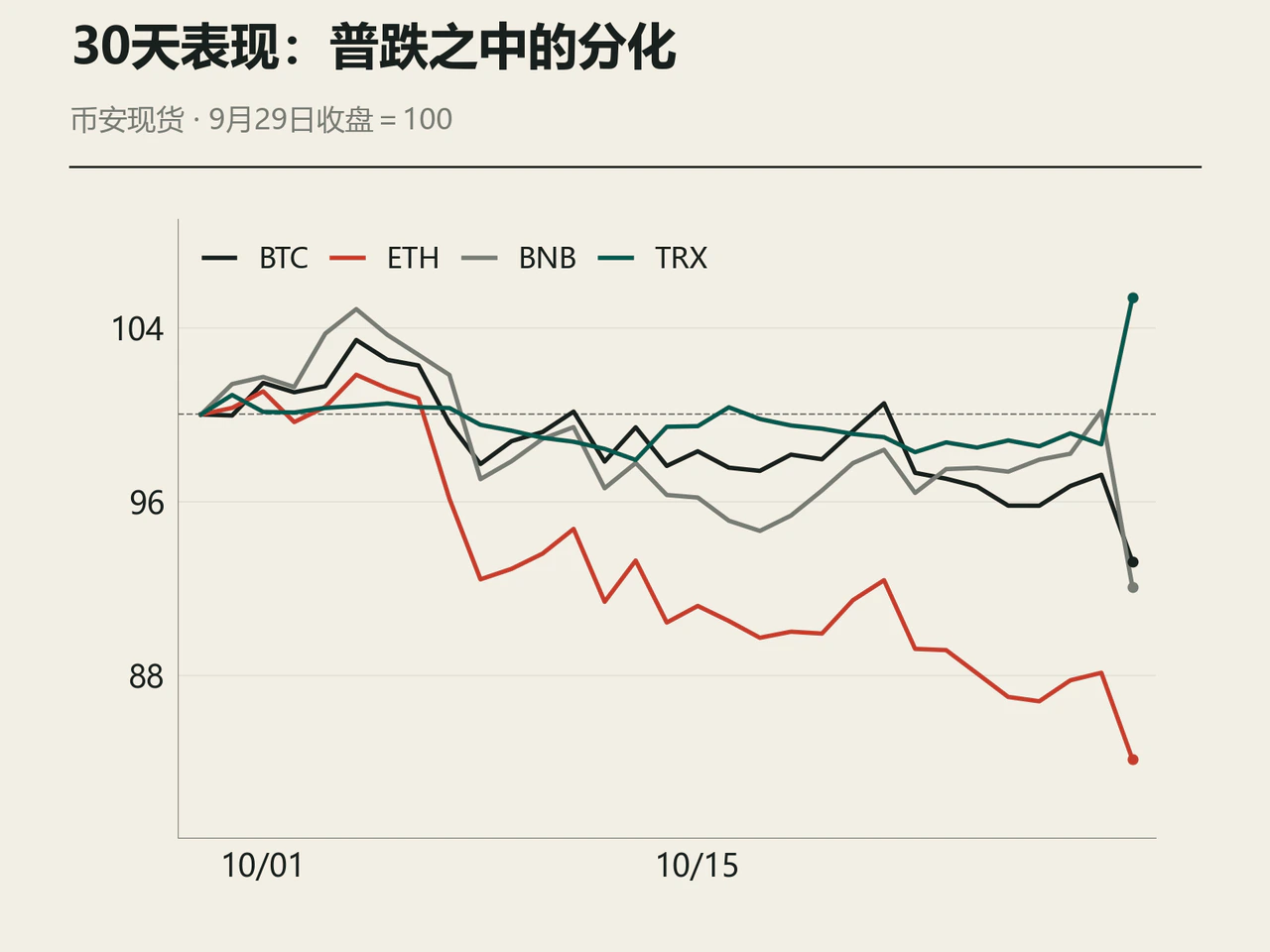
Of the ten Binance spot USDT trading pairs in the fixed sample, nine declined and only TRX advanced. SOL fell 6.64%, XRP 6.66%, ADA 7.62%, LINK 10.14%, AVAX 8.05% and DOGE 5.64%. Highly liquid tokens fell broadly, but selling pressure varied across projects.
TRX rose 6.85% to close at 0.3524 USDT, with turnover 4.35 times the previous day's level. Its gain against the prevailing trend created pockets of divergence amid broad risk reduction. Price action alone cannot establish the specific motives behind flows into TRX, but its advance showed that traders continued to differentiate among assets and trading opportunities.
Trading in Bitcoin and Ether also increased markedly. Daily spot turnover reached 1.906 billion USDT and 949 million USDT, respectively, or 1.79 and 2.26 times the previous day's levels. Higher turnover did not produce a recovery by the close. Bitcoin's finish near its daily low, in particular, indicated that increased activity primarily reflected more intense trading and transfers of holdings, while buying demand was still insufficient to return prices to their earlier range.
The pattern of weakness becomes clearer over a 30-day horizon. Relative to the September 29 close, Bitcoin was down 6.78%, Ether 15.86%, SOL 19.73%, LINK 27.30% and AVAX 27.59%. Relative weakness within the market had already accumulated before the Binance security concerns emerged, and the one-day shock deepened the divergence.
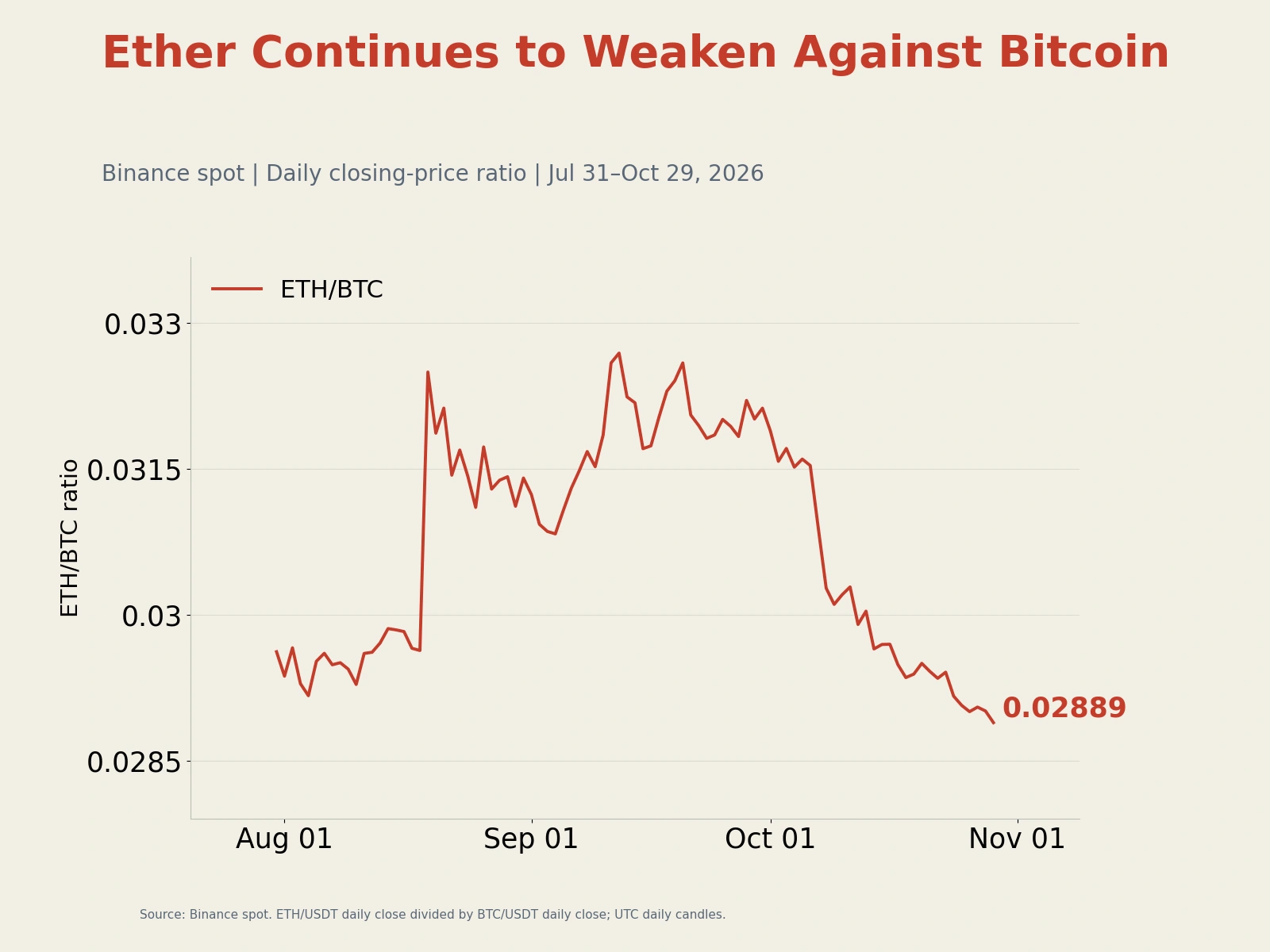
On the same daily-candle basis, the ETH/BTC ratio fell from 0.02901 the previous day to 0.02889, compared with approximately 0.03201 thirty days earlier. Ether's underperformance relative to Bitcoin continued during this sell-off. A CoinGecko market-wide snapshot taken before the trading day ended put total crypto market capitalization at approximately $2.63 trillion and Bitcoin's share at about 59.36%. This snapshot uses a different basis from Binance closing prices: the former captures the size and asset weights of the overall market, while the latter reflects trading on a single platform. Bitcoin's share of nearly 60% shows that it continued to account for the predominant market weight.
A subsequent recovery depends on progress on two fronts. At the platform level, Binance's disclosures about its security investigation, the handling of funds and the resumption of withdrawals will be important in reducing uncertainty over the movement of funds. On prices, the key questions are whether Bitcoin can regain a stable footing around 80,000 USDT and whether Ether and other highly liquid tokens can improve alongside it. If rebounds remain confined to a few assets while higher turnover continues to accompany broad declines, it will be difficult to conclude that internal market pressure has eased materially.
Click “Read Original” for the full article.