On October 29, 2026, Binance announced an investigation into a potential security issue. Tether and Circle subsequently disclosed freezes on related stablecoin funds. According to media accounts of statements by the two companies' executives, the freezes covered more than $1.567 billion in USDT and more than $800 million in USDC, totaling more than $2.367 billion.
Funding conditions had already begun to diverge: U.S. spot Bitcoin ETFs had returned to net inflows, Ethereum ETFs continued to see net redemptions, and the stock of dollar stablecoins was declining. Demand for allocations had recovered in some areas, but on-chain dollar funding had not expanded alongside it. The security incident has now brought fund transfers and counterparty risk management into sharper focus.
Bitcoin ETFs Take In $423.6 Million over Three Days as Stablecoin Supply Falls $3.542 Billion in a Week

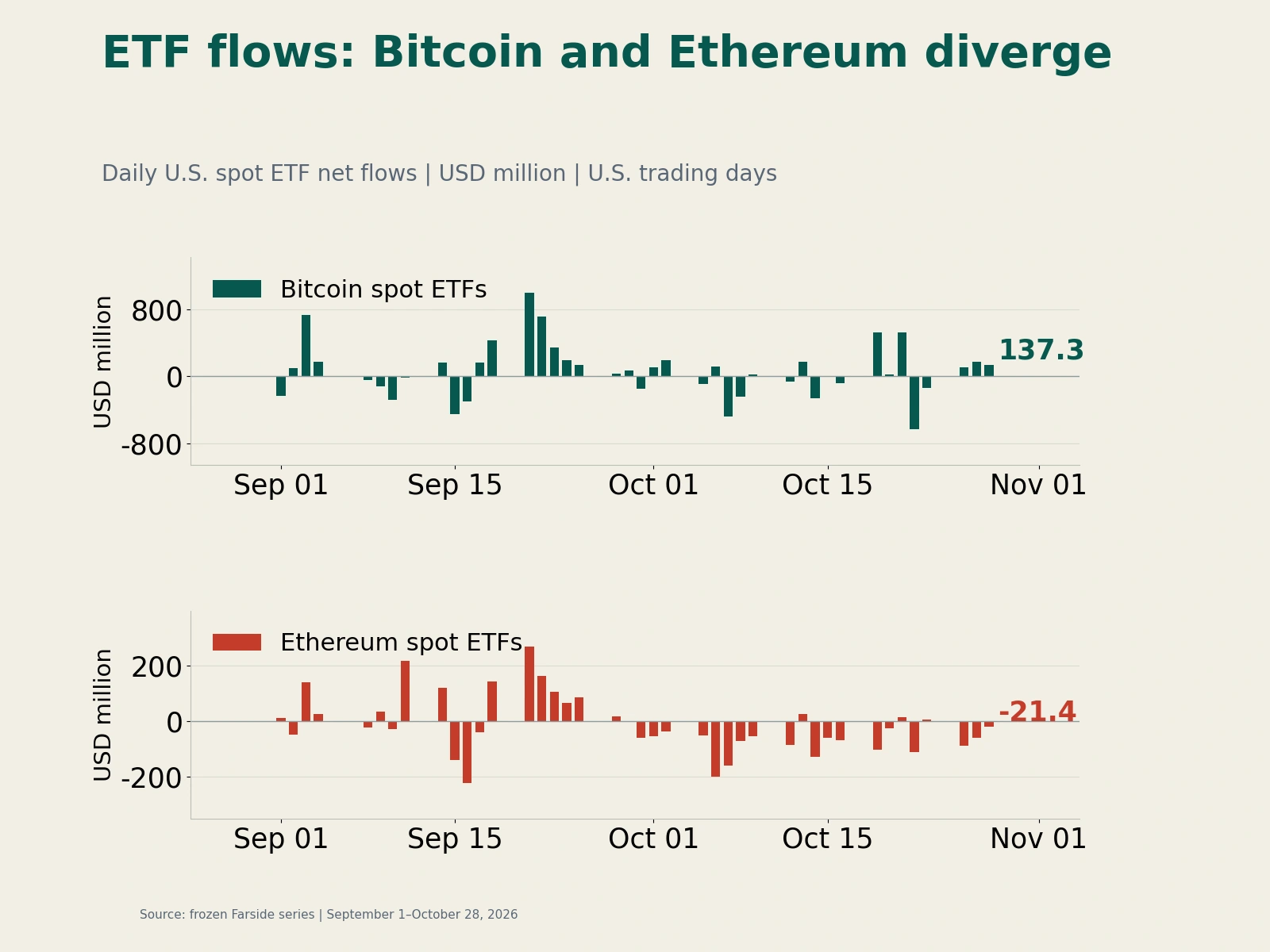
Farside's complete figures show that U.S. spot Bitcoin ETFs recorded net inflows of $137.3 million on October 28. BlackRock's IBIT attracted $136 million and Bitwise's BITB received $1.3 million, leaving almost all of the day's new subscriptions concentrated in IBIT.
Over the longer period from October 26 through 28, Bitcoin ETFs took in a cumulative net $423.6 million. However, combined net outflows on October 22 and 23 had totaled $773.5 million. The subsequent three days of inflows amounted to only about 55% of those two days' redemptions. Subscriptions have resumed, but they have yet to fully offset the earlier withdrawals.
Ethereum ETFs continued to record net outflows: $21.4 million on October 28 and a cumulative $170.2 million from October 26 through 28. On the 28th, BlackRock's ETHA lost a net $44.8 million, while Fidelity's FETH attracted $18.8 million. Two other products also recorded small subscriptions, but these were insufficient to reverse net redemptions across the category. The contrast between ETFs for the two assets indicates that allocation flows remain selective. Inflows into Bitcoin products alone do not establish that funding conditions have improved across the market.
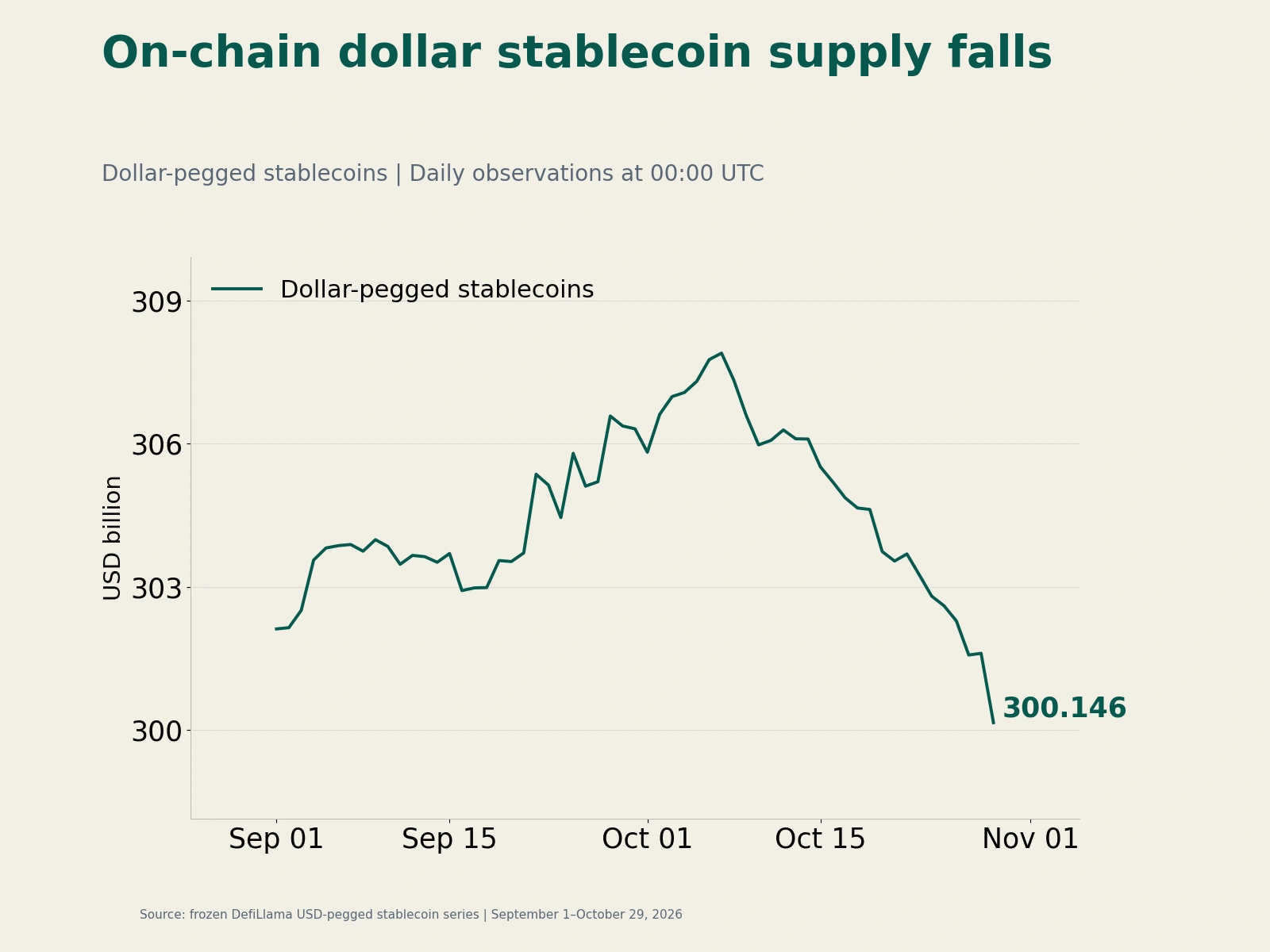
On-chain dollar funding was also weak. DefiLlama's dollar-pegged stablecoin series stood at $300.146 billion at 00:00 UTC on October 29, down $1.456 billion from the previous day and $3.542 billion from a week earlier. The same measure had been $307.905 billion on October 7 and had gradually declined since then.
ETF subscriptions create allocation demand through fund vehicles, while stablecoins are widely used for trade settlement, collateral and payments, making them an important source of funding for crypto trading and on-chain activity. Stablecoin supply has not expanded alongside renewed Bitcoin ETF inflows, suggesting that buying in particular products may not spread to other assets and trading channels. Whether the recovery broadens will depend on an easing of redemption pressure in products such as Ethereum ETFs and a halt to the decline in on-chain dollar supply.
Freezes Restrict Fund Transfers as $11 Billion in Bitcoin Options Approach Expiry

The security incident introduced another constraint. According to BNO and the Associated Press, Tether froze the related USDT, while Circle said its freeze was coordinated with law enforcement. Binance also said user funds were safe and that the investigation was ongoing. A freeze restricts transfers of designated tokens. The eventual disposition of the frozen funds, recovery of the related assets and functioning of trading channels will shape market assessments of how much funding is available for use.
A freeze differs from an investor redeeming stablecoins with an issuer. The former restricts transfers of designated tokens; the latter involves a holder returning tokens in exchange for fiat currency. The amount frozen therefore cannot be treated directly as a redemption amount. The DefiLlama observation cited above predates the incident's disclosure on the evening of October 29 and captures a contraction that was already underway. The market subsequently faced a combination of an existing decline in supply and sudden restrictions on transfers.
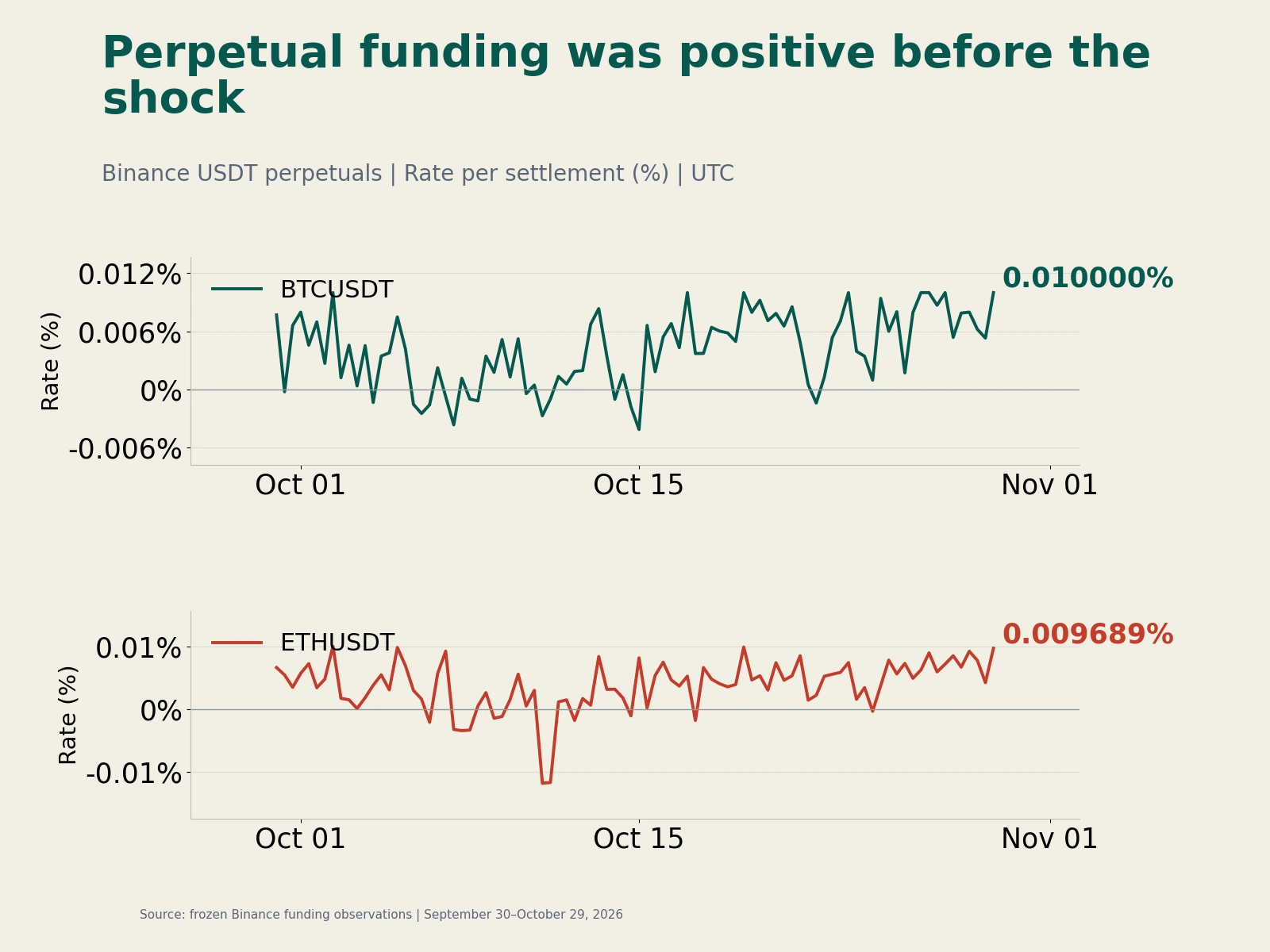
Derivatives data capture the positioning structure before the incident. Funding rates for Binance BTCUSDT perpetual futures at 00:00, 08:00 and 16:00 UTC on October 29 were 0.006216%, 0.005306% and 0.010000%, respectively, totaling 0.021522% across the three settlements. All three corresponding rates for ETHUSDT perpetual futures were also positive, totaling 0.021664%. Positive funding means that longs paid shorts at those settlement times, incurring a cost to maintain their positions. The final settlement preceded reports of the security incident, so these figures reflect only the trading structure before the shock.
Meanwhile, Bloomberg reported on October 29 that about $11 billion in Bitcoin options would expire on October 30, representing roughly one-third of Bitcoin options open interest on Deribit. A large concentration of expiries creates a need to close positions, roll them forward and adjust hedges. If fund transfers or collateral allocation also encounter obstacles, participants may become more inclined to reduce exposure and preserve available margin. Short-term prices could then become more sensitive to changes in order flow.
The recovery in funding conditions remains selective. Bitcoin ETF subscriptions have resumed, but net redemptions from Ethereum ETFs and the decline in on-chain dollar supply have yet to reverse, while stablecoin freezes have added uncertainty over the availability of funds. How far subsequent buying support can extend will depend on whether Bitcoin ETF subscriptions persist, stablecoin supply recovers and trading channels continue to function smoothly.
Click Read Original for the full article.


