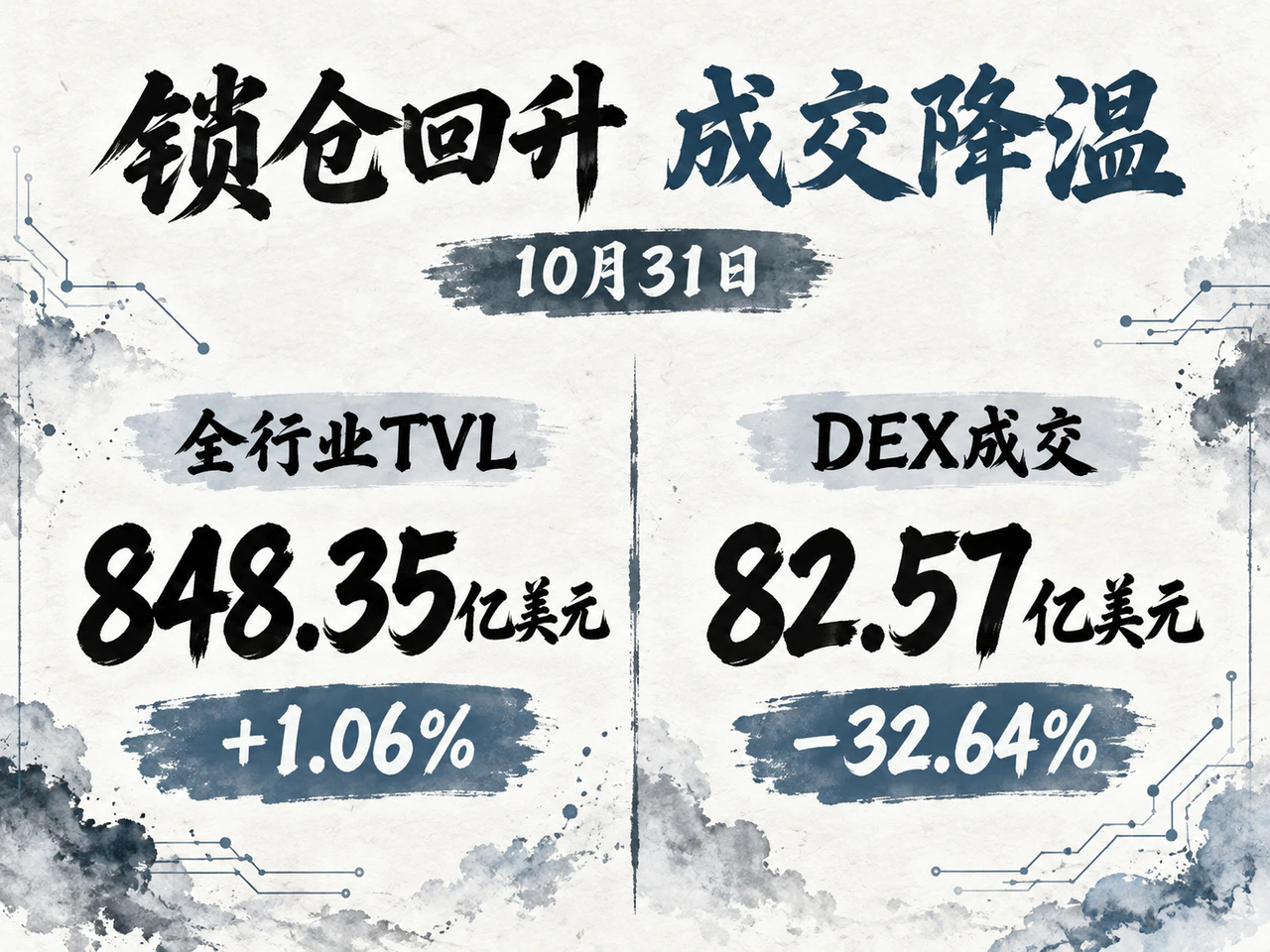
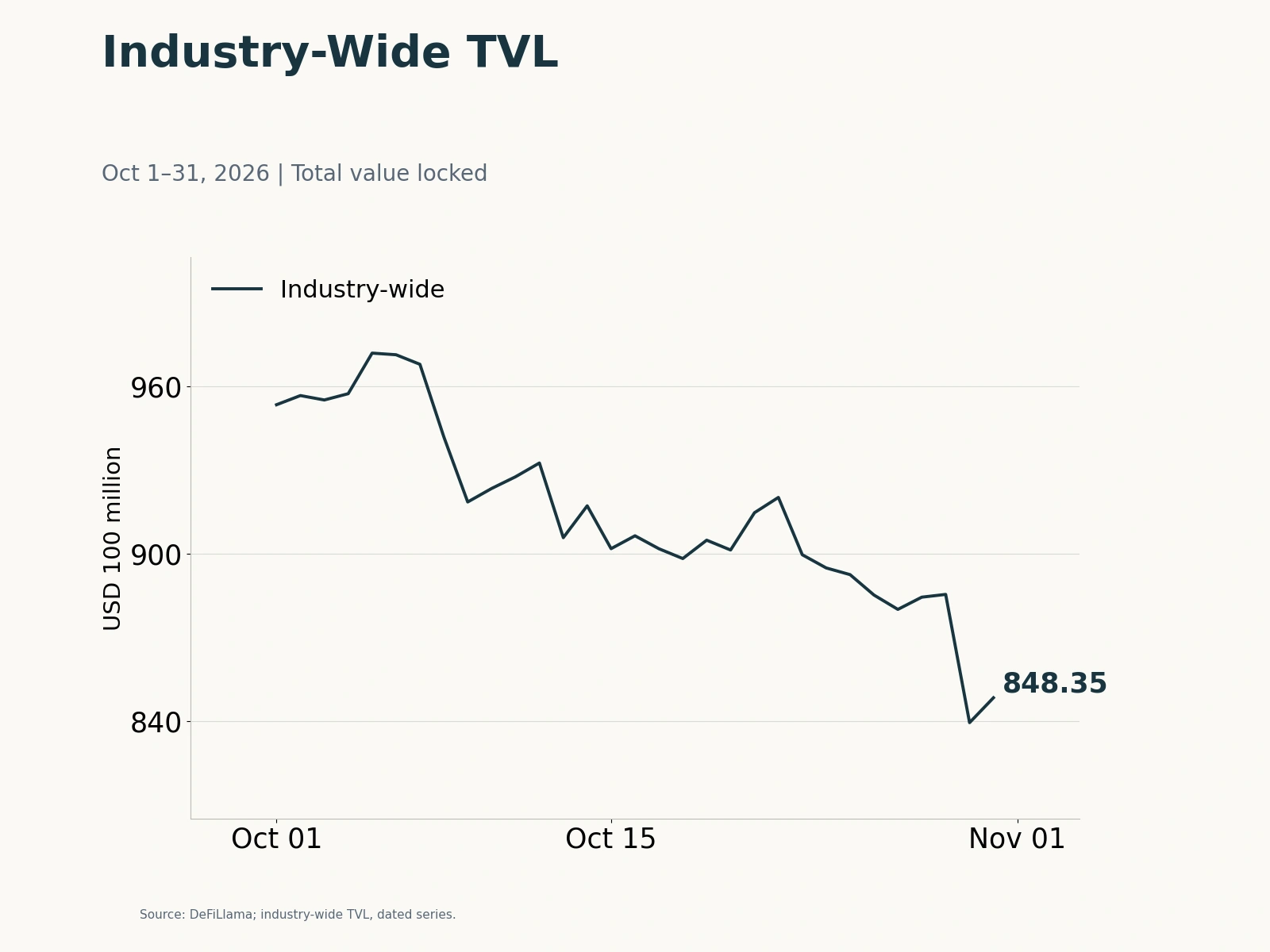
On October 31, 2026, DeFiLlama's dated series showed industry-wide total value locked (TVL) recovering to $84.835 billion, up 1.06% from the previous day but still 4.19% below October 29. Major blockchains and layer-2 networks broadly recovered, while decentralized exchange (DEX) turnover cooled sharply. Following the Binance hot-wallet incident, attention in on-chain markets has expanded beyond asset prices to available cash in lending pools, collateral permissions and the sequence in which funds resume circulating.
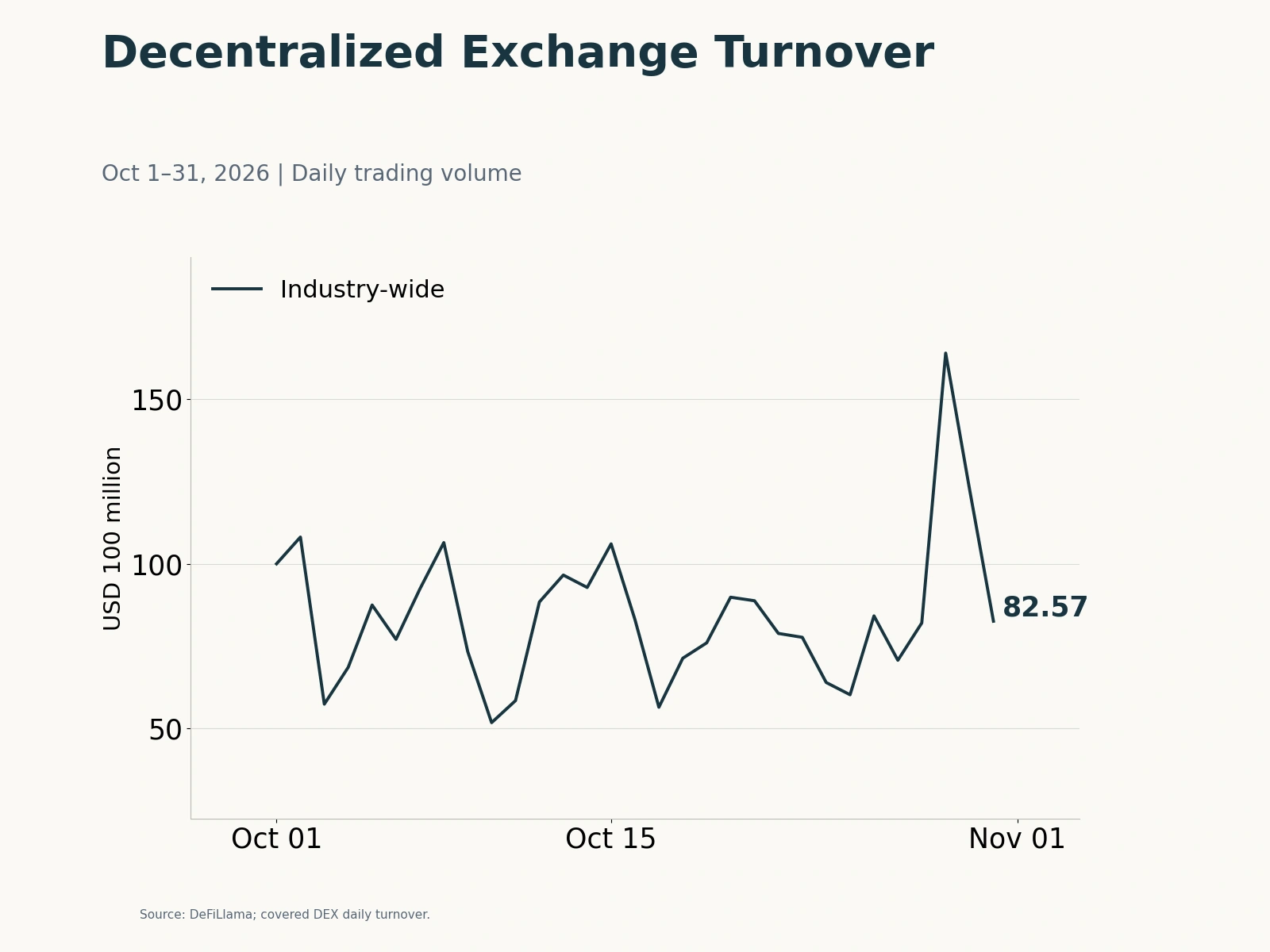
TVL rises across five major networks as DEX turnover falls 32.64%
On October 31, Ethereum's TVL stood at $43.992 billion, up 1.73% from the previous day; Solana's reached $5.414 billion, up 1.33%; and BSC's reached $5.235 billion, up 0.33%. Among layer-2 networks, Base rose 1.71% to $5.876 billion and Arbitrum 0.38% to $1.443 billion. All five networks recovered somewhat but remained approximately 3%–5% below October 29.
TVL is measured at market prices and changes with both coin prices and deposits and withdrawals, but operating activity did not recover alongside it. DEXs covered by DeFiLlama recorded $8.257 billion in turnover that day, down 32.64% from October 30. In its fee-tracking sample, users paid approximately $92.01 million that day, down 16.32%. A recovery in assets' marked value coexisted with lower trading and fee-paying activity, providing insufficient support for a broad recovery in demand.
Beyond the trading disruption, payment businesses continued to develop at their own pace. The Solana Foundation's September recap, published on October 9, described how Column had integrated stablecoins into its core banking systems, enabling round-the-clock conversion among USDC, USDT on Solana and US dollars. Payment channels aggregate multiple small calls for settlement at the end. These developments affect access to payments and settlement efficiency, a different dimension from weekend fluctuations in trading volume.
Aave stages its unfreezing as Jupiter Lend faces cash pressure

An October 30 response update on the Aave governance forum provides a concrete example of lending liquidity conditions. LlamaRisk disclosed that an attacker-linked address had previously deposited 60 million USDT into Aave V3 Ethereum Core and borrowed 19,762 WETH. The protocol subsequently froze new deposits and new borrowing across multiple networks while preserving repayments, withdrawals and liquidations.
The freeze limited new risk but also cut off the normal channel for replenishing cash. In an update at 13:49 UTC on October 30, LlamaRisk said depositor withdrawals had pushed utilization in some reserves to 92%–100%. When new deposits cannot enter, higher interest rates struggle to attract replenishment funding and instead increase borrowers' debts. Risk managers therefore temporarily adjusted interest-rate curves so that the annual borrowing rate in the relevant reserves would not exceed 10% at full utilization.
Reopening also followed a staged approach. The update disclosed that borrowing-cap adjustments in Aave V3 and V4 removed approximately $3.7 billion and $130 million of unused borrowing capacity, respectively. The unfreezing plan also treated three measures separately: restoring deposits, restoring normal collateral eligibility and continuing to restrict new borrowing capacity against assets held by the attacker. Loan-to-value ratios for retained-list assets such as USDT and USDC remained at zero, mainly affecting new borrowing capacity; liquidation thresholds for existing V3 positions were preserved. The arrangement aimed to restore the cash entry channel first while limiting the speed at which new funds could be borrowed out.
The treatment of permissioned assets illustrates a further distinction. Aave risk service provider LlamaRisk disclosed that Horizon's real-world asset (RWA) market was excluded from the initial broad freeze because its collateral was permissioned. Asset admission rules determine not only which funds can enter a protocol but also the scope of risk responses. The operating conditions of open lending, permissioned assets and payment networks therefore cannot be captured by a single TVL measure.
Jupiter Lend on Solana offered another example of cash pressure. An on-chain investigation published by Bitquery on October 30 showed that a withdrawal of approximately $44 million on the evening of October 29 drained 99.94% of the USDC pool's available cash. A snapshot at 16:18 UTC on October 30 showed depositor claims of approximately $416.1 million but only $88.89 of immediately withdrawable USDC. Based on borrowing and balance records at the time, the investigation attributed the problem to inadequate cash buffers and concentrated large deposits. The loans remained collateralized, so a withdrawal queue cannot be equated directly with asset losses.
Together, the two cases show that normalization in lending markets requires monitoring three elements: whether new deposits can enter, whether borrowers repay and whether new collateralized borrowing reopens. TVL reflects asset scale, withdrawable cash determines whether users can exit, and collateral permissions influence whether funds will rapidly flow out again. The October 31 recovery in TVL across networks signaled a repair in prices and asset scale. A sustained operating recovery still depends on restoring these cash flows to working order.
Click through to the original article for full details.