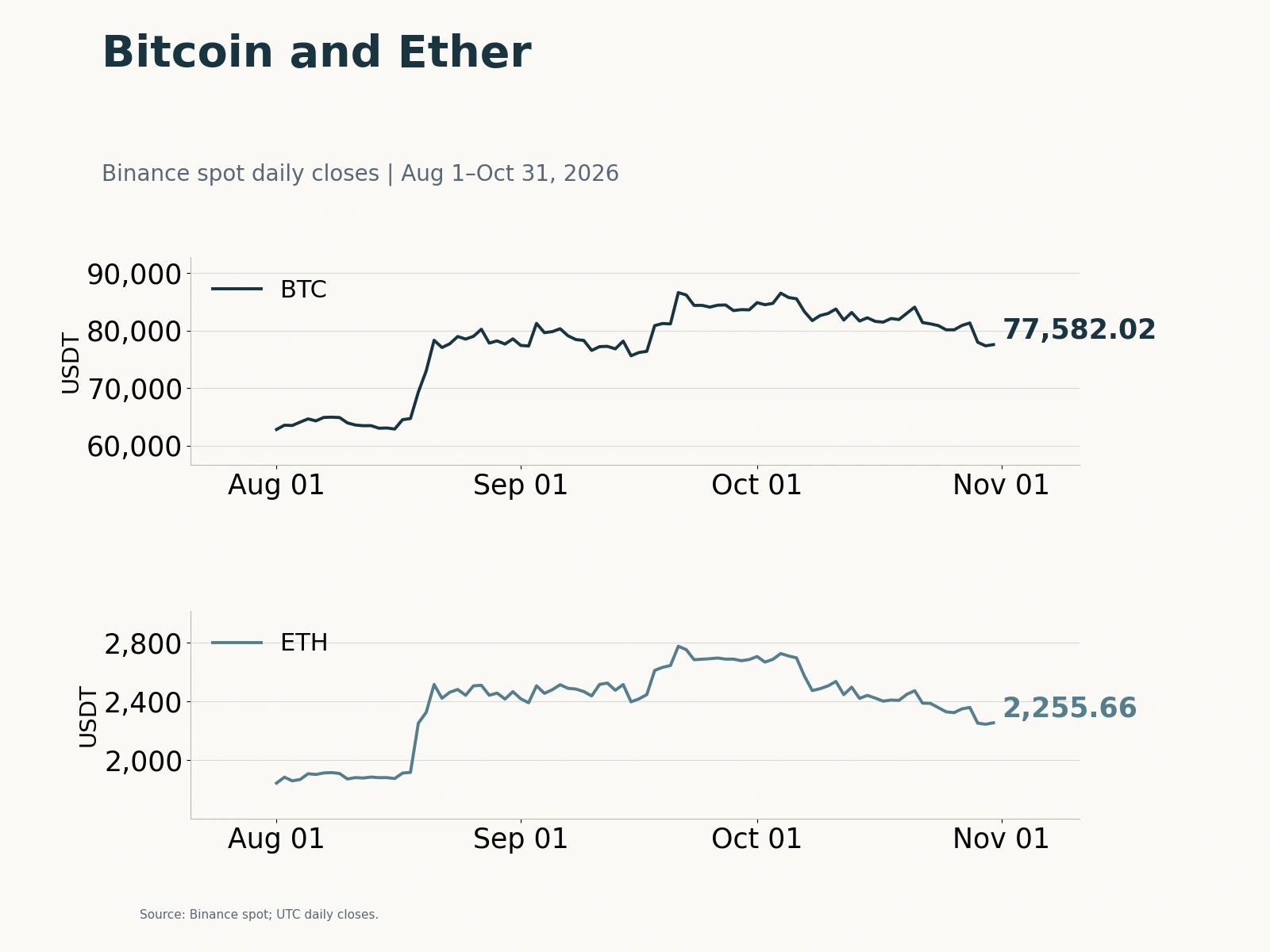
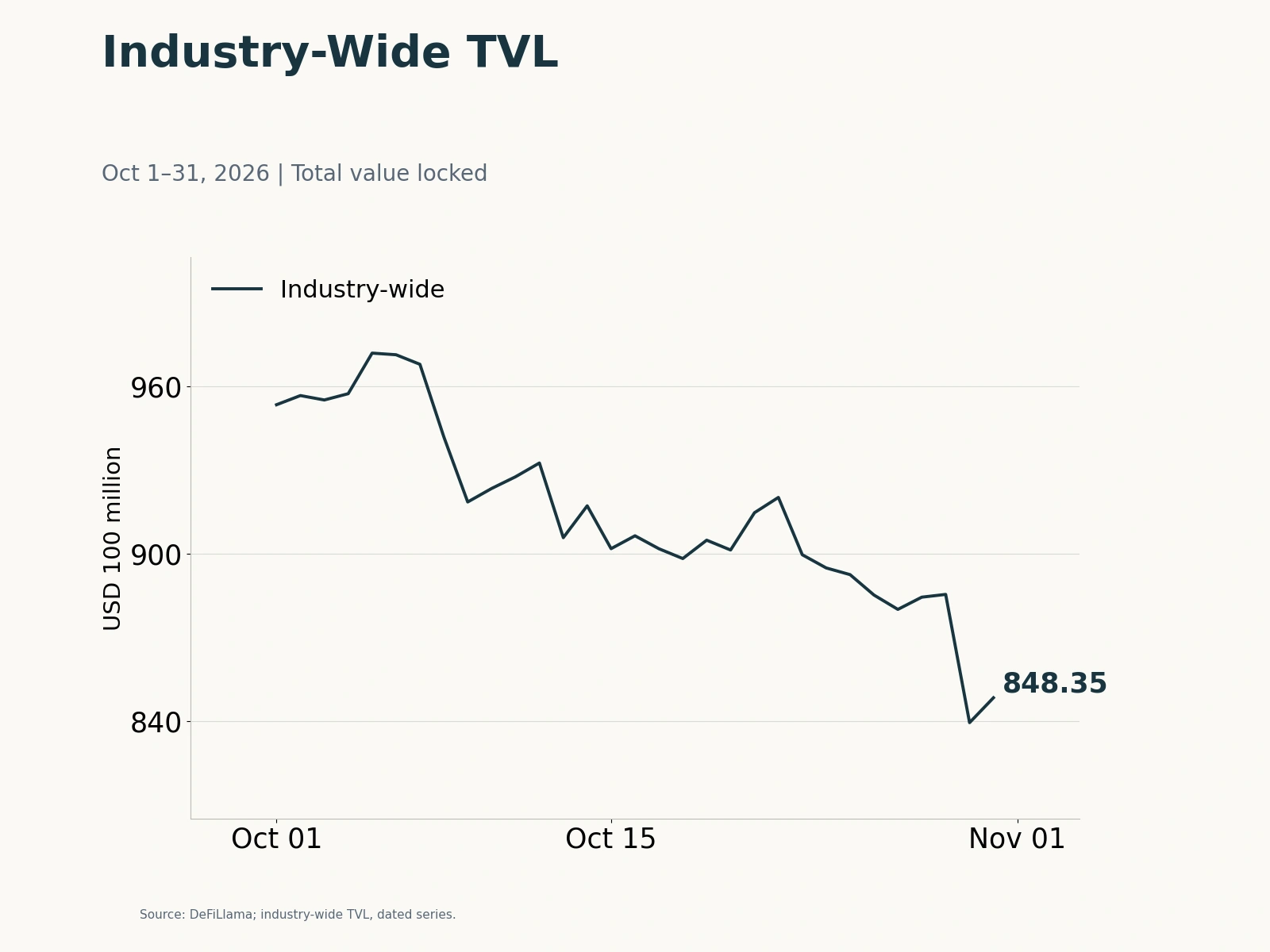
On October 30, 2026, US spot Bitcoin ETFs recorded net outflows of $643.2 million, with a single day's redemptions exceeding the total net inflows of the preceding four trading days. As weekend trading began on October 31, two parallel developments shaped funding conditions: neither ETFs nor stablecoins indicated an expansion in fresh purchasing power, while perpetual futures diverged—Bitcoin longs continued paying funding, and Ether shorts continued paying. Spot allocation demand weakened, but different assets faced different pressures in leveraged markets.
Combined ETF net outflows reach $798.9 million in one day as stablecoin supply continues to fall
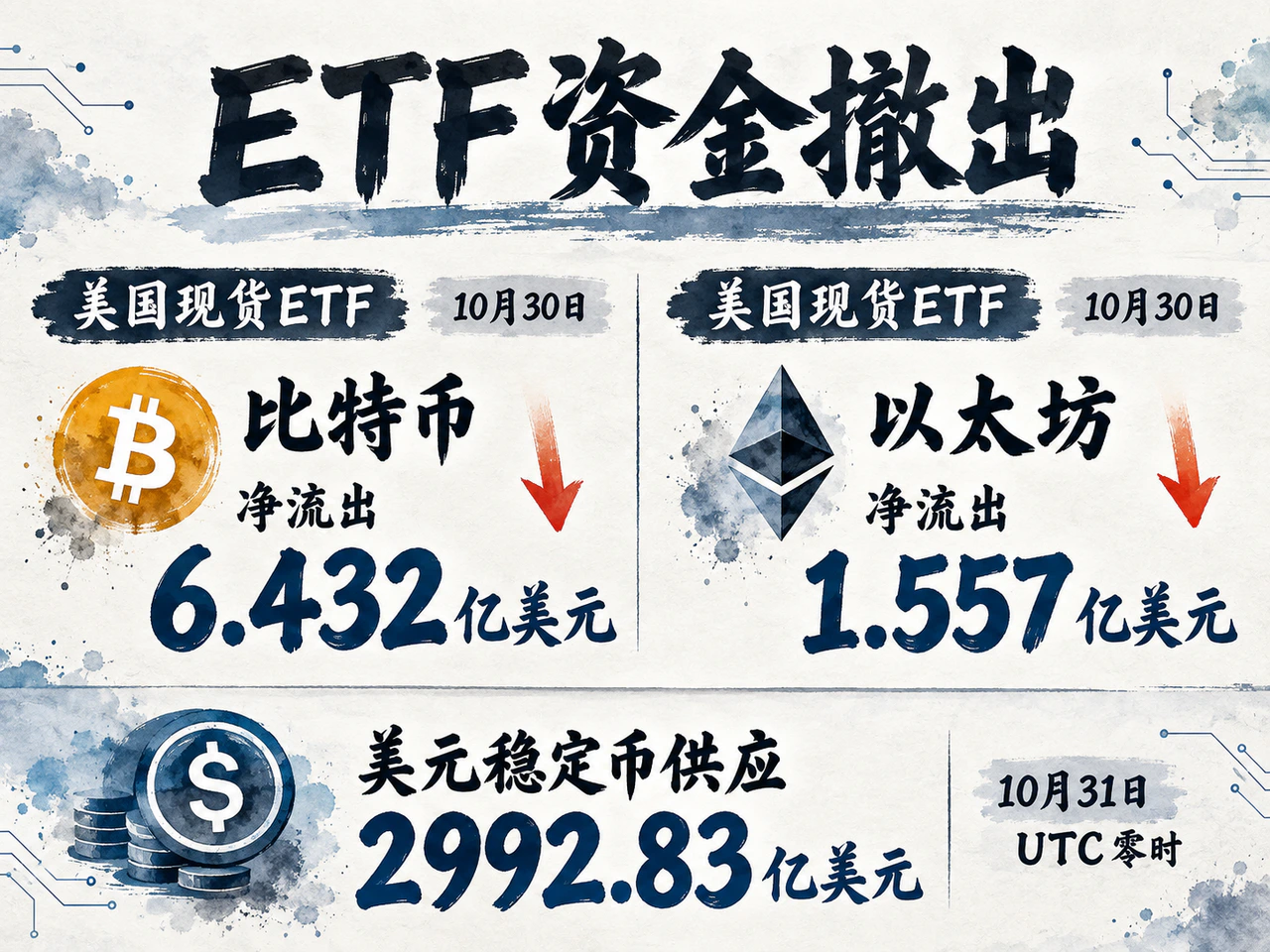
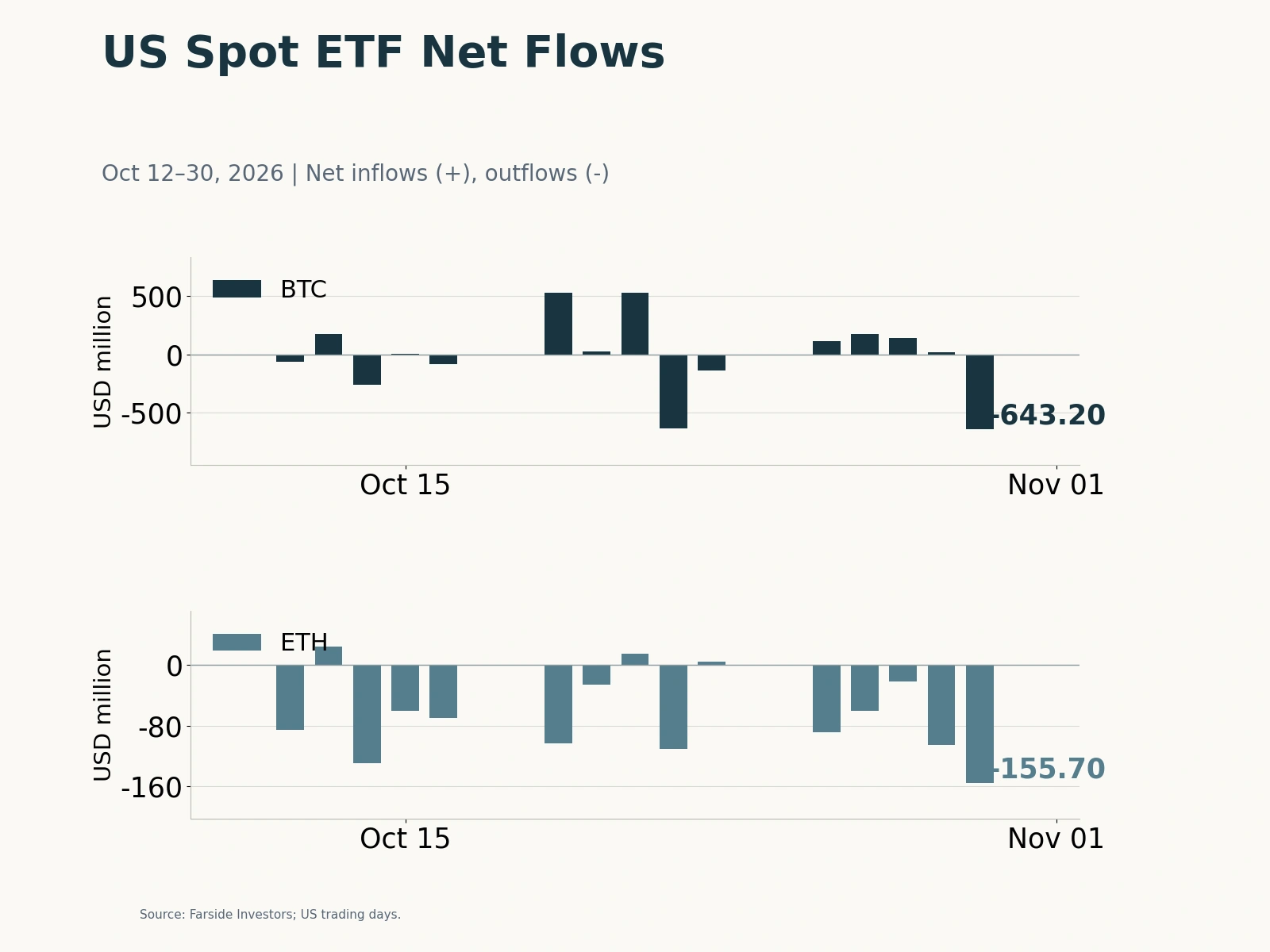
Farside data show Bitcoin ETF net inflows of $110.3 million, $176.0 million, $137.3 million and $17.2 million on October 26–29, respectively, totaling $440.8 million over four days. After $643.2 million of net outflows on October 30, the five trading days from October 26 to 30 swung to net outflows of $202.4 million. The preceding week, October 19–23, had still recorded $301.2 million of net inflows. Month-end redemptions erased the week's brief return of inflows and weakened spot funding support ahead of the weekend.
Redemptions were concentrated in large funds but were not isolated to one product. On October 30, IBIT, FBTC and ARKB recorded outflows of $233.7 million, $201.0 million and $129.5 million, respectively, while GBTC and BITB lost $53.3 million and $25.7 million. IBIT and FBTC together accounted for approximately 67.6% of that day's net outflows. Selling pressure extended across several products, and the preceding four days' inflows provided an insufficient buffer against month-end redemptions.
Withdrawals from Ether ETFs were more persistent. Net outflows reached $155.7 million on October 30, marking five consecutive trading days of outflows from October 26 to 30 totaling $431.4 million. The preceding week had already seen $220.7 million of net outflows. Unlike Bitcoin ETFs, where a brief return of inflows reversed, Ether ETFs experienced continuing withdrawals on a larger weekly scale. The two ETF groups together lost a net $798.9 million on October 30, both facing allocation pressure ahead of the weekend.
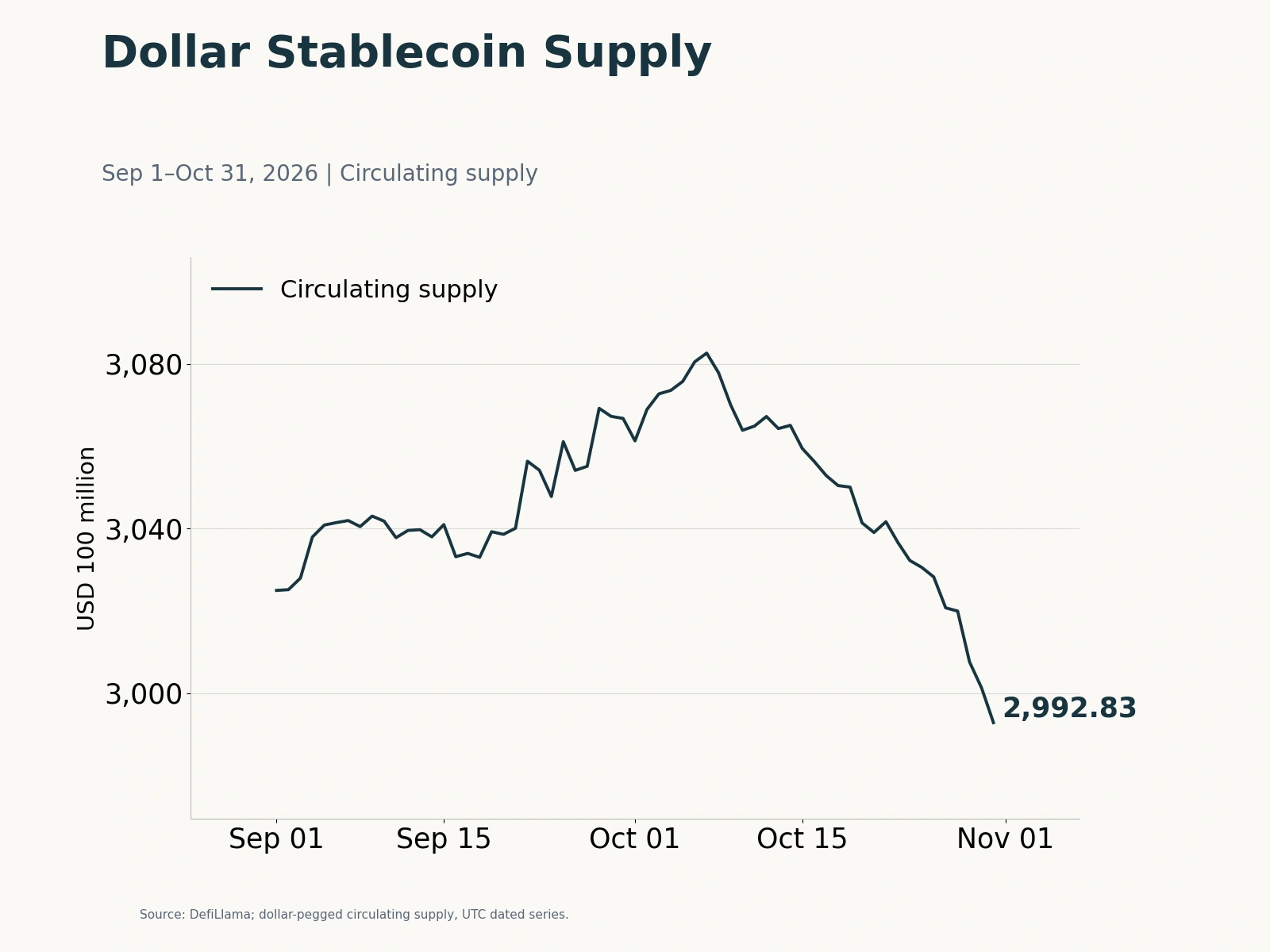
The stock of on-chain dollar funding was also shrinking. DefiLlama's circulating-supply series for dollar-pegged stablecoins recorded approximately $299.283 billion at 00:00 UTC on October 31, down $847 million from 00:00 on October 30, $3.939 billion from October 24 and $6.845 billion from October 1. This measure counts the circulating quantity of dollar-pegged stablecoins, differs from market capitalization that fluctuates with trading prices, and excludes stablecoins pegged to other fiat currencies.
ETF redemptions correspond to weaker allocation demand through securities accounts, while declining stablecoin supply means a contraction in the total stock of transferable on-chain dollar instruments. Stablecoins also serve settlement, payment and collateral functions, so supply changes cannot be equated directly with trading capital leaving the market and must be considered alongside actual uses. In terms of fresh purchasing power, however, the two channels are not currently expanding together, leaving relatively weak funding support for risk assets.
All three Ether funding settlements are negative; Bitcoin longs continue paying

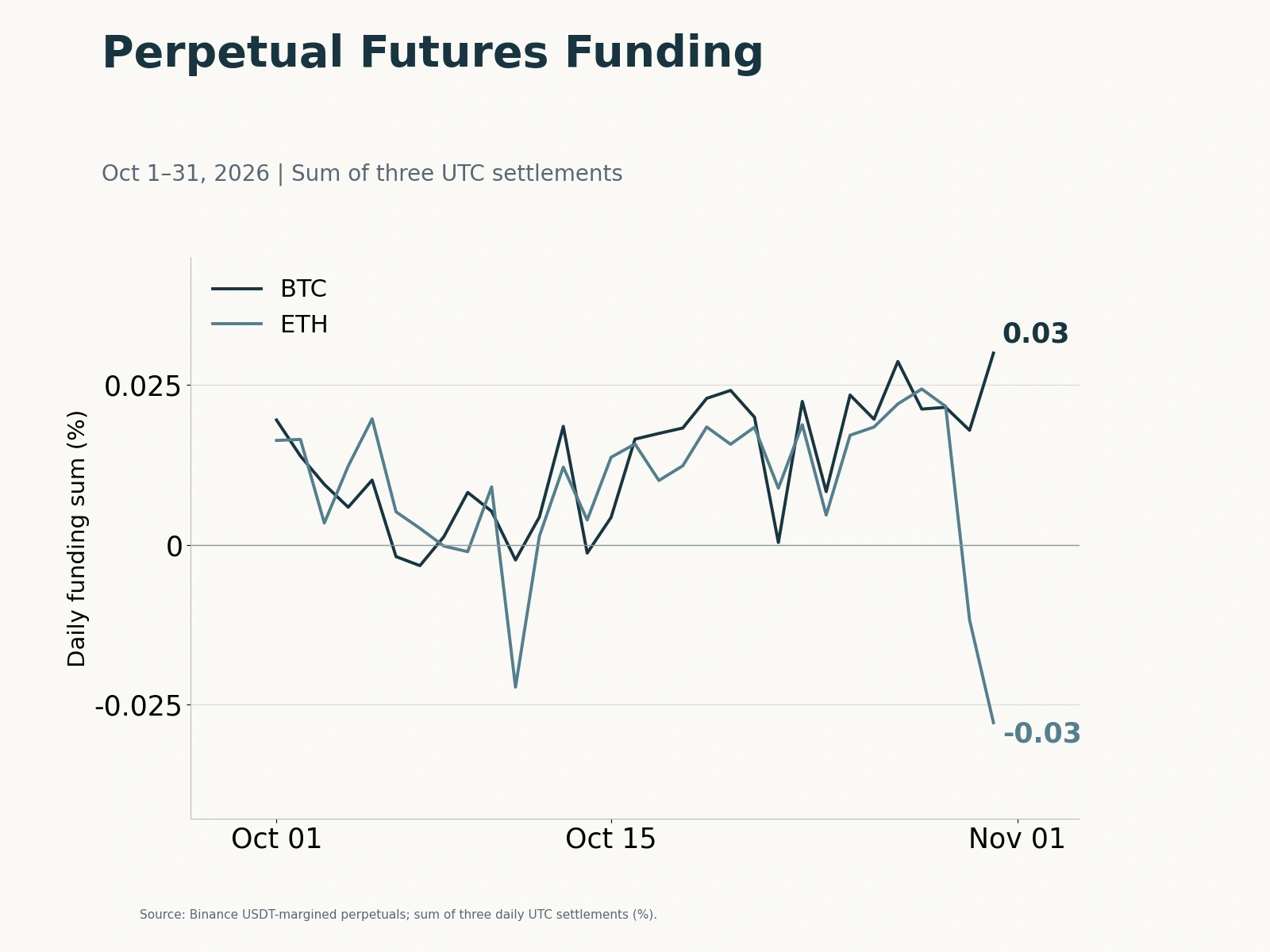
Actual settlement records for Binance's USDT-margined perpetual futures show Bitcoin funding rates of 0.01% per eight hours at 00:00, 08:00 and 16:00 UTC on October 31. Ether's corresponding rates were -0.013577%, -0.010637% and -0.003597%. A positive rate means longs pay shorts to hold positions, while a negative rate means shorts pay longs. The amount paid by Ether shorts narrowed with each settlement, but none of the day's three rates turned positive.
Ether's spot and leverage signals were more consistent: ETFs continued to suffer redemptions, and perpetual futures also reflected short-selling or hedging demand. Bitcoin differed: despite substantial ETF outflows, longs still paid funding in perpetual futures. Spot allocations and leveraged positions did not move in the same direction, and price stabilization alone is insufficient evidence that allocation demand has recovered.
Position quantities also indicate a build-up of leverage over the preceding 24 hours. Binance's daily records show that between 00:00 UTC on October 30 and 00:00 on October 31, Bitcoin open interest rose from 94,785.416 BTC to 96,319.846 BTC, while Ether open interest rose from 2,321,977.167 ETH to 2,336,914.726 ETH. Their respective notional values increased from approximately 7.391 billion to 7.447 billion USDT and from 5.231 billion to 5.243 billion USDT. These are daily snapshots of two contracts on a single exchange. They do not establish that longs alone added positions, and changes in dollar notional value alone are an inadequate gauge of market pressure.
The key weekend change was therefore in the structure of funding, rather than a synchronized turn across all markets: ETF allocations weakened and dollar stablecoin supply declined; in the perpetual contracts that continued trading, Bitcoin and Ether paid funding in opposite directions, while position quantities in both contracts increased. Renewed ETF net inflows, stabilization in stablecoin supply and further convergence of Ether's negative funding rates would make it easier for spot funding and derivatives demand to provide support again. Until then, the greater trading activity associated with rising positions may also amplify price moves in both directions.
Click through to the original article for full details.