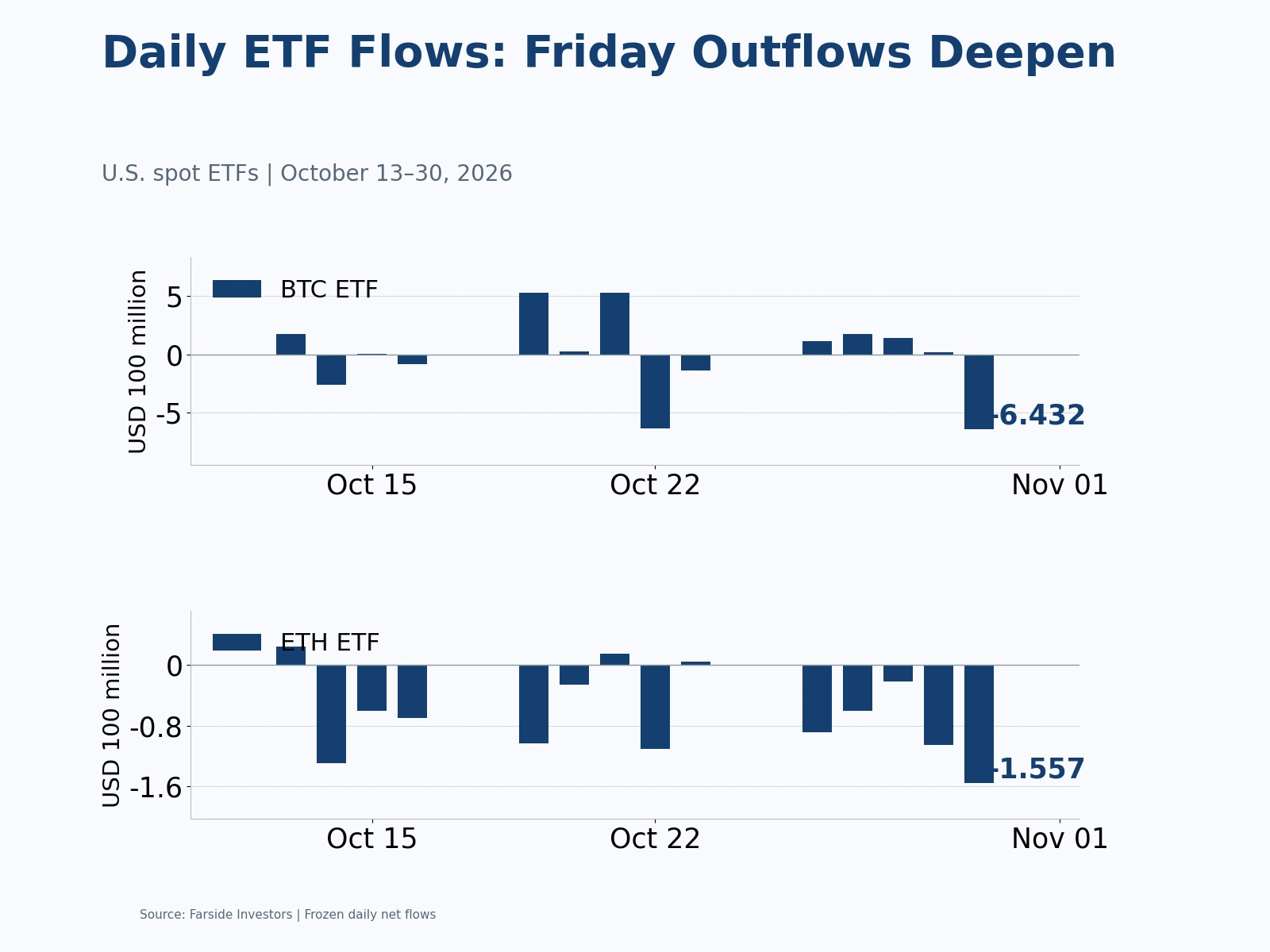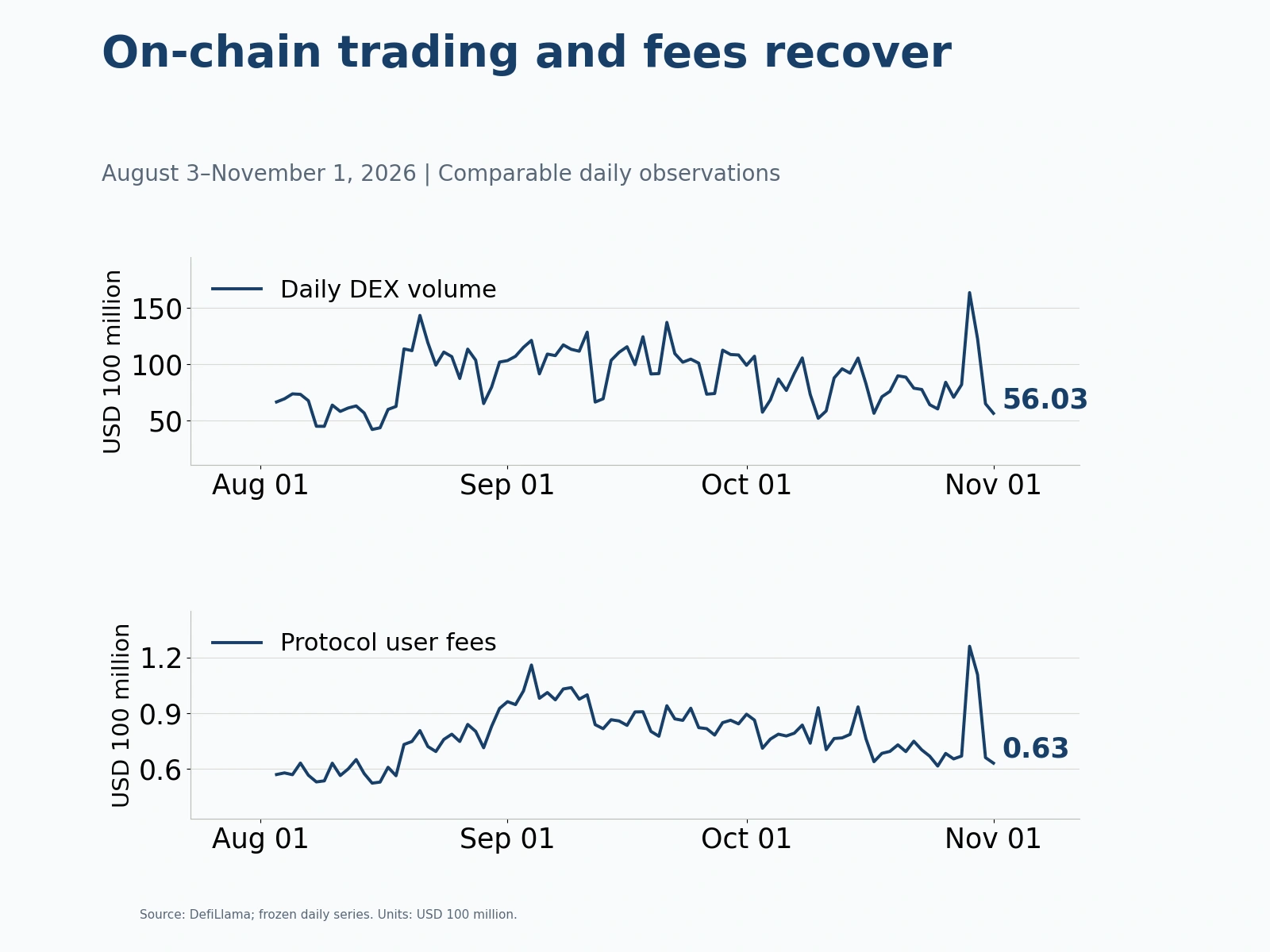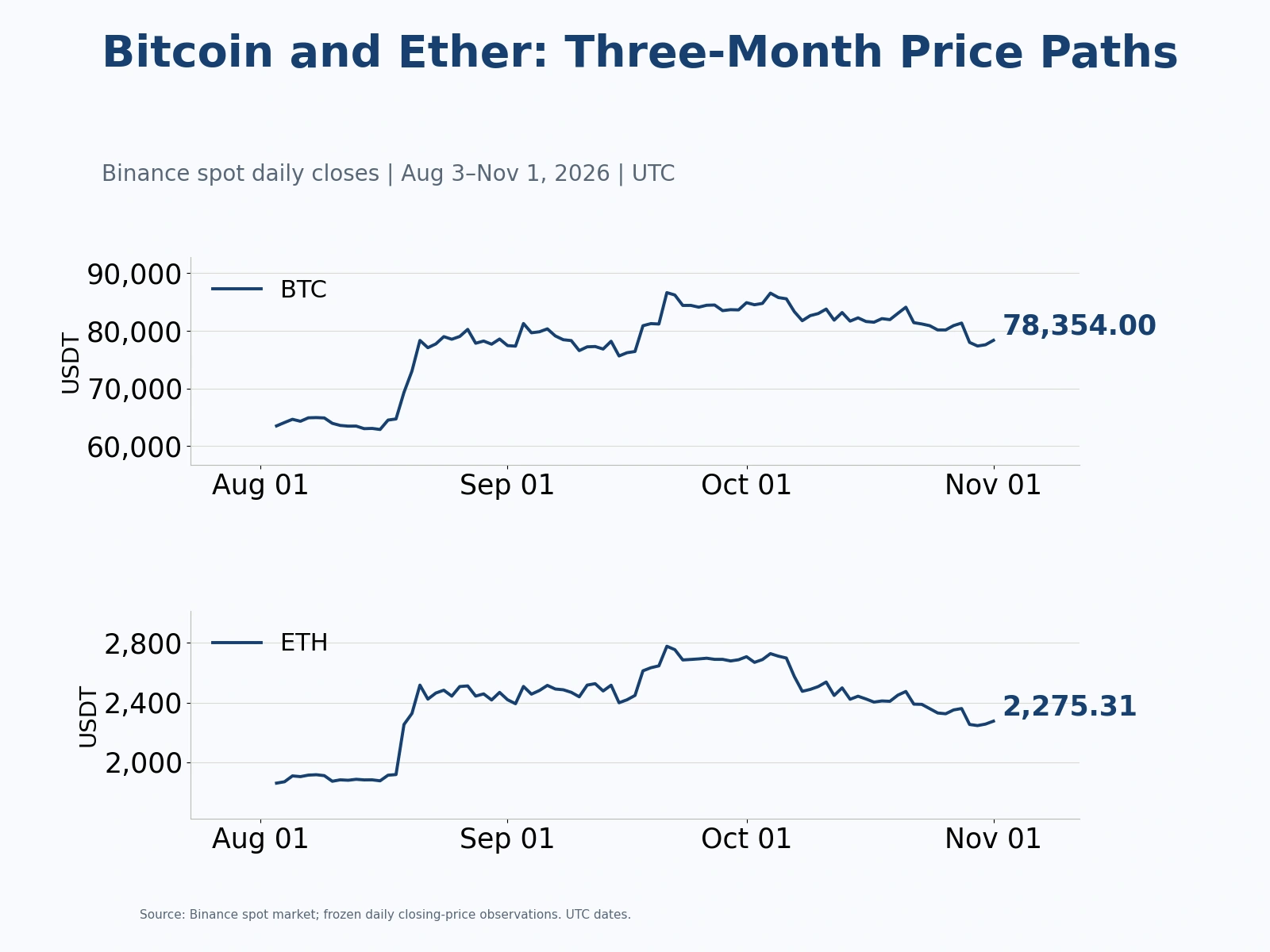
On October 30, 2026, Binance disclosed that a hot-wallet security incident had occurred at 20:05 UTC on October 29, with approximately $6.3 billion in token assets stolen, interrupting the gradual recovery earlier in the week. This review covers the seven complete UTC trading days from October 26 to November 1, using Binance spot prices quoted in USDT: Bitcoin closed at 78,354 USDT, down 2.25%, while Ether closed at 2,275.31 USDT, down 2.34%. Both rebounded over the weekend but failed to regain their pre-incident prices.
The market's focus broadened this week from interest rates and selling by long-term holders to exchange security, withdrawal capacity and progress in replenishing assets. The shift from a sharp sell-off to stabilization broadly coincided with the rollout of the exchange's response. Whether the recovery can continue depends on fund flows after withdrawals resume and on whether trading activity stabilizes.
Two days of heavy-volume declines from Thursday leave all eight major tokens lower for the week

Bitcoin closed broadly unchanged on Monday before advancing on Tuesday and Wednesday, ending Wednesday at 81,343.50 USDT. It fell 4.12% on Thursday and another 0.80% on Friday, when it touched the week's intraday low of 76,325.98 USDT. Ether followed a similar path: it closed Wednesday at 2,359.68 USDT, fell 4.52% on Thursday and reached a Friday low of 2,174.08 USDT. The steepest losses were concentrated in two days rather than spread evenly across the week.
The surge in trading was concentrated in the same period. Weekly turnover in Binance's BTC/USDT spot pair totaled 8.142 billion USDT, of which Thursday and Friday accounted for 3.789 billion, or approximately 47%. Weekly turnover in Binance's ETH/USDT spot pair was 3.668 billion USDT, with those two days contributing 1.981 billion, or approximately 54%. The combination of concentrated volume and falling prices indicates that the market priced in most of the shock over those two days. However, with the exchange itself affected by the security incident, trading volumes were also influenced by fund transfers and service availability. Trading activity after withdrawals resume will therefore warrant closer attention.
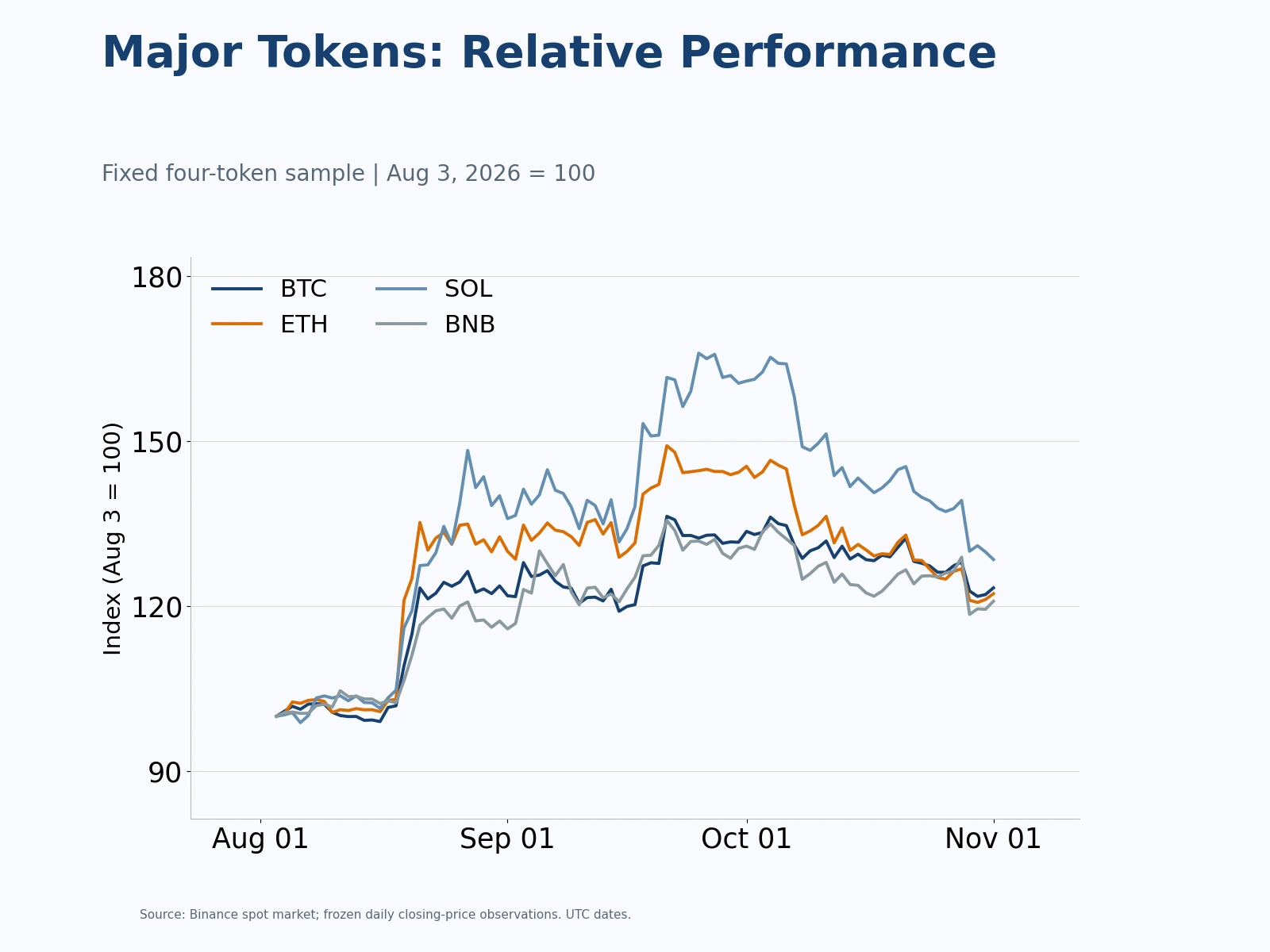
The broader fixed sample was also weak. On the same basis, alongside Bitcoin and Ether, SOL fell 6.78% for the week, ADA 5.44%, BNB 3.52%, XRP 3.51%, DOGE 1.83% and LINK 0.56%. All eight highly liquid assets in the sample, which excludes stablecoins and wrapped tokens, declined. BNB faced direct pressure from the incident, but SOL and ADA suffered larger weekly losses, indicating that the correction had spread beyond tokens directly associated with the exchange, with selling pressure extending to other major tokens.
Ether's performance relative to Bitcoin changed little over the week, with ETH/BTC slipping from approximately 0.02907 at the previous weekend to 0.02904. The differences are clearer over the 30 days through November 1: Bitcoin fell 7.29%, Ether 14.74% and SOL 20.33%. The simultaneous weekend rebound came against a backdrop of weakness that had already persisted for some time. Similar short-term losses did not erase the divergence accumulated earlier.
Macroeconomic conditions offered little obvious support for a recovery. On October 28, the Federal Reserve left its federal funds rate target range at 3.75%–4%, with two members favoring a 25-basis-point increase, while its statement continued to emphasize elevated inflation. For crypto assets without fixed cash flows, still-high cash yields raise the opportunity cost of holding them, while financing costs restrain demand for leverage. Crypto prices still rose on Wednesday, so the subsequent sharp decline cannot simply be attributed to the rate decision. The more direct new shock in the latter part of the week came from the exchange security incident.
Binance sets aside more than $6.34 billion and resumes phased withdrawals on November 1

In its October 30 update, Binance said it would absorb the loss and had set aside more than $6.34 billion in corporate funds. Of that amount, $5 billion was already held in the affected tokens, with the remainder being purchased through market and over-the-counter channels. The exchange also suspended withdrawals, intensified infrastructure checks and said approximately $3 billion in assets had been frozen on-chain. Absorbing losses, provisioning tokens for withdrawals and freezing assets on-chain are distinct steps, affecting expectations of repayment, the execution of withdrawals and subsequent recovery efforts, respectively.
Market views differed in the immediate aftermath. Analysts at Zeus Research interviewed by The Block argued that the security incident intensified broad selling, with liquidations of leveraged long positions amplifying the pressure. Laevitas's head of markets, by contrast, considered the market reaction limited relative to the scale of the incident, with the exchange's asset base and rapid freezes by stablecoin issuers providing a buffer. Both views describe the same transmission chain: the incident first prompts investors to cut exposure, but whether the exchange can absorb the loss and users can recover their assets determines whether the shock continues to spread.
On November 1, Reuters reported that Binance had resumed phased withdrawals and said it had replenished 95% of the stolen assets. According to the exchange's disclosures, net customer outflows had reached $3.64 billion by 15:30 UTC; Binance said the initial surge in withdrawals was stabilizing. Once service resumes, users can actually choose whether to stay or leave. Subsequent changes in withdrawals and deposits will say more about whether funds are returning than the exchange's statements alone.
Bitcoin rose 0.28% on Saturday and 1.00% on Sunday, while Ether gained 0.45% and 0.87%, respectively. Prices moved off their lows, indicating that the most immediate risks had eased somewhat, but Bitcoin's weekend close remained approximately 3.68% below Wednesday's close. For now, the more measured assessment is a partial recovery from the shock, whose durability depends on the simultaneous stabilization of assets available to meet withdrawals, withdrawal operations and market trading activity.
In an October 26 report, Galaxy head of research Alex Thorn argued that selling pressure from long-term holders had declined and highlighted the significance of Bitcoin reclaiming its 50-week moving average. He also set a condition: if the weekly close fell below the 50-week moving average of $76,540 cited in the report and failed to reclaim it within a month, the bullish assessment would be challenged. That condition places the current rebound in a longer-term context. In the near term, the market still needs to establish whether, once exchange risks ease, the rebound can broaden beyond Bitcoin and Ether to other major tokens and reverse their relative weakness over the preceding month.
Click “Read the original” for further details.