On October 28, the Depository Trust Company (DTC), a DTCC subsidiary, launched its tokenization service, with 20 participating institutions having signed agreements to connect. Hong Kong's opening of secondary trading in tokenized money market funds this week and BNY's expansion of digital asset custody point in the same direction: financial institutions are filling in the infrastructure for asset transfers, safekeeping and liquidity management after issuance.
The commercial value of tokenization lies not only in turning assets into on-chain tokens, but also in whether those assets can be reliably held in custody after issuance, transferred when needed, and integrated into collateral and payment processes. This week's developments address different parts of that chain, while each retains its own eligibility and approval requirements.
Hong Kong opens round-the-clock secondary trading in tokenized funds; DTC enables tokenization of securities entitlements
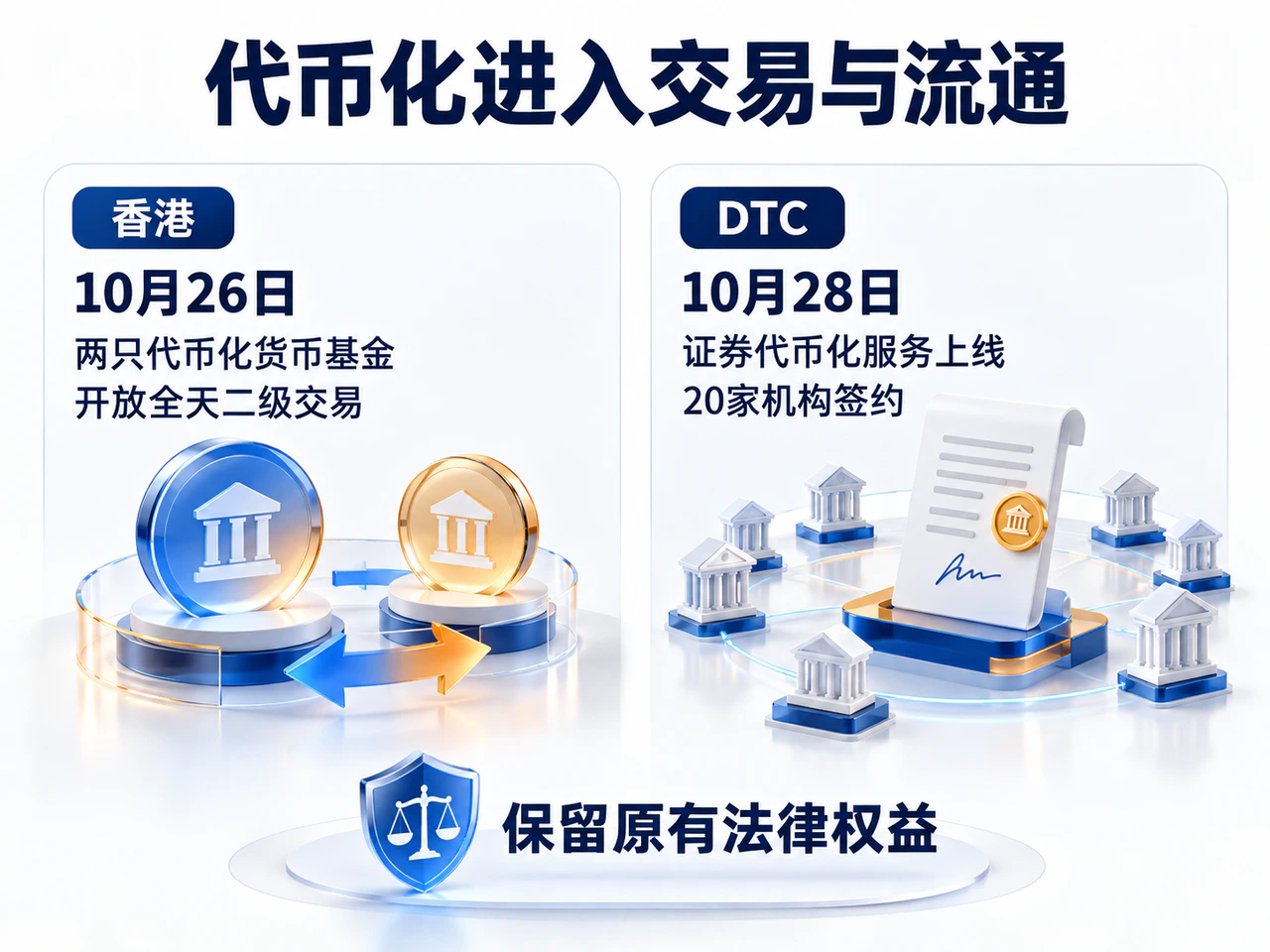
On October 26, Hong Kong's Securities and Futures Commission (SFC) announced that the first two existing SFC-authorized tokenized money market funds had begun offering round-the-clock secondary trading on licensed virtual asset trading platforms: the ChinaAMC HKD Digital Money Market Fund and the ChinaAMC USD Digital Money Market Fund. The regulatory framework was proposed in April this year and moved into live trading this week.
Round-the-clock trading extends the hours during which investors can transfer their fund interests. Subscriptions and redemptions in the underlying funds continue to follow the product terms, while the secondary market provides a way to adjust cash allocations outside normal trading hours. Whether this model can operate reliably depends on prices staying close to net asset value and on sustained market-making liquidity. The SFC framework already addresses fair pricing, liquidity arrangements and disclosure; any subsequent expansion in the range of products will depend on operating experience.
In the United States, the change is taking place in depository infrastructure. According to DTCC's announcement, the tokenization service allows eligible users to convert entitlements to securities held at DTC into tokenized form and move between traditional and tokenized forms, while preserving existing ownership, investor protections and economic rights. The service currently connects to the Canton Network and DTCC's private Besu network, with expansion to other networks planned for 2027.
DTC holds more than $114 trillion in assets in custody, providing a vast existing asset base for the service. Actual business progress should be assessed through the conversion and use of eligible assets, as well as transactions by participating institutions. The first 20 institutions to sign agreements include banks, brokers and clearing service providers, indicating that adoption is proceeding along the existing securities services chain. If tokenized entitlements can be incorporated into collateral management processes, they could shorten the operational time needed to move assets from a custody account into usable collateral. Whether this improves capital efficiency will still depend on actual usage.
Hong Kong is focusing on fund trading hours, while the United States is focusing on the movement of existing securities entitlements across digital networks. Together, these developments are shifting the competitive focus of tokenization toward assets' usability after trading. Preserving legal rights, asset records and operational responsibilities creates the conditions for new network connections to become part of institutions' everyday business.
BNY expands custody to XRP and RLUSD; direct client minting and redemption still await approval
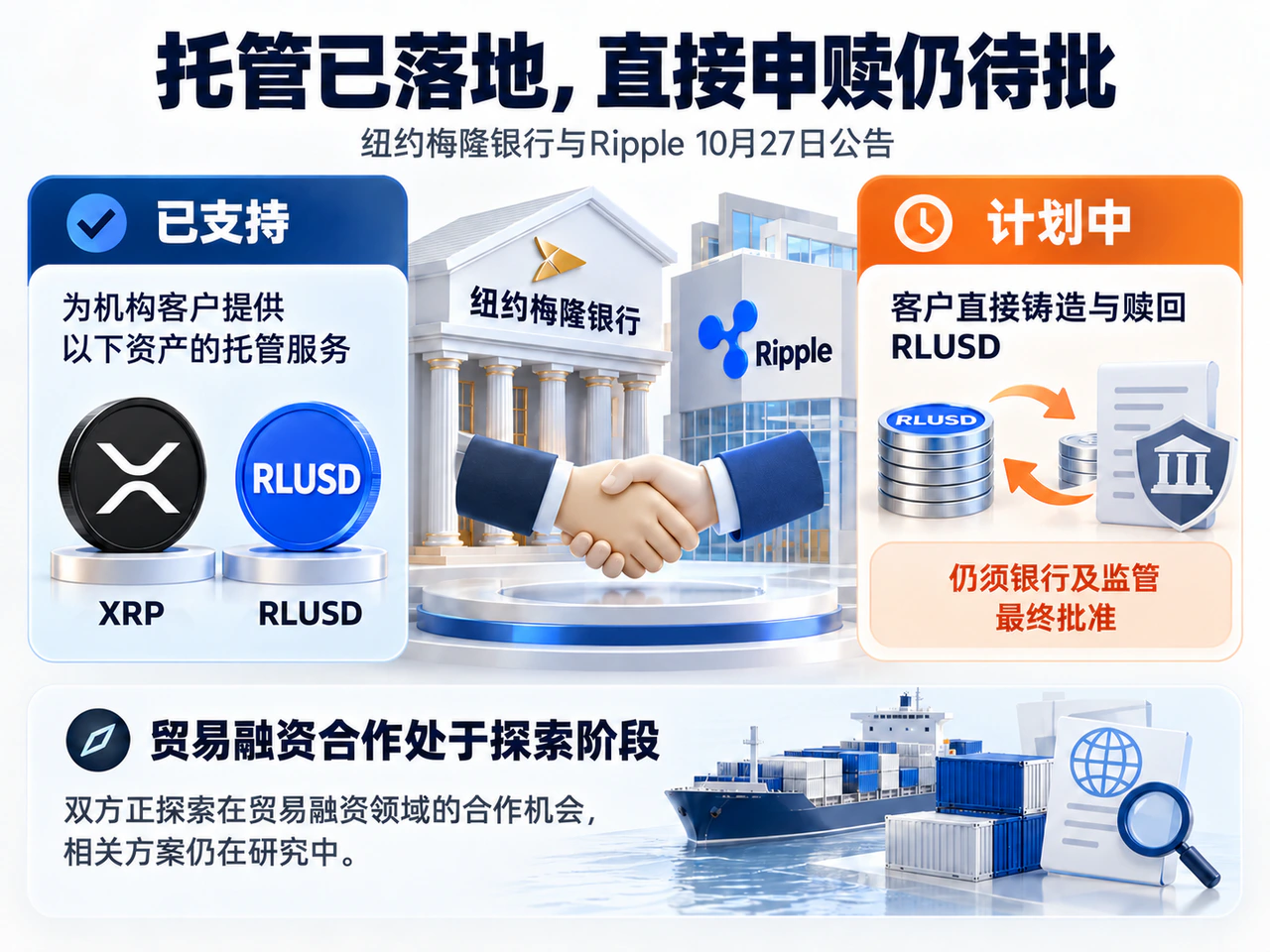
On October 27, BNY and Ripple announced an expansion of their partnership. The bank's digital asset custody platform now supports XRP and the US dollar stablecoin RLUSD, allowing eligible institutional clients to custody, hold and transfer these assets. BNY was already the primary custodian of RLUSD reserves. The expansion extends its role to the tokens held by clients themselves, connecting reserve management with digital asset safekeeping.
The partnership announcement also set out the next steps: supporting tokenized investment products on the XRP Ledger, enabling clients to mint and redeem RLUSD directly through the bank, and exploring supply chain financing arrangements with C2FO. The first two planned offerings still require final bank and regulatory approval. Trade finance remains exploratory, with the scope of implementation dependent on client demand.
These steps address different business needs. Custody addresses how institutions can hold assets safely; direct minting and redemption affect the efficiency of conversion between cash and tokens; supply chain finance seeks to broaden the investor base for financing assets. Connecting the three requires product compliance, client onboarding and operational processes to be put in place together. For now, the clearest advance is the expansion of custody capabilities. Further value should be assessed by tracking product launches, client usage and the implementation of financing arrangements.
This week's policy and institutional developments show tokenization moving from innovation in product form toward a complete process spanning issuance, trading, custody, collateral and payments. The next questions are whether round-the-clock trading can generate stable liquidity, whether securities entitlements can be used consistently for settlement and collateral, and whether banking channels can turn custody relationships into actual demand for payments and financing. The launch of infrastructure creates the conditions for these changes; commercial results will depend on subsequent transaction and usage data.
Click ‘Read the original’ for more details.