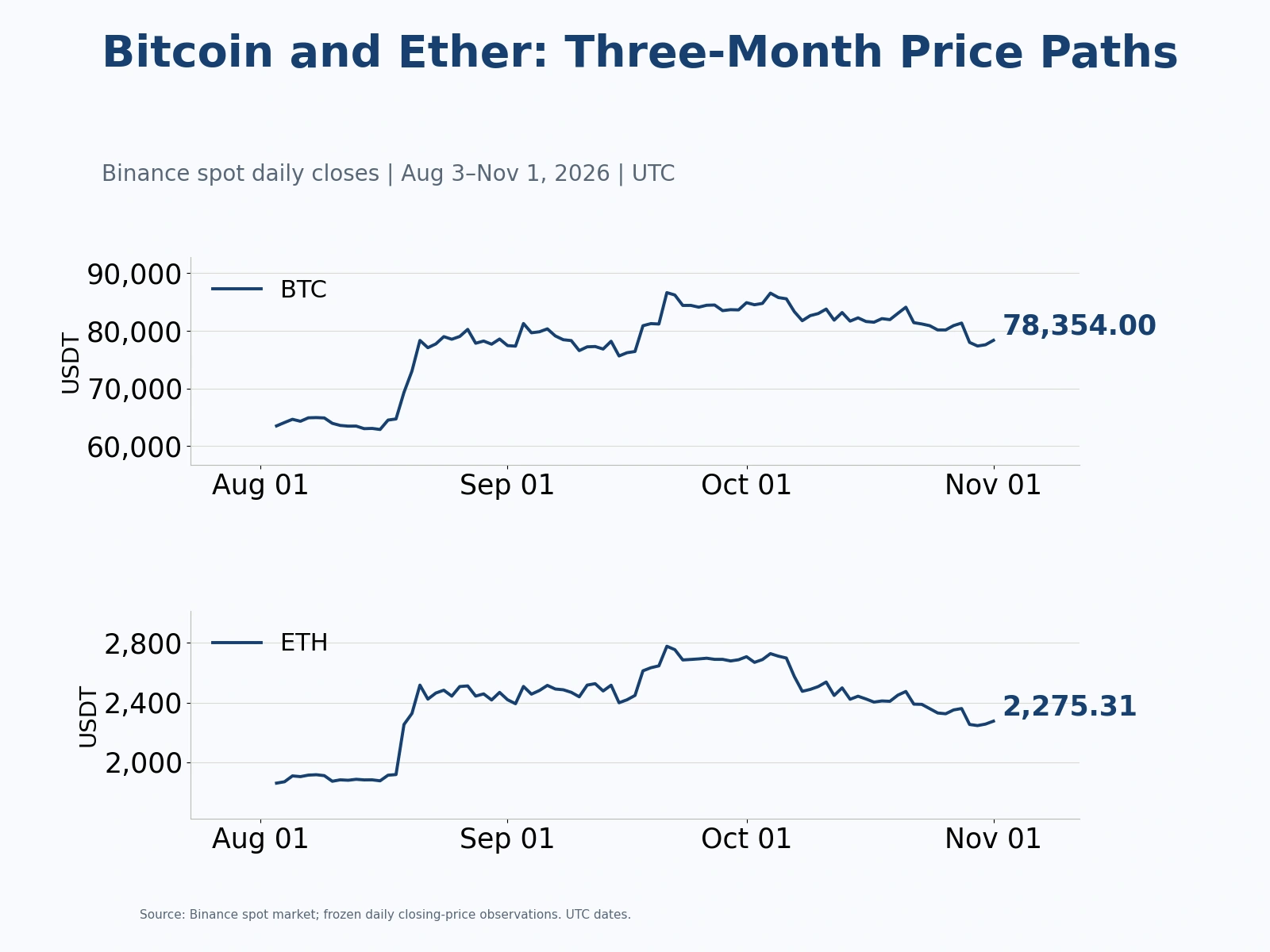
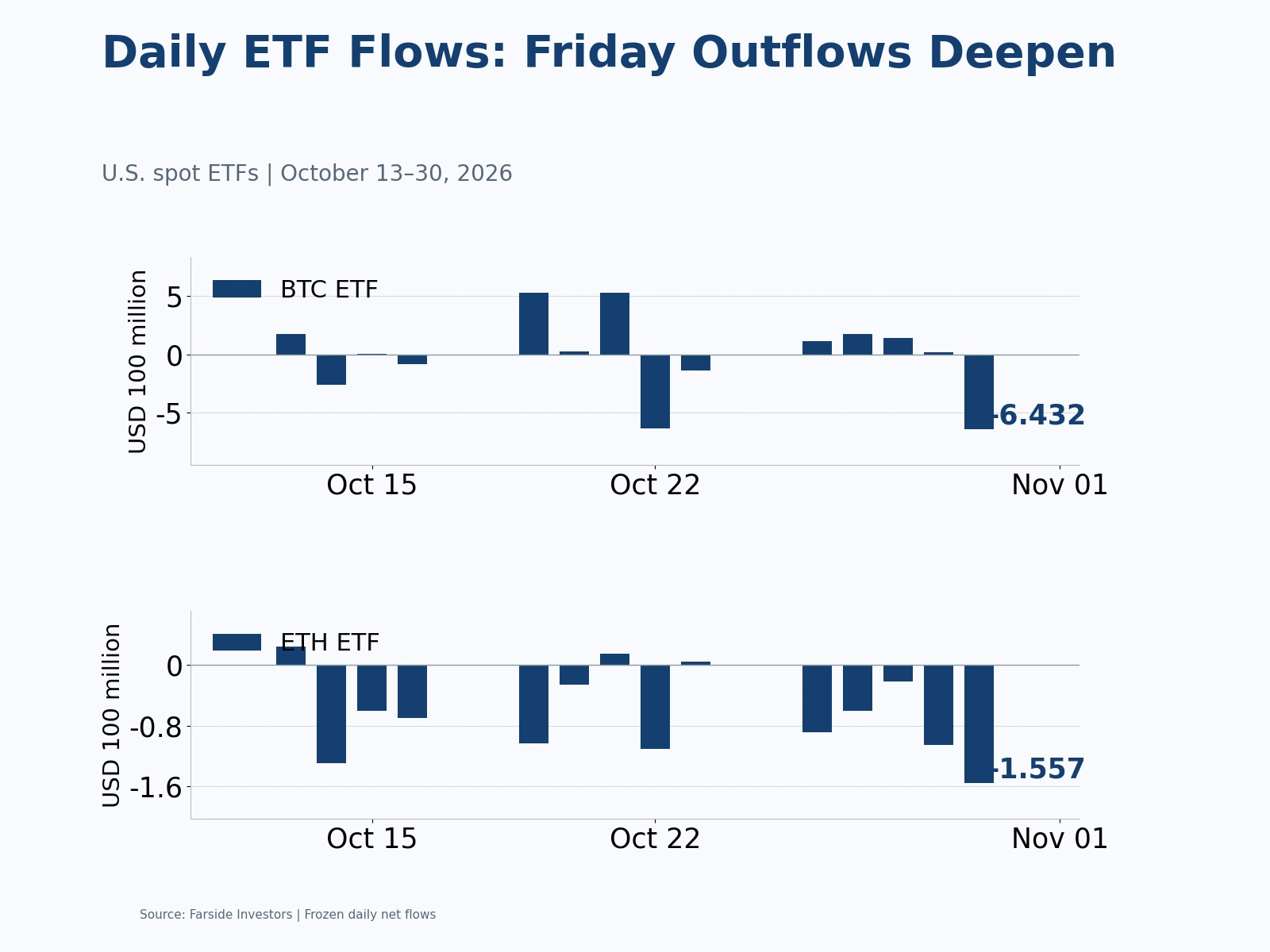
On October 29, 2026, Chainlink launched an around-the-clock asset-pricing service covering weekends and holidays, with Aave as its launch partner. Assets can circulate at any time, but collateralized financing still depends on usable prices, liquidation routes and capital willing to take the other side; this service addresses the pricing component. Comparable data through November 1 show a recovery in DEX trading and user fees this period, a further decline in industry-wide TVL, commercial applications of stablecoin payments, and a continuing gap between the outstanding stock of real-world assets (RWAs) and their use as collateral.
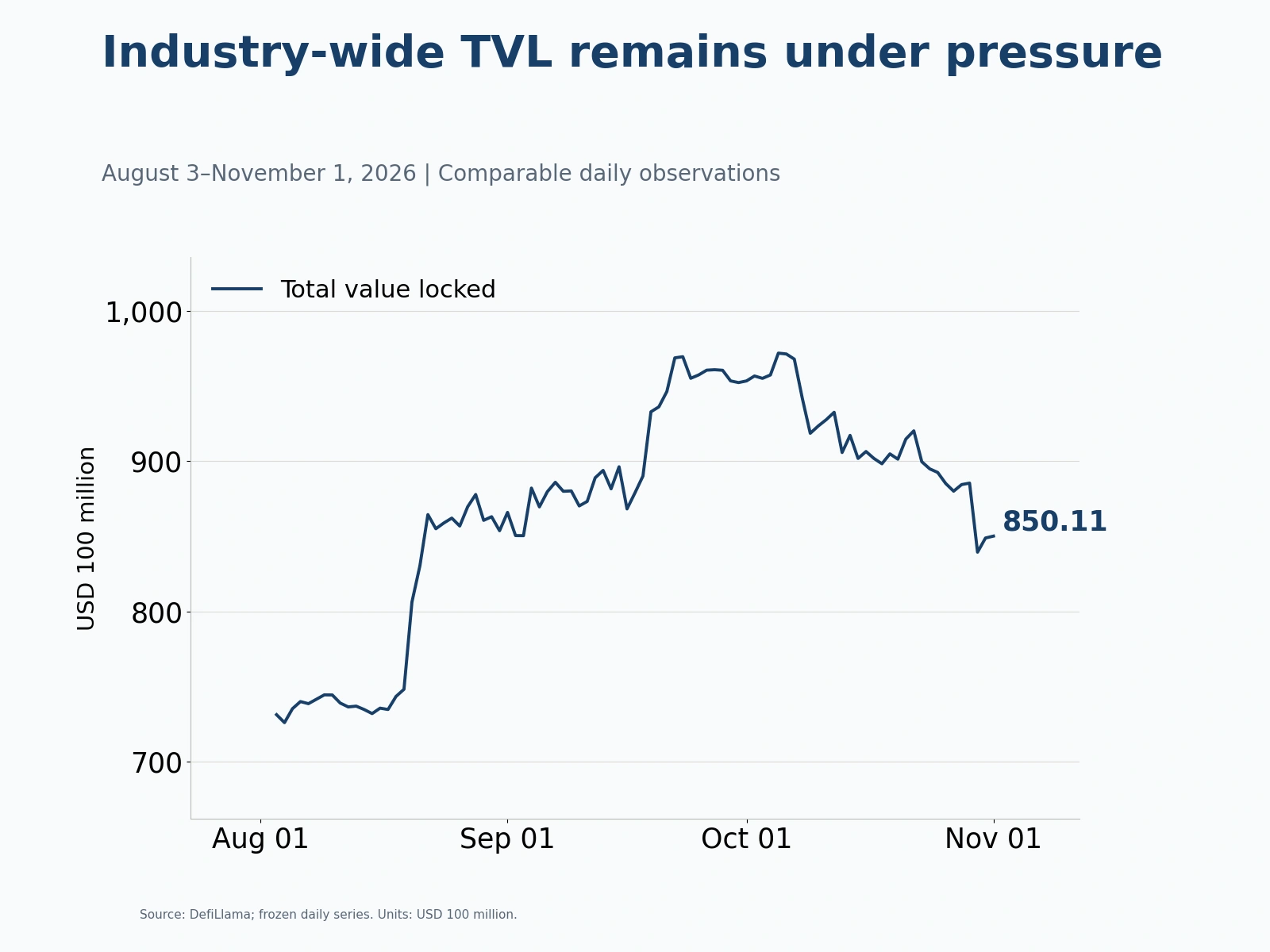
Weekly DEX volume rises 20.6%; industry-wide TVL falls to $85.011 billion
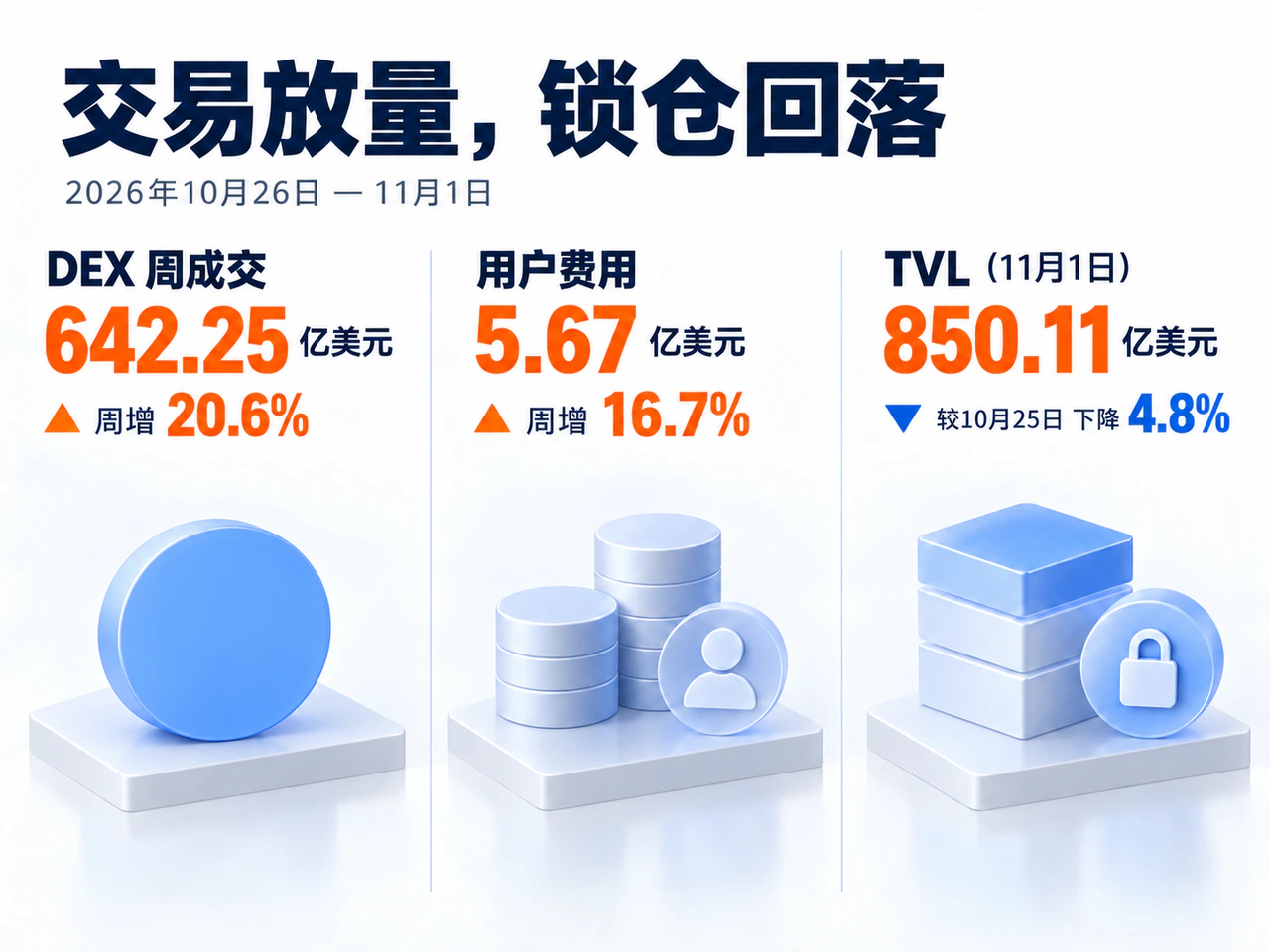
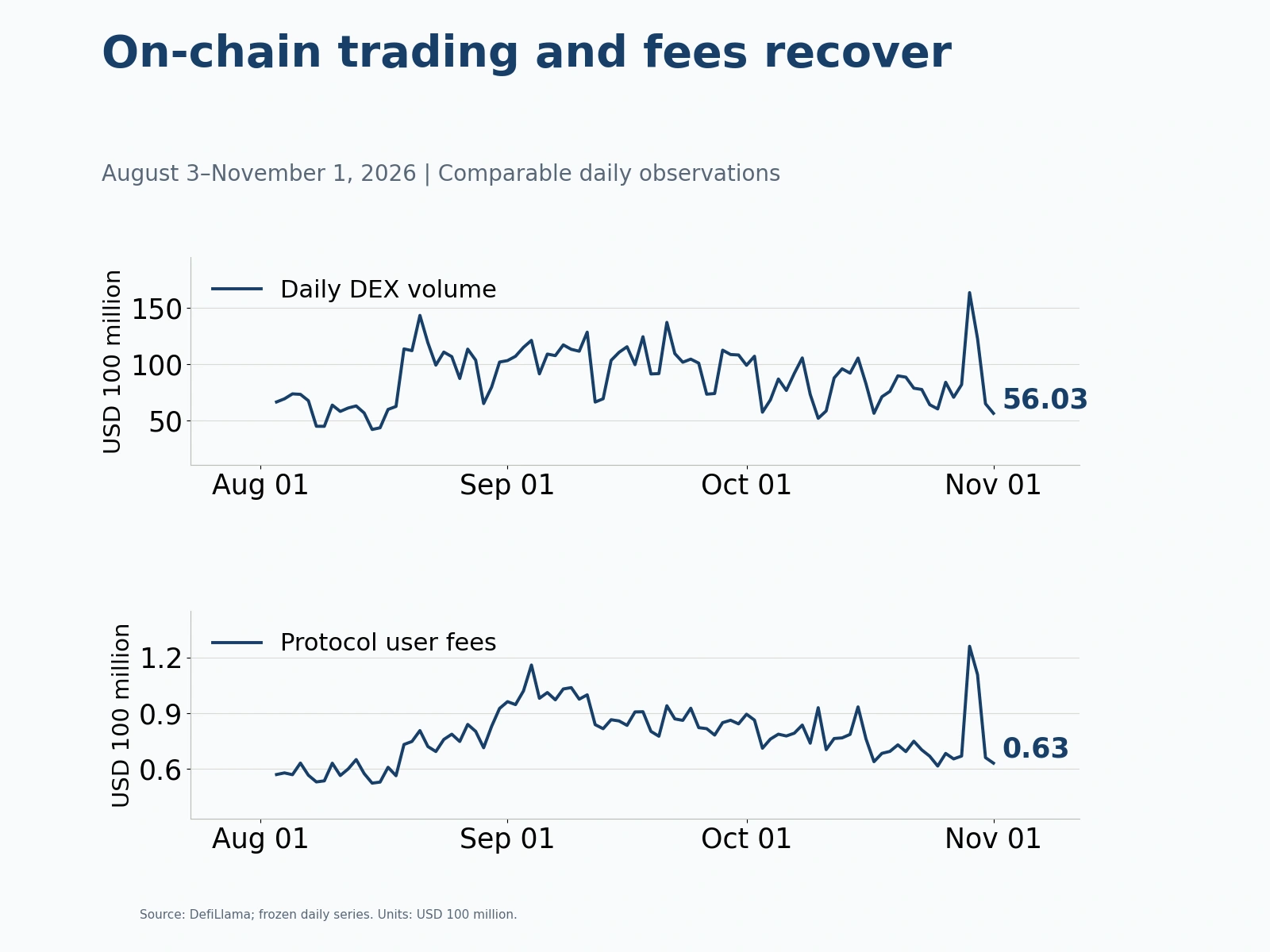
Summing DefiLlama's comparable daily series, decentralized exchange (DEX) volume totaled approximately $64.225 billion this period, up 20.6% from the preceding week; user fees across the covered protocols totaled about $567 million, up 16.7%. The simultaneous increase points to more trading and usage. User fees, however, are not the same as protocol revenue: they include amounts paid to liquidity providers and other participants. Only the portion retained under each protocol's allocation rules accrues to the protocol, while returns available to token holders also depend on governance arrangements.
The pickup in activity has yet to translate into a larger pool of locked assets. On November 1, industry-wide dollar-denominated total value locked (TVL) stood at approximately $85.011 billion, down 4.8% from October 25. TVL measures the valuation of assets locked in protocols. Both falling prices and deposits or withdrawals can change the reading, so it cannot be treated directly as a measure of net capital outflows.
Networks also diverged. Ethereum's TVL was approximately $43.887 billion, down 10.4% for the week; Solana's was about $5.431 billion, down 5.7%; and BSC's was roughly $5.239 billion, down 9.1%. The two major layer-2 (L2) networks sampled posted smaller declines: Base stood at about $5.967 billion, down 1.8%, and Arbitrum at approximately $1.439 billion, down 1.1%. Valuation and capital adjustments varied by network; determining whether capital has migrated still requires cross-chain net-flow and asset-quantity data.
Over a longer horizon, industry-wide TVL was down 11.2% from 30 days earlier but remained 16.3% above its level 90 days earlier. Over those respective 30-day and 90-day periods, Base was down 6.1% and up 31.0%, while Arbitrum was up 1.1% and 16.5%. This looks more like a structural adjustment following an earlier expansion; it does not establish that all networks are at the same stage of the cycle.
The improvement in trading is clearer. Average daily DEX volume this period was approximately $9.175 billion, above the 30-day average of $8.106 billion and the 90-day average of $8.877 billion. Average daily user fees were approximately $80.98 million, also above both the 30-day and 90-day averages. Trading activity and the accumulation of assets in protocols are diverging: higher turnover can create more opportunities to collect fees, but sustainable operations still depend on whether trading leaves behind stable liquidity and recurring demand.
Visa's stablecoin settlement exceeds a $25 billion annualized run rate
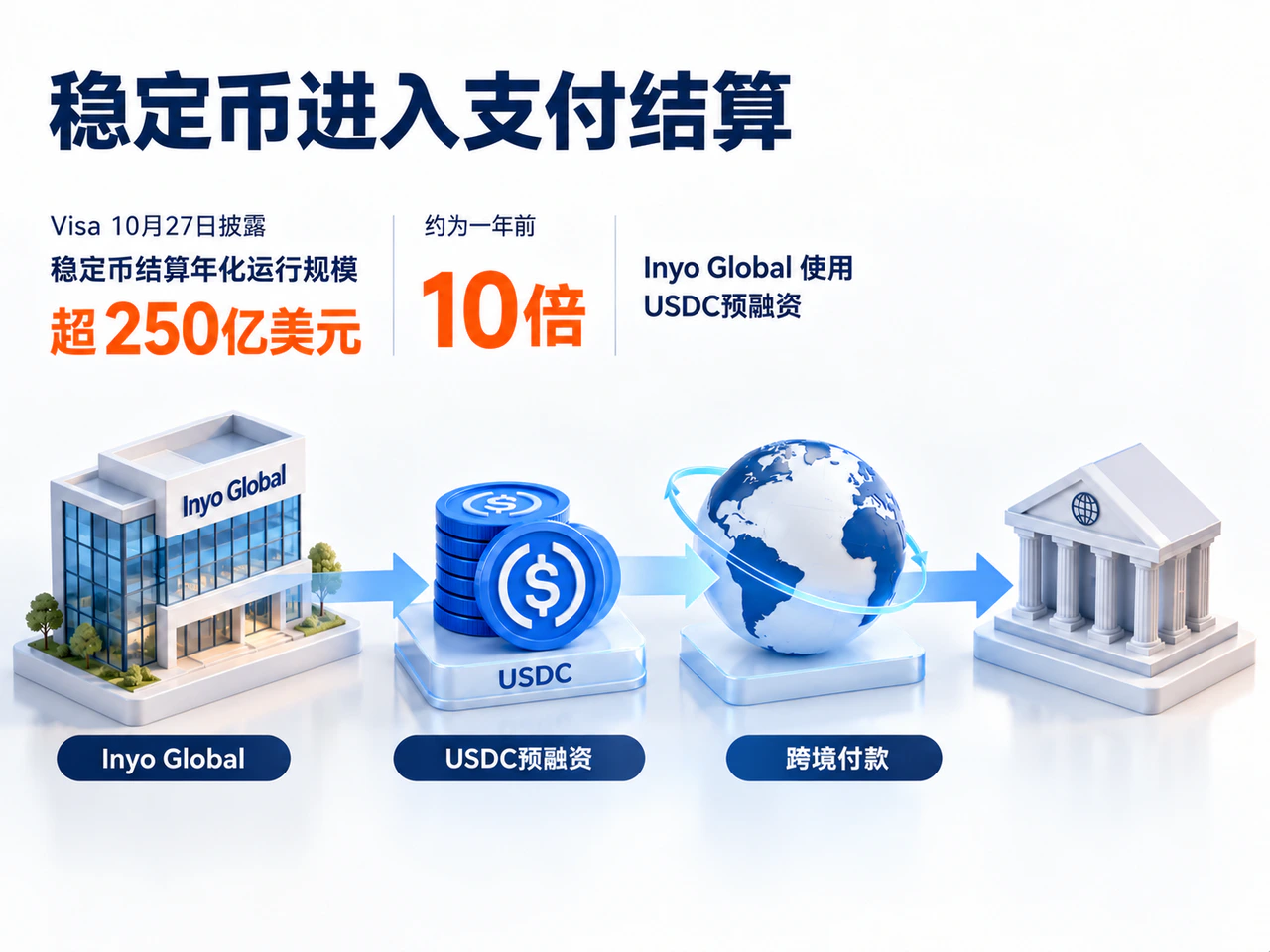
Stablecoin payments offer a more concrete use case. According to BeInCrypto's report on Visa's October 27 earnings call, Visa's stablecoin settlement had exceeded an annualized run rate of $25 billion, roughly ten times its level a year earlier. This annualized figure extrapolates the recent pace of settlement; it is not the amount actually accumulated over the past year. Settlement takes place between issuing and acquiring institutions and is not equivalent to total consumer card spending.
Commercial implementation has also progressed. On October 15, Visa announced that Inyo Global had put its stablecoin prefunding capability into commercial operation, allowing eligible customers to prefund cross-border payments with USDC. Here, on-chain funds are used to shorten funding delays and improve flexibility in moving money. The fees charged by payment providers, stablecoin issuers and underlying networks determine how value is shared; settlement volumes cannot be used directly to infer returns on public-blockchain tokens.
RWA collateral use remains low; Chainlink addresses pricing during market closures
RWAs face another constraint. Using October 16 data, RedStone's October research estimated that approximately 0.1% of the roughly $3.56 billion in distributed RWAs on Stellar was being used as lending collateral. Among the 19 major tokenized fund products on Ethereum covered by the research, approximately 2.5% of their value was used as lending collateral. Although the two samples differ in scope, both reveal a substantial gap between outstanding issuance and use in financing. Restrictions on token-holder eligibility, freezing and recovery powers, and whether assets can be sold on-chain all affect how much capital lenders are willing to provide.
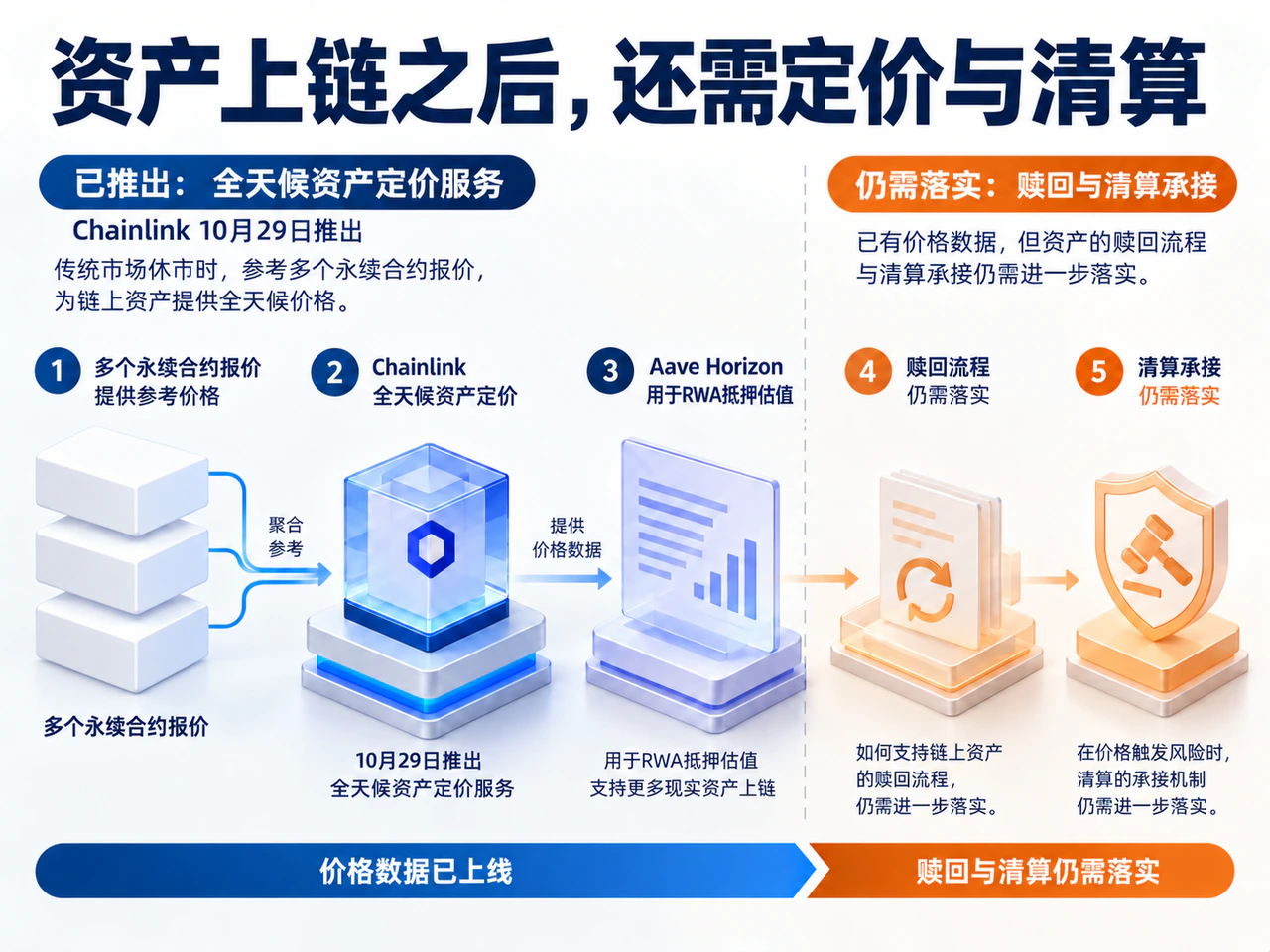
Chainlink's service this week targets the pricing component. According to its announcement, once traditional markets close, the price reference shifts to quotes from multiple perpetual-contract venues. Aave uses the data in Horizon to value tokenized RWA collateral. Prices can continue to change during market closures, but the liquidity comes from derivatives markets, and lending protocols need to set collateral ratios and liquidation parameters accordingly. Continuous quotes provide continuity in valuation; redemption channels and the capacity to absorb liquidations still need to be established separately.
This period's developments in the on-chain economy came mainly from higher trading volumes, the commercialization of payments and progress in supporting infrastructure for RWAs. Three questions warrant attention next: whether higher volume can become recurring revenue, whether payment services can generate reliable repeat usage, and how much newly tokenized value actually enters lending and trading. Bringing assets on-chain will translate further into financial-service capacity only when capital can be used repeatedly and risks can be resolved.
Click “Read original” for the full details.