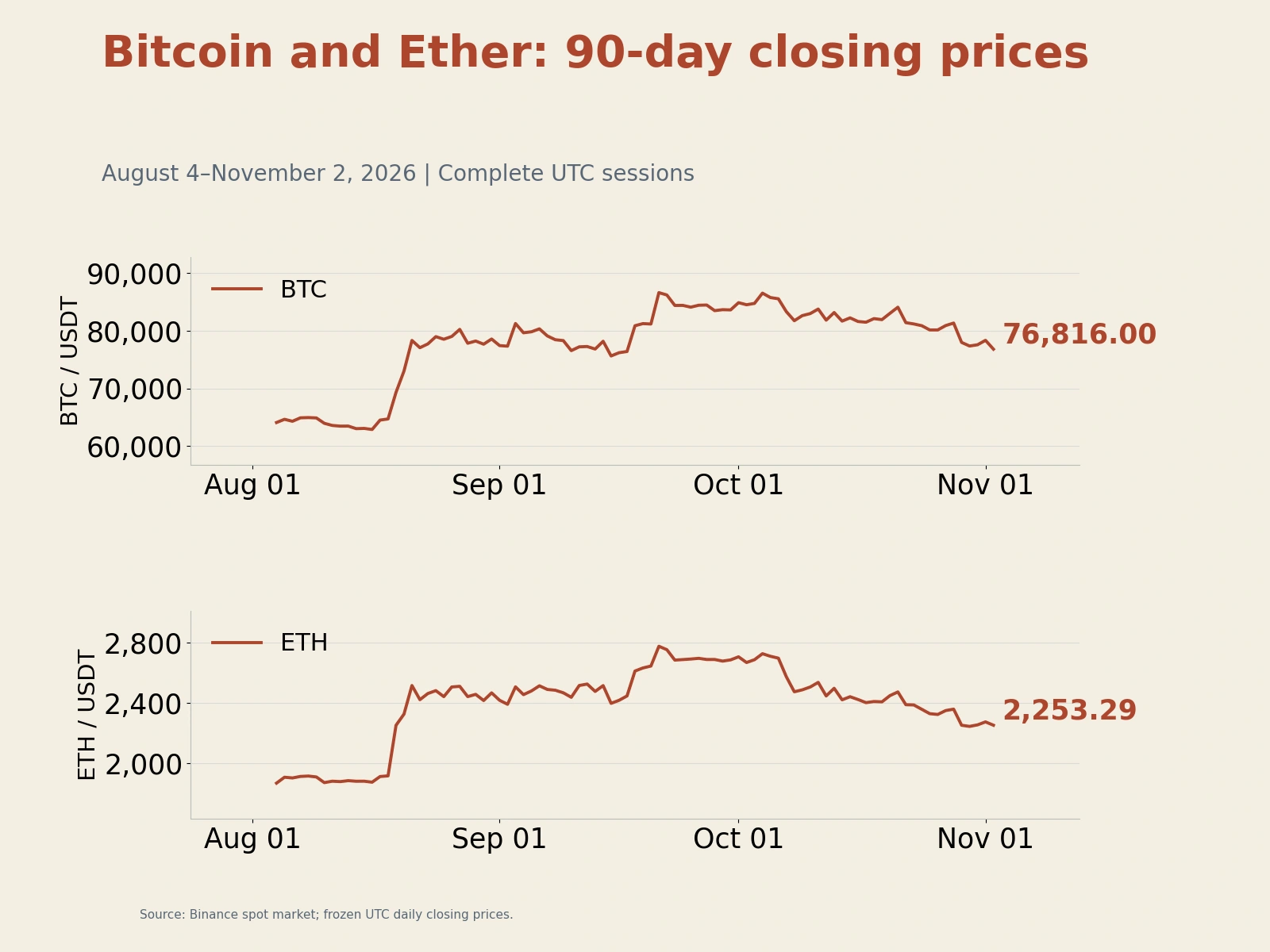
On November 2, 2026, Reuters reported that Binance said customers had withdrawn a cumulative net $4.72 billion since withdrawals resumed, mainly in USDT. Binance also said it had received $2.7 billion in customer inflows since Sunday, and that withdrawals were stabilizing after the initial rush. Net outflows represent withdrawals offset by deposits, so money was still moving in both directions; Binance said the $4.72 billion was equivalent to about 3% of the platform's assets.
Following the security incident, customers reduced their exposure to a single platform and diversified their custody arrangements, changing the distribution of assets across exchanges. USDT transferred to personal wallets or other trading venues remains available to buy crypto assets; only when holders redeem stablecoins for fiat currency does the pool of dollar funding available to the crypto market shrink further. Exchange net outflows alone are insufficient to determine changes in spot buying demand; stablecoin supply also needs to be considered.
Stablecoin supply falls $4.587 billion in a week, with USDT accounting for about two-thirds
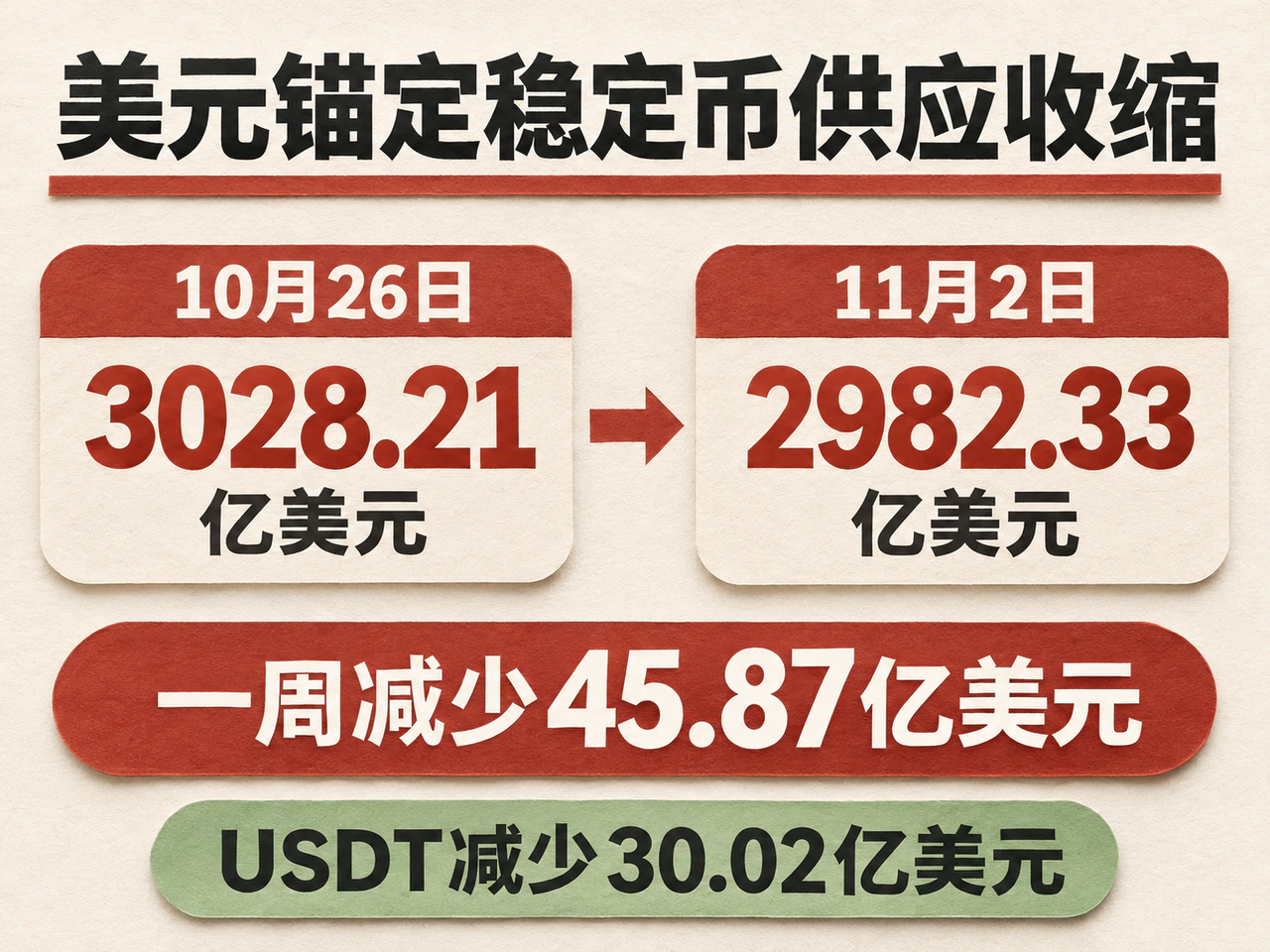
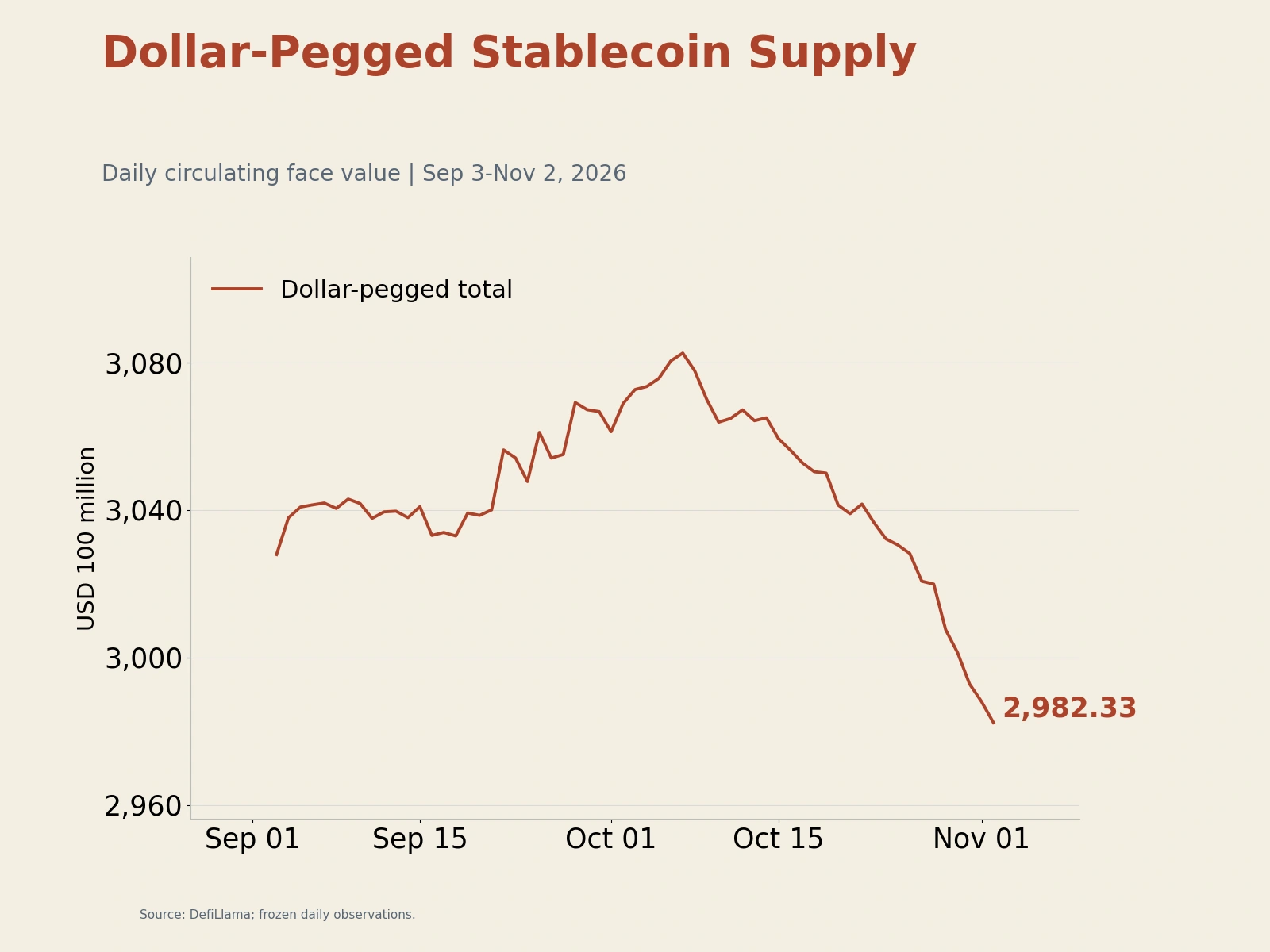
DefiLlama data show that dollar-pegged stablecoins in circulation totaled $298.233 billion on November 2, down $4.587 billion, or 1.51%, from $302.821 billion on October 26. Supply was also $9.036 billion, or about 2.94%, below its October 3 level. Stablecoin supply had already been contracting for some time, with the decline accelerating over the latest week; the funding base was weak even before the security incident.
By token, USDT supply fell from $182.463 billion on October 26 to $179.461 billion on November 2, a $3.002 billion decline that accounted for about two-thirds of the week's contraction in dollar-pegged stablecoin supply. Over the same period, USDC fell from $71.712 billion to $71.647 billion, a net decline of about $64.8 million, after briefly recovering to $71.903 billion on October 31 and then retreating. The supply adjustment was clearly concentrated in USDT.
Stablecoin supply measures the stock in circulation, which serves payments and on-chain finance as well as trade settlement. For risk assets, a sustained contraction weakens the funding base for potential buying demand. Even if transfers between exchanges stabilize, other channels must still be watched for evidence of fresh buying.
Weak ETF demand: Bitcoin withdrawals cluster on Friday, while Ethereum sees outflows all week
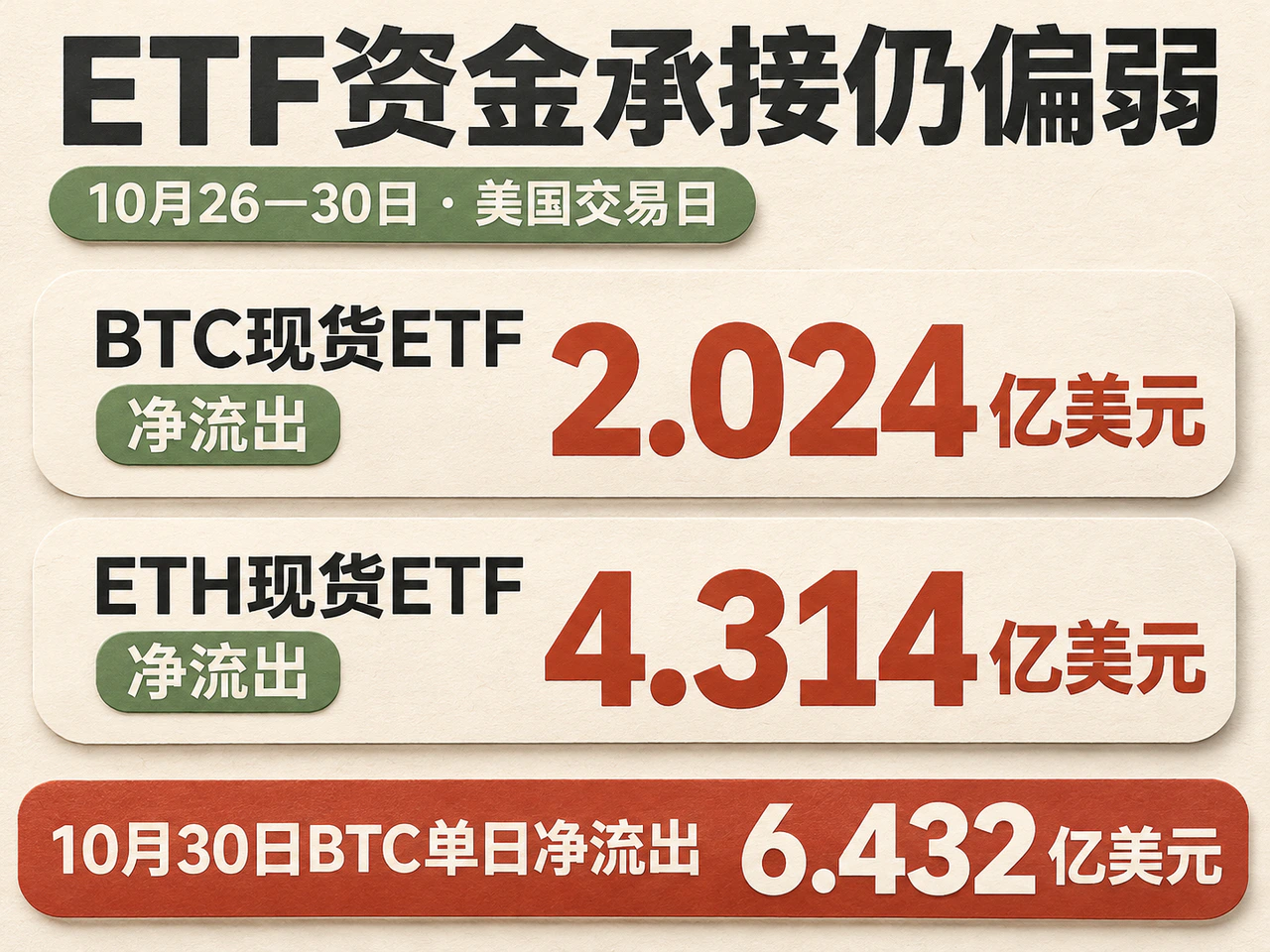
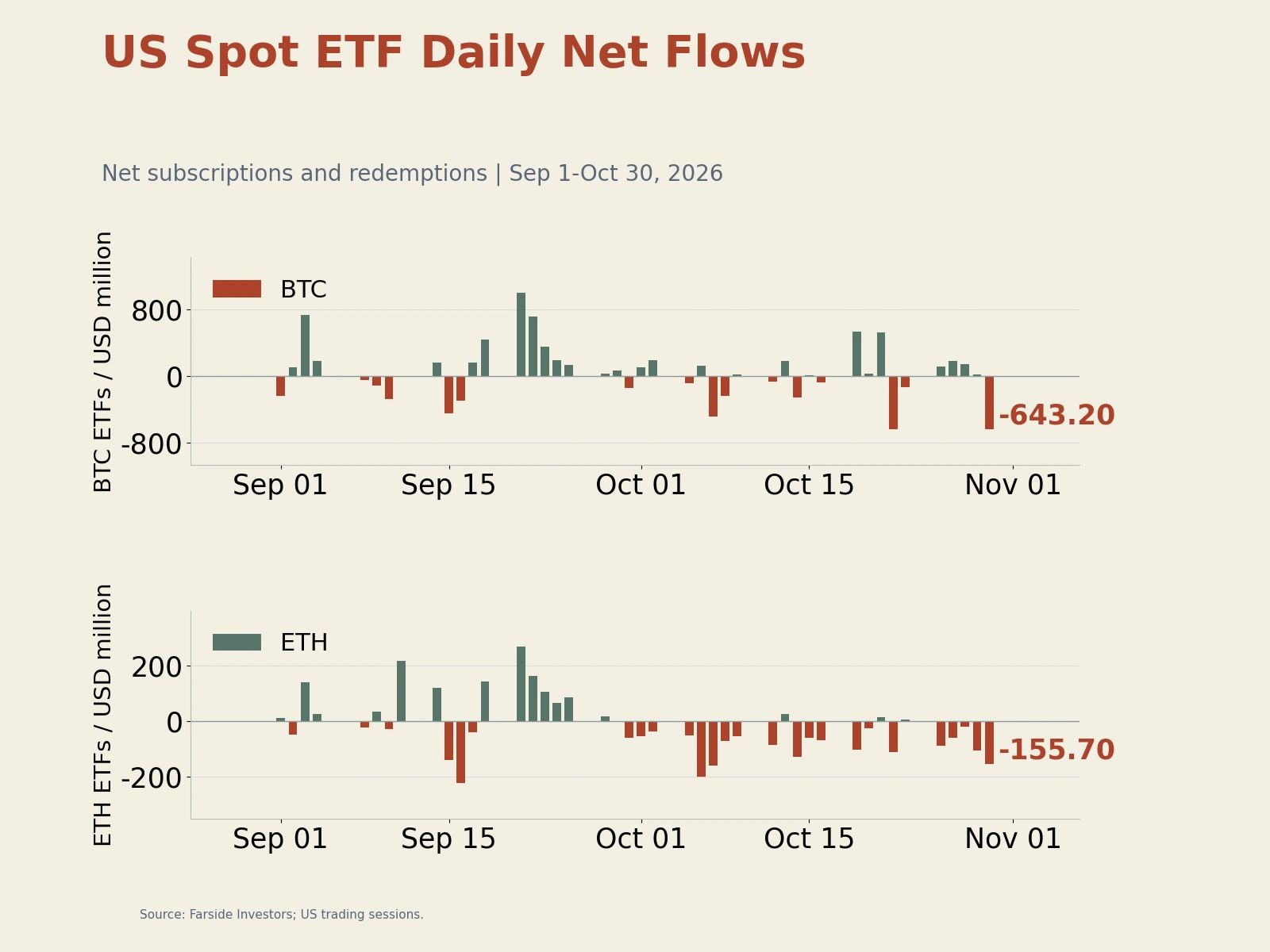
Farside data show that US spot Bitcoin ETFs recorded net outflows of $643.2 million on October 30, including $233.7 million from IBIT, $201.0 million from FBTC and $129.5 million from ARKB. The four trading sessions from October 26 to 29 brought combined inflows of $440.8 million, but Friday's redemptions pushed the full week to a net outflow of $202.4 million.
The adjustment in US spot Ethereum ETFs was more persistent: all five trading sessions from October 26 to 30 recorded net outflows, totaling $431.4 million, including $155.7 million on Friday. Bitcoin saw withdrawals concentrated ahead of the weekend, while Ethereum faced a sustained reduction in fund allocations throughout the week. At a minimum, this indicates that the fund channel has yet to provide a stable source of fresh demand.
Bitcoin perpetual open interest rises 3.95%, without a matching surge in funding rates
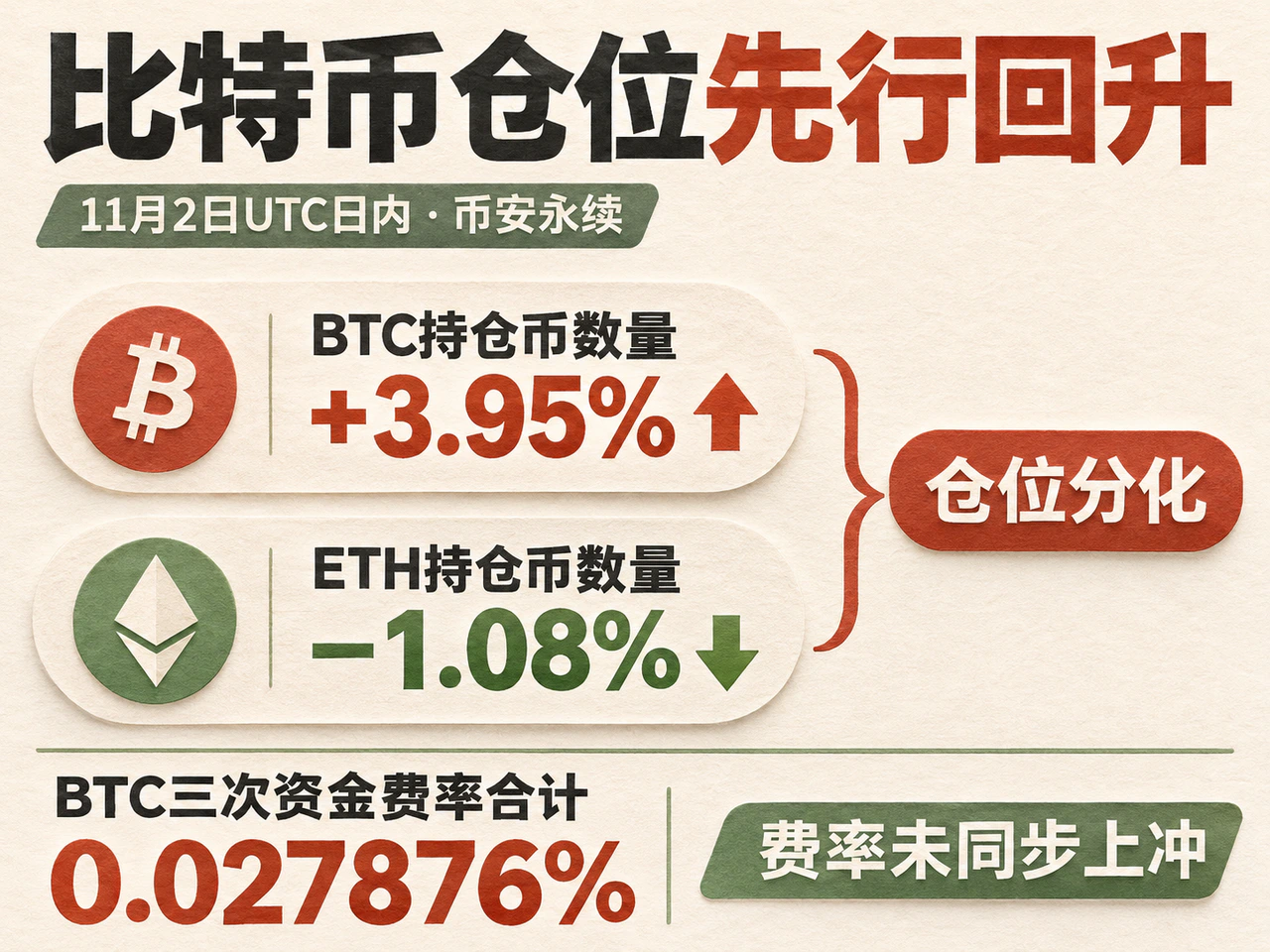
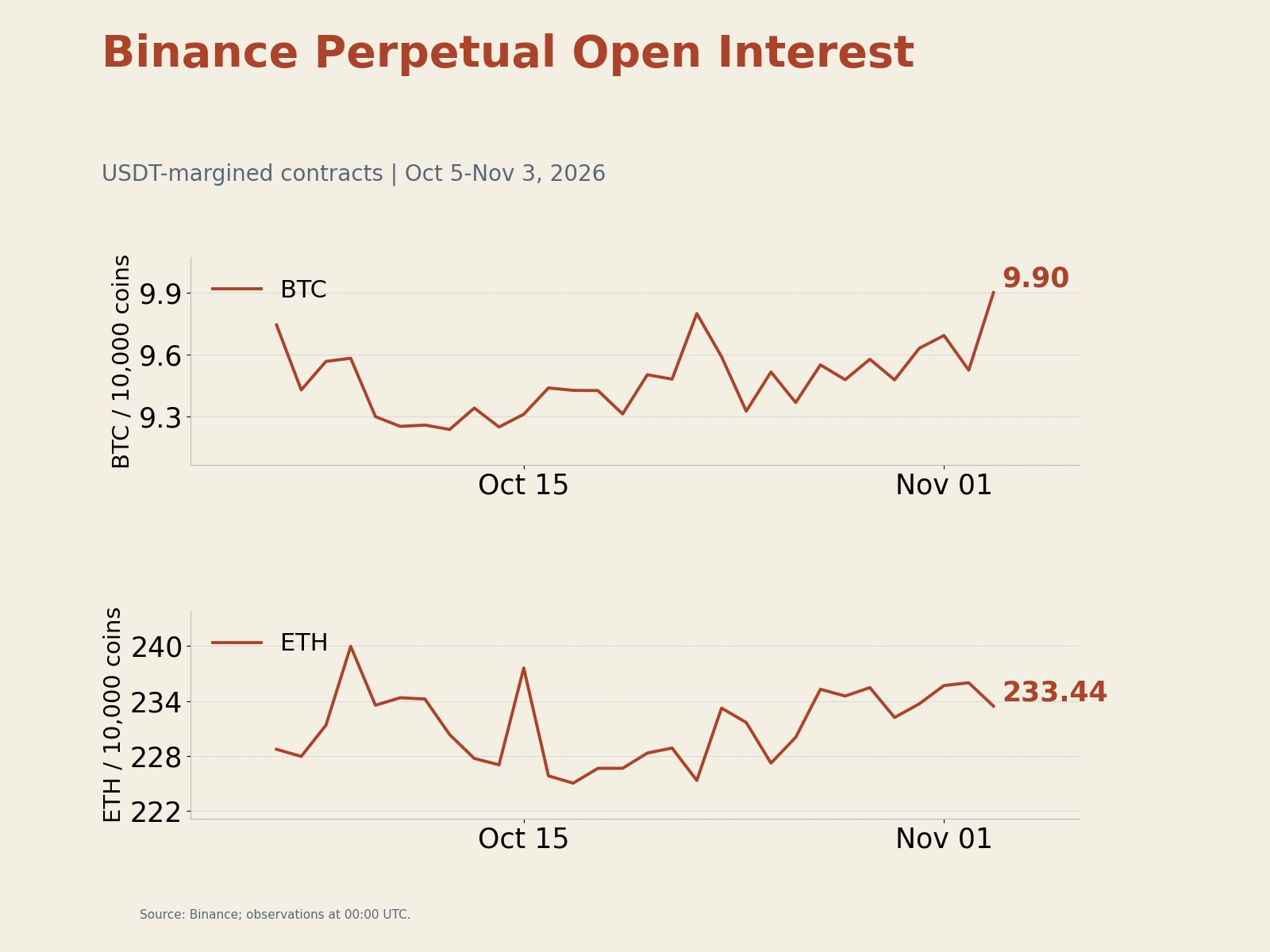
Bitcoin derivatives positioning, by contrast, began to recover first. Binance data for USDT-margined perpetual contracts show that from 00:00 UTC on November 2 to 00:00 UTC on November 3 (08:00 Beijing time on November 2 to 08:00 on November 3), Bitcoin perpetual open interest increased from 95,260 BTC to 99,020 BTC, a gain of 3.95%. Over the same period, its notional value rose from approximately 7.460 billion USDT to 7.604 billion USDT, up 1.93%. The larger increase in coin terms than in notional value shows that the expansion in open interest was not simply a paper increase caused by a higher Bitcoin price.
Every open contract has both a long and a short side, so higher open interest reflects an expansion in outstanding risk exposure. Positions added after a market decline may represent dip buying, hedging or arbitrage; assessing their vulnerability also requires watching whether the cost of holding positions rises rapidly.
During the November 2 UTC trading day, the three eight-hour funding rates for Bitcoin perpetual contracts were 0.0100%, 0.008758% and 0.009118%, all paid by longs to shorts. Their simple sum was 0.027876%, below the previous day's three-payment total of 0.0300%. Positioning recovered somewhat, but the funding cost of holding long positions did not rise in tandem. The combination of strengthening prices, open interest and funding rates has yet to emerge.
Ethereum's positioning was more restrained. Over the same UTC trading day, ETHUSDT perpetual open interest fell from 2.3599 million ETH to 2.3344 million ETH, down 1.08%, while its notional value declined 2.01%. The three funding rates switched between positive and negative, totaling 0.003295%, well below Bitcoin's figure. Positioning in the two leading assets moved in opposite directions, indicating that traders have yet to increase risk-taking in unison.
Spot funding has yet to catch up with derivatives positioning

The key funding question remains whether spot capital can catch up with the recovery in derivatives positioning. ETFs and stablecoin supply underpin spot purchasing power, while derivatives positioning determines how much price swings may be amplified. The data above show Bitcoin open interest recovering first, while stablecoin supply and fund allocations remain under pressure; a continued price recovery still needs support from spot capital. If stablecoin supply stops contracting and ETF inflows persist while derivatives funding costs remain moderate, the recovery will have a firmer foundation. If open interest keeps rising while spot capital fails to arrive, fresh price shocks will be harder to absorb.
Click through to the original article for further details.