On November 2, 2026, Binance published a new proof of reserves, saying it had used its own funds to replenish about 95% of the assets affected by an earlier security incident. Customer funds continued to leave, however, and Brazilian exchange Mercado Bitcoin suspended deposits and withdrawals that same day following a security incident. As platforms worked on repairs and investors reassessed custody risk, Bitcoin failed to hold its weekend rebound. Ether fell less sharply, while major cryptocurrencies broadly weakened.
All seven tracked cryptocurrencies fall; ETH/BTC recovers about 1%
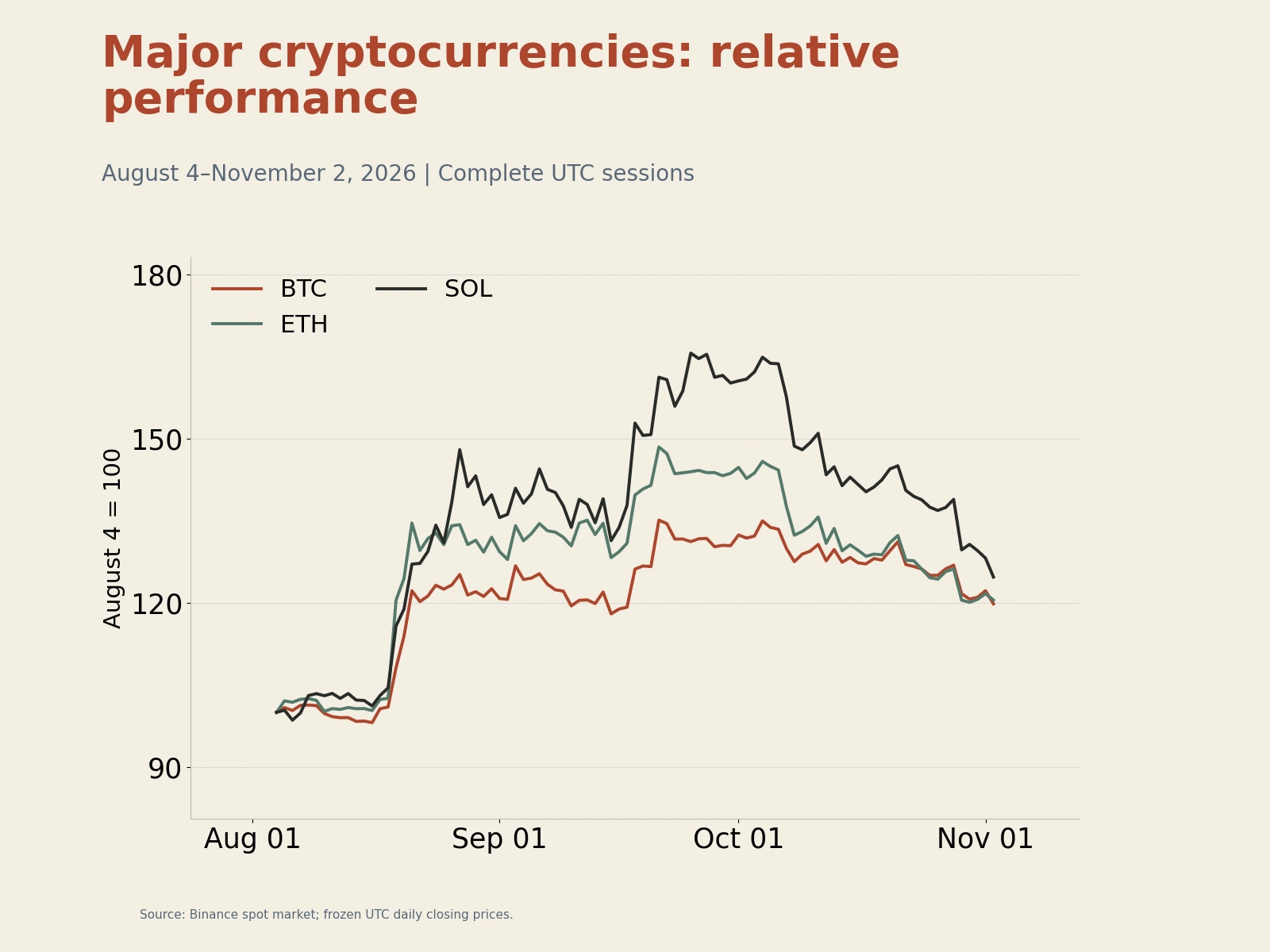
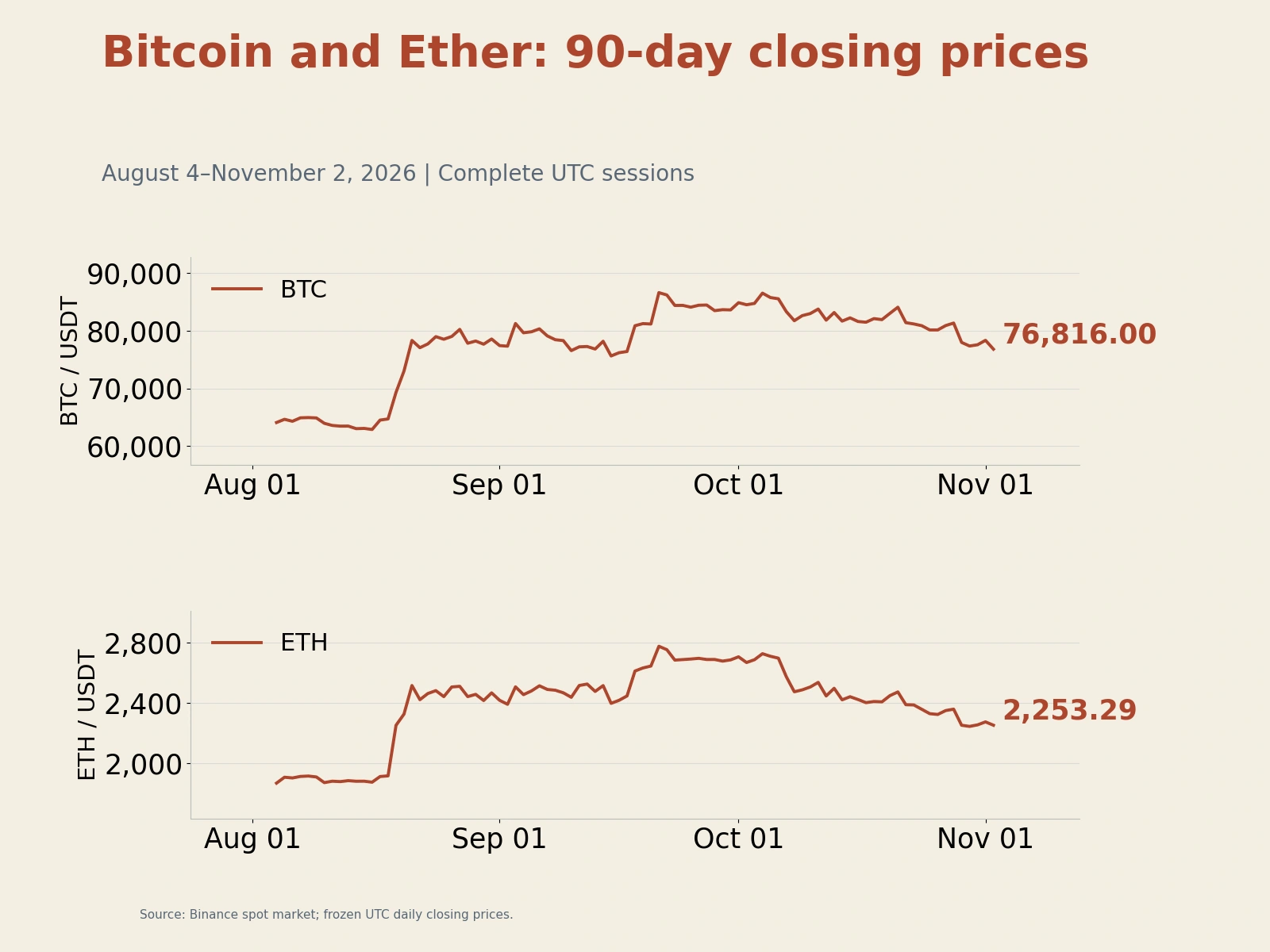
Using Binance spot prices quoted in USDT and UTC daily candles, Bitcoin closed the November 2 trading session, which ended at 8 a.m. Beijing time on November 3, at 76,816 USDT, down 1.96% from the previous close. Ether closed at 2,253.29 USDT, down 0.97%. Bitcoin traded as high as 78,878.01 USDT and as low as 76,705 USDT, finishing near its intraday low; Ether traded between 2,237.38 and 2,317.84 USDT.
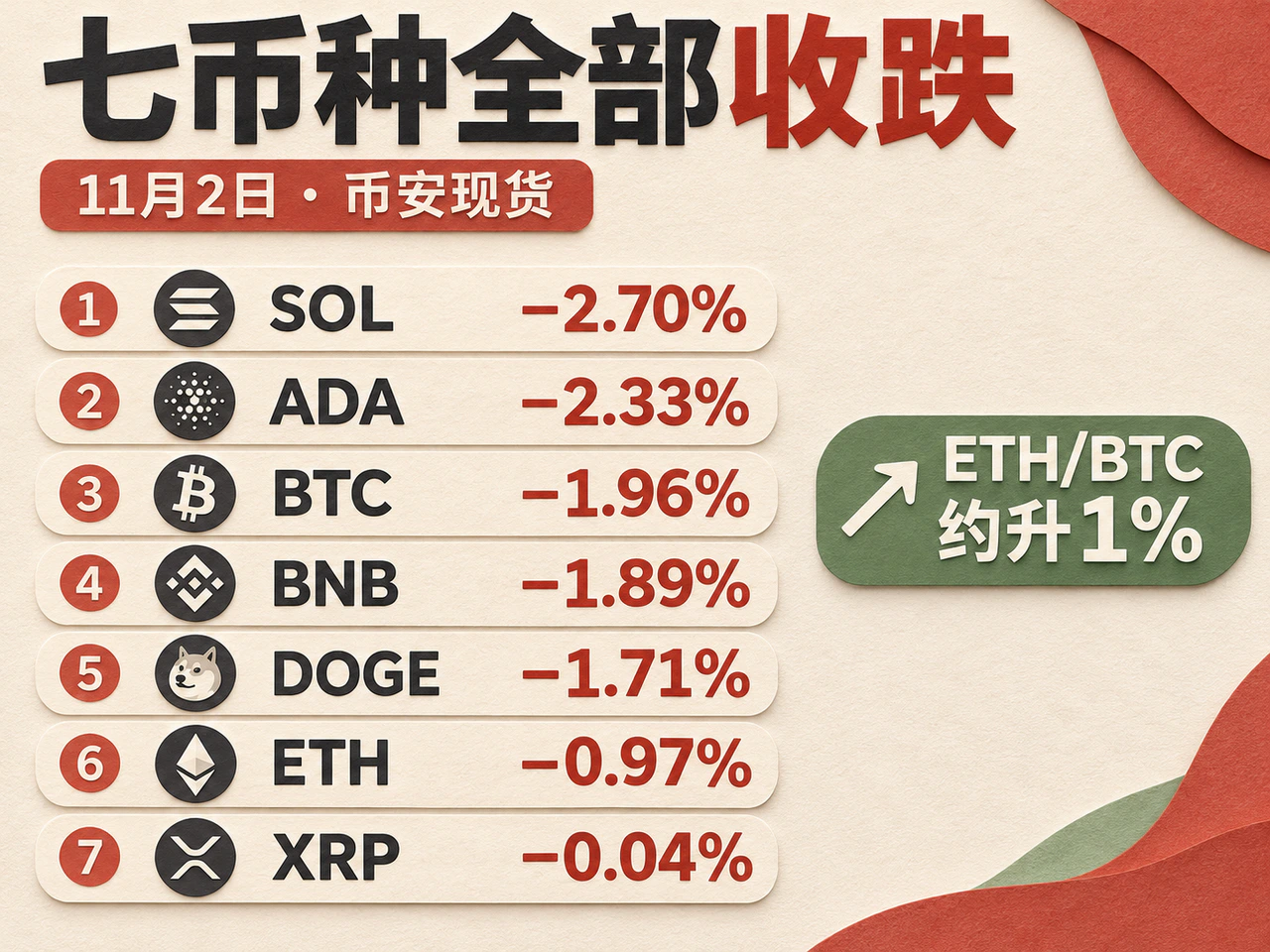
The selling was broad. All seven cryptocurrencies in this report’s regular coverage—BTC, ETH, SOL, BNB, XRP, DOGE and ADA—closed lower. SOL fell 2.70% and ADA 2.33%, while BNB and DOGE lost 1.89% and 1.71%, respectively. XRP slipped just 0.04%, ending almost unchanged. This highly liquid sample suggests that money leaving Bitcoin did not broadly rotate into other major cryptocurrencies: the market was still reducing overall risk exposure.
| Asset | Closing price (USDT) | Daily change |
|---|---|---|
| BTC | 76,816.00 | -1.96% |
| ETH | 2,253.29 | -0.97% |
| SOL | 91.98 | -2.70% |
| BNB | 699.25 | -1.89% |
| XRP | 1.2502 | -0.04% |
| DOGE | 0.07423 | -1.71% |
| ADA | 0.1886 | -2.33% |
Ether was relatively resilient. The ETH/BTC ratio, calculated from their respective USDT closing prices, rose from 0.02904 to 0.02933, a gain of about 1%. Over the past 30 complete trading sessions, however, Bitcoin and Ether were down 9.37% and 16.15%, respectively, while SOL had lost 23.11%. Ether’s one-day relative improvement therefore came against a backdrop of substantial earlier declines.
Trading activity increased as the working week resumed. Daily turnover in Binance’s BTC/USDT pair reached 983 million USDT, up 92.7% from Sunday; ETH/USDT turnover was 576 million USDT, up 181.9%. Rising volume alongside falling prices indicates that buying after the weekend rebound failed to absorb fresh selling pressure. Sunday’s low base also amplified the percentage increases. Assessing the quality of a rebound still requires watching whether prices can move away from recent lows and whether gains can broaden across major cryptocurrencies.
Traditional risk assets also lacked stable support. Reuters reported on November 2 that, after an early rebound in U.S. equities, technology stocks turned lower in the afternoon as investors reassessed artificial intelligence capital spending and its returns. The approaching U.S. midterm elections also exposed risk assets to shifting policy expectations. Crypto markets were thus facing their own security and custody pressures amid an unsettled broader appetite for risk, making it harder for any single repair milestone to sustain a rebound.
Binance replenishes about 95% of affected assets, but net outflows reach $4.72 billion after withdrawals resume
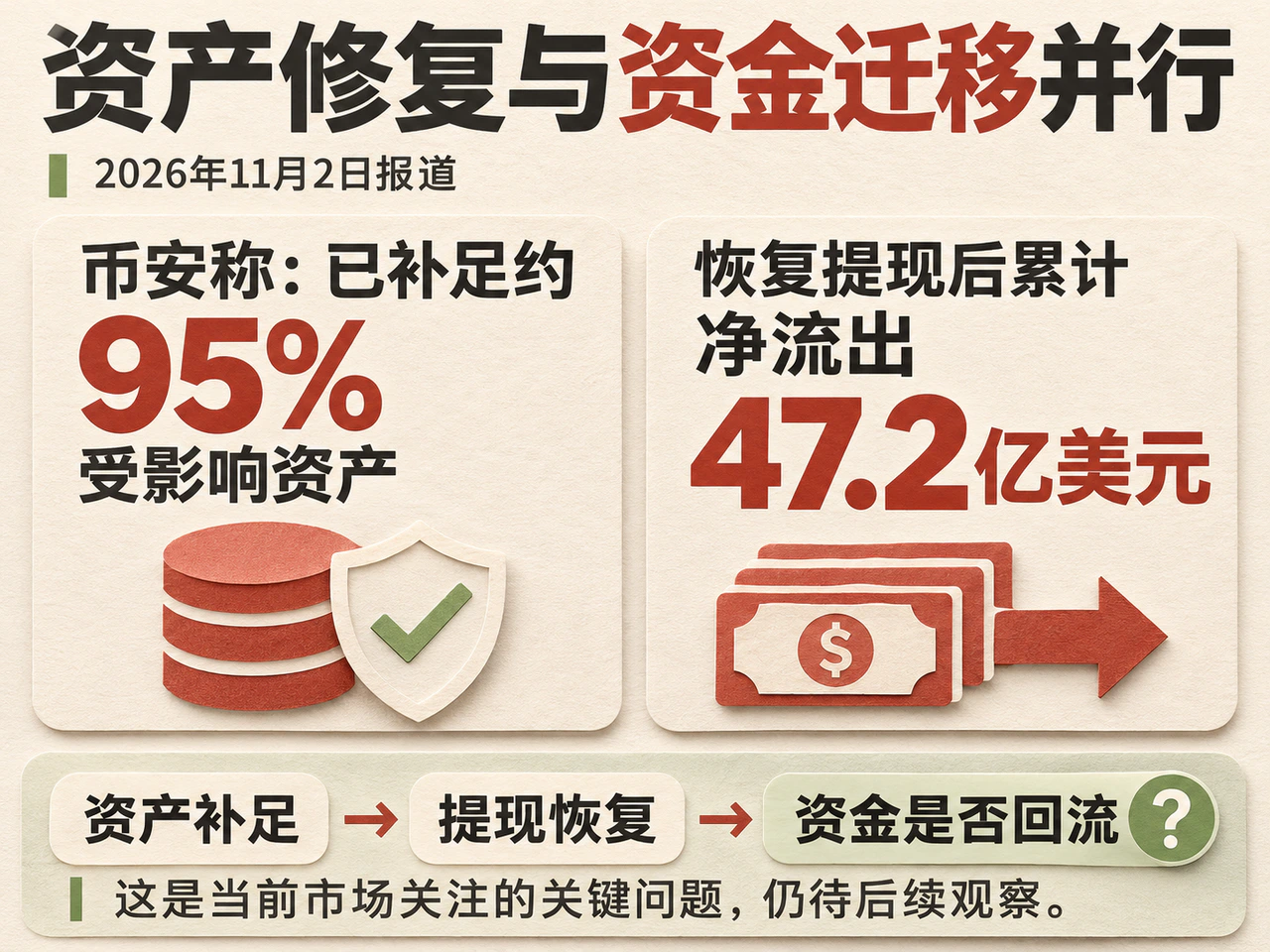
The substantive progress in Binance’s updated proof of reserves lies in replenishing assets and making their backing verifiable. The Block reported that the new zero-knowledge proof of reserves covers ten assets: BTC, ETH, USDT, BNB, SOL, USDC, XRP, USD1, RLUSD and ZEC. Users can verify whether their balances are backed one-for-one. The platform said it had used its own funds to replenish about 95% of affected assets; the remainder mainly consisted of illiquid tokens it was still buying. It also planned to restore withdrawals gradually across more networks and assets.
This eases concern that customers will bear losses directly, but funds are still moving. Reuters reported on November 2 that Binance had recorded cumulative net outflows of $4.72 billion since resuming withdrawals. Binance said this represented about 3% of assets on the platform, that most withdrawn assets were USDT, and that withdrawal volumes were stabilizing after the initial surge. The figure captures the movement of funds at the platform level; some customers may be opting for self-custody or transferring assets to other exchanges. The next questions for the market are whether customers continue to reduce the assets they keep on exchanges and whether repairs can bring funds back.
A second incident that day kept security in the spotlight. Mercado Bitcoin said a security incident had affected one of its systems and that it had suspended deposits and withdrawals as a precaution. It said customers had suffered no losses and there had been no data breach. Citing preliminary findings by security firm Hypernative, Decrypt reported more than $40 million in suspicious transfers across multiple blockchains; the exchange had not confirmed that amount. Tether’s chief executive said more than 4.5 million USDT linked to the incident had been frozen.
No connection between the two platforms’ incidents has been confirmed. Together, though, they remind asset holders that full asset backing, control over wallet operations and the ability to withdraw funds at any time depend on different safeguards. Proof of reserves helps establish whether balances are covered; restored withdrawals test whether customers can actually recover their funds. Repeated security incidents can raise institutions’ scrutiny of these controls, with effects that may outlast short-term price fluctuations.
Some institutions continued buying during the same period. On November 2, Strategy disclosed that it had acquired 811 Bitcoin for approximately $65.5 million between October 26 and November 1, resuming purchases after a one-week pause. Bitmine disclosed that same day that it had added 8,573 Ether over the past week. Both show that corporate crypto treasury strategies remain in operation, but these purchases accumulated across several days and do not share the same time window as the selling that persisted in the market that day.
The next developments can be assessed in three stages: first, whether asset replenishment and the restoration of withdrawals are delivered; second, whether movements of funds away from platforms stabilize; and third, whether prices and the breadth of gains across major cryptocurrencies improve together. Bitcoin’s close near its intraday low and declines in all seven tracked assets show that the market was still primarily working through risk that day. Continued institutional buying, meanwhile, preserves a base of demand for a subsequent recovery.
Click “Read original” for the full details.