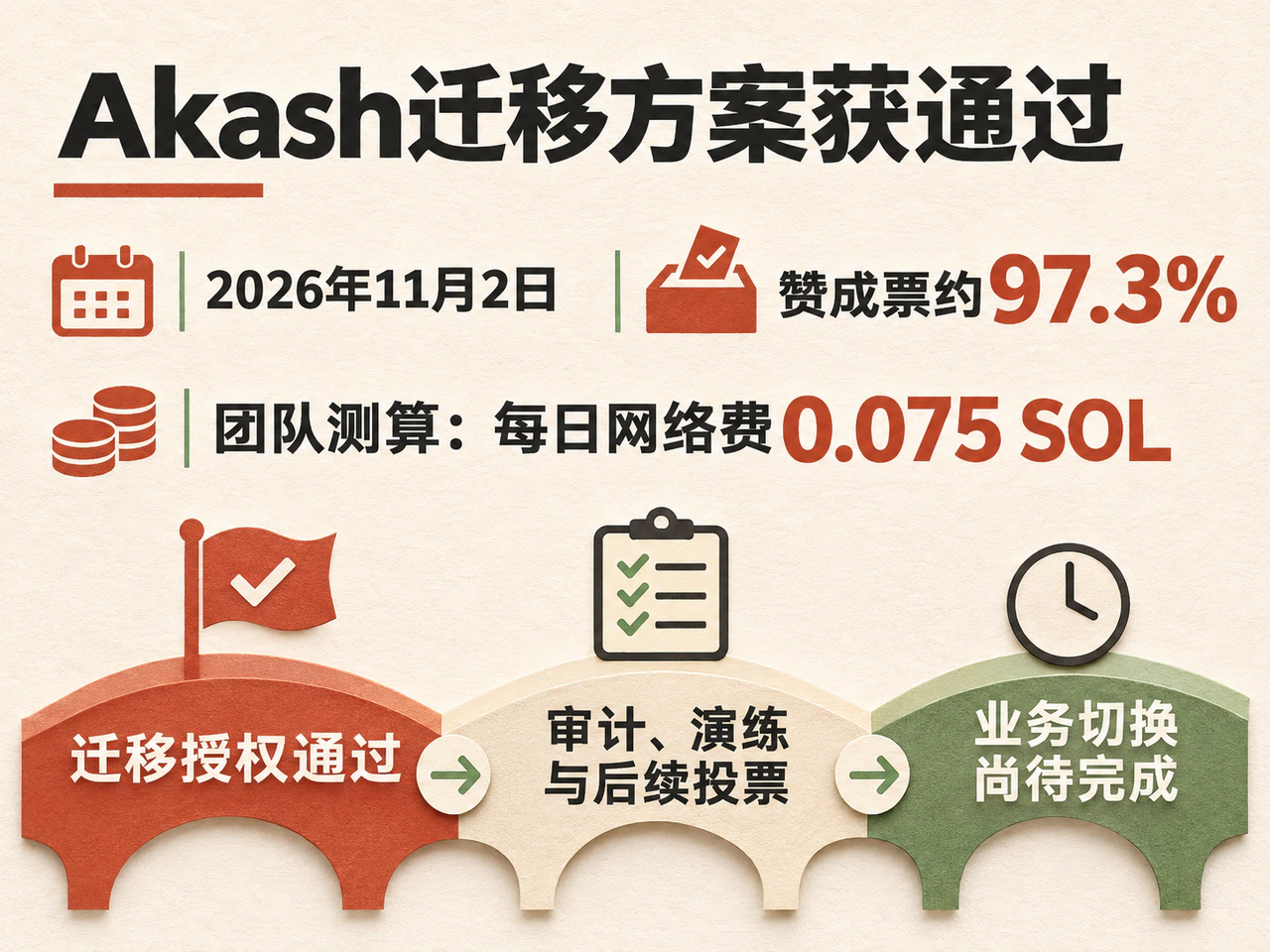
On November 2, 2026, voting closed on Proposal 346 from decentralized cloud computing project Akash. Onchain records show that the plan to migrate to Solana passed, with votes in favor accounting for approximately 97.3% of all votes cast. Having originally built its own blockchain, Akash now plans to entrust consensus and settlement to a general-purpose network and focus on running its compute marketplace. For the onchain economy, the more telling questions are how applications use such a move to cut costs and access liquidity, and who ultimately captures the additional revenue.
TVL falls across most of six chains over the month; transaction counts need to distinguish fund transfers
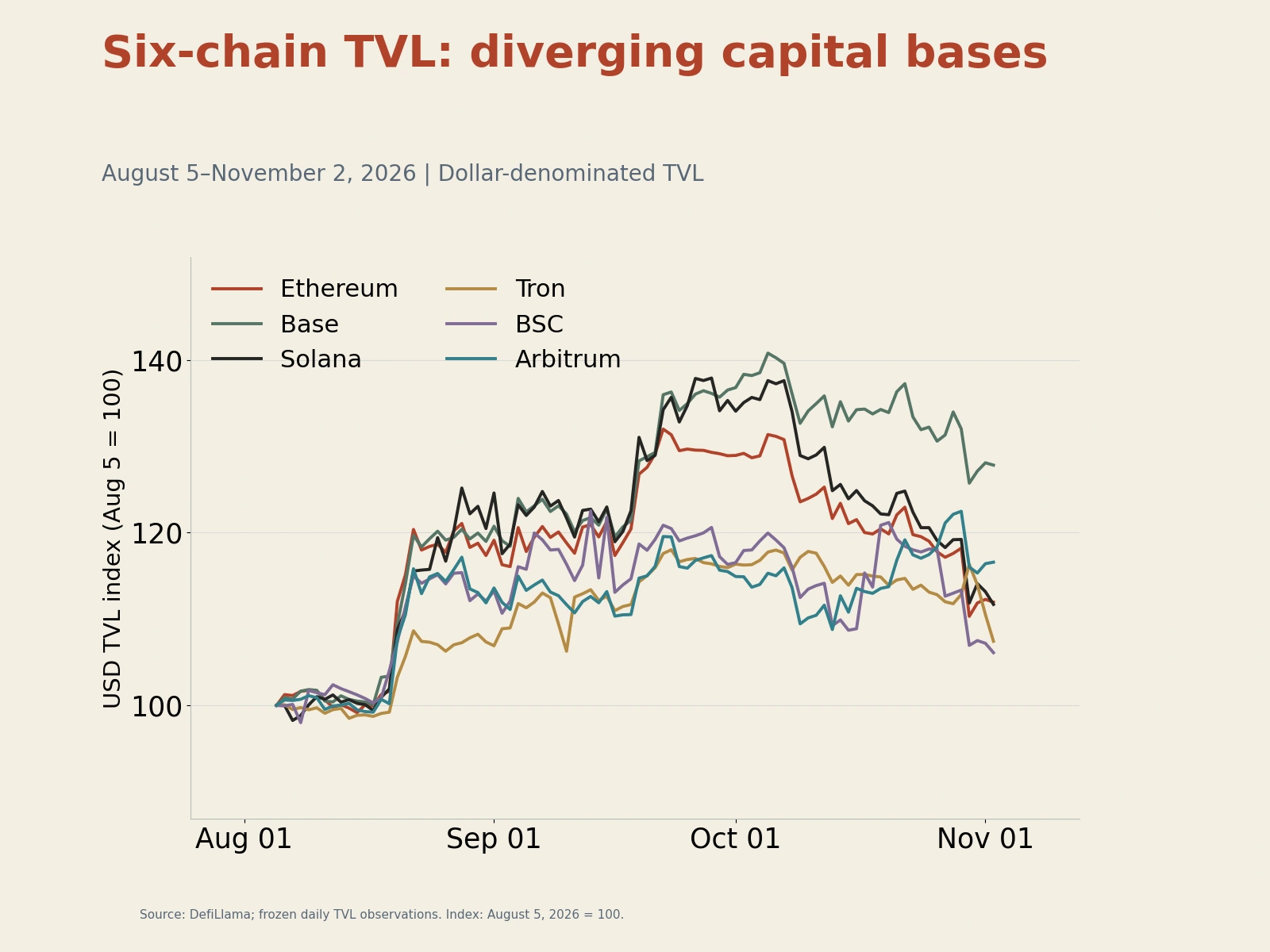
The capital bases of public blockchains still differ markedly. According to DefiLlama data labeled November 2, the total value locked in protocols on Ethereum was approximately $43.57 billion, compared with $5.87 billion on Base, $5.34 billion on Solana, $5.21 billion on Tron, $5.18 billion on BSC and $1.44 billion on Arbitrum. Ethereum retains a clear lead in its stock of capital; on this measure, Base now has more value locked than Solana.
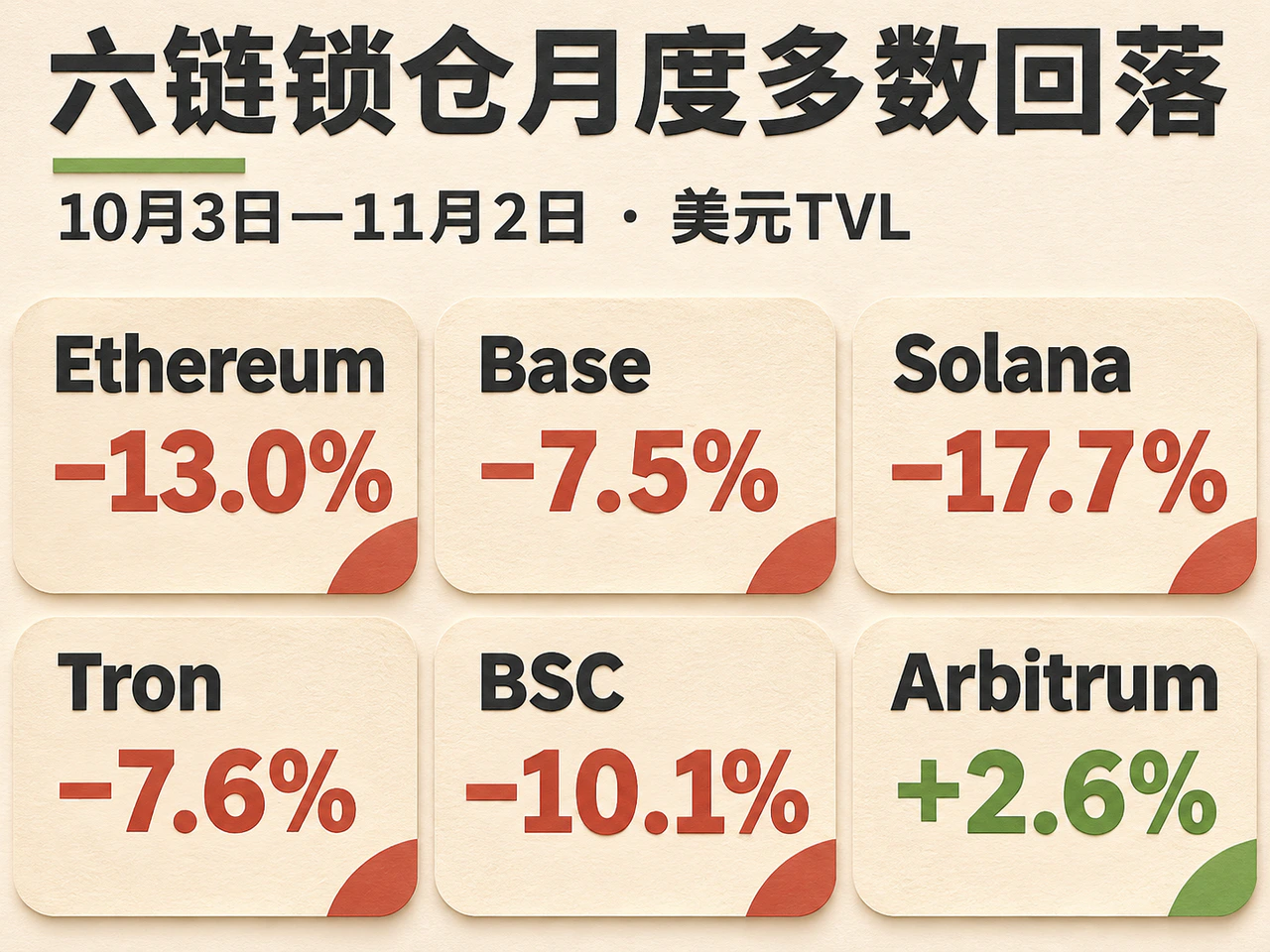
Over the longer window from October 3 to November 2, Arbitrum was the only one of the six networks to record an increase in dollar-denominated TVL, of approximately 2.6%. Ethereum, Base, Solana, Tron and BSC declined by approximately 13.0%, 7.5%, 17.7%, 7.6% and 10.1%, respectively. Dollar-denominated TVL reflects both token prices and asset quantities. These figures capture changes in the scale of each chain's balance sheet and cannot be directly equated with net capital inflows or outflows. For the operation of applications, capital's ability to remain in lending, market-making and settlement systems is more informative than short-lived transaction rankings.
The purposes of transaction activity also need to be distinguished. In a tracking update on November 2, Elliptic said funds stolen from Binance on October 29 had touched 11 chains, approximately 12,000 wallets and more than 40,000 transactions. Their transfer routes included decentralized exchange swaps, cross-chain bridges and lending vaults. Repeated splitting and transfers by a single group controlling the funds can generate large numbers of addresses and transactions. The resulting onchain operations consume network resources, but cannot directly be treated as new customers or sustained demand for payments.
Meanwhile, real-world asset applications are trying to turn the assets they hold into usable collateral. In a guide to bringing RWAs into DeFi published on November 2, RedStone cited its October research as putting the onchain real-world asset market at more than $38 billion, with approximately 11% already deployed in DeFi. The guide's example of the trade-finance token oTFY connects to Kamino on Solana, Morpho on Ethereum, and trading venues including Raydium and Uniswap. Growth of this kind requires borrowers, stablecoin lenders and secondary-market liquidity to be in place together. Issuing assets onchain is only the first step; they must subsequently be usable for financing and allow investors to exit.
This also explains why applications weigh both costs and the depth of capital when choosing a settlement network: lower transaction costs reduce the expense of high-frequency operations, while the combination of stablecoins, lending and market-making determines whether the business can actually scale.
Akash estimates daily network fees of 0.075 SOL after migration; the increase in blockchain fee revenue may be limited
In its migration explanation, Akash's core team said the marketplace currently handles approximately 15,000 operations a day, while the team has to maintain its own fork of the underlying software and rely on approximately 100 validators to secure consensus. Orders, bids and lease settlements need reliable execution, but the team's code review found no requirement for these functions to depend on an independent consensus mechanism. Running a separate chain has therefore become a fixed cost open to reassessment.
The migration plan provides a specific estimate: at current activity levels, moving the entire marketplace to Solana would incur network fees of approximately 0.075 SOL a day. After comparing seven alternatives, the team identified Solana mainnet and existing Ethereum layer-2 networks as the two options meeting all mandatory requirements. It ultimately placed greater weight on Solana's cost headroom, operating model and existing cluster of decentralized hardware applications. Engineering, audit and fee-subsidy support from the foundation was also one of the conditions behind the choice.
For Akash, the economic significance of the change is to reduce the resources spent maintaining the blockchain itself and concentrate them on compute supply, the leasing experience and liquidity. For Solana, taking on an application with ongoing operations could broaden the use of stablecoin settlement, collateralized financing and other services. But the estimate of 0.075 SOL in daily network fees also suggests that the direct increase in network fees could remain very small, even if the migration succeeds. Growth in application revenue and the revenue accruing to a blockchain's token depend on different parts of the fee structure.
The distribution of value within Akash will change as well. The approved proposal stipulates that inflation and staking rewards on the old chain will end when marketplace operations switch over. The old chain will halt 90 days after the switch, ending validators' roles and income. The new token issuance curve and the size of transitional compensation for validators must still be disclosed before the subsequent switch-over proposal. Token incentives previously used to secure consensus will be realigned with the compute marketplace's actual operations; holders will need to assess sources of returns and dilution arrangements accordingly.
What passed on November 2 was authorization for the migration. A one-way conversion channel for exchanging AKT into a Solana token at a 1:1 ratio must open after the audit is completed. The marketplace itself still needs audits, rehearsals and another governance vote before switching over, and existing leases will continue to operate until then. Whether demand for paid compute grows, leasing revenue rises and actual costs fall after migration will test this path. How the savings are distributed among compute providers, users and token holders is equally important. Lower-cost infrastructure is a starting point for improved operations; lasting value must ultimately come from users continuing to pay for the service.
Click “Read the original” for full details.