Base DEX volume rises 33.8% as payments and tokenized products expand across chains
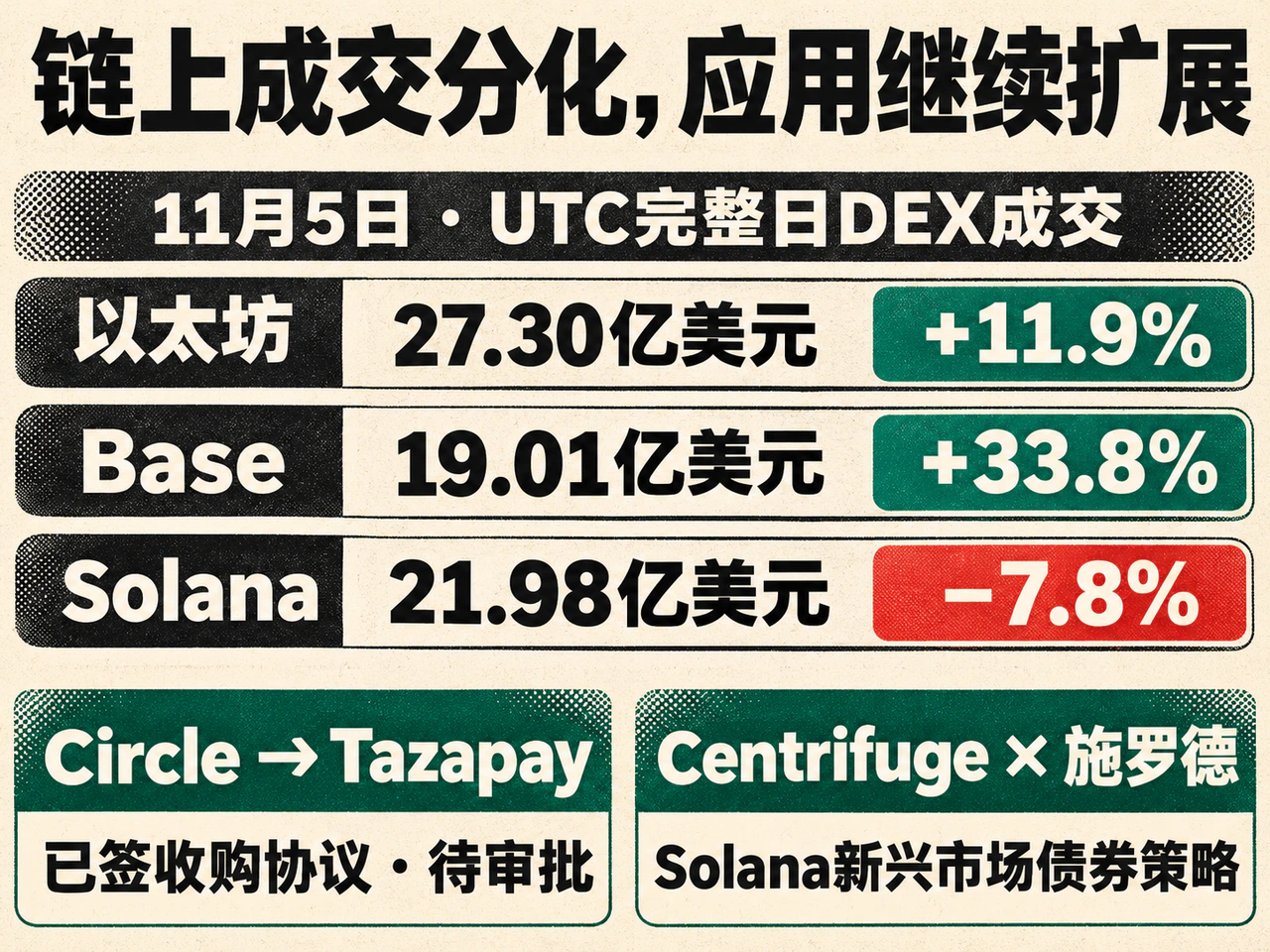
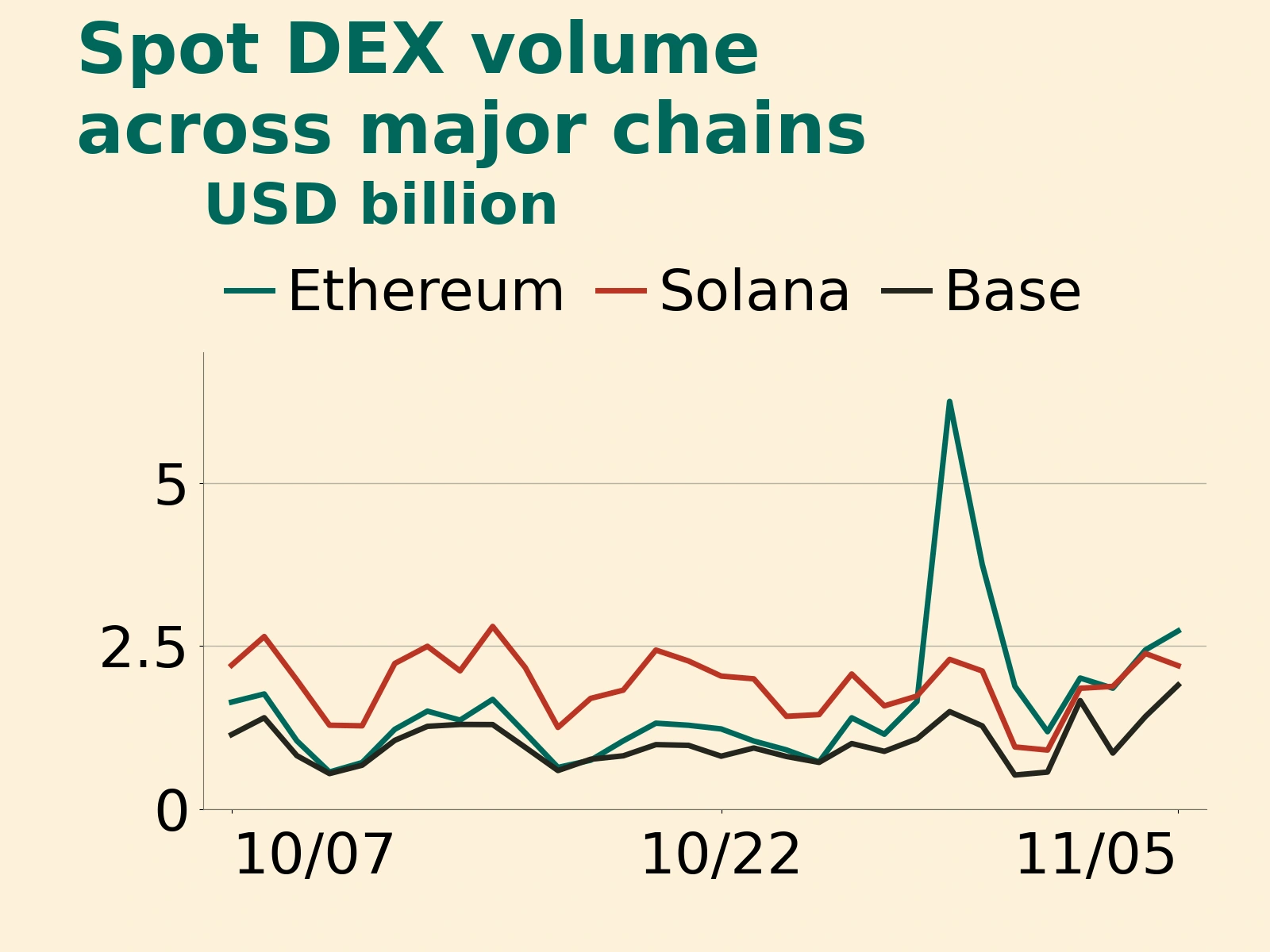
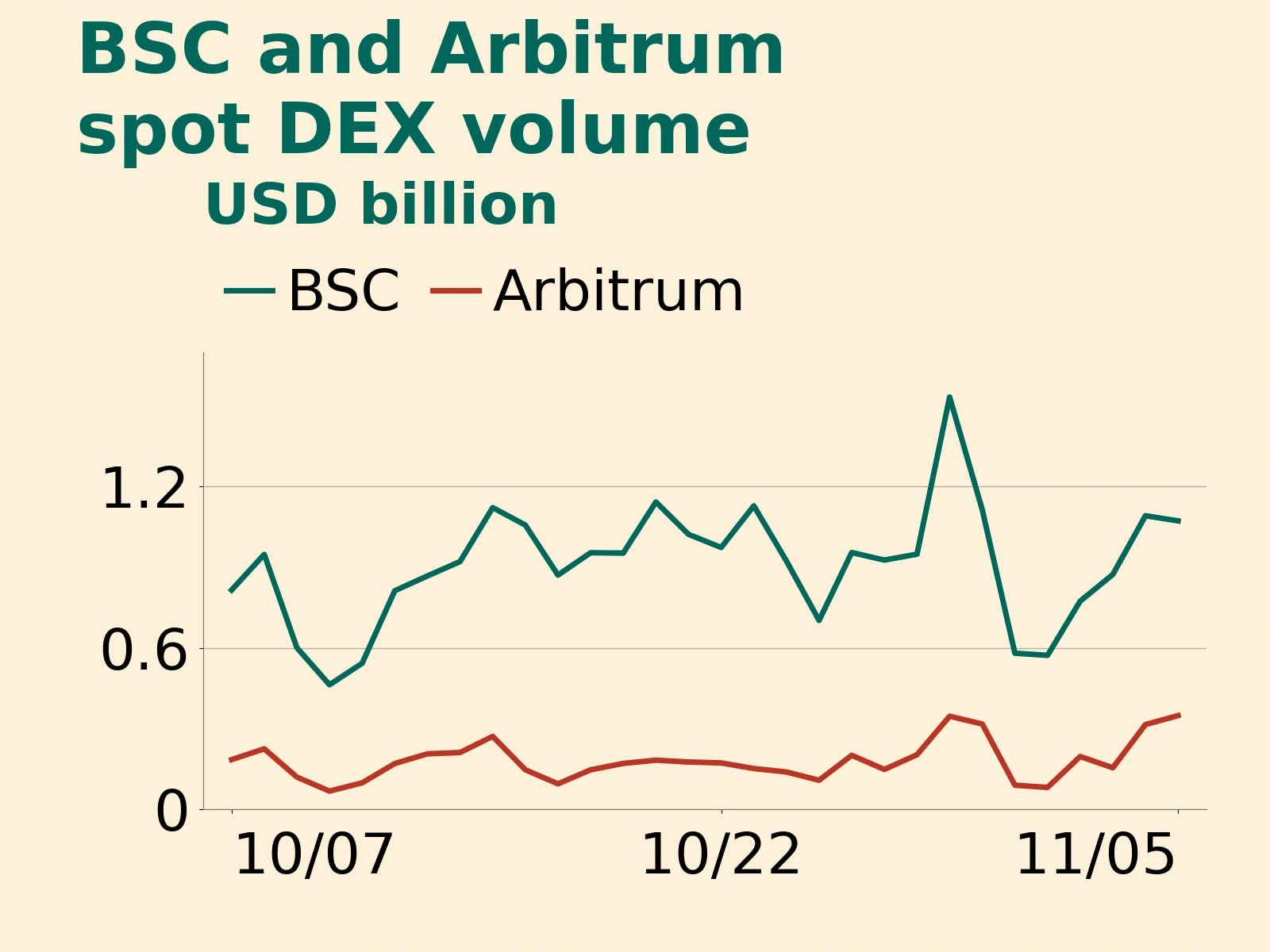
On November 5, 2026, the latest UTC day marked complete by DeFiLlama, spot trading volume on decentralized exchanges on Ethereum mainnet reached $2.730 billion, up 11.9% from the previous day. Base volume rose 33.8% to $1.901 billion, while Solana volume fell 7.8% to $2.198 billion. Arbitrum also recorded higher volume than the previous day, while BNB Smart Chain edged lower. Base's trading volume that day was approaching Solana's, although these figures measure turnover alone and do not establish whether capital moved from one chain to another.
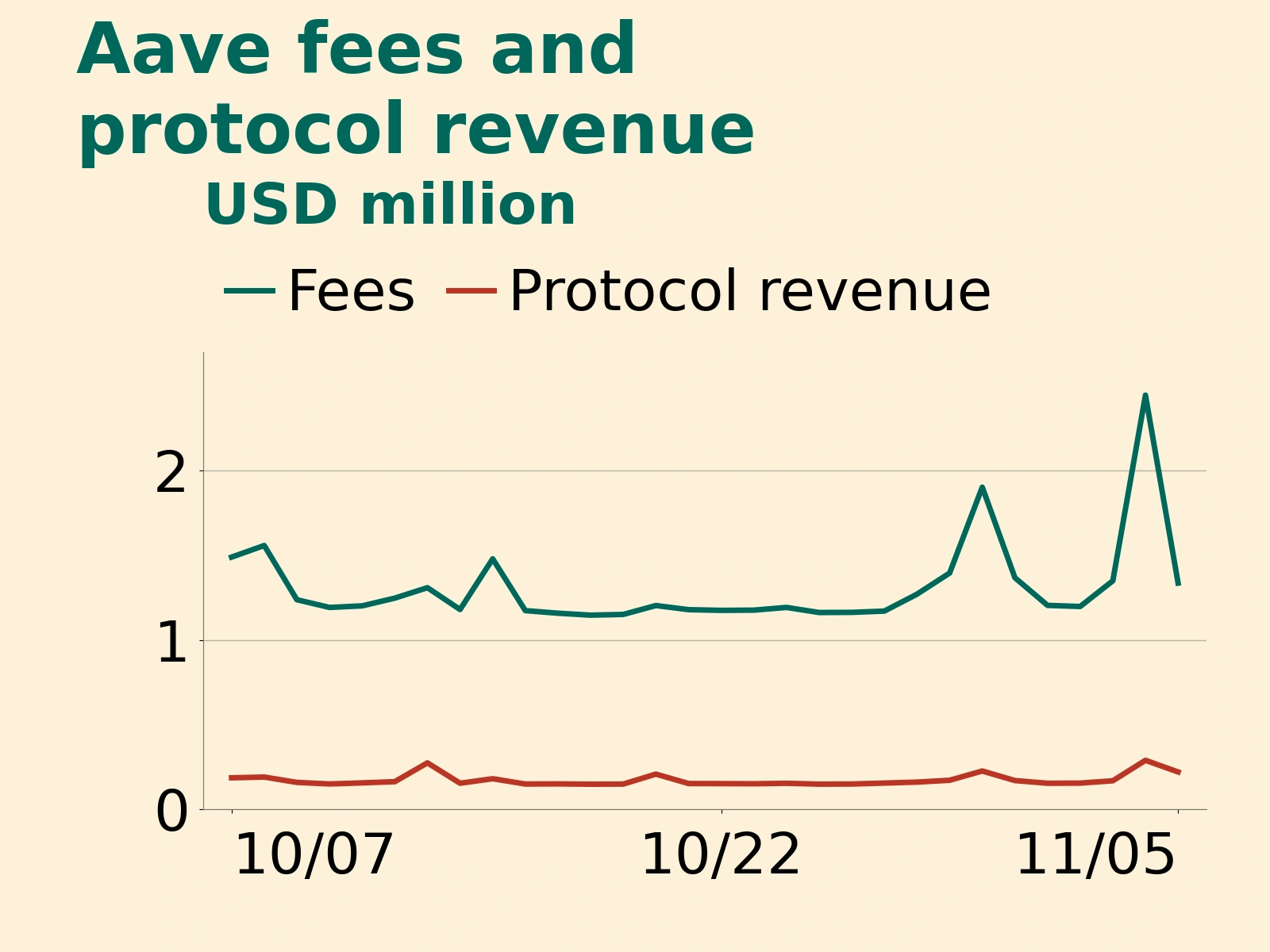
Lending protocol fees and revenue can also diverge from spot trading volume. On November 5, DeFiLlama recorded approximately $1.34 million in Aave fees and $220,000 in protocol revenue, down about 45% and 24%, respectively, from the previous day. Some of the borrowing interest and other fees paid by users goes to capital providers, with the protocol retaining a share. Assessing whether AAVE can benefit from the protocol's operations therefore requires distinguishing user payments, earnings accruing to capital providers, and the amount retained by the protocol. Trading activity alone is insufficient.
Payward, Kraken's parent company, disclosed in an announcement the same day that its affiliated funds and clients had purchased AAVE in the secondary market. The amount was undisclosed. Those purchases directly change governance-token ownership without changing the protocol's borrowing demand. Any increase in borrowing demand from the platform's exploration of further cooperation with Aave will depend on business data following integration.
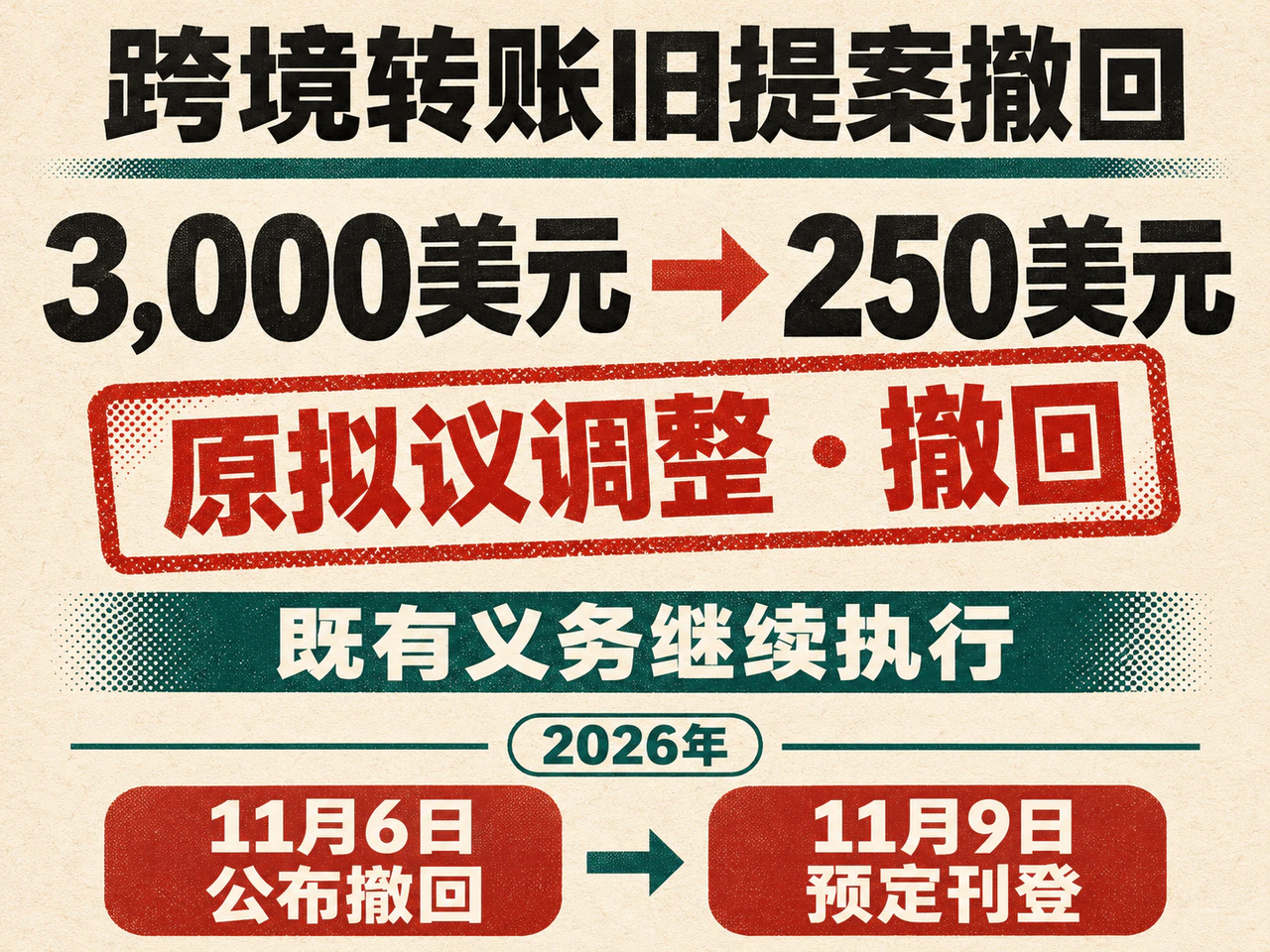
In its third-quarter results released on November 4, Circle disclosed that it had signed an agreement to acquire Tazapay, a Singapore-based cross-border B2B payments platform. Completion is expected in 2027, subject to regulatory approvals and other closing conditions. Payment institutions can use stablecoins to settle between institutions, while merchants or recipients may still require payments and receipts in local fiat currency.
Centrifuge announced the same day that it was launching a Schroders-managed emerging-market bond strategy on Solana, adding exposure to emerging-market sovereign, corporate, and other debt to the investment choices available on a public blockchain. Fund subscriptions and redemptions, together with the liquidity of the underlying bonds, continue to constrain such products. Onchain transaction throughput cannot remove those constraints.
An older Reth calculation path can produce incorrect state roots, prompting separate responses on two networks
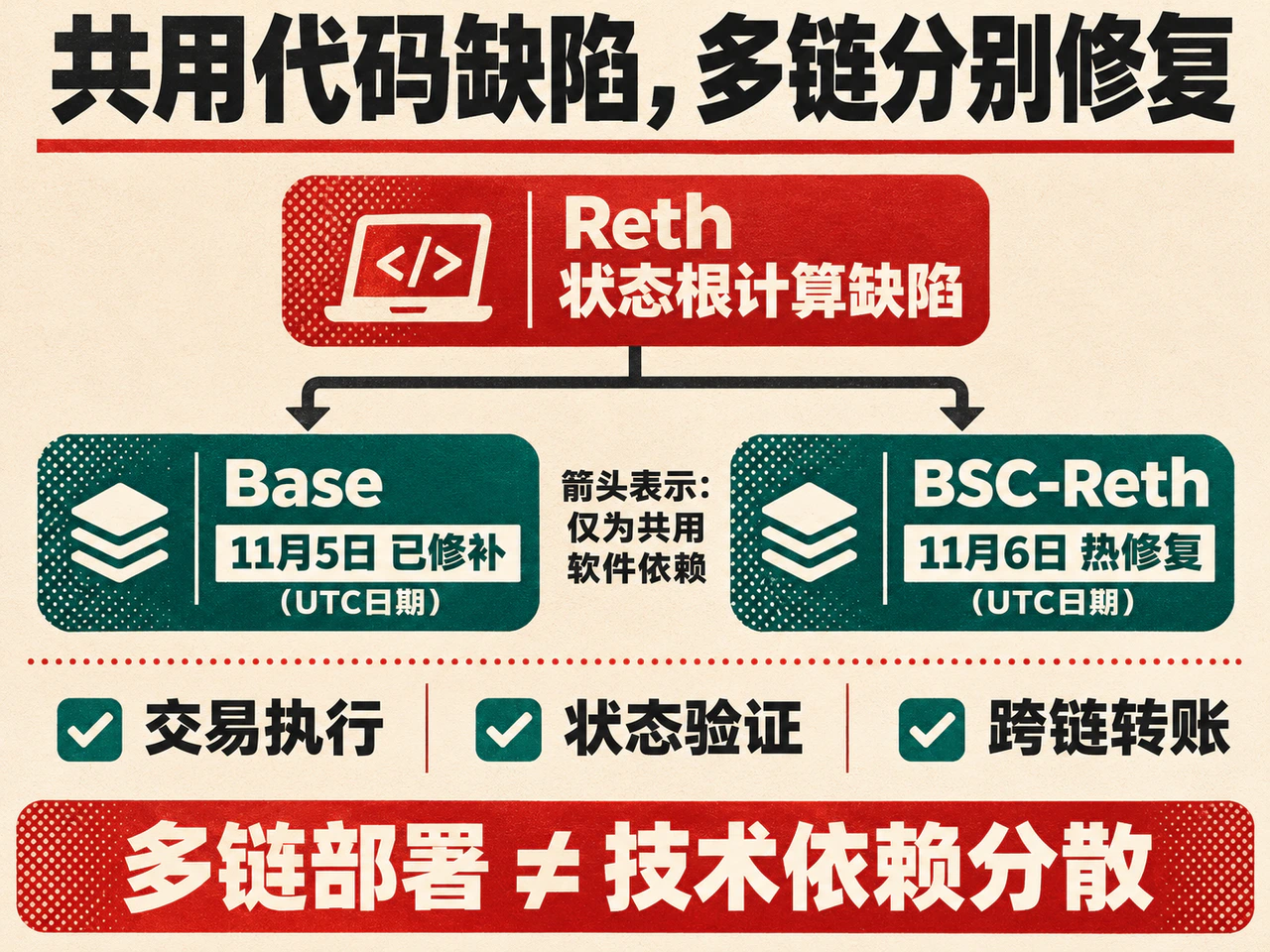
On November 6, 2026, BNB Chain released a hotfix for nodes using BSC-Reth to address incorrect state-root calculations under specific conditions. By UTC date, Base had announced its fix for the same upstream defect on November 5. The two networks operate separately, yet an error in shared code still requires each node ecosystem to respond. For lending services, payment platforms, and tokenized funds already connected to public blockchains, network independence requires examining transaction execution, state verification, and cross-chain transfers individually, alongside the number of chains on which they are deployed.
A state root can be understood as a fingerprint of the blockchain's current ledger. Changes to account balances and contract storage ultimately appear in this piece of data. Georgios Konstantopoulos, Paradigm's chief technology officer, disclosed that, with a particular contract storage layout, carefully constructed transactions could cause an older Reth calculation path to generate an incorrect state root. Nodes using that path could reach different conclusions about the same block, potentially leading them to stop accepting blocks or encounter synchronization problems. The defect was discovered through automated testing by the Tempo team.
On November 5, Reth's maintainers included the fix in v2.10.0 and classified the release as high priority for both block-producing and non-block-producing nodes. The following day, BNB Chain advised BSC-Reth nodes to update and restart as soon as possible. The fix requires neither a database migration nor a hard fork.
Base's response shows that shared execution code can coexist with independent verification. Base said it patched the nodes responsible for building blocks on the day the issue was discovered, recalculated the chain's state roots, and confirmed that the results were correct. Its proof system also checks state roots through a separate implementation. Independent proofs help identify state calculation errors, while each network still needs to complete its node upgrades.
Base's Denim upgrade status update that day also referred to an investigation into intermittent delays in transaction inclusion. The two disclosures concern separate issues, a potential verification error and actual block-inclusion delays. For cross-chain applications, the safety of withdrawals of onchain assets and the temporary availability of a transfer route are also separate assessments. According to Unchained, Frax Finance said LayerZero had temporarily paused some cross-chain routes as a precaution and that Frax's assets and contracts were unaffected.
For lending vaults and payment platforms deployed across multiple chains, listing several networks in the same deployment table demonstrates the availability of more business access points. Establishing that technical dependencies are separate requires further examination. If those access points share an execution client or cross-chain infrastructure, the same event can still trigger sequential upgrades, route suspensions, and other responses. To assess the operational impact of such events, the next indicators to watch individually are node-upgrade coverage, restoration of transfer routes, and transaction-inclusion delays. DEX trading volume captures only part of the picture.
Click Read the Original for the full details.