On November 6, 2026, the U.S. Financial Crimes Enforcement Network (FinCEN) announced two regulatory actions moving in different directions: together with the Federal Reserve, it withdrew an earlier proposal to lower the information-collection threshold for cross-border transfers, while also issuing an order restricting funds transfers involving MEXC Global. A plan to broaden reporting coverage is being withdrawn as enforcement against a specific platform proceeds, further differentiating the additional compliance costs and funding-channel constraints facing digital-asset institutions.
Cross-Border Transfer Information Threshold Will Not Fall to $250 for Now

The withdrawn proposal, introduced in October 2020, would have lowered the recordkeeping and information-transmittal threshold for funds transfers that begin or end outside the United States from $3,000 to $250. It would also have clarified that the relevant definitions apply to convertible virtual currencies and digital assets with legal-tender status.
The withdrawal document made public on November 6 is scheduled for publication in the Federal Register on November 9; the withdrawal is subject to formal publication. The document states that more than five years have passed since the proposal was issued and that both the digital-asset market and the legal framework have changed. Any similar amendments pursued in the future would require a new round of public comment. Small cross-border transfers that would have fallen within the expanded scope will therefore, for now, avoid the additional obligations under this proposal. Existing recordkeeping, information-transmittal and suspicious-activity reporting requirements continue to apply under current rules.
Public comments reflected the trade-off between the breadth of information available to regulators and compliance costs. A lower threshold would expand information coverage while increasing the cost to financial institutions of processing transactions and retaining personal information. System upgrades and per-transaction processing costs could be more pronounced for smaller institutions and remittance businesses. Withdrawal of the earlier proposal means these additional compliance costs will not take effect for now; any subsequent changes to the rules will depend on a new public process.
The banking industry's concerns about information gaps remain. In an open letter dated November 6, the Bank Policy Institute (BPI) argued that digital-asset intermediaries holding customer and transaction information should bear corresponding anti-money-laundering obligations. It also called for greater information sharing among banks, stablecoin issuers, law-enforcement agencies and blockchain analytics firms. These remain policy recommendations from a banking industry organization, pending a regulatory response. The debate also extends beyond the level of the threshold to the allocation of responsibility: which participant in the payment chain should collect, retain and transmit information, and whether additional requirements would deliver sufficient enforcement value.
MEXC Funds-Transfer Restrictions Take Effect 30 Days After Formal Publication
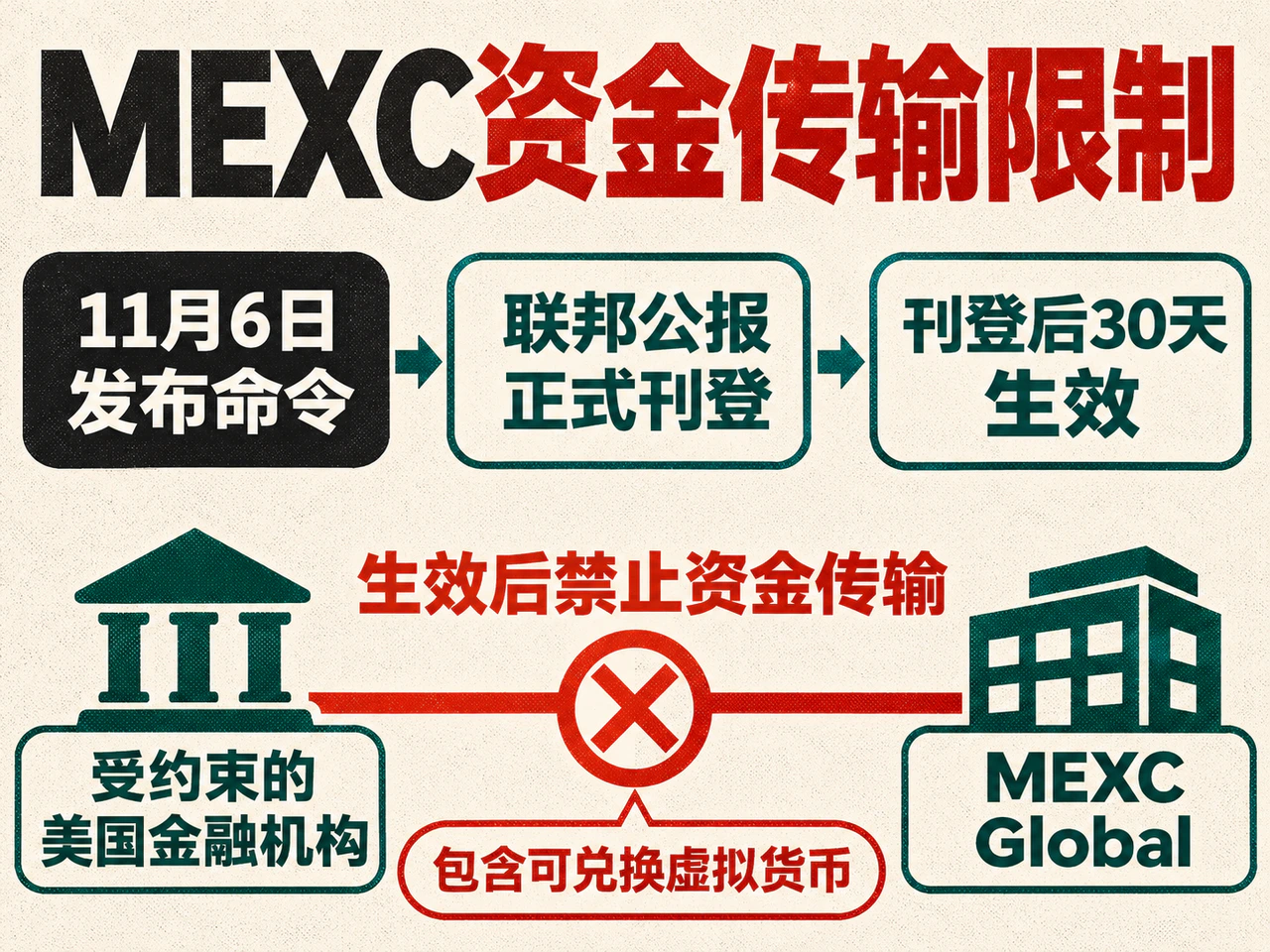
The other document directly targets a platform's funding channels. In its November 6 announcement, the U.S. Treasury Department said FinCEN had issued an order under the relevant statutory authority prohibiting covered U.S. financial institutions from transmitting funds to or from MEXC Global. The order's definition of funds includes convertible virtual currency.
The restrictions do not take effect upon announcement. Both the Treasury announcement and the text of the order specify that the order becomes effective 30 days after formal publication in the Federal Register. The currently available public text still contains a placeholder for the publication date. November 6 therefore does not mark an immediate closure of the relevant channels, and the specific effective date remains to be determined following formal publication.
Treasury said MEXC processed at least $16 billion in funds associated with sanctions evasion, cybercrime and other illicit activities between May 2021 and May 2026. These are findings and allegations presented by U.S. regulators in this enforcement action. The figure covers a five-year period; it is neither a one-day outflow on November 6 nor a measure of customer asset losses. Assessing the direct impact on the platform's operations will require watching whether partner financial institutions stop processing the relevant funds, how other trading venues assess counterparty exposure, and the routes customers take to migrate.
The order governs U.S. financial institutions' handling of funds transfers involving MEXC; it does not mean that every jurisdiction worldwide is simultaneously closing the platform. Its economic effects may nevertheless extend beyond its direct legal reach. Partners with exposure to the U.S. financial system will re-examine payment routes and counterparties, while the platform will have to address channel adjustments, compliance checks and pressure on customer confidence. These are operational risks whose effects remain to be observed; reliable data on their actual scale are not yet available.
Taken together, the two measures show that regulatory changes facing digital-asset institutions are not moving uniformly toward either easing or tightening. Withdrawal of the earlier proposal shelves one category of additional obligations covering a broad range of transfer activity, while the MEXC order makes scrutiny of specific counterparties and funding channels more important. The key developments to monitor are the order's formal publication and effective-date arrangements, public responses from the platform and its partner institutions, and whether FinCEN proposes a new information-collection framework.
Click “Read the original” for further details.