On November 6, 2026, a much stronger-than-expected US employment report for October pushed Treasury yields and the dollar higher, weighing on gold, while chip stocks that had been sold off the previous day led a recovery in US equities. The improvement in hiring brightened the outlook for corporate revenue while extending the constraints that high interest rates place on valuations and financing. The divergence across equities, bonds and commodities reflects a market seeking a new balance between resilient demand, the cost of capital, returns on AI investment and the recovery in energy supplies.
October payroll gain of 165,000 lifts Treasury yields as November inflation expectations ease
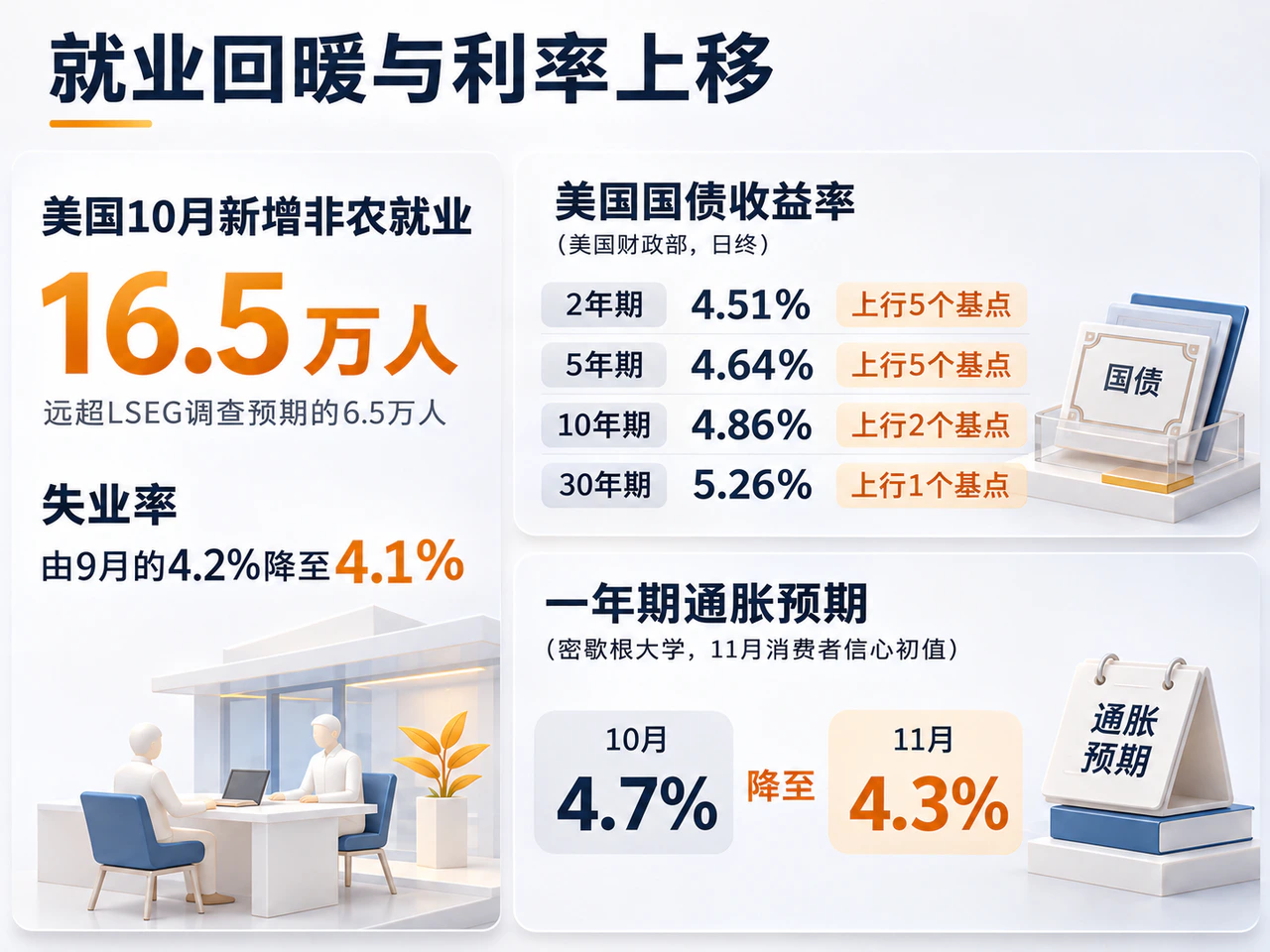
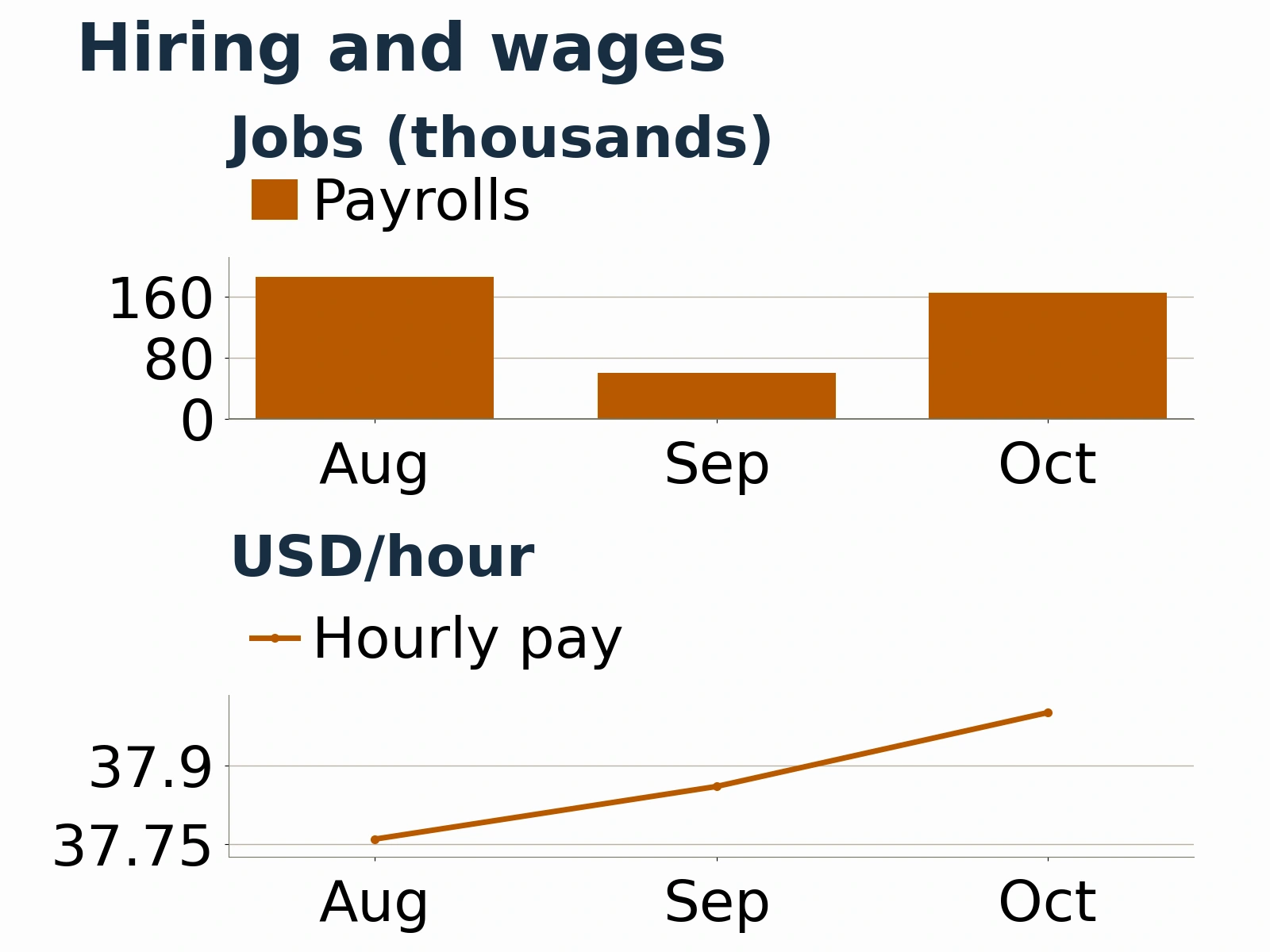
US nonfarm payrolls rose by 165,000 in October, far above the 65,000 expected in an LSEG survey, while the unemployment rate fell from 4.2% in September to 4.1%. August and September payroll gains were revised to 186,000 and 60,000, respectively, a combined upward revision of 84,000. Average hourly earnings in the private sector rose 0.4% month on month, above the 0.3% expected by LSEG, and 3.1% year on year. Stronger hiring and wages reduced the urgency for a monetary policy pivot forced by a pronounced economic slowdown.
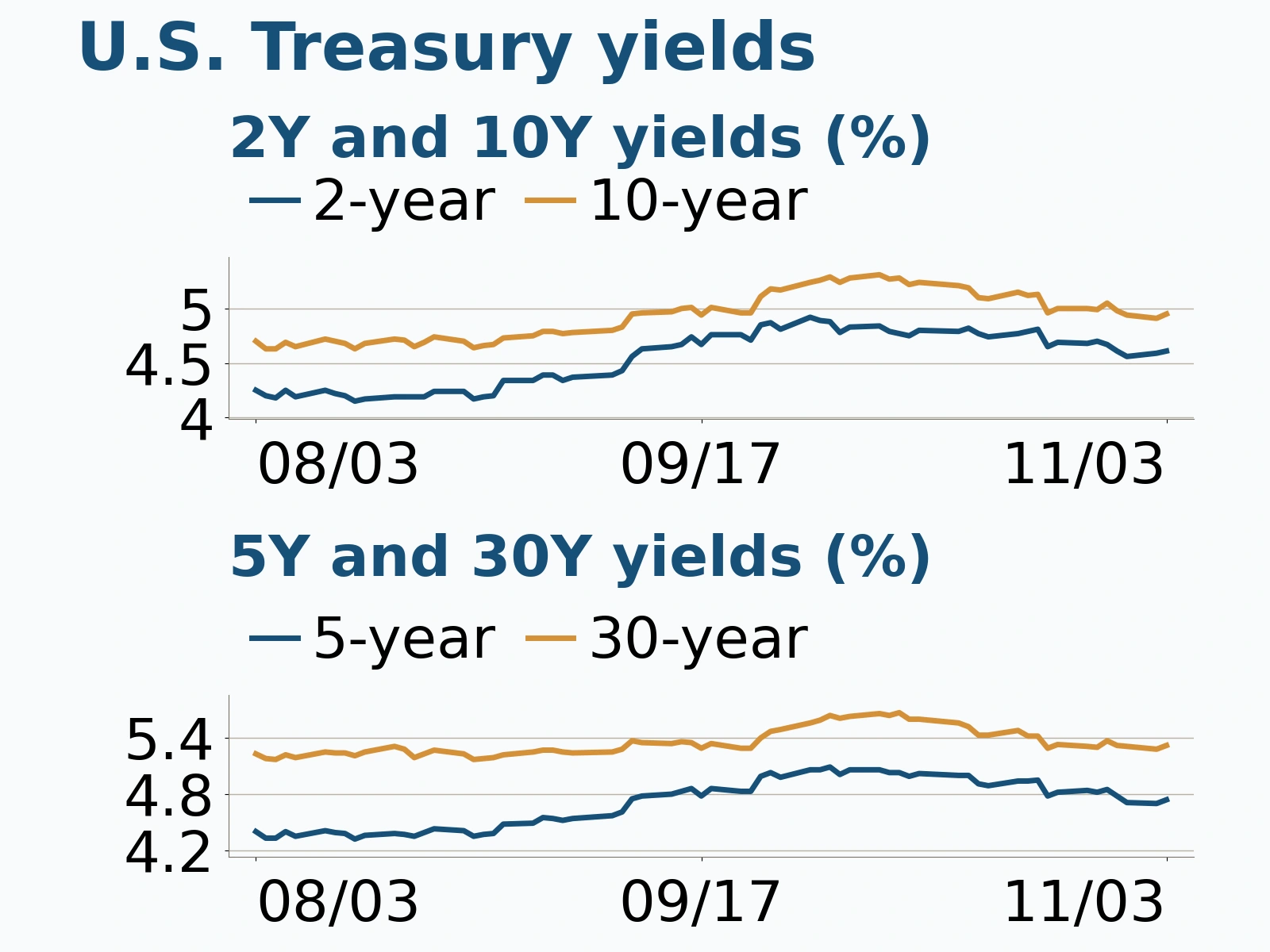
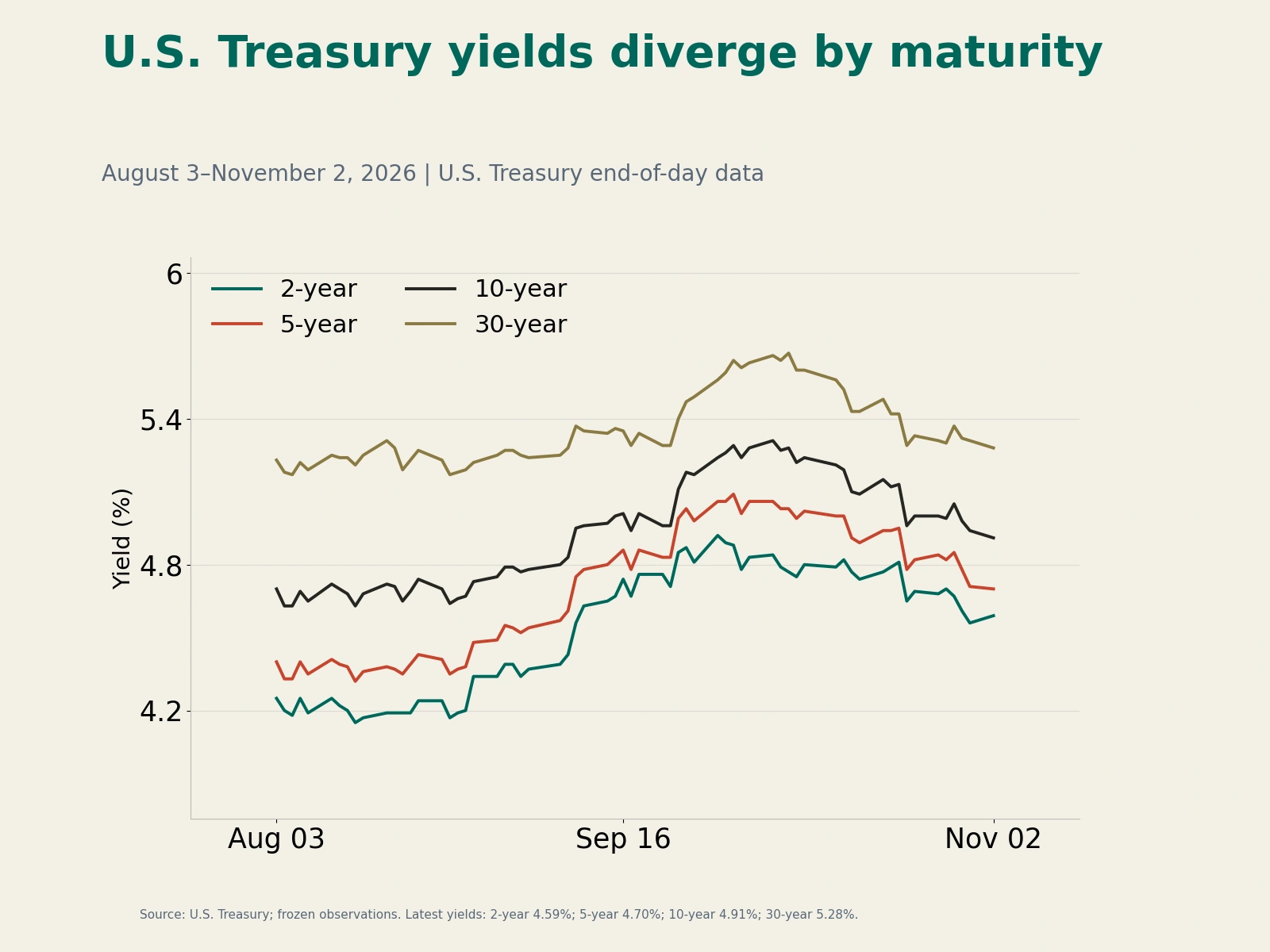
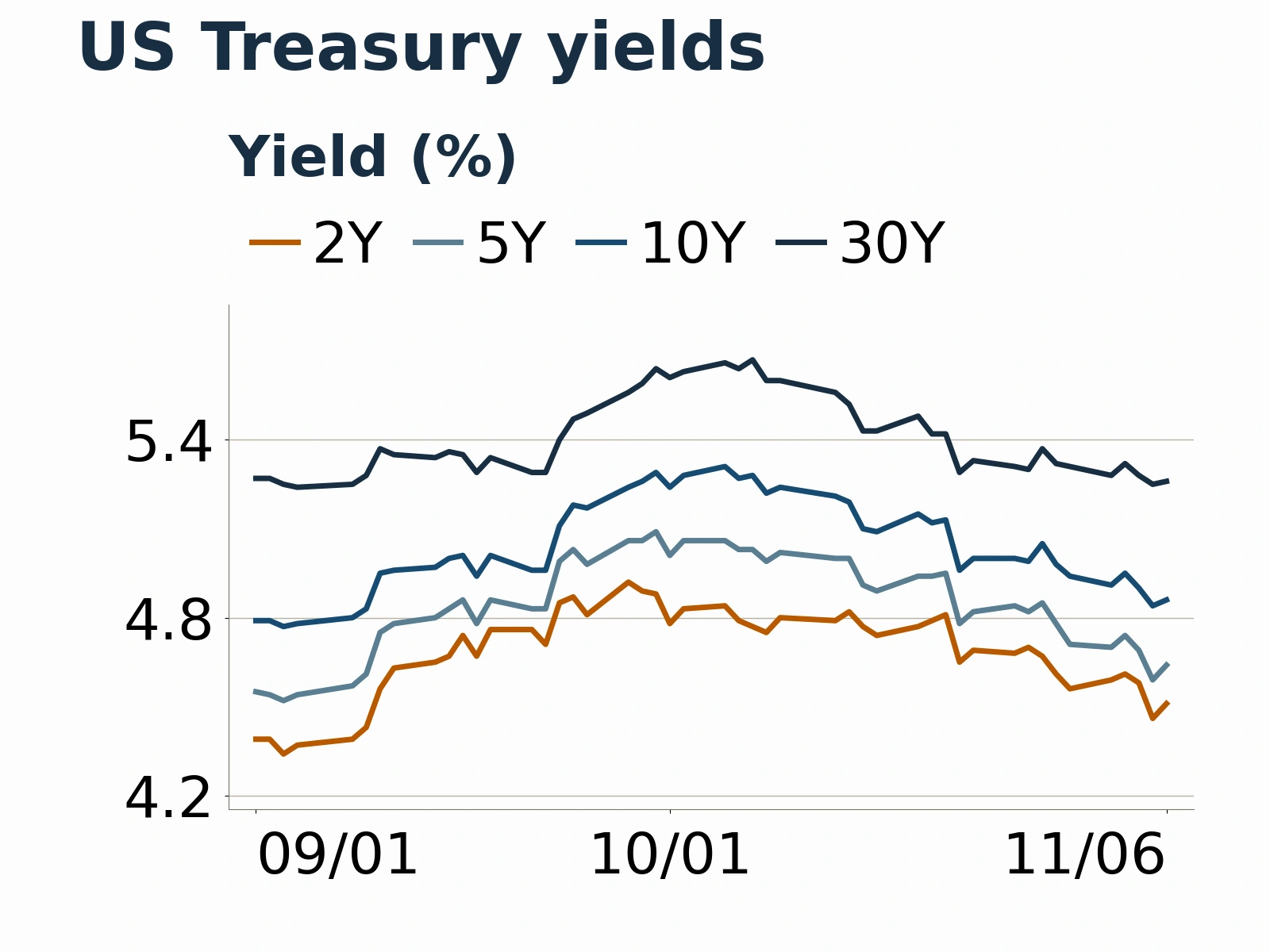
The Treasury market reaction was concentrated at the short and intermediate maturities. On a consistent basis using the US Treasury's November 6 and November 5 end-of-day curves, the 2-year and 5-year yields both rose 5 basis points to 4.51% and 4.64%, respectively. The 10-year and 30-year yields rose 2 basis points and 1 basis point to 4.86% and 5.26%. The 10-year–2-year spread narrowed from 38 basis points to 35 basis points. ALM First's intraday chronology shows that Treasuries had already been selling off modestly before the payroll release, after which the rise in front-end yields accelerated markedly, corroborating the role of the employment data in repricing the near-term policy path.
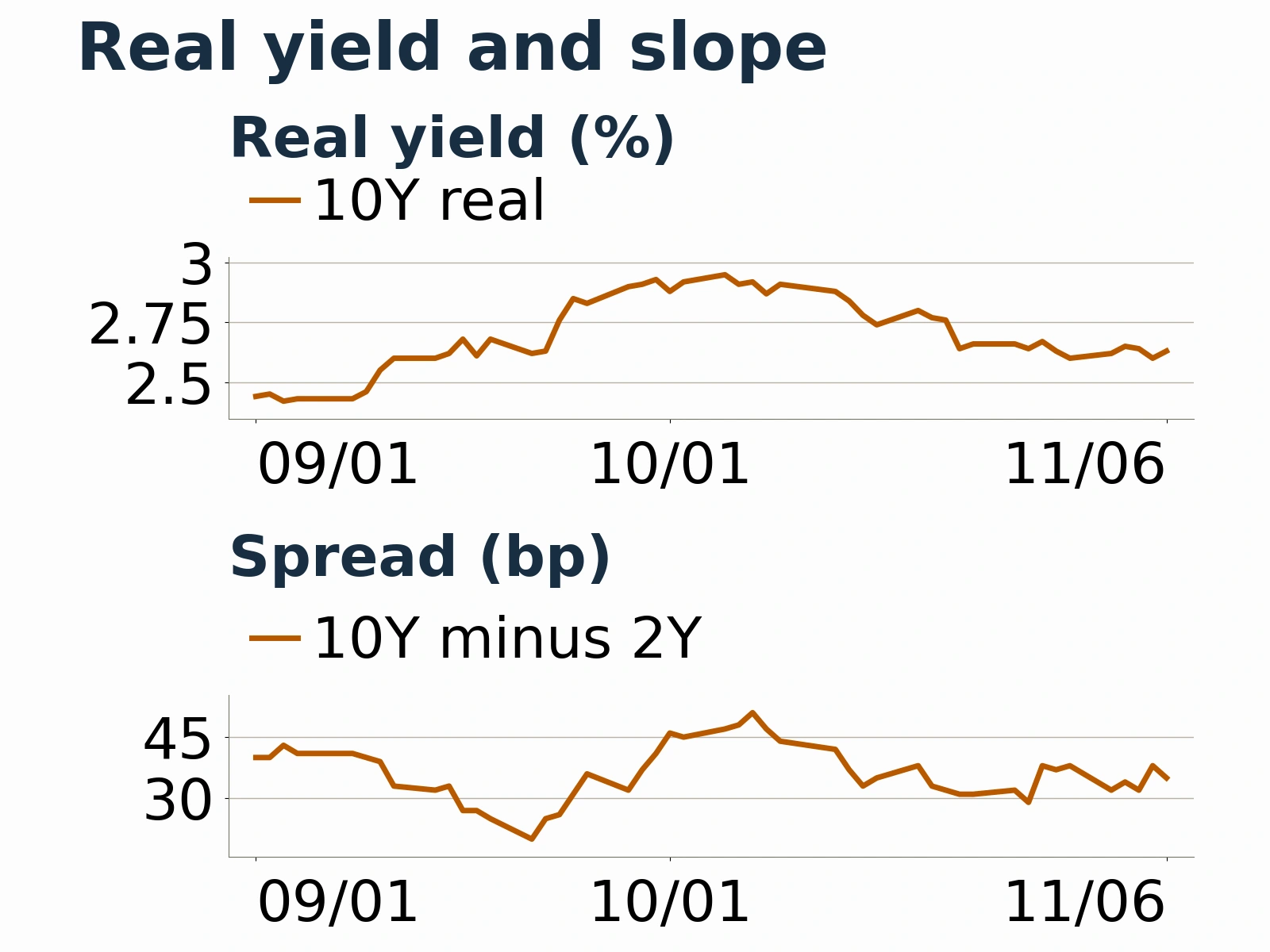
Real yields also moved higher. The Treasury's 10-year real yield rose from 2.60% to 2.63%, slightly more than the increase in the nominal yield. The spread obtained by directly subtracting the real yield curve from the nominal curve, which includes inflation compensation as well as liquidity and risk premiums, edged down from 2.24% to 2.23%. This indicates that the day's adjustment in long-term bonds primarily reflected a higher real discount rate, without a corresponding widening in inflation-related compensation.
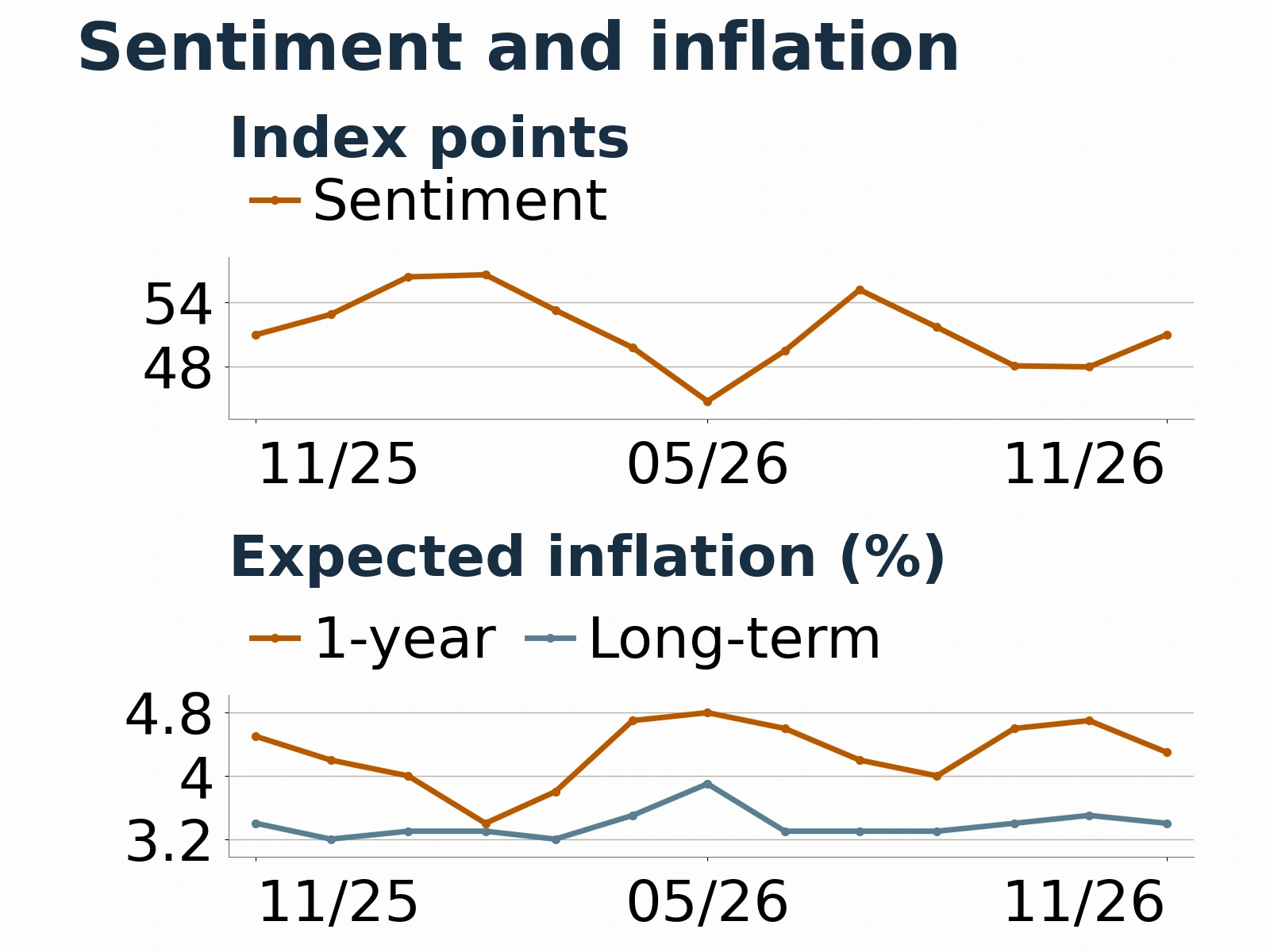
Household expectations improved modestly. The University of Michigan's preliminary November consumer sentiment index rebounded from 48.0 in October to 51.0. One-year inflation expectations fell from 4.7% to 4.3%, and long-term inflation expectations declined from 3.5% to 3.4%. The breadth of the improvement in consumption prospects remained constrained, however: sentiment was still below February's 56.6, and 57% of respondents spontaneously mentioned high prices eroding their living standards. The employment report also showed that involuntary part-time employment increased by 339,000 to 4.8 million, indicating persistent pressure from insufficient working hours and the cost of living.
Markets are awaiting the October US CPI release on November 10. If realized inflation eases alongside expectations, labor-market resilience will translate more directly into improved corporate cash flow. If price pressures remain strong, resilient growth will give monetary policy room to keep fighting inflation, sustaining a higher discount rate for valuations.
Semiconductors lead US stocks higher as heavy tech bond issuance and shifting orders expose divisions in AI
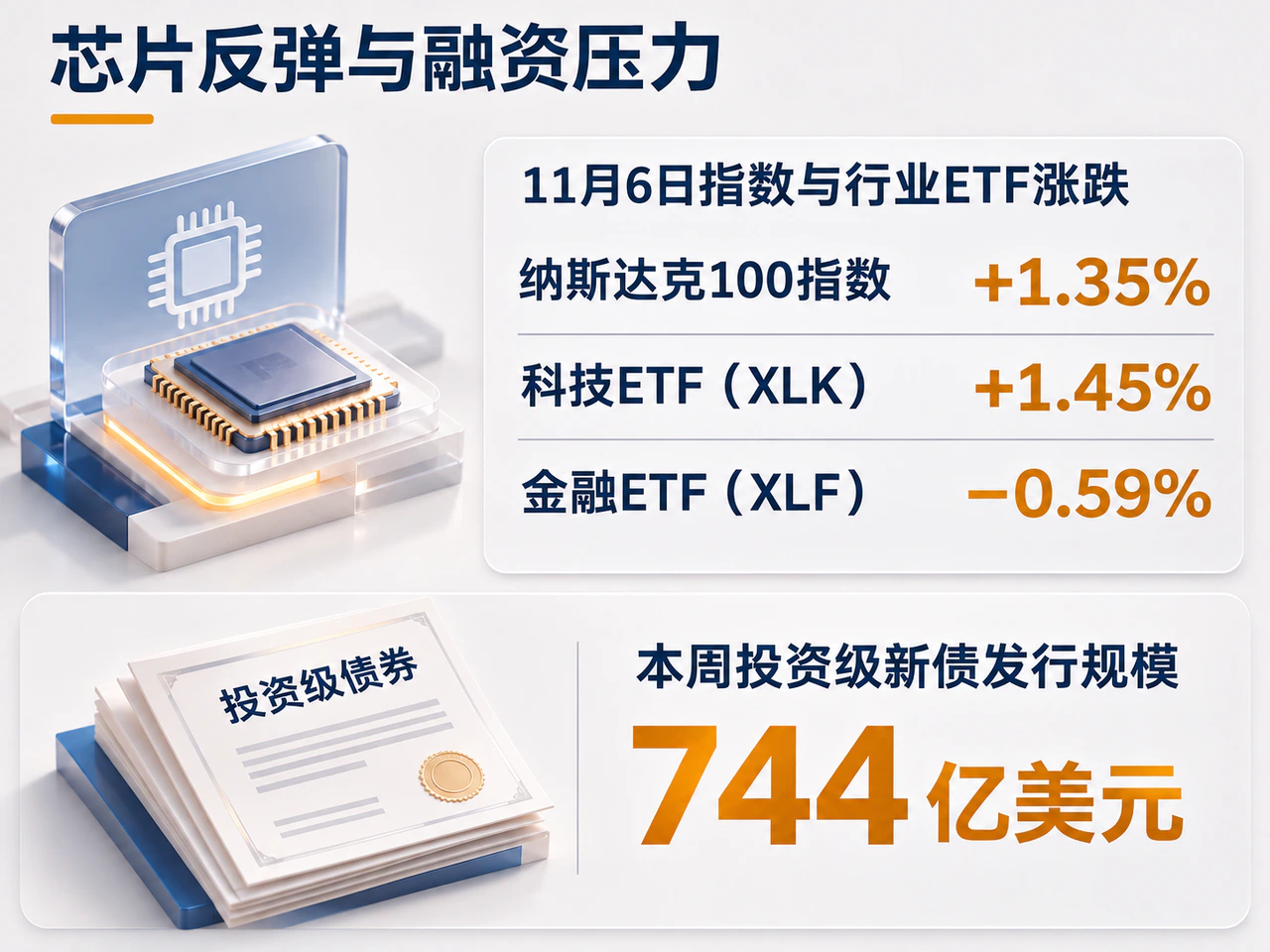
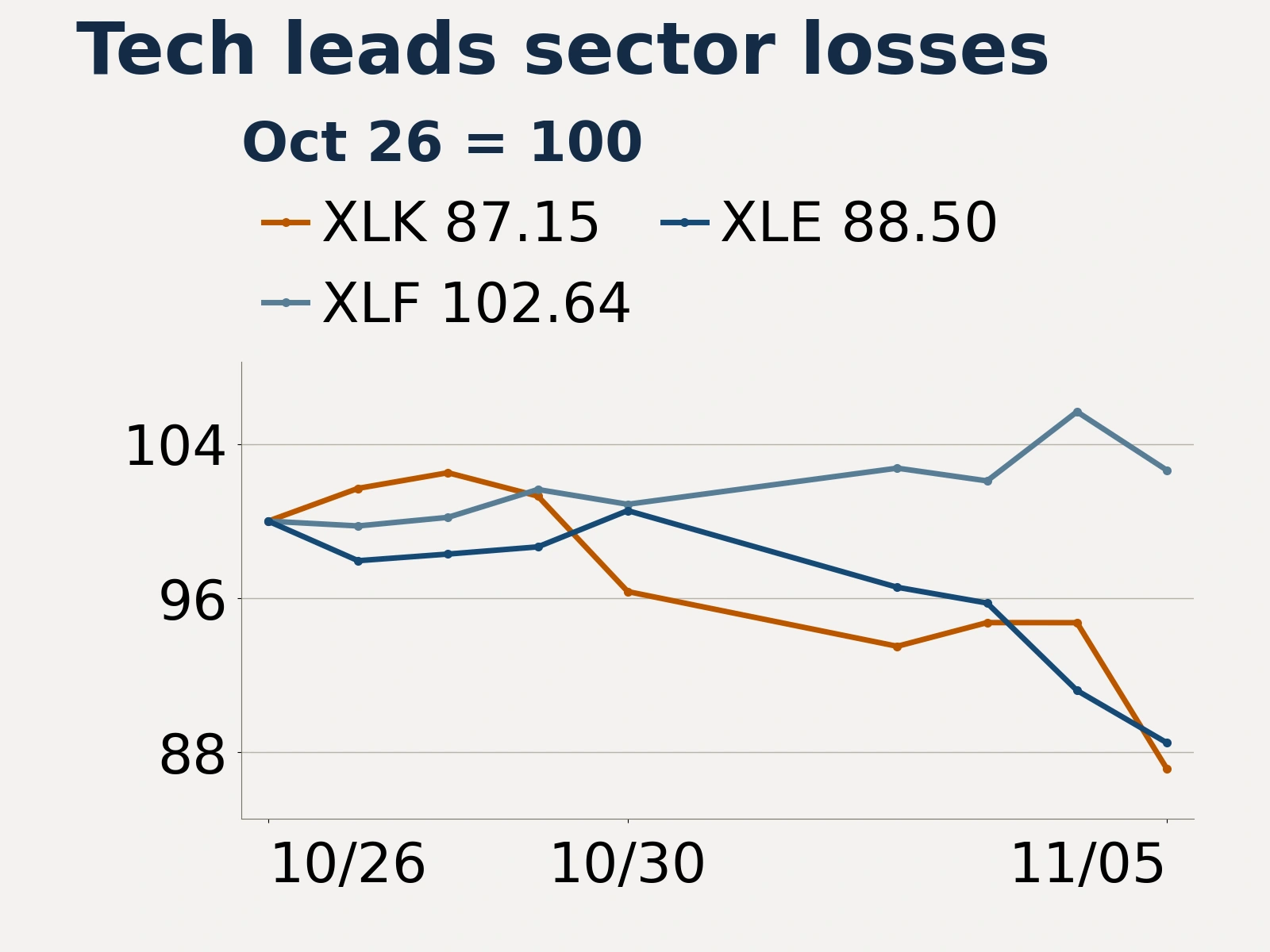
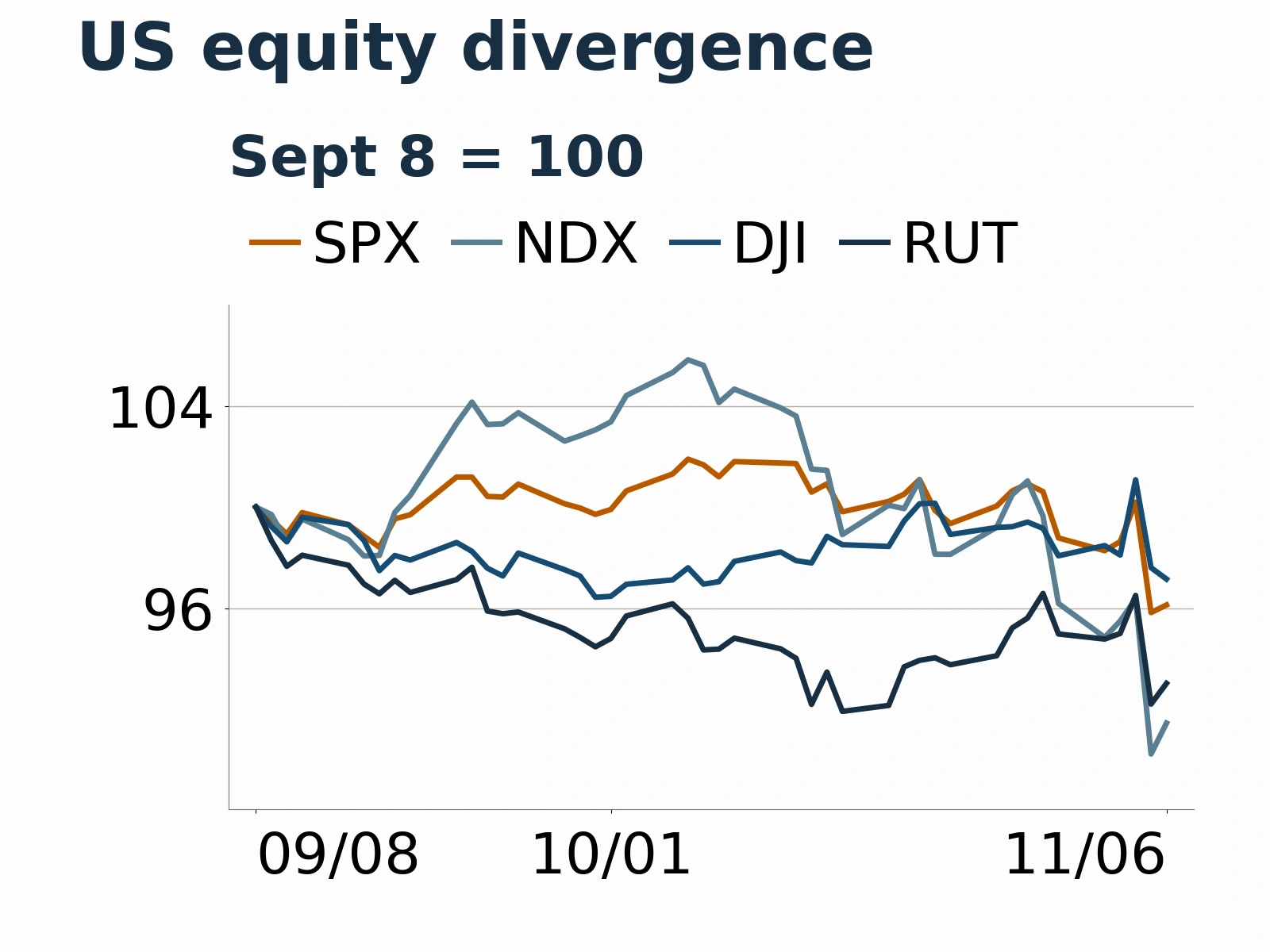
The three major US equity benchmarks diverged on Friday: the S&P 500 rose 0.31% to 7,376.86, the Nasdaq 100 gained 1.35% to 26,989.99, and the Dow Jones Industrial Average fell 0.46% to 51,285.73. Small caps also recovered, with the Russell 2000 up 0.89%. At the sector level, the technology ETF XLK rose 1.45%, while the financial ETF XLF fell 0.59%. The VIX volatility index retreated from 28.18 to 25.64, indicating some easing in the sharp rise in risk aversion seen earlier.
Semiconductors were the main force behind the market recovery. Closing data showed the semiconductor index jumping 4.2%, Nvidia rising about 2.8%, and AMD surging roughly 11%. CNBC cited Bank of America analysts as saying that the recent correction in AI hardware mainly reflected valuation multiple compression, with no cuts to their medium- and long-term earnings forecasts for the companies they cover. That divergence between fundamental expectations and falling share prices helped support Friday's rebound.
Yet the buildout of computing capacity and the allocation of orders within the AI supply chain are changing. On November 6, CNBC, citing people familiar with the matter and a Bloomberg report, said Microsoft was considering reducing the number of emerging cloud providers it works with and withdrawing from some arrangements to lease computing capacity from Oracle. This means markets can no longer conflate end-user AI demand, cloud providers' own capacity buildouts and orders awarded to third-party suppliers. Whether aggregate industry demand turns into revenue for a particular company increasingly depends on customer choices and the pace at which projects are delivered.
Uneven earnings delivery was also evident in trading around results. Cloudflare shares jumped about 10% on Friday after its earnings release following the November 5 close; Airbnb rose roughly 12% after raising its guidance, while DraftKings plunged about 21%. FactSet's figures as of November 6 showed that, among the 88% of S&P 500 companies that had reported third-quarter results, 84% beat earnings-per-share estimates. The aggregate earnings beat was only 2.7%, however, below the five-year average of 7.5%. Combining reported results with estimates for companies yet to report, third-quarter S&P 500 earnings were growing 31.4% year on year. With strong aggregate earnings growth but a narrower margin of outperformance, high valuations continue to demand a great deal from incremental earnings delivery.
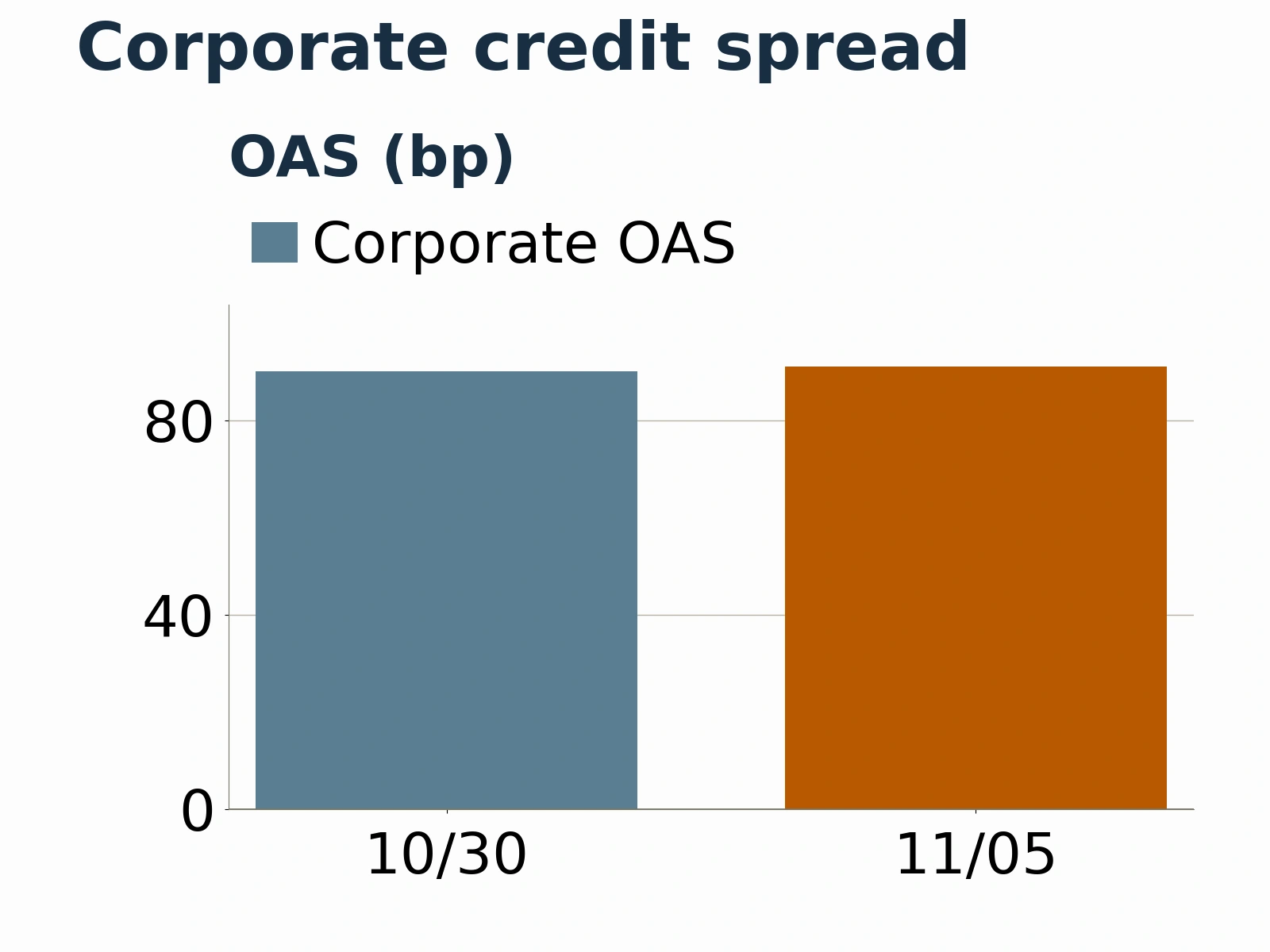
Credit markets reflected the financing pressure associated with technology capital spending. Cincinnati Asset Management's weekly review, published on November 6, put the corporate bond index option-adjusted spread, or OAS, at 91 basis points on November 5, above 90 basis points at the previous week's close and 80 basis points in early October. New investment-grade bond issuance for the week reached $74.4 billion, far exceeding the market's $45 billion estimate, driven mainly by technology giants including Oracle, Meta and Apple. Surging bond supply and wider credit spreads subject technology equity investments to the twin challenges of expanding financing needs and a rising cost of capital.
This credit pressure has spread to the Asian dollar bond market. Bloomberg reported on November 6 that SoftBank's dollar bonds due in 2032 fell 1.5 cents, while traders said yield premiums on Asian dollar bonds widened by at least 3 basis points. The cumulative widening in credit spreads, combined with Friday's rise in benchmark Treasury yields, indicates that a sustained recovery in AI-related assets still needs support from financing conditions. Although the equity rebound improved short-term sentiment, creditors continue to scrutinize companies' construction spending, customer orders and debt-servicing capacity.
A stronger dollar and higher rates weigh on gold as easier physical crude supply tempers inflation concerns
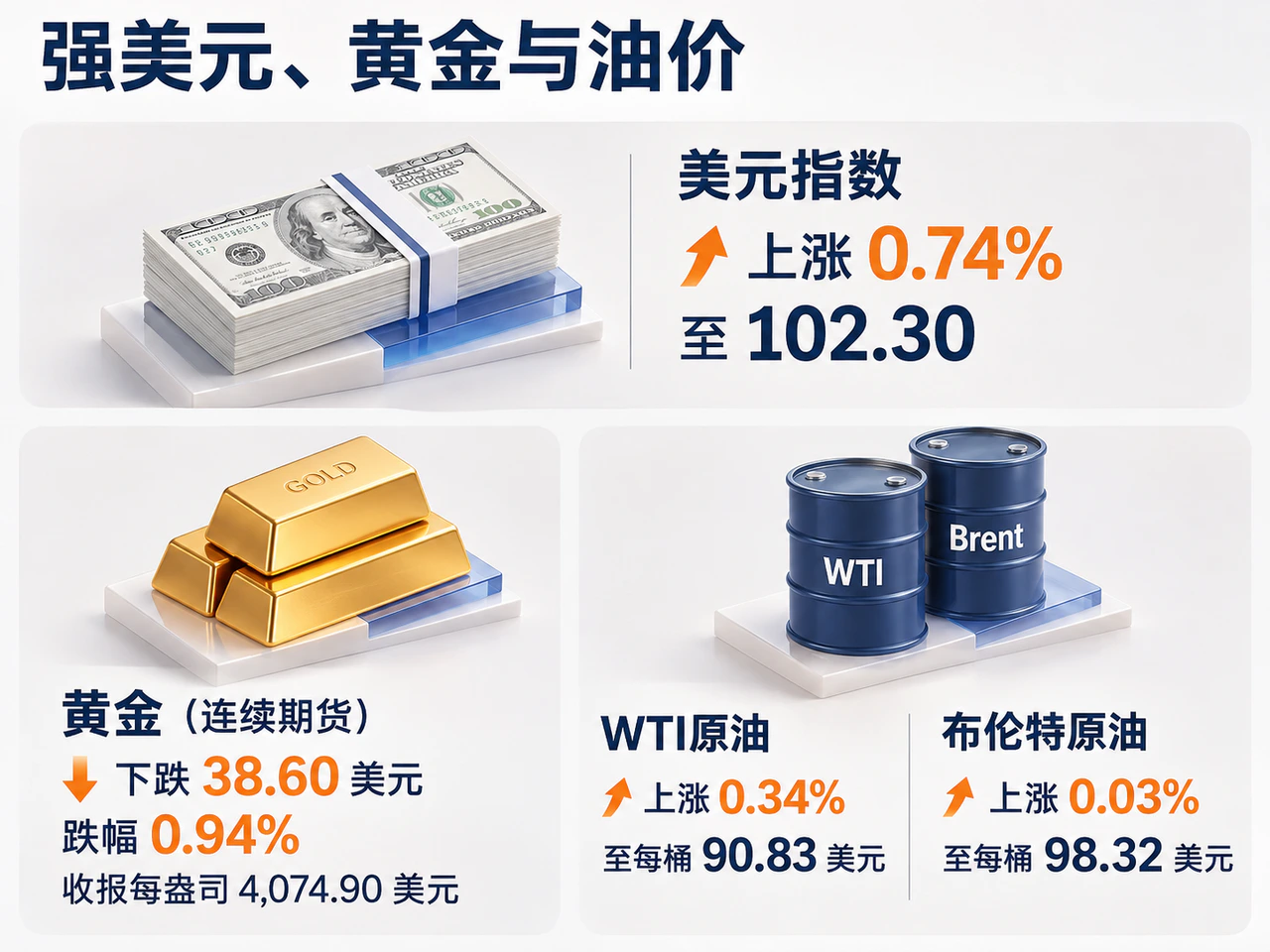
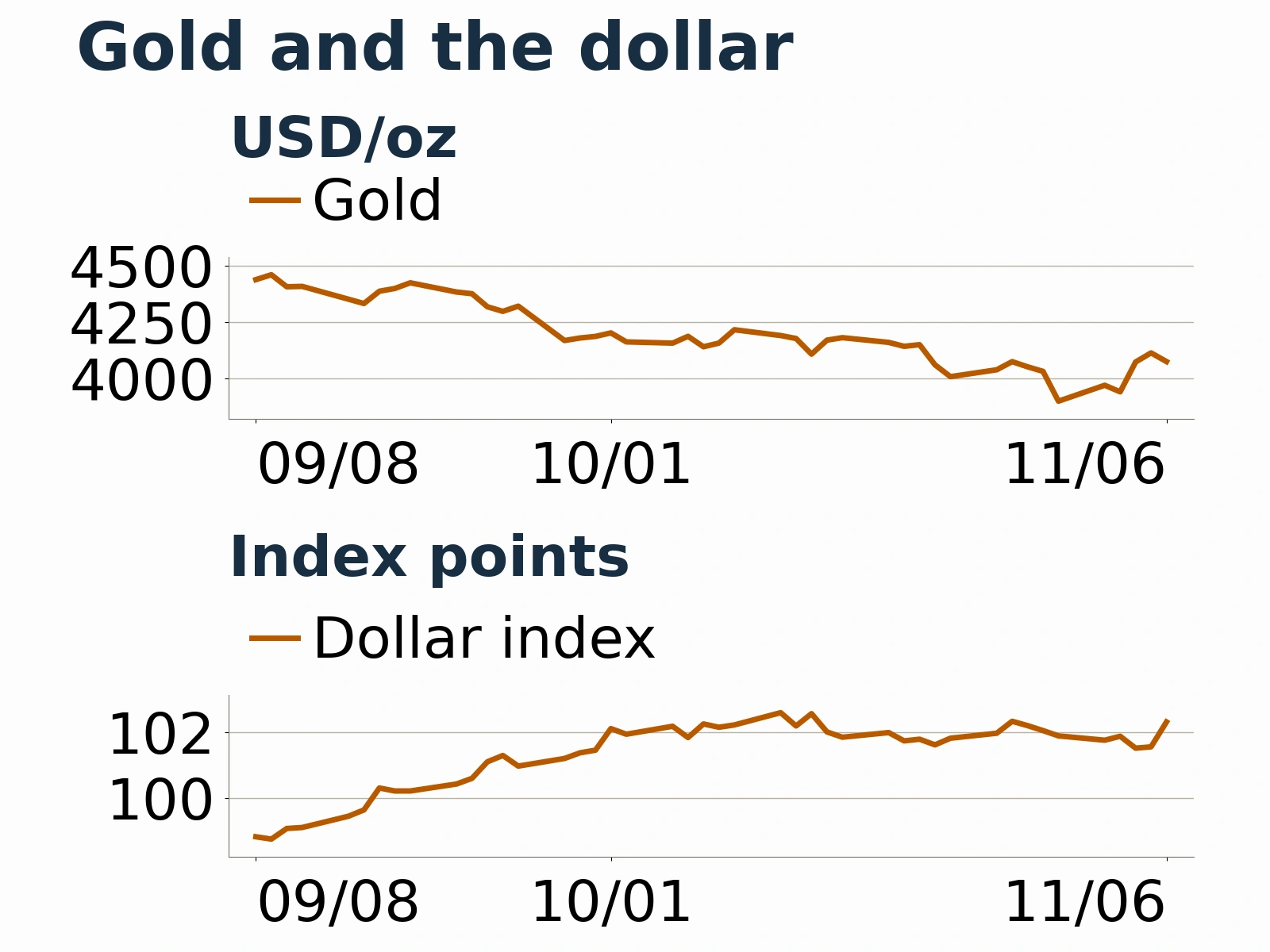
The dollar index rose 0.74% to 102.30 on November 6, supported by higher Treasury yields. On the continuous-futures provider's daily closing basis, gold fell $38.60, or 0.94%, to $4,074.90 per ounce. Dollar strength increased the cost of buying gold for non-dollar buyers, while higher real yields raised the opportunity cost of holding the non-interest-bearing metal, putting joint pressure on its price. Physical demand nevertheless provided support at lower levels: Reuters reported that falling gold prices had stimulated retail buying in India ahead of Diwali.
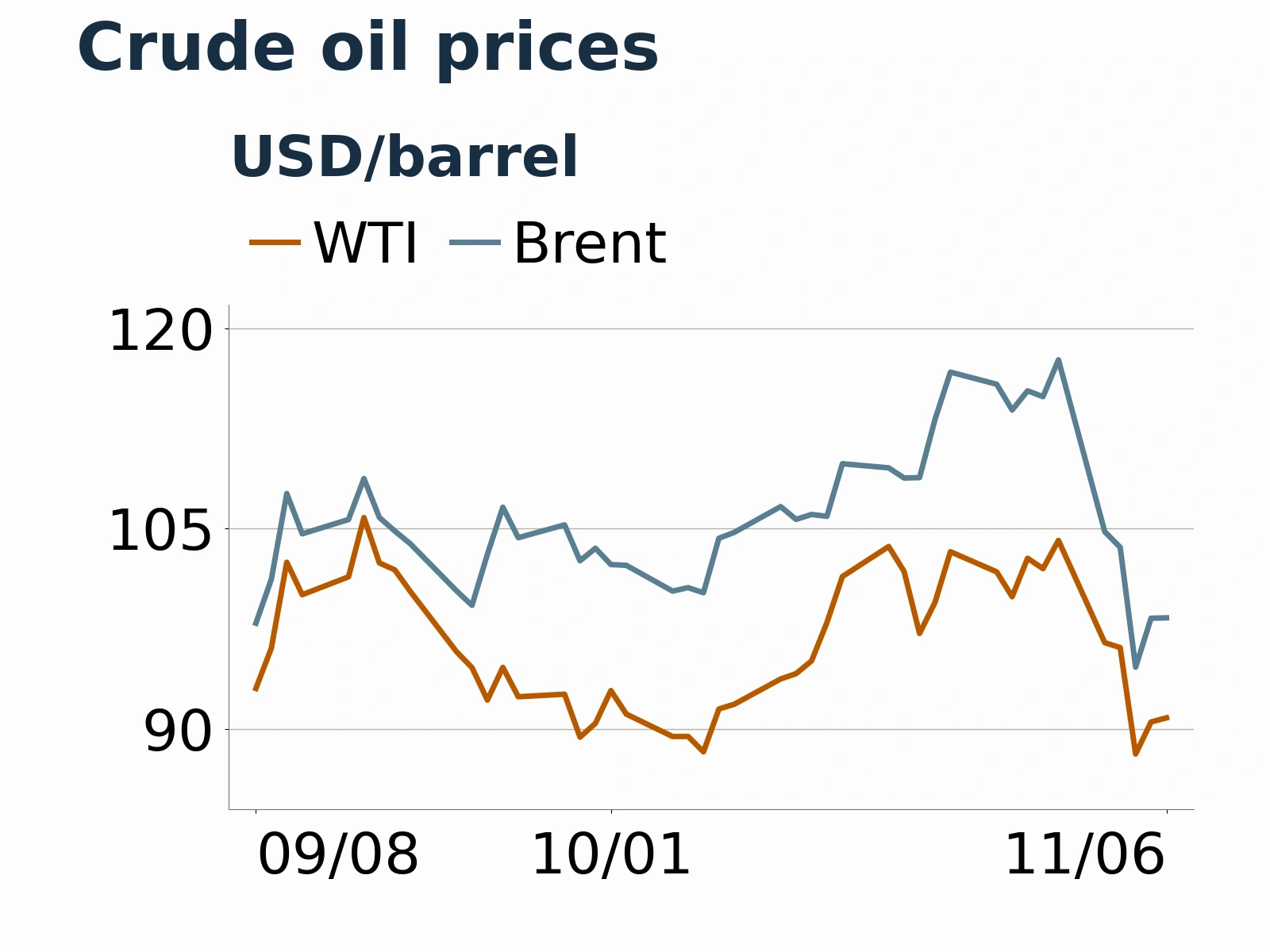
International oil prices edged higher on the day. On the same daily closing basis, WTI crude gained 0.34% to $90.83 per barrel, and Brent rose 0.03% to $98.32 per barrel. The relationship between physical and futures prices showed early signs of easier physical supply. According to Reuters, near-term weekly Brent contracts for differences had moved into contango, with delivery this week priced below delivery next week, while the forward futures curve from January 2027 delivery onward remained in backwardation, with nearer deliveries priced above later ones. Improving immediate supply coexists with risks to future deliveries, limiting the extent of oil prices' response to recovering supply.
Institutions still differ in their assessments of the extent to which global oil supply and demand have recovered. JPMorgan estimated an October global oil surplus of 1.4 million barrels per day. Goldman Sachs judged the market to have been broadly balanced in September and October, with global inventories no longer declining as they had previously. Shipping data reveal differences in the recovery across the supply chain: Vortexa estimated that Gulf crude and condensate exports in October had recovered to about 86% of their prewar level, while refined-product exports were only slightly above half of normal. The faster recovery in crude supply than in refined products means relief from downstream energy costs is still arriving with a lag.
New data released over the weekend provided further evidence of recovering crude supply. A Bloomberg survey published on the evening of November 7, Beijing time, showed that OPEC crude production rose by 930,000 barrels per day month on month in October to 22.8 million barrels per day, led by higher Saudi output. That was about 88% of the February output of the same member countries. The geopolitical risk premium has not fully dissipated, however. Axios, citing people familiar with the matter around the same time, said indirect US–Iran talks were progressing slowly. Whether diplomatic arrangements can be implemented will continue to affect expectations for energy supply through shipping security in the Strait of Hormuz. If crude and refined-product flows continue to recover, lower energy costs could cushion household consumption and corporate profits, in turn influencing the inflation path and the length of time that high interest rates remain a constraint.
Treasuries turn to year-end funding and the debt ceiling as an export-control extension clarifies the compliance window

With the US midterm elections concluded, markets' focus on fiscal risk is shifting from the election outcome to the December 11 government funding deadline and subsequent debt-ceiling arrangements. Institutional views compiled by Reuters pointed to two countervailing forces: divided government could restrain new large-scale fiscal expansion, while political bargaining over appropriations and borrowing authority could increase uncertainty around short-term financing. Moody's argued that the US medium- and long-term debt trajectory, driven by mandatory spending, population aging and interest costs, might not change materially as a result of the election.
For bond markets, the scale of medium- and long-term issuance and liquidity risks around imminent deadlines operate through different channels. BMO rates strategist Vail Hartman noted that, unless the debt ceiling is adequately addressed before year-end, political gridlock in 2027 could distort the pricing of Treasury securities maturing near the projected cash-exhaustion date, or X-date. As the corporate bond market absorbs heavy issuance, the Treasury's refinancing arrangements and money-market liquidity will become another key variable determining overall financing conditions.
The technology supply chain has gained a clearly defined regulatory breathing space. The US Commerce Department's Bureau of Industry and Security, or BIS, has submitted a final rule extending the suspension of the Affiliates Rule until January 10, 2027, with the extension scheduled to take effect on November 9, 2026. The rule was intended to extend certain export controls automatically to subsidiaries owned 50% or more, individually or in aggregate, by listed entities. The extension helps affected companies organize near-term compliance screening and order deliveries, while other existing export-control measures remain in force.
Markets are also beginning to factor the direction of industry regulation following the change in Congress into valuations. A November 6 Scotiabank research report identified the costs of additional energy demand, bank capital requirements and oversight of nonbank finance as key areas to watch. For AI infrastructure projects, the mechanism for allocating the costs of electricity and supporting grids will directly affect investment returns. For banks and private credit providers, capital requirements and the scope of regulation will determine their capacity to meet the enormous financing needs of the technology sector.
Japanese and Korean stocks slump under earlier selling pressure as China accelerates disbursements to improve cash flow
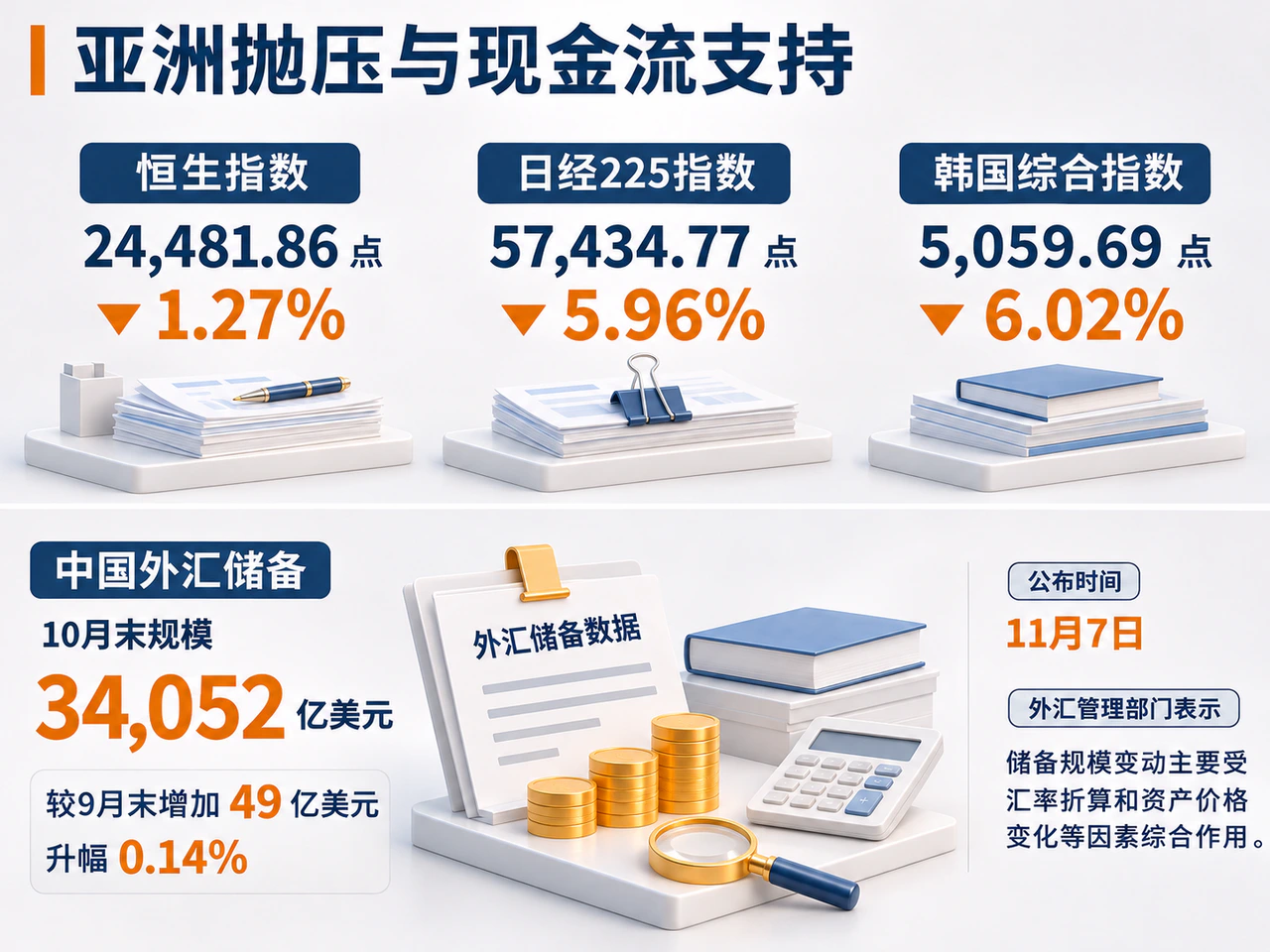
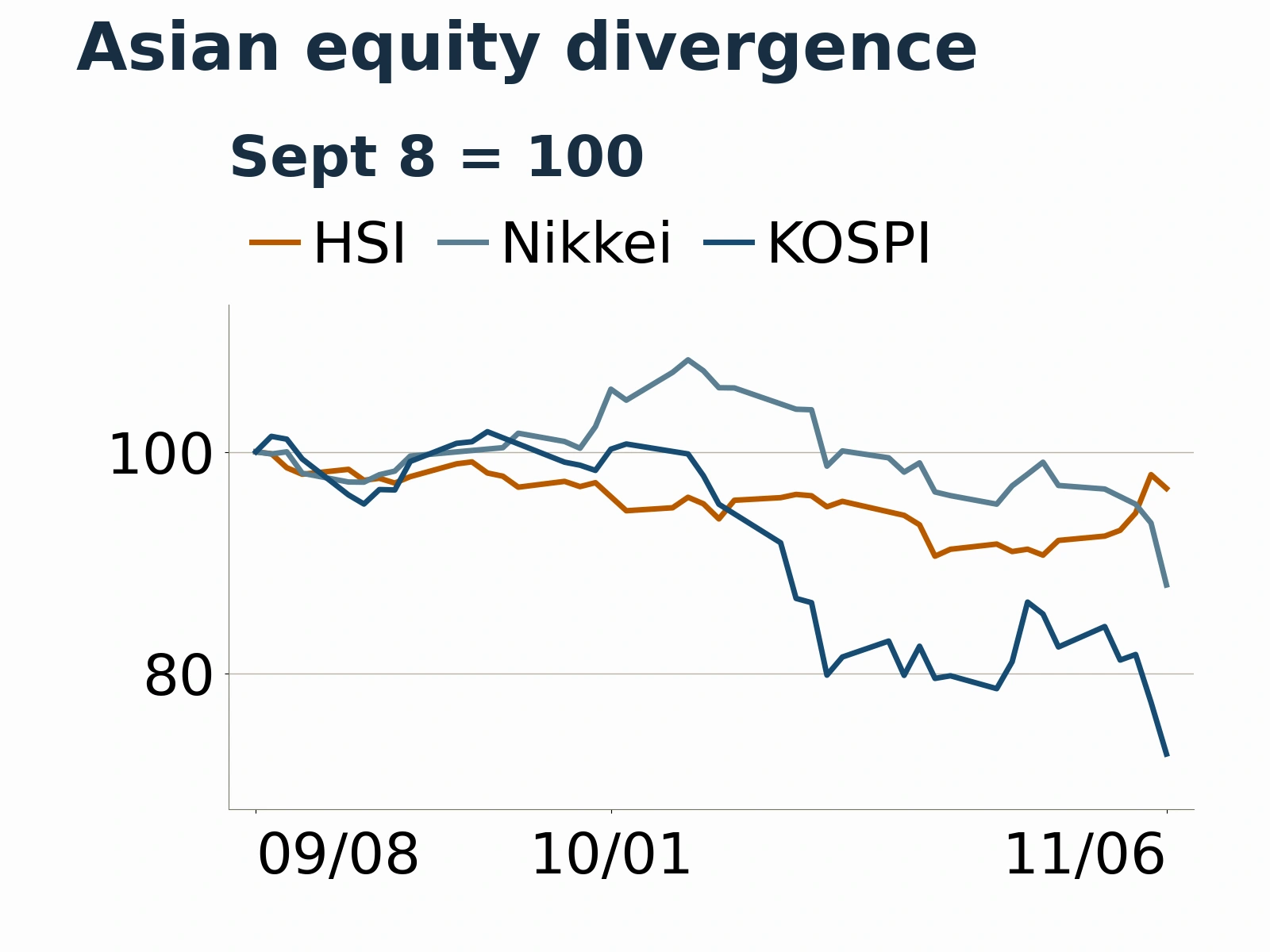
Because of time-zone differences, Asian markets on November 6 were mainly absorbing the previous day's global technology selloff; their trading sessions preceded Friday's rebound in US equities. The Hang Seng Index fell 1.27% to 24,481.86, the Nikkei 225 plunged 5.96% to 57,434.77, and South Korea's KOSPI tumbled 6.02% to 5,059.69. Japanese and Korean markets faced a more severe selloff across the semiconductor supply chain. Any boost to Asian markets from Friday's recovery in US chip stocks will emerge in subsequent sessions, and transmission channels differ: Japanese semiconductor equipment makers and Korean memory-chip producers are more directly tied to global AI capital spending and the orders they actually secure, while Hong Kong technology shares are driven more by global growth-stock valuation levels and foreign investors' risk appetite.
Amid a complex external environment, China's domestic policy is focused on unblocking funding channels and improving corporate cash flow. The State Council executive meeting on November 6 called for faster construction of major projects and the "six networks," support for equipment upgrades and investment in intangible assets, full use of policy funds, timely and full disbursement of payments due to local authorities and enterprises, and stronger coordination of policies across years. The emphasis is on improving the efficiency with which existing funding is paid out and implemented. The effects on companies' cash collections, project construction and orders along supply chains will emerge gradually.
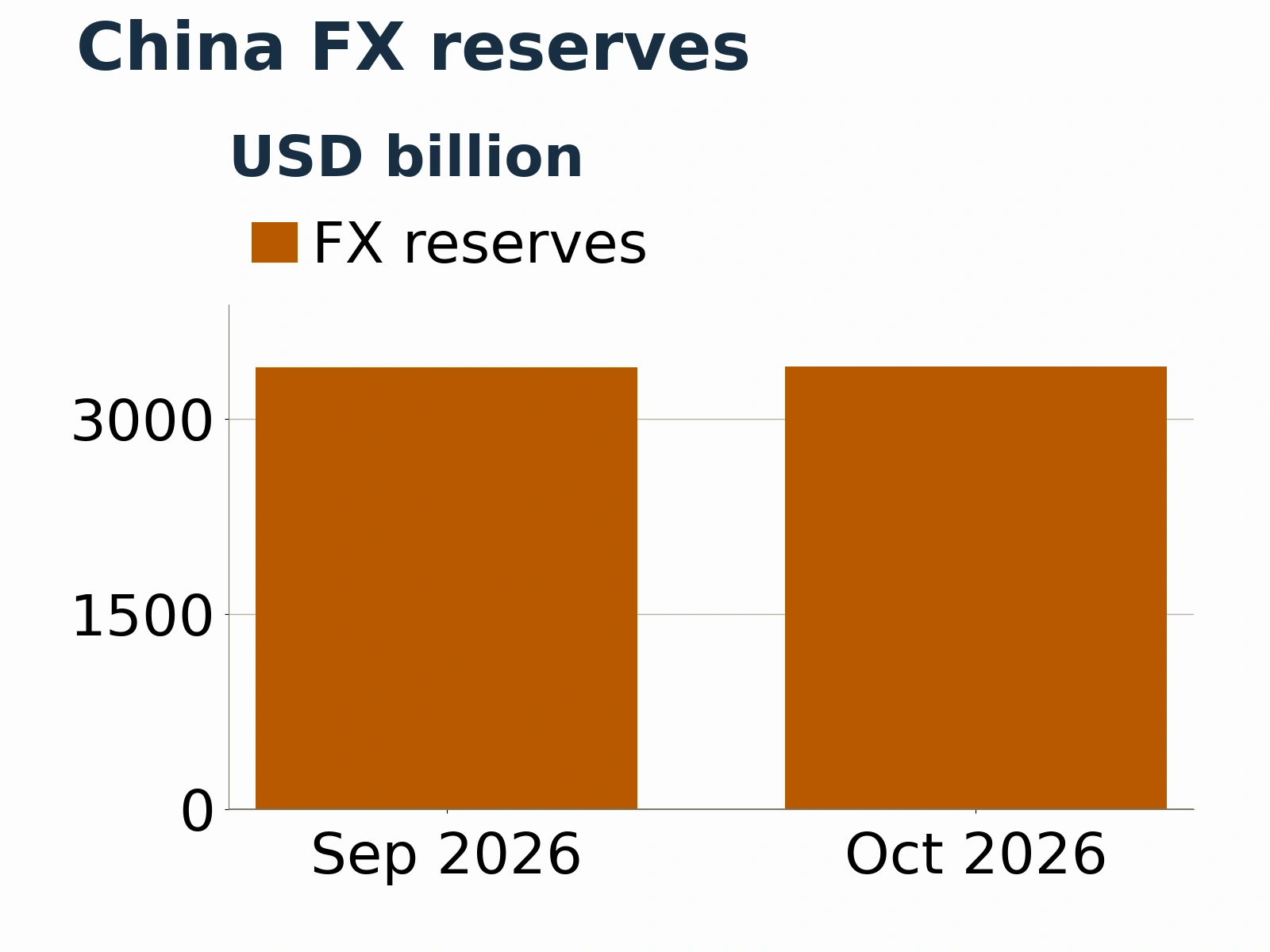
The external buffer also remains solid. Data released on November 7 showed China's foreign exchange reserves at $3,405.2 billion at the end of October, an increase of $4.9 billion, or 0.14%, from the end of September. The foreign exchange authorities said the change mainly reflected the combined effects of exchange-rate translation and changes in asset prices. With highly valued global assets under pressure and dollar financing conditions tightening, stable foreign exchange reserves provide an external cushion, while faster fiscal disbursements aim to repair domestic cash flow. Together, they provide important fundamental support for assessing the resilience of local Asian assets.