On November 2, 2026, Iran’s Foreign Ministry said the Strait of Hormuz could reopen within two days if the United States agreed to Iran’s terms. During the week of November 2–8, Qatar continued relaying proposals, while U.S. forces carried out limited strikes on Qeshm Island and announced the formation of the Iron Gate task force to curb the movement of certain goods and funds across Iran’s land borders and through the Caspian Sea. Diplomatic contacts left room for de-escalation, but the two sides had yet to agree on the order in which to address shipping arrangements, sanctions and the nuclear issue.
Both sides are trying to turn the pressure they can exert into terms for a deal. Iran has tied reopening the strait to demands including sanctions relief and the release of frozen assets. The United States continues to provide military escorts and blockade Iranian ports while insisting that the nuclear issue be part of the initial talks. Progress depends on whether the two sides can agree on a sequence they can begin to implement.
Iran says the strait could reopen within two days if the U.S. accepts Iran’s terms, which remain unresolved

Early in the week, a Qatari delegation traveled to Tehran for further talks with Iranian Foreign Minister Abbas Araghchi. By November 5, Reuters had reported, citing a senior Iranian official, that Iran had conveyed a proposal covering the nuclear issue to the United States through Qatar. That day in Russia, Rezaei, secretary of Iran’s Supreme National Security Council, said Iran would open the strait and enter talks only if the United States met seven conditions. The disclosed demands included lifting U.S. sanctions, unfreezing Iranian assets and paying war reparations.
Iran wants economic and security concessions first, while the United States wants the nuclear issue on the agenda from the outset. How quickly the strait can reopen depends on when both sides accept the terms for getting started. Qatar has kept a channel open for exchanging proposals, but those exchanges have yet to produce a shipping agreement in force.
Statements after the U.S. midterm elections did little to bring the two sides closer together. Iran’s leadership interpreted the result as a source of pressure on U.S. war policy. Research organizations reviewing Iran’s November 4 statements noted that Tehran also emphasized that changes in U.S. political leadership would have little effect on the fundamentals of Washington’s Iran policy. That assessment makes Tehran more inclined to hold to its existing terms, even as it leaves room for diplomacy.
Limited strikes continue as Iran’s Revolutionary Guard says it has lifted its self-imposed missile range limit

According to research organizations that drew on U.S. accounts and media reports, Iran attempted to attack U.S. military aircraft near Qeshm Island on November 2, and U.S. forces then struck the air defense systems involved. On November 6, Trump confirmed that U.S. forces had carried out limited strikes and said they had destroyed an Iranian air defense installation. Iranian media reported that a missile had hit Qeshm Island. Washington describes these operations as defensive measures to protect commercial shipping. The localized exchanges have left channels for talks open, but every encounter involving ships or military aircraft carries a fresh risk of escalation.
On November 7, a spokesperson for Iran’s Revolutionary Guard said it had lifted a self-imposed limit on missile range, without specifying whether it already had operational missiles that could reach beyond the former limit. The change in deterrence messaging came ahead of any demonstration of that capability.
U.S. strikes a ship to enforce the blockade as Iron Gate seeks to curb flows along overland and Caspian routes

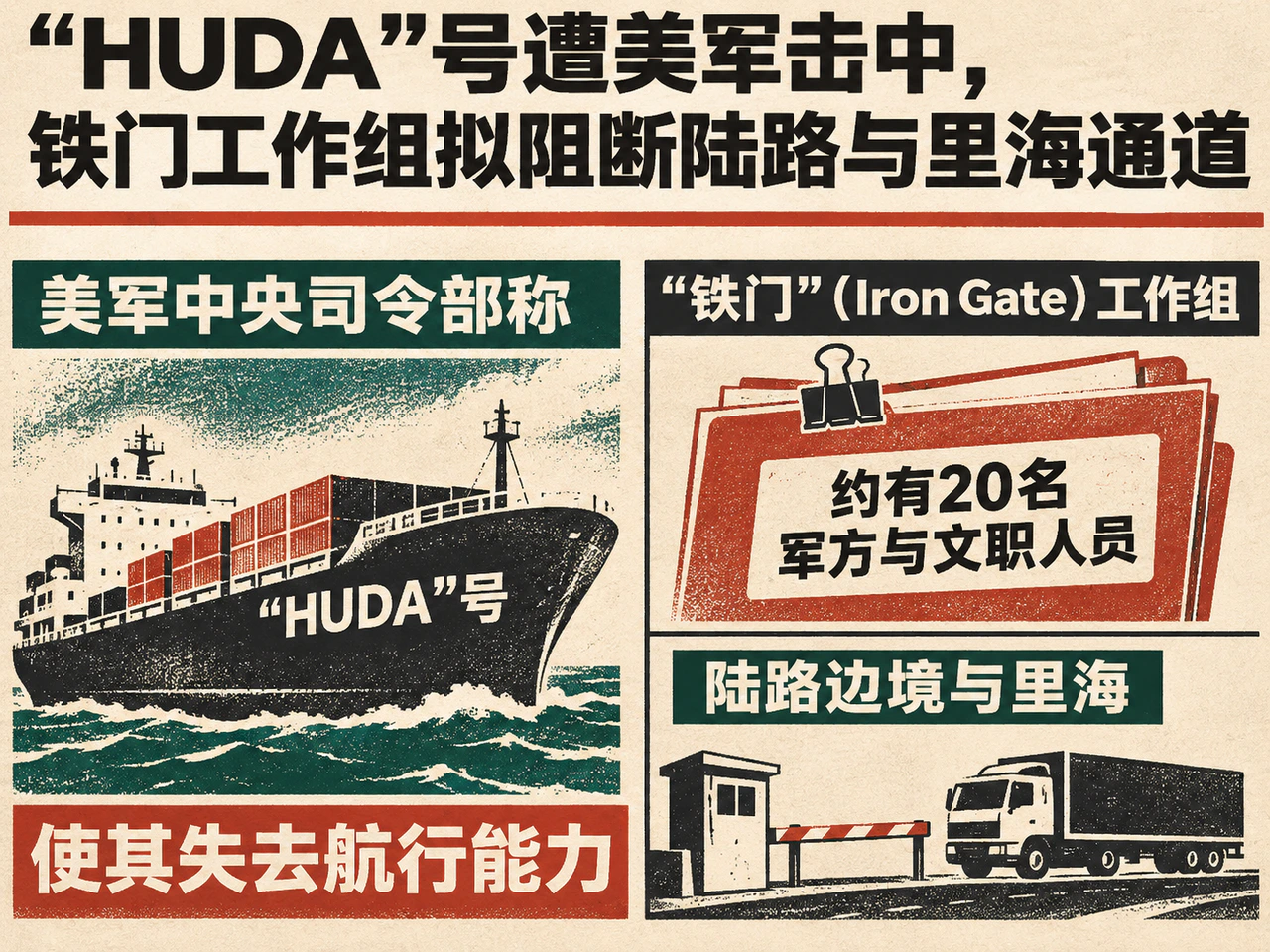
The maritime blockade has already led to a strike. The U.S. military said it carried out a precision strike on the stern of the cargo ship Huda in the Gulf of Oman on November 7, disabling the vessel. It said the ship had repeatedly tried to breach the blockade after calling at Iranian ports. The United States said it instructed the crew to leave the targeted area before the strike. Enforcing the blockade by force is turning the dispute over passage into costs for commercial shipping.
On the same day, U.S. Central Command announced the formation of the Iron Gate task force, intended to stop advanced weapons, dual-use technology, sanctioned goods and illicit funds from moving across Iran’s land borders and through the Caspian Sea. The Florida-based task force comprises about 20 military and civilian personnel. Its immediate effect is to extend sanctions enforcement and interagency coordination to land and Caspian routes. The announcement left open whether the group would conduct military operations and gave no details on its interdiction capabilities or how it would enforce the measures.
Tanker explosion kills one crew member as Saudi Aramco-linked building sustains minor damage

Shipping risks have already turned deadly. On November 6, the tanker’s management company disclosed that an explosion had occurred the previous day aboard the Marshall Islands-flagged Velos Sapphire as it sailed toward Bahrain. A missile strike was suspected. One crew member died, and the ship was taken to a port in Bahrain for a damage assessment. In a separate report, United Kingdom Maritime Trade Operations said an explosion had occurred near a tanker’s waterline. The crew were safe and the vessel could continue sailing.
Iran has also repeatedly claimed that tankers struck mines. Independent details on the vessels, their routes and the damage remain incomplete, so these claims are excluded from the tally of confirmed damaged vessels for now. Explosions, fires and casualties continue even as military escorts remain in operation. It will take considerably more to restore low-risk commercial passage than to get shipping moving again.
Fighting elsewhere in the region widened the risks. On November 8, the Houthis claimed attacks on Riyadh’s financial district, its airport and energy-related targets. Saudi energy authorities said debris from an interception caused minor damage to a building linked to Saudi Aramco and reported no casualties. Witnesses differed in their accounts of how badly the building was damaged. Reports of casualties in Yemen continued to mount. The Houthis put the civilian toll from airstrikes in Sanaa governorate at 22 dead and 30 injured. The escalation complicates the regional security conditions surrounding the talks with Iran.
After the week ended, Trump says another large-scale attack on Iran is very unlikely if talks progress

Early on November 9 Beijing time, before the reporting cutoff, Trump said another large-scale attack on Iran was very unlikely if talks made progress, and that any decision still depended on the terms of an agreement. Araghchi said mediators had yet to resume their visits after the U.S. midterm elections and would need time to do so. Trump’s remarks left room for a deal, while Araghchi’s indicated that mediation remained on pause.
Risks to shipping continued. Early on November 9, the United Arab Emirates’ National Guard said it had rescued 22 crew members from a cargo ship that caught fire in the Sea of Oman.
A genuine shift would come if both sides agreed on a sequence for implementation. They would need to decide how to start restoring passage through the strait, how to adjust economic measures and when to bring the nuclear issue into the talks, while addressing whether fighting elsewhere in the region can ease at the same time. The week’s events show that both sides are keeping negotiations open as military and economic pressure continues to build. Only once concrete arrangements are put into effect can a timetable for reopening the strait become something shipping companies can rely on.
Key developments

Times below are in Beijing time and refer to when the reports were published. Entries from the early hours of November 9 are updates from after the week ended.
| Key developments |
|---|
| 11-09 03:47Iranian Foreign Minister Abbas Araghchi said mediators had yet to resume their visits after the U.S. midterm elections and would need time to do so. |
| 11-09 03:39Trump said another large-scale attack on Iran was very unlikely if talks made progress and that any decision still depended on the terms of an agreement. |
| 11-09 02:36The United Arab Emirates’ National Guard said it had rescued 22 crew members from a cargo ship that caught fire in the Sea of Oman. |
| 11-08 23:15The Houthis claimed attacks on Riyadh’s financial district and other targets. Saudi energy authorities said debris caused minor damage to a building linked to Saudi Aramco and reported no casualties. |
| 11-08 05:00U.S. Central Command said it disabled the cargo ship Huda after repeated warnings, citing the vessel’s repeated attempts to breach the maritime blockade of Iran. |
| 11-07 22:23U.S. Central Command announced the formation of the Iron Gate task force to stop advanced weapons, dual-use technology, sanctioned goods and illicit funds from moving across Iran’s land borders and through the Caspian Sea. |
| 11-07 21:43A spokesperson for Iran’s Revolutionary Guard said it had lifted its self-imposed missile range limit, without specifying whether it already had operational missiles that could reach beyond the former limit. |
| 11-07 21:16The Houthis said airstrikes in Sanaa governorate killed 22 people and injured 30. |
| 11-07 16:26Trump confirmed that U.S. forces had carried out limited strikes and said they had destroyed an Iranian air defense installation. Iranian media reported that a missile had hit Qeshm Island. |
| 11-06 22:42The tanker’s management company disclosed that an explosion aboard the Velos Sapphire while it was sailing toward Bahrain the previous day had killed one crew member. A missile was suspected. |
| 11-06 14:37Media reports citing Reuters said Iran had submitted a nuclear proposal to the United States through Qatar and outlined seven conditions to be met first, including lifting sanctions, unfreezing assets and paying war reparations. |
| 11-04 10:12Research organizations reviewing the events of November 2 said Iran had attempted to attack U.S. military aircraft near Qeshm Island and that U.S. forces had then struck the air defense systems involved. |
| 11-02 21:44Iran’s Foreign Ministry said the Strait of Hormuz could reopen within two days if the United States agreed to Iran’s terms. A Qatari delegation continued to mediate. |