On November 10, 2026, Anchorage Digital announced a partnership with payment infrastructure company Lydian to provide minting, redemption and custody support for merchants accepting stablecoin payments. An order from the U.S. Financial Crimes Enforcement Network (FinCEN), published the same day, prohibits covered financial institutions from participating in certain transmittals of funds involving MEXC Global. The order is scheduled to take effect on December 10. These developments concern merchant payments and funds transmission, respectively: for digital assets to enter everyday financial services, clearly identifiable licensed institutions and channels for moving funds in and out are needed, together with enforceable compliance responsibilities.
For businesses, the speed of on-chain transfers is only one part of the payment experience. Whether customer payments can be readily converted into local currency and deposited into a bank account, and who screens, blocks and takes responsibility for suspicious transactions, determine whether the system can fit into existing operations. Institutional competition is consequently shifting toward specific functions such as conversion, custody, settlement and compliance execution.
Lydian connects to bank minting and redemption; merchants still receive local currency
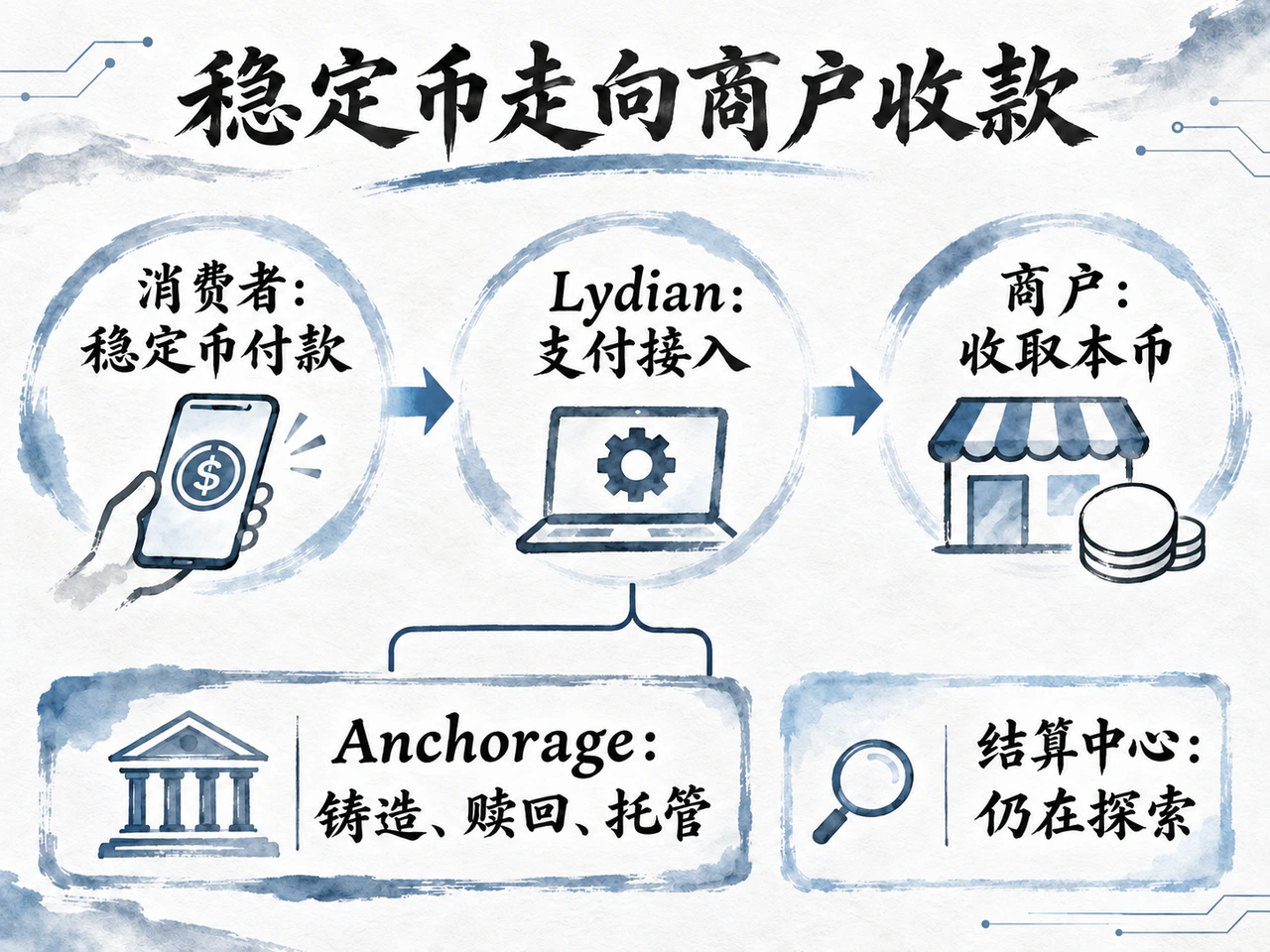
According to Anchorage's announcement, Lydian has integrated Anchorage Digital Bank's stablecoin minting and redemption services, with the bank providing custody of the digital assets. Lydian connects payment service providers and point-of-sale systems. Consumers can pay with stablecoins or other digital assets through supported wallets, while merchants receive local currency without having to hold and manage digital assets themselves.
This division of responsibilities preserves a familiar payment acceptance experience for merchants at the front end, while placing digital asset conversion and safekeeping with a regulated institution. Merchants do not first need to build a wallet management team, and payment service providers can expand their payment options using existing infrastructure. For stablecoin service providers, lasting commercial value comes from entering merchants' existing payment networks and handling the conversion, custody and receipt-of-funds requirements of each transaction.
The two companies are also exploring a broader arrangement: consolidating stablecoin payment flows from Lydian's merchant network for settlement at Anchorage Digital Bank. The announcement compares this role to that of an acquiring bank in the digital asset sector. Minting, redemption and custody have already been integrated; a broader settlement hub remains an area of exploration. The partnership announcement did not disclose the volume of merchant transactions already processed or the associated revenue, so the scale of the business cannot yet be quantified.
Traditional banks are also seeking a position on the issuance side. On November 10, Bloomberg, citing people familiar with the matter, reported that a stablecoin project involving institutions including Goldman Sachs, Citi, Santander and Deutsche Bank had secured approximately $270 million in funding commitments to support the proposed issuer's first five years of operations. Internally codenamed Project Faro, the project is targeting a commercial launch in the first half of 2027. The report was relayed by Investing.com; at this stage, it remains an institutional initiative under preparation.
The funding commitment reflects banks' willingness to jointly build issuance and distribution capabilities, but does not represent a balance of stablecoins already purchased by users. Issuers are competing for reserve assets and issuance relationships, payment platforms for merchant interfaces, and banks for conversion and settlement services. The type of account in which customer funds ultimately remain, the cost of conversion, and whether working-capital savings can cover service fees will determine how much commercial benefit each participant can capture.
FinCEN restrictions on MEXC-related funds transmission take effect December 10
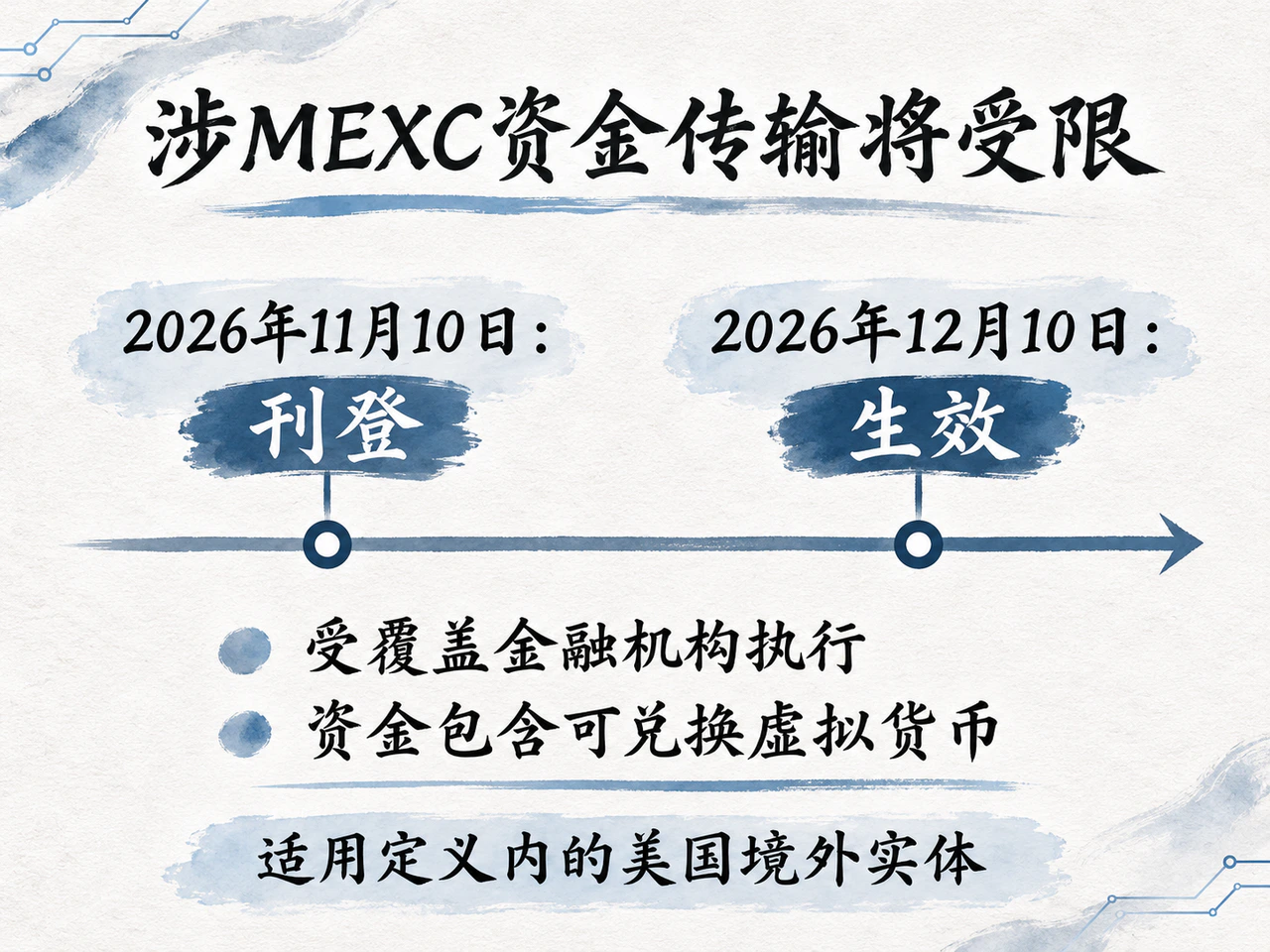
FinCEN's order prohibits covered financial institutions from participating in sending funds to or receiving funds from MEXC Global, with funds defined to include convertible virtual currency. The order's definition of MEXC Global encompasses its branches, subsidiaries, offices and successor entities operating outside the United States; related entities located within the United States are explicitly excluded from that definition. The order takes effect on December 10, 2026, and has no expiration date.
FinCEN links the action to risks of Russia-related illicit finance and sets out its analytical basis in the document. The direct restrictions apply to the financial institutions covered by the order and the relevant transmittals of funds. For custodians, payment providers and other financial service institutions connected to trading platforms, implementation priorities include identifying counterparties and affiliated entities, checking the path of funds, and adjusting transaction-processing rules before the effective date.
These policy and institutional developments outline a more concrete division of responsibilities: licenses and business authorizations define which services may be provided, while anti-money-laundering requirements, sanctions and special measures constrain where funds can enter and which counterparties they can reach. Banks' entry into the stablecoin market will expand the payment and custody interfaces available for compliant business, while bringing more clearly defined screening responsibilities into the transaction chain.
Commercial adoption of stablecoins therefore requires meeting the practical needs of merchants and businesses alongside financial institutions' ongoing requirements to identify and manage financial risks. Indicators to watch include whether announced partnerships generate verifiable transaction volumes, fee revenue and reliable receipt of payments, and whether the institutions involved can put compliance responsibilities into everyday practice. Issuance plans and technical integration are only the starting point; eventual commercial returns still depend on these operating functions.
Click “Read the original” for further details.