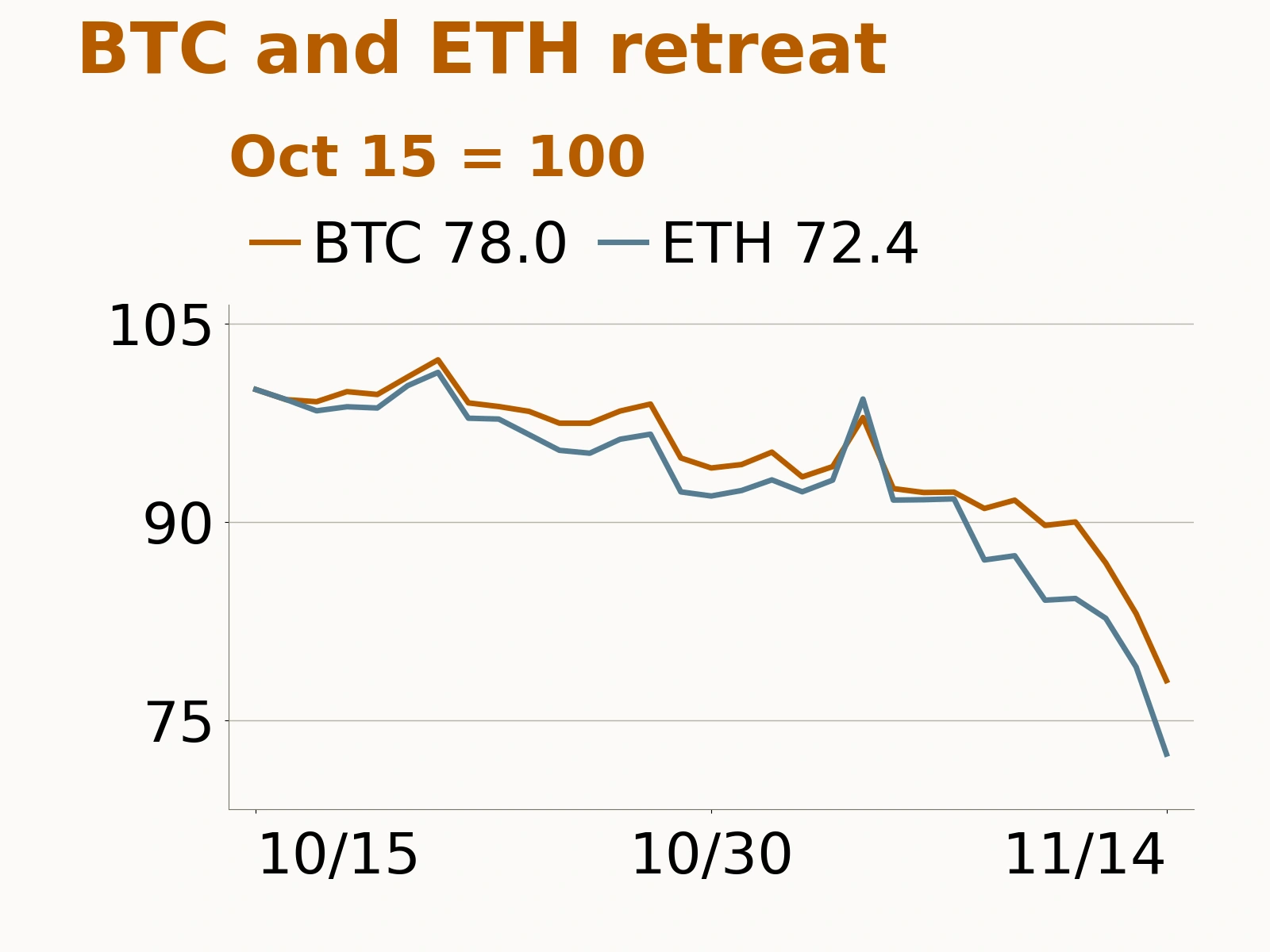
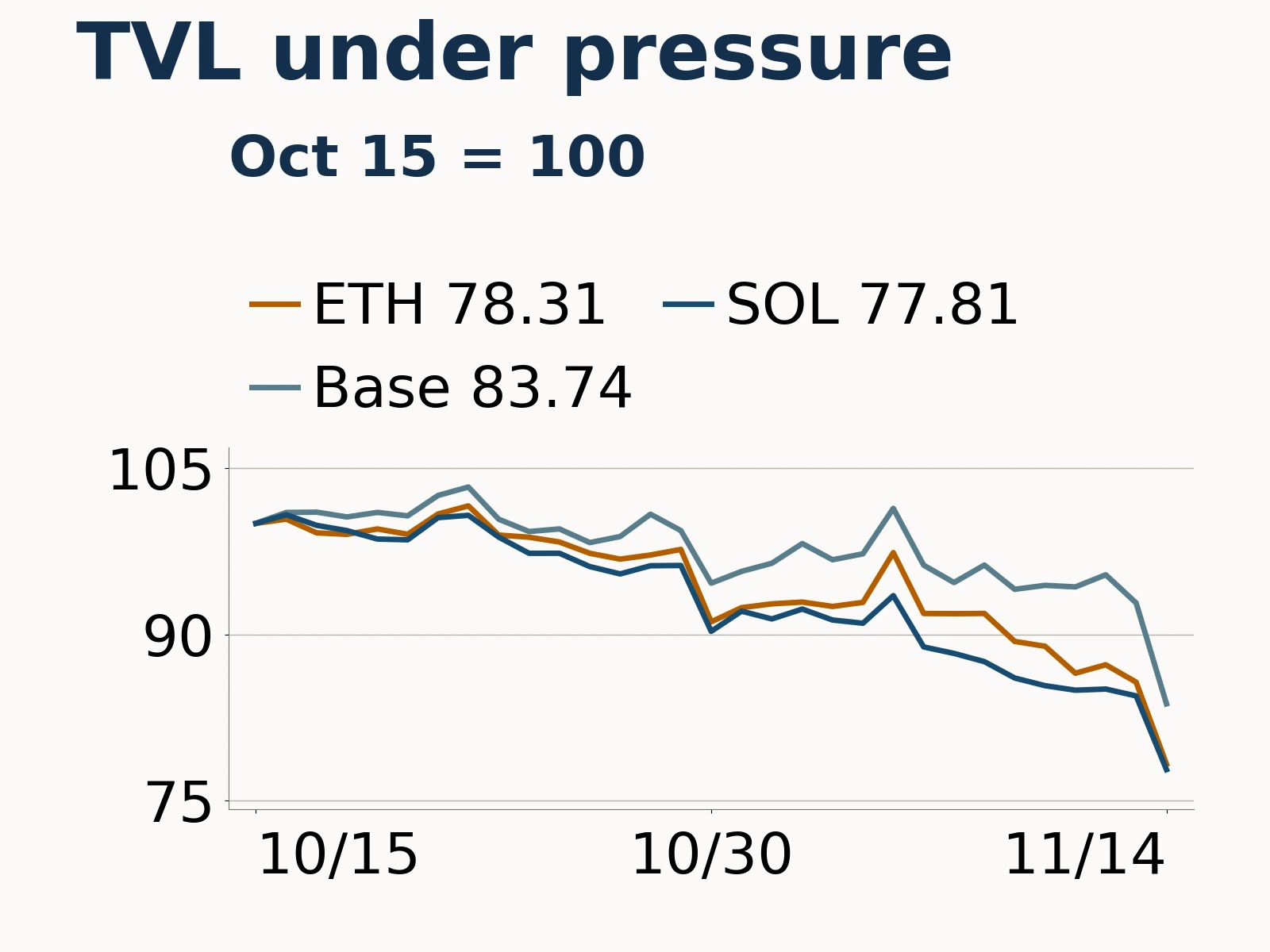
On November 14, 2026, Bitcoin continued to fall. Funding pressure came from more than forced liquidations: U.S. spot Bitcoin ETFs entered the weekend after repeated redemptions, while the circulating supply of stablecoins continued to contract. Open interest in Binance perpetual contracts fell sharply in USDT terms but declined only slightly in coin terms. Substantial contract exposure remained in the market after the price decline.
Bitcoin ETFs post seven straight trading days of outflows; stablecoin supply falls $4.441 billion in seven days
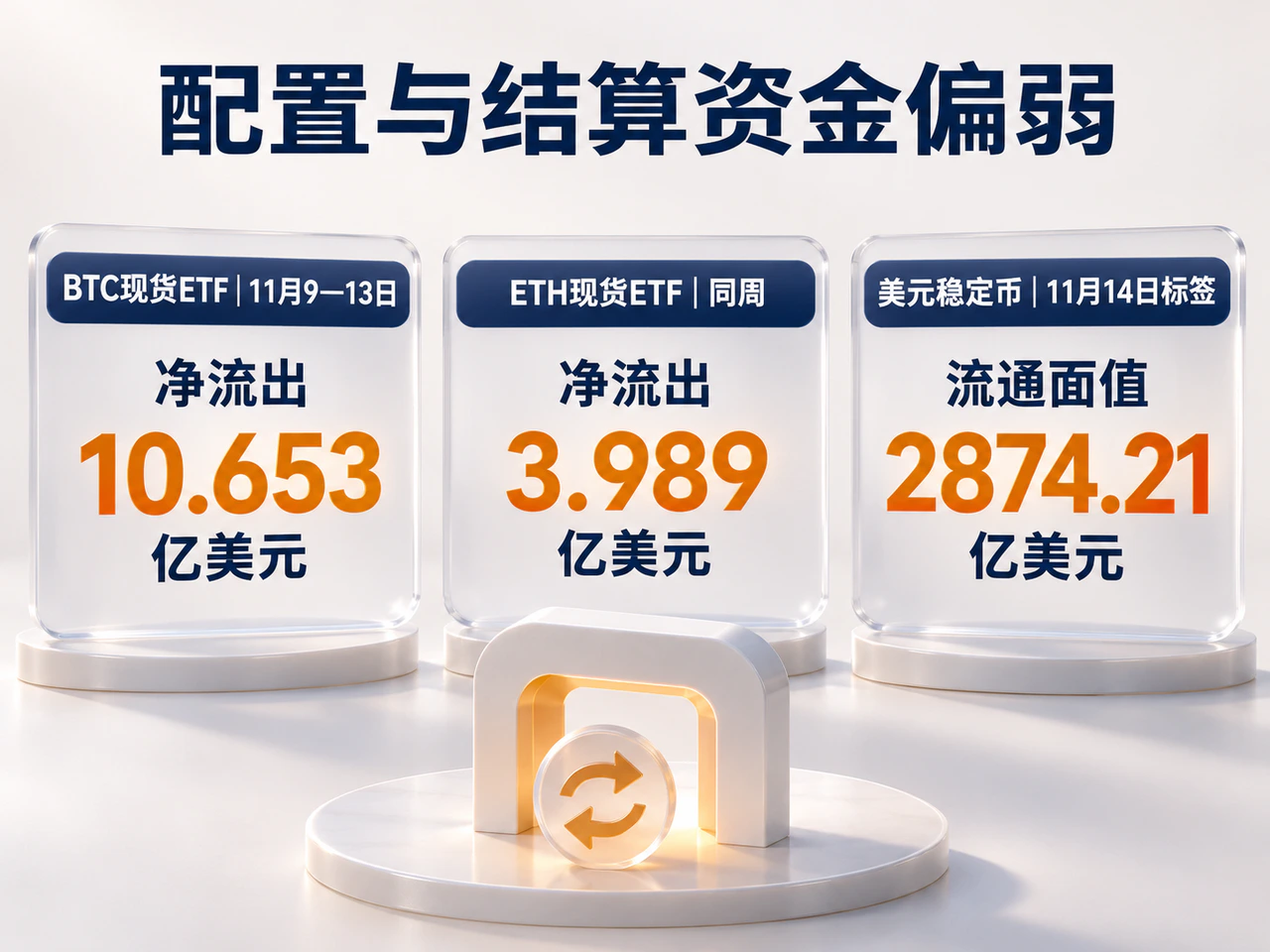
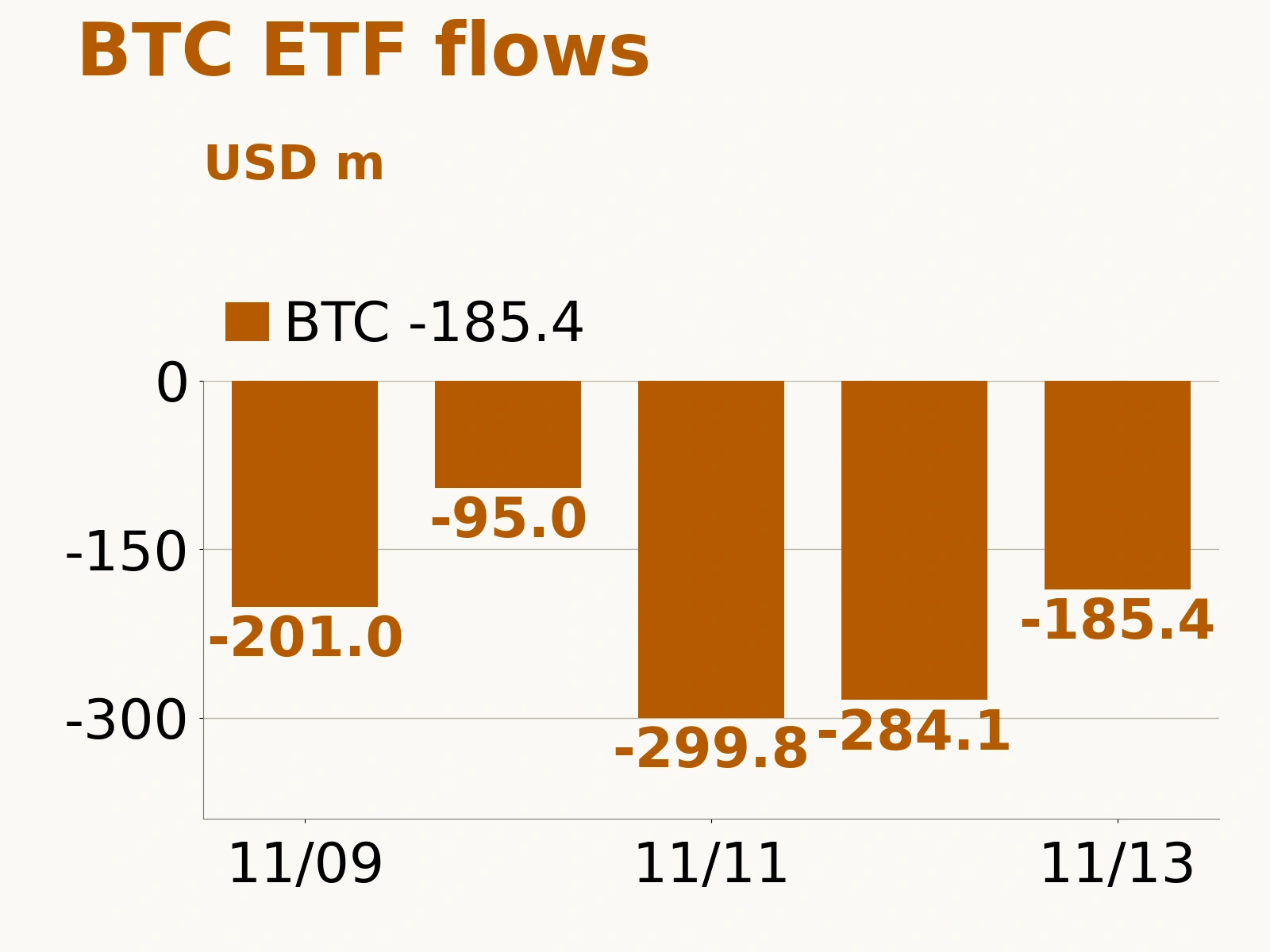
The latest completed U.S. trading day was November 13. Farside data show that spot Bitcoin ETFs recorded net outflows of $185.4 million that day, including $143.5 million from BlackRock's IBIT and $41.9 million from Fidelity's FBTC. Net outflows totaled $1.0653 billion over this week's five trading days and $1.9074 billion over seven consecutive trading days. Daily outflows have not set records every time, but net subscriptions have yet to resume, leaving redemptions as a persistent source of pressure.
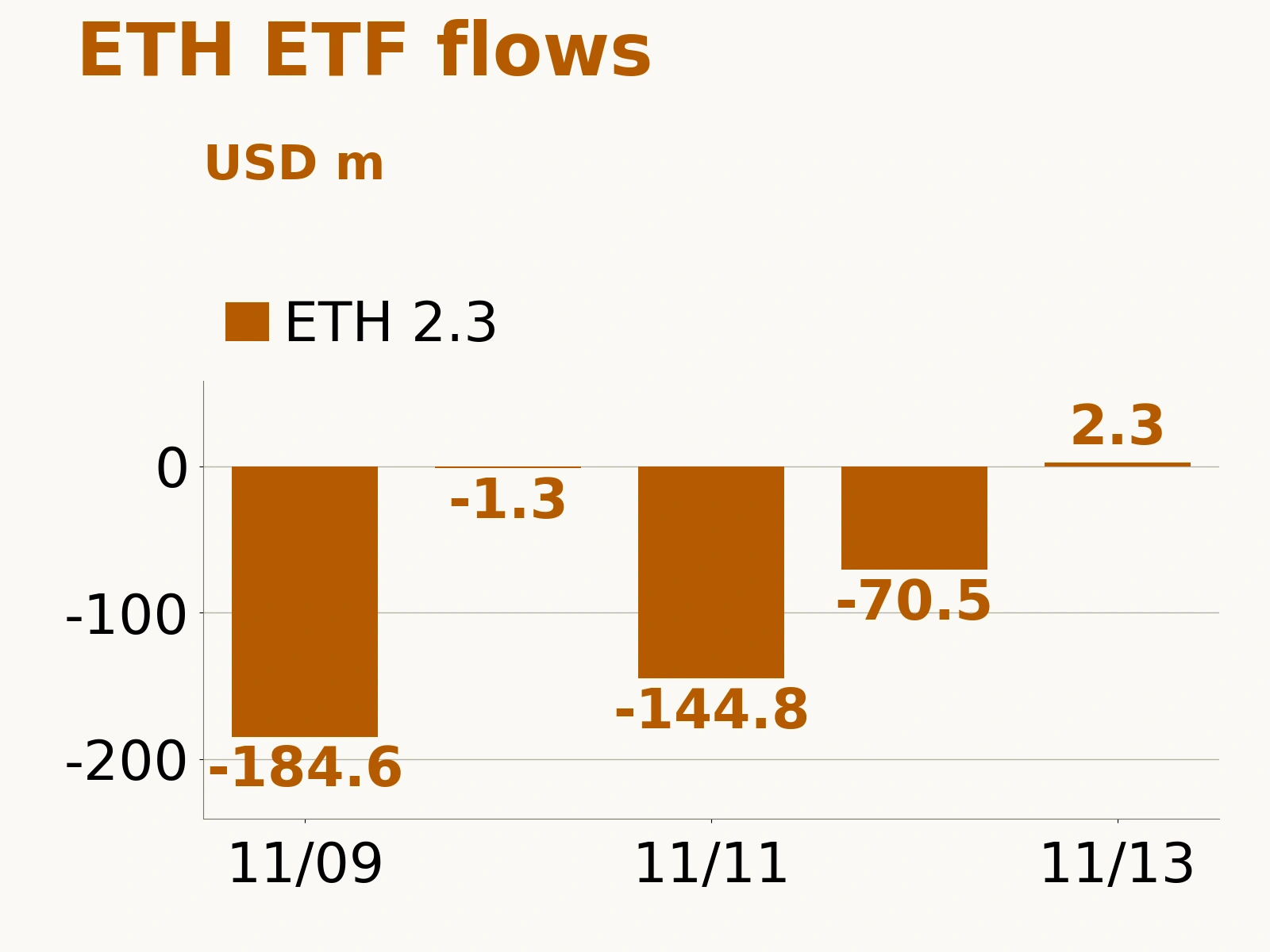
Ethereum ETFs recorded net inflows of $2.3 million on Friday, ending the preceding run of outflows. Fidelity's FETH took in $11.6 million that day, largely offset by $9.3 million of outflows from Grayscale's Ethereum Mini Trust; the week still ended with net outflows of $398.9 million. Some buying support has appeared, but the weekly direction of flows has yet to reverse. November 14 was a Saturday, with no new U.S. ETF trading-day subscription and redemption results, so weekend trading faced this accumulated pressure.
The on-chain supply of dollar funding is also contracting. DefiLlama's November 14 UTC date label shows roughly $287.421 billion in circulating face value of dollar-pegged stablecoins, down $758 million from the preceding date label, $4.441 billion over seven days and $16.388 billion over thirty days. This metric measures the outstanding circulating stock; changes include issuance, redemptions and other factors, and do not directly represent buying and selling funds at any particular exchange.
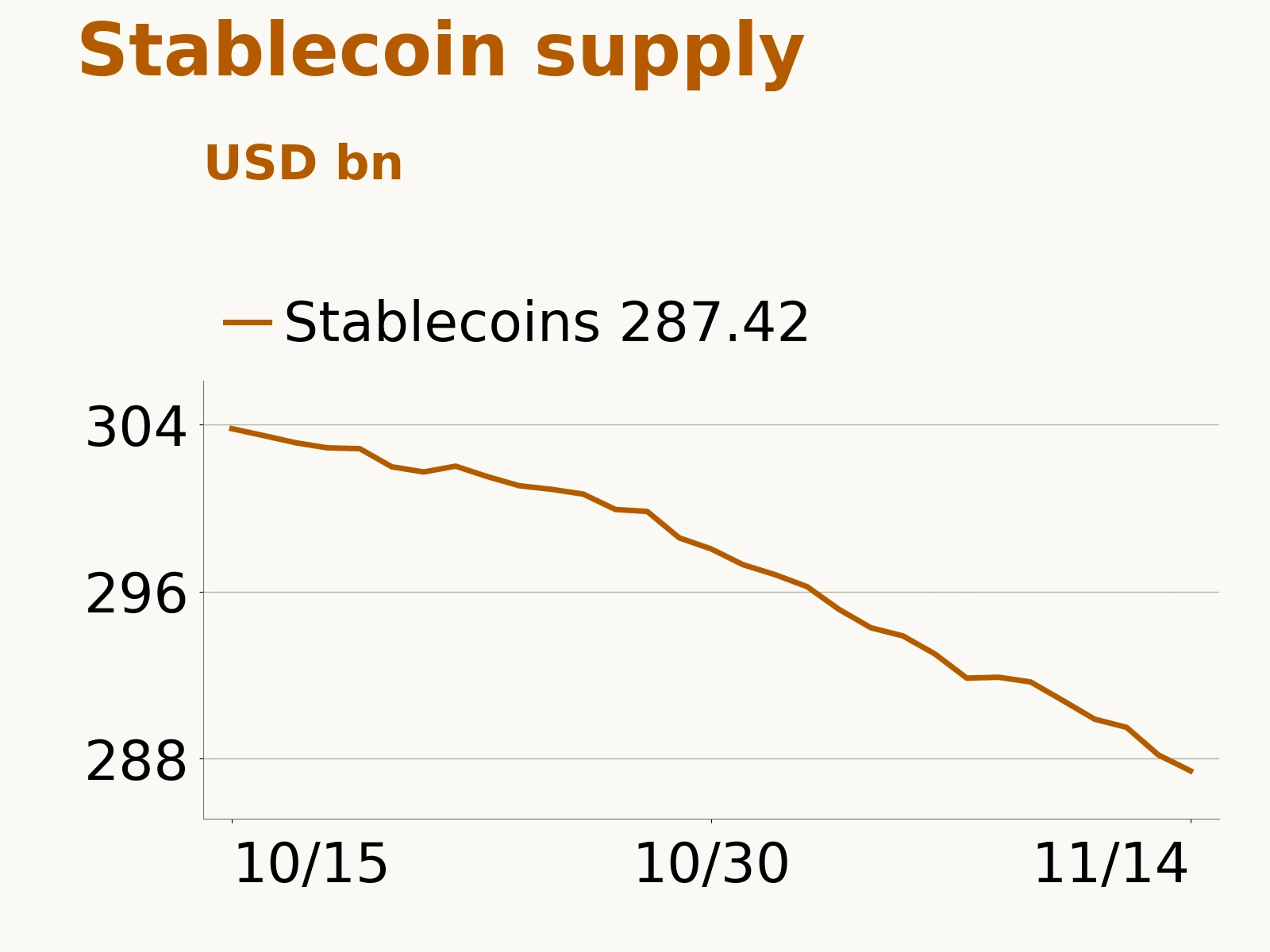
If investors merely sold crypto and temporarily held stablecoins, ample settlement funds would remain on-chain. This time, the overall stablecoin pool is shrinking as well, leaving potential buying support constrained by a contracting supply of funds. ETF redemptions and the decline in stablecoins cannot simply be added together as a measure of total capital withdrawal, but both channels point to the same constraint: new risk positions lack a steady replenishment of funding.
In its institutional weekly report covering November 5–11, Talos noted that 1% order-book depth in selected Bitcoin spot markets was below normal. Thin liquidity magnifies the price impact of leveraged selling. Trading continues over the weekend while the ETF subscription and redemption channel is temporarily closed, making the absorption of marginal orders more dependent on existing liquidity.
Falling prices explain most of the drop in open-interest value; Bitcoin DVOL rises to 47.29
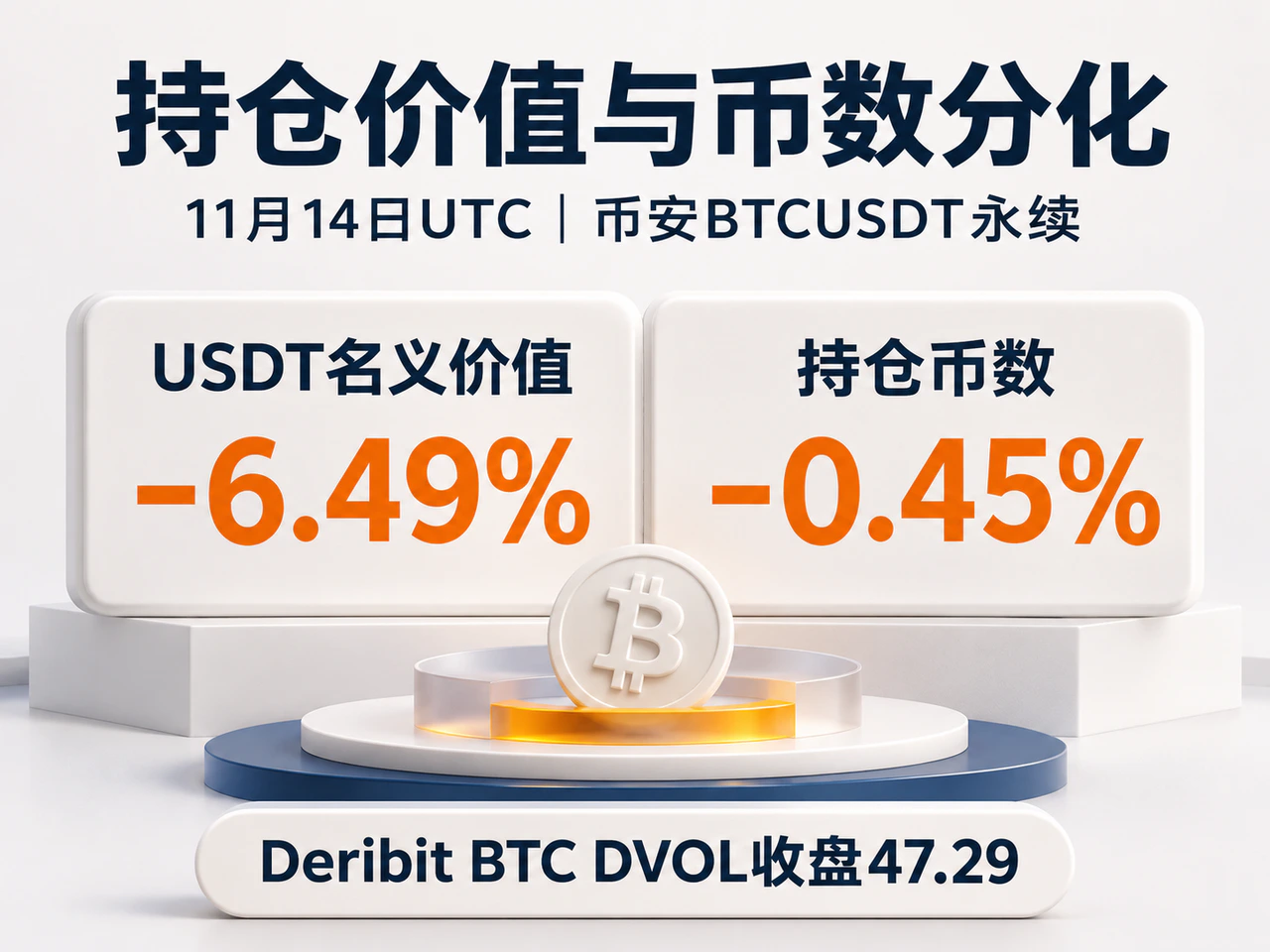
Separating futures open interest into coin quantity and notional value helps distinguish falling prices from positions being closed. Binance BTCUSDT perpetual snapshots at UTC day boundaries show that, over November 14, open interest fell from 98,388.97 BTC to 97,950.51 BTC, a decline of 0.45%; its USDT notional value fell from 6.717 billion USDT to 6.281 billion USDT, down 6.49%. For the equivalent Ethereum contracts, open interest in coin terms declined 0.26%, while its USDT value fell 8.58%. Most of the decline in value for both contracts came from falling underlying prices.
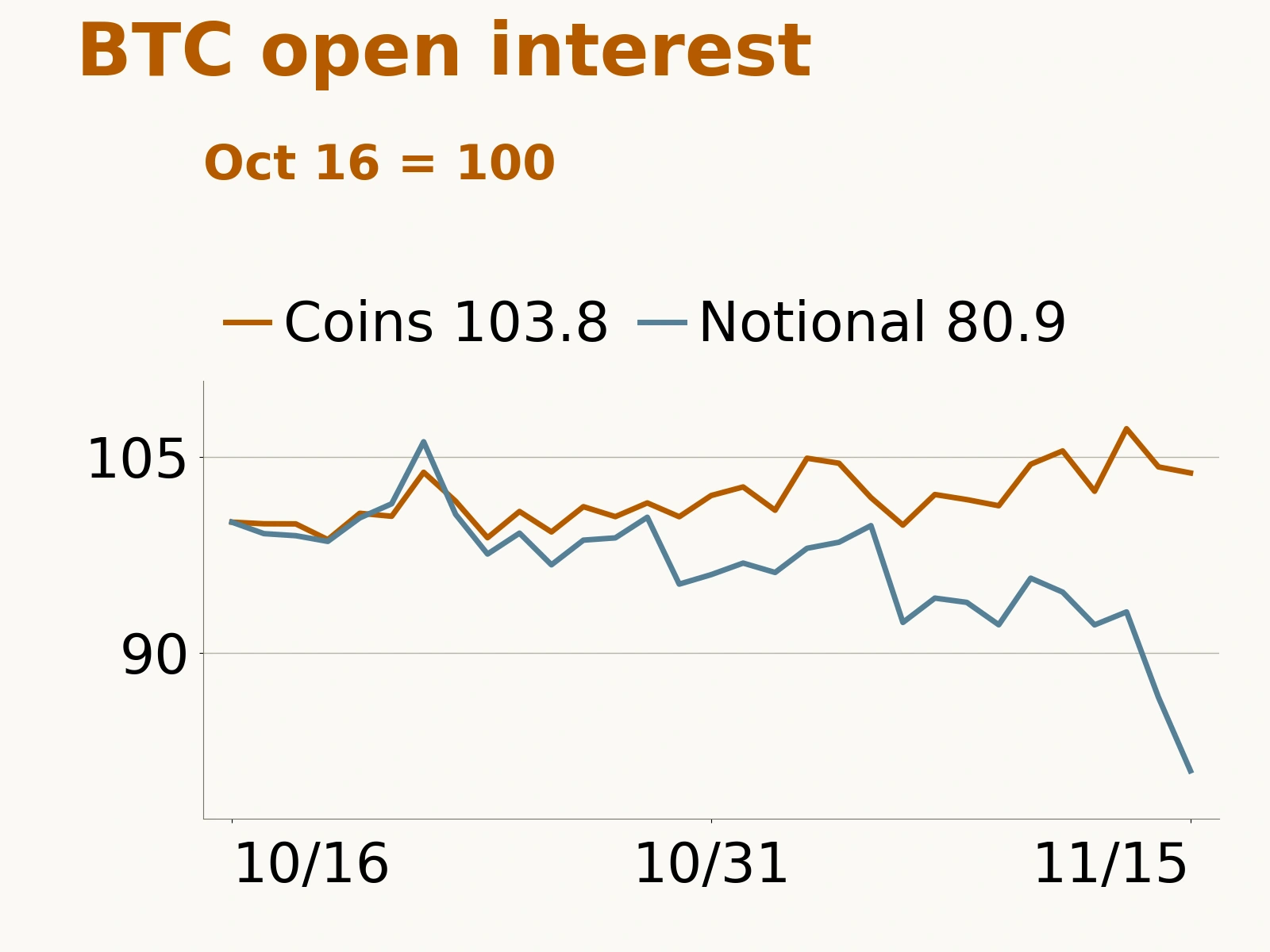
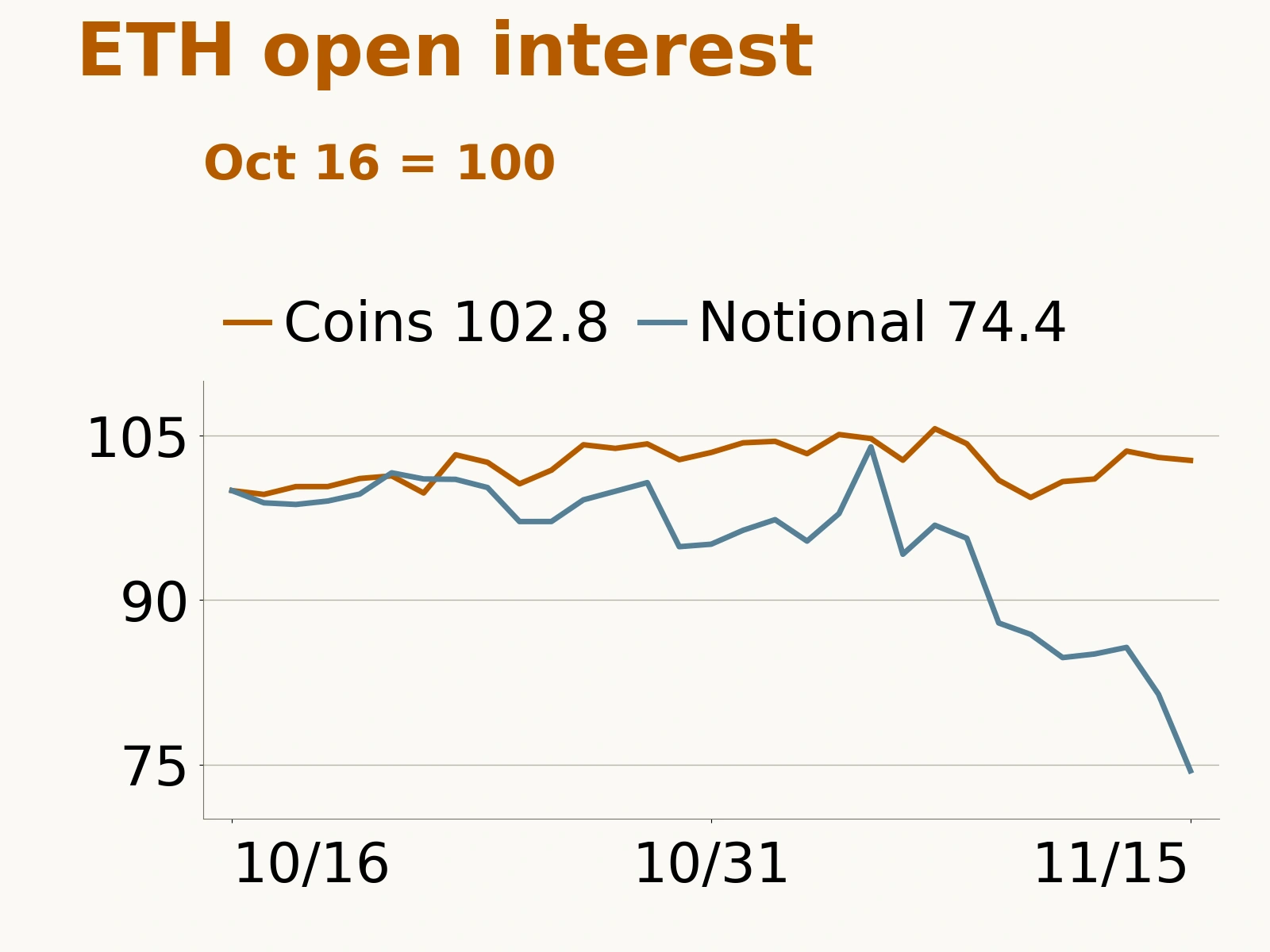
A decline in the USDT value of open interest does not mean that risk positions have left the market on a large scale. Open-interest quantity reflects the net result of positions being opened and closed: as liquidations remove some positions, new long and short contracts may also enter. Collateralization and the directional distribution of remaining positions still affect subsequent risk. Data from Binance, a single exchange, provide a concrete view of the difference between these two measures.
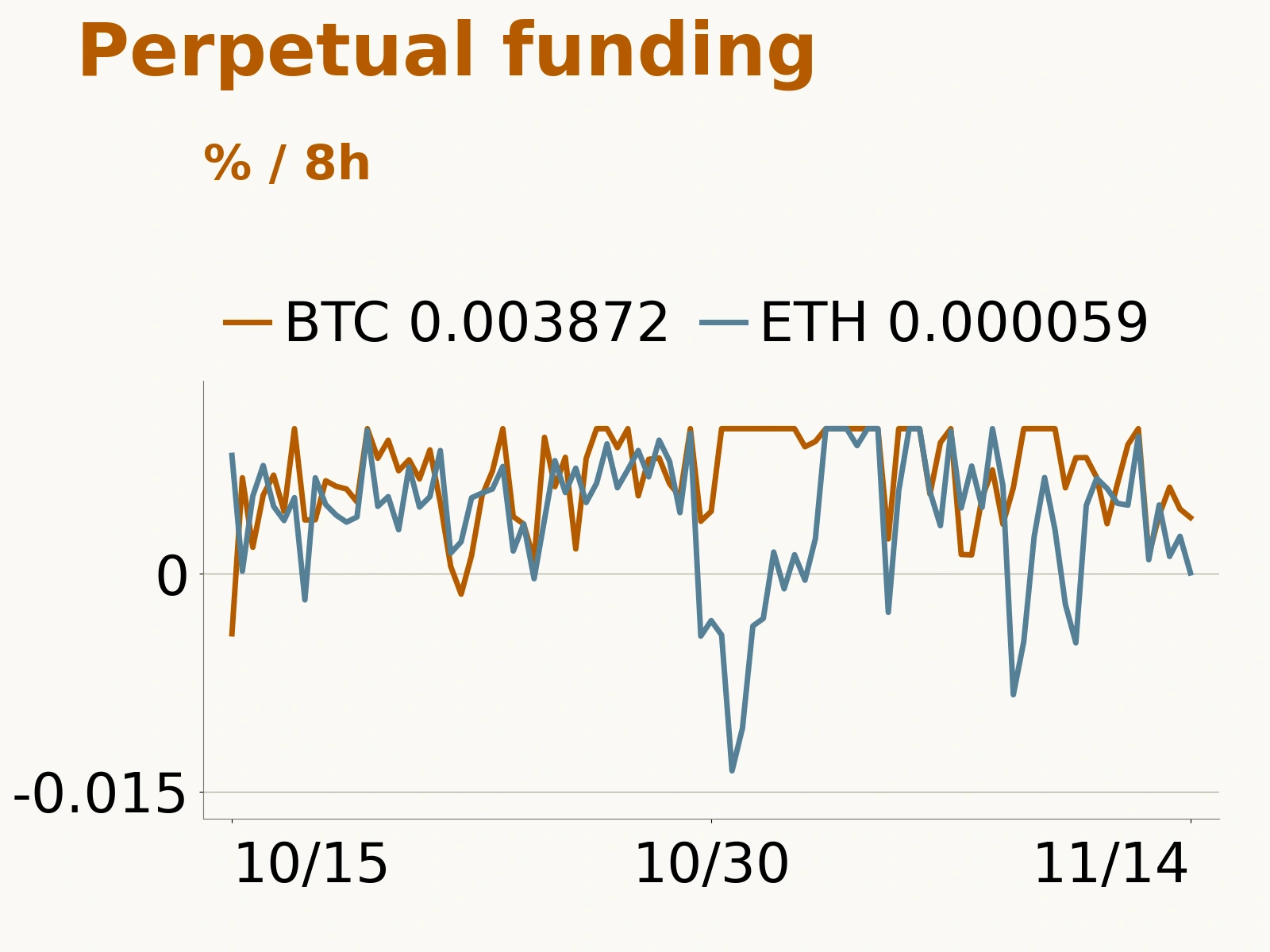
Funding rates likewise do not indicate extreme short-side pressure. On November 14 UTC, Bitcoin's three settled funding rates were 0.005972%, 0.004461% and 0.003872%, each an eight-hour rate, with positive readings gradually declining. Ethereum's final rate fell to 0.000059%, close to zero. The cost for longs to maintain perpetual positions has fallen and crowding has eased somewhat; whether spot-market capital returns requires separate observation.
Liquidation pressure has already been released during the day. A report published by The Crypto Times at 03:46 UTC on November 14, citing CoinGlass data, put liquidations over the then-rolling 24 hours at about $1.26 billion, with roughly 86% coming from longs. That window spans two UTC dates and reflects the hit to long positions early in the weekend.
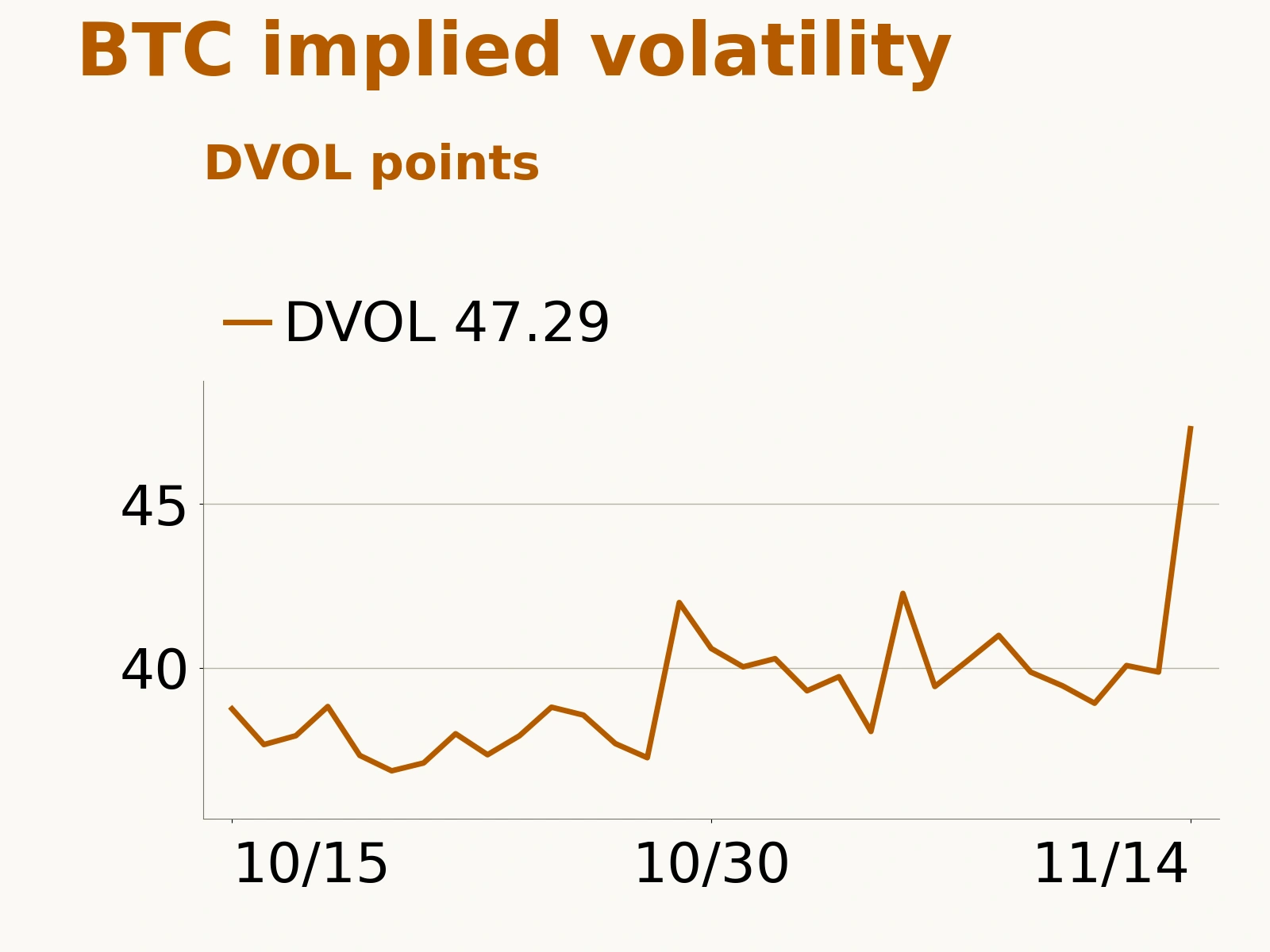
The cost of options protection, meanwhile, is rising. Deribit's Bitcoin DVOL volatility index closed its November 14 UTC daily session at 47.29, up 7.42 volatility points from 39.87 the previous day, after reaching an intraday high of 49.31. Perpetual funding rates measure the cost of holding leveraged directional positions, while options implied volatility reflects the price the market pays for future volatility. Falling funding rates alongside rising implied volatility correspond to cooling demand for directional positions and increasingly expensive risk insurance.
Taken together, these funding and open-interest signals suggest that positions have not yet adjusted sufficiently to absorb the contraction in funding supply. With persistent ETF redemptions and a shrinking circulating stablecoin pool, even a brief stabilization in prices remains vulnerable to the next round of selling. A material improvement in buying capacity requires allocation capital to return, settlement funds to resume growing, and contract exposure and volatility risk to cool. A decline in open interest measured in USDT is not, by itself, enough to show that this process is complete.
Click through to the original article for further details.