On November 16, 2026, U.S. Treasuries rebounded after the previous week's selloff, technology stocks continued to lead equities lower, and crude oil and gold both fell. Lower nominal interest rates did not produce a broad recovery in valuations: the 10-year Treasury real yield rose to 2.92%, while the AI supply chain faced both a test of its ability to deliver profits and tighter export controls. Chinese and U.S. economic releases that day showed signs of cooling demand, although corporate employment, high-tech production and some investment plans remained resilient. Markets are repricing the balance between slower growth, falling inflation compensation and high real financing costs.
Nominal Treasury yields fall, but the 10-year real yield rises to 2.92%
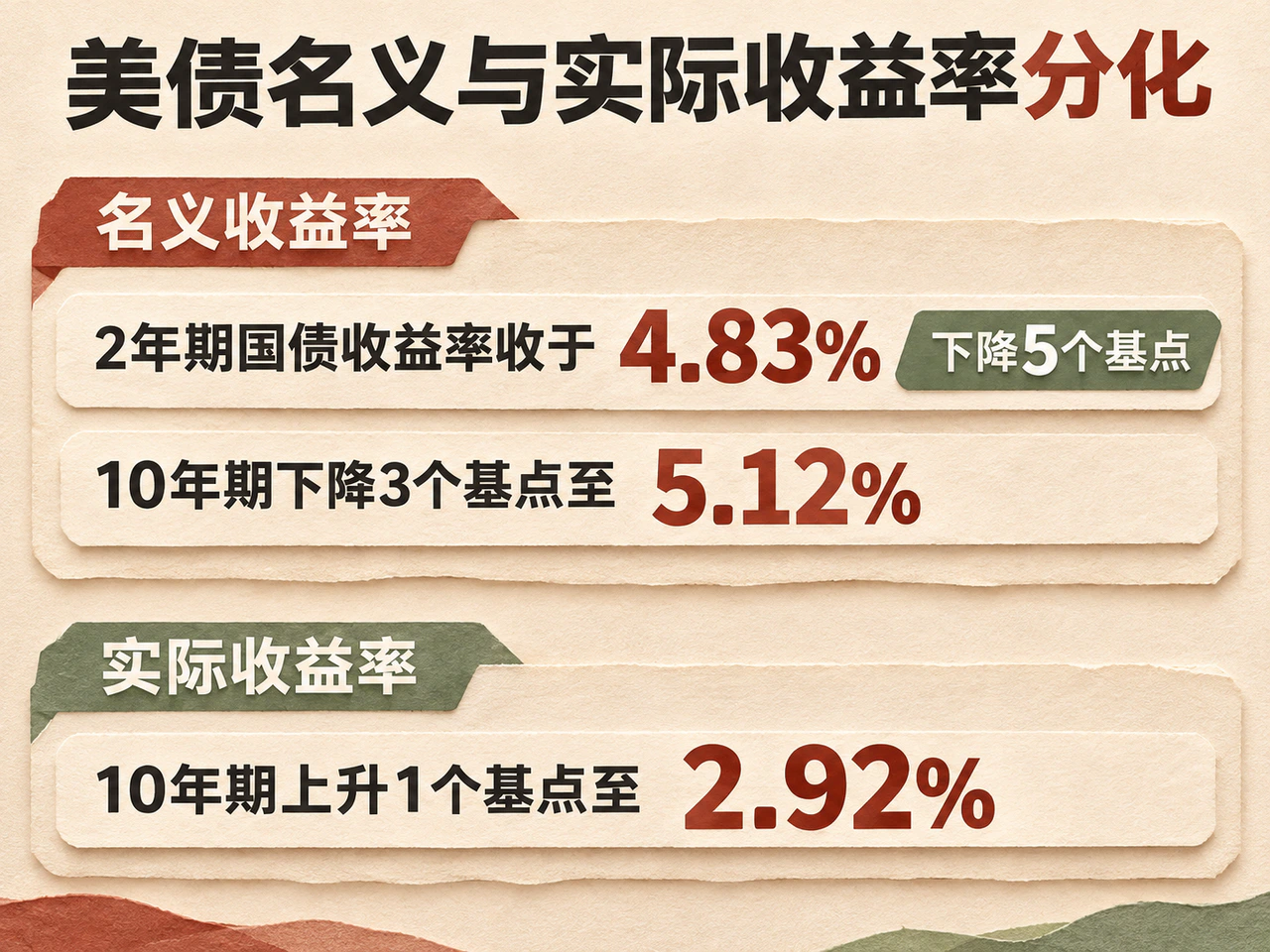
The U.S. Treasury's daily yield curves, measured on a consistent basis, show that short- and intermediate-maturity Treasuries rallied more strongly than the long end on November 16. The 2-year yield closed at 4.83%, down 5 basis points from November 13; the 5-year fell 5 basis points to 4.93%, the 10-year declined 3 basis points to 5.12%, and the 30-year edged down 1 basis point to 5.46%. The spread between 10- and 2-year yields widened from 27 to 29 basis points.
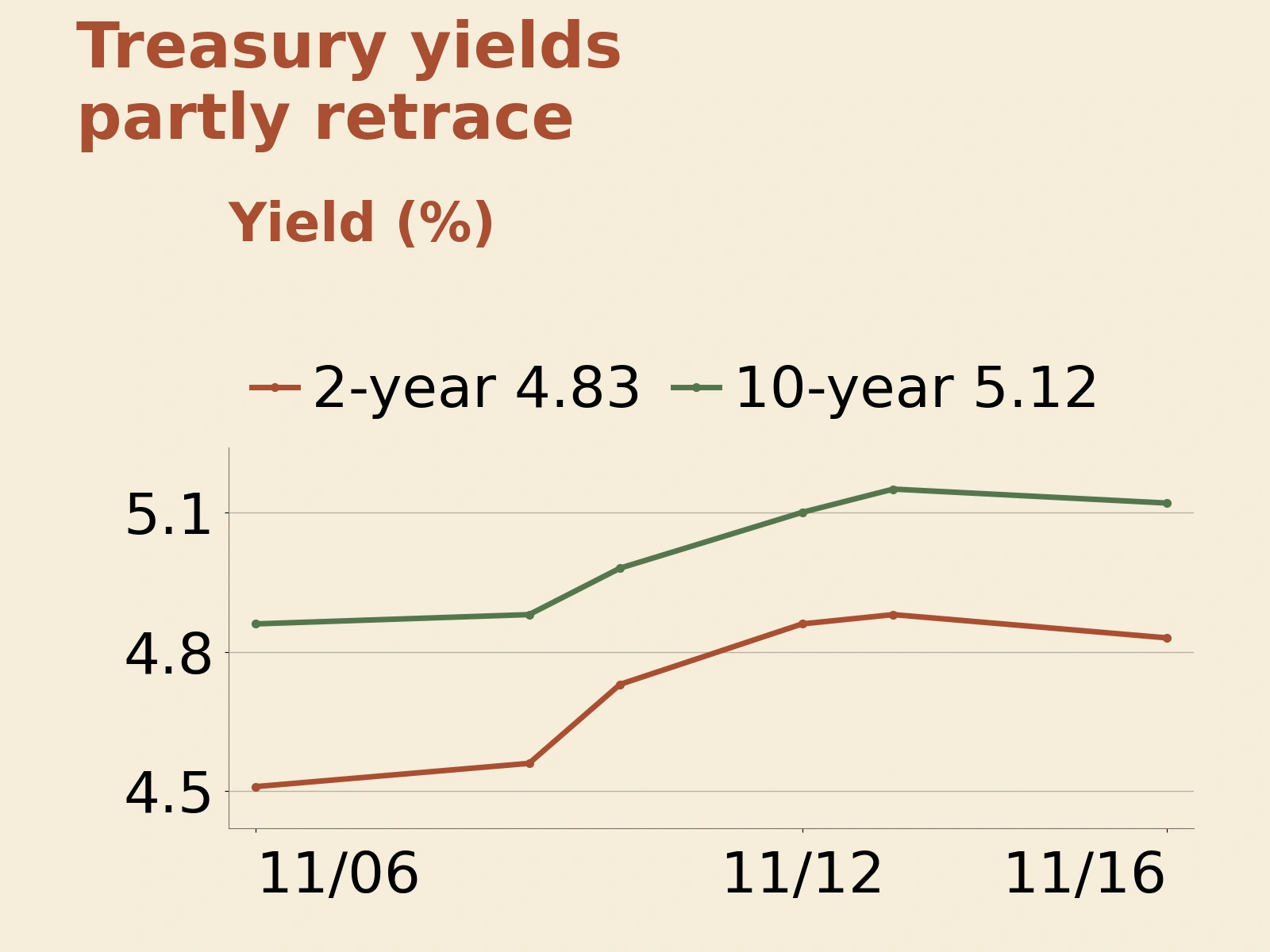
The rebound recovered only part of the preceding week's losses, from November 6 to 13, when 2- and 10-year yields had jumped 37 and 29 basis points, respectively. In early European trading on November 16, Dow Jones Newswires attributed Treasury buying to demand for safe havens as technology shares fell. However, LSEG pricing cited in the report still implied approximately 62 basis points of cumulative rate increases over the next three policy decisions. Safe-haven buying and expectations of further tightening coexisted during the session.
Real interest rates remain the central constraint on valuations. On November 16, the 5-year real yield was unchanged at 2.68%, while the 10-year rose 1 basis point to 2.92% and the 30-year increased 2 basis points to 3.30%. Breakeven inflation, measured as the difference between nominal and real yields of the same maturity and incorporating inflation compensation as well as risk and liquidity premiums, narrowed markedly. The 10-year difference fell from 2.24% to 2.20%, and the 5-year from 2.30% to 2.25%. The decline in nominal yields primarily reflected shrinking inflation compensation; real discount rates applied to long-term cash flows remained elevated.
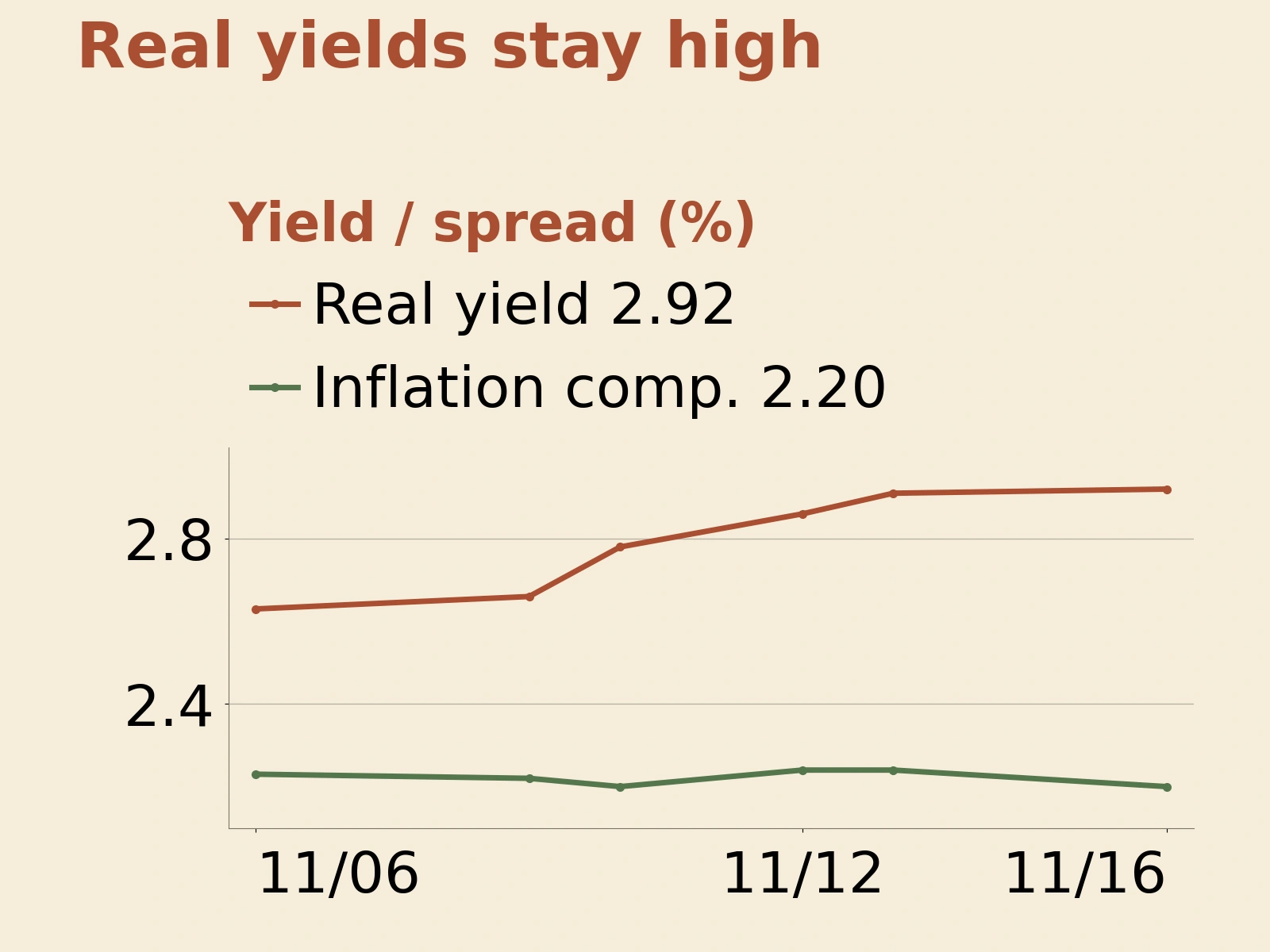
Long-dated bonds also face a supply test. Penn Mutual Asset Management noted in its November 16 morning commentary that, after soft demand at the previous week's 3-, 10- and 30-year Treasury auctions, a 20-year Treasury sale was due on Wednesday, followed by a reopening of 10-year Treasury Inflation-Protected Securities (TIPS) on Thursday. The 30-year nominal yield fell only marginally that day while its real yield continued to rise, offering very limited interest-rate relief for long-duration assets.
Tighter computing controls and an earnings test send the Philadelphia Semiconductor Index down 5.3%
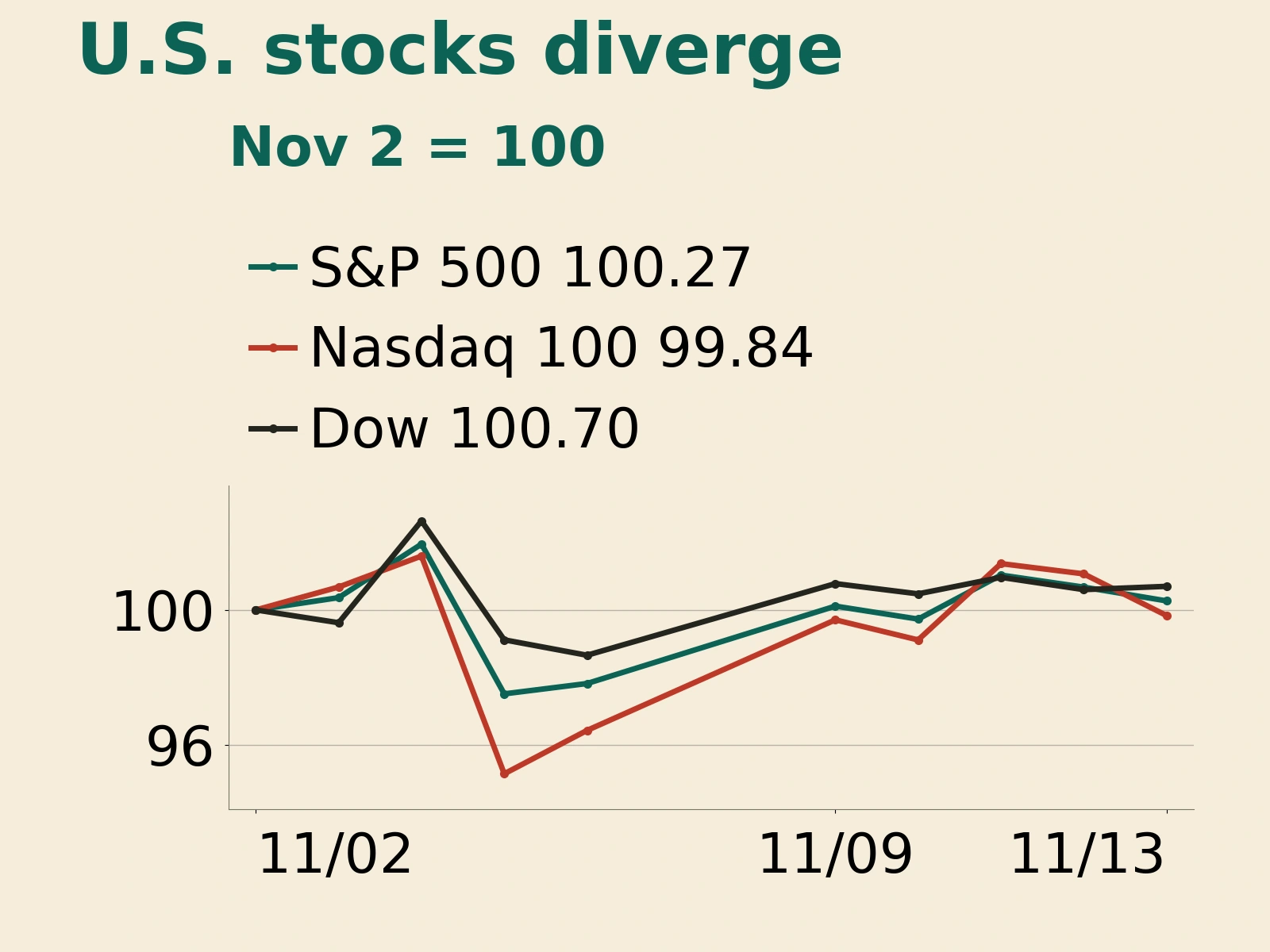
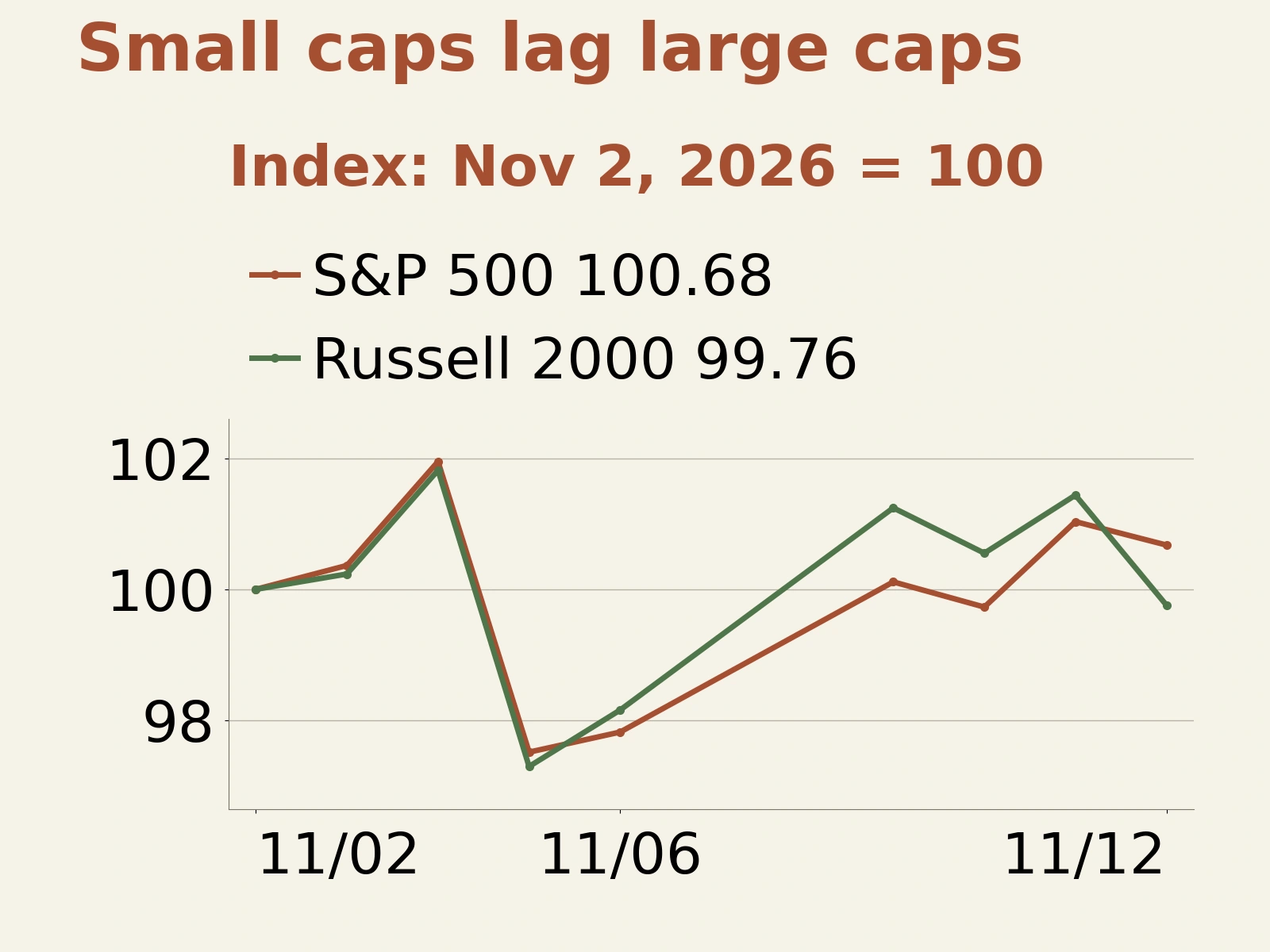
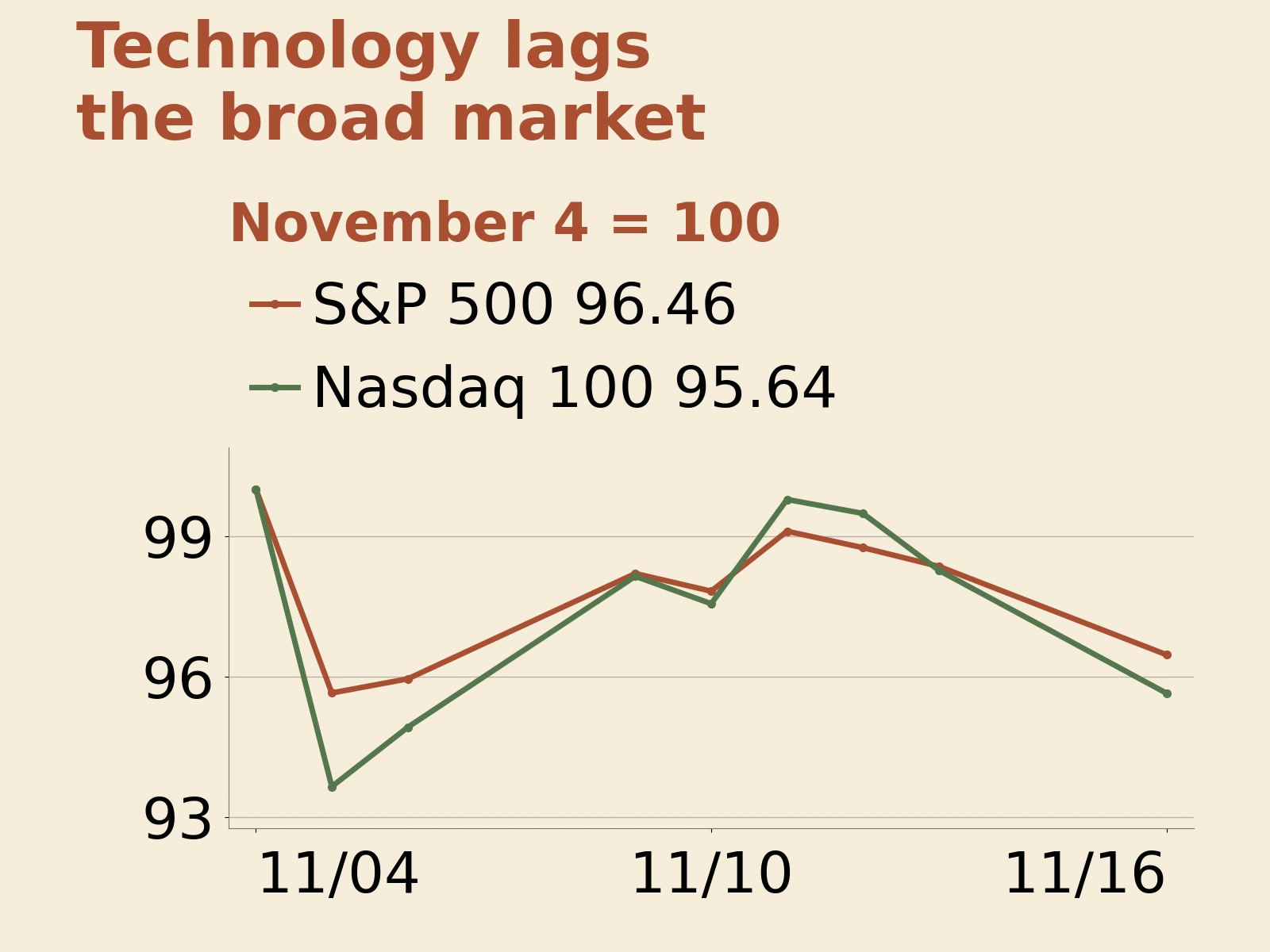
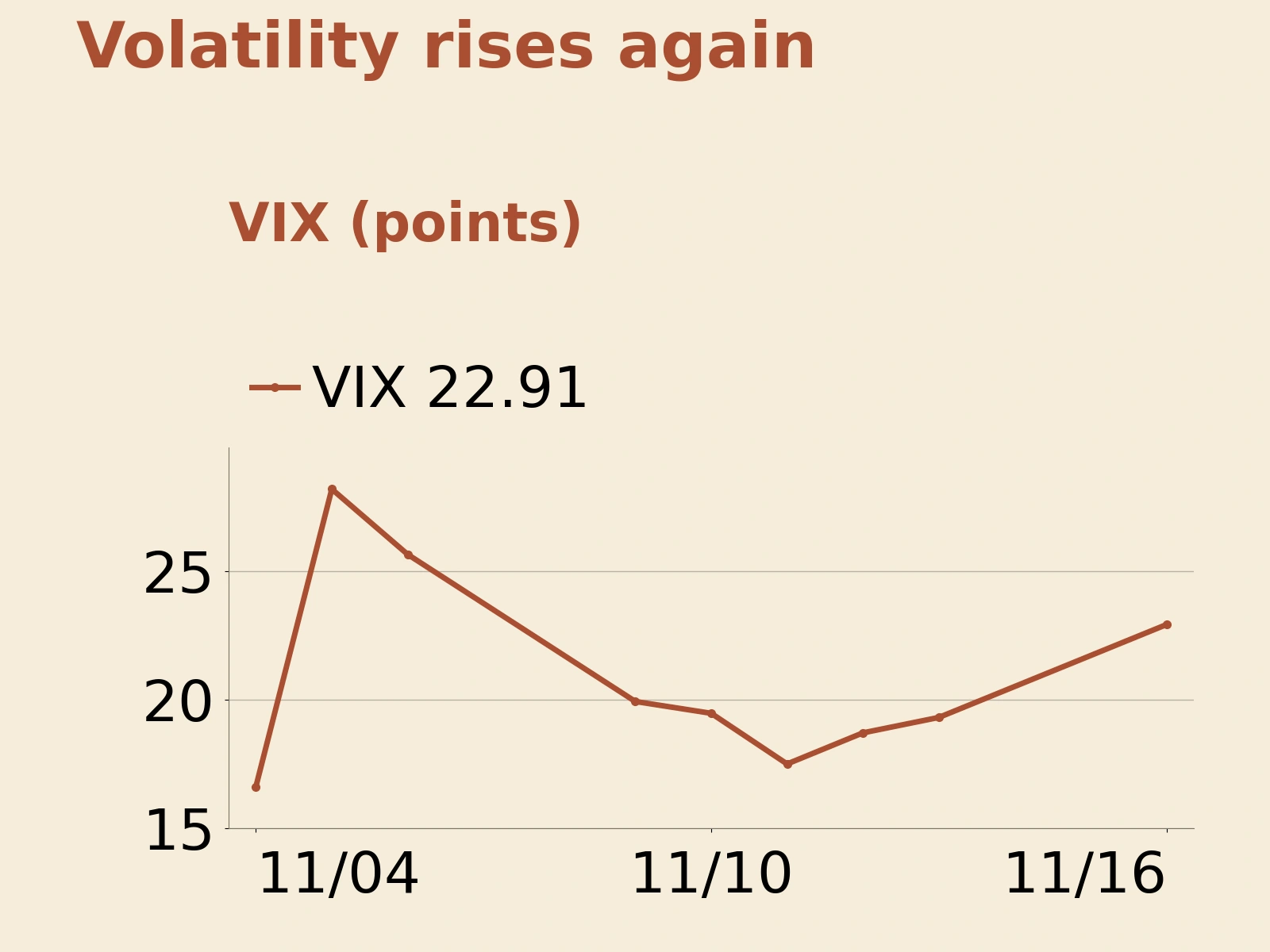
The three major U.S. equity benchmarks all fell on Monday. The S&P 500 closed at 7,416.59, down 1.92%; the Nasdaq 100 finished at 27,197.15, down 2.67%; and the Dow Jones Industrial Average ended at 51,608.17, down 1.41%. The Russell 2000 lost 1.70% to 2,742.94. Technology led the decline: the technology ETF, XLK, fell 3.24%, far more than the financial-sector ETF, XLF, which lost 0.85%. The VIX volatility index rose from 19.30 to 22.91, and declining stocks outnumbered advancers by 3.45 to 1 on the New York Stock Exchange, indicating that selling pressure had spread across the market.
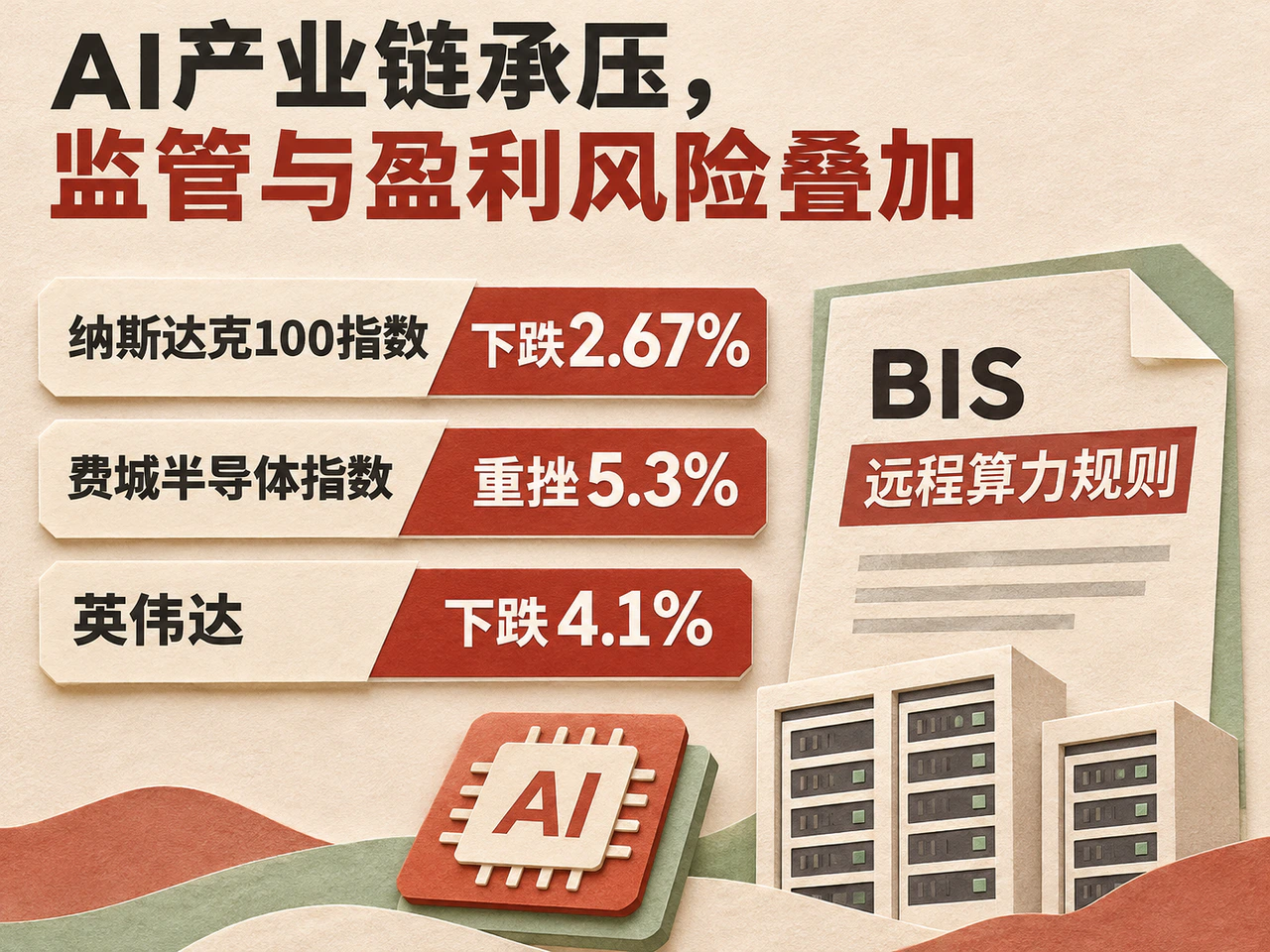
The AI supply chain came under concentrated selling pressure. Nvidia fell 4.1% as the impact of management changes continued to reverberate; the Philadelphia Semiconductor Index plunged 5.3%, with Intel and Micron each losing more than 7%. Downstream server manufacturers Dell and Super Micro fell 7.0% and 6.9%, respectively, while computing-capacity rental providers CoreWeave and Nebius dropped 6.1% and 7.6%. The broad decline across chips, servers and rented computing capacity shows investors demanding stronger execution, financing capacity and delivery of profits throughout the AI capital-expenditure chain.
Regulation further increased cross-border compliance costs. On November 16, the U.S. Commerce Department's Bureau of Industry and Security (BIS) announced a remote-computing rule extending scrutiny beyond physical chip exports to the provision of large-scale computing capacity by overseas data centers to specified parties. It also added licensing requirements for deliveries of advanced semiconductors to Indonesia, Malaysia, Singapore, Thailand and Brazil, retaining only exemptions such as those for qualifying U.S.-headquartered companies. The public-inspection version states that the rule takes effect upon publication in the Federal Register, although the specific date has not yet been inserted, and allows a 90-day transition after the effective date for existing remote services to obtain licenses. China and the United States discussed tariffs and agricultural trade and agreed to maintain communication at their first Trade Council videoconference on November 13. Nevertheless, controls on advanced computing continue to tighten, and customer due diligence and license approvals will directly affect delivery schedules and the timing of revenue recognition for some overseas orders.
Markets are awaiting crucial evidence from earnings and fundraising. Nvidia is scheduled to report quarterly results after the U.S. market close on November 17, while Anthropic plans to list this week. The two events will test the quality of industry profits and public equity markets' capacity to absorb fresh financing, respectively. Reuters cited Pepperstone head of research Chris Weston as saying that, even if Nvidia delivers strong near-term results, investors are reassessing its medium- and long-term competitive advantages following its management changes.
Chinese and U.S. demand cools, while production and employment retain structural resilience
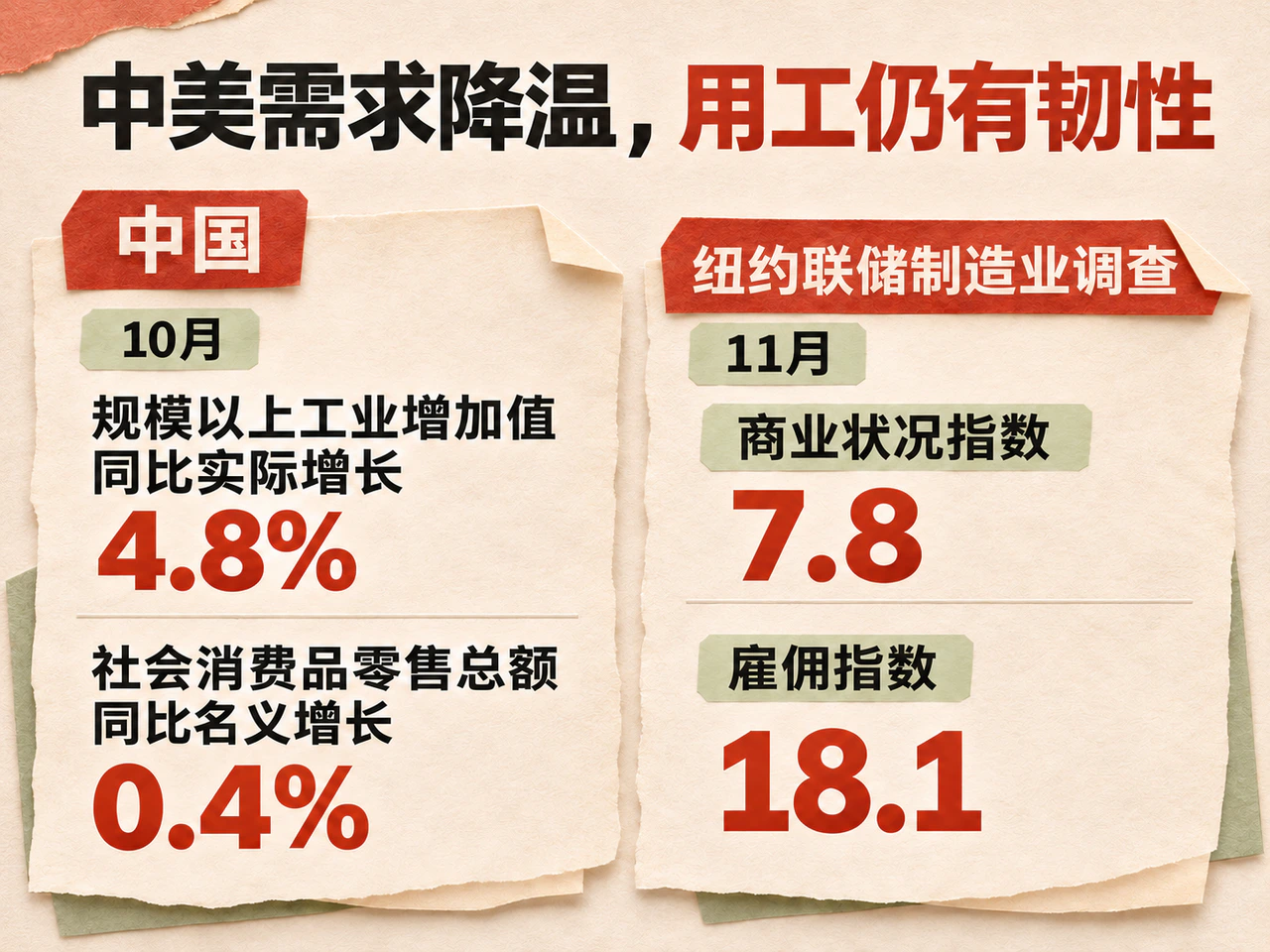
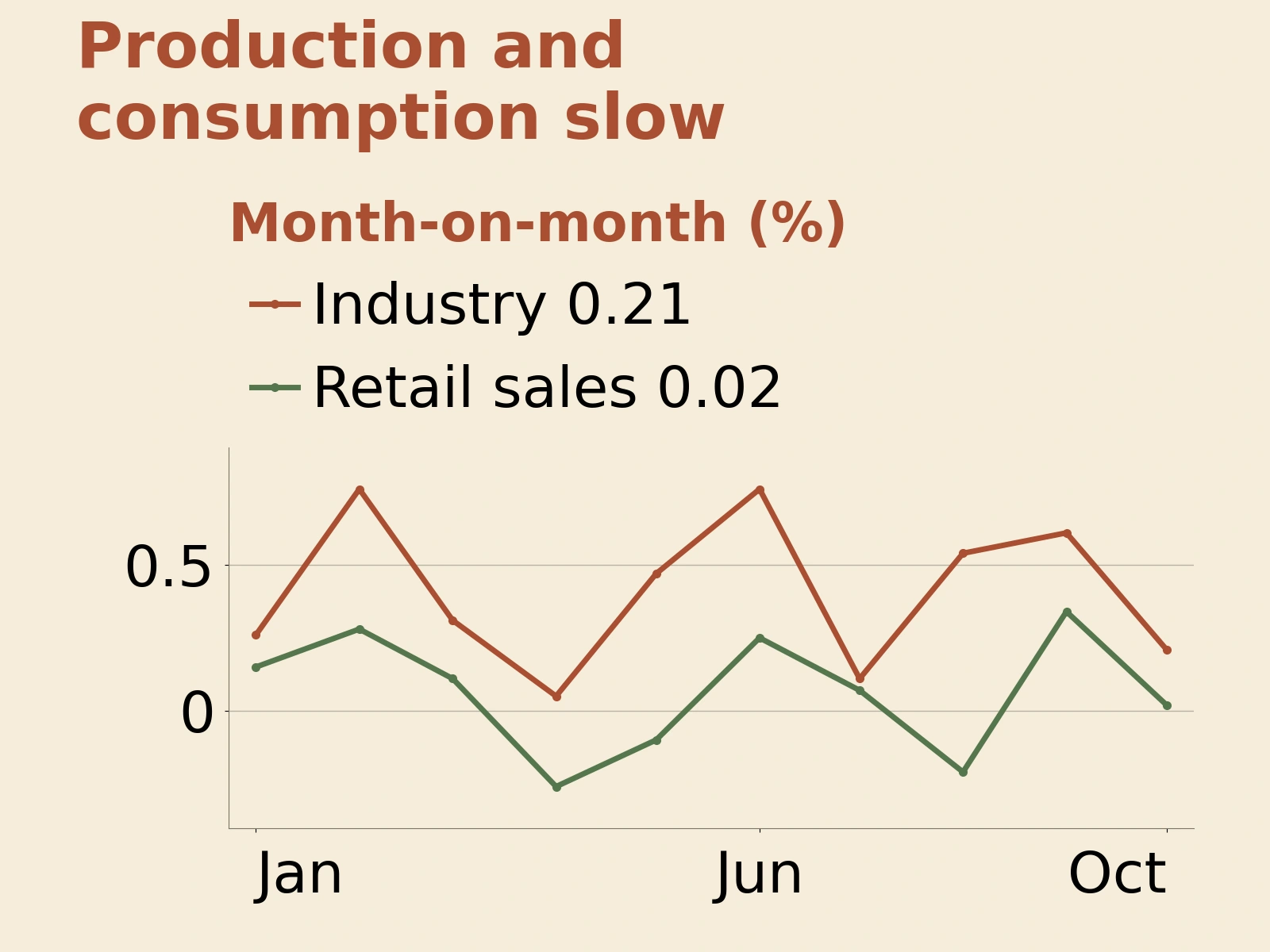
China's October macroeconomic data, released on November 16, showed a further easing in demand. Real value added at industrial enterprises above the designated size grew 4.8% year on year in October, below September's 5.5% and the 5.3% expected in a Reuters poll. Total retail sales of consumer goods increased 0.4% in nominal terms from a year earlier, below September's 1.1% and the 0.8% forecast. On a seasonally adjusted month-on-month basis, industrial value-added growth slowed from September's revised 0.61% to 0.21%, while retail-sales growth fell from 0.34% to 0.02%. Automobile retail sales at businesses above the designated size plunged 21.4% year on year, a major drag on overall retail sales; retail sales of consumer goods excluding automobiles rose 2.5%.
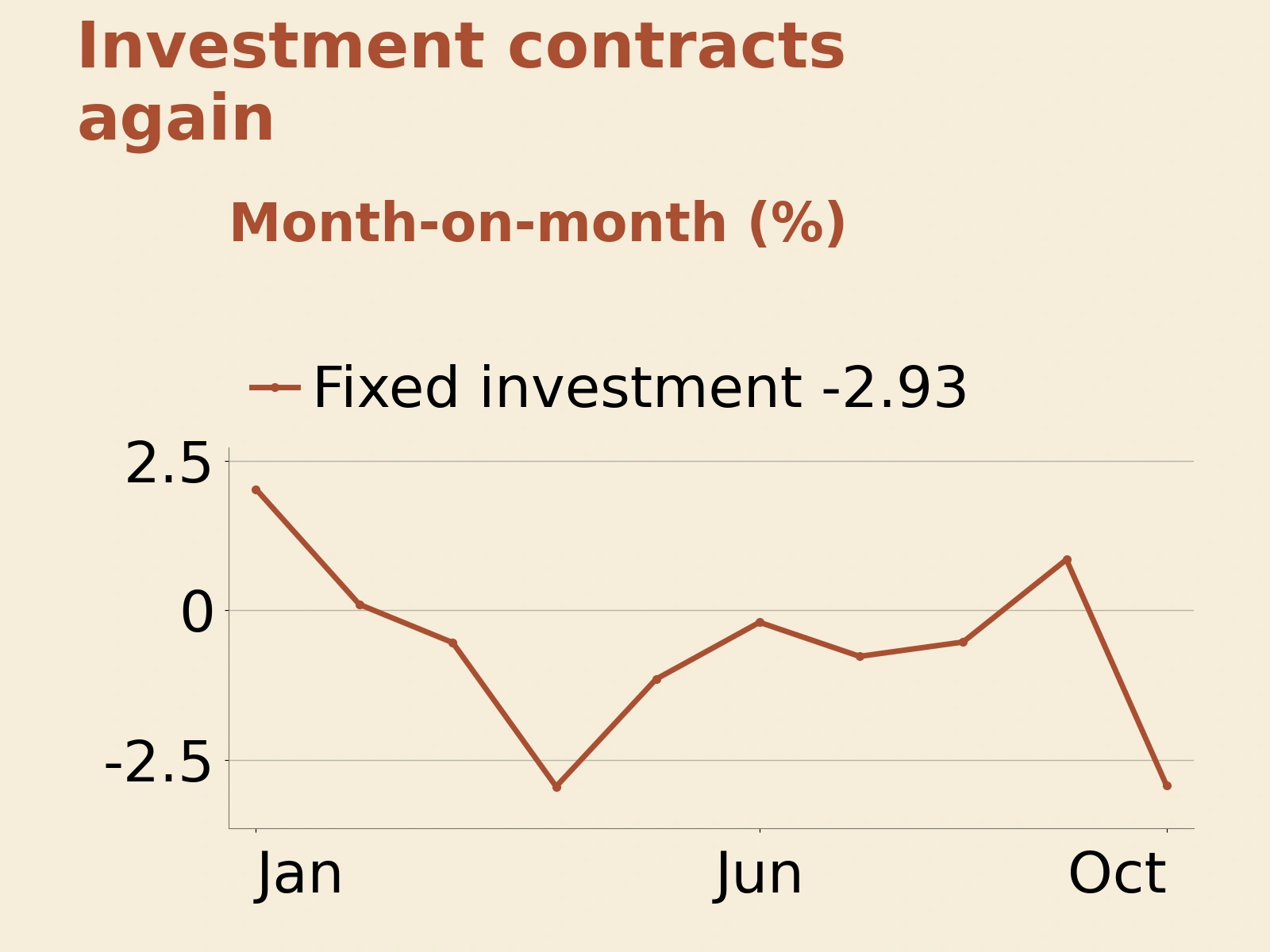
Investment was also under pressure. Fixed-asset investment excluding rural households fell 8.1% year on year in nominal terms in January–October, a decline 0.9 percentage points greater than in the first three quarters. In October alone, it fell 2.93% month on month on a seasonally adjusted basis. By component, fixed-asset investment excluding property development declined 5.1% year on year, while manufacturing and infrastructure investment fell 2.9% and 5.1%, respectively.
Support came mainly from high-tech industries and services. In October, value added in high-tech manufacturing grew 17.6% year on year, while computer, communications and other electronic-equipment manufacturing expanded 19.4%. In January–October, investment in equipment, tools and instruments rose 8.9%, and retail sales of services increased 4.9%. The surveyed urban unemployment rate fell from 5.2% to 5.1% in October. International financial institutions differed on the policy implications of this uneven performance. In Reuters' reporting, ING argued that more policy support was needed, while ANZ expected full-year economic growth still to exceed 4.5% and no new stimulus before year-end. The central disagreement is whether external demand and emerging industries can continue to offset weak domestic demand.
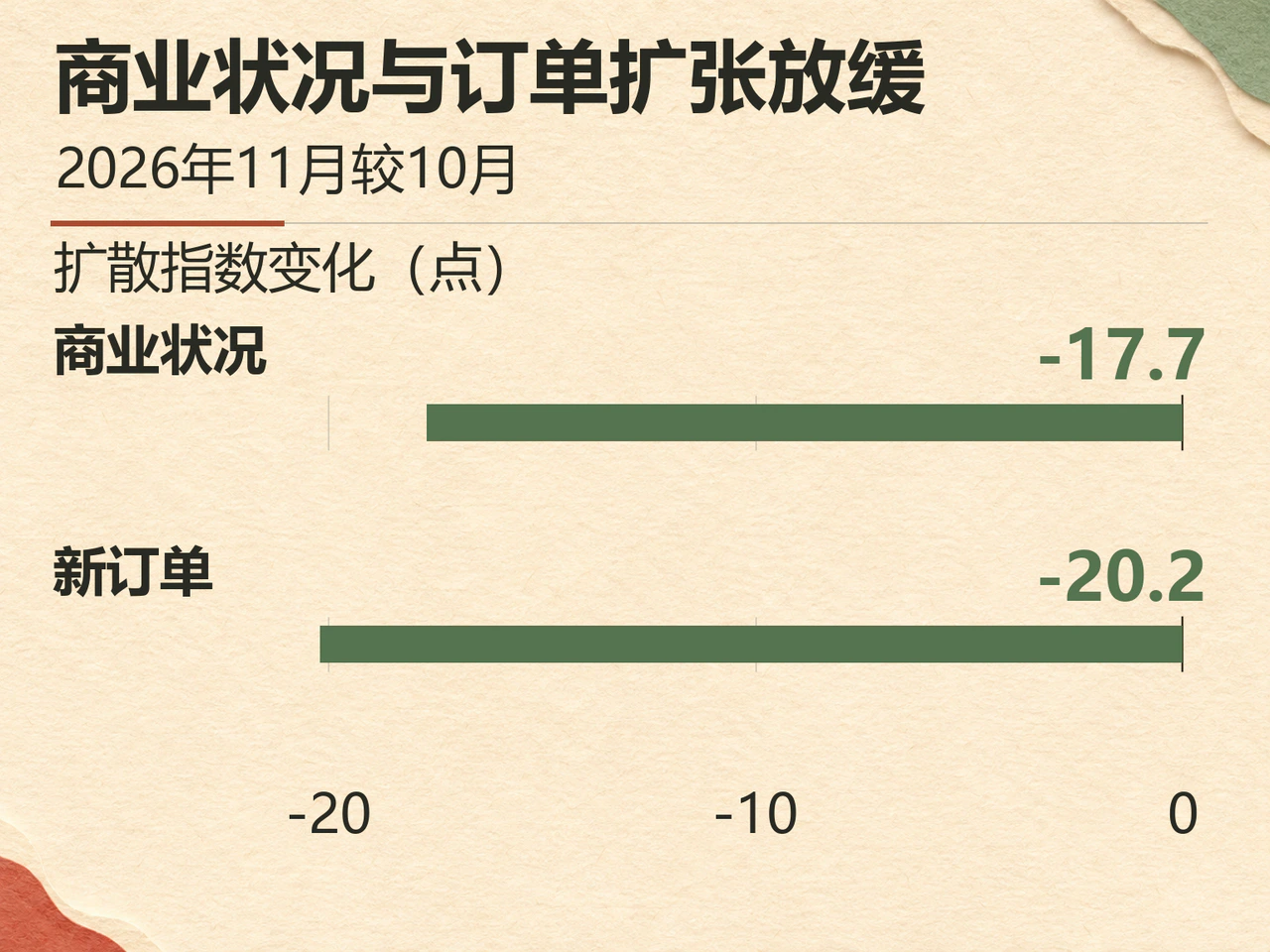
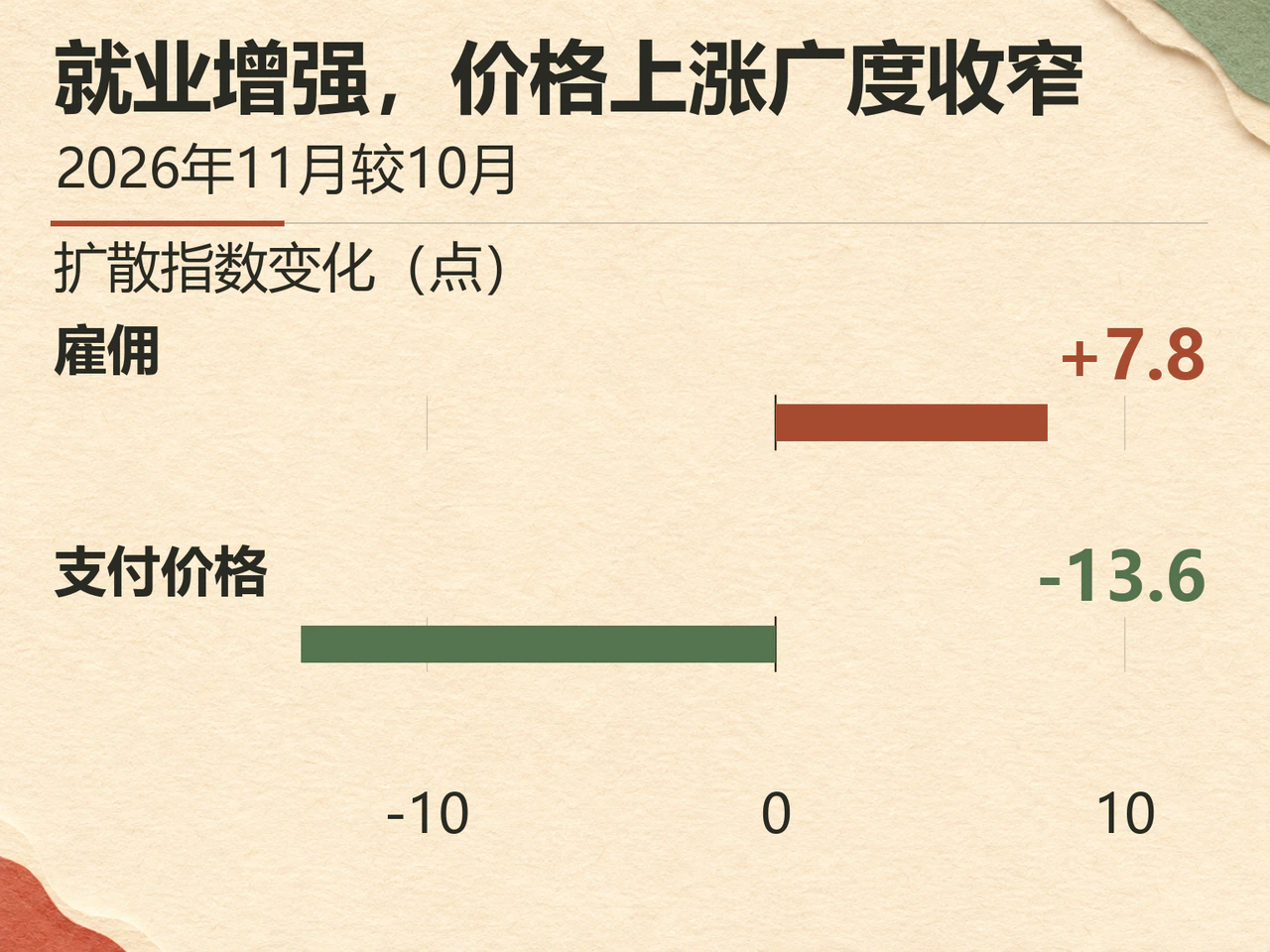
The New York Fed's November manufacturing survey, released the same day, showed a similar mix of strength and weakness. Its diffusion indices, which measure the difference between the shares of firms reporting an increase and a decrease in an indicator, showed the general business conditions index falling sharply from 25.5 to 7.8, new orders dropping from 23.2 to 3.0, and prices paid declining from 59.5 to 45.9. However, the employment index rose from 10.3 to 18.1, and the index of capital-spending plans over the next six months increased from 14.0 to 23.0. The narrower breadth of order growth and price increases corroborates cooling demand and falling inflation compensation, but corporate employment and investment intentions remain expansionary. Markets are closely watching U.S. October retail-sales and industrial-production data due on November 17 to assess nationwide demand and the policy-rate outlook further.
Supply-recovery expectations push oil down more than 3.5%; high real rates restrain gold
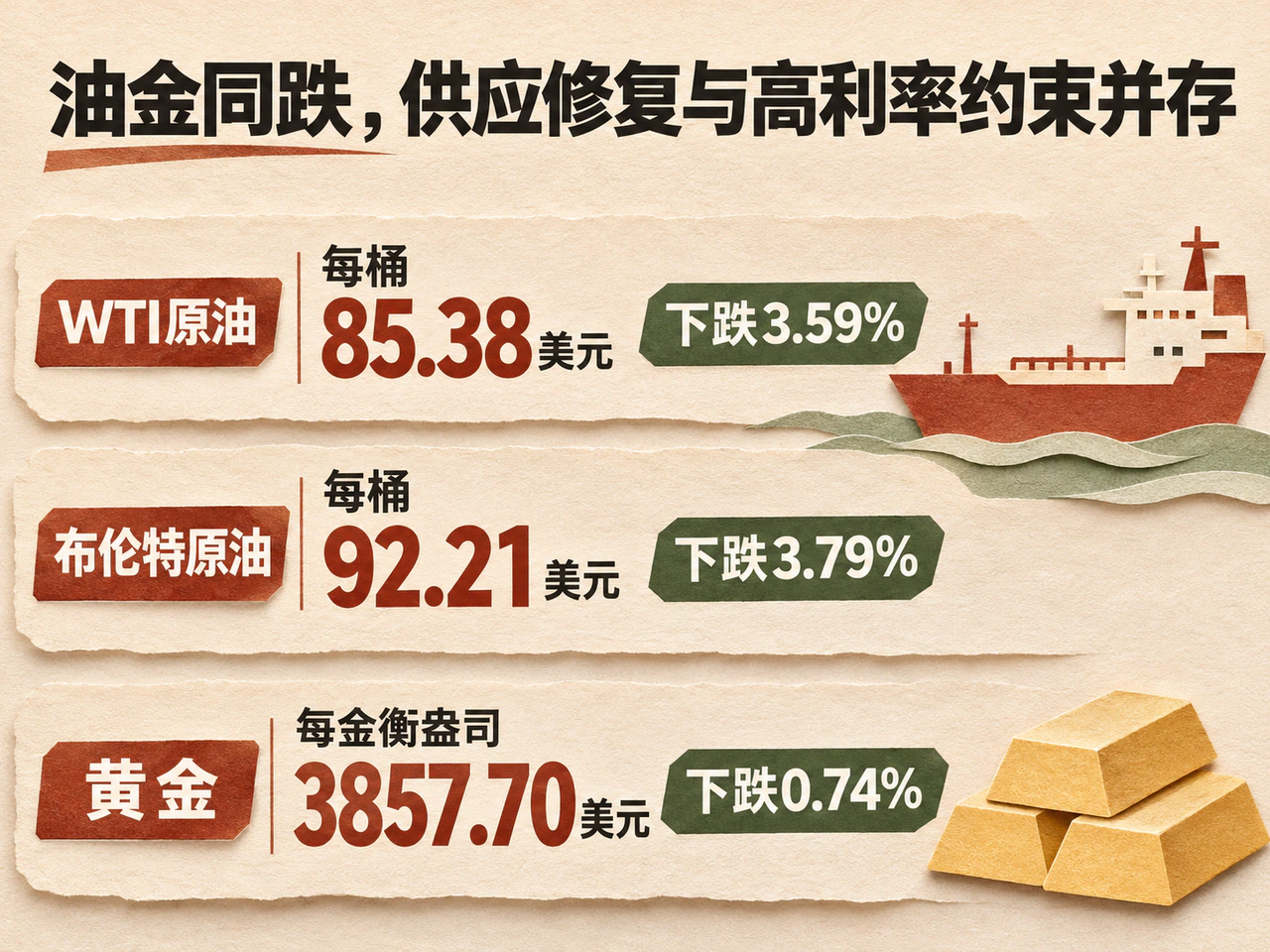
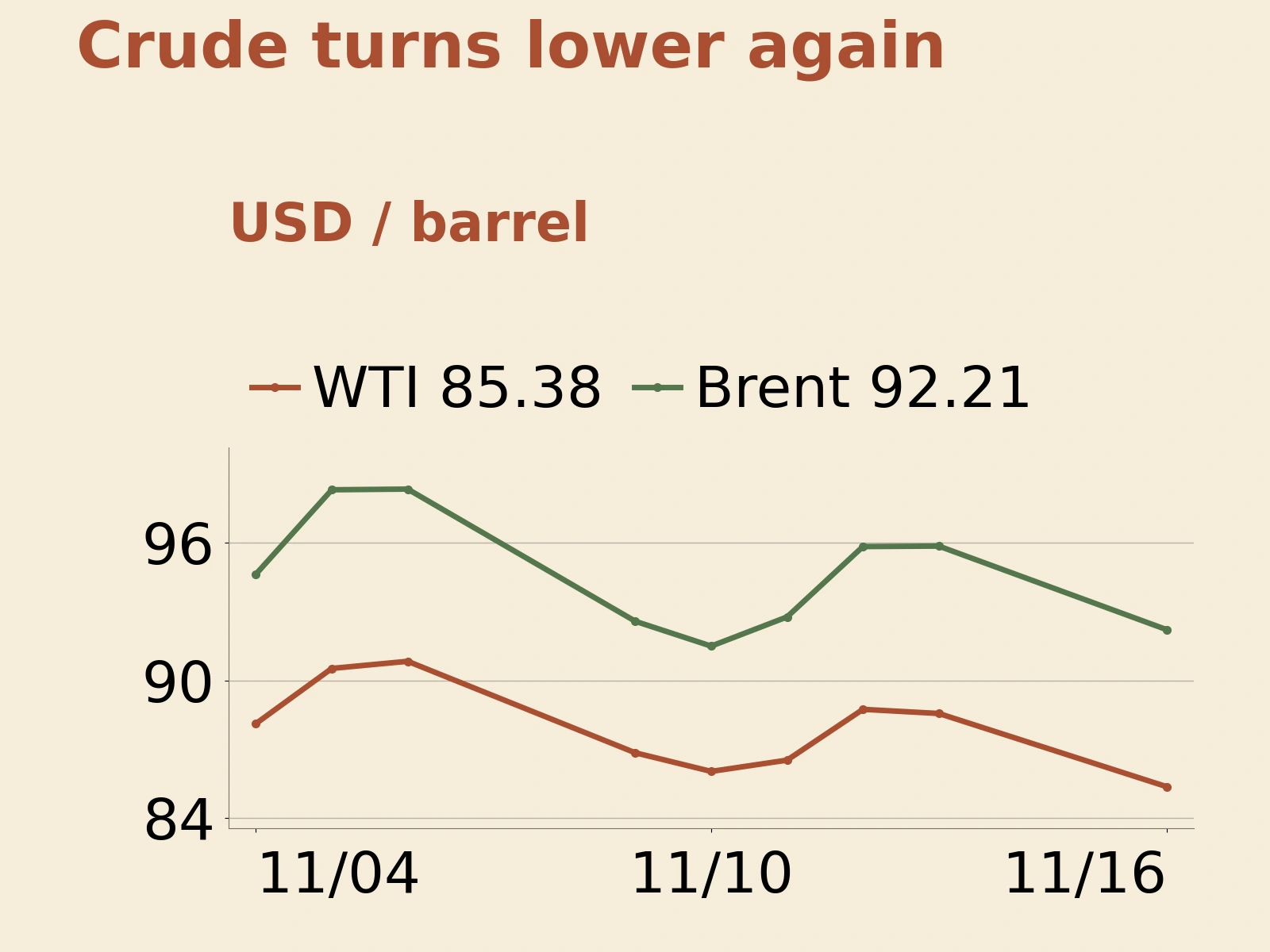
In commodities, oil prices fell sharply as recovering flows through the Strait of Hormuz and expectations of a future surplus weighed on the market. On the data provider's daily closing basis for continuous futures, WTI crude ended Monday at $85.38 a barrel, down 3.59%, while Brent closed at $92.21 a barrel, down 3.79%. The declines dragged the U.S. energy-sector ETF, XLE, down 1.96%.
October physical-market data in the International Energy Agency's (IEA) monthly report, released on November 13, showed global oil supply increasing by 2.3 million barrels a day from the previous month to 105.4 million barrels a day. Gulf oil exports excluding Oman recovered to 18.4 million barrels a day, although they remained 26% below prewar levels. An IEA forecast cited by Reuters on November 16 indicated that global oil supply could exceed demand by 1.7 million barrels a day in the fourth quarter if the recovery in supply continues. Meanwhile, China's October refinery throughput fell 8.1% year on year, adding to demand-side pressure.
Physical logistics bottlenecks have not yet fully cleared, however. IEA data showed global observed oil inventories rising by 52 million barrels in October, but oil on water increased by 86 million barrels, while onshore inventories fell to their lowest level since at least 2016. There is a lag between additional crude loadings and actual refinery receipts, and freight rates from the Middle East to Asia remain near historical highs. Relief in end-user fuel costs is therefore expected to arrive more slowly than the decline in futures prices. In addition, new EU restrictions on Russia that took effect on November 16 added more financial institutions and companies linked to energy and the shadow fleet to the sanctions list, increasing frictions in payments, financing and shipping. Their substantive impact on global oil prices will depend on the extent of disruption to Russian oil exports and the response of alternative supplies.
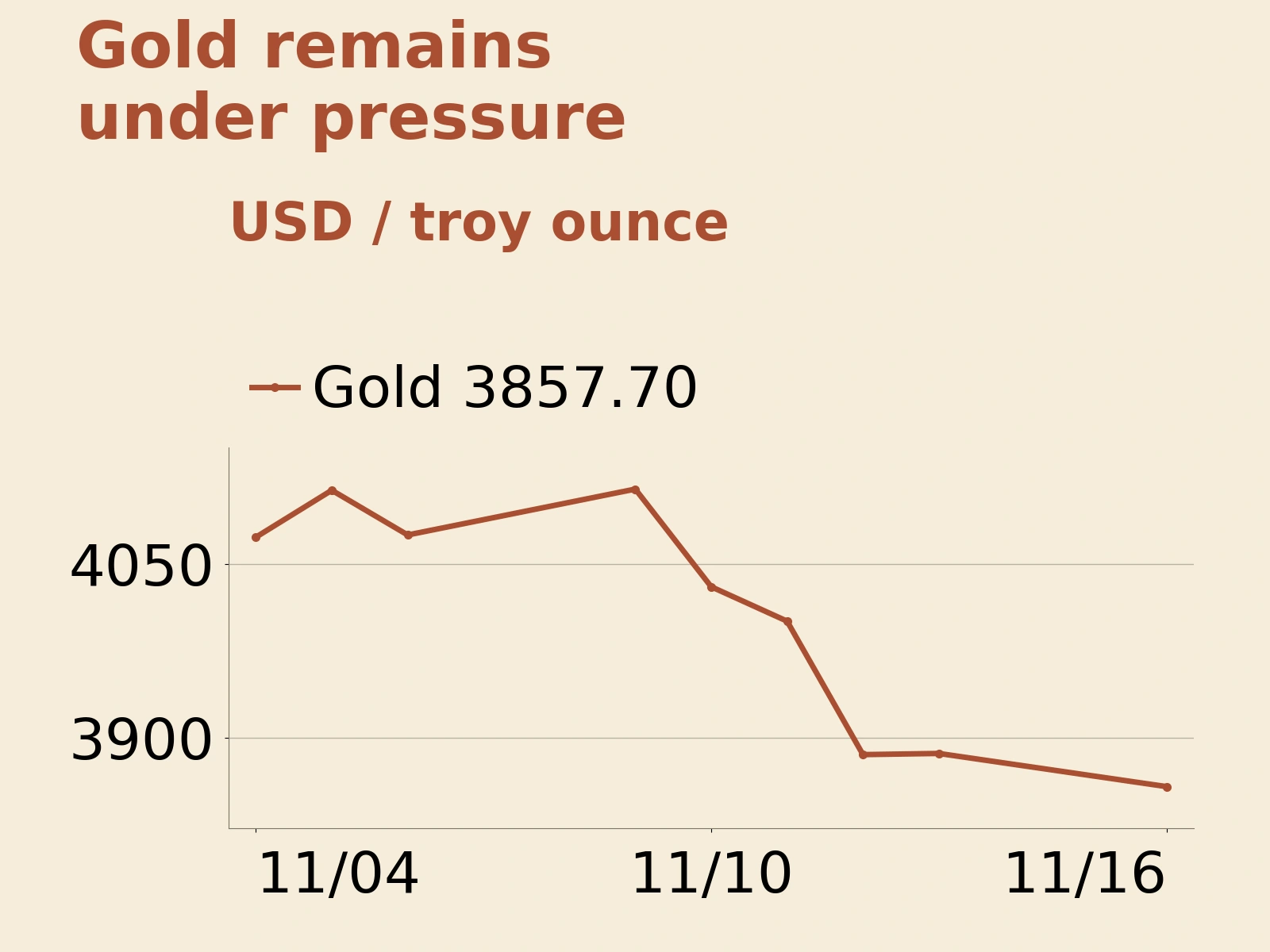
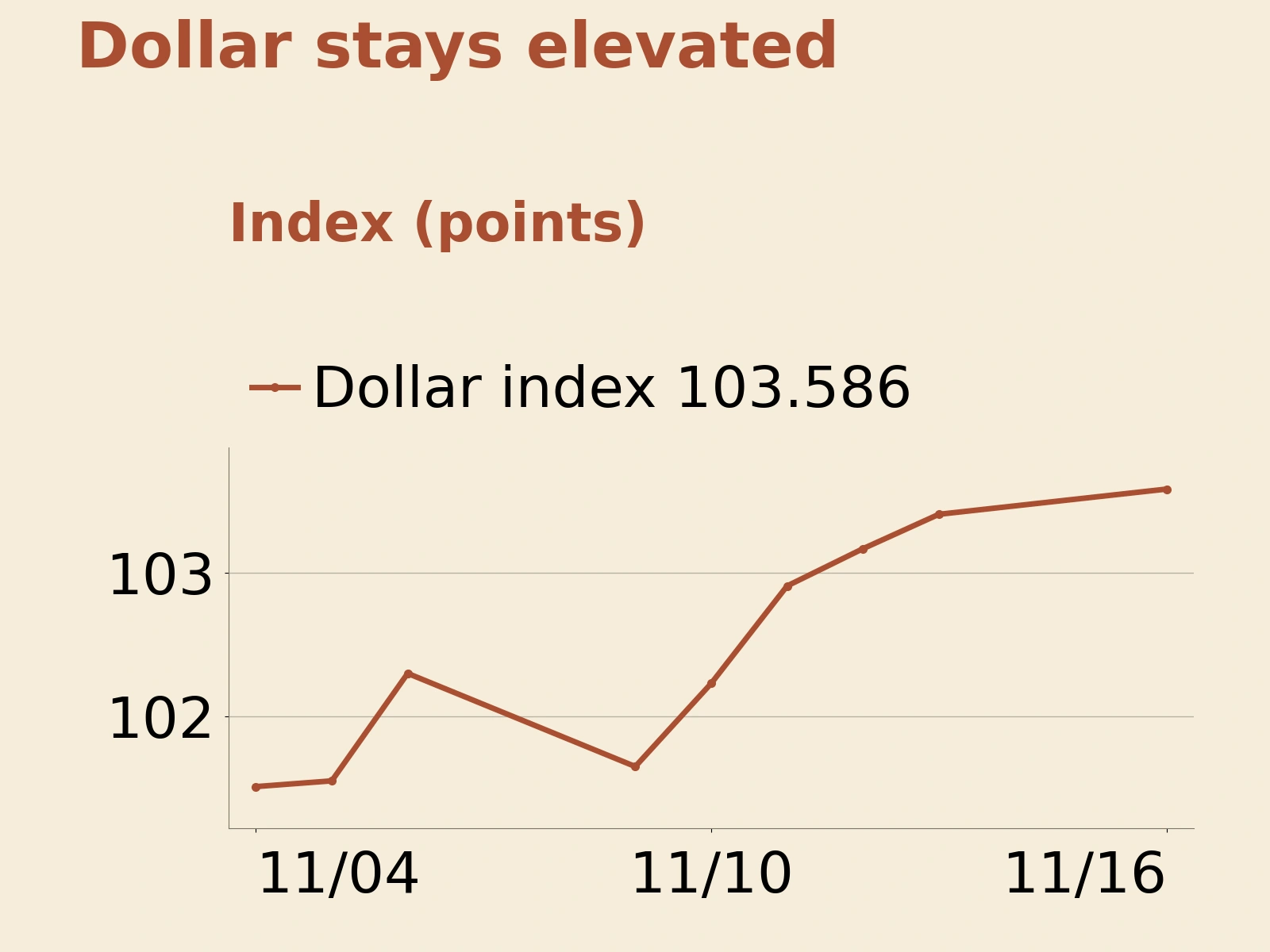
Precious metals were also under pressure. On the same daily closing basis, continuous gold futures fell 0.74% to $3,857.70 per troy ounce. The dollar index rose 0.17% to 103.586 that day, while the 10-year Treasury real yield reached 2.92%. A higher opportunity cost of holding gold and higher purchase costs for buyers using other currencies restrained safe-haven demand. Reuters cited Zaner Metals strategist Peter Grant as saying that the previous week's inflation data had reinforced expectations of a Federal Reserve rate increase in December, putting direct pressure on gold. Medium- and long-term allocation demand persists: Reuters reported third-quarter net inflows of 211 tonnes into physically backed gold ETFs, and the World Gold Council estimated global central-bank purchases at 675 tonnes in January–September. Nevertheless, MKS PAMP strategist Nicky Shiels noted that, when risk assets fall broadly, gold can also face short-term selling to raise liquidity.
Asia-Pacific equities diverge along the chip supply chain; bond markets face liquidity and fiscal constraints
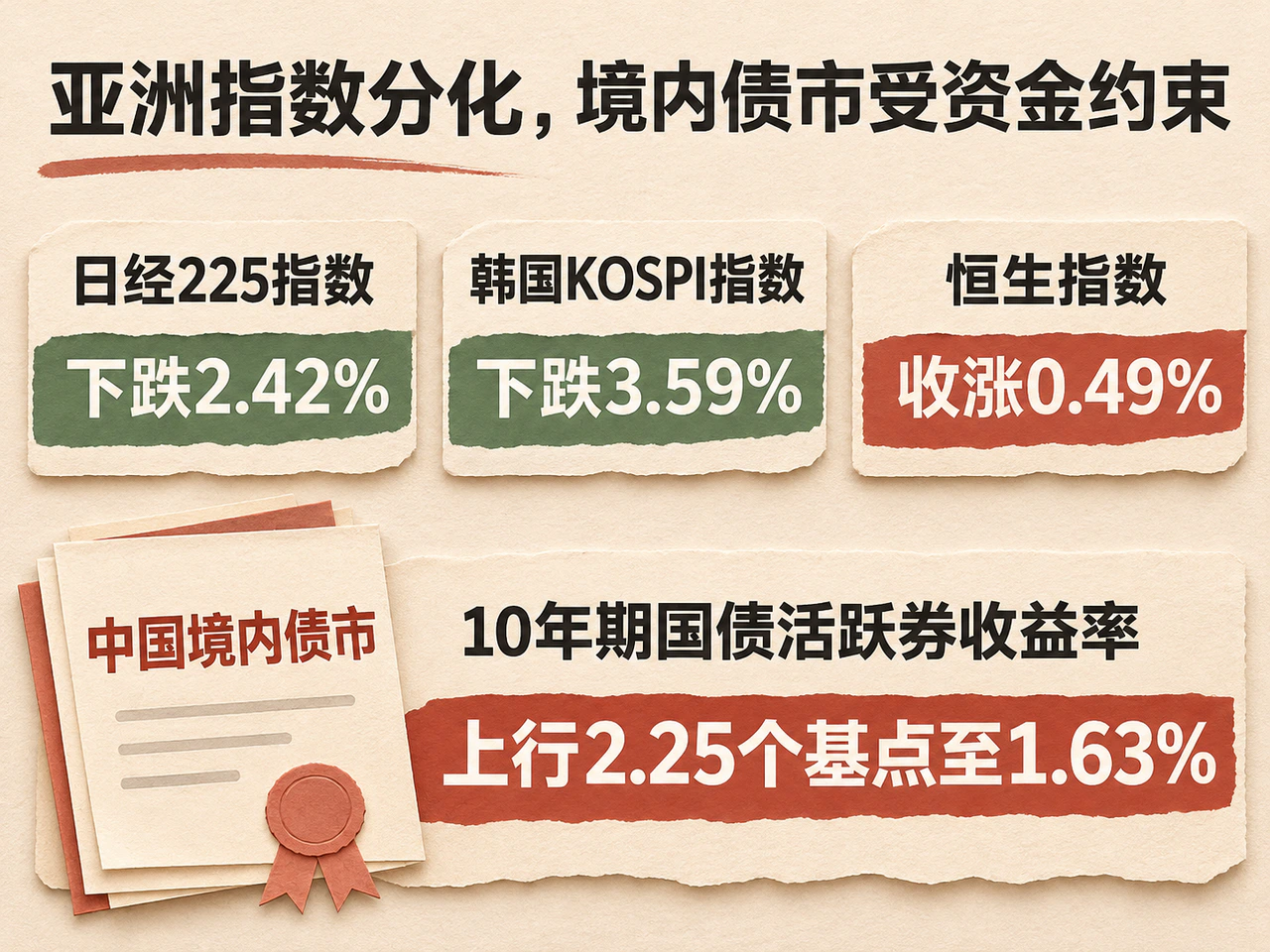
During the Asian session on November 16, before the U.S. market close, Japanese and South Korean equities, which have heavy semiconductor weightings, had already fallen. A StreetAccount roundup published by BNY showed the Nikkei 225 losing 2.42% to 59,662.02 and South Korea's KOSPI falling 3.59% to 5,100.50. Chip-equipment and memory giants led the decline: Japan's Advantest and Tokyo Electron plunged 11.1% and 7.1%, respectively; South Korea's Samsung Electronics fell 4.5%, and SK Hynix lost approximately 8%.
Hong Kong equities followed a relatively independent course. The Hang Seng Index closed up 0.49% at 23,753.84, while RTHK reported that the Hang Seng TECH Index edged down 0.3% to 3,801. Among individual stocks, New World Development plunged approximately 41% after proposing a HK$24.9 billion rights issue. As U.S. technology shares extended their losses overnight, external spillover pressure on Japanese and South Korean semiconductor stocks and Hong Kong technology shares increased ahead of the Asia-Pacific market open on November 17.
Bond and financing markets were constrained by their respective liquidity structures and fiscal agendas. In China's onshore market, weak October economic data failed to lift bonds. Xinhua Finance reported that the yield on the active 10-year government bond rose 2.25 basis points to 1.63% on November 16, while the active 30-year yield increased 1.75 basis points to 2.077%. The People's Bank of China injected a net RMB96 billion through overnight reverse repos that day, but rolled over its six-month outright reverse repos at a reduced amount. The two operations together withdrew a net RMB4 billion. With tax-related cash outflows and redemption pressure on institutions, the maturity structure of funding drove that day's trading.
In offshore markets, U.S. investment-grade and high-yield bond option-adjusted spreads (OAS) stood at 89 and 320 basis points, respectively, as of November 12, narrower than the 93 and 342 basis points recorded on November 6. Credit spreads remained stable. Under arrangements previously announced by China's Ministry of Finance, up to $2 billion of sovereign bonds are scheduled to be issued in Hong Kong this week. Alongside the offshore renminbi bond index launched by HKEX on November 16, this provides new pricing references for offshore dollar and renminbi assets.
Looking toward year-end, U.S. fiscal negotiations will be another variable shaping interest rates and sector expectations. KPMG's November 16 morning weekly report noted that the current U.S. temporary funding measure expires on December 11, while the 12 required annual appropriations bills have yet to be approved. A request for $350 billion in defense funding also remains under negotiation. Subsequent developments will directly affect Treasury financing supply, expectations for defense orders and the functioning of the federal government.