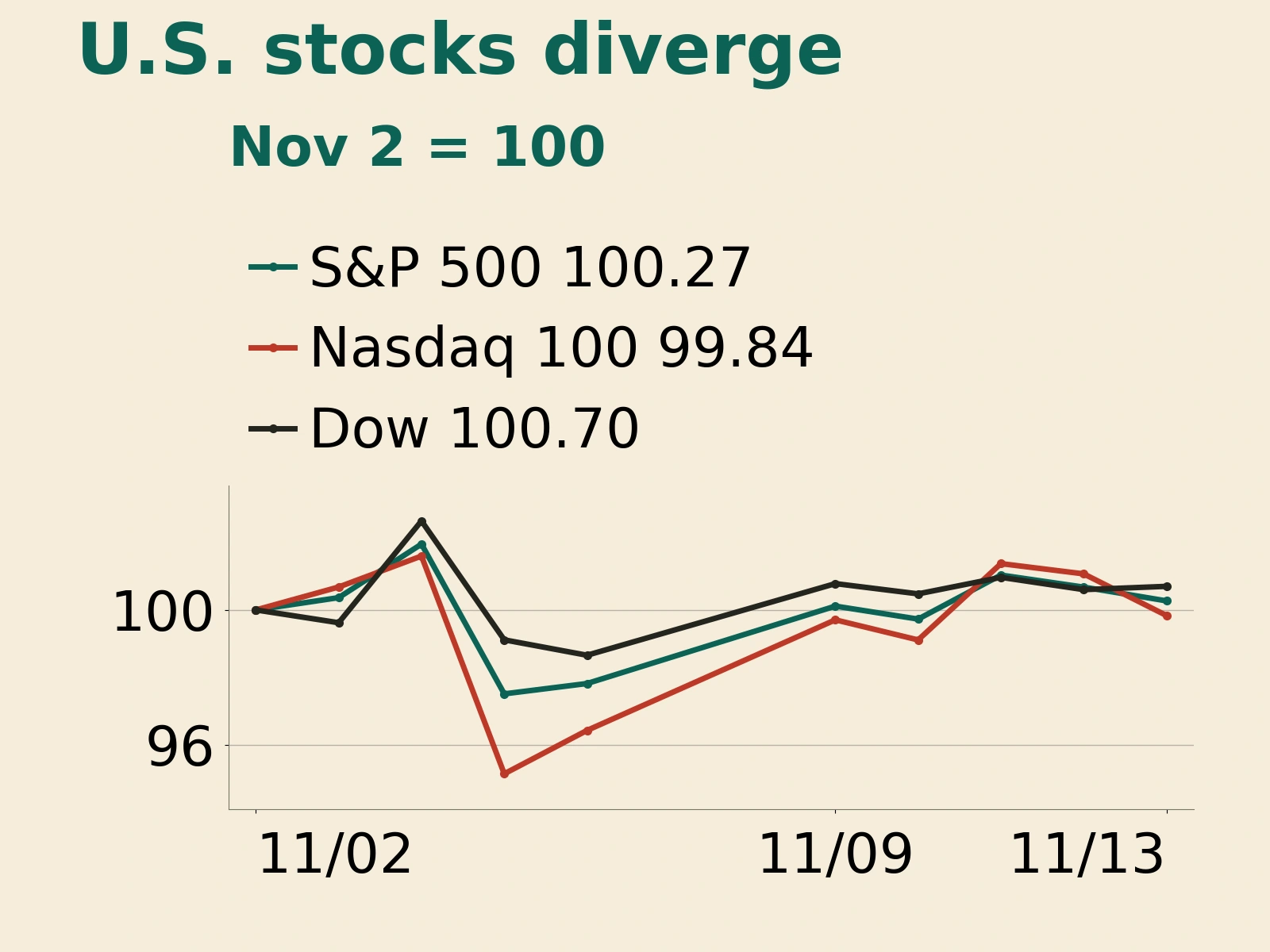
On November 17, 2026, the S&P 500 fell for a fourth consecutive session, while the Dow lost nearly 850 points. Investors were waiting for Nvidia's earnings, but financials and small-cap stocks suffered the deeper losses during the day. Money flowed into US Treasuries, pushing short- and intermediate-term yields lower, while interest-rate futures continued to price in a December Federal Reserve rate increase almost fully. After the close, Nvidia issued revenue guidance above market expectations, sending its shares up about 2% in after-hours trading.
Financials fall more than technology; Nvidia rebounds after hours
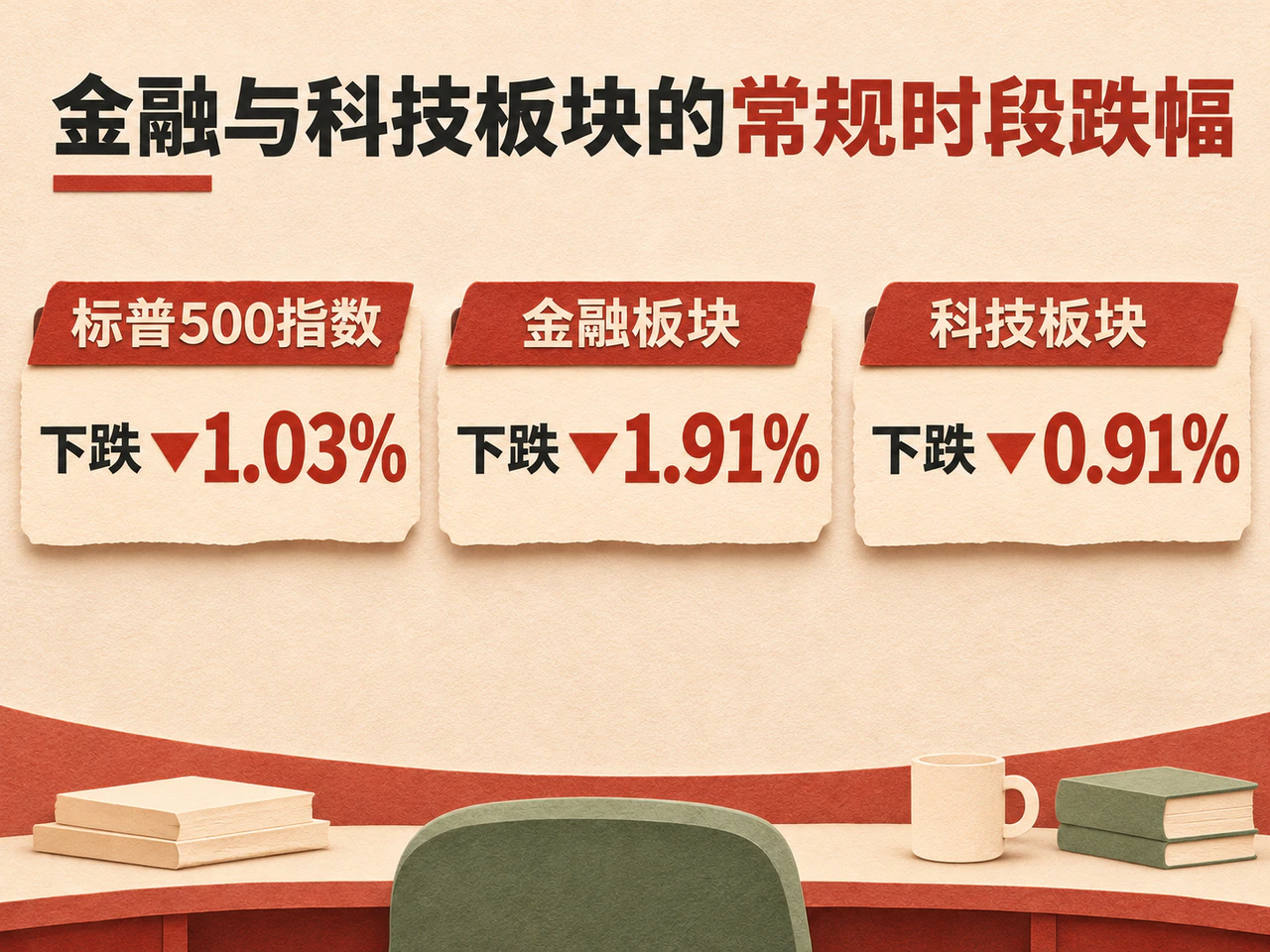
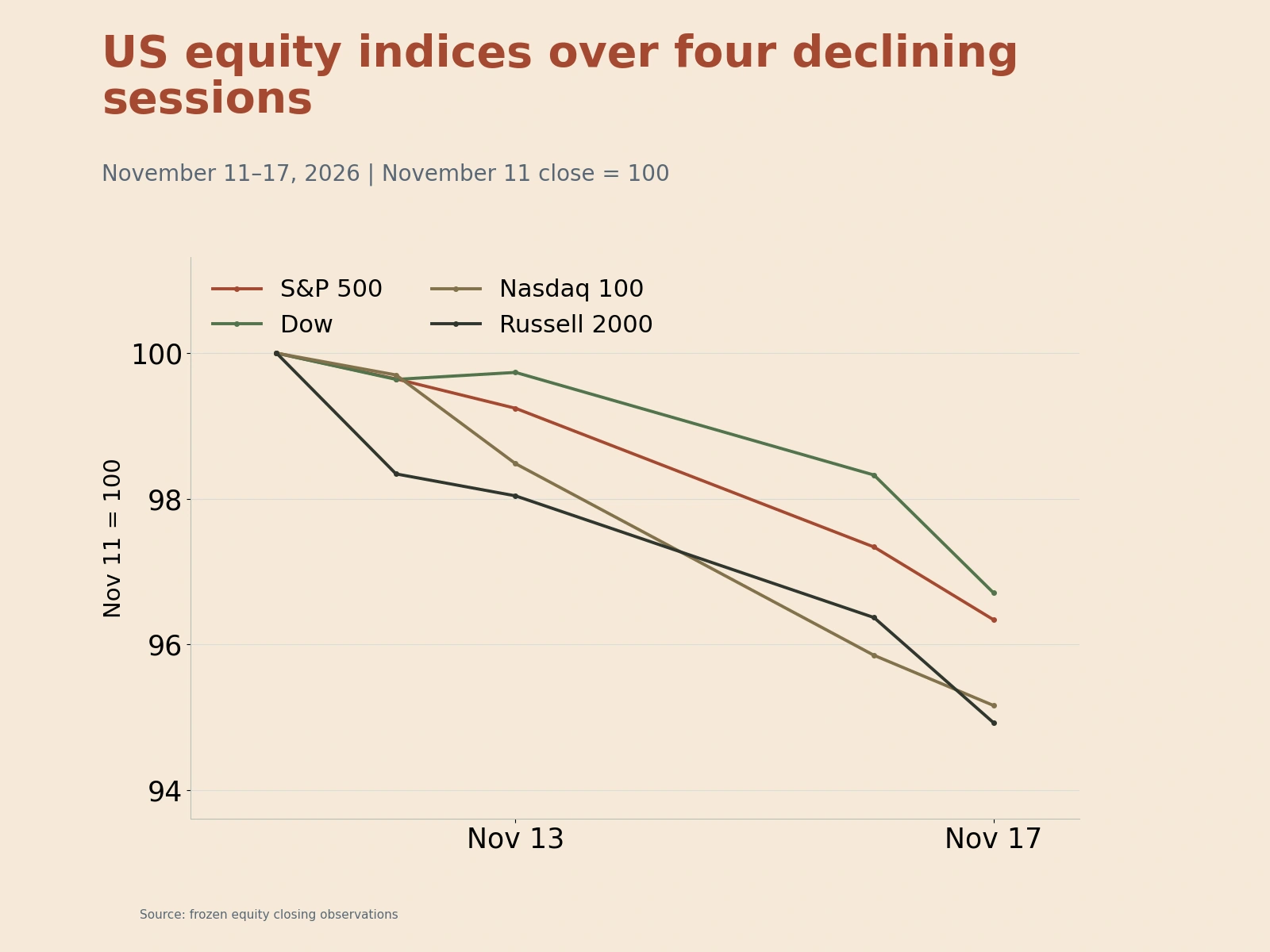
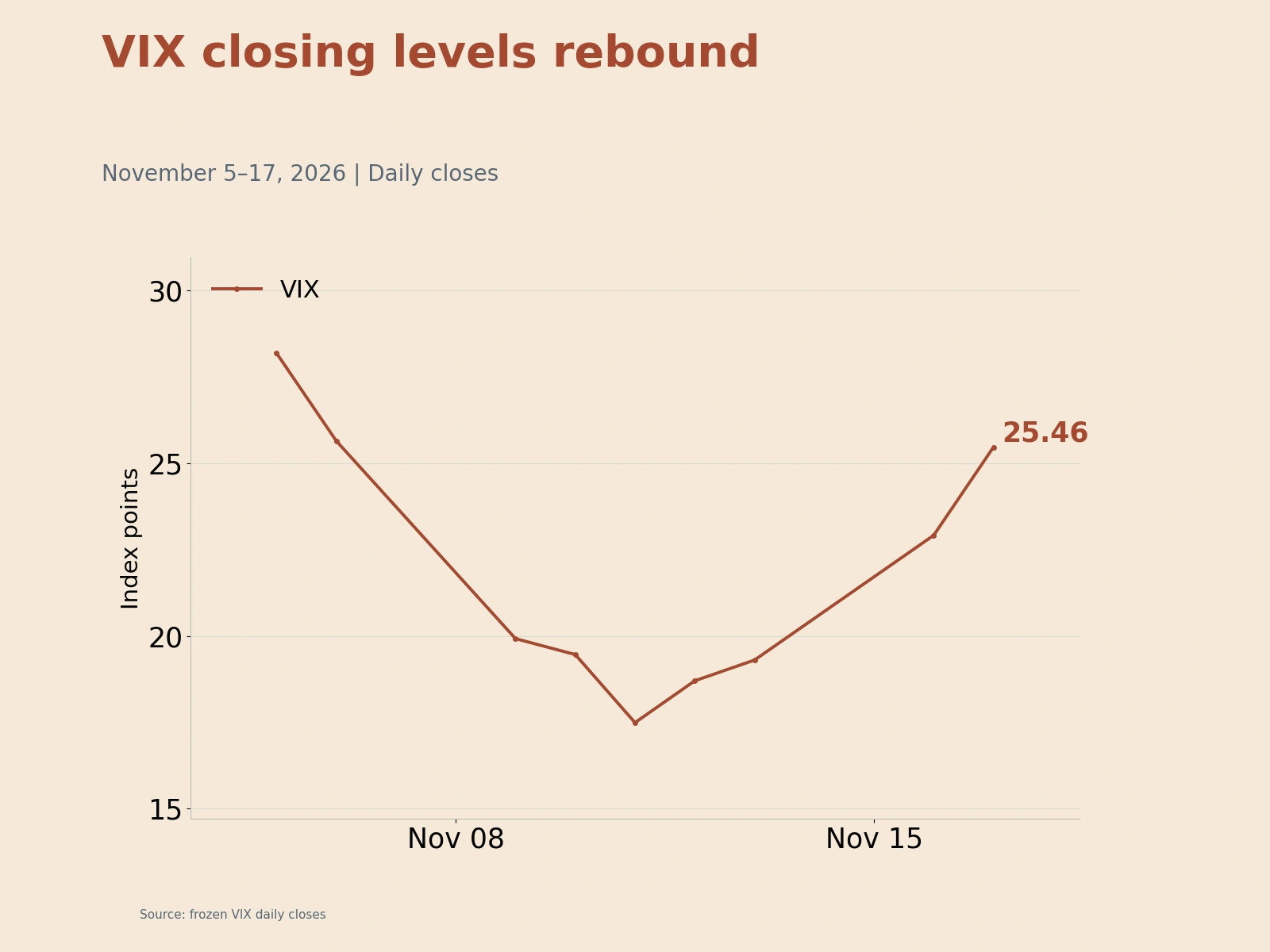
The Dow closed at 50,759.42, down 848.75 points, or 1.64%. The S&P 500 fell 1.03% to 7,340.53, bringing its cumulative decline since the November 11 close to 3.66%. The Nasdaq 100 lost 0.72% and the small-cap Russell 2000 fell 1.50%. Sector ETFs showed financials down 1.91% and technology down 0.91%. The VIX, which reflects expected S&P 500 volatility over roughly the next month, rose from 22.91 to 25.46.
Nvidia fell as much as 3.7% during regular trading. Alpine Macro equity strategist Nick Giorgi told Reuters that investors were also watching who would lead the company over the long term. Its after-hours results provided a fresh reading on chip demand. For the third fiscal quarter ended October 25, revenue rose 103% year over year to $115.8 billion, including a 110% increase in data-center revenue to $107.6 billion. Shipments of the next-generation Vera Rubin systems have begun, and partners including Microsoft Azure, Google Cloud and Oracle are already operating the racks.
Nvidia expects fourth-quarter revenue of about $130 billion, plus or minus 3%. The quarter contains one more week than usual. Under US generally accepted accounting principles, the company forecasts a gross margin of 71% to 72%, below the third quarter's 74.8%. Sales could therefore continue to grow while the gross profit retained from each dollar of revenue declines. Reuters reported that, alongside Nvidia's after-hours rebound, a technology-heavy South Korean equity ETF rose more than 1% in late New York trading. In the Asian cash sessions that had already ended, South Korea's KOSPI fell 2.59%, the Nikkei 225 lost 1.34% and the Hang Seng fell 1.03%.
For Asian data-center operators, strong chip sales represent only one side of demand: customers' ability to keep renting computing capacity also affects revenue. New rules announced by the US Commerce Department on November 16 extend advanced-chip restrictions to certain arrangements providing remote computing services through data centers in third countries. Reuters reported that Malaysian data-center infrastructure companies MN Holdings and Critical Holdings each fell nearly 20% intraday on November 17, while YTL Power lost nearly 10%. A Saxo Bank strategist said facilities dependent on Chinese customers could face pressure on both occupancy and rental rates. The Thailand Data Center Council noted that some capacity could be redirected to US customers. Nvidia announced the same day that its board had established a standing committee to oversee national-security and export-control matters.
Big-ticket sales slow, while other spending remains supported
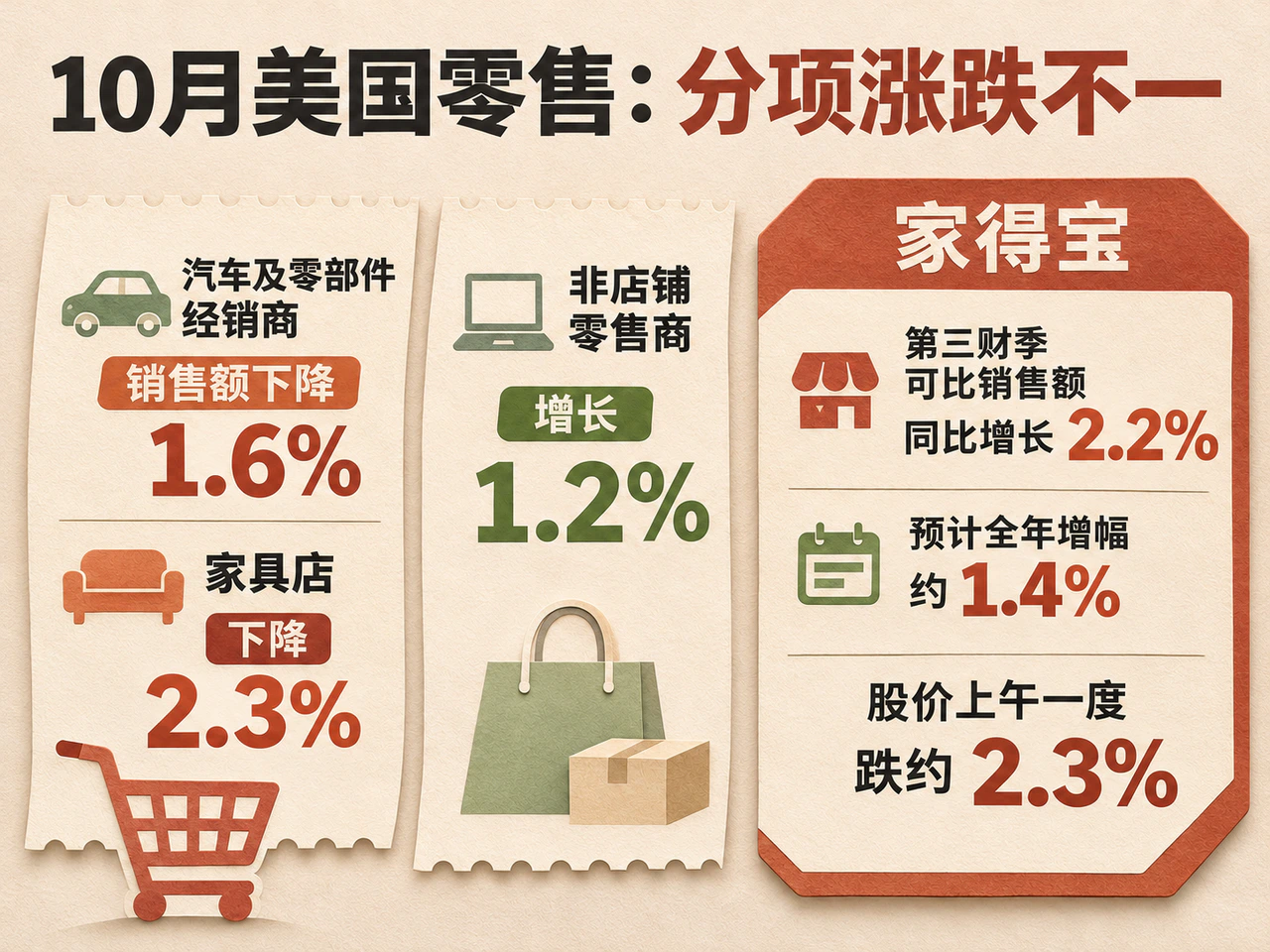
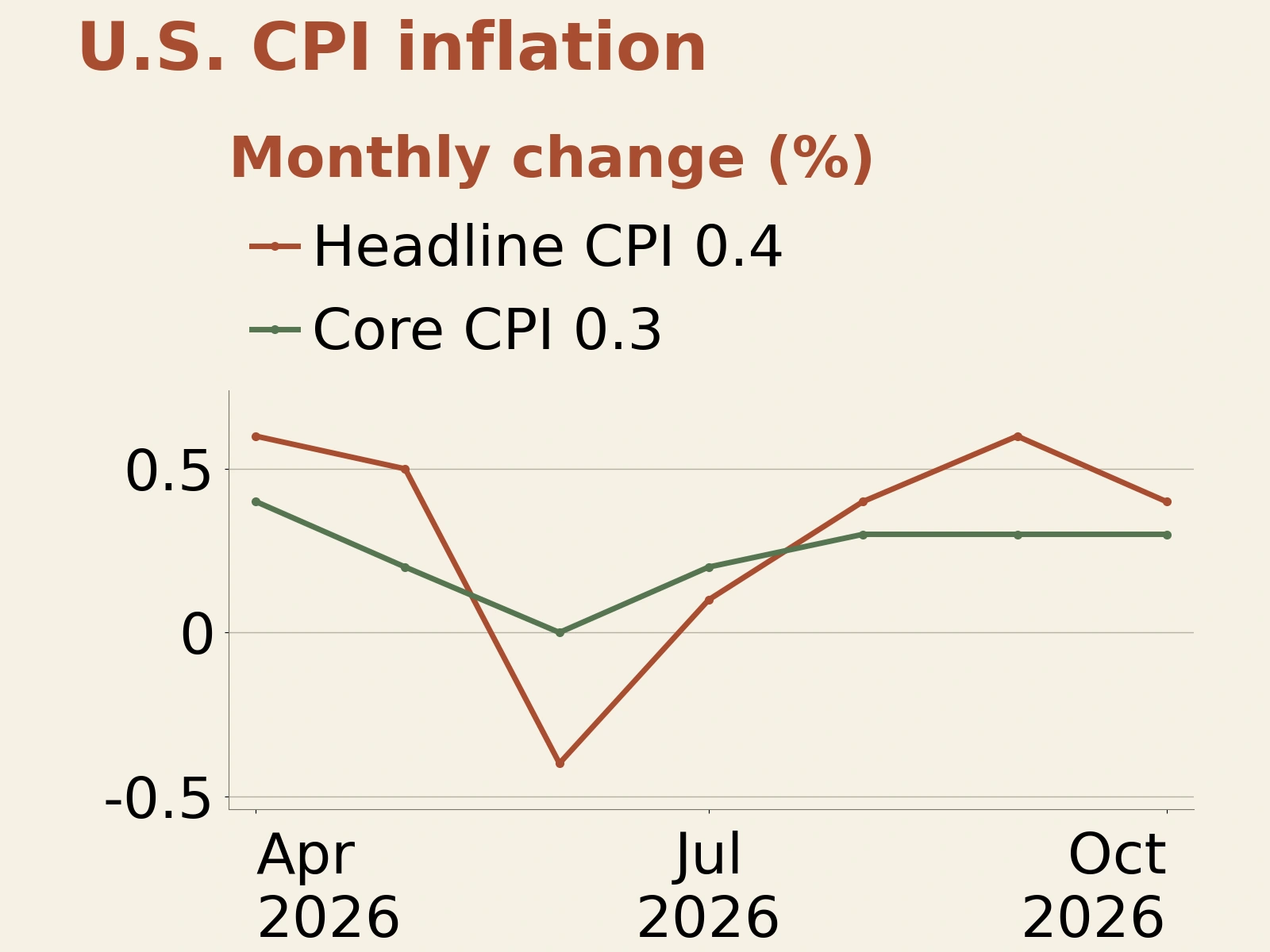
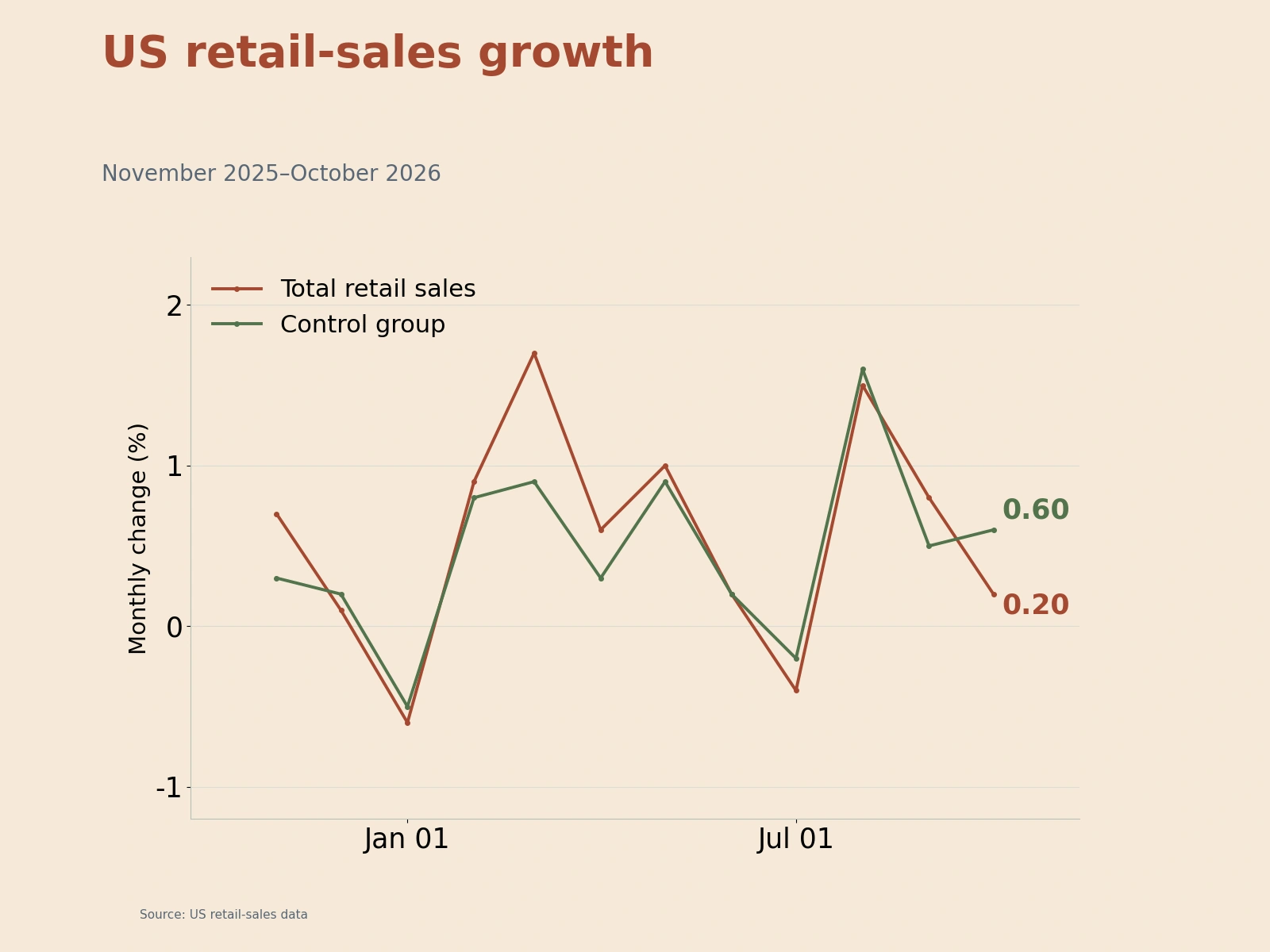
US retail and food-service sales totaled $748.2 billion in October, rising a seasonally adjusted 0.2% from the previous month, down from September's 0.8% and in line with expectations in a Reuters poll. Sales at motor-vehicle and parts dealers fell 1.6%, furniture-store sales declined 2.3%, and nonstore retailers posted a 1.2% increase. The retail control group, which excludes vehicles, gasoline stations, building materials and food services and is used to estimate goods consumption in GDP, rose 0.6% month over month, exceeding the 0.4% forecast. September's control-group increase was also revised from 0.1% to 0.5%. In current-price terms, consumers cut back on some big-ticket purchases, while sales of other goods remained resilient at the start of the fourth quarter.
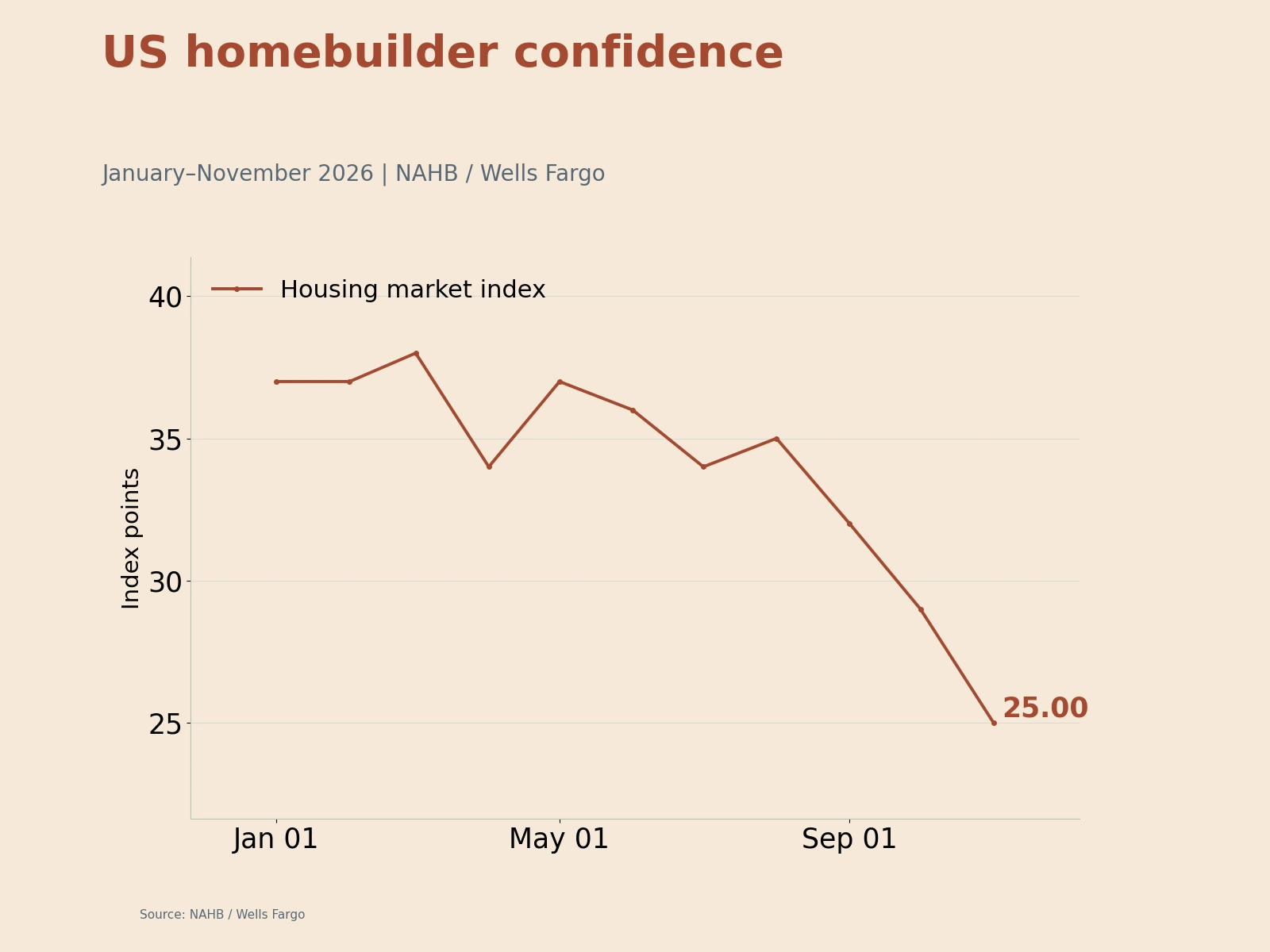
The housing market faces more direct pressure from interest rates. In November, the National Association of Home Builders/Wells Fargo index of the market for newly built single-family homes fell from 29 to 25, its lowest level since April 2012. Of the builders surveyed, 46% cut prices, by an average of 6%, and 68% offered sales incentives. NAHB Chief Economist Dietz said mortgage rates above 7% were eroding buyers' affordability. Before the market opened, Home Depot reported a 2.2% year-over-year increase in third-quarter comparable sales and forecast full-year growth of about 1.4%. Its shares fell about 2.3% at one point during the morning. Slower housing turnover also limits renovation business generated when homes change hands.
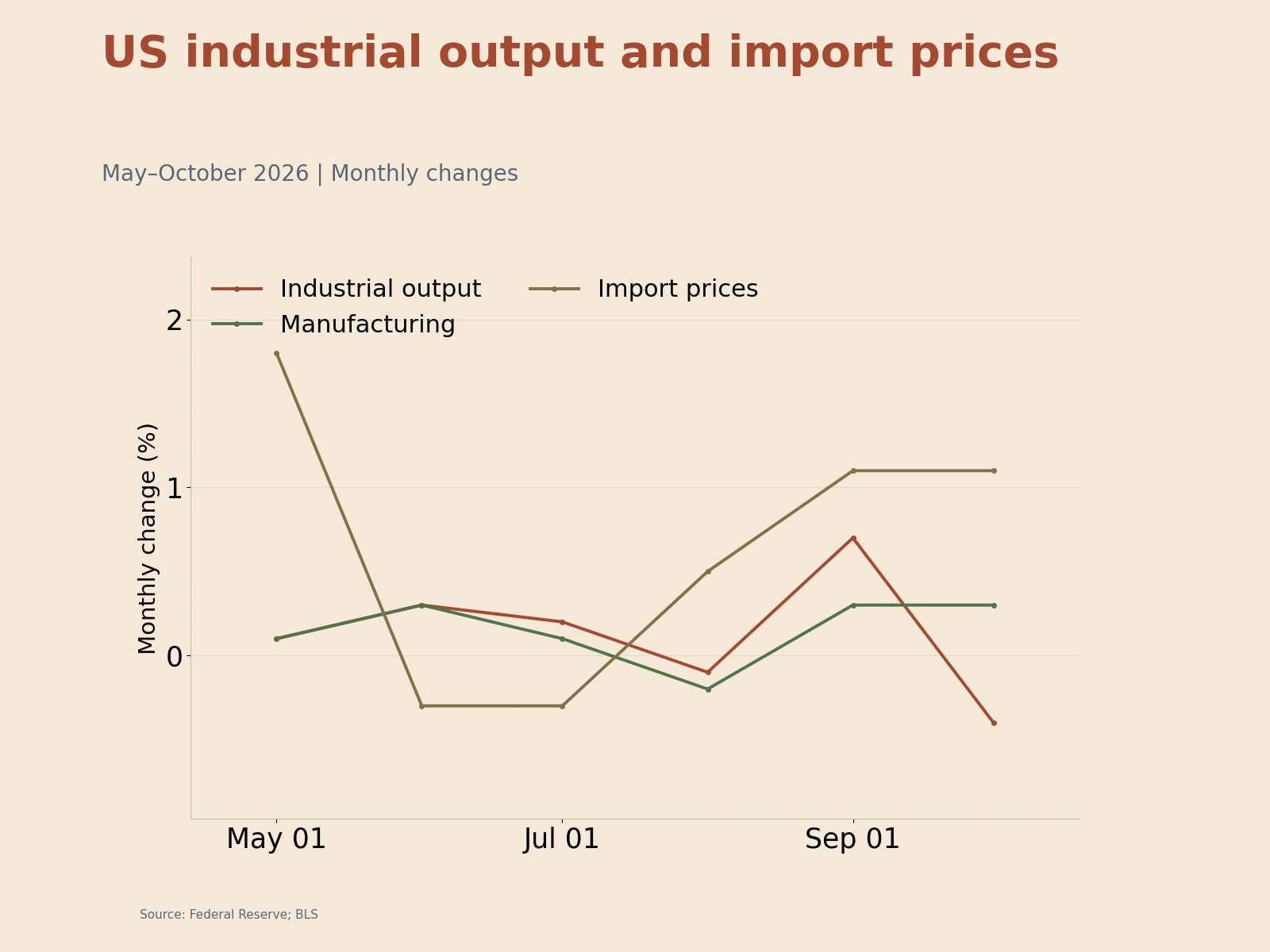
Business equipment investment continues to support industrial demand. US industrial production fell 0.4% month over month in October, including a 4.3% decline in utilities output. Manufacturing output rose 0.3%, but fell 0.1% excluding motor vehicles and parts. Business equipment output rose 1.0% from the previous month and 7.8% from a year earlier. Equipment procurement costs are also increasing. The Bureau of Labor Statistics reported that import prices rose 1.1% in October, above the 0.7% forecast. Nonfuel import-price growth accelerated from 0.5% to 0.8%. Capital-goods prices rose 1.5%, the largest increase since monthly compilation began in December 1988, driven mainly by computers, semiconductors and industrial machinery. The index excludes tariffs. Equipment buyers can purchase less with the same budget; which party ultimately bears the cost depends on the bargaining power of buyers and sellers.
Treasuries recover, but borrowing remains expensive for lower-rated companies
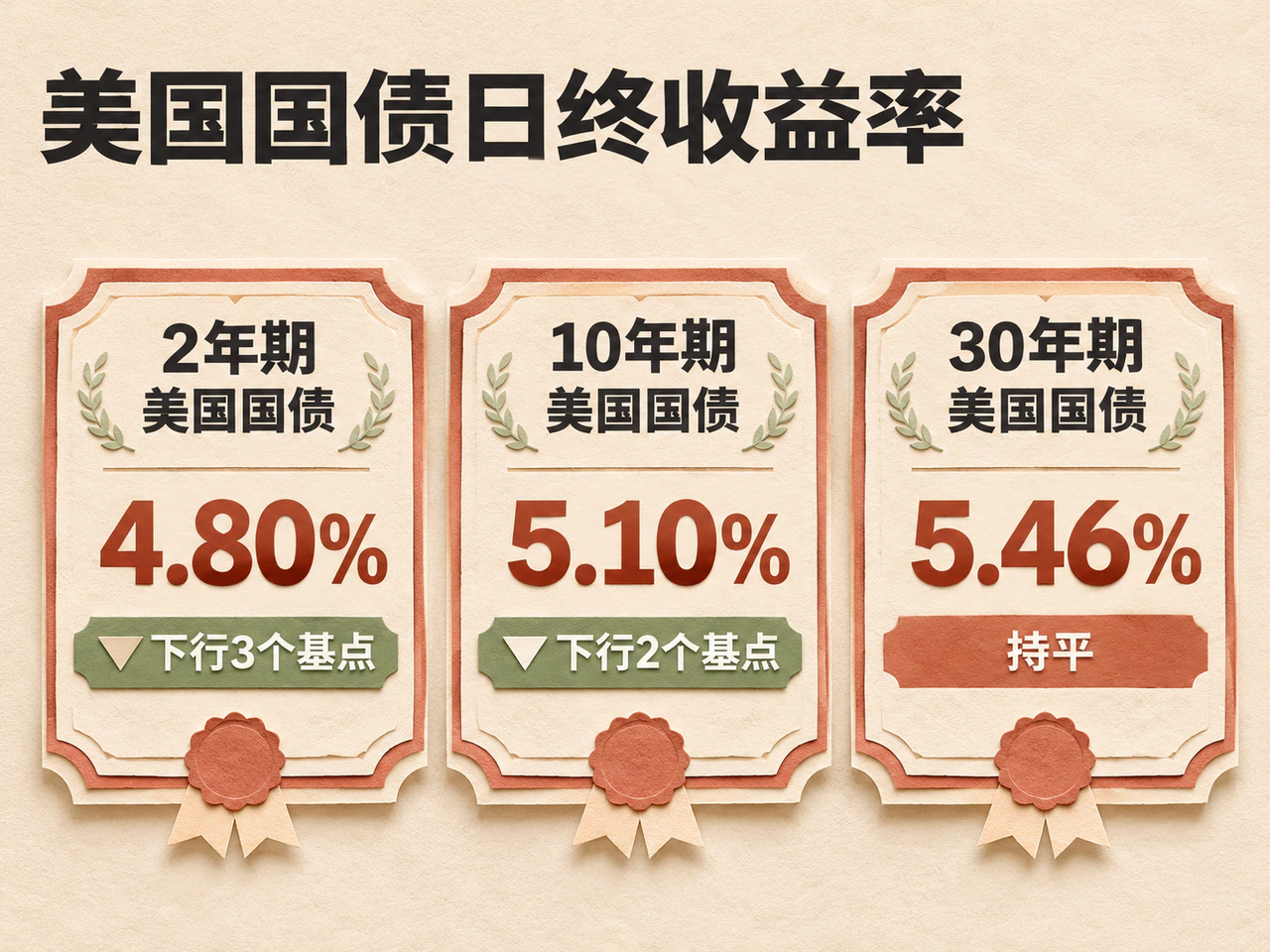
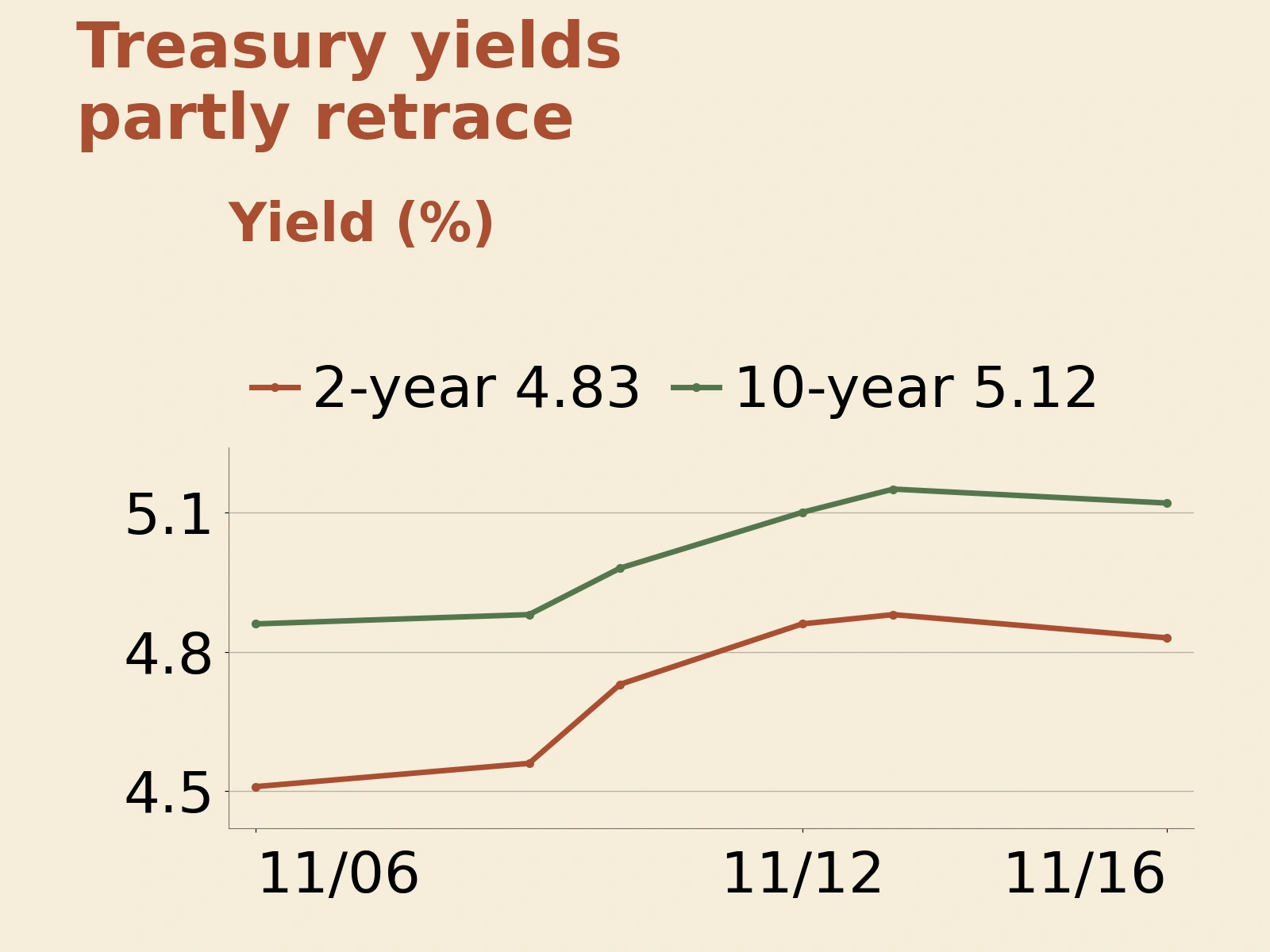
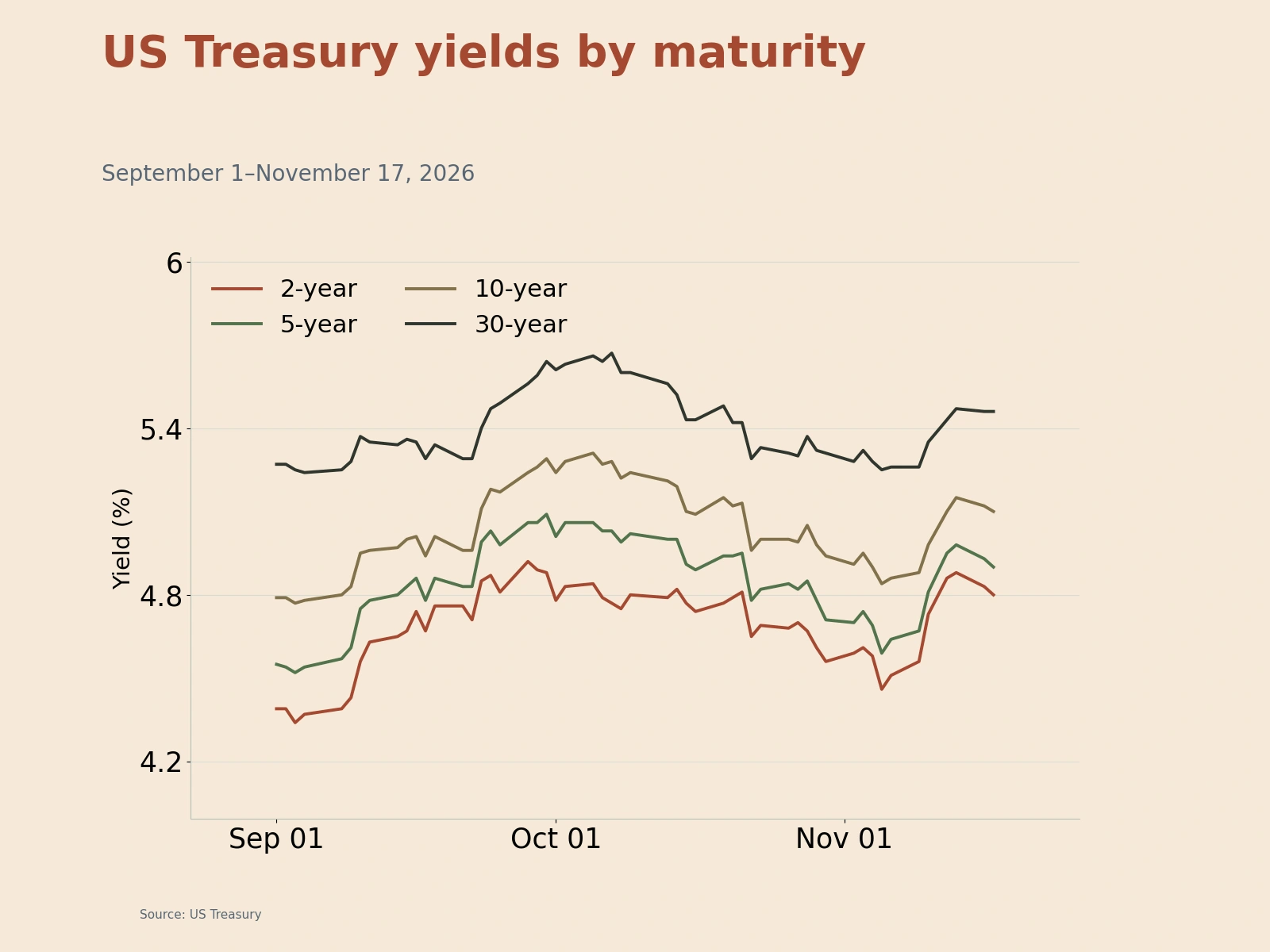
Treasury yields initially rose after the retail-sales release. As equity losses deepened, safe-haven buying pushed short- and intermediate-term yields lower. The US Treasury's end-of-day curve showed the two-year yield down 3 basis points to 4.80%, the five-year down 3 basis points to 4.90%, the ten-year down 2 basis points to 5.10%, and the thirty-year unchanged at 5.46%. From November 5 to 17, however, two- and ten-year yields were still up a cumulative 34 and 26 basis points, respectively. Reuters cited CME FedWatch data that afternoon showing an approximately 98% market-implied probability of a 25-basis-point increase at the December 8–9 meeting, with the remaining roughly 2% assigned to a 50-basis-point increase. With consumption still resilient and import-price growth above expectations, the day's bond rally is more consistent with a search for safety.
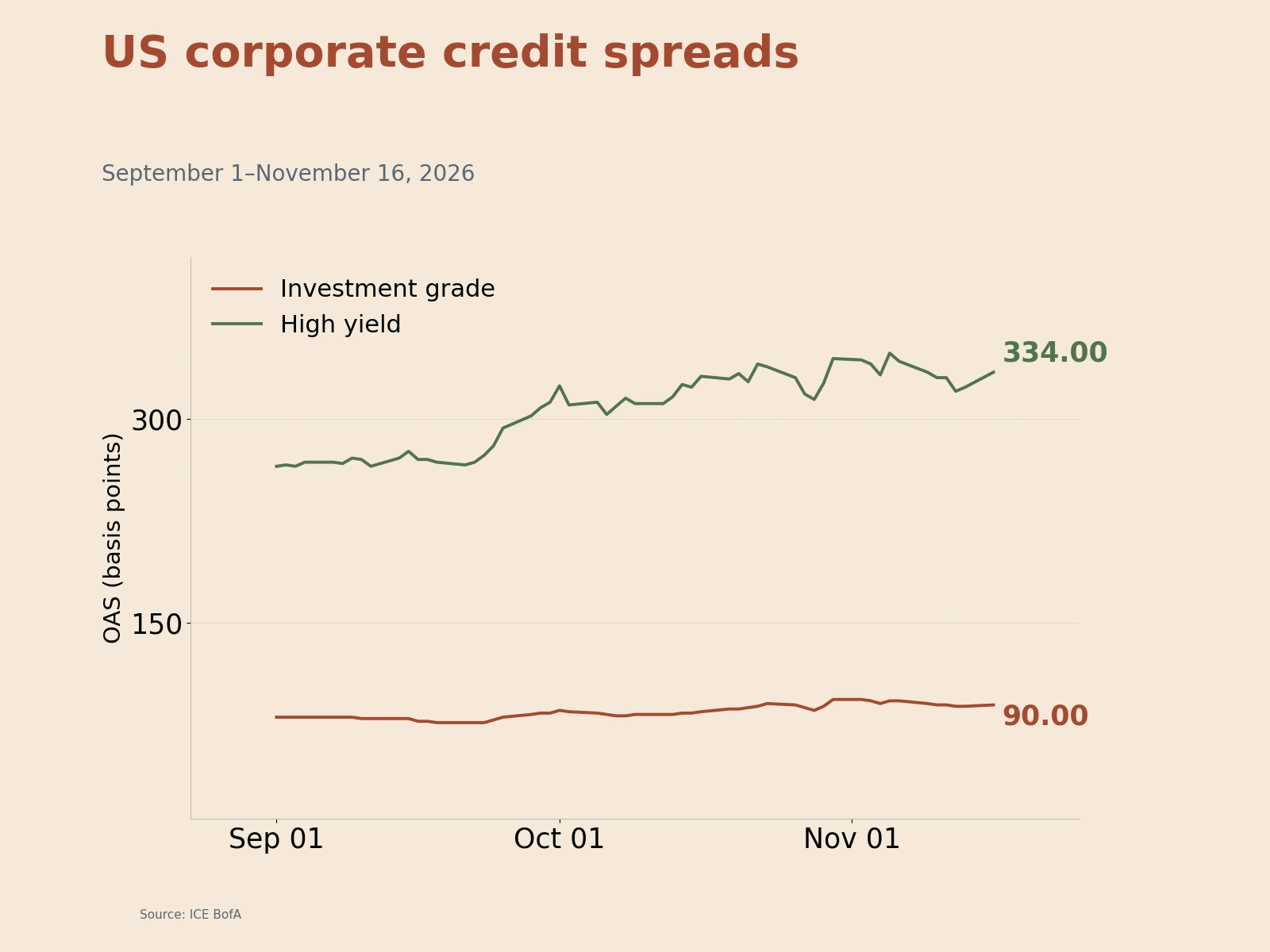
For companies, Treasury yields are only one component of financing costs. On November 16, the option-adjusted spread on the ICE BofA US Corporate Index widened 1 basis point from November 13 to 90 basis points, while the high-yield spread widened 11 basis points to 334 basis points. Bloomberg indices cited in OCBC's November 17 morning report also showed Asian US-dollar investment-grade bond spreads widening 2 basis points to 71 basis points in the preceding session, and high-yield spreads widening 13 basis points to 362 basis points. Both markets were demanding greater compensation from lower-rated issuers. Hong Kong's New World Development proposed a rights issue of about HK$24.9 billion on November 15. Earlier, the company's debt exchange had retired a combined total of about US$199 million of bonds due in 2027 and 2028, below its original target.
Prompt crude retains a premium; gold edges higher
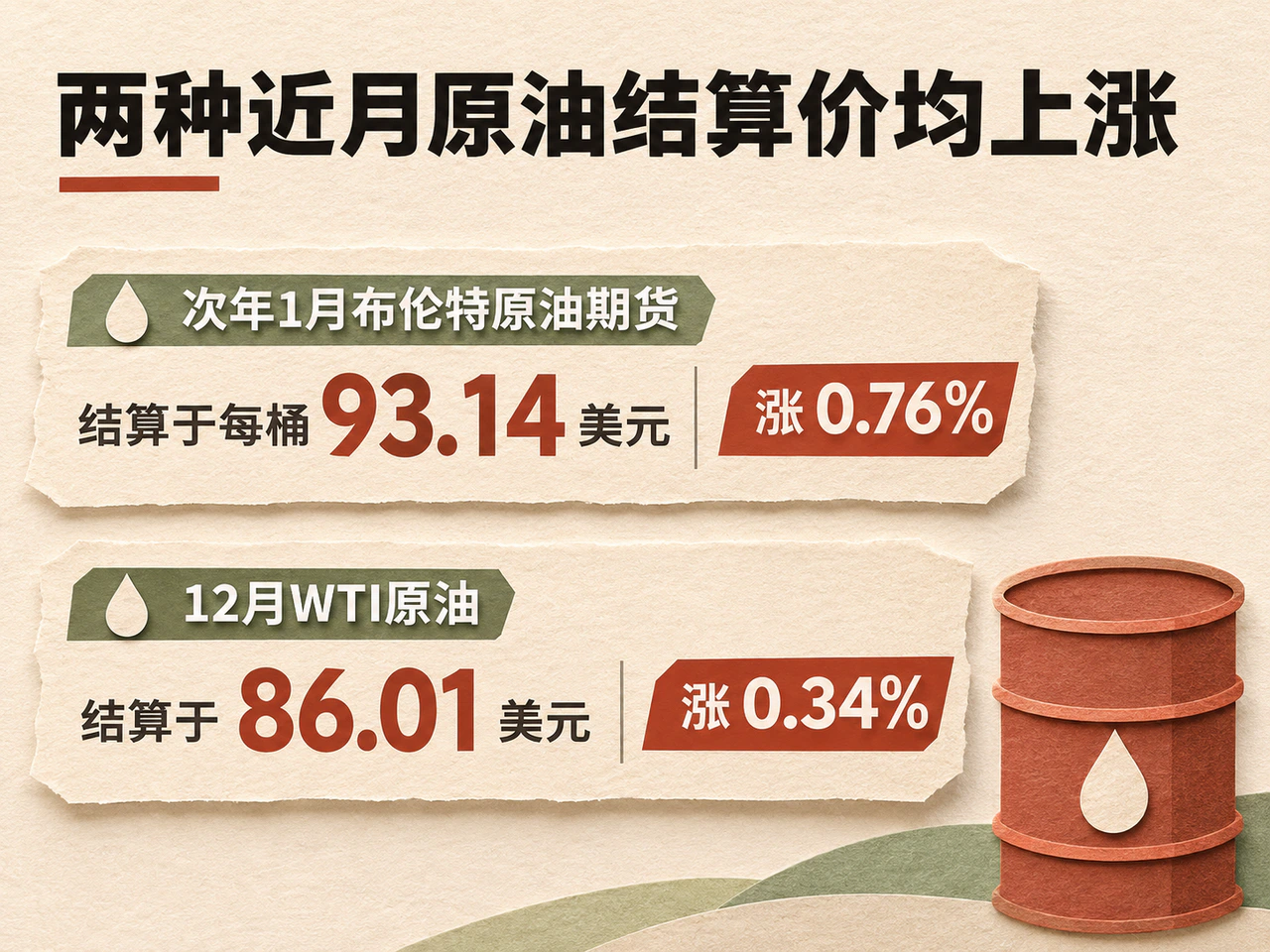
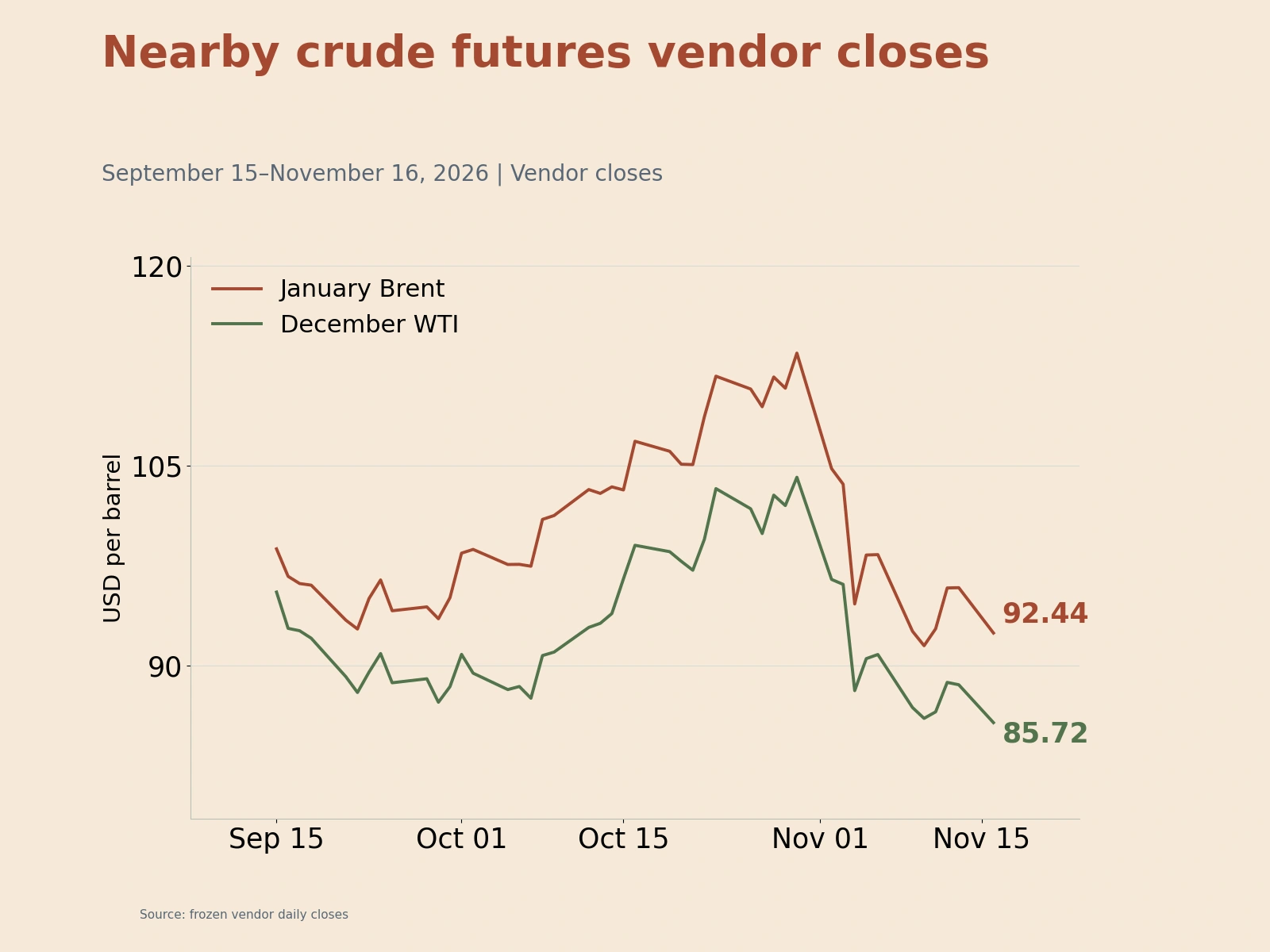
On November 17, January 2027 Brent crude futures settled at $93.14 a barrel, up 0.76%. December WTI settled at $86.01, up 0.34%. The settlement-price gap between the two nearby contracts widened from $6.72 the previous day to $7.13. Intraday quotes indicated that buyers remained willing to pay more for earlier delivery. At 11:45 a.m. Eastern Time, OPIS quotes showed January Brent about $2.65 above February, and December WTI about $1.35 above January 2027.
The International Energy Agency estimates that global observed oil inventories increased by 52 million barrels in October, including an 86-million-barrel increase in oil on water, while onshore inventories continued to decline to their lowest level since at least 2016. The agency expects global supply could again exceed demand in the fourth quarter. It still takes time for loaded cargoes to reach refineries, so rising inventories in transit can coexist with a premium for crude available for delivery soon. Agence France-Presse, citing the Oman News Agency, reported that the Iranian and Omani foreign ministers discussed safeguarding maritime trade and diplomatic options for resuming talks in Muscat on November 17. The two sides have yet to announce any new shipping arrangements.
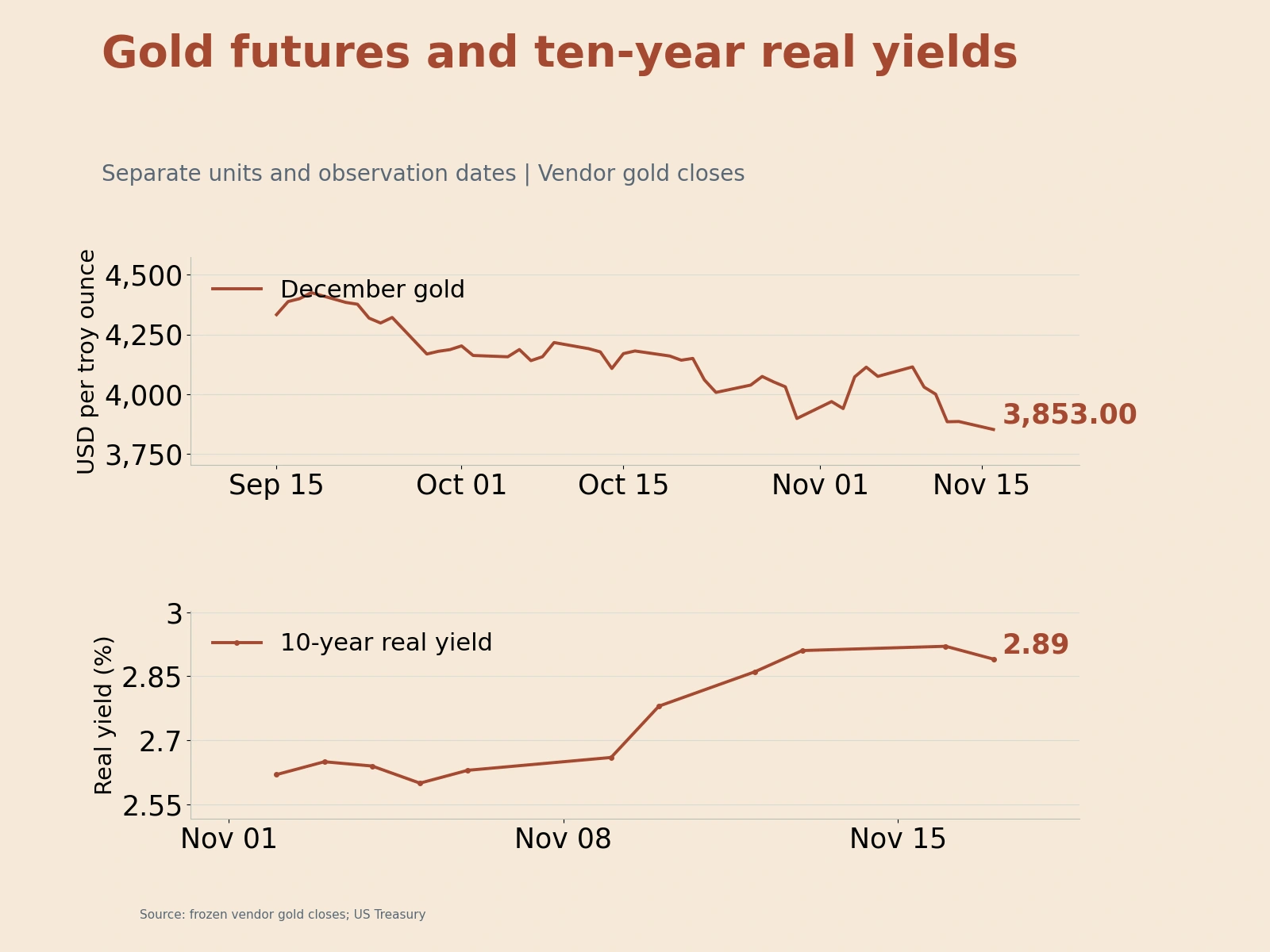
December gold futures in New York settled at $3,864.20 per troy ounce, up about 0.2%. The US Treasury's ten-year real yield fell from 2.92% on November 16 to 2.89% on November 17, slightly reducing the opportunity cost of holding non-interest-bearing gold. Real yields remained close to 3%, while the dollar index stood near 103.60; a stronger dollar also raises the cost of gold for buyers using other currencies.
China and Canada expand selected tariff relief
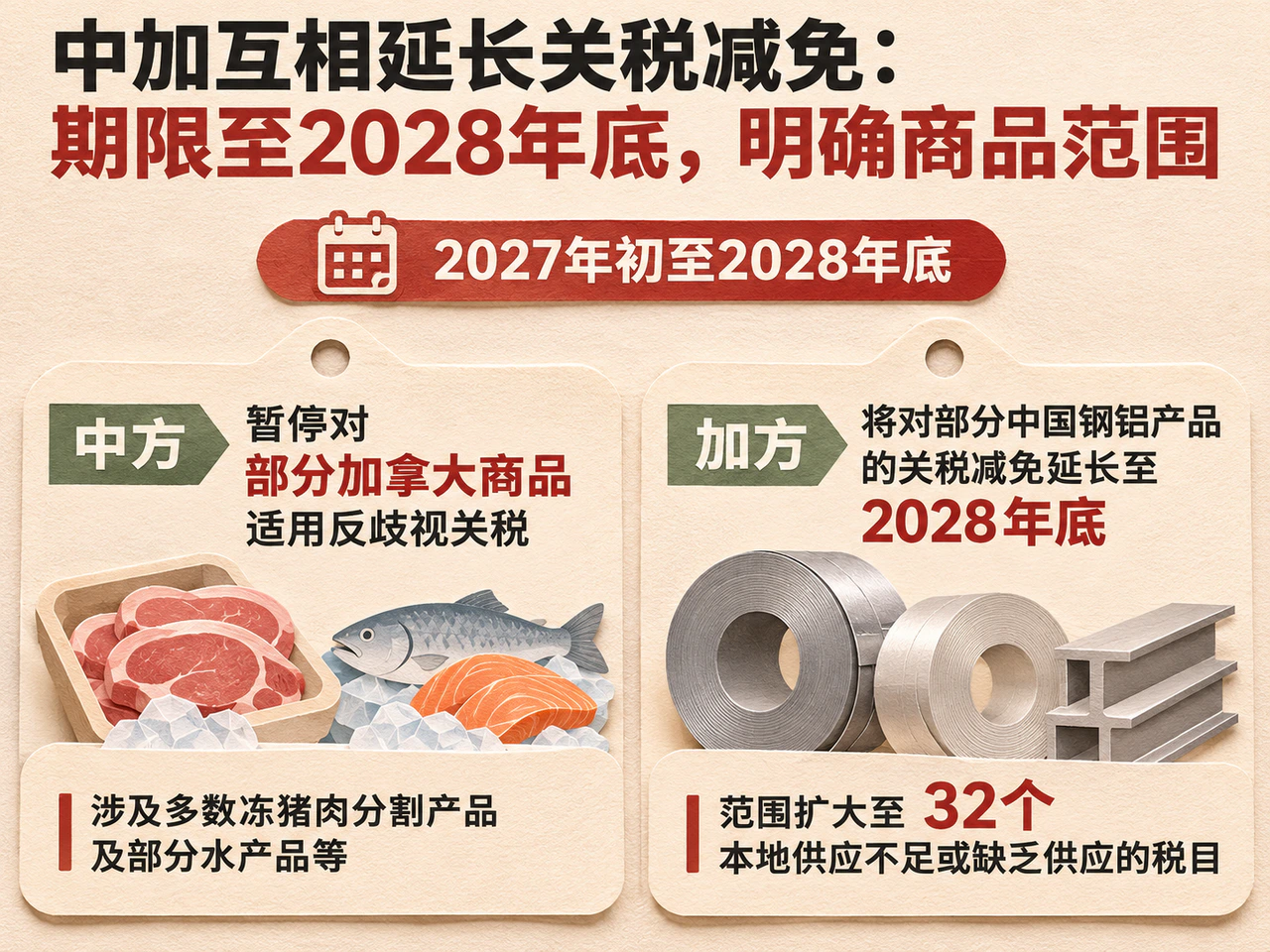
China and Canada announced expanded tariff relief for selected goods on November 17. According to the Canadian Prime Minister's Office, China agreed to suspend anti-discrimination tariffs on certain Canadian products from the beginning of 2027 through the end of 2028, covering most frozen pork cuts and some aquatic products, among other goods. Canada estimates the affected exports at about C$400 million. Canada will extend tariff remission for selected Chinese steel and aluminum products through the end of 2028, expanding coverage to 32 tariff items for which domestic supply is insufficient or unavailable.
China's Ministry of Finance released the outcomes of the November 8–9 China–Canada Economic and Financial Strategic Dialogue on the same day. The two central banks plan to conduct a rehearsal of their renewed bilateral local-currency swap arrangement before year-end and test a drawdown in 2027. When planning purchases for the next two years, companies can factor tariff relief with specified implementation periods into their contract costs. The swap rehearsal prepares liquidity support for a future expansion in local-currency settlement.