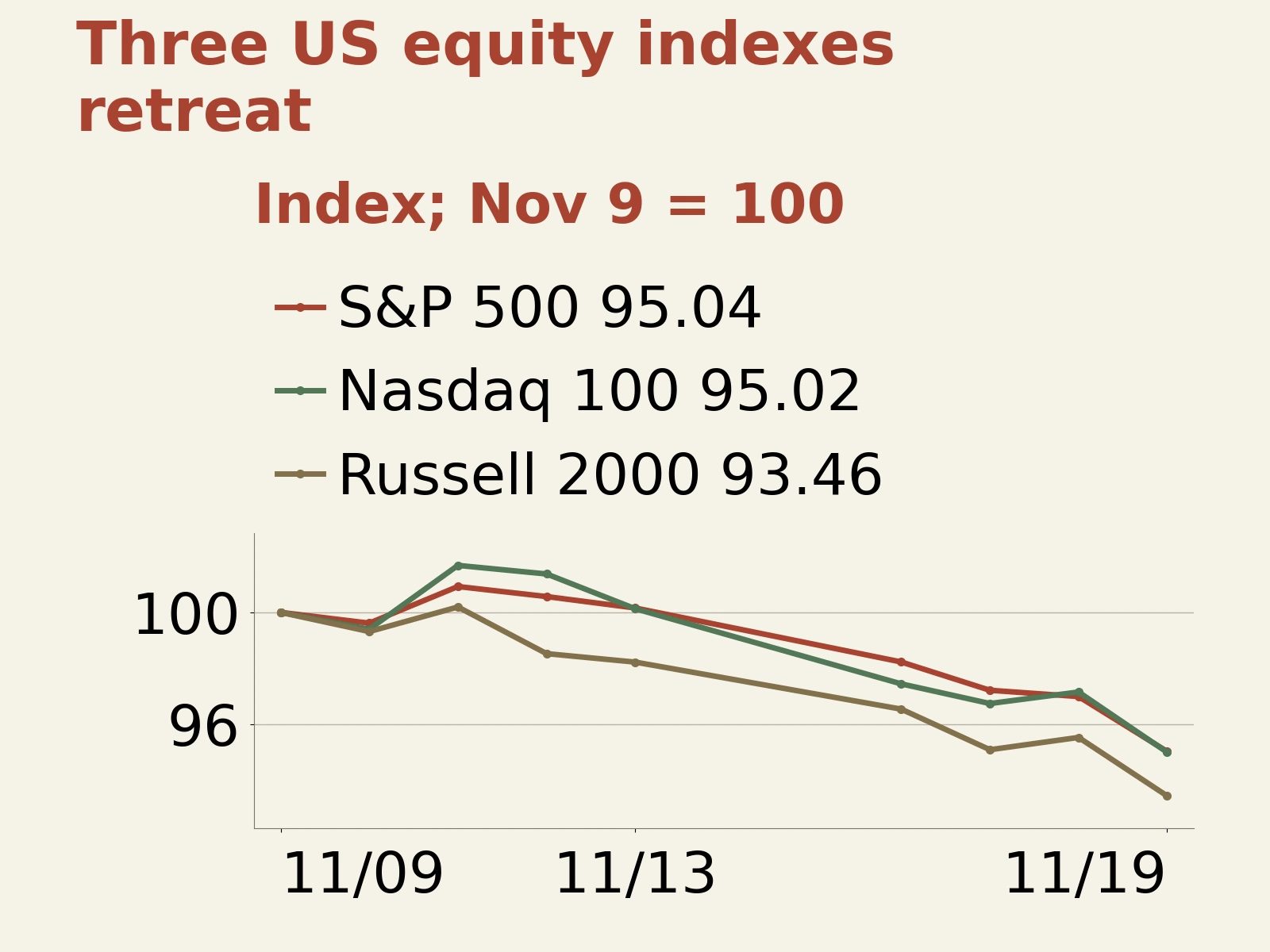
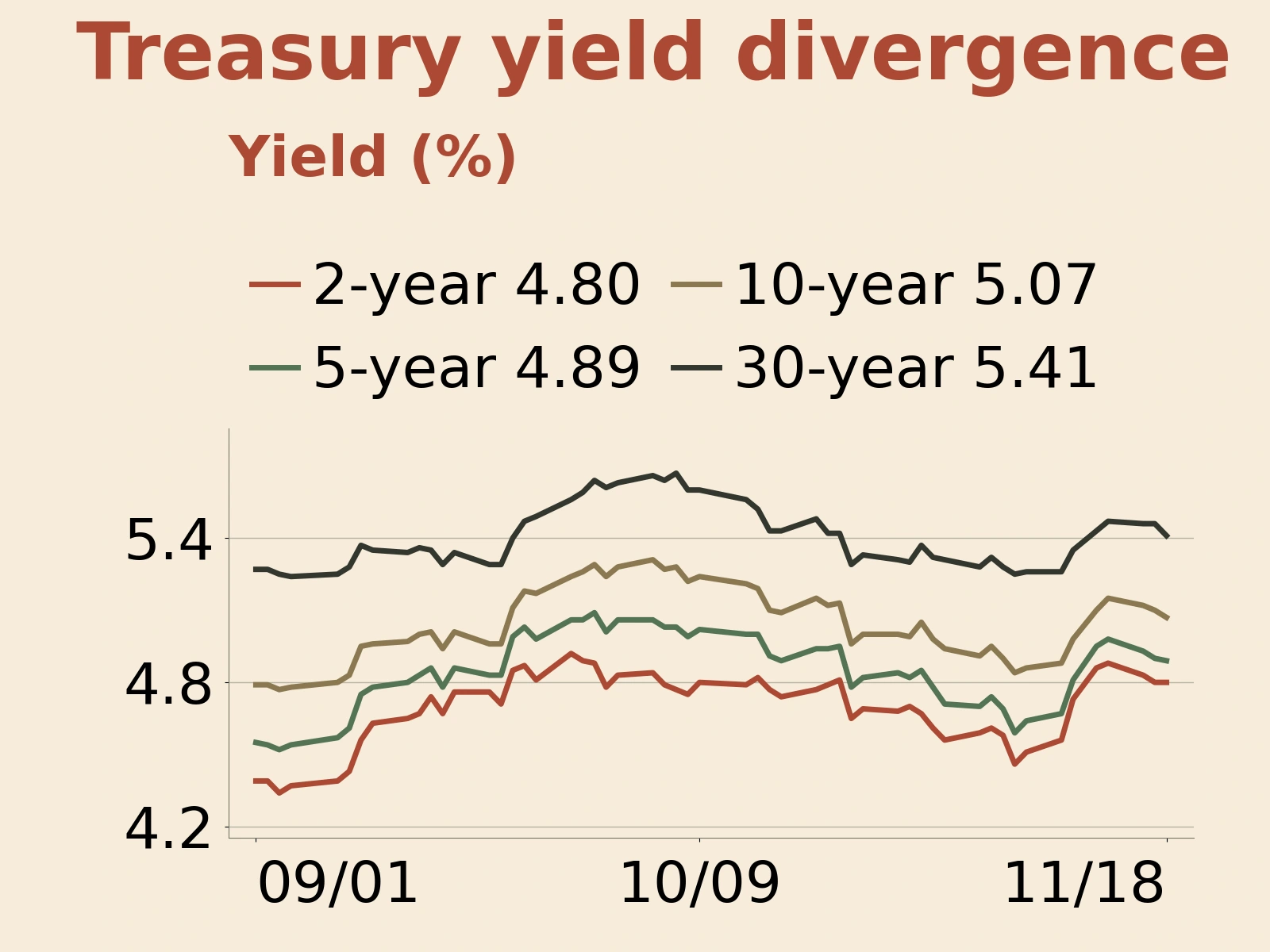
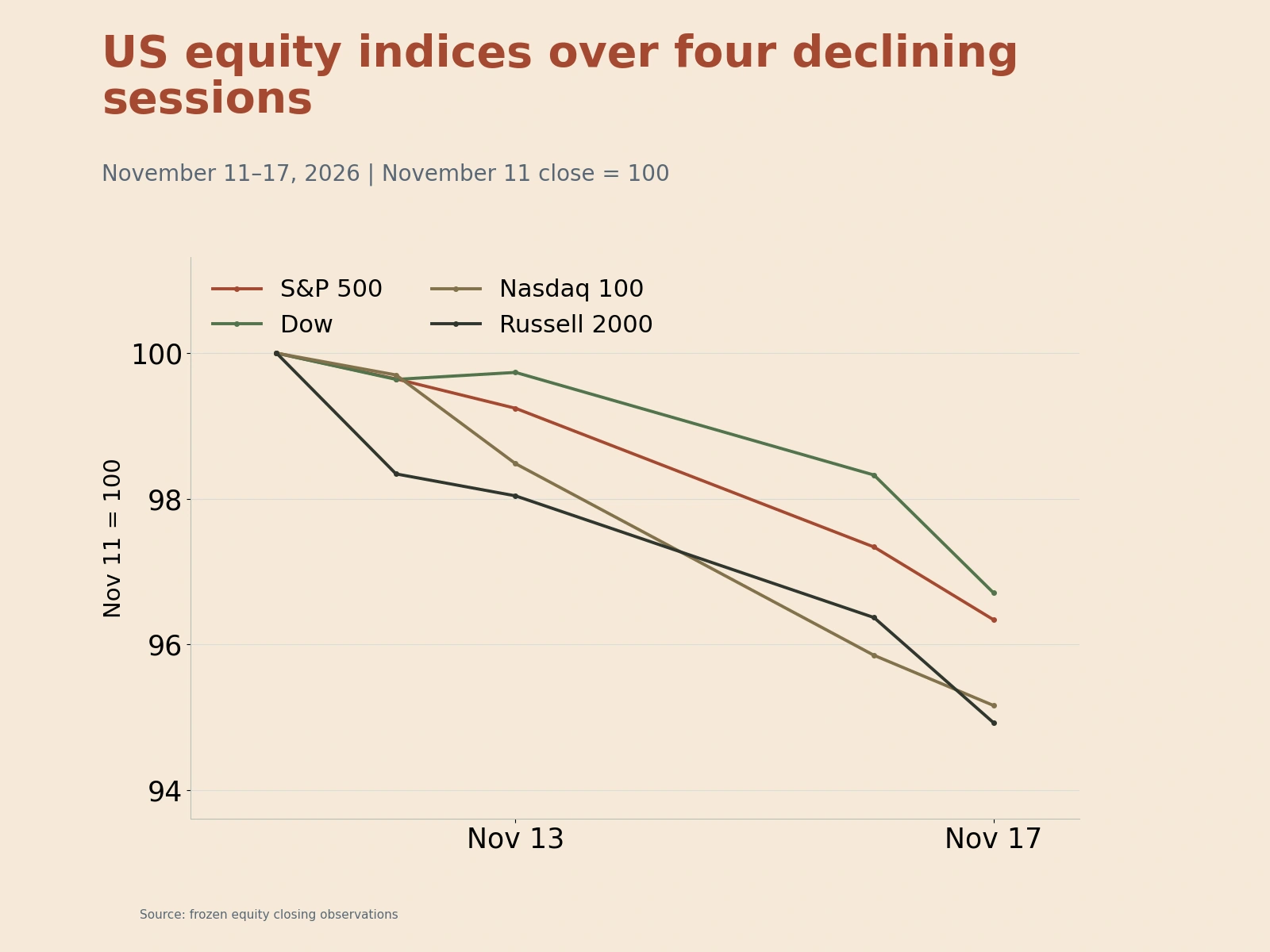
On November 20, 2026, the S&P 500 fell for a seventh consecutive trading session, closing at 6,910.39, down 3.70%. Money flowed into US Treasuries, pushing the 10-year yield down from 5.15% to 4.92% over the week, with roughly half of the decline occurring on Friday. Yet gold, also regarded as a safe haven, fell nearly 4%. The simultaneous selloff in chip stocks, rally in Treasuries and retreat in gold suggest that investors were reassessing returns on artificial intelligence investment while also seeking protection from equity volatility and raising cash.
Chip stocks extend losses in New York afternoon trading
Asian markets were the first to face selling. Tokyo and Seoul closed at 3:30 p.m. local time on Friday, with the Nikkei 225 down 5.06% and Japan's TOPIX down 3.88%; South Korea's KOSPI fell 5.21% and the KOSDAQ lost 5.71%. Hong Kong's Hang Seng Index finished its closing auction at 22,410.80, down 1.89%. At that point, the New York report concerning Nvidia's accounting had yet to appear.
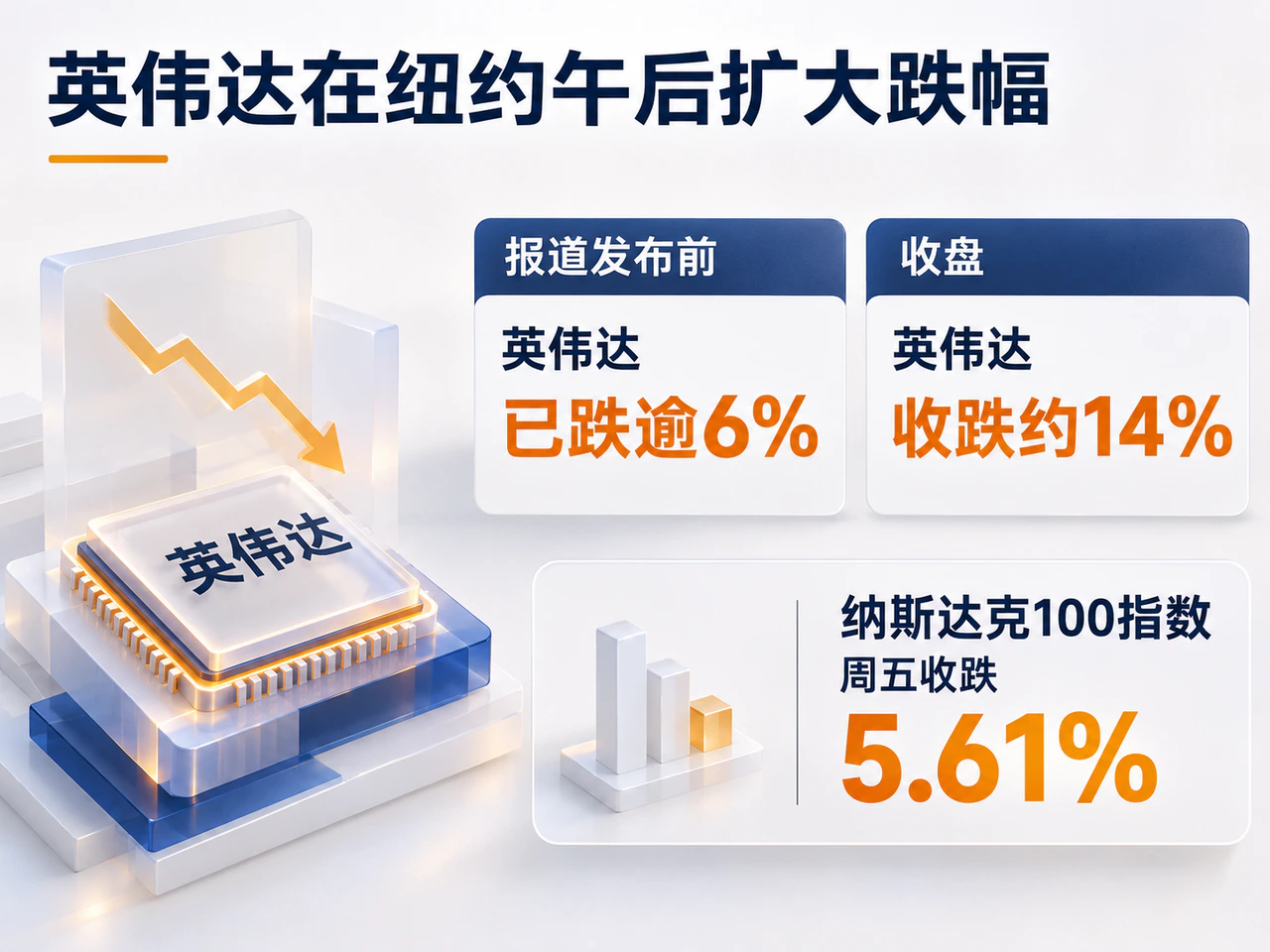
At 2:16 p.m. US Eastern time on Friday, Reuters, citing two people familiar with the matter, reported that enforcement staff at the US Securities and Exchange Commission (SEC) were examining potential accounting issues at Nvidia. The SEC declined to comment, and Nvidia did not immediately respond. Nvidia had already fallen more than 6% that day before the report; its intraday decline subsequently widened to around 13%, and it ultimately closed roughly 14% lower. Fellow chipmakers AMD and Micron Technology closed down more than 13% and nearly 14%, respectively.
The earnings model of chipmakers is coming under the same scrutiny. According to Reuters, Nvidia both invests directly in some AI companies and cloud service providers and provides guarantees for data-center projects using its equipment. Financing customers can support chip sales, but if data-center construction slows, equipment suppliers face the combined pressure of fewer orders and investment impairments. Nvidia's interim chief executive, Colette Kress, said on Tuesday's earnings call that the company would be more selective about such financing arrangements. Richard Saperstein, chief investment officer at Treasury Partners, said markets were lowering expectations for the pace of data-center construction, the availability of financing and technology companies' profit growth. Newly listed AI model developer Anthropic rose about 17% from its $83 offering price on its first trading day, then fell 8.5% on its second, while remaining above the offering price.
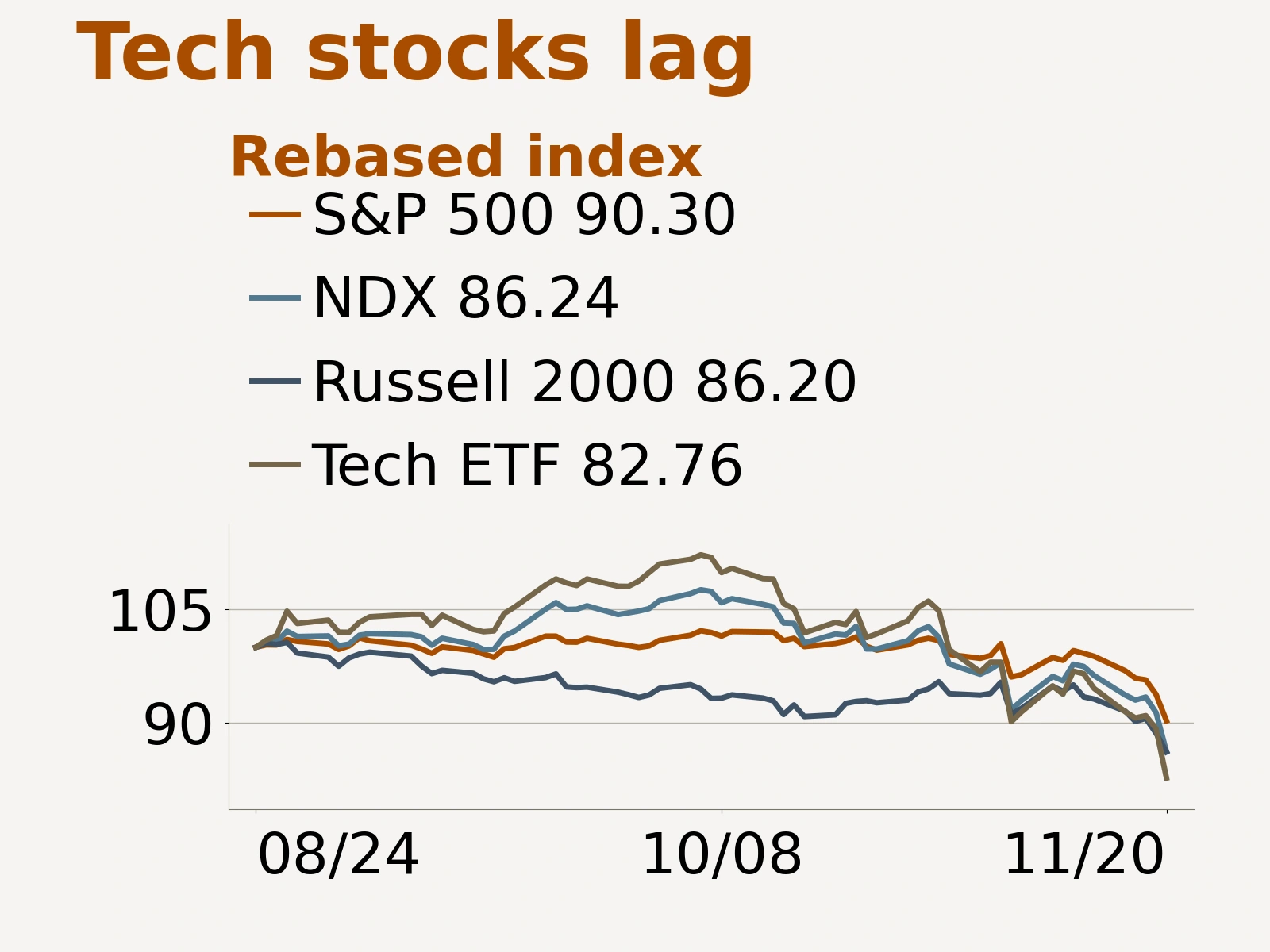
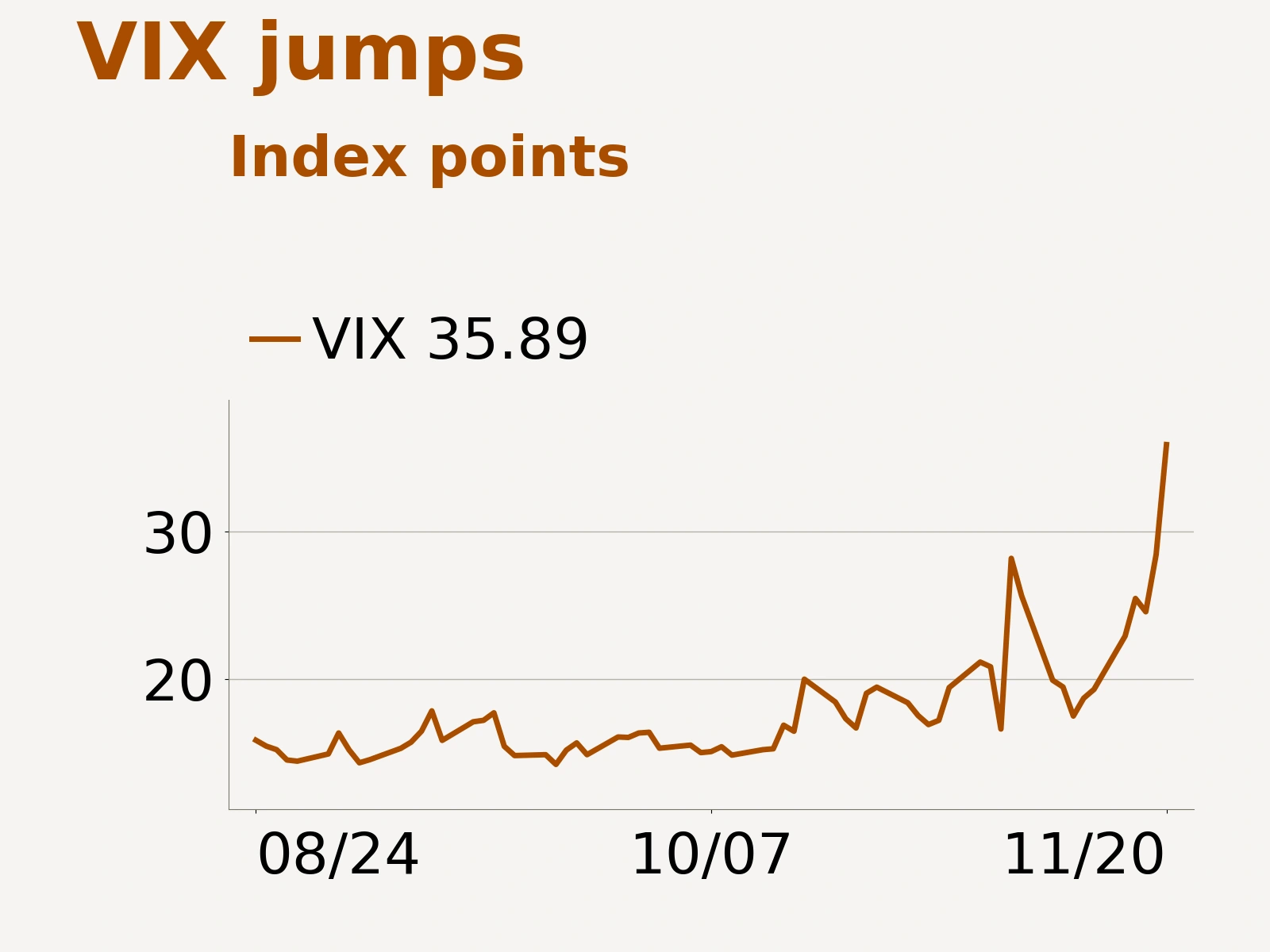
Dragged down by large growth stocks, the Nasdaq 100 fell 5.61% on Friday, while the Nasdaq Composite lost 5.28%, wiping out all its gains for the year. The Dow Jones Industrial Average fell 1.93%; both it and the S&P 500 were at least 10% below their respective record closing highs. The small-cap Russell 2000 fell 2.76% and the financial-sector ETF lost 1.82%, both smaller declines than the technology-sector ETF's 7.27%. Among defensive stocks, Walmart, Costco, Procter & Gamble and Johnson & Johnson rose against the broader decline. The VIX, which measures implied volatility in S&P 500 options, climbed from 28.44 to 35.89. This indicates that investors were paying more for options protection against equity-index volatility and shifting toward retail and healthcare companies whose revenue depends less on technology capital spending.
Treasury yields fall as lower-rated corporate bond spreads widen
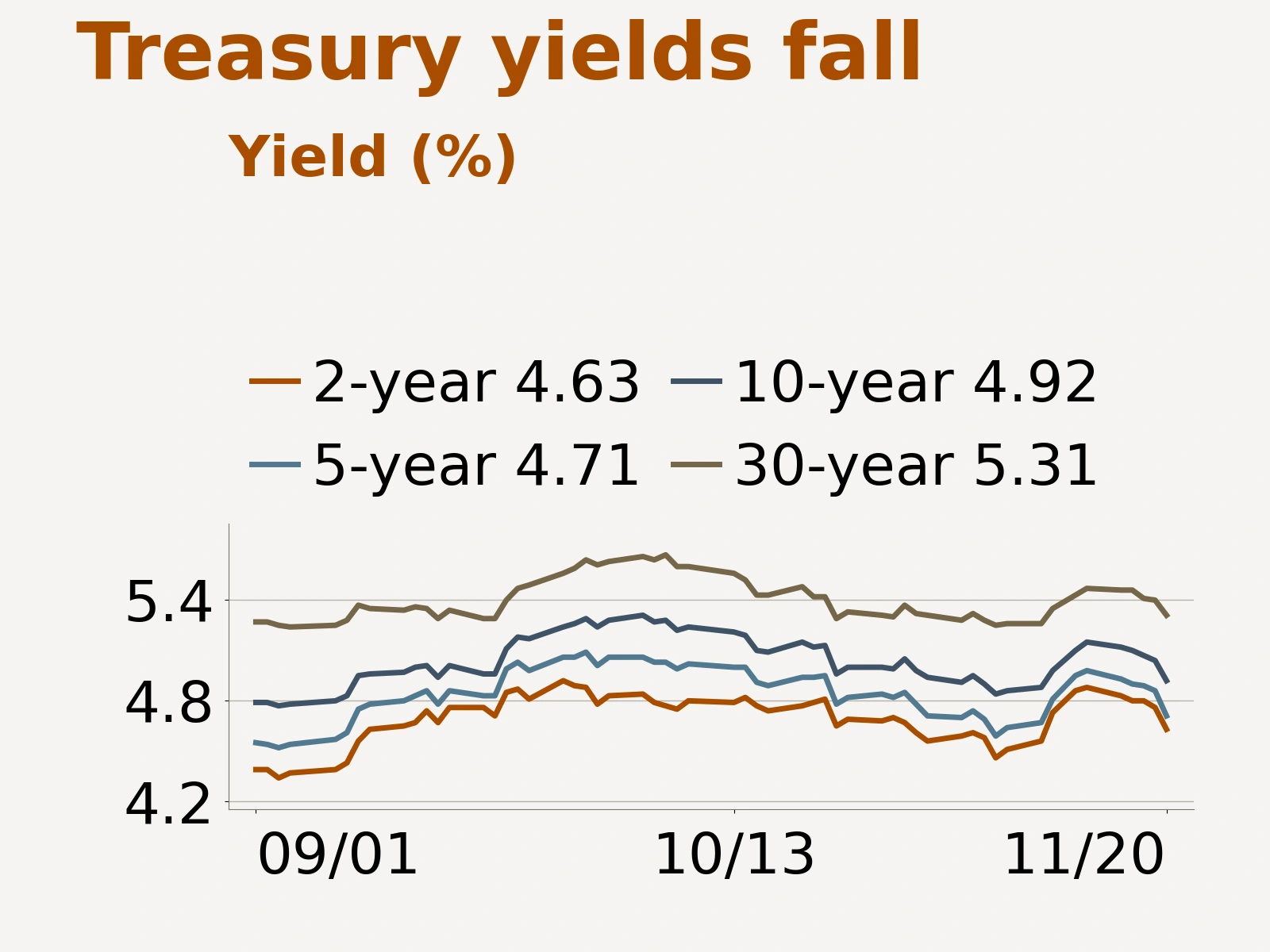
The US Treasury's end-of-day yield curve shifted lower across maturities: the 2-year yield was 4.63%, down 13 basis points from the previous day; the 5-year was 4.71%, down 15 basis points; the 10-year was 4.92%, down 12 basis points; and the 30-year was 5.31%, down 9 basis points. With the largest decline in the middle of the curve, the spread between 30-year and 5-year yields widened from 54 to 60 basis points. According to Reuters, the technology-stock selloff drove safe-haven inflows into Treasuries, even as rates markets continued to price in the possibility of a Federal Reserve rate increase in December.
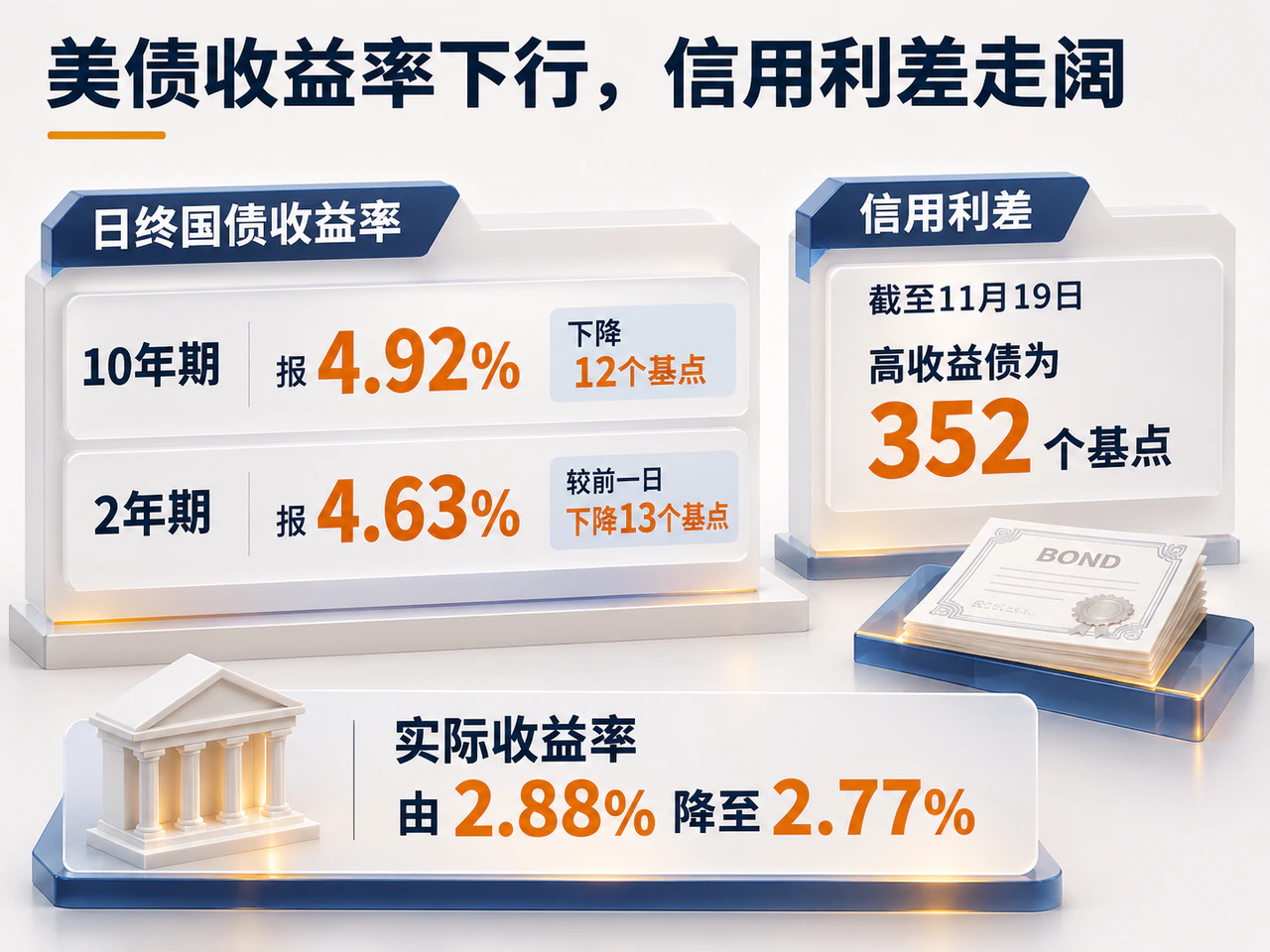
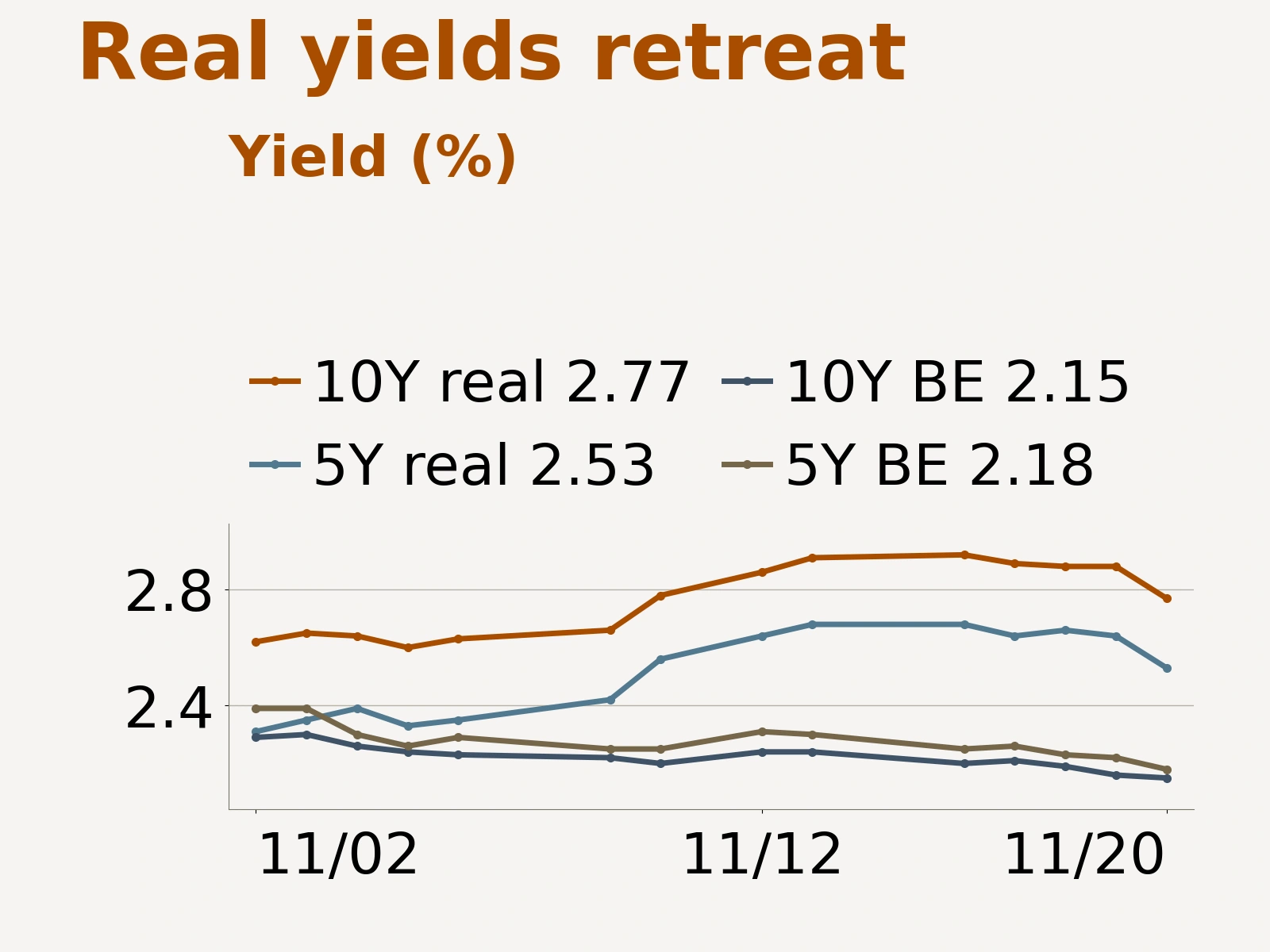
Breaking down the yield move, the real yield on 10-year Treasury Inflation-Protected Securities (TIPS) fell from 2.88% to 2.77%. The difference between nominal and real yields, or breakeven inflation, edged down only from 2.16% to 2.15%. Thus, around 11 basis points of the 12-basis-point decline in the nominal 10-year Treasury yield came from lower real yields. For 5-year securities, the real yield also fell 11 basis points, while the gap between nominal and real yields narrowed from 2.22% to 2.18%, indicating a more pronounced decline in inflation compensation.
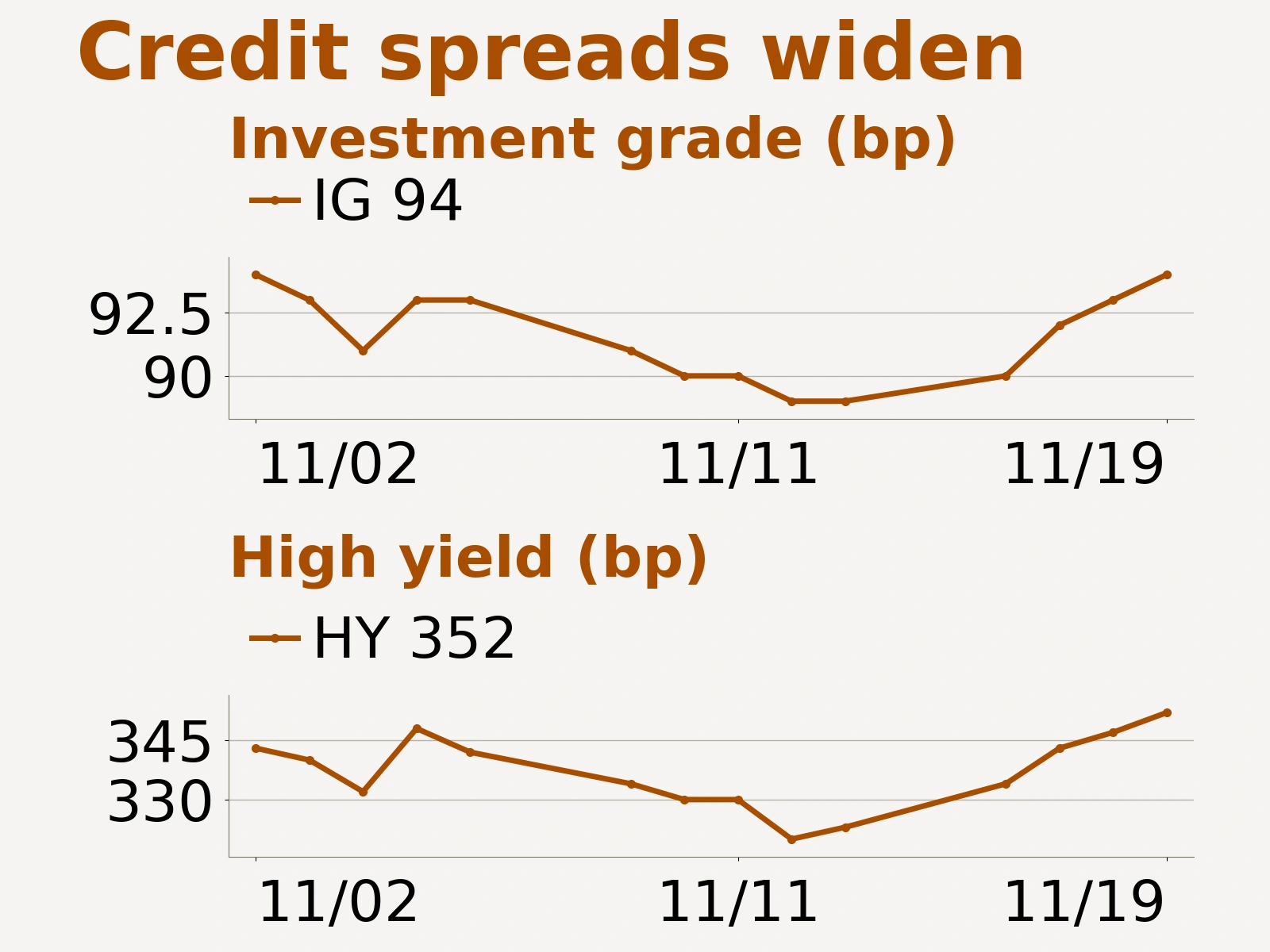
As Treasury benchmark yields fell, the additional risk compensation demanded in credit markets increased. ICE BofA indices show that, as of November 19, US investment-grade corporate bonds had an option-adjusted spread (OAS) of 94 basis points and high-yield bonds a spread of 352 basis points, wider by 5 and 29 basis points, respectively, than on November 13. Structural differences between debt instruments also produced different returns. BlackRock, citing Bloomberg indices, noted that US leveraged loans returned a cumulative 0.2% between September 21 and November 16, compared with -1.5% for high-yield bonds. In BlackRock's analysis, floating-rate leveraged loans were less affected by the earlier rise in Treasury yields, while high-yield bonds had greater exposure to AI project financing.
Europe is also considering how to share early-stage project risks in capital-intensive technology industries. Speaking in Frankfurt on Friday, European Central Bank President Christine Lagarde proposed that EU-level public funds absorb first losses on projects such as chip factories and data centers to attract private capital. Lagarde also noted that the ECB had made its euro repo facility for other central banks permanent in February this year, and more than 30 central banks had expressed interest in participating. For central banks holding euro assets, obtaining euro liquidity against collateral during market stress can reduce the need to sell bonds outright.
Gold faces selling as crude oil's nearby premium widens
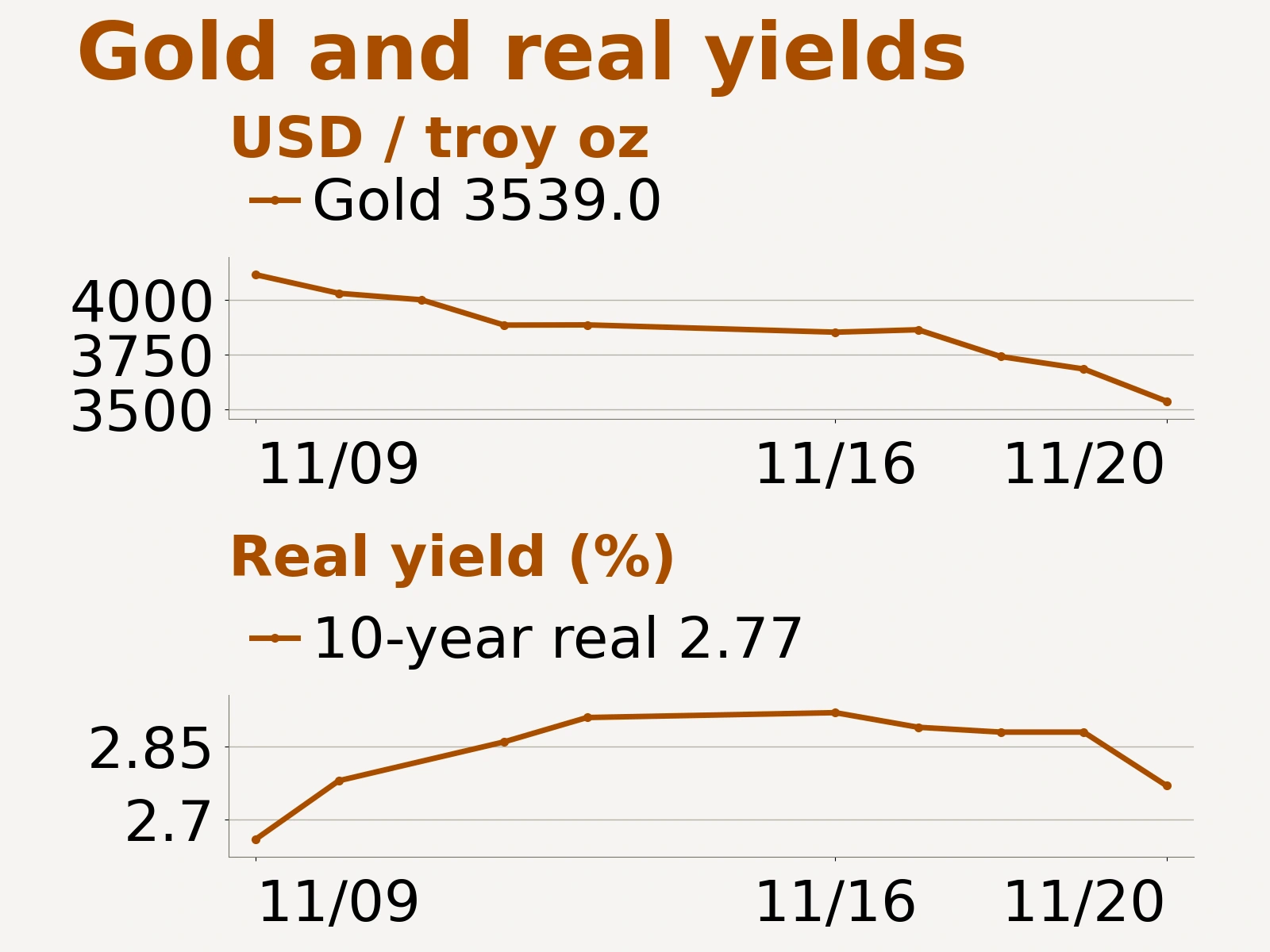
New York continuous gold futures fell on Friday from $3,685.50 to $3,539.00 per troy ounce, a decline of 3.98%. The dollar index edged down from around 103.90 to 103.84 that day, while the real yield on 10-year US Treasuries also declined. Both factors would normally support gold. Explaining gold's contrary move, Rich Checkan, president of Asset Strategies International, told Kitco that some investors might be selling gold to raise cash for margin calls on leveraged equity accounts.
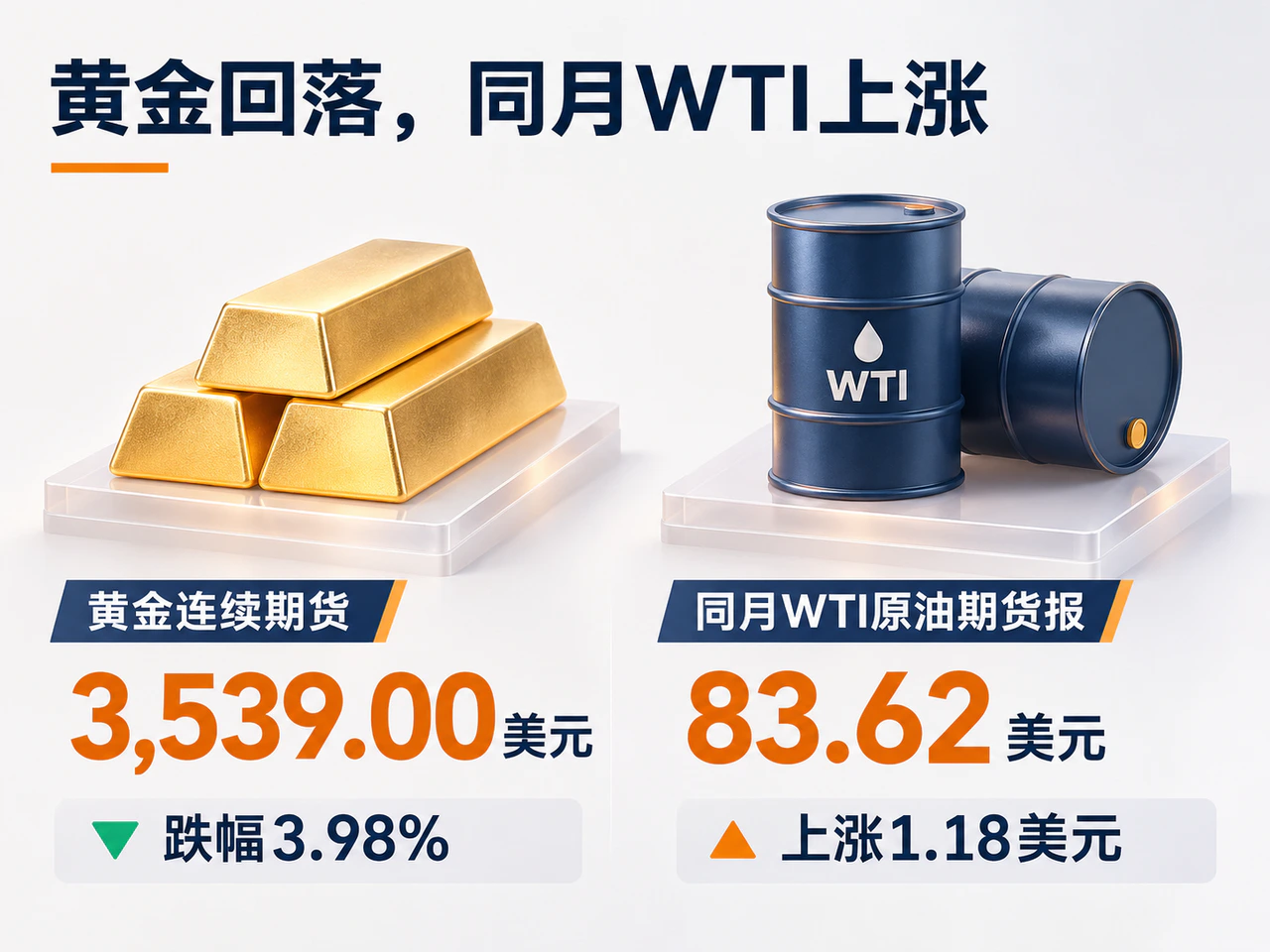
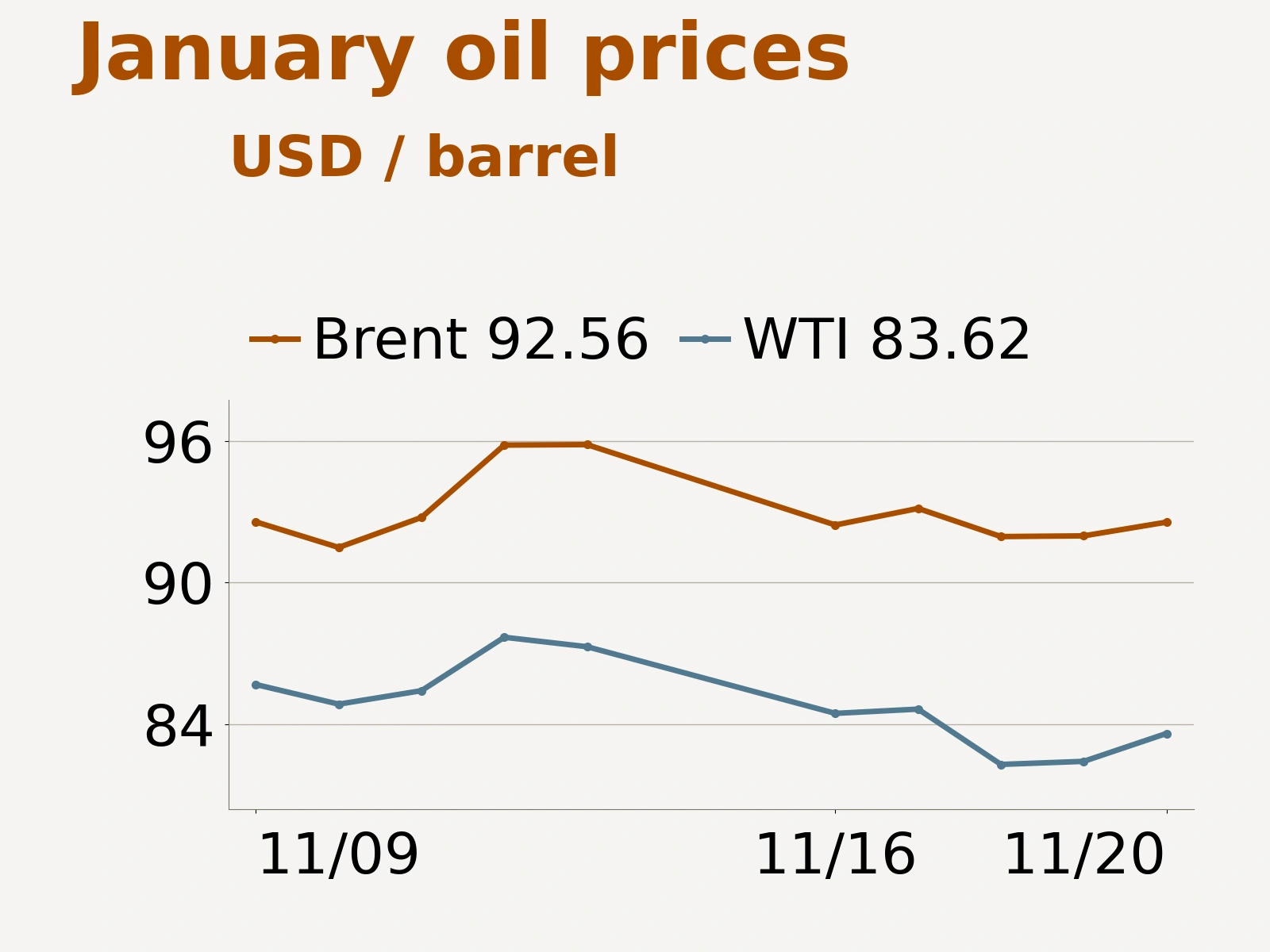
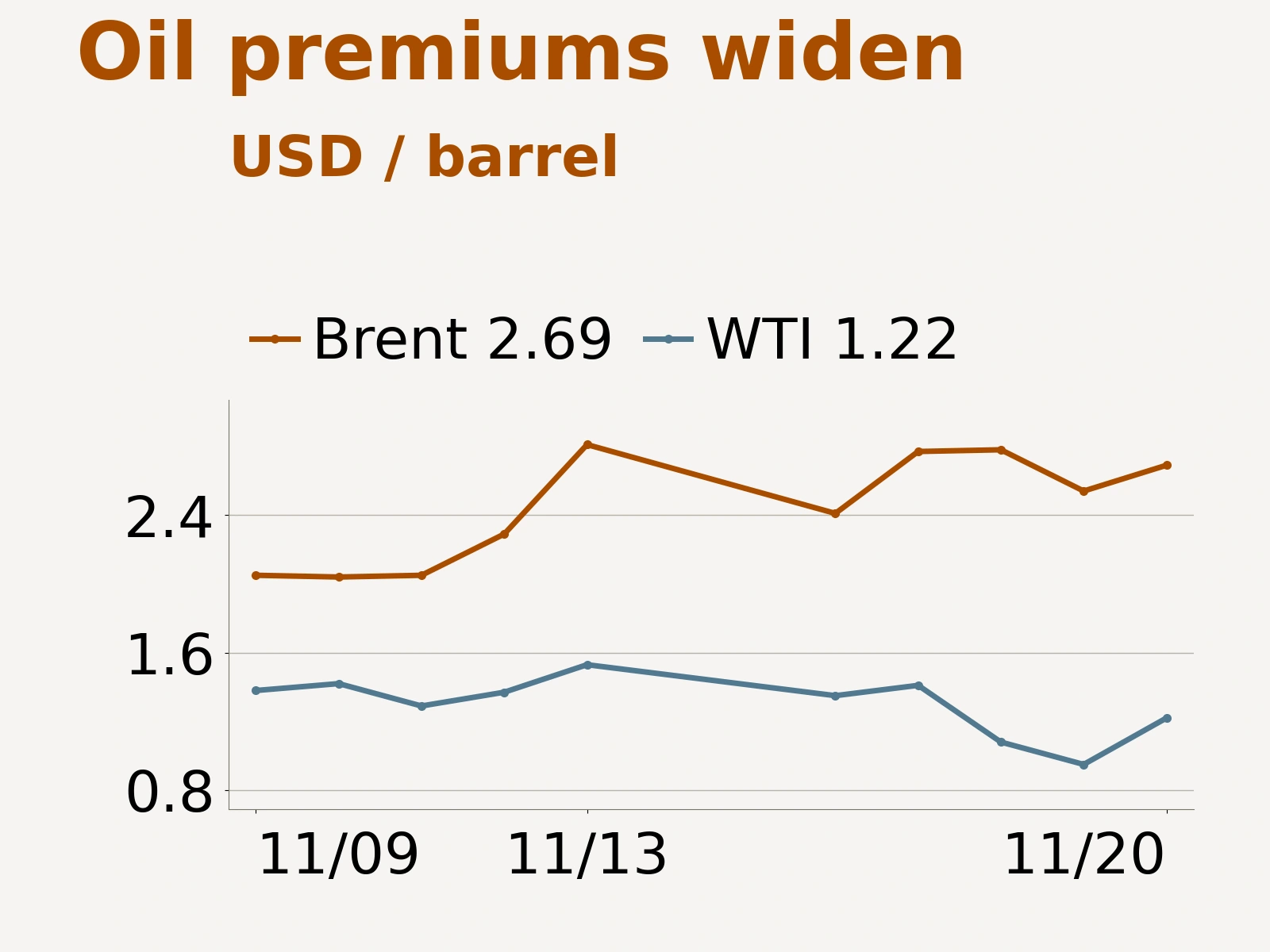
In oil markets, contracts for nearer delivery retained a premium. Based on the data vendor's daily closing prices, January 2027 Brent financially settled futures on the New York Mercantile Exchange stood at $92.56 a barrel, up $0.58 from the previous day, while WTI futures for the same month rose $1.18 to $83.62. The Brent-WTI spread narrowed from $9.54 to $8.94. That day, the vendor's continuous Brent series had rolled from January to the lower-priced February contract, while its continuous WTI series had rolled from December to January. Comparing January and February 2027 contracts consistently for each crude benchmark, Brent's nearby premium widened from $2.54 to $2.69, and WTI's from $0.95 to $1.22.
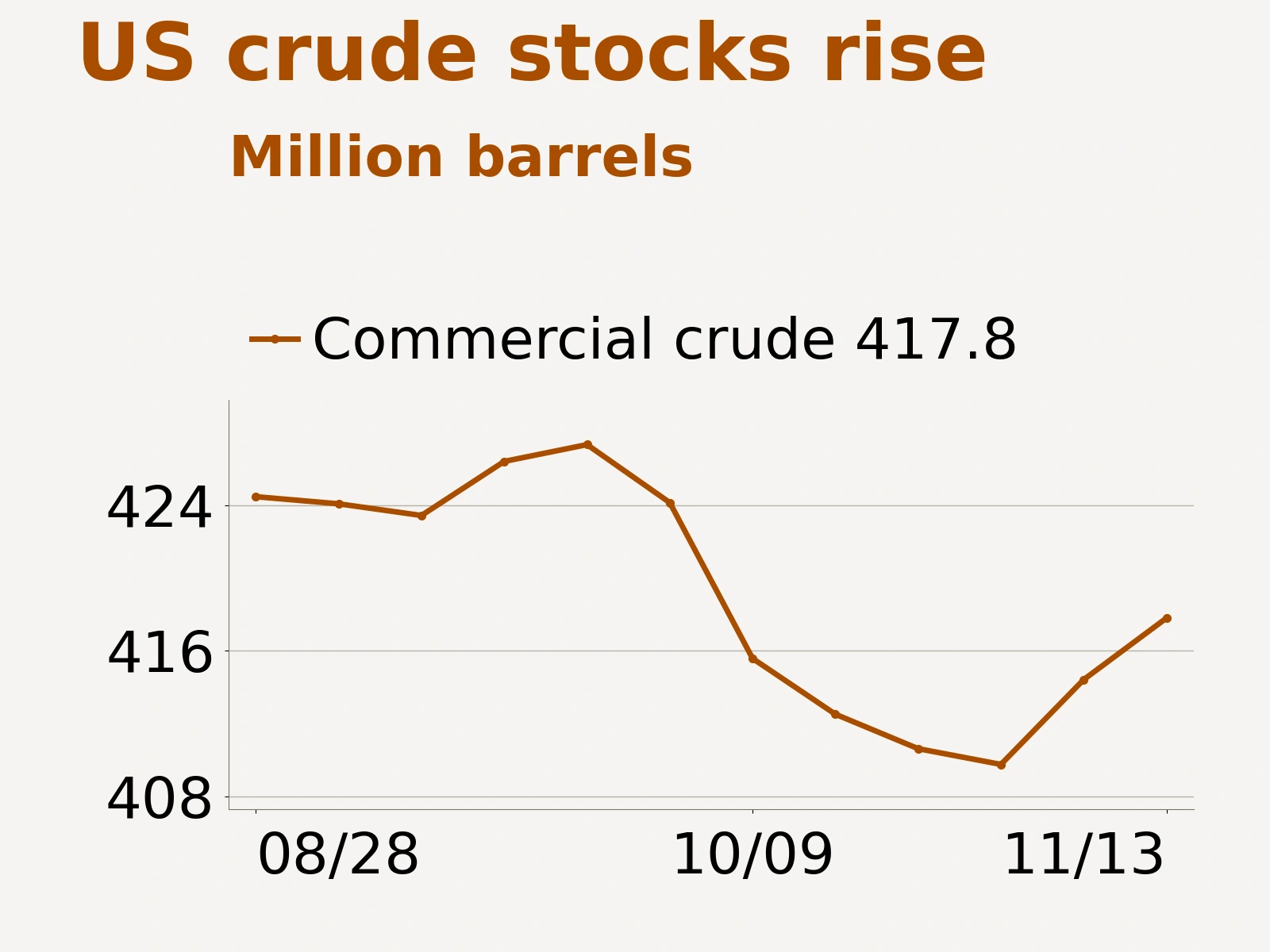
On supply and inventories, Reuters reported that crude shipments through the Strait of Hormuz had broadly returned to prewar levels. US Energy Information Administration (EIA) data showed that commercial crude inventories, excluding the Strategic Petroleum Reserve, rose by 3.38 million barrels to 417.8 million barrels in the week ended November 13, the second consecutive weekly increase. Around the close of New York equity trading on Friday, the US Treasury announced sanctions against four Iranian nationals, alleging that their associated networks were involved in collecting proceeds from overseas oil sales. The sanctions directly target payment settlement; whether physical supply is disrupted will depend on buyers' ability to continue taking delivery.
US household inflation expectations ease; federal funding talks remain divided

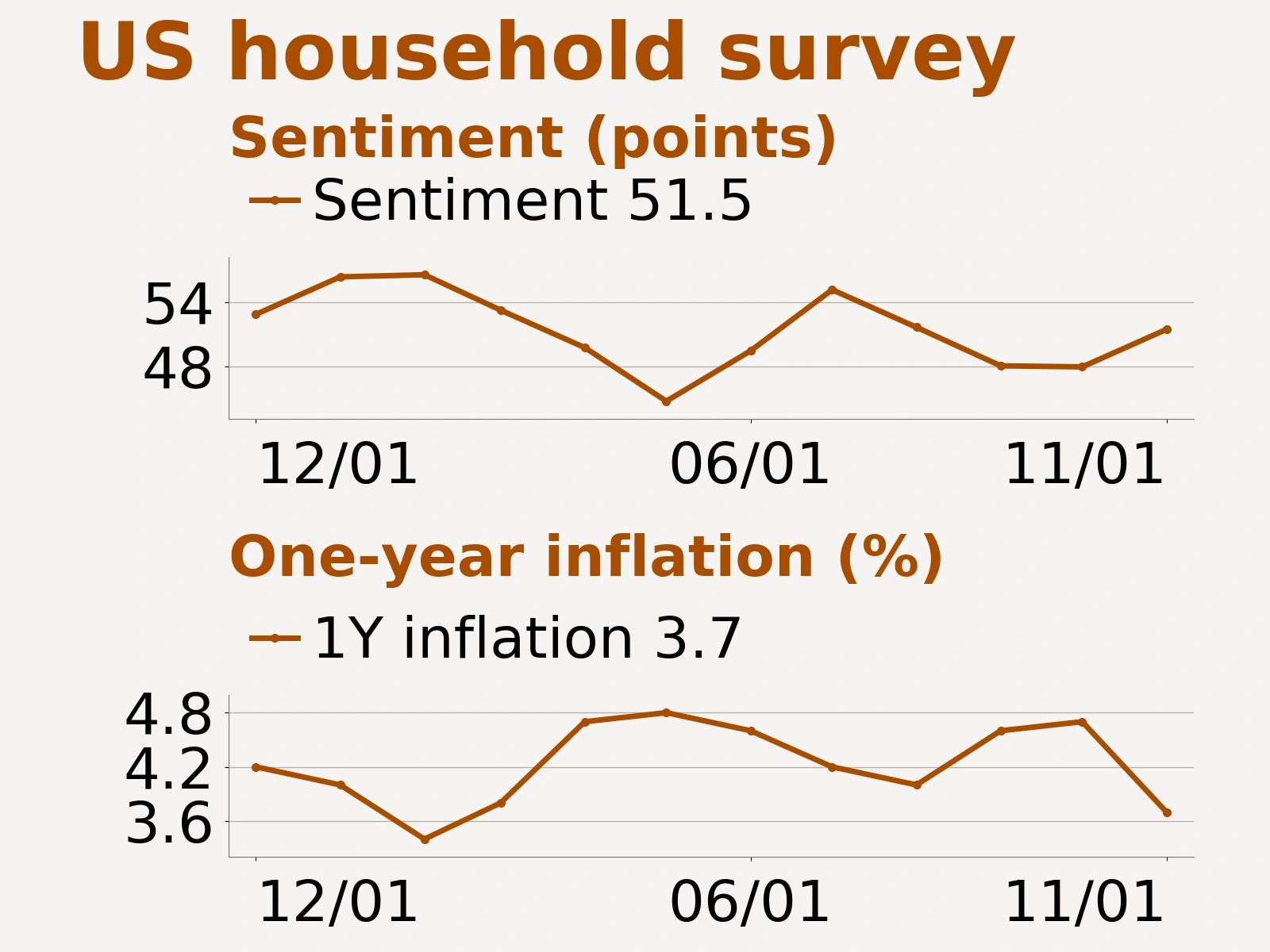
Data released by the University of Michigan on Friday put the final November US consumer sentiment index at 51.5, above the preliminary reading of 51.0 and October's final reading of 48.0. Respondents' median one-year inflation expectation fell from 4.7% to 3.7%, while long-run inflation expectations eased from 3.5% to 3.3%. The survey ended on November 16, so it did not capture the impact of Friday's sharp equity selloff. Survey director Joanne Hsu said falling gasoline prices had improved lower-wealth households' perceptions of their current finances, while households with the largest stockholdings had already reported deteriorating finances. This suggests that oil- and equity-price movements affect spending intentions differently across households with different asset allocations.
In the labor market, October state employment data from the US Bureau of Labor Statistics showed that the improvement in hiring was limited in breadth. Only four states—California, Indiana, Kansas and Iowa—recorded statistically significant increases in nonfarm payroll employment; changes in the other 46 states and the District of Columbia were not statistically significant. Meanwhile, current funding for federal agencies expires on December 11. According to Reuters, both parties in Congress favor a temporary funding bill to keep the government operating, but disagreements persist over the White House's request for an additional $350 billion for the Pentagon. If negotiations extend beyond the deadline, some federal employees face delayed pay.
Trade agreements also take time to translate into actual imports and exports. Reviewing ten agreements between the United States and Asian trading partners, Reuters found that although Indonesia pledged in February this year to import $4.5 billion of US agricultural products, US Census Bureau data showed that US agricultural exports to Indonesia totaled less than $2.4 billion in the first nine months, merely matching the average for the same period over the past decade. By product, US soybean exports to Indonesia had fulfilled 54% of the annual volume commitment, while soybean meal had fulfilled only 4%. Full-year delivery against those commitments will depend on shipments in the fourth quarter.
China's fiscal revenue outpaces spending in January–October; November LPR unchanged
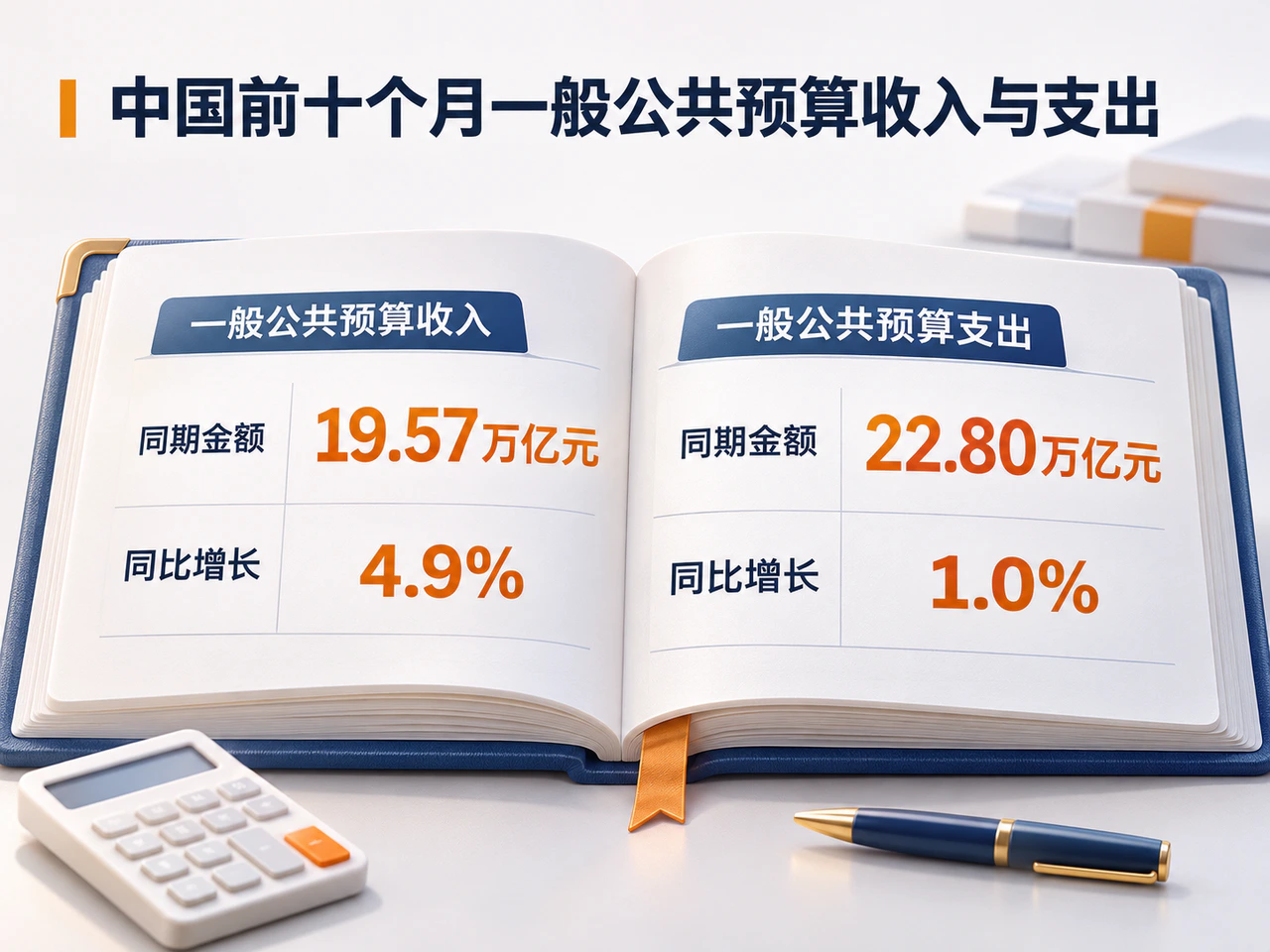
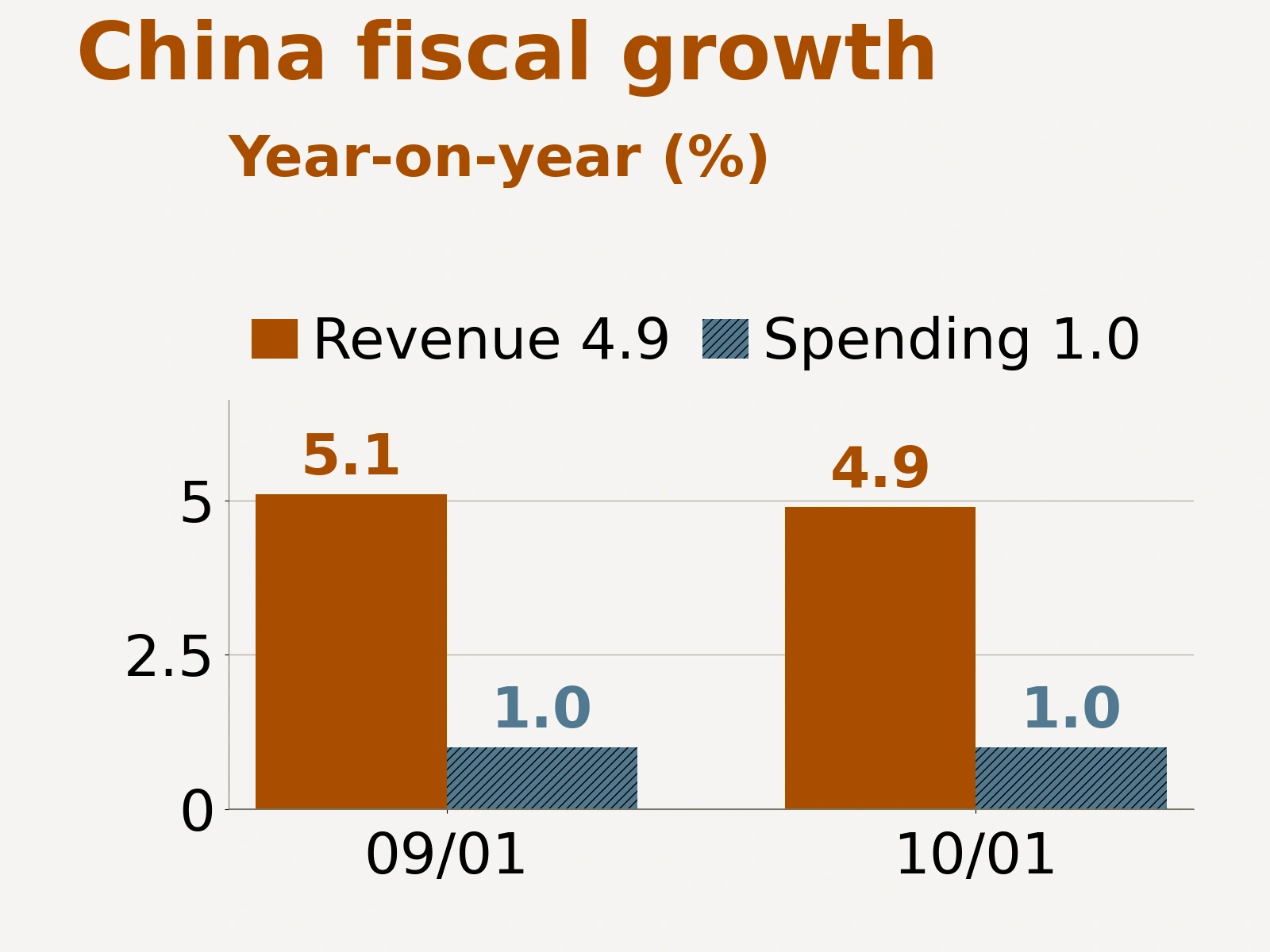
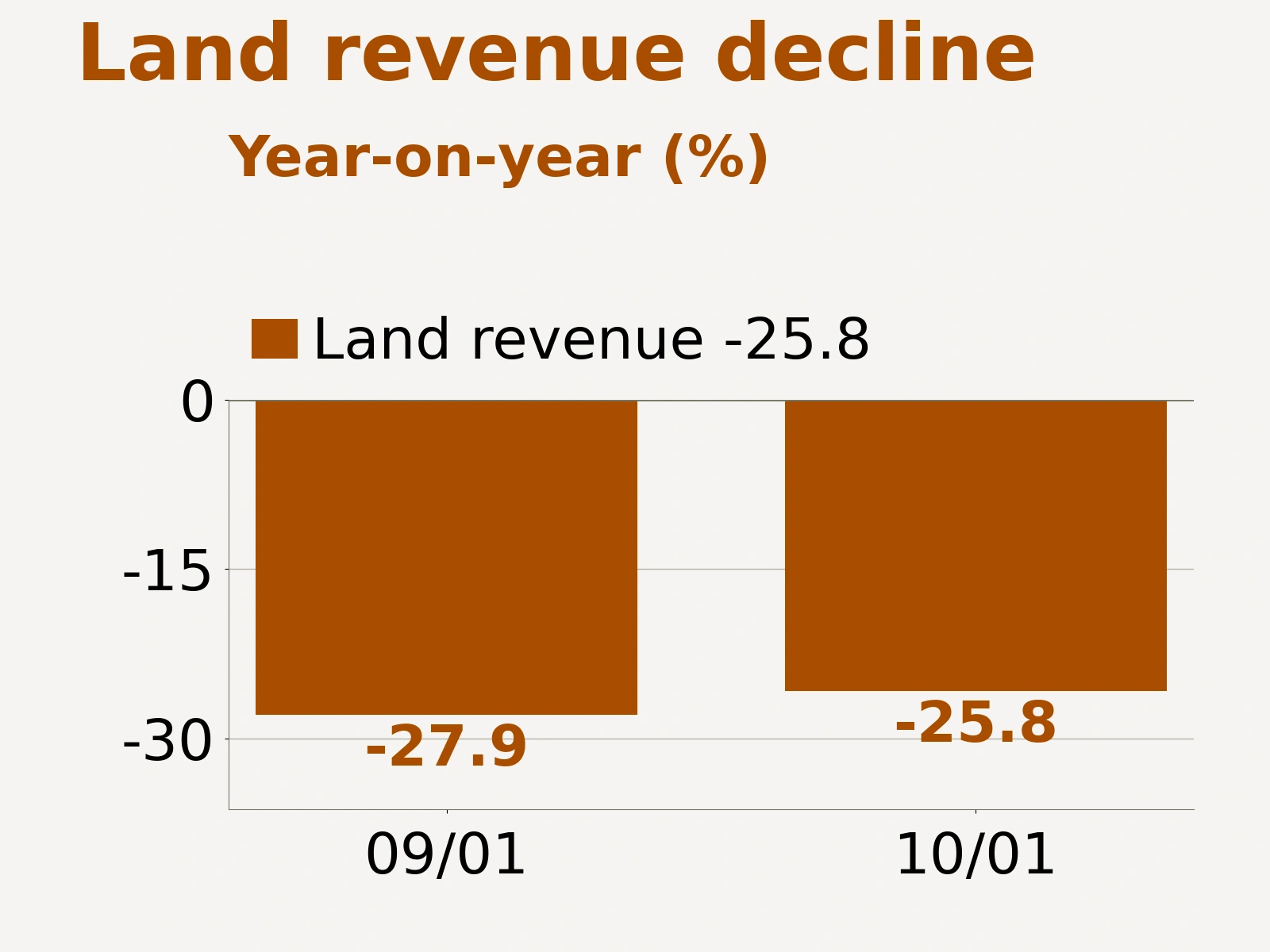
China's Ministry of Finance reported on Friday that nationwide general public budget revenue totaled RMB19.57 trillion in January–October, up 4.9% year on year, while general public budget expenditure was RMB22.80 trillion, up 1.0%. Within spending, central government expenditure rose 5.4%, while local general public budget expenditure edged up 0.2%. In the government-managed funds budget, local revenue from the sale of state-owned land-use rights fell 25.8% year on year in January–October, a decline 2.1 percentage points narrower than in the first three quarters; local government-managed funds budget expenditure fell 9.4%. Taken together, the figures across levels of government and separate budget accounts show a recovery in nationwide fiscal revenue alongside tight funding for local projects.
On monetary policy, China's loan prime rates (LPRs) were unchanged in November for an 18th consecutive month, at 3.00% for the 1-year rate and 3.50% for the rate for maturities over 5 years. Wang Qing, chief macroeconomic analyst at Golden Credit Rating, said the effects of recently introduced structural measures, including mortgage interest subsidies, still needed to be assessed. Dong Ximiao, chief economist at Merchants Union Consumer Finance, said further deposit-rate cuts to ease banks' funding costs could leave room for lower LPRs around year-end.
On offshore sovereign issuance, China's Ministry of Finance disclosed on Friday that it had successfully issued $2 billion of 3-year sovereign bonds in Hong Kong the previous day at an issue yield of 4.821%. Orders totaled $72.3 billion, roughly 36 times the issue size, and sovereign investors received 59% of allocations, demonstrating institutional allocation demand for US dollar sovereign debt. During the same week, the Hong Kong Mortgage Corporation also priced a multicurrency benchmark bond offering, including $1.1 billion of 5-year US dollar bonds.