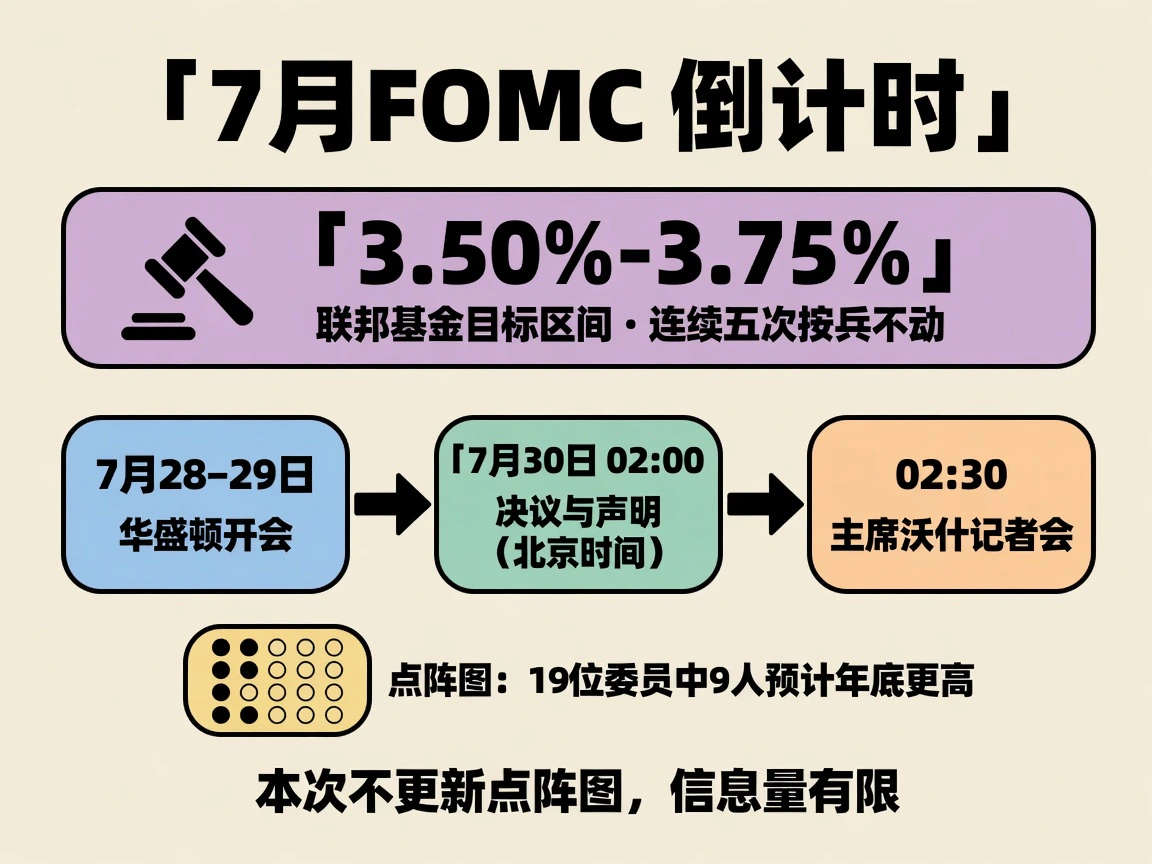
The federal funds target range remains 3.50%–3.75%, after June marked the fifth consecutive meeting without a change. The July FOMC meeting is under way in Washington on July 28–29 US Eastern time, with the decision due early on July 30 Beijing time.
Although June inflation and employment data cooled markedly, giving the Fed room to keep watching, several officials sent hawkish signals in rapid succession before the meeting. Together with the rate-hike premium embedded in interest-rate swaps, those comments make the main trade clear: a July hold at this meeting is seen as almost beyond doubt; the real contest concerns whether rate increases resume in September or later.
Economic Data: Inflation and Employment Weaken Together
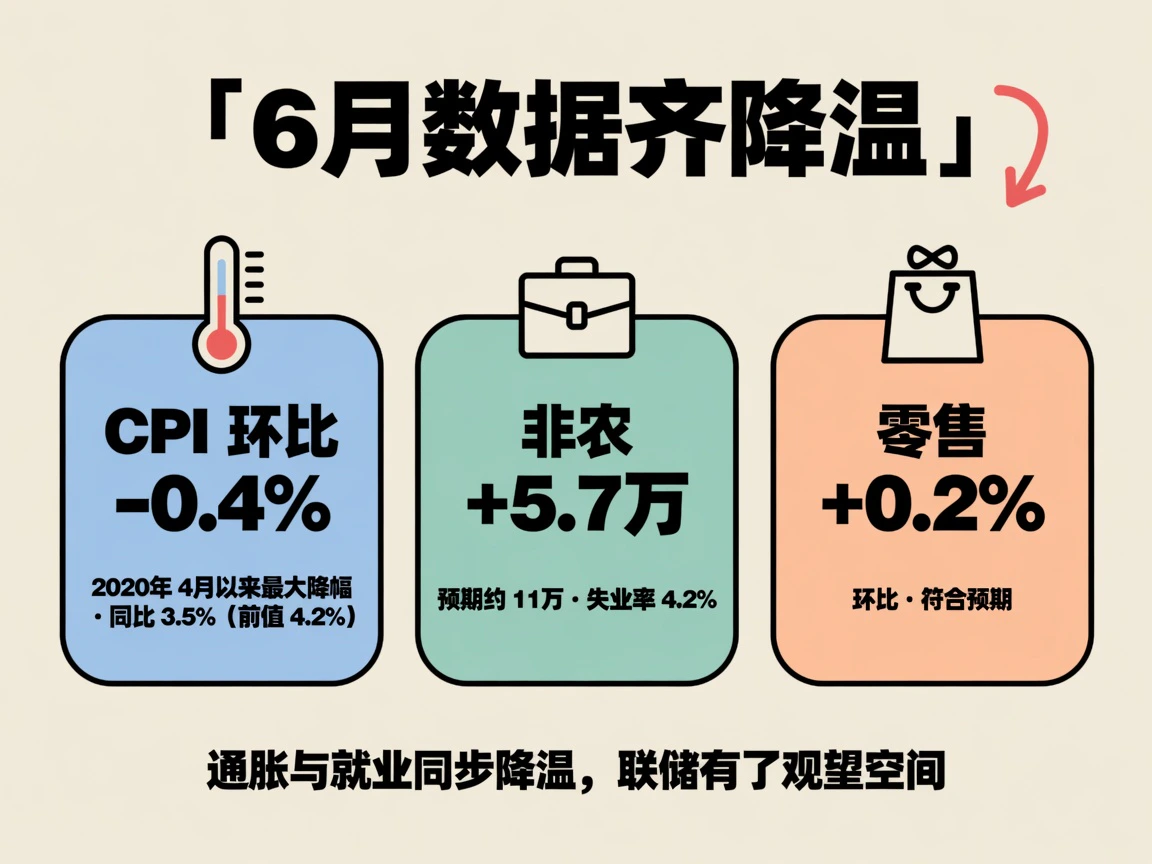
The key indicators released in the pre-meeting window show a fairly consistent slowdown:
June CPI, released by the Bureau of Labor Statistics on July 14: Consumer prices fell 0.4% month on month, the largest monthly decline since April 2020; annual inflation slowed to 3.5% from 4.2%. Core CPI was unchanged on the month, at 0.0%, and slowed to 2.6% year on year from 2.9%. Energy prices fell 5.7% on the month, including a 9.7% plunge in gasoline, the principal drag on the headline reading. Both headline and core figures were well below prior market expectations, which had been around a 0.1%–0.2% monthly decline and 3.8% annual inflation.
June nonfarm payrolls, released on July 2: Employment rose by only 57,000, well below the market consensus of about 110,000. Unemployment edged down to 4.2% from 4.3%, and average hourly earnings rose 3.5% year on year. The preceding two months' payroll gains were revised down by a combined 74,000. Leisure and hospitality lost 61,000 jobs, the main drag; some statistical organizations noted that the scheduling of major sporting events had introduced a degree of seasonal disruption to that month's survey.
June retail sales, released on July 16: Sales rose 0.2% month on month, in line with expectations. The core control group, which excludes volatile components, rose 0.5%, its fifth consecutive monthly expansion. Household consumption remains resilient, but its momentum is narrowing at the margin.
PCE price index: The latest available reading is still May's, with core inflation at 3.4% year on year and headline inflation at 4.1%. The June PCE data, more closely watched by the Fed, are scheduled for the morning of July 30 US Eastern time, the same day as the first estimate of second-quarter GDP. Coming immediately after the FOMC decision, they will give markets a fresh test of the quality of the slowdown and whether the Fed's stance is justified.
Meeting Preview: A Transitional Decision Without a New Dot Plot
The June meeting minutes show that although the rate hold was unanimous, disagreement about the subsequent path had become explicit. Some participants favored opening a discussion of cuts if inflation kept falling; others insisted on retaining the option to hike if price persistence exceeded expectations. The statement removed its earlier easing bias and placed greater emphasis on data dependence.
The June Summary of Economic Projections (SEP) showed a median dot leaning toward one rate hike during 2026 followed by cuts. Nine of the 19 participants expected the year-end rate to be above the current range, leaving the two camps close to evenly divided.
The July meeting offers relatively little new information. By convention, updated dots and economic projections are provided only at the March, June, September and December meetings; none will be released this time. The policy statement is due at around 02:00 on July 30 Beijing time, followed by Chair Warsh's press conference at around 02:30. Since officials entered their pre-meeting blackout in mid-July, market pricing has relied entirely on extrapolating the policy signals sent beforehand.
Officials' Signals: Hawks and Doves Before the Blackout
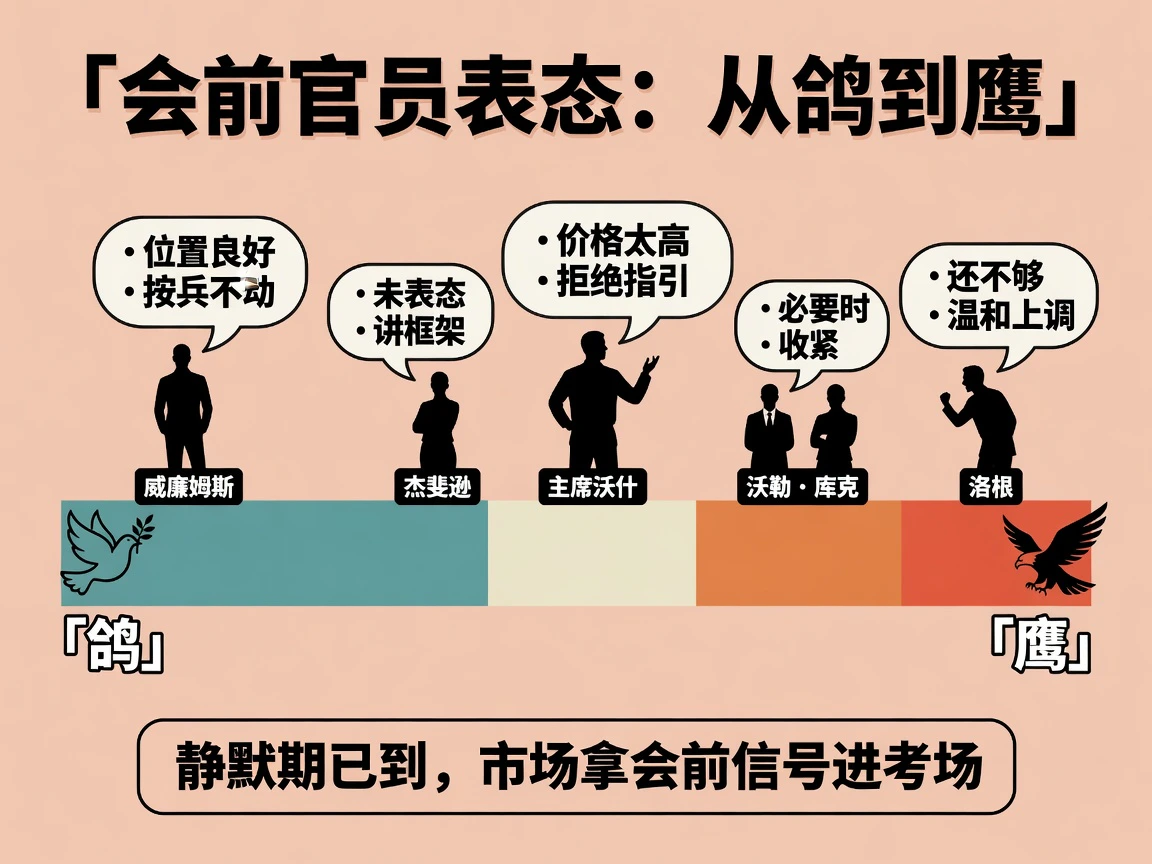
During the two weeks before the blackout, Fed officials expressed distinctly different policy preferences:
- Chair Warsh—cautious, downplaying short-term fluctuations: At the Sintra central-bank forum on July 1, he said prices were still too high and declined to offer guidance on the near-term rate path. In subsequent congressional testimony, he explicitly tempered enthusiasm about one soft monthly CPI report, stressing that a single improvement was no basis for declaring victory over inflation. He also advocated dedicated working groups on communications, the balance sheet and other issues. His approach to policy communication is shifting visibly toward less advance guidance and a stronger framework for responding to developments.
- Governor Waller—hawkish caution: In New York on July 13, he said that although the labor market was moving toward balance, core inflation remained at a critical juncture. The Fed had to remain ready to tighten further to avoid repeating its 2021 mistake of falling behind the curve.
- Governor Cook—the balance tilts: On July 15, she said the balance of risks had shifted from employment back toward prices, and that she would favor further action if a disinflationary trend did not become established quickly.
- New York Fed President Williams—moderately dovish: On July 15, he said he had observed multiple signs that inflation had peaked, judged the current rate appropriately restrictive and supported keeping policy unchanged.
- Dallas Fed President Logan—explicitly hawkish: On July 16, she said the recent slowdown in prices was not yet sufficient to provide reassurance and that a modest further increase in the policy rate remained necessary.
- Vice Chair Jefferson—a neutral framework: At Stanford University on July 16, he focused on a supply-and-demand shock framework to analyze the combined inflation effects of geopolitical energy volatility, tariff expectations and AI capital spending. He offered no direct recommendation for the level of interest rates.
Market Pricing and Asset Performance
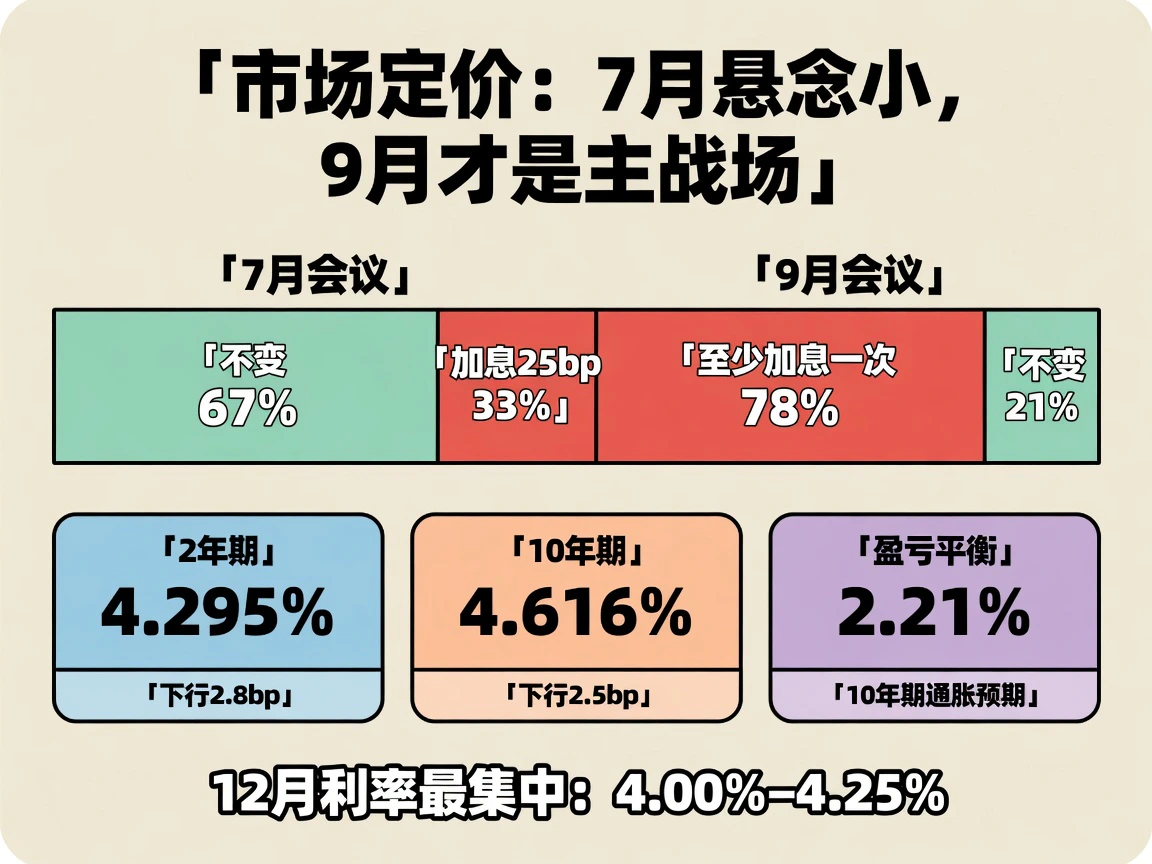
Near-term hike expectations jump: As of July 28, CME FedWatch showed about a 67% chance of no change in July and roughly a 33% chance of a 25-basis-point hike. The latter had been only 12%–18% two weeks earlier. On the Kalshi prediction market, the probability of keeping July's target range unchanged was about 76%.
September becomes the main pricing window: Markets currently assign only about a 21% probability to no change by the September meeting, while the priced probability of at least one cumulative hike has reached 78%. Expectations for the December endpoint are concentrated mainly in the 4.00%–4.25% range, implying room for another one to two hikes this year. The forward effective-rate anchor is around 4.0%.
Bonds firm modestly as inflation expectations ease: Ahead of the decision, the policy-sensitive two-year Treasury yield closed at 4.295%, down 2.8 basis points from the preceding trading day. The ten-year yield was 4.616%, down 2.5 basis points. The ten-year breakeven inflation rate also fell, by five basis points to 2.21%. The parallel decline in yields and inflation expectations indicates that the market's base case still favors a July hold, while short-end spreads leave ample premium for a September hike.
The details of the decision and the tone of Warsh's press conference will be revealed first, early on July 30 Beijing time. June PCE and second-quarter GDP will follow, becoming the next key inputs for calibrating the rate path in the second half.


