The Federal Reserve will announce its July FOMC rate decision at 14:00 Eastern time on July 29, approximately 02:00 Beijing time on July 30. Chair Kevin Warsh's press conference will follow at 14:30 Eastern time. The federal funds target range has remained at 3.50%–3.75% since the June 16–17 meeting. This will be Warsh's second policy meeting as chair and will not include a quarterly Summary of Economic Projections, or SEP. The material new information available to markets will therefore center on small changes to the statement's wording, the distribution of dissenting votes and the tone of the subsequent press conference.
At the reporting cutoff of 17:19 Beijing time on July 29, the decision had not yet been announced. Federal funds futures continued to price an unchanged rate at this meeting as the base case, but the probability of an immediate increase had risen to roughly one-third; expectations for a first hike in September were stronger still. Weak June CPI and employment readings had substantially reduced the urgency for an immediate increase compelled by the data. Nevertheless, fears of an energy shock from geopolitical turmoil, core inflation still substantially above the 2% target and divisions among voting members over the policy path left room for either a surprise hike or a more restrictive hawkish hold.
Economic Data
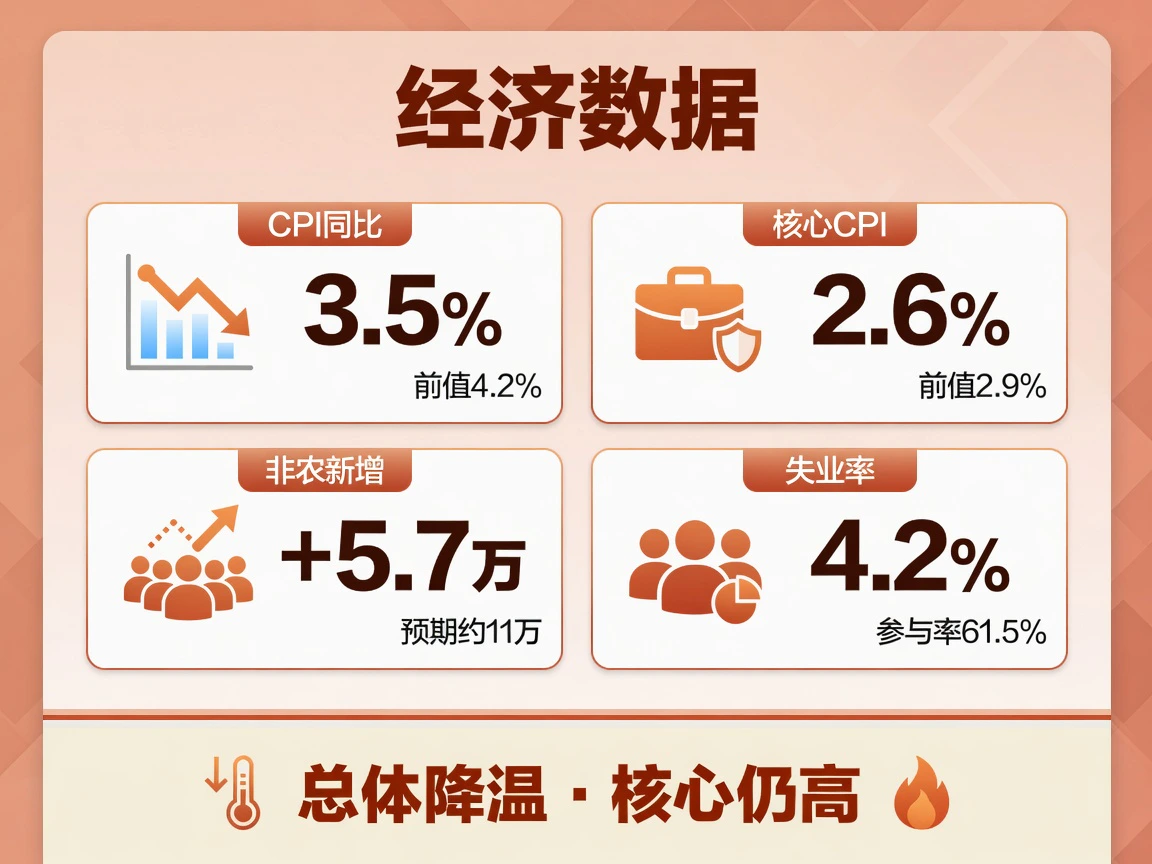
Hard data released in the run-up to the meeting presented a distinctly mixed picture. Headline inflation and job creation had cooled significantly, but the core inflation measures central to the Fed's assessment remained well above its mandated target.
Inflation. Bureau of Labor Statistics data released on July 14 showed June CPI inflation slowing to 3.5% year on year from 4.2% in May, below expectations of around 3.8%. Prices fell 0.4% month on month, led by declines of approximately 5.7% in energy and 9.7% in gasoline. These reflected the earlier interval of easing tensions in the Middle East and falling international oil prices. Core CPI inflation slowed to 2.6% year on year from 2.9% in May, with prices essentially unchanged on the month; this too was below the roughly 2.8% consensus. Energy effects largely drove the fall in headline inflation, but the simultaneous cooling in core inflation materially weakened the argument that the data would force an immediate rate increase.
The statistical window matters: these price data were collected before the renewed escalation in the Middle East. If oil prices surged again, headline CPI could rebound in July–August. Meanwhile, improvement in the PCE price measures closely watched by the Fed was slower. Over the 12 months through May, headline PCE inflation was approximately 4.1% and core PCE inflation about 3.4%, on the basis used in the July Monetary Policy Report. Governor Cook noted on July 15 that, despite recently soft CPI and PPI releases, the target price index she monitored remained near 3.7% through June, approximately 1.7 percentage points above the longer-run 2% target.
Employment. June nonfarm payrolls, released on July 2, increased by only about 57,000, against expectations of 110,000–115,000. The preceding two months were also revised down by a combined 74,000. The unemployment rate was 4.2%, largely influenced by labor-force exits: participation fell to approximately 61.5%, and the labor force shrank by roughly 720,000. The labor market continued to cool mildly in a low-hiring, low-firing environment. It was neither overheating nor experiencing a sudden hard landing.
Growth. First-quarter real GDP grew at an annualized rate of 2.0%–2.1%. Within the economy, capital spending on data centers and AI remained strong, while residential investment was weak. The preliminary second-quarter GDP estimate was expected around July 30. It would serve as a post-meeting test; this article does not prejudge it.
Taken together, these fundamentals gave the Fed room to wait for another meeting in July. They also provided ample grounds for debate within the committee about persistently elevated core inflation and the possibility of renewed energy pass-through.
Policy Meetings
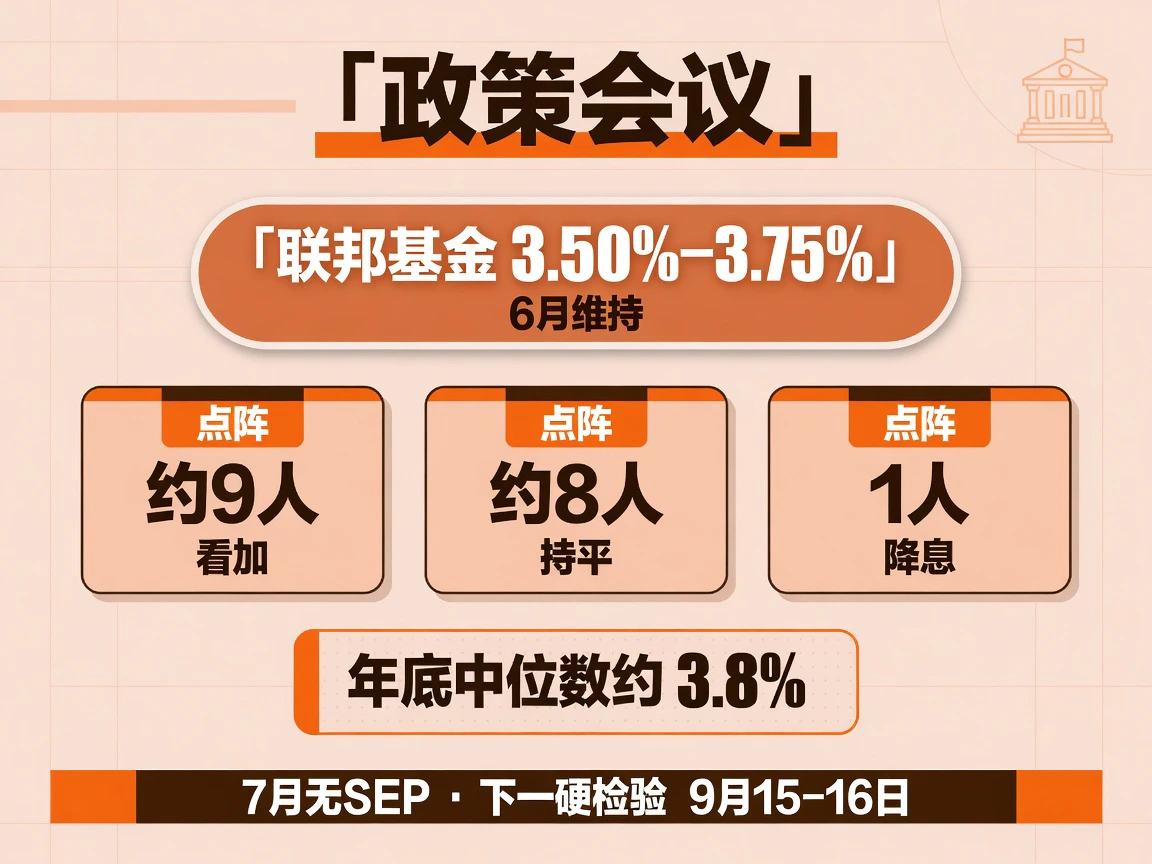
Before the July decision was formally announced, the latest complete policy reference point remained the June 16–17 FOMC meeting.
That meeting left the federal funds target range at 3.50%–3.75%. In its SEP, Warsh did not submit an individual dot projection. Of the other 18 participants, approximately 9 expected the year-end rate to be above the current range, 8 expected no change and only 1 expected a cut. The median year-end rate accordingly moved up from roughly 3.4% in March to approximately 3.8%. The center of the dot plot shifted from a bias toward cuts to the possibility of hikes. The new chair's missing individual projection further amplified uncertainty in policy communication.
The semiannual Monetary Policy Report released in early July maintained a cautious, relatively restrictive tone: inflation remained elevated, employment was stable at low levels and economic activity was expanding moderately. The two-day July meeting was under way, and no new official remarks had appeared between the start of the blackout period and the reporting cutoff. The decision, voting breakdown and press-conference remarks had not been released by the cutoff; this article does not prejudge the vote.
After taking office, Warsh initiated five working groups to reassess communications, the balance sheet, data methods, productivity and employment, and the inflation framework. His communication strategy deliberately played down traditional forward guidance. With no dot plot or SEP accompanying the July meeting, any shift in policymakers' emphasis would have to be inferred from changes in the statement's length, details of its wording, the presence of dissents and Warsh's tone at the press conference. The next substantive test with a full set of projections would come at the September 15–16 meeting.
Official Remarks
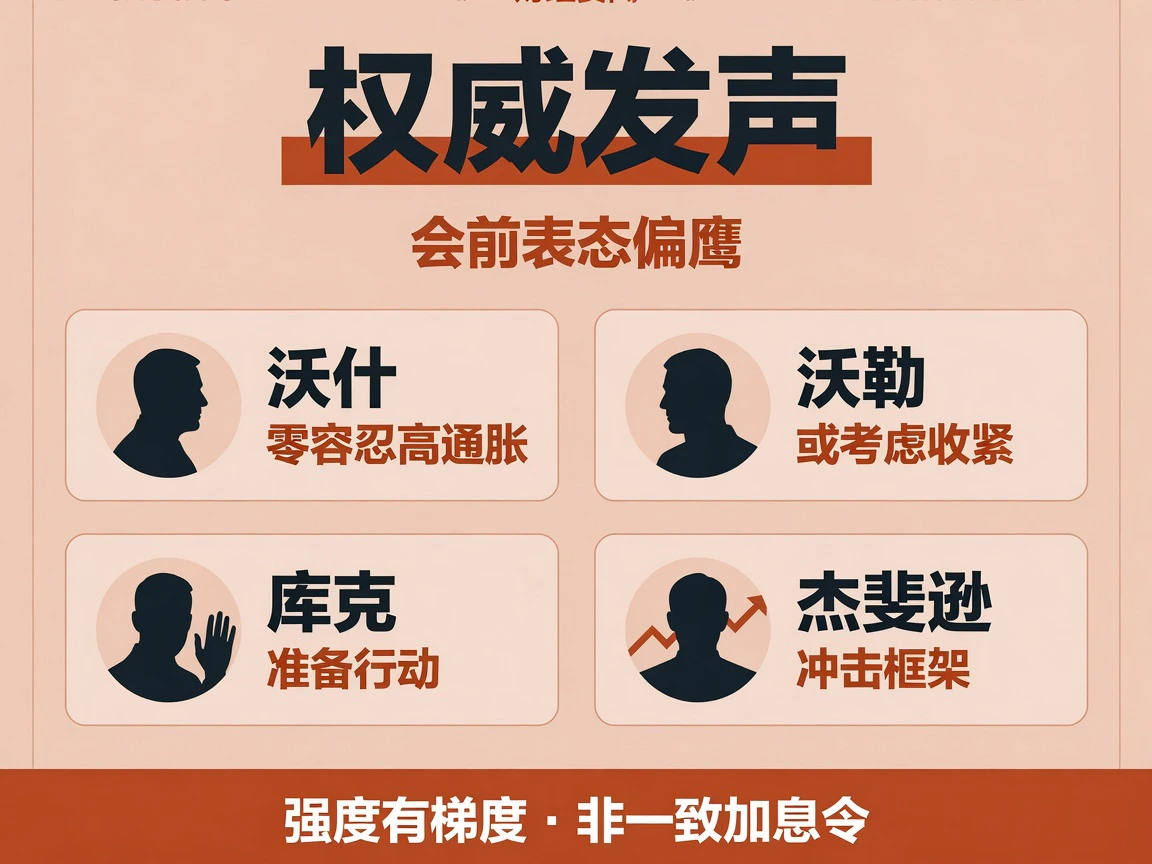
Public remarks by officials in mid-July, before the meeting, were hawkish overall but displayed clear differences in the strength of their calls for tightening. There had been no new statements on policy preferences after the blackout began and before the reporting cutoff.
Warsh, at the July 14–15 semiannual congressional hearings: He confirmed the cautious rationale for holding rates in June, reiterated the Fed's zero tolerance for persistently high inflation and announced the five working groups described above. He explicitly declined to offer specific guidance on the July decision. He characterized energy volatility and similar developments as particular price shocks that monetary policy could not directly control in the short run. He also observed that a one-time change in the price level associated with AI does not necessarily amount to persistent, broad-based inflation. This preserved tactical flexibility to observe whether external shocks would persist while firmly anchoring the central bank's longer-term credibility to the 2% inflation objective.
Governor Waller, in his July 13 New York speech, “Monetary Policy at a Crossroads”: He noted that core PCE inflation had risen from approximately 3% in December 2025 to about 3.4% in May 2026. If core inflation rebounded again, the FOMC would need to consider resuming tightening in the near term. He also cautioned policymakers against blindly fighting the last war and emphasized that action must remain grounded in hard data.
Governor Cook, in her July 15 Exchequer Club speech: She emphasized that inflation risks were clearly greater than downside employment risks. She supported waiting in June to see whether the shock would prove a one-off, but stated explicitly that the Fed was prepared to act if renewed inflation pressure failed to subside.
Vice Chair Jefferson, on July 16: He focused more on the theoretical framework of supply and demand shocks and did not directly state whether he favored a July increase.
External political pressure was also evident. Around July 27, Trump publicly praised Warsh's performance while expressing his preference for lower rates. This was an external political demand rather than an FOMC policy judgment. The White House wanted a more accommodative rate environment, while interest-rate futures assigned roughly a 30% probability to an immediate hike. The two forces were pulling in different directions.
The Market-Implied Path
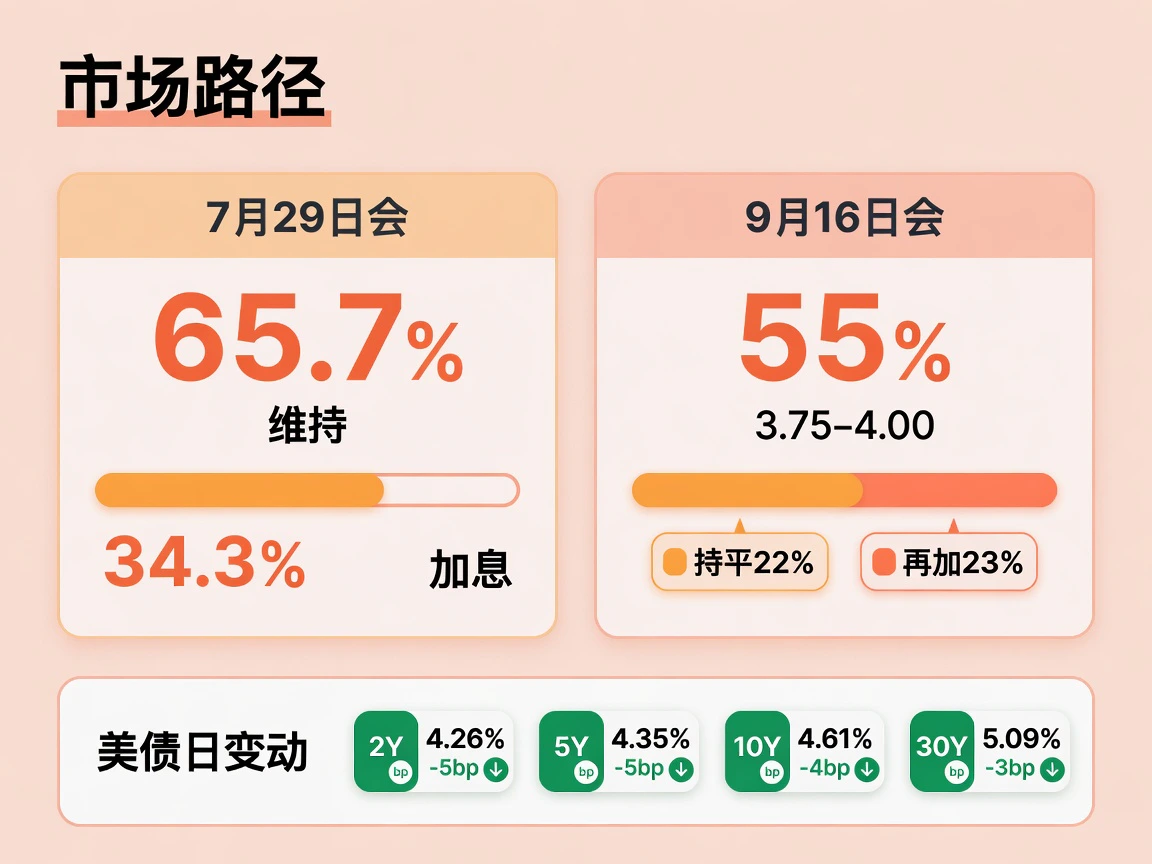
CME federal funds futures, tracked and reported by Investing.com at approximately 05:05 Eastern time on July 29, 2026, indicated the following:
- July 29 meeting: The probability of holding at 3.50%–3.75% was approximately 65.7%, compared with about 69% a day earlier and 75.6% a week earlier. The probability of a 25-basis-point increase to 3.75%–4.00% had risen to approximately 34.3%, versus around 31% a day earlier and only 24.4% a week earlier. Although a hold remained the central scenario, the probability of an immediate increase had risen substantially over the preceding week to roughly one-third.
- September 16 meeting: The probability of a target range of 3.75%–4.00% was about 55%; remaining at the current range carried approximately 22%; and a further increase to 4.00%–4.25% carried 23%. Pricing for the first hike was clearly concentrated in September.
Treasury yields across maturities were consistent with a hold as the pre-meeting base case. Using the U.S. Treasury's official daily benchmark closes for July 28 compared with July 27 on a close-to-close basis, the two-year yield closed at 4.26%, down 5.0 bp; the five-year at 4.35%, down 5.0 bp; the 10-year at 4.61%, down 4.0 bp; and the 30-year at 5.09%, down 3.0 bp. Lower front-end yields aligned with the futures market's base case of no immediate change. Daily changes use official closing observations consistently, avoiding distortion from intraday fluctuations.
The logic beneath market pricing had three mutually consistent layers. First, June CPI was broadly below expectations and payrolls weakened markedly, reducing the conditions under which overheated data would force an immediate hike. Second, nearly half of the participants in the June dot plot favored a rise during the year. Alongside the risk of renewed energy pressure from Middle Eastern events and the reduced transparency associated with Warsh's retreat from forward guidance, this meant the tail risk of a surprise hike could not readily be dismissed. Third, even if rates remained unchanged, hawkish statement wording, dissents favoring an increase or press-conference signals that the hurdle for September had fallen could quickly turn the decision into a hawkish hold in market pricing.
Beyond the decision itself, several major tests awaited in the following days: the statement's characterization of persistent inflation and energy developments, together with the voting divisions; preliminary second-quarter GDP around July 30 and the subsequent core PCE release; and July payrolls and CPI in early August. If gasoline rebounded, would headline CPI resume rising, and could core inflation continue to ease? September rate pricing would respond directly to the meeting's communication. Further reforms to forward guidance by Warsh's working groups would also continue to have a substantial effect on the predictability of the Fed's reaction function.


