Over the past 24 hours, military action on several fronts has shattered the expectation of a pause in escalation that markets had been pricing in. Geopolitical risk premiums have quickly returned to oil and shipping markets.
On Tuesday evening US Eastern time, Iran's Islamic Revolutionary Guard Corps (IRGC) fired multiple ballistic missiles beyond the country's borders. US Central Command (CENTCOM) and Jordan's military subsequently reported air-defense interceptions. Hours later, US and Saudi aircraft jointly struck pro-Iran militia positions inside Iraq, marking Riyadh's first public acknowledgment of a cross-border military operation since the US–Iran war began. Iraq's Popular Mobilization Forces (PMF) later raised their casualty count to at least 20 dead and 32 wounded, prompting the Iraqi prime minister to convene an emergency ministerial meeting on national security.
On the diplomatic front, Trump held separate closed-door meetings at the White House with Ukrainian President Volodymyr Zelensky and Israeli Prime Minister Benjamin Netanyahu that day. Before the meetings, however, he publicly pushed back against Israeli demands to expand the strikes and again threatened Tehran with the destruction of critical infrastructure. Commercial shipping through the Strait of Hormuz remained almost at a standstill after Iran rejected an Omani compromise on passage. Oil prices rebounded sharply as markets unwound ceasefire expectations, with intraday gains approaching 4%.
Missile Attacks and Air Defenses: US and Saudi Aircraft Open an Iraqi Front

CENTCOM said the IRGC launched several ballistic missiles from Iranian territory at 17:45 US Eastern time on Tuesday, or around 05:45 Beijing time on Wednesday, in an attempt to launch a surprise attack on US bases in the Middle East. It said US forces had intercepted every incoming missile and remained on the highest alert. CNN, citing US officials' preliminary assessment, put the number launched at no more than four.
The launches came just one day after Trump's unilateral claim that he had paused strikes at Iran's request. Iranian Foreign Ministry spokesman Esmaeil Baghaei had already explicitly rejected reports of negotiations, saying there was currently no contact between the two sides. Iran's state broadcaster Press TV said the IRGC missiles targeted US bases in Jordan. CENTCOM did not identify the precise locations attacked, but Jordan's military subsequently issued a formal statement confirming that its air defenses had intercepted and shot down five missiles from Iran within Jordanian airspace. It reiterated that it would firmly counter any violation of national security or threats to its citizens. The statements corroborate the fact of a cross-border attack, although their accounts still differ on the number launched and where the missiles were headed.
Saudi Arabia's public shift in its defense stance is a geopolitical turning point with implications extending beyond the direct US–Iran exchange. The Saudi Defense Ministry announced that its air force had joined US forces in limited, targeted strikes on pro-Iran armed groups in Iraq, in retaliation for recent attacks on Saudi energy facilities. Riyadh also confirmed that it had previously downed several drones arriving through Iraqi airspace and attempting to strike oilfields in eastern Saudi Arabia. CENTCOM added that coalition aircraft had focused on weapons depots and logistics sites in eastern Iraq to curb more than 30 IRGC-directed drone incursions over the past 72 hours.
CNN emphasized that this was Riyadh's first public acknowledgment of cross-border airstrikes inside Iraq since this round of Middle East conflict began. Saudi Arabia had long responded to harassment by Iranian proxies primarily through air-defense interceptions at home, seeking to avoid direct military retaliation across borders. Its conspicuous intervention now means that the conflict has expanded from a bilateral US–Iran confrontation to direct involvement by a major Gulf oil producer.
Iraq's Response: PMF Casualties Rise as Baghdad Confronts an Urgent Sovereignty Crisis
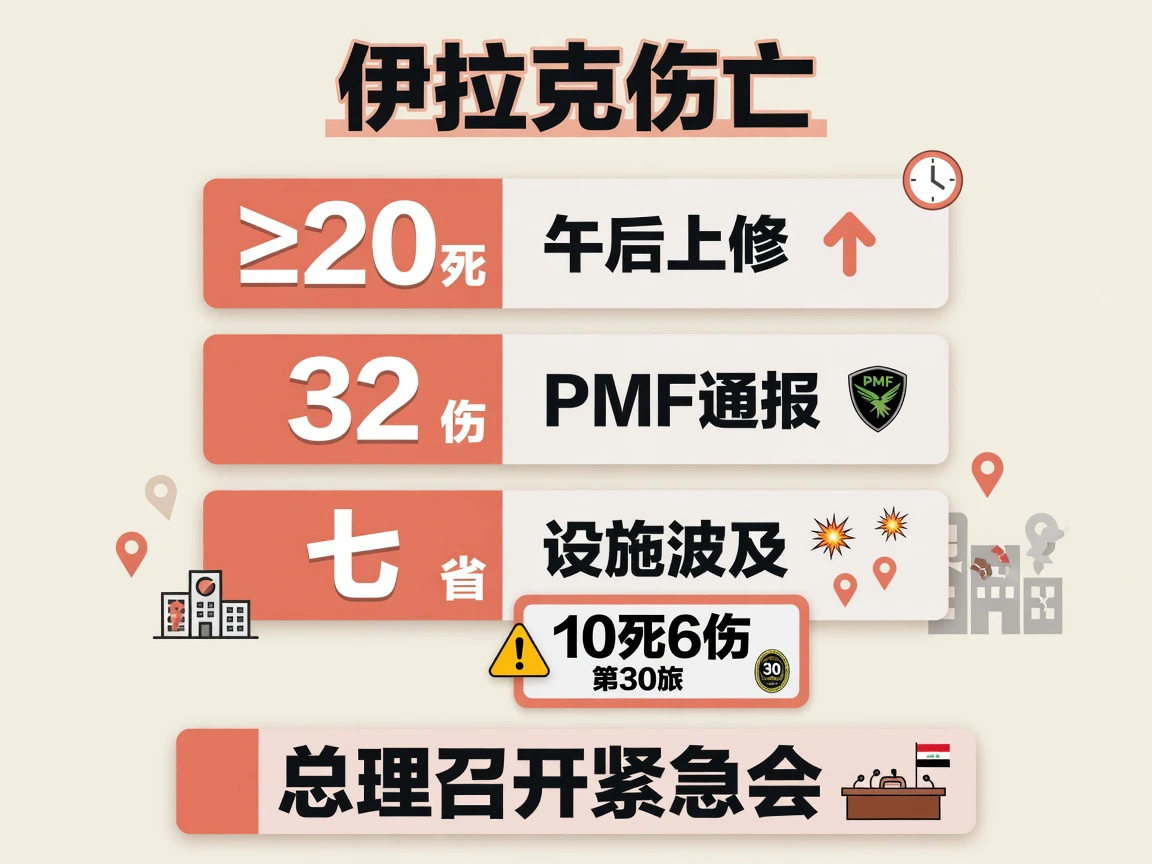
The PMF casualty count continued to rise after the airstrikes. Its initial morning statement reported only a few people killed or wounded and accused the US–Saudi operation of gravely violating Iraqi sovereignty and official security institutions. By the afternoon, the reported toll had risen sharply to at least 20 dead and 32 wounded. Strikes spanned seven provinces—Baghdad, Wasit, Nineveh, Basra, Kirkuk, Karbala and Diyala—with severe damage to several command centers, logistics assets and military vehicles.
The PMF's 30th Brigade said in a statement that a key position in Nineveh province had suffered seven consecutive waves of airstrikes at around 3:20 a.m. local time, killing 10 and wounding six at that site alone. The Iraqi prime minister's office announced that an emergency national-security ministerial meeting had been convened on Wednesday to assess possible responses.
The US–Saudi coalition and Iraqi authorities differ fundamentally over the legal characterization of the strikes. Washington and Riyadh describe the targets strictly as terrorist armed-group positions threatening regional energy and military security. Legally, however, the PMF has been incorporated into Iraq's official security apparatus, with its salaries and equipment included in the state establishment. Powerful militia factions within it nevertheless maintain close ties to Tehran's Revolutionary Guards and form a key part of the so-called axis of resistance. This dual status produces two diametrically opposed accounts of the cross-border strikes: counterterrorism and self-defense on one side, and a violation of Iraqi national sovereignty on the other. Independent third parties have yet to verify the casualties comprehensively, and the Iraqi government has not issued a specific ban restricting US or Saudi use of its airspace.
Two Closed-Door White House Meetings: US–Israeli Differences and an Energy Red Line
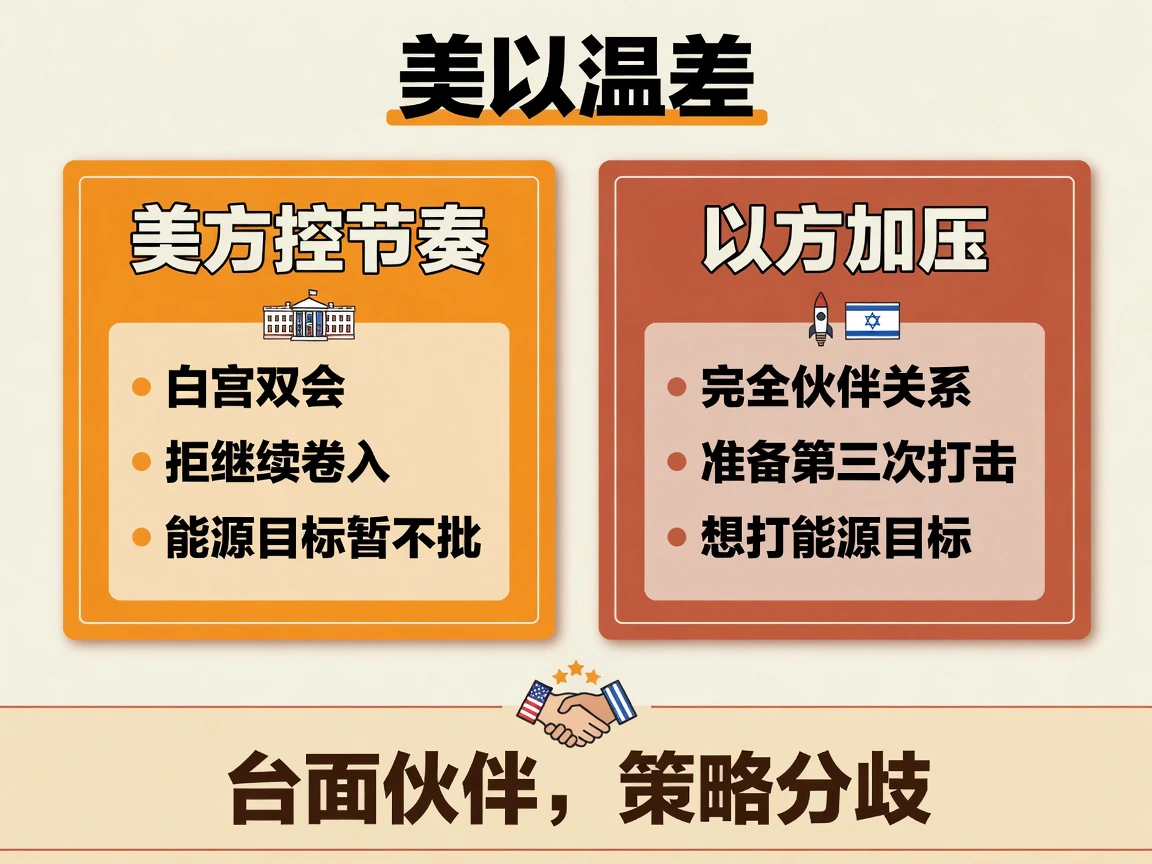
On Tuesday, Trump held successive closed-door White House talks with Zelensky and Netanyahu. The US–Ukraine meeting focused on licensing the joint production of Patriot air-defense interceptors and finding a diplomatic opening; the US–Israel meeting centered on military coordination against Iran. Afterward, Netanyahu praised the meeting as one of their best conversations, emphasizing a full partnership of mutual support and the overriding objective of preventing Iran from obtaining nuclear weapons. White House press secretary Karoline Leavitt also described the talks as positive and productive. After their private discussions, the two leaders jointly attended the funeral of the late Senator Graham at Washington National Cathedral.
The diplomatic language could not conceal deeper differences in strategic objectives. Just hours before the meeting, Trump publicly voiced his concern about being drawn into an all-out conflict in a Fox News interview: he said he did not need Netanyahu to provide intelligence and that Netanyahu always wanted to pull the United States in deeper. Trump continued to threaten Iran with the destruction of the underground facilities at Pickaxe Mountain if it failed to sign an agreement, and with disabling most of its bridges within an hour. Yet he also drew an explicit line, saying he would not strike desalination plants to avoid harming civilians.
Subsequent public comments by Israeli Defense Minister Israel Katz further illustrated the gap. Katz said that although Israel's military was very eager to strike Iran's energy hubs, the United States currently prohibited it from crossing that line because of global macroeconomic and inflation risks. He also confirmed extensive coordination between US and Israeli air bases and aerial-refueling corridors. Katz acknowledged that the two countries' strategic interests did not fully coincide, saying the United States had considerations in the Gulf extending beyond Israel's domestic security. This suggests that Washington's central aim is to calibrate escalation and contain inflation, while Tel Aviv seeks to use the opportunity to push military pressure to the limit.
Energy and Shipping: Oil Rebounds 4% Intraday as Hormuz Talks and Traffic Stall
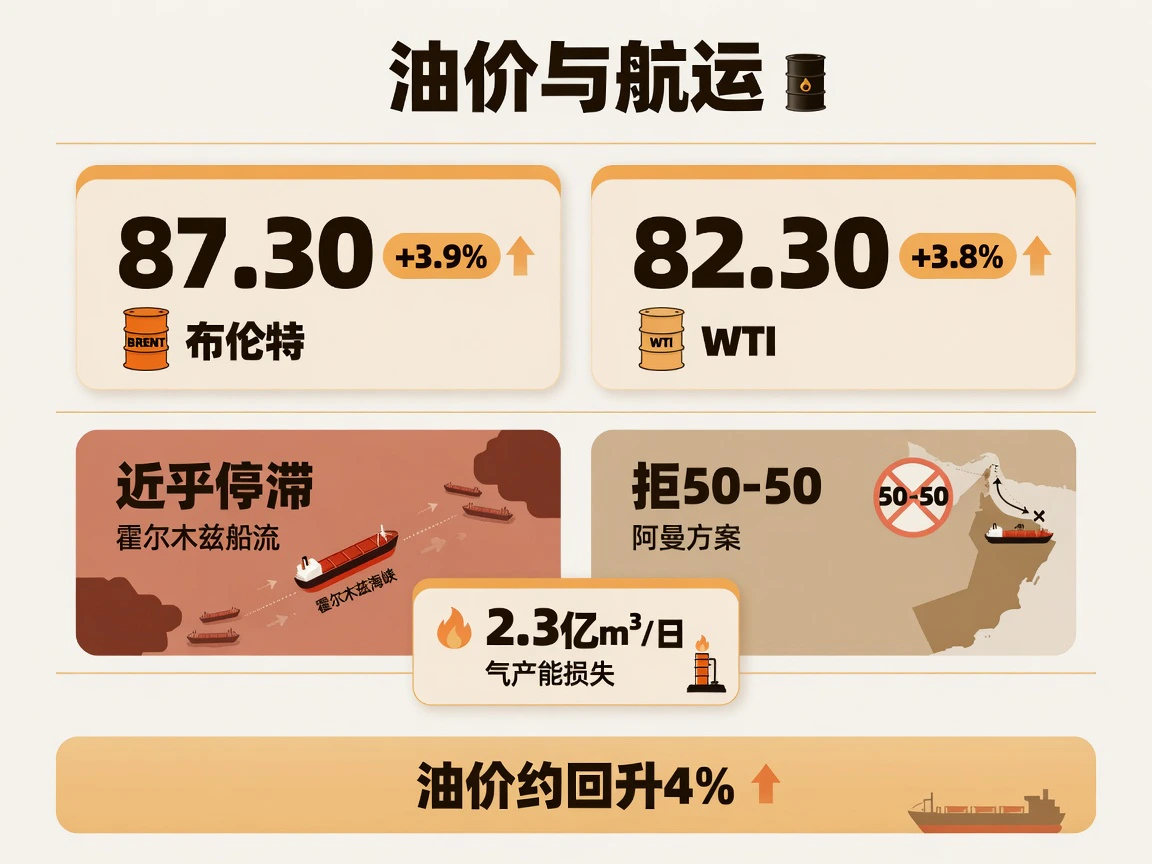
Commodity markets rapidly absorbed the gulf between fragile diplomatic statements and military confrontation on the ground. Early Tuesday trading continued to reflect the relief associated with the earlier pause in strikes: Brent briefly fell below $86 a barrel, down about 2.9%, while WTI slipped toward $80. News of Jordanian air-defense interceptions and the joint US–Saudi airstrikes then brought a rapid restoration of the geopolitical premium.
By early Wednesday US Eastern time, Brent crude futures had rebounded 3.9% to $87.30 a barrel, with WTI up 3.8% at $82.30. ING's commodity strategists said the renewed threat to Saudi oil infrastructure had extinguished hopes of a rapid cooling of tensions in the Persian Gulf, while commercial tanker traffic through Hormuz remained effectively near a standstill. Alongside the war premium, Reuters cited industry data showing a draw of roughly 3.3 million barrels in US commercial crude inventories in the week ended July 24. Expectations of physical-market tightness combined with the Middle East fighting to intensify price volatility.
The contest over effective control of the shipping corridor remained deadlocked. A spokesman for Iran's highest military command publicly warned that vessels belonging to any country or shipping company cooperating with US efforts to use Iran's frozen overseas assets to compensate cargo-loss claims would be barred from the Strait of Hormuz.
In the shuttle diplomacy, Iran's Foreign Ministry acknowledged technical contacts with Oman on a framework for safe passage through the strait, but insisted that the discussions fell within the sovereign remit of coastal states and had nothing to do with the United States. Iran explicitly rejected Oman's proposed 50-50 compromise for escorting shipping. Although a scheme for nonmandatory, voluntary contributions modeled on the Strait of Malacca remained under discussion, there had been no substantive breakthrough in the short term.
Meanwhile, the blockade and war were imposing rapidly mounting costs on Iran's domestic economy. Government spokeswoman Fatemeh Mohajerani confirmed that the country had lost 230 million cubic meters of daily natural-gas production capacity since the war began. The Iranian Chamber of Commerce's energy committee estimated a daily gas shortfall of 300 million to 450 million cubic meters and a nationwide power deficit exceeding 15,000 megawatts. Amid extreme summer heat in the south, warnings of power rationing and risks of winter heating-fuel shortages were already emerging. On humanitarian supplies, the cargo ship Touska was finally released and entered an Iranian port after more than 90 days in US custody. Its cargo of dialysis medicines was expected to provide urgent relief for tens of thousands of chronically ill patients.
Regional Spillovers: Ukraine–Iran Contacts Ease Caspian Tensions as Pressure Builds Inside Tehran

On a peripheral front, Ukraine and Iran signaled a limited easing through diplomatic contact. Ukrainian Foreign Minister Andrii Sybiha and Iranian Foreign Minister Abbas Araghchi spoke by telephone about the recent attack on a Caspian cargo ship. Ukraine clarified that the operation had not intended to target civilian vessels. Araghchi said Tehran did not seek escalation but demanded compensation for casualties and losses. The two sides continued to dispute the vessel's status: Kyiv had maintained that it targeted a Russian military logistics ship, while Tehran said the ship carried only commercial iron ore.
Within Iran, wartime repression and legal controversies were developing in parallel. Human-rights group HRANA reported that Tehran's authorities had executed two participants in protests earlier in the year in Isfahan, while 14 others in the same case faced death sentences. In the US Congress, Democratic lawmakers again raised the earlier airstrike on an elementary school in Minab that caused severe civilian casualties, accusing the authorities of allowing the investigation to languish for months.
On the rebuilding of military industry, acting Iranian Defense Minister Ebnolreza told the semiofficial Tasnim news agency that domestic defense production lines had accelerated across the board, with priority given to replenishing air- and sea-based asymmetric capabilities. That claim diverges sharply from the US military's earlier assertion that it had functionally paralyzed Iran's defense-industrial system. Overall, despite the major powers' frequent diplomatic smoke signals about peace talks, military confrontation involving proxies and regional states continues to deepen from Iraq's interior to the Red Sea and Persian Gulf shipping routes.
Live Timeline
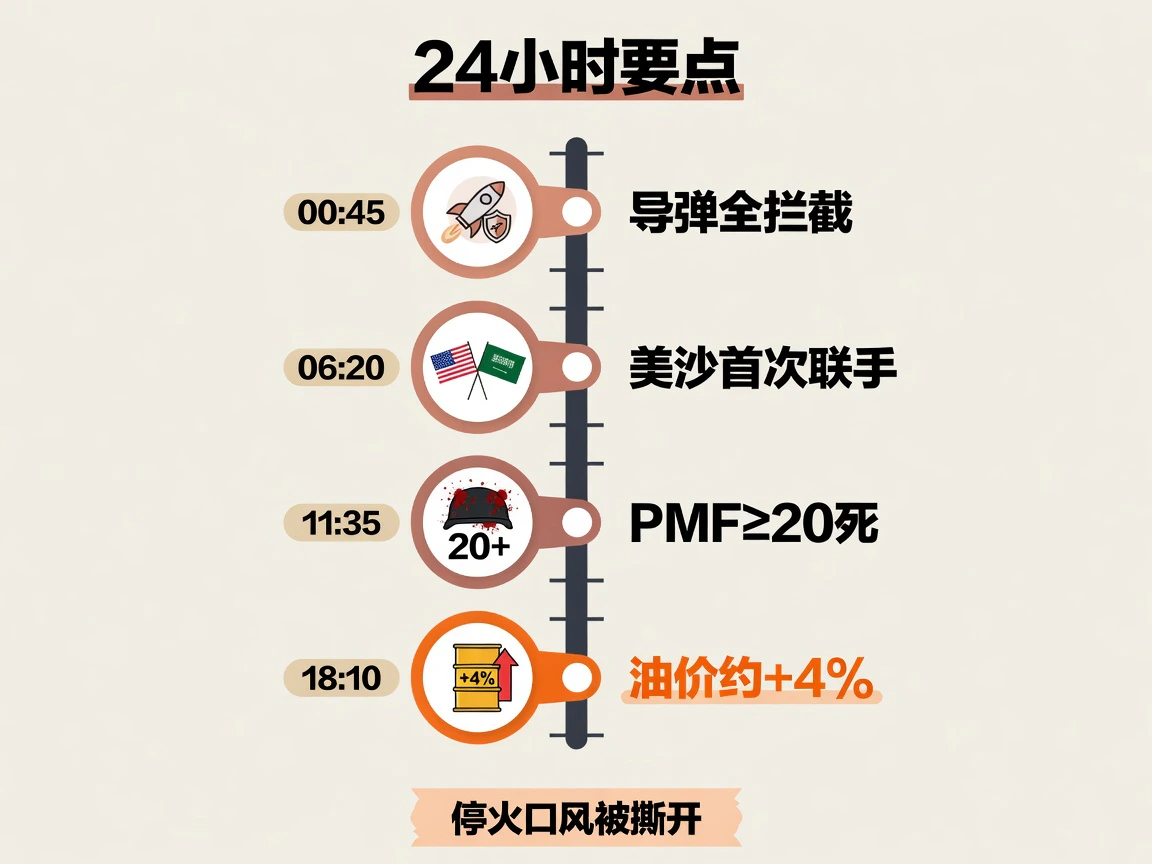
Key developments over the past 24 hours, in reverse chronological order by Beijing time. Principal sources: CNN Live and others.
| Key Developments |
|---|
| 07-29 17:04International oil prices rebound about 4%: Brent at $87.30 and WTI at $82.30. Institutions assess Hormuz shipping as nearly stalled; Iran rejects Oman's 50-50 escort proposal. |
| 07-29 16:01Iraq's PMF says US–Saudi airstrikes have killed at least 20 and wounded 32, hitting facilities in seven provinces. Iraq's prime minister convenes an emergency national-security meeting. |
| 07-29 14:35Background: The PMF is an official Iraqi security umbrella organization, but its core militia factions are closely aligned with Iran's IRGC. |
| 07-29 13:18The PMF's initial morning report says several bases were attacked and a few people killed or wounded, condemning a grave violation of Iraqi sovereignty. |
| 07-29 13:10Jordan's military says its air defenses intercepted and shot down five ballistic missiles launched from Iran into Jordanian airspace. |
| 07-29 12:56Democratic US House members demand accountability for the earlier attack on Minab elementary school, criticizing months of delay in the investigation. |
| 07-29 12:49Netanyahu praises the Trump meeting as one of their best conversations and reiterates the US–Israeli objective of preventing Iran from acquiring nuclear weapons. |
| 07-29 10:11The PMF reports US–Saudi airstrikes on several of its military and logistics bases inside Iraq. |
| 07-29 10:00Iranian state media report that the IRGC has fired ballistic missiles at US bases in Jordan. |
| 07-29 08:54Saudi Arabia announces joint targeted strikes with US forces on pro-Iran militias in Iraq, Riyadh's first public acknowledgment of cross-border military strikes since the war began. |
| 07-29 08:38CENTCOM says coalition forces struck several armed-group positions in eastern Iraq in response to more than 30 drone incursions in the past 72 hours. |
| 07-29 07:37Oil prices recover after news of the air-defense interceptions, beginning to rebuild the geopolitical premium. |
| 07-29 06:41CENTCOM reports intercepting Iran's surprise ballistic-missile attack; its preliminary assessment puts the number of incoming missiles at no more than four. |
| 07-29 03:22In a post-meeting video, Netanyahu emphasizes the full US–Israeli partnership and vows to block Iran's nuclear program. |
| 07-29 01:49The Ukrainian and Iranian foreign ministers hold an urgent call about the mistaken strike on a Caspian cargo vessel; both say they do not seek escalation. |
| 07-29 00:52A White House briefing describes Trump's separate closed-door meetings with Netanyahu and Zelensky as productive. |
| 07-29 00:11Iran's acting defense minister says defense production lines have accelerated across the board, prioritizing gaps in air and maritime capabilities. |
| 07-29 00:07Iran's central command issues an ultimatum: vessels cooperating with US use of Iran's overseas assets for compensation will be barred from Hormuz. |
| 07-28 23:57Zelensky identifies the main issues in his Trump talks: licenses to produce Patriot air-defense missiles and renewed diplomatic efforts. |
| 07-28 22:14Analysts say US and Iranian accounts remain deeply divided beneath talk of peace, with Hormuz discussions confined strictly to coastal states. |
| 07-28 21:55Israeli Defense Minister Katz says the United States currently tightly restricts Israeli strikes on Iranian energy hubs; Israel is ready for a third round of retaliation. |
| 07-28 21:38Iran reports losing about 230 million cubic meters of daily gas capacity since the war began, with its electricity deficit exceeding 15,000 megawatts. |
| 07-28 20:58Trump again threatens Iran's critical transport infrastructure, claiming he could destroy most of its bridges within an hour. |
| 07-28 20:53In a media interview, Trump openly expresses wariness of Netanyahu, accusing him of trying to draw the United States deeper into war and threatening Pickaxe Mountain's underground facilities if Iran does not compromise. |
| 07-28 19:56Foreign media report that the Hormuz talks draw on Malacca's voluntary-contribution mechanism. Iran describes its contacts with Oman as constructive. |
| 07-28 18:11HRANA says Iran's judiciary has executed two protesters from earlier in the year, with 14 others in the same case sentenced to death. |
| 07-28 17:56The Touska is released after more than 90 days in custody. Iran says its dialysis medicines can meet the needs of tens of thousands of patients. |
| 07-28 17:47Ceasefire optimism pushes oil prices lower: Brent falls below $86 and WTI approaches $80. |