On July 29, 2026, the Federal Reserve's superficially uneventful July rate decision triggered a sharp repricing across global markets. The Fed voted 9 to 3 to keep its benchmark rate unchanged, but three regional Fed presidents dissented in favor of an immediate 25-basis-point increase, producing the most divided vote since 2016. The hawkish decision coincided with a sudden escalation in the Middle East that sent international oil prices more than 6% higher. Long-dated Treasuries underwent a sharp bear-steepening, while the S& P 500 fell more than 1.5%. After the U.S. close, contrasting results from Microsoft and Meta brought scrutiny of the returns on enormous AI capital expenditures to a critical juncture.
FOMC: A 9–3 Hold, With Three Dissents Marking the Biggest Split in Nearly a Decade
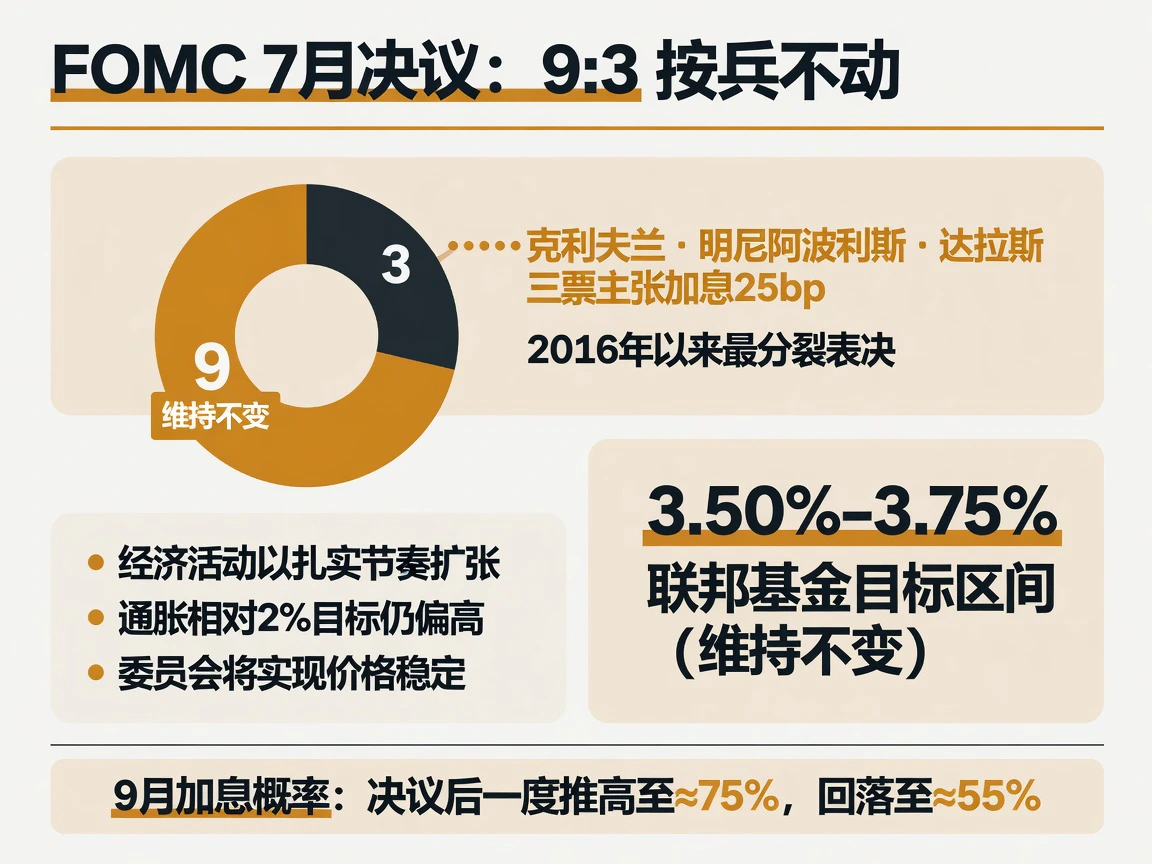
The Fed left the federal funds target range at 3.50%–3.75%, but the details of the vote revealed substantial tensions. Cleveland Fed President Hammack, Minneapolis Fed President Kashkari and Dallas Fed President Logan all dissented, an unusual joint call for a 25-basis-point increase at the meeting. It was the first time since September 2016 that as many as three FOMC members had dissented in favor of a hike.
The statement's overall tone was distinctly hawkish. The Fed acknowledged that economic activity continued to expand at a solid pace, that inflation remained elevated relative to its longer-run 2% objective, and specifically mentioned supply shocks, including energy. It closed by affirming that the committee was firmly committed to price stability, without providing any specific forward guidance.
At the subsequent press conference, Fed Chair Warsh reiterated his zero-tolerance stance on inflation but was notably restrained in describing the policy reaction function. He observed that nominal and real Treasury yields had both risen substantially since the June meeting and that financial conditions had continued to tighten. This gave the committee some comfort because markets themselves were performing part of the tightening. Warsh emphasized that he wanted markets to respond more to changing economic fundamentals and spend less effort speculating about the Fed's wording.
Market reactions were sharply divided. The two-year Treasury yield, which is particularly sensitive to policy rates, edged down 4 basis points. This mainly reflected the temporary removal of a July hike probability of roughly one-third to almost one-half that markets had priced before the decision. Long-end yields and breakeven inflation rates, however, surged together, showing that markets had certainly not interpreted the decision as a dovish turn. Reuters reported that traders briefly raised the implied probability of a September hike to around 75% after the announcement before it eased back to approximately 55%. The debate over the policy path remained far from settled.
On the evening of July 30, Beijing time, the United States was due to release its preliminary second-quarter GDP estimate, for which consensus was around 1.8%, and June core PCE inflation, with consensus around 3.3%. These would provide the first hard test of Warsh's approach of proceeding cautiously while waiting for data.
Treasuries: Bear-Steepening Takes the 30-Year Yield Back to Its Highest Level Since 2007
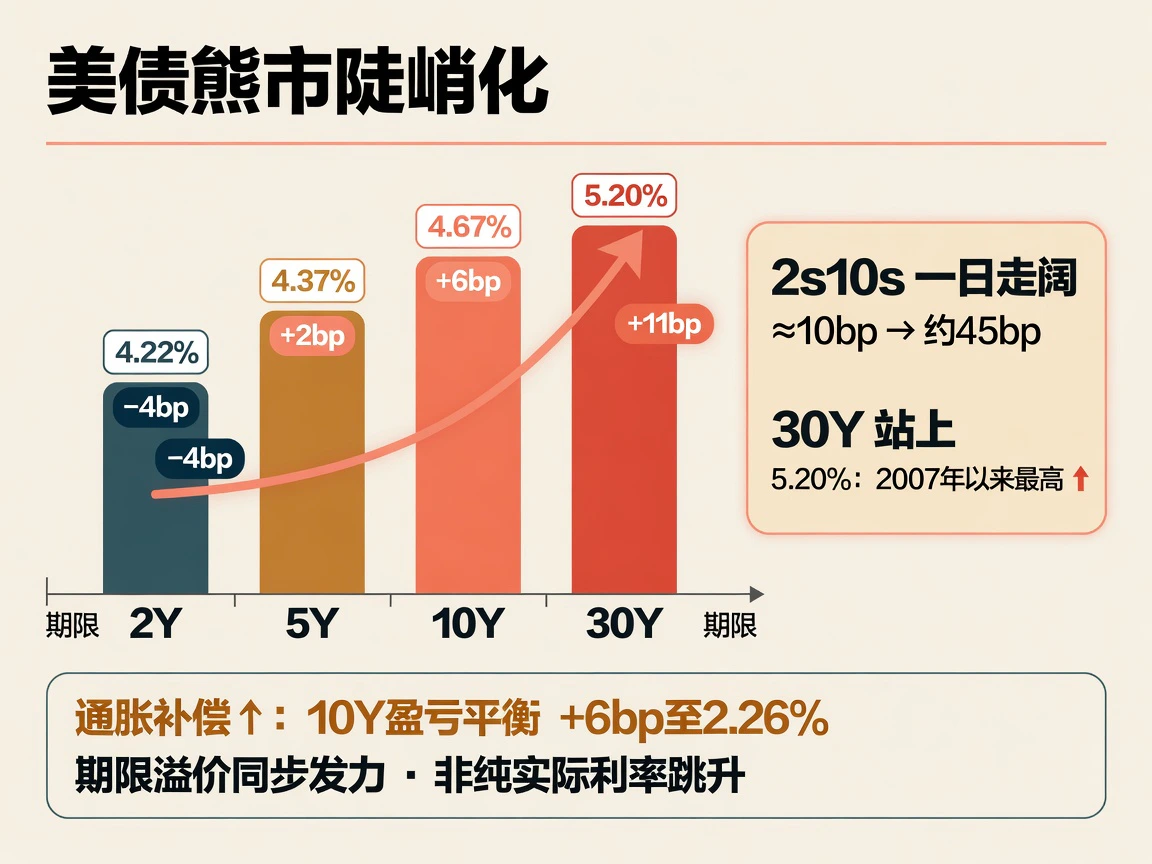
The forces driving Treasury pricing on July 29 were particularly clear. A more hawkish division within the FOMC than expected, together with the energy shock from surging oil prices, pushed up long-end term premiums and inflation compensation.
Treasury yield changes, on a closing basis:
- Two-year: 4.22% (−4 bp)
- Five-year: 4.37% (+2 bp)
- 10-year: 4.67% (+6 bp)
- 30-year: 5.20% (+11 bp)
The 2s10s curve spread widened by approximately 10 basis points in a single day to around 45 bp, displaying a particularly clear bear-steepening pattern: front-end yields edged lower while long-end yields rose sharply. The 30-year yield firmly reached 5.20%, its highest level since 2007.
Within the long-end sell-off, the 10-year breakeven inflation rate rose 6 bp to 2.26%, while the five-year breakeven increased by 8 bp. The sharp rebound in oil significantly lifted near-term inflation compensation. The breakdown indicates that the rise in long-end yields was not simply driven by higher real rates; inflation compensation and the premium for holding duration reinforced one another.
In credit, high-yield and investment-grade option-adjusted spreads stood at relatively tight levels of 2.84% and 0.81%, respectively, as of July 28; exact July 29 figures were still pending. On a day when benchmark Treasury yields broadly rose and long bonds sold off sharply, credit total returns faced considerable pressure. For Asian dollar bonds, where exposure to underlying interest rates was the dominant issue, highly rated securities with long duration were especially vulnerable to the jump in the 30-year yield.
Equities: Three Pressures Combine as the S& P 500 and Nasdaq Both Fall
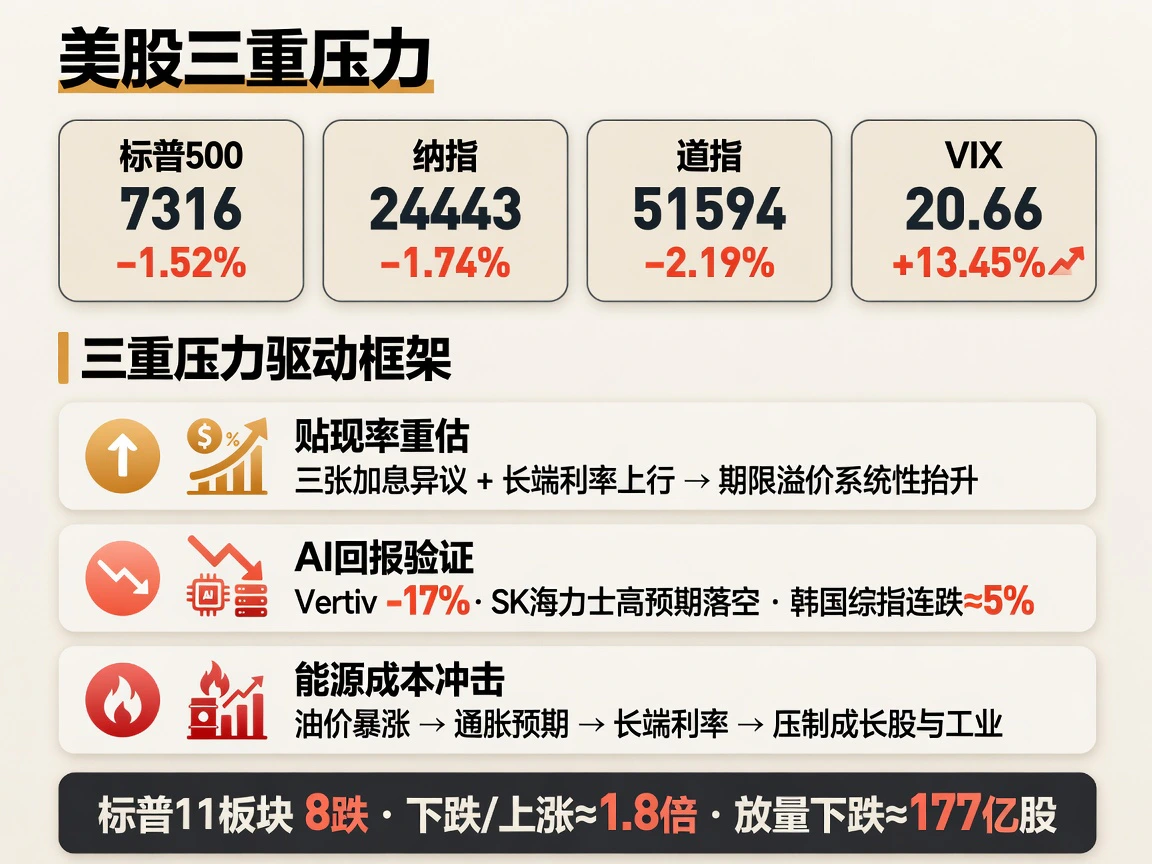
The broad U.S. equity pullback on July 29 essentially reflected three reinforcing pressures: expectations for macroeconomic liquidity, scrutiny of returns on AI capital expenditure, and the shock to energy costs.
The S& P 500 closed at 7,316.15, down 1.52%; the Nasdaq Composite at 24,442.94, down 1.74%; the Dow Jones Industrial Average at 51,594.14, down 2.19%; and the small-cap Russell 2000 at 2,906.31, down 1.61%. Risk aversion rose sharply, with the VIX jumping 13.45% to 20.66. Trading volume totaled approximately 17.7 billion shares, above the trailing 20-day average, indicating a clear sell-off on elevated volume.
Losses were broad across the S& P 500: 8 of its 11 major sectors fell. Industrials led the decline at 3.24%, followed by a 2.5% fall in information technology. Declining stocks outnumbered advancing stocks by roughly 1.8 to 1 across the market. Nasdaq stocks recording new lows numbered 230, far exceeding the 121 reaching new highs.
The main pressures came from three directions:
First, higher discount rates and a repricing of policy risk. Three dissents in favor of a rate increase, combined with surging long-term Treasury yields, prompted markets to reprice a benign status quo into a much more aggressive allowance for persistently high rates and term premiums. The simultaneous jump in long-end yields and broad equity losses indicated a systematic increase in risk premiums across asset classes. This differed fundamentally from the falling stocks and rising bonds normally associated with recession fears.
Second, exacting scrutiny of returns on AI capital expenditure. The focus had shifted from technological aspirations to practical commercial returns: which companies could quickly turn substantial cash investment into actual net profit. End demand had not been disproved, but investors had become unprecedentedly demanding about earnings delivery. Data-center infrastructure leader Vertiv plunged roughly 17% in one session after quarterly revenue missed expectations. In Asia-Pacific markets, SK Hynix faced a sell-the-news reaction despite a surge in profit, contributing to consecutive sharp falls in Korean equities.
Third, the drag from rising energy costs. The sharp surge in international oil prices lifted inflation expectations and risk-free discount rates while directly increasing operating costs in the real economy. Long-duration growth stocks and traditional industrial cyclicals both suffered.
The implications for Asian markets: The KOSPI fell sharply on both July 28 and July 29, making Korean equities one of the most volatile links in the global AI hardware supply chain. By the time of writing, the index had slipped to around 5,716, more than 5% below its July 28 close of 6,024. Hong Kong stocks, by contrast, showed greater independence: the Hang Seng Index gained 1.96% on July 29 to around 25,808 despite the global decline. This suggested relative defensive advantages in Chinese internet companies and local high-dividend assets during a correction in the global hardware chain.
Commodities: Oil Surges More Than 6% on Geopolitics and Inventory Draws
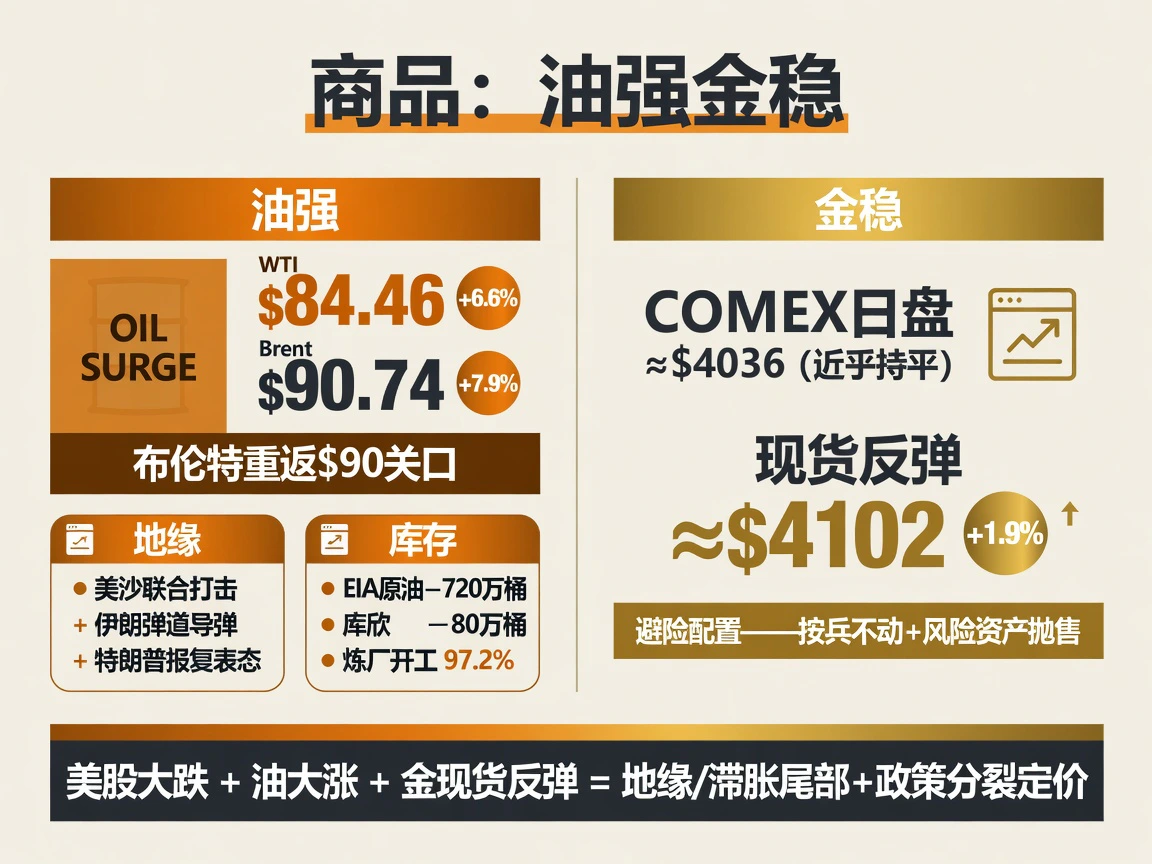
Commodity trading on July 29 displayed a risk-averse pattern of surging crude and steadily strengthening gold.
Front-month WTI crude settled at $84.46 a barrel, up 6.6% on the day. Brent settled at $90.74 a barrel, up 7.9%, decisively reclaiming the $90 threshold.
The oil-price surge was driven by geopolitical escalation and a tight supply-demand balance. First, the geopolitical situation abruptly reversed: U.S. Central Command intercepted Iranian ballistic missiles, Trump publicly threatened severe punishment, and joint U.S.-Saudi precision strikes hit Iran-aligned armed groups in Iraq. These direct confrontations shattered the brief-ceasefire narrative that markets had previously anticipated, rapidly restoring crude's geopolitical premium. Second, the U.S. Energy Information Administration's official weekly report released the same day reinforced the move. U.S. commercial crude inventories fell by a larger-than-expected 7.2 million barrels to 404.5 million barrels, roughly 7% below the five-year seasonal average. Stocks at the key Cushing delivery hub fell by 800,000 barrels, and refinery utilization climbed to a high 97.2%. Fears of supply interruptions and a larger-than-expected physical inventory draw acted in the same direction, giving oil substantially greater upside sensitivity than other commodities.
Brent's gain substantially exceeded WTI's, widening the spread by about $1.45 to approximately $6.28 a barrel. This indicated that risk pricing remained heavily concentrated on the global supply threat from disruption to key Middle Eastern shipping routes, rather than on North America's domestic supply-demand balance.
In precious metals, front-month COMEX gold futures settled almost unchanged in the day session at around $4,036 an ounce. After the FOMC decision, however, spot gold rallied rapidly, extending its gain to approximately 1.9% in the U.S. afternoon and reaching around $4,102 an ounce. With the Fed holding rates and global risk assets correcting sharply, investors again recognized gold's value as a safe-haven allocation.
Across assets, the combination of sharply lower U.S. stocks, surging oil and stronger gold closely matched pricing for geopolitical escalation and potential stagflation risk, rather than a healthy cyclical expansion supported by improving economic fundamentals.
Geopolitics: Middle Eastern Escalation Accelerates Again
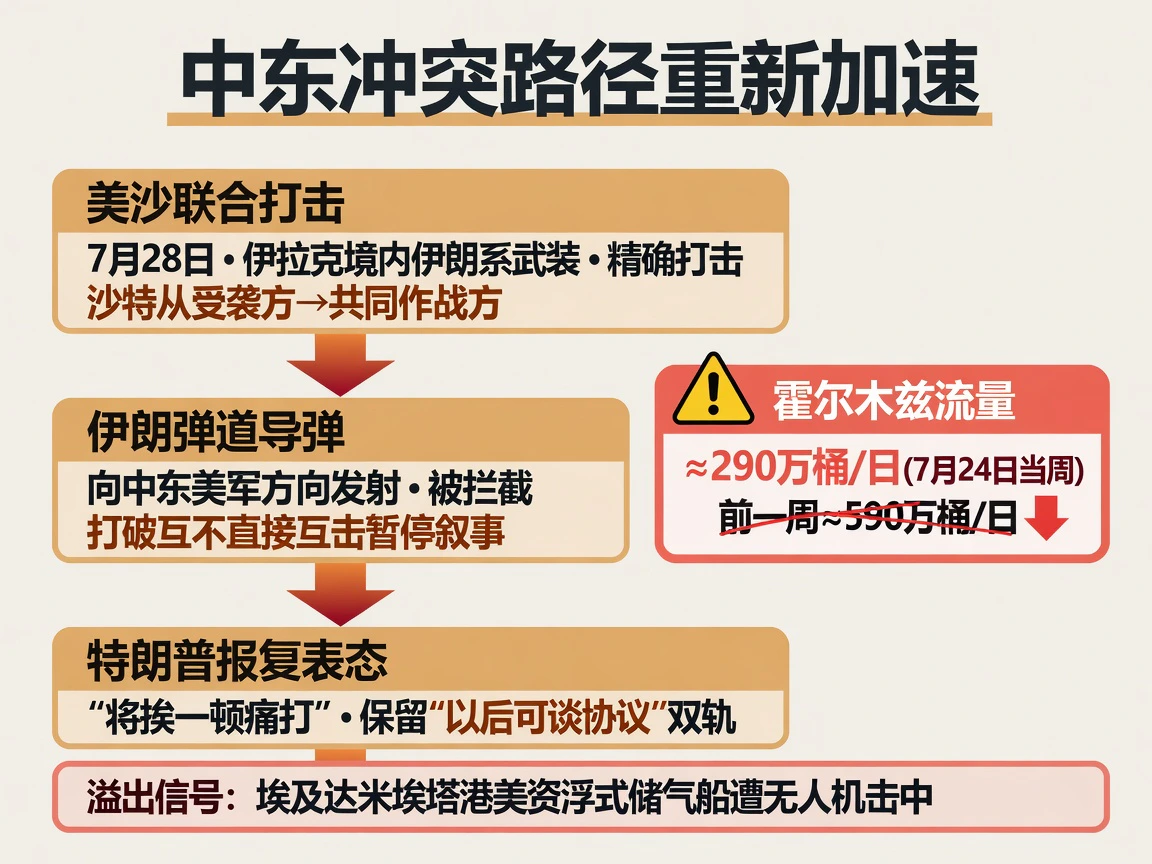
On July 29, the cycle of retaliation in the Middle East again appeared to accelerate out of control, prompting assets across markets to price substantial premiums for further escalation.
Three events directly intensified the situation in quick succession. First, joint U.S.-Saudi strikes: U.S. Central Command and Saudi forces carried out targeted airstrikes against Iran-aligned militias in Iraq on the night of July 28. Saudi Arabia had effectively moved from being a passive target earlier in the conflict to an active participant in coordinated military action. Second, Iran's missile retaliation: although ballistic missiles fired at U.S. military sites were intercepted, the attack shattered the two sides' previous tacit understanding to avoid direct confrontation. Third, Trump's forceful message: he told the media that Iran would be hit severely, while maintaining a second track by leaving room for a future negotiated agreement.
At the critical Strait of Hormuz chokepoint, Iran firmly rejected the Oman-coordinated proposal for joint regional management by multiple countries and voluntary transit fees. Tehran insisted that its authority over rules governing passage through the strait was inalienable. Third-party shipping trackers reported that, in the week through July 24, average daily net shipments of crude and refined products through Hormuz had fallen to roughly 2.9 million barrels, nearly halving from approximately 5.9 million barrels a day in the preceding week. Actual shipping flows remained deeply depressed relative to normal prewar levels.
A more dangerous sign of spillover emerged along the Mediterranean. A U.S.-owned floating storage and regasification unit, or FSRU, berthed at Egypt's Damietta port caught fire after a drone attack. Maritime security agencies provisionally assessed that a long-range drone had been used. The attack on this key energy facility indicated that the conflict's geographic reach was spreading from the Persian Gulf and Red Sea into the eastern Mediterranean.
Market reactions were unambiguous: oil rapidly regained its risk premium, U.S. stocks fell sharply and volatility indexes rose broadly. The Treasury curve did not show the broad rally typical of a conventional flight to safety. Instead, it bear-steepened as short-end yields edged lower and long-end yields surged. The rates market was clearly absorbing two shocks at once: divisions over Fed policy and a war-related inflation premium.
Big Tech Earnings Diverge: Microsoft Holds Up, Meta Loses Momentum
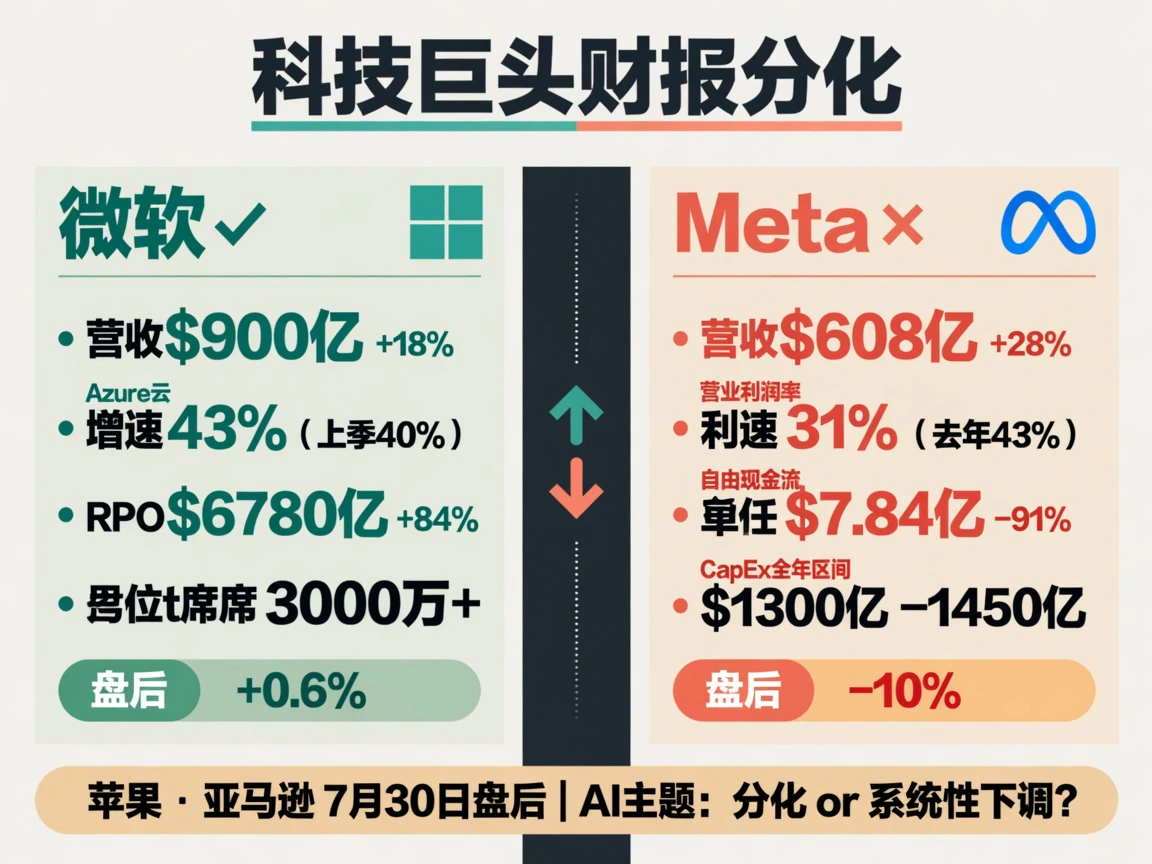
Two major technology earnings releases after the U.S. close put the returns on enormous AI capital expenditures under intense scrutiny. The two companies delivered sharply contrasting results.
Microsoft: broadly positive. Quarterly revenue reached $90 billion, up 18% year on year. Closely watched Azure cloud growth accelerated to 43% from 40% in the previous quarter. Commercial remaining performance obligations, or RPO, reached $678 billion, up 84% year on year, and paid commercial Copilot seats surpassed 30 million. Faster cloud growth and a stronger-than-expected backlog substantially eased concerns that Microsoft's investment in AI computing capacity would produce spending without profits. Its shares edged up approximately 0.6% after hours.
Meta: significantly negative. Revenue remained solid at $60.8 billion, up 28% year on year, but its operating margin dropped from 43% a year earlier to 31%. Free cash flow fell 91% to $784 million. More significantly, management raised the lower end of its annual capital expenditure guidance from $125 billion to $130 billion, setting the full-year range at $130 billion–$145 billion. Shrinking margins, collapsing cash flow and higher spending guidance delivered a triple blow, directly shaking the optimistic view that profits from its core advertising business could finance AI investment internally. Meta shares fell approximately 10% after hours.
Apple and Amazon were scheduled to report after the close on July 30. Investors were watching closely for convincing evidence of monetization. If the remaining giants showed cash-flow pressure similar to Meta's, the selective trading divergence within the AI hardware chain could rapidly develop into a systematic valuation repricing of the entire AI investment theme.