On July 30, global markets were digesting the previous day's FOMC decision, and the main drivers of the major asset classes diverged clearly. Long-term rates consolidated at elevated levels with almost no retreat. US equities split sharply in response to contrasting AI earnings from Microsoft and Meta. As US military strikes took place, geopolitical anxiety eased somewhat and oil gave back gains. Although VIX fell almost a fifth, long Treasury yields remained firm, with each asset class following its own pricing logic.
Rates: Elevated levels hold as markets digest the decision
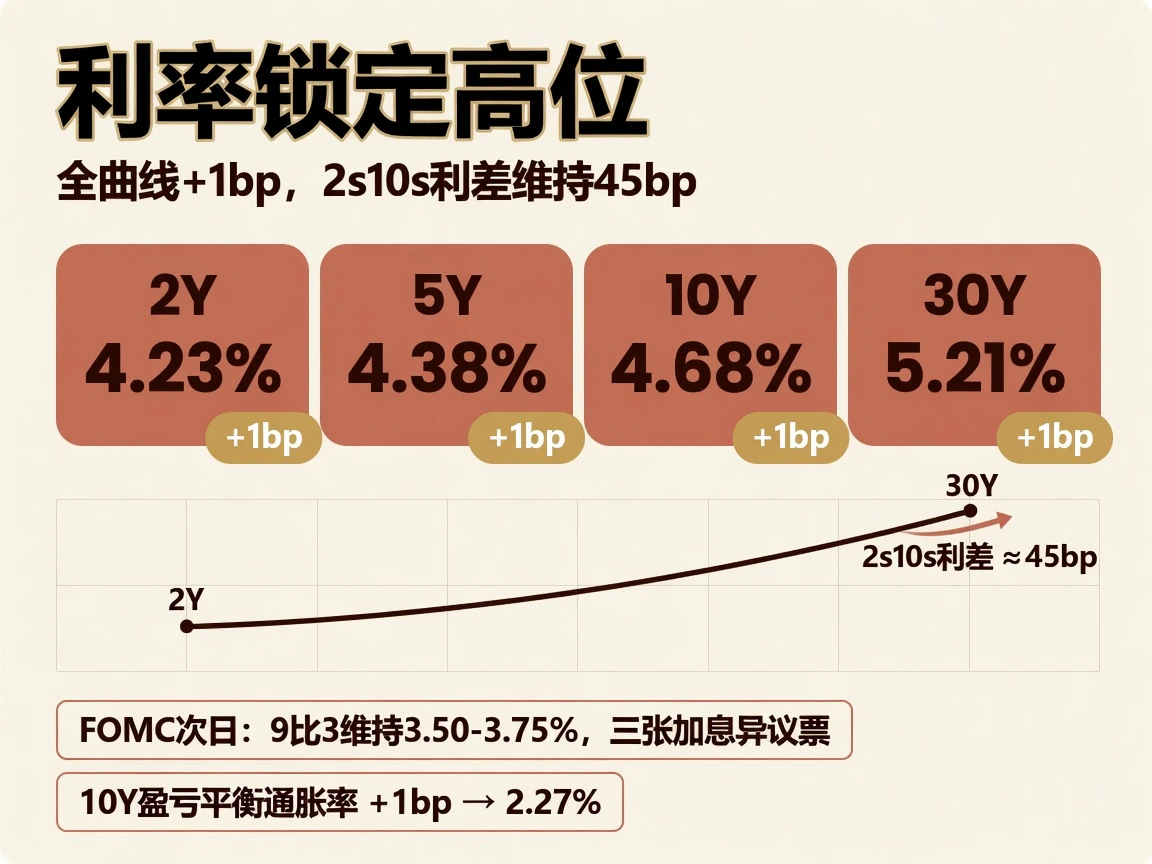
On July 30, Treasury yields across the curve were broadly unchanged from the previous day. The US Treasury's daily par curve showed the 2-year at 4.23%, 5-year at 4.38%, 10-year at 4.68% and 30-year at 5.21%. Key maturities edged up about 1 basis point, while the 2s10s spread remained around 45 basis points.
Markets treated this as confirmation of existing expectations rather than another shock. The previous day's FOMC held the policy rate at 3.50%–3.75% by a 9–3 vote. The Cleveland, Minneapolis and Dallas Fed presidents favored an immediate 25-basis-point hike, the largest number of dissents since 2016. Chair Warsh played down traditional forward guidance and explicitly said that higher long-term yields were sharing the work of tightening. The 30-year yield briefly reached around 5.24%, its highest level since mid-2007.
The mere 1-basis-point rise across maturities the next day, with the curve's slope unchanged, indicated market acceptance that long-end premiums would be difficult to bring down materially in the near term. Shorts also showed no urgency to cover. The front end, around 4.23%, likewise lacked a catalyst for lower yields. Three pro-hike dissents and Warsh's public reference to vigorous internal debate effectively shut down room for a near-term rate-cut narrative to revive.
The 10-year breakeven inflation rate also rose 1 basis point to 2.27%, showing that inflation compensation remained part of the marginal rise in nominal yields. More striking was the divergence between stocks and bonds: equities rebounded and VIX declined, but long yields did not follow lower. Buying associated with recovering risk appetite did not flow into long bonds. Term premiums and fiscal issuance pressure continued to dominate pricing at the very long end.
Equities: Returns on AI spending diverge between computing infrastructure and applications
On July 30, investors focused on whether AI giants could turn their enormous capital expenditure into commercial returns, and earnings outcomes were sharply polarized.
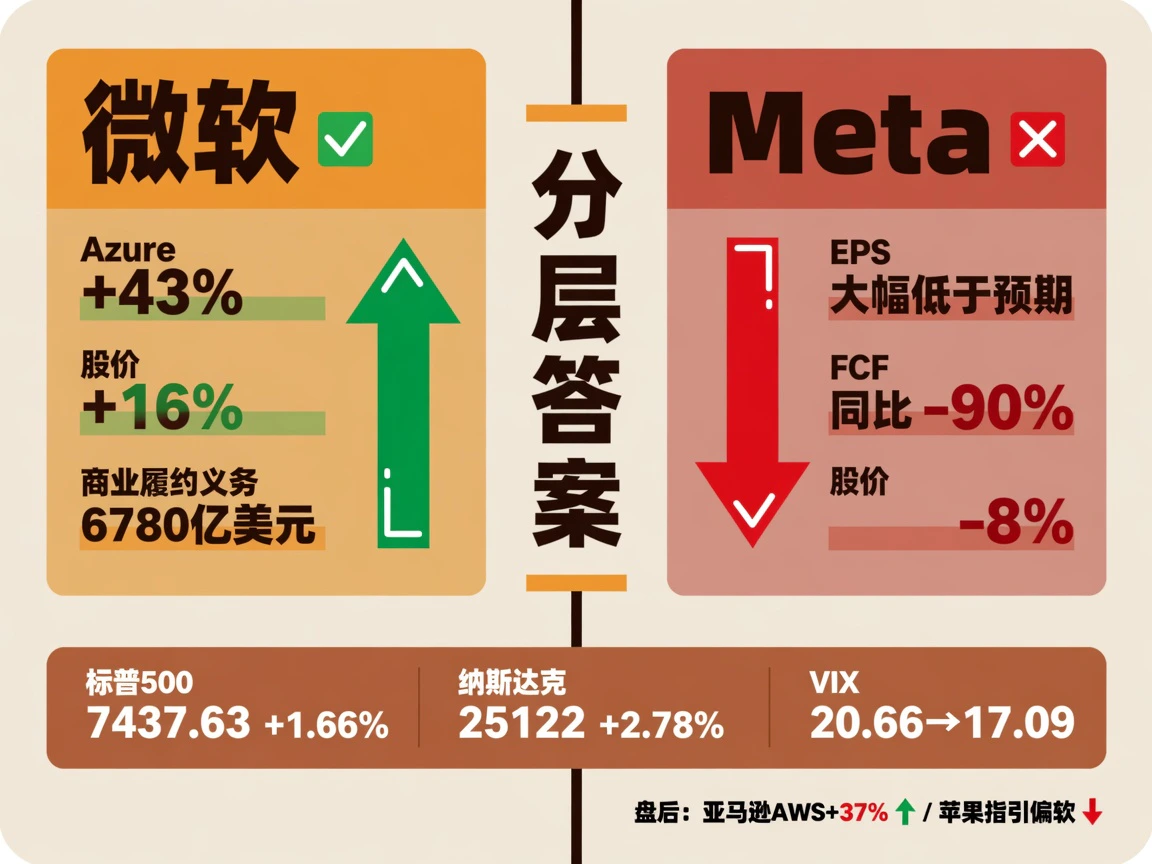
Microsoft beat expectations. Azure cloud growth recovered from about 40% to 43%; annual Azure revenue exceeded $100 billion for the first time; and commercial remaining performance obligations, or RPO, reached about $678 billion. This directly validated the contribution of AI infrastructure spending to cloud revenue. Microsoft shares surged about 16%, lifting the semiconductor supply chain: the Philadelphia Semiconductor Index gained more than 8%, Micron about 18% and AMD more than 13%.
Meta's results, by contrast, missed expectations. Quarterly earnings per share were well below forecasts, free cash flow plunged about 90% year over year, and the midpoint of third-quarter revenue guidance was weak. Without an external cloud business like Azure to monetize investment directly, large AI capital outlays translated directly into cost pressure on profits, sending shares down about 8%.
The divergence continued in after-hours earnings. Amazon AWS growth reached 37% year over year, its strongest in about 18 quarters. Management raised full-year capital spending further to about $220 billion and said capacity still could not fully meet demand, pushing shares up more than 10% after hours. Apple's quarterly revenue and profit both beat forecasts, but its next-quarter revenue growth guidance of 9%–11% fell short of the roughly 12% expected. It also cited memory-chip and supply-chain bottlenecks. Shares fell more than 6% after hours, weighing on sentiment toward the hardware supply chain.
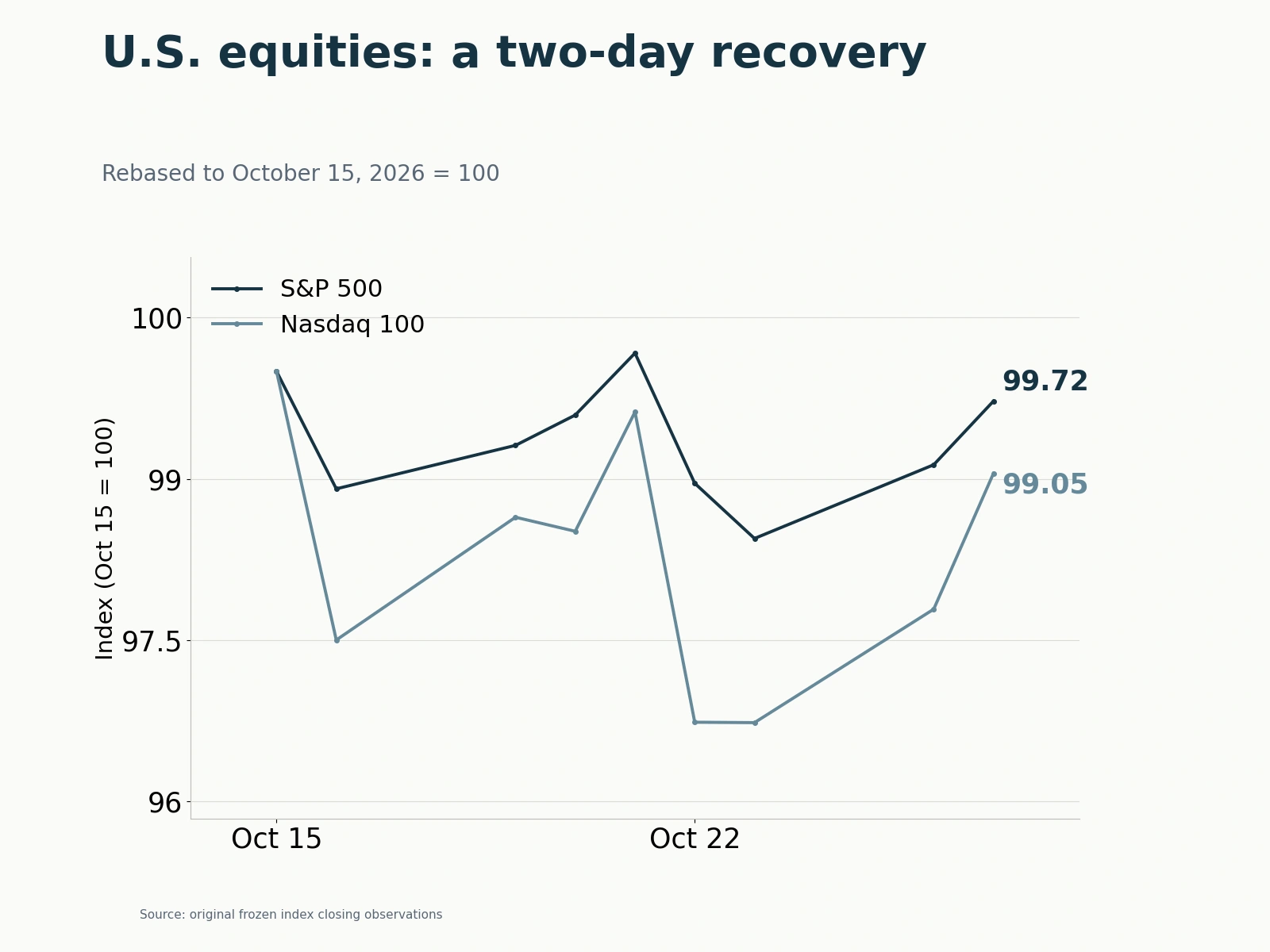
All the major US indexes closed higher. The S&P 500 gained 1.66% to 7,437.63, the Nasdaq Composite 2.78% to 25,122.18 and the Dow Jones Industrial Average 1.19% to 52,208.06. VIX fell from 20.66 to 17.09. Market breadth remained narrow, however: information technology and other heavily weighted technology stocks drove the gains, while most other sectors struggled to keep up.
The US technology rally produced a substantial catch-up effect in early Asian trading on July 31. At the July 30 Asia-Pacific close, the Nikkei 225 had risen 0.71% to about 61,867, while South Korea's KOSPI had fallen 1.23% to about 5,594. By the morning of July 31, buoyant semiconductor sentiment drove the KOSPI above 6,424, a gain of more than 13%, and the Nikkei toward 64,930. In currencies, USD/JPY quickly fell from about 163.30 at the July 30 close to around 160.65. This created some currency headwinds for Japanese exporters, but global technology beta trading outweighed that resistance in the short term.
Macro: Headline growth slows while domestic demand remains resilient
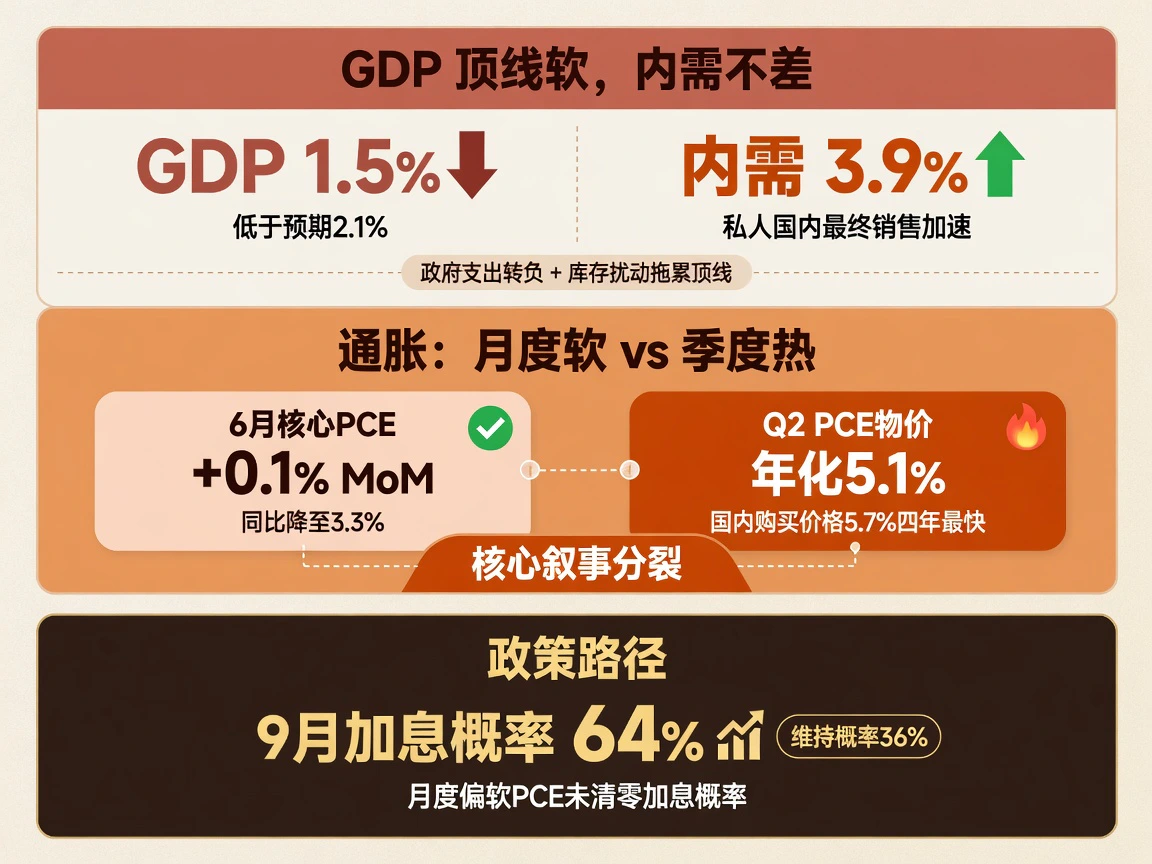
The July 30 releases combined slower headline GDP and monthly inflation with domestic demand and employment that remained relatively tight.
The advance estimate put second-quarter US real GDP growth at just 1.5% quarter over quarter annualized, well below the 2.1% forecast and the first quarter's 2.1%. The main drags were government spending turning negative, including the national-accounts subtraction from government consumption associated with releases from the Strategic Petroleum Reserve, and slower growth in nonresidential investment and net exports. The details, however, showed real final sales to private domestic purchasers rebounding to 3.9% annualized from 1.7% in the first quarter. This indicated that weak headline GDP growth largely reflected fluctuations in government spending and inventories, while household consumption and private fixed investment still showed resilient domestic demand.
On inflation, June core PCE rose 0.1% month over month, below the 0.2% forecast and previous 0.3%, while annual inflation edged down to 3.3%. Headline PCE turned negative at -0.1% monthly and was 3.7% higher year over year. These monthly readings confirmed some easing of near-term price momentum. Yet the advance second-quarter PCE price increase was 5.1% annualized, and the gross domestic purchases price index rose 5.7% annualized, its fastest in about four years. This contradiction between softer monthly and hotter quarterly data drove the day's pricing divergence: equities emphasized weaker recent monthly inflation, while bonds did not overlook its quarterly persistence.
The labor market remained relatively tight. Weekly initial jobless claims fell to 197,000, slightly below the 200,000 expected, and the four-week average declined further to about 203,000. This was consistent with the Fed's description of labor supply and demand as broadly balanced.
Federal funds futures still implied about a 64% probability of a 25-basis-point September hike, against roughly 36% for a hold. Cooler monthly PCE had not eliminated concern about tightening. The focus had simply shifted from whether the Fed would hike in July to whether it would act in September.
Commodities: Oil retreats while gold resumes its rise
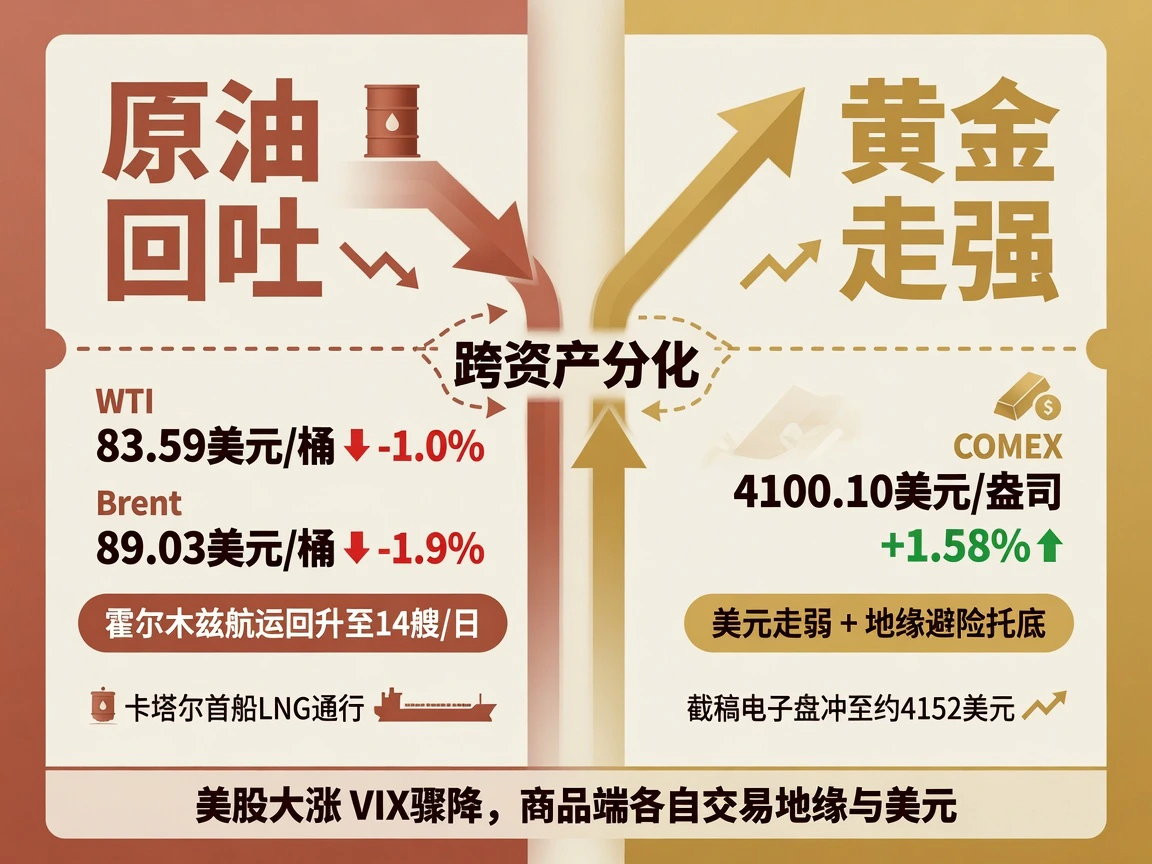
After Wednesday's sharp rally, international oil prices gave back gains on July 30. Nearby WTI futures settled at $83.59 a barrel, down about 1.0%; nearby Brent settled at $89.03, down about 1.9%.
The immediate catalyst was a marginal improvement in Hormuz transit conditions. Vessel tracking showed two-way merchant traffic recovering to about 14 ships on Wednesday, a substantial improvement from single-digit daily transits. Qatar also sent its first LNG vessel through the waterway since the conflict began. This eased extreme fears of an immediate, complete closure. Nevertheless, 14 ships per day was still far below normal traffic. Renewed suspension of CPC pipeline loadings in the Black Sea after an attack, alongside potential Red Sea risks, meant oil-supply tail risks had not disappeared.
Over the week, WTI had fallen from above $92 at its July 23 high to around $79 on July 28, rebounded rapidly to about $84 on July 29 as conflict escalated, and edged back to around $83.6 on July 30. The overall pattern was narrowing volatility after an elevated price spike. Oil had neither returned to the panic peak nor fallen through the earlier low, so this was not yet a downward trend reversal.
Precious metals followed a markedly different course. COMEX August gold futures settled at $4,100.10 an ounce, up about 1.58%, ending two consecutive days of declines. Support came primarily from a weaker dollar—EUR/USD rose 0.71% and USD/JPY fell 0.34%—and continuing geopolitical safe-haven demand. In electronic trading, gold rose further toward $4,152, in step with yen appreciation and dollar weakness in early Asian trading.
Across assets, rising stocks and falling VIX coincided with weaker oil and stronger gold. This indicated that the recovery in risk appetite was concentrated in equities, while commodities continued to price geopolitical developments and currency fluctuations independently.
Geopolitics: Strikes are delivered and elevated premiums narrow
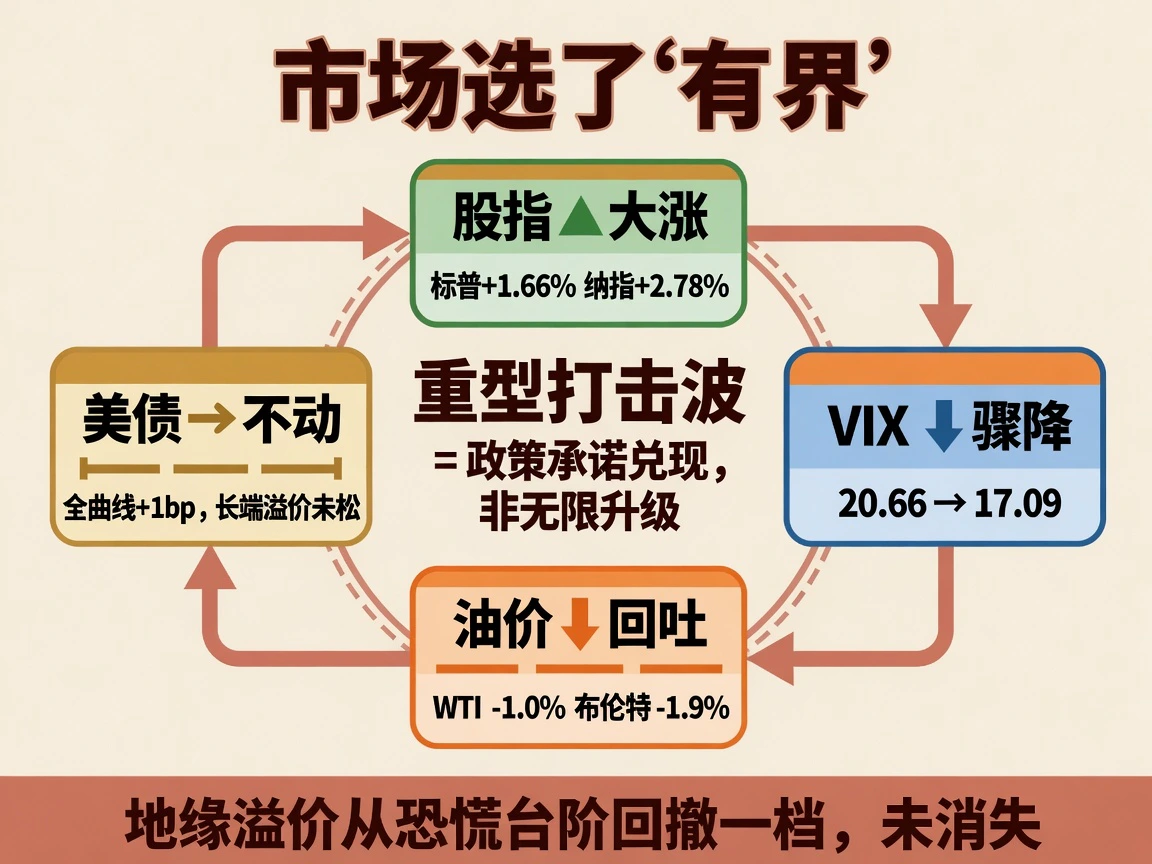
On July 30, the market's geopolitical focus shifted from when retaliation would take place to whether the intensity after the strikes could be contained. Asset prices suggested investors viewed the operation as limited, with defined targets and a manageable scope.
US Central Command confirmed strikes on multiple Iranian targets on the evening of July 29 Eastern time. They covered dozens of nodes, including Islamic Revolutionary Guard Corps command centers, missile and drone bases, coastal radar facilities and maritime forces. Iran fired ballistic missiles toward Jordan the same day, with Jordanian air defenses intercepting 5. Debris struck a Chinese-owned company's facility in northern Kuwait and caused casualties, demonstrating that spillover risks had extended to third-country territory and institutional assets.
The contest over Hormuz also extended to its rules. The US Treasury imposed another round of sanctions aimed at cutting off Iran's mandatory insurance and toll-collection networks for passage through the strait. Iran continued to reject an Oman-mediated regional co-management proposal, insisting on effective control of the key waterway.
Across markets, rebounding equity indexes, lower oil and falling VIX showed that investors interpreted the concentrated strikes as delivery of military deterrence rather than the beginning of endless escalation. Treasury yields nevertheless edged higher across the curve, indicating that rates had not fully cleared geopolitical risk: inflation and supply constraints remained. The geopolitical premium had narrowed from its emotional peak, but had not materially disappeared.