On July 31, the policy repercussions of the Fed's July meeting became apparent together. Three regional Fed presidents who had dissented in favor of a hike issued formal statements on the same day, while St. Louis Fed President Alberto Musalem explicitly backed tightening in a Financial Times interview. Meanwhile, reports said Chair Kevin Warsh was discussing reducing the number of regular annual meetings from 8 to 6. As policy differences became public, all three economic releases that day showed persistent strength at elevated levels, pushing the 30-year Treasury yield to a close above 5.27%, its highest since 2007. Interest-rate futures raised the implied probability of a September hike to about 66%.
Economic data: Inflation remains elevated and sticky, with no slowdown in wage costs
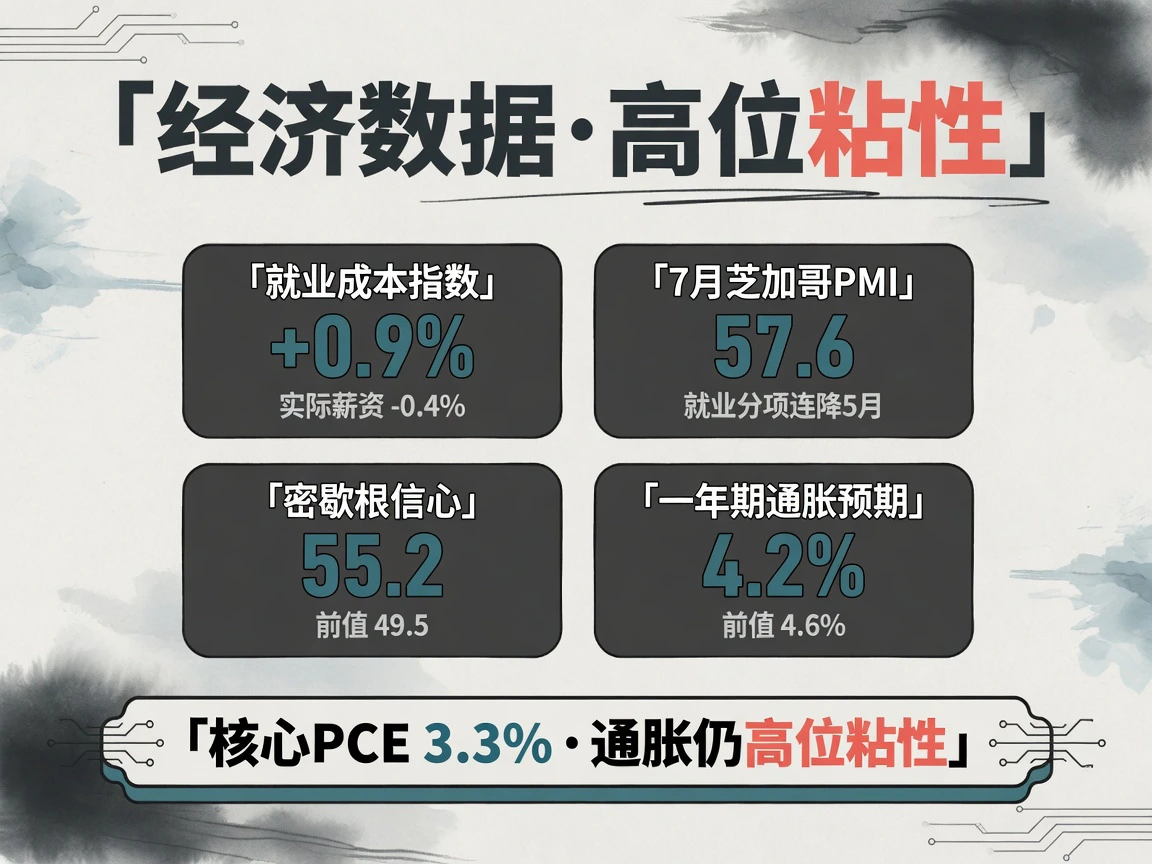
Three releases on July 31 pointed to the same reality: inflation pressures had not eased materially, and labor costs remained elevated.
Second-quarter Employment Cost Index: Total compensation rose 0.9% quarter over quarter, unchanged from the previous quarter and slightly above the expected 0.8%; the annual increase was 3.4%. After inflation, private-sector real wages fell 0.4% year over year. The ECI, the Fed's most closely watched wage-cost measure, gave no sign of slowing. Nominal wage gains continued to catch up with prices, supporting underlying inflation persistence.
July Chicago PMI: The reading of 57.6 exceeded June's 56.7 and market expectations. New orders reached their highest level since early 2022, but employment remained in contraction for a fifth consecutive month. The divide between strong production activity and shrinking corporate employment persisted.
Final July University of Michigan consumer sentiment: The index rose markedly to 55.2 from June's 49.5. Respondents' one-year inflation expectations fell from 4.6% to 4.2%, while five-year expectations held at 3.3%. Although expectations eased, their absolute level remained significantly elevated.
Together with the earlier June PCE report—headline inflation of 3.7% year over year and core inflation of 3.3%—and the advance second-quarter GDP estimate—annualized quarterly growth of 1.5%, including 3.9% growth in private final sales—the recent run of data offered little convincing evidence that inflation was smoothly returning to 2%.
Policy meetings: Eight annual meetings could become six

July's FOMC held rates unchanged by a 9–3 vote, the first meeting with three dissenters since 2016. The subsequent discussion of institutional reform and the forthcoming calendar became new variables for markets.
Three focal points for the minutes: The Fed's official calendar confirms that July's FOMC minutes will be released on August 19. Attention centers on three issues: the specific arguments for a hike advanced by the three dissenting presidents and the extent of internal support; progress in the five policy task forces established under Warsh; and whether discussion of fewer regular meetings formally appears in the minutes.
Jackson Hole focuses on the macroeconomic framework: The Kansas City Fed's annual symposium will take place on August 27–29 under the theme of the implications of financial innovation for payments and policy. Warsh previously said his speech was still a blank sheet of paper. Markets expect the emphasis to be on the medium- to long-term institutional framework, rather than explicit guidance on near-term policy.
Discussion of fewer policy meetings: According to The Wall Street Journal and The New York Times, Warsh asked colleagues at the latest meeting to consider reducing the regular FOMC calendar from 8 meetings annually to about 6. This remains an internal discussion. The current eight-meeting schedule dates from 1981, whereas the statutory requirement is only at least 4 meetings a year. Warsh has experience with similar reform: his 2014 review of the Bank of England recommended reducing its annual meetings from 12 to 8, a change implemented in 2016. He said press conferences would continue after the remaining meetings in 2026, but the longer-term arrangement was undecided. Cautious observers warn that fewer meetings could concentrate too much positioning and expectation risk in each decision, magnifying market volatility.
Vice Chair Michelle Bowman is also scheduled to attend an online discussion on August 8; the detailed agenda has not yet been released.
What officials said: Three dissenters spell out their hawkish positions

On July 31, the three dissenting regional Fed presidents issued formal post-meeting statements on the same day, explaining their hawkish arguments in detail.
- Beth Hammack, Cleveland Fed: Inflation has remained elevated for too long, and she does not believe it will return to the 2% target on its own. Beyond external supply disruptions, she stressed demand-side pressures. Business contacts reported pricing pressures spreading rather than fading, indicating that monetary policy was plainly insufficiently restrictive on aggregate demand.
- Lorie Logan, Dallas Fed: Inflation expectations risk becoming anchored in the mid-2% range rather than at 2%, and upside risks remain prominent. From employment and personal consumption to broader financial conditions, policy has not meaningfully constrained the economy. A modest increase now could effectively reduce the likelihood of being forced into greater tightening later.
- Neel Kashkari, Minneapolis Fed: He listed successive supply shocks from the pandemic, geopolitical conflict, tariffs and the Middle East situation, compounded by additional demand from AI infrastructure investment. Drawing on the stagflation experience of the 1970 s, he argued that monetary policy must not retreat in the face of persistent supply shocks. Small, gradual tightening is preferable to hesitation that eventually forces larger moves.
Meanwhile, St. Louis Fed President Alberto Musalem, a nonvoter this year, reinforced the case for action in a July 31 Financial Times interview. He called the week's sharp selloff in long-term Treasuries a clear signal from Mr. Market, emphasizing that the Fed must earn policy credibility through clear communication and decisive action. Early, small and gradual rate adjustments now would be preferable and less costly than delayed, larger and more abrupt hikes forced on it later. Musalem also rejected criticism that the Fed was outsourcing decisions to markets, saying Congress had never assigned responsibility for price stability to financial markets. This was an unusually explicit correction to the idea that market pricing alone should force policy decisions.
Politically, an August 1 Associated Press analysis argued that the rate-cut expectations Trump had pushed for suffered a material setback. Higher long-term yields drove 30-year mortgage rates to about 6.66%, while hike risk became the dominant market theme. Although Council of Economic Advisers Chair Kevin Hassett reiterated confidence in Warsh on July 30 and stressed respect for Fed independence, tensions between politics and policy were intensifying in advance of September's meeting.
Market pricing: Thirty-year yield reaches a nineteen-year high
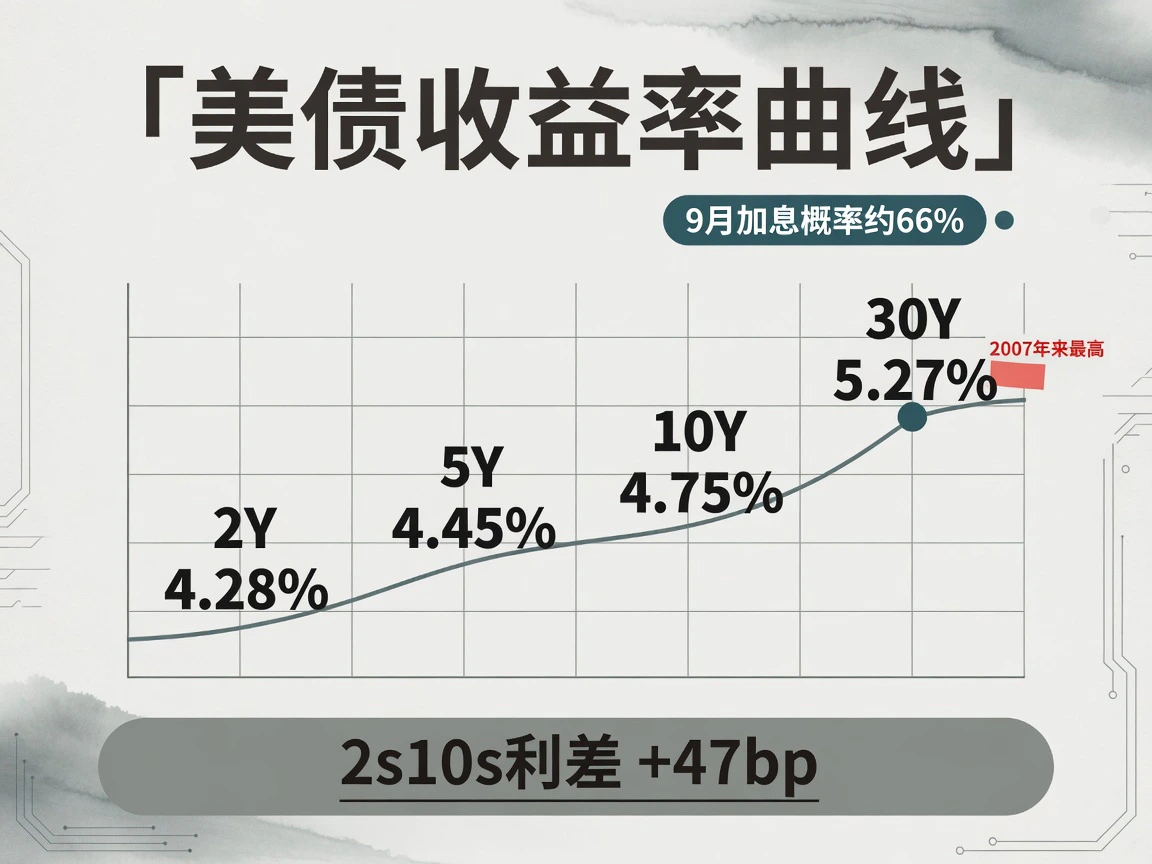
The US Treasury's official daily par curve, on a close-to-close basis, showed yields rising across the curve on July 31: 2-year 4.28%, up 5.0 basis points; 5-year 4.45%, up 7.0; 10-year 4.75%, up 7.0; and 30-year 5.27%, up 6.0. The 30-year close was the highest since 2007, with its intraday peak approaching 5.28%. The 2s10s spread widened further to +47 basis points, a typical bear steepening.
Deadline snapshot for reference: the period after the reviewed trading day was a closed-market weekend. CNBC's terminal showed the 2-year at 4.262%, 10-year at 4.718% and 30-year at 5.267% at 17:05 Eastern on July 31. Differences in measurement account for the slight divergence from Treasury's end-of-day data.
September hike pricing rose to about 66%: Officials' comments and persistent data materially shifted federal funds futures pricing. At about 00:35 Eastern on August 1, following a post-close recalculation, Investing.com's Fed Rate Monitor, based on CME 30-day rate futures, put the probability of a September 25-basis-point hike to 3.75%–4.00% at 65.9%, with hold odds down to 34.1%; the prior-day and week-earlier comparison readings were 60.4% and 54.5%, respectively. MacroMicro's tracked FedWatch measure likewise rose to 67.0%, compared with about 61% immediately after the July 29 meeting. The policy-sensitive 2-year Treasury yield held near 4.3%, closely consistent with current hike pricing.
Historically, the last policy meeting at which three regional Fed presidents collectively favored a hike—Esther George, Loretta Mester and Eric Rosengren—was September 2016. The committee subsequently raised rates in December of that year. Such organized internal dissent often provides an important early signal of the next policy action.
Before the September 15–16 FOMC decision, markets face a dense calendar of catalysts: the July and August payrolls and CPI reports, the August 19 minutes and the August 27–29 Jackson Hole symposium. Continued slowing in monthly inflation and a marked decline in wage growth would substantially cool September hike expectations. Conversely, if Brent above $90 a barrel keeps feeding into core and services prices, the roughly 66% hike probability could ultimately become reality.


