On July 31, 2026, the third trading day following the Fed's hold, Treasuries sold off across the curve. Two- through 30-year yields rose 5–7 basis points, with the 30-year closing in its highest range since July 2007. The week completed a cycle from pre-meeting relief to a post-meeting twist and then deep repricing across maturities, with long-end-led bear steepening particularly clear. Cloud earnings narrowed U.S. equity losses, but breadth remained fragile. Korea's exceptional daily surge reflected AI cloud monetization; oil was strong monthly, weak weekly and up daily, while higher Treasury rates weighed on gold.
Weekend statements on conditionally canceling strikes briefly pulled electronic oil back toward $80, but this reflected immediate headlines. The week's major employment releases would provide the hard directional test for the curve.
Treasuries: another broad selloff puts the 30-year at its highest since 2007
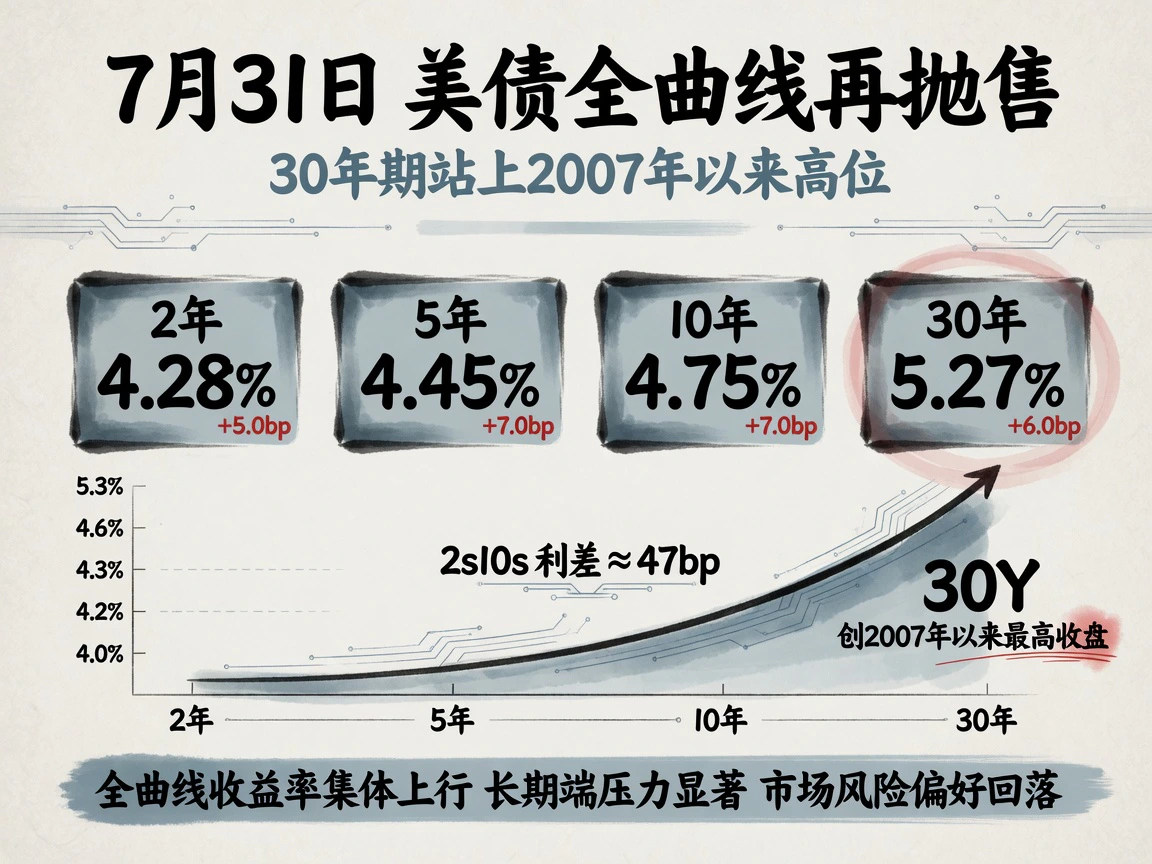
Official July 31 Treasury closes were two-year 4.28% (+5.0 bp), five-year 4.45% (+7.0 bp), ten-year 4.75% (+7.0 bp) and 30-year 5.27% (+6.0 bp). The two-/ten-year spread widened from 45 to about 47 bp, shifting from the initial post-meeting short-end dip and long-end rise into mild bear steepening. The 30-year rose for three sessions and closed in its highest range since July 2007. Trading Economics and FRED history placed its last sustained period above 5.2% just before the subprime crisis.
Friday's renewed selling completed the weekly repricing. The two-year slipped from 4.31% to 4.28%, down three bp for the week, while five-, ten- and 30-year yields rose five, ten and 15 bp. The two-/ten-year spread widened from +34 to +47 bp; the very long end's gain was 1.5 times the ten-year's, while weekly breakeven inflation rose from 2.21% to 2.28%. Friday's seven-bp ten-year jump was 70% of its weekly increase, and the two-year's five-bp rebound largely erased post-meeting relief. Front-end investors were again paying for additional tightening around September, though the two-year remained below July 23–24 highs, short of fully pricing an aggressive cycle.
Three forces drove the move: Friday's written arguments from three dissenters, hawkish Musalem remarks in the Financial Times, and stronger-than-expected Chicago PMI alongside oil gains above 1%. The ten-year nominal yield rose seven bp but its breakeven only one bp to 2.28%, leaving most of the increase to real rates and term premiums. Credit largely tracked duration: LQD fell about 0.15% and HYG was flat, a rate shock with stable credit risk. Heavy hyperscaler issuance, wider secondary spreads and lower subscription coverage nevertheless left supply pressure unresolved.
After hours through the morning August 3 Beijing-time cutoff, quotes eased moderately. CNBC showed two-year 4.25%, ten-year 4.70% and 30-year 5.24% at 21:08 Eastern on August 2; main Treasury futures rebounded slightly from Friday settlements. Immediate weekend geopolitical relief drove these moves, with actual direction still needing Monday August 3 cash-market confirmation.
Macro: FOMC dissent becomes public as September hike expectations rise
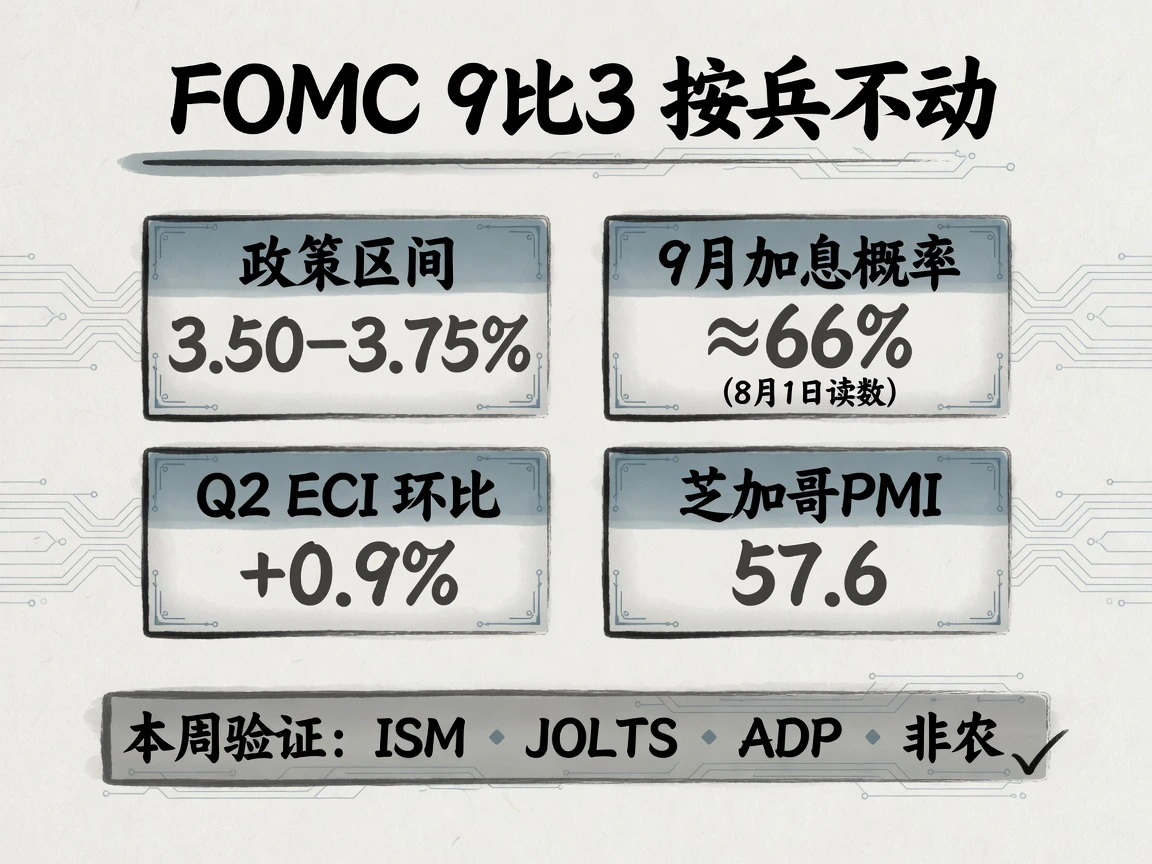
The weekly narrative moved from geopolitical energy premiums lifting term premium to public FOMC divisions, reinforced by sticky inflation and hawkish dissenters. On Wednesday July 29, a nine-to-three vote held 3.50%–3.75% for a fifth consecutive meeting, with an unusual three voters seeking 25 bp of tightening. The statement acknowledged supply shocks lifting some prices, but Powell blurred forward guidance at the press conference, initially producing a twist with easier short rates and long-end pressure.
Thursday July 30 brought preliminary second-quarter GDP of +1.5% annualized, below the roughly +2.1% consensus, alongside June PCE. Despite slower aggregate growth, private domestic final purchases grew 3.9%, showing resilient demand, while annual core PCE at 3.3% remained well above 2%. Friday July 31's second-quarter ECI rose 0.9% quarterly versus 0.8% expected and 3.4% annually, resilient but not uncontrolled wages and insufficient alone to explain the selloff. Chicago PMI at 57.6 versus 56.0 expected, with multiyear-high orders, directly confirmed strong demand and ignited concern.
Officials' concentrated remarks drove repricing. Cleveland's Hammack said now was the time to act and doubted automatic disinflation. Minneapolis's Kashkari favored a 25-bp increase and earlier small steps. Dallas's Logan said labor, consumption and easy financial conditions showed insufficient policy restraint. Even nonvoting St. Louis President Musalem called for earlier, smoother tightening to preserve credibility. Reported September hike odds briefly reached 60%–70%, though they reflected that moment's sentiment and softened somewhat as weekend yields eased.
The week's tests were July ISM manufacturing on August 3, JOLTS on August 4, ADP and ISM services on August 5, and July payrolls on August 7. With June gains only 57,000 and major prior revisions, payrolls would distinguish temporary distortion from a weakening trend. Stronger figures would reinforce September hikes and further bear steepening; weak numbers could quickly revive curve-reversal trades. Later windows were August 26 PCE second revisions and revised GDP, August 27–29 Jackson Hole and the next FOMC in mid-September.
Commodities: oil strong monthly, weak weekly and up daily; rates pull gold lower
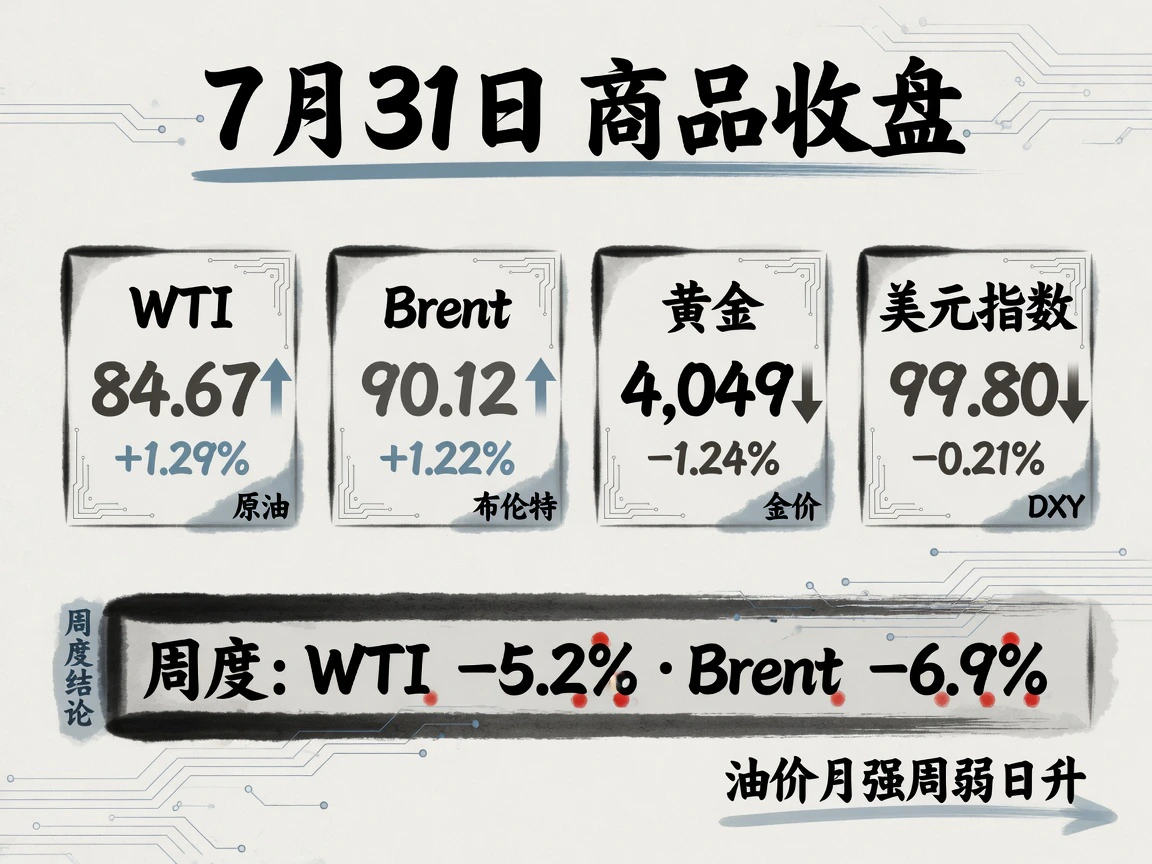
Oil traced a deep V. Monday–Tuesday de-escalation and navigation hopes stripped premiums, taking WTI from the prior Friday's near $89 below $79 and Brent from around $97 to $84. Wednesday's renewed air strikes and passage risks, plus a larger-than-expected EIA commercial draw of 7.17 million barrels in the week ended July 24, lifted prices 6%–8% in a day. Thursday consolidated, and Friday Iranian vessel-attack claims drove another gain above 1%.
For the week, WTI fell 5.2% to $84.67/barrel and Brent 6.9% to $90.12, yet they recovered about 6.8% and 7.2% from their weekly lows. July gains remained around 20%, the strongest month in three. July 31 thus combined monthly strength, a weekly correction and daily gains: WTI +1.29% to $84.67 and Brent +1.22% to $90.12. Their spread stayed around $5.45, with synchronized repricing.
Iran claimed the Guard intercepted and struck two U.S.-escorted tankers and forced four other vessels back. U.S. and British maritime agencies had not independently confirmed this, while Kpler showed occasional large tankers passing rather than a physically sealed channel. The trade was a persistent shipping surcharge from friction. Houthi Red Sea restrictions continued, London insurers expanded high-risk waters and a Saudi-led 14-country escort alliance was announced, with actual protection and insurance relief untested. Gold followed real-rate pricing: main COMEX futures settled at $4,049/ounce (-1.24%) as two- and ten-year yields climbed. DXY slipped 0.21% to 99.80 but gold still fell, confirming rates rather than dollar strength as the main pressure.
By 08:59 August 3 Beijing time, electronic WTI was near $80.70, about 4.7% below Friday, responding to weekend talk of resumed negotiations and conditional cancellation of strikes. This was immediate electronic headline pricing pending physical-market validation, distinct from Friday's settlement move. Gold futures meanwhile recovered modestly toward $4,112.
Equities: cloud earnings support indices, while breadth and Asian transmission reveal risks
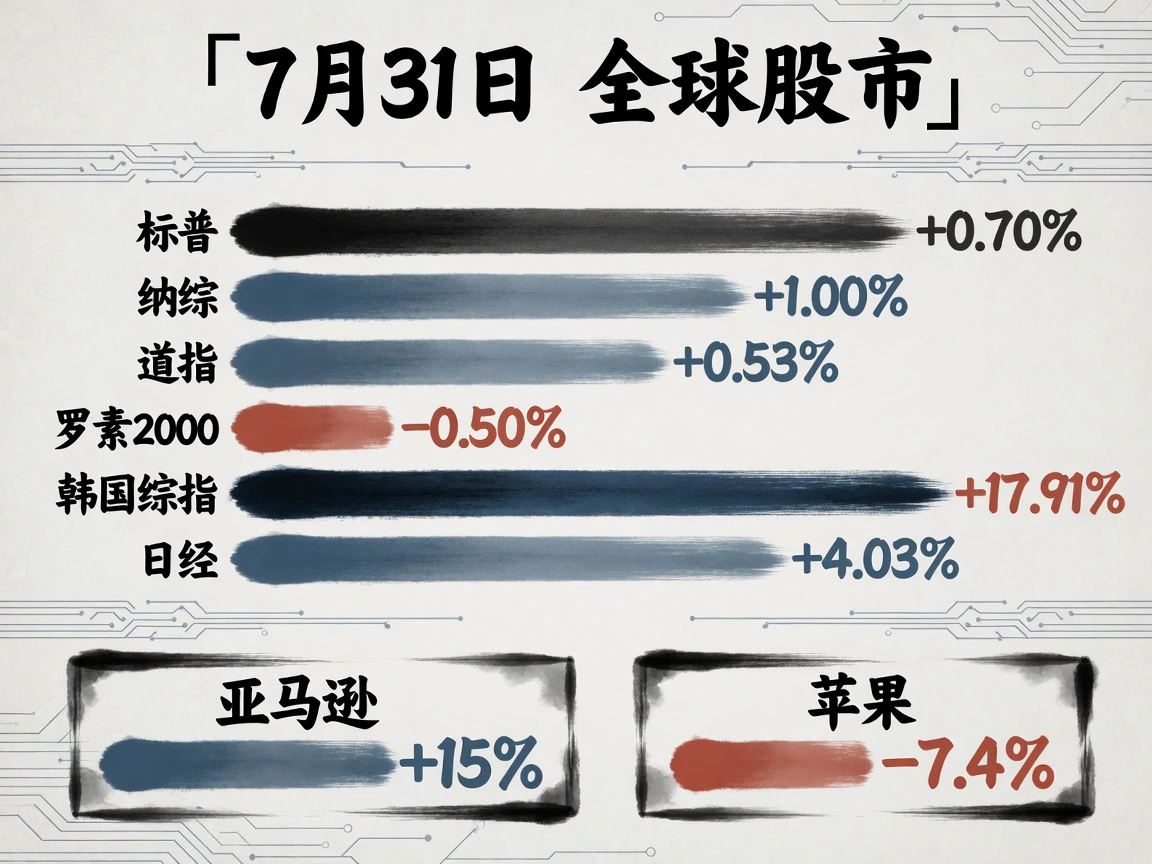
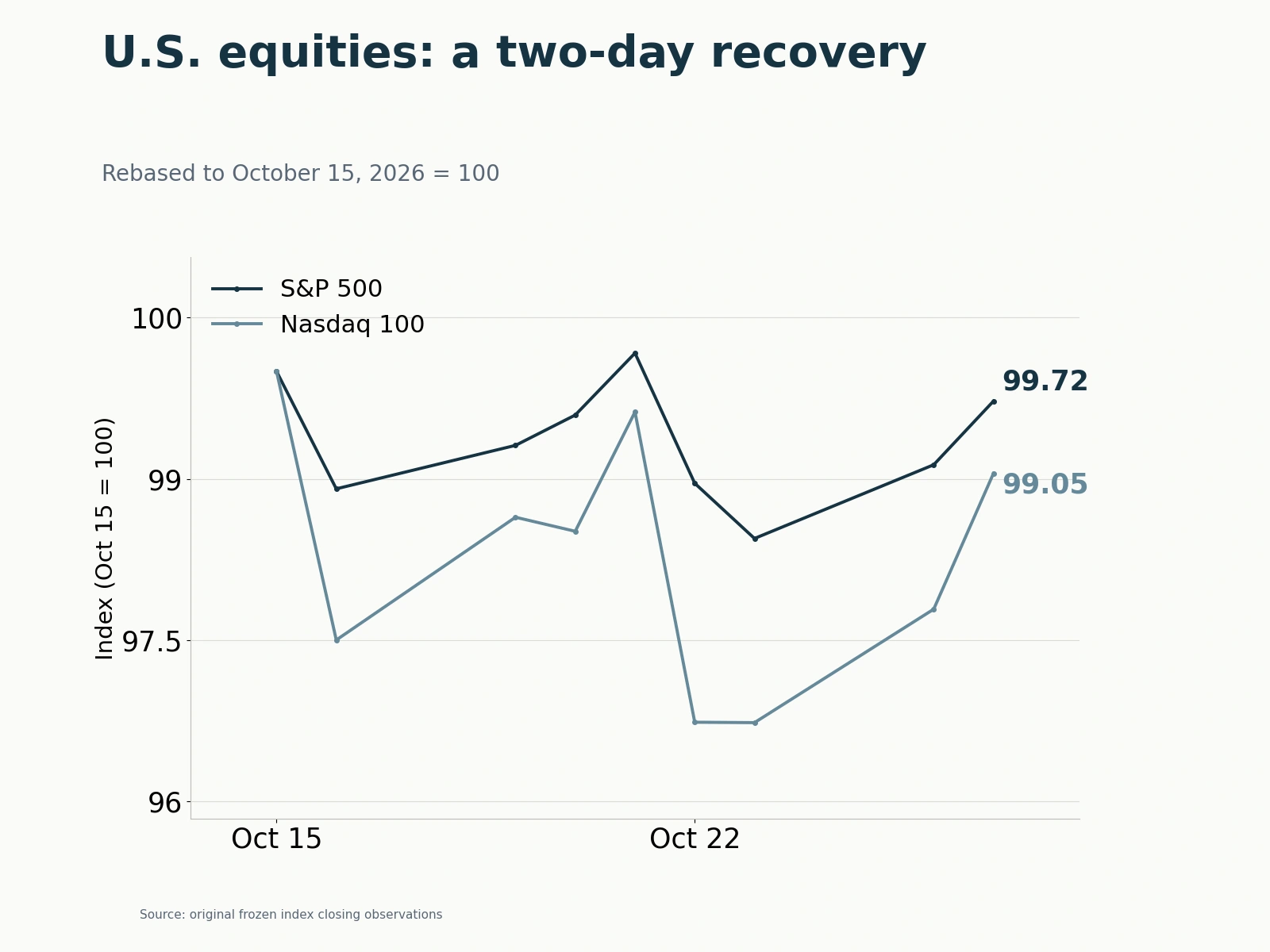
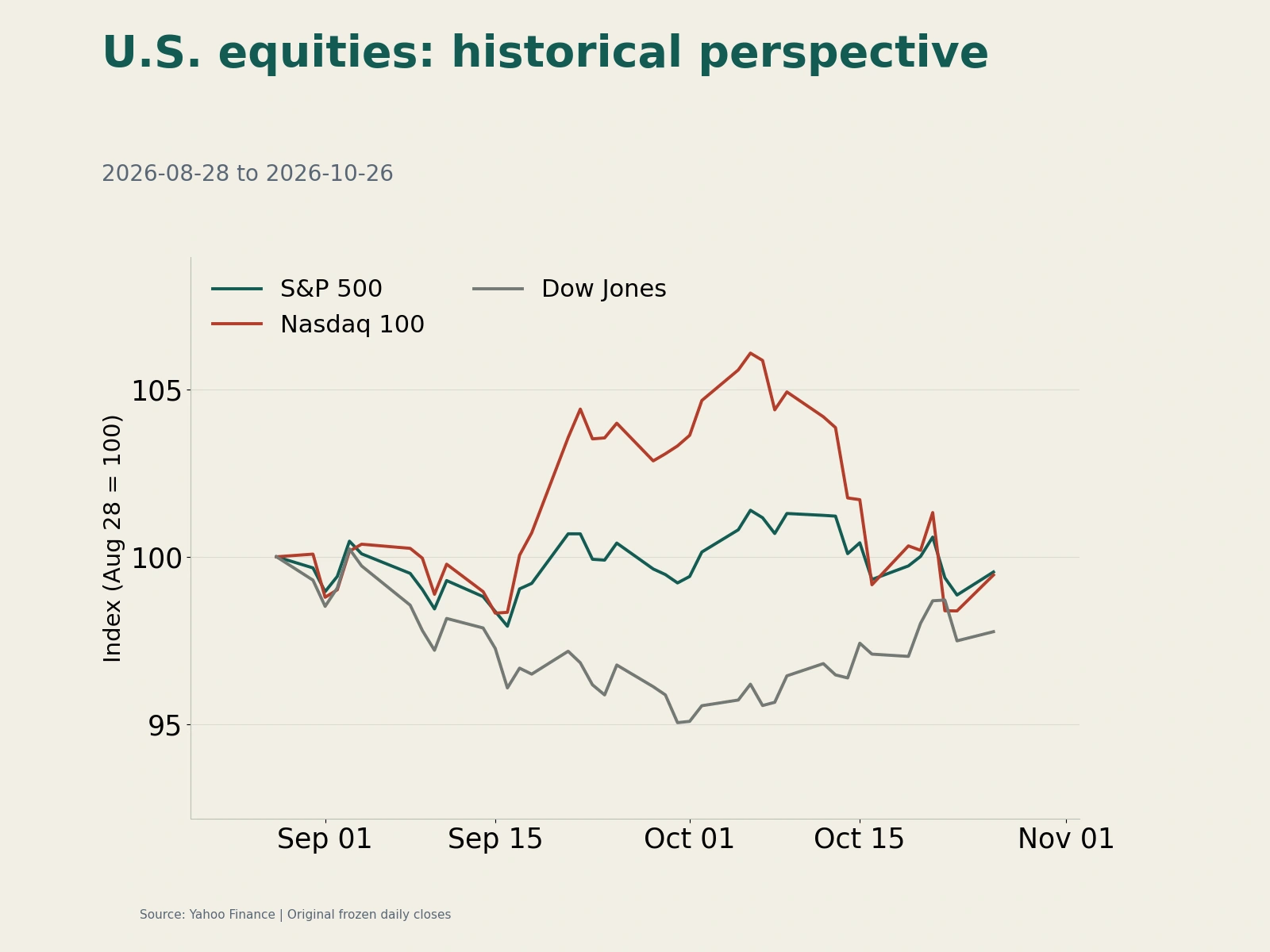
Two themes dominated the week: whether AI capex lacked returns, with Wednesday Microsoft/Meta and Thursday Amazon/Apple results revealing differences; and anti-inflation resolve compressing valuations, including a Wednesday 1.5% S&P 500 decline to its weekly low of 7,316. Weekly totals were S&P 500 +1.05% to 7,489.72, Nasdaq Composite +1.59%, Dow +1.04%, Russell 2000 flat and VIX -13.94% to 15.99. Gains concentrated in earnings-validated cloud leaders: Microsoft about +22%, Amazon +17%, Alphabet +11%, versus Meta -6% and Apple -7%. July's S&P 500 was broadly flat and Nasdaq down around 3%, leaving a sustained monthly recovery unfinished.
July 31 was dominated by validation of cloud profitability without universally stronger appetite. S&P 500 7,489.72 (+0.70%), Nasdaq Composite 25,373.85 (+1.00%), Dow 52,485.03 (+0.53%), Russell 2000 2,931.34 (-0.50%); VIX 15.99 (-6.44%). S&P 500 decliners outnumbered gainers about 1.3 to one. Technology fell 0.5% under Apple's weight, while Amazon's consumer discretionary sector rose 6.1%. Amazon surged nearly 15%: AWS revenue was $42.2 billion, up about 37%, and full-year capex guidance rose near $220 billion. Investors rewarded demand exceeding supply without yet penalizing persistently negative free cash flow. Apple fell 7.4%: profit slightly beat but revenue guidance missed, with supply-chain and memory-cost constraints weakening shipment expectations. Microsoft added about 3% after Thursday's 15%. The Philadelphia Semiconductor Index rose just 0.07%, failing to match Asia's hardware rebound.
Asia was the strongest sentiment amplifier. KOSPI surged a record 17.91% Friday to 6,595.45; Samsung gained 26.8% and SK Hynix nearly 30% to its limit, with foreign buying and retail profit-taking. Yet Korea still lost roughly 22% in July and nearly 30% from June highs, making Friday an extreme oversold rebound on U.S. cloud results. Nikkei 225 +4.03% to 64,362; Hang Seng only +0.10%, disconnected from Japanese and Korean chips. USD/JPY closed at 160.18, a 1.91% yen gain, and USD/KRW at 1,420.60.
At 09:08 August 3 Beijing time, U.S. cash equities were closed but Japan and Korea were trading: Nikkei around -2.1% to 63,026 and KOSPI -4.3% to 6,309, giving back Friday's unusual impulse. ES and NQ futures instead gained 0.5%–0.7%, showing time-zone divergence. The yen reached around 156.1, roughly four further points stronger than Friday, potentially affecting exporters' earnings and global liquidity.
Geopolitics: ceasefire rhetoric suppresses premiums, but restricted passage remains priced

The week moved from rapidly priced de-escalation to renewed multi-point conflict and Friday's reintroduced event premium without broad equity panic. Monday–Tuesday normalization hopes caused the largest oil losses. Midweek, the Houthis announced Saudi restrictions, a Damietta drone attack set an LPG carrier ablaze and London insurers widened high-risk waters. Friday was a partial rebound. Weekly oil losses of 5%–7%, stock gains and falling VIX showed markets treating friction as a continuing supply-chain tax rather than systemic supply rupture.
Friday's cash and commodity trading included Iranian claims of striking two U.S.-protected tankers and turning four back, unconfirmed by U.S. or British agencies. Actual sporadic large-tanker and cargo transits showed Hormuz far below normal without complete closure. In protectionism, Section 232 patent-drug tariffs took effect for the first large multinationals at 00:01 Eastern July 31: a 100% baseline with exemptions tied to reshoring and drug-price discounts, a slower medium-term variable. Russia secondary-tariff legislation passed a Senate procedural vote 86–12, but with the House recessed until August 31, enactment remained distant.
Post-close focus shifted to conditional ceasefire bargaining. U.S. social and onboard statements said operations were ready but canceled because a core framework had been agreed, with full Hormuz opening and complete elimination of Iranian nuclear capability as conditions. Washington said Israel agreed and talks would resume Monday afternoon. Iranian official and military spokesmen denied seeking a ceasefire and said Hormuz could never return to prewar normal. UKMTO reported two incidents off Oman, including projectile damage to a tanker; Kuwait intercepted an Iranian-direction drone. Iran warned of symmetric retaliation against Saudi/UAE oilfields and Qatari/Israeli gasfields if its energy facilities were hit. Most remained statements, warnings and hypothetical conditions, without a legally signed agreement or normalized passage. Before the new week, talks pressured prompt oil premiums but failed hopes could produce a sharp repricing.