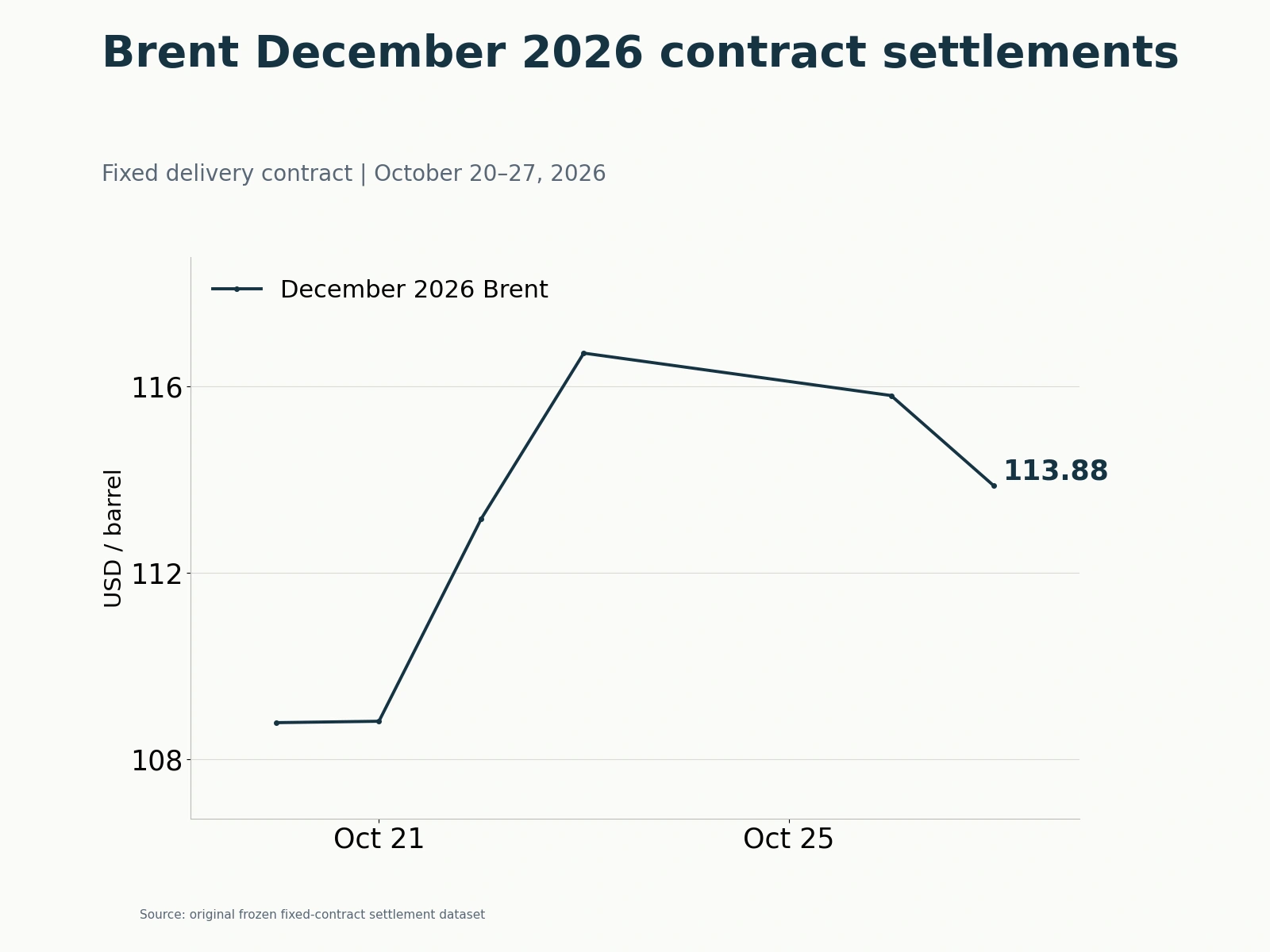
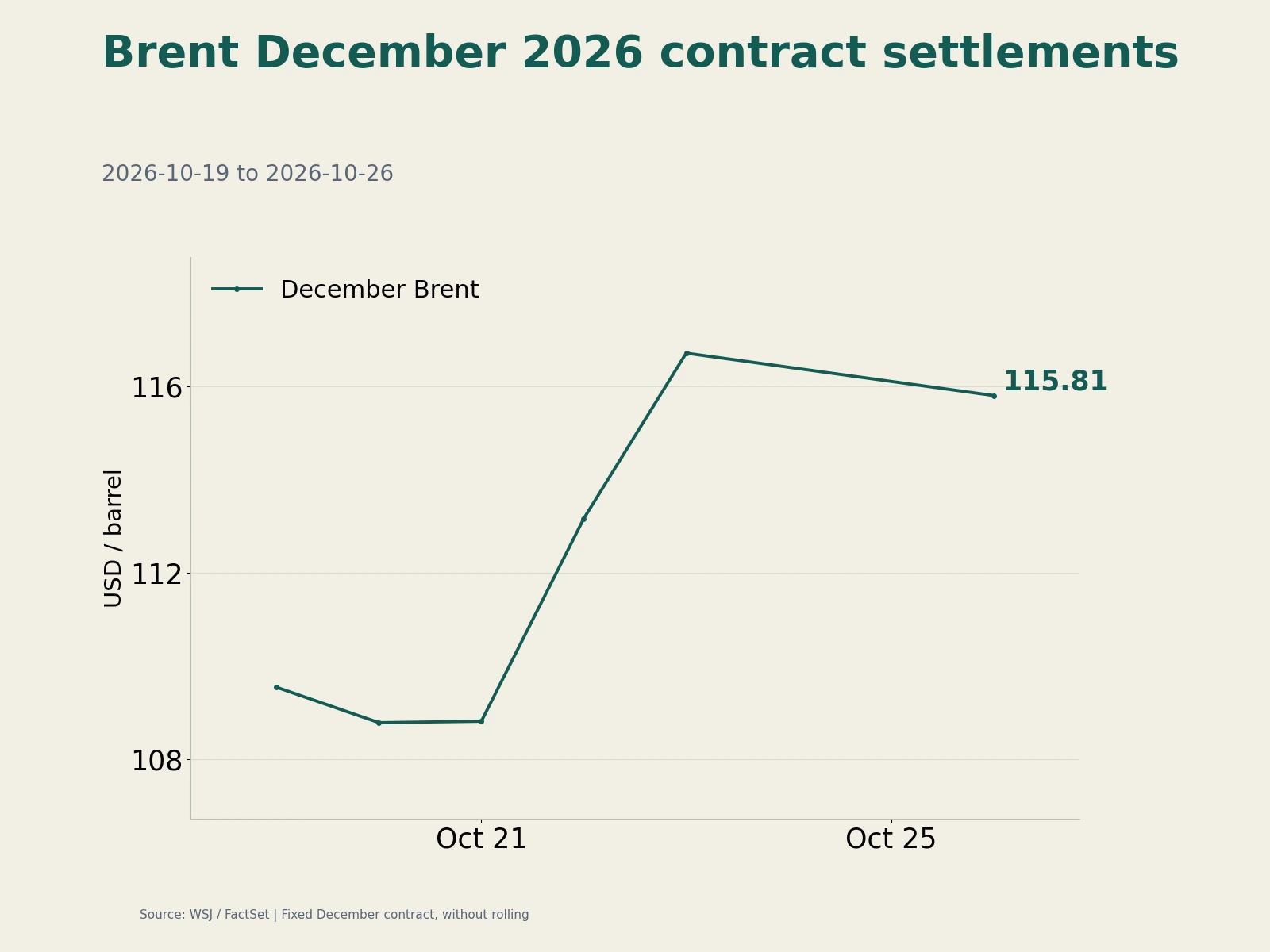
On July 31, 2026, crude closed moderately higher after sharp two-way trading, with Brent above $90. Both benchmarks nevertheless lost over 5% for the week, breaking July's advance. Weekend news changed abruptly: the US halted strikes, announced August 3 talks and OPEC+ confirmed planned September increases. Monday's Asian peace trade sent oil down nearly 5%, WTI below $81. Physical conditions did not ease in tandem: Hormuz traffic remained in very low single digits and freight and insurance at extremes. Markets front-ran peace expectations despite severe physical fundamentals.
Friday holds $90, but weekly losses exceed 5%
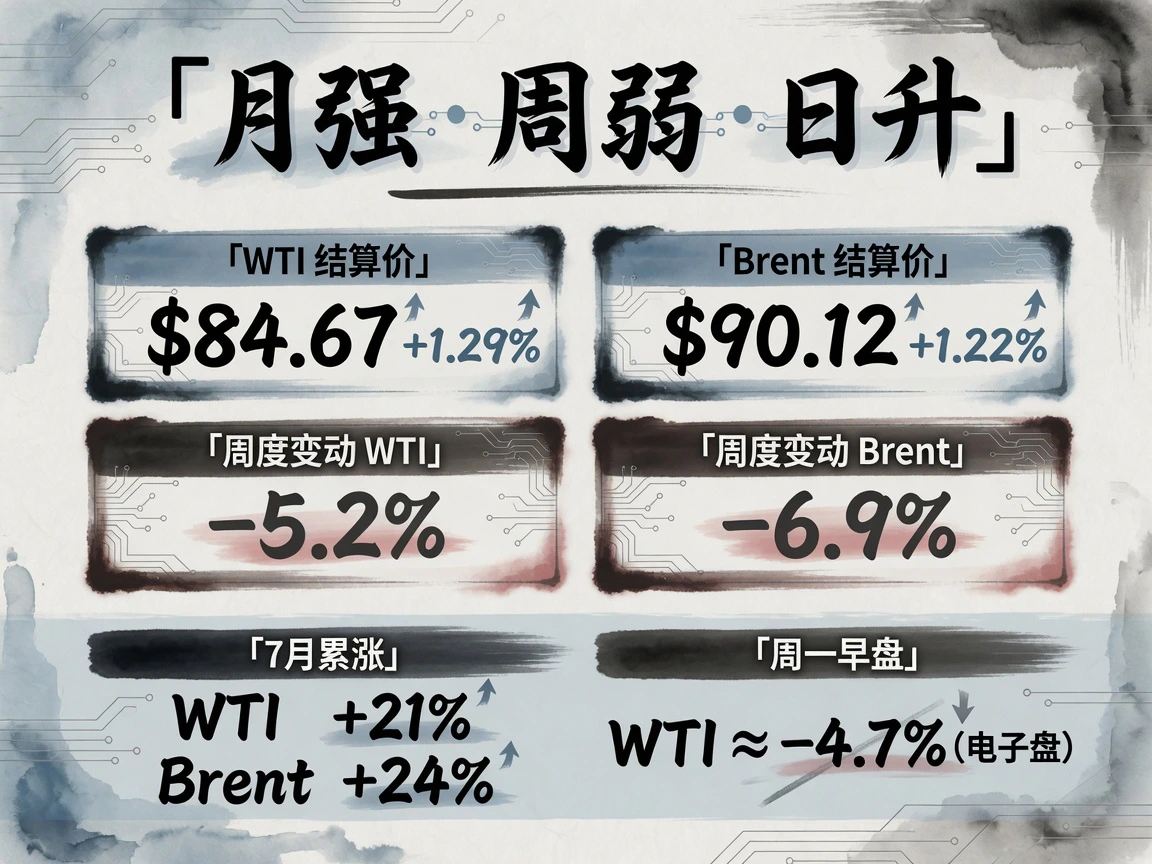
September WTI settled July 31 at $84.67/barrel, up $1.08 or 1.29%; September Brent at $90.12, up $1.09 or 1.22%. That Brent contract expired afterward, shifting Monday's nearby contract to October, whose Friday settlement was $87.93.
The week was turbulent. Monday fell on suspended US strikes; Tuesday reached weekly lows of WTI $79.26 and Brent $84.09. Renewed attacks and blockade news drove a 6.5%–7.9% Wednesday rebound, followed by Thursday profit-taking and Friday gains. Against July 24's $89.31 and $96.78, WTI lost 5.2% and Brent 6.9%. Even so, July gains were about 21% and 24% on Reuters' basis, the largest monthly increases since March.
At Monday's roughly 08:00–09:00 Beijing electronic snapshot, not a settlement, WTI traded around $80.66–80.70, down 4.7% from Friday, and October Brent $83.85–83.93, down 4.6%. Option fear remained crisis-level: OVX closed Friday at 63.04 after reaching 70.16 intraday.
Backwardation narrowed without reversing. Brent's September/October spread was about +$2.19 Friday. September WTI at $84.67 stood around $8–9 above December near $76–78. Brent–WTI held near $5.45.
Commercial stocks fall to a 2018 low as OPEC+ confirms September increases
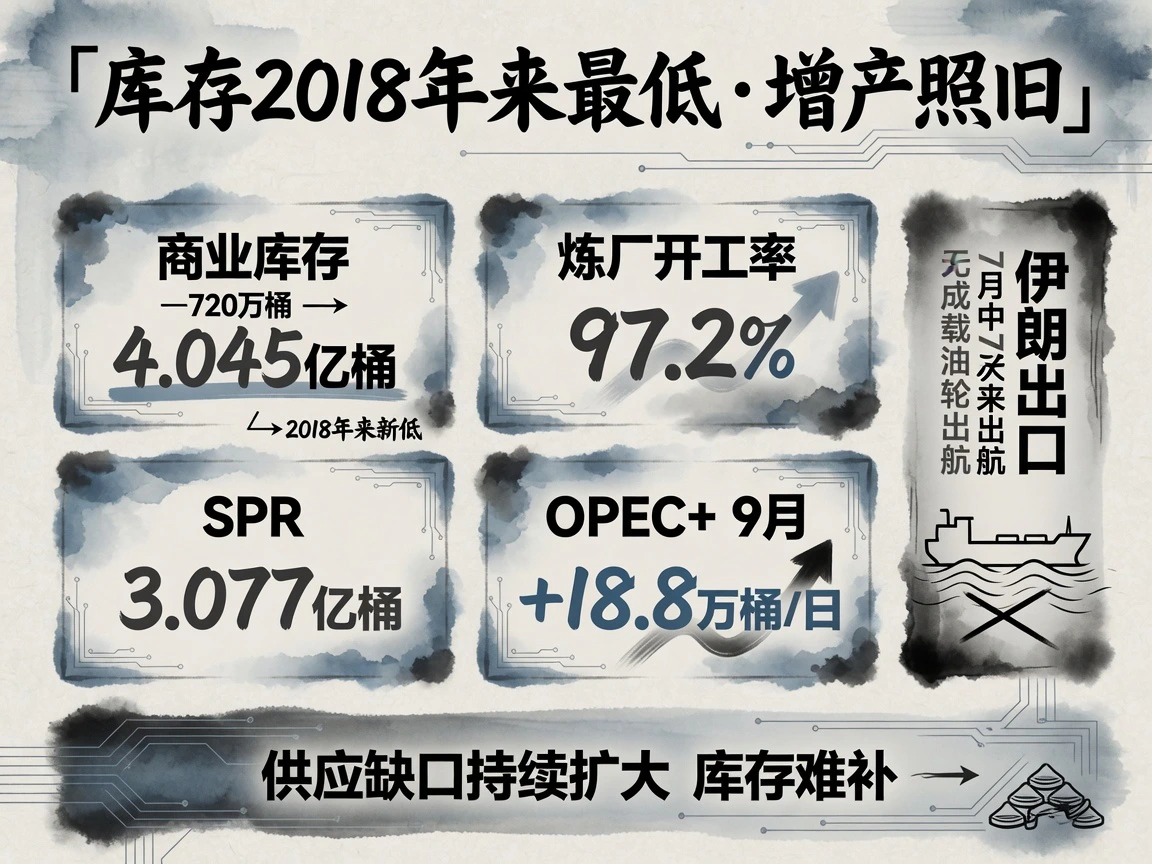
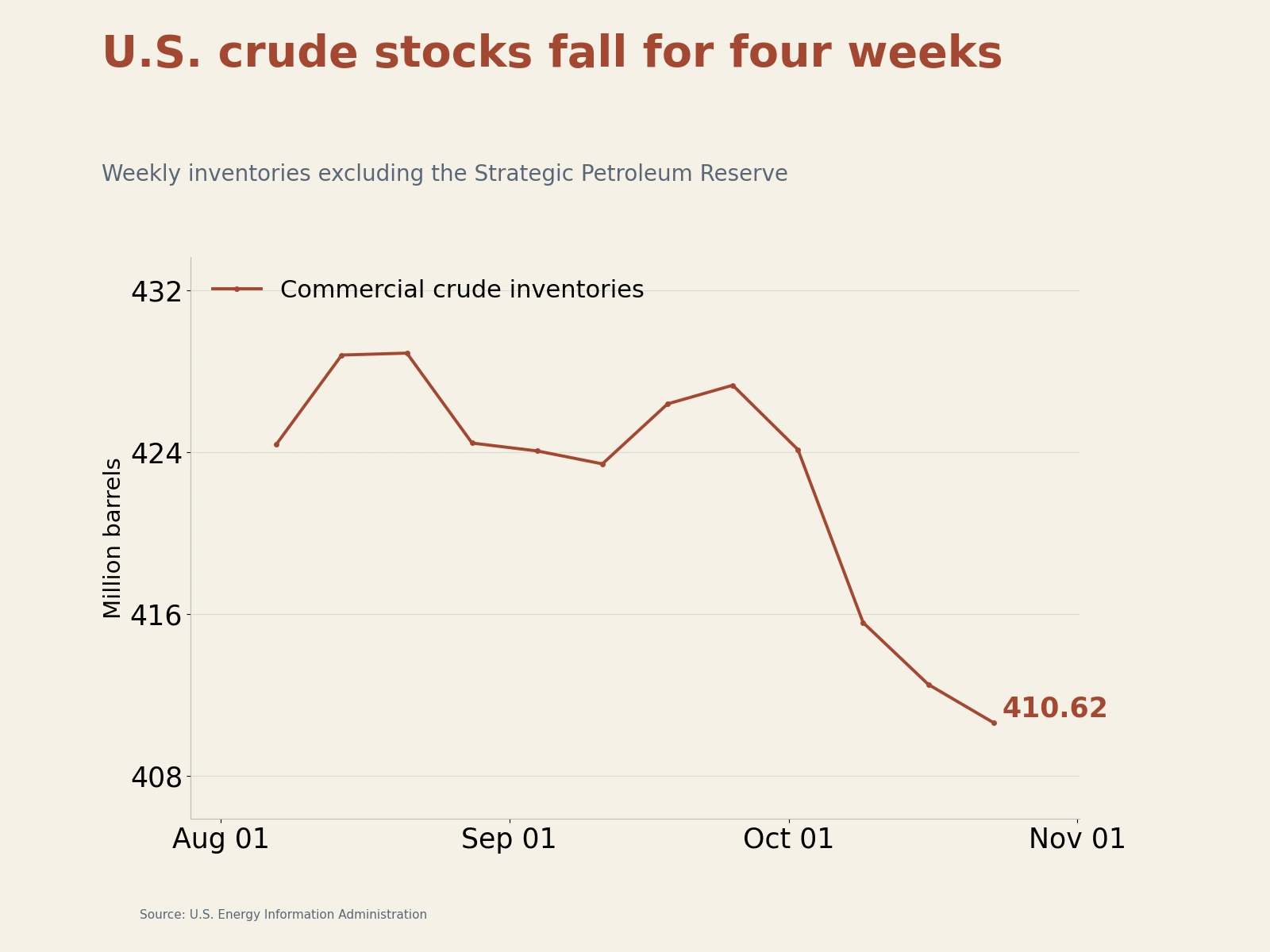
EIA's July 29 report for the week ended July 24 showed commercial crude down 7.2 million barrels to 404.5 million, the lowest since 2018 and around 6%–7% below the five-year average. Cushing was 18.6 million, below operational safety levels. Refinery utilization reached 97.2%, processing 17.3 million barrels/day; distillates rose 1.1 million. SPR fell 3.8 million to 307.7 million. The August 5 report, for July 31, would first fully capture the renewed blockade.
At their August 2 online ministerial meeting, seven core OPEC+ members—Saudi Arabia, Russia, Iraq, Kuwait, Kazakhstan, Algeria and Oman—confirmed a September quota increase of 188,000 barrels/day, completing the unwinding of 1.65 million voluntary cuts begun April 2023. Reuters had reported a possible pause afterward, but the official statement did not confirm it. The next monthly meeting was September 6 and JMMC October 4. Actual barrels remained uncertain under de facto Hormuz disruption.
US supply resilience remained firm. Baker Hughes July 31 data showed 451 oil rigs, up one, and 588 total rigs, also up one. May production was about 2% below April's peak, but recent exports set records on global arbitrage demand, according to Reuters.
Iran remained the most visible physical shortfall. UANI tracked June exports recovering near 1.76 million barrels/day, but after the July 14 blockade restart, no laden crude tanker had departed since July 12 and around 48 remained stranded. Full July tracking was pending. China imported 7.12 million barrels/day in June, down 41.3% year on year to its lowest since October 2016. Kpler expected July seaborne imports near 7.8 million. Shandong independents accelerated nonsanctioned spot purchases from Qatar, Iraq and the UAE as Iranian supplies stalled.
Weak dollar versus higher Treasury yields; falling oil seen as inflation relief
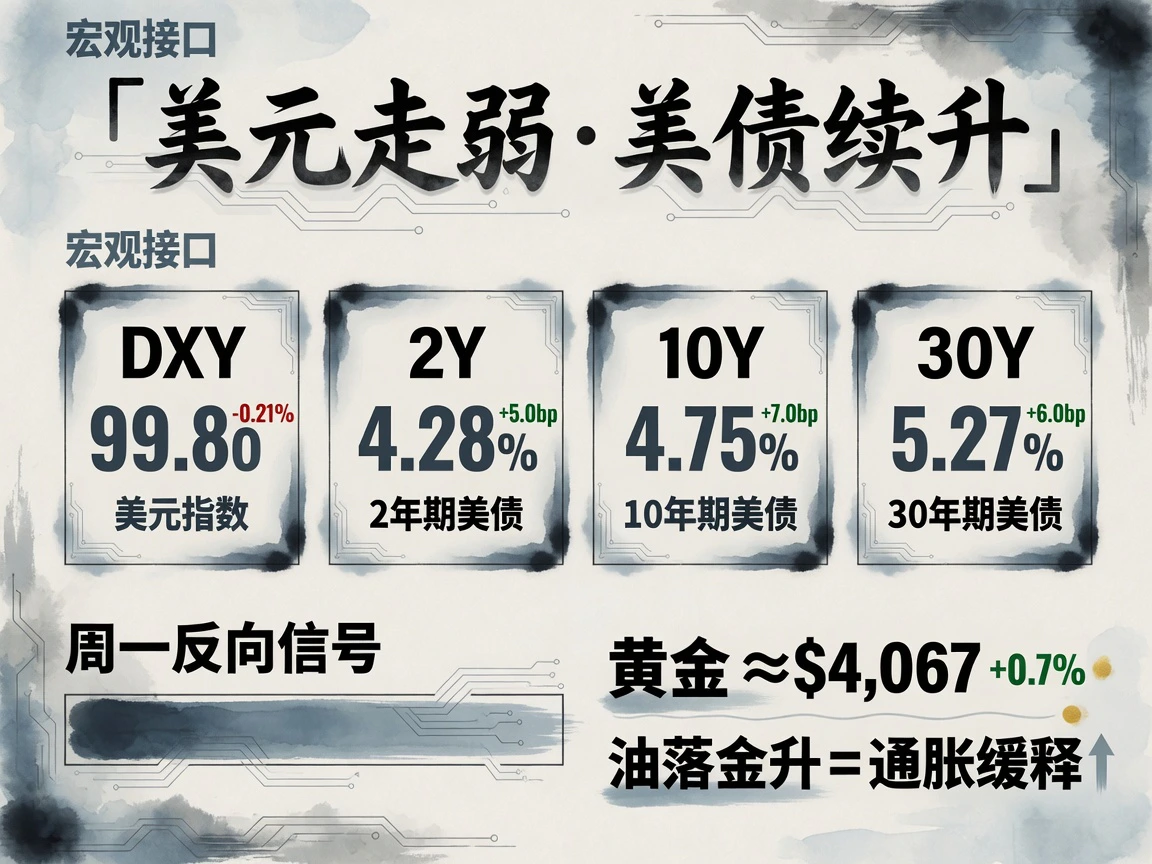
The macro backdrop had previously supported oil. DXY closed Friday at 99.80, -0.21%, then slipped near 99.60 Monday morning. Close-to-close Treasury yields rose across maturities: 2-year 4.28%, +5.0 bp; 10-year 4.75%, +7.0; 30-year 5.27%, +6.0.
Friday's simultaneous oil and yield increases showed supply shocks overriding normal discount-rate transmission. Monday Asia brought the opposite signal: Reuters put spot gold around $4,067, up 0.7%, while lower oil was interpreted as easing imported inflation. For allocators, crude shifted temporarily from uncontrollable inflation input to a tradable geopolitical pullback.
Canceled strikes and renewed talks cannot hide very low Hormuz traffic
On August 2, the US halted large-scale strikes, claimed a framework had been agreed and demanded immediate full Hormuz reopening, with talks resuming August 3. Iran immediately denied any agreed framework. Repeated failed ceasefires made markets relatively cautious about sudden peace hopes.
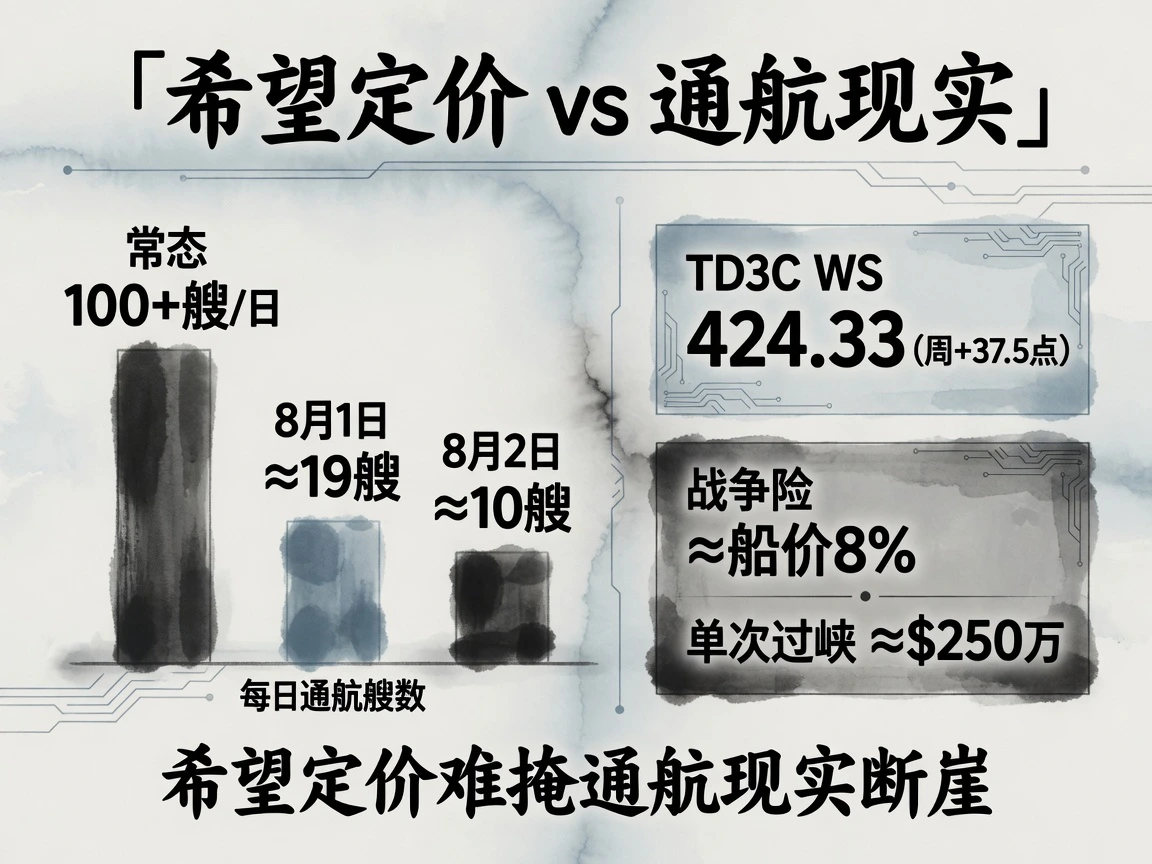
Politics and traffic remained disconnected. Windward showed around 19 passages August 1, while Shipfinder showed about ten August 2, still a fraction of normal daily traffic above 100 carrying around 20% of world oil trade, per EIA. Risks persisted: reports described an August 1 strike on an LNG ship carrying Qatari cargo during a dark transfer. Iran claimed two tankers destroyed on the southern route and others turned back; Western agencies had not independently verified it, but fear was evident.
Freight remained extreme. July 31 TD3C VLCC rates were WS 424.33, up 37.5 points on the week, with TCE near $423,000/day versus one-year charters around $100,000–$115,000. The gap showed recognition that spot rates were unsustainable, but owners would not risk passage before normalization. War insurance remained around 8% of hull value, an estimated $2.5 million per VLCC transit.
Red Sea blockade risk also rose. Since declaring a Saudi maritime embargo July 20, Houthis attacked tankers including Encelia, Layla, NCC Masa and NCC Ghazal. Encelia's late-July strike near Jizan caused a bow fire without casualties. Saudi Arabia led the formation of a maritime-defense coalition with 13 other countries on July 30. Two laden Saudi tankers nevertheless exited the Red Sea through Bab el-Mandeb under escort over the weekend, Reuters reported August 3; around 29 merchant vessels passed July 30, still far below precrisis levels.
Nearby prices reflect real scarcity; deferred contracts anticipate restored supply
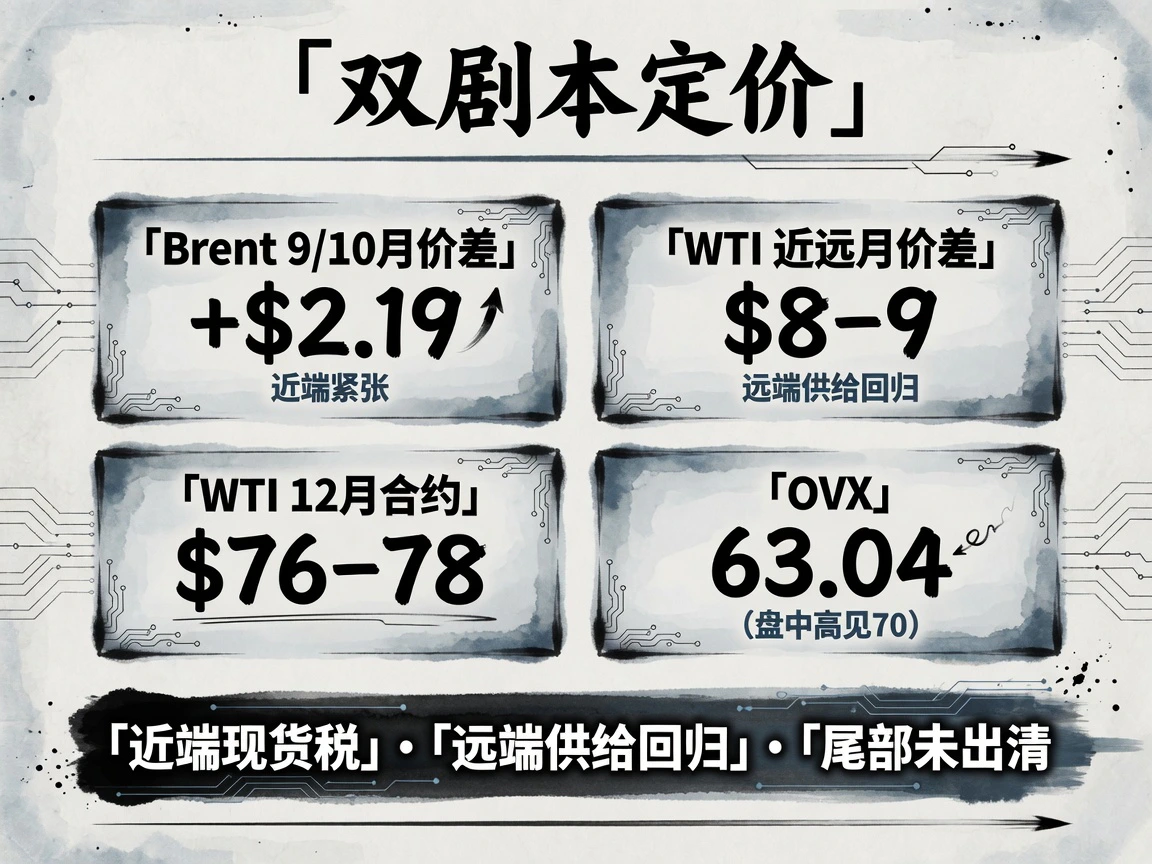
The curve trades two different narratives simultaneously.
Nearby contracts price absolute physical tightness: multi-year-low US inventories, single-digit Hormuz passage and extreme freight and premiums. Backwardation remains firm. Until talks deliver, constraints are unchanged. Monday's removal of war premium aggressively equated renewed negotiations with approaching full reopening.
Deferred prices anticipate supply normalization within months, with December WTI around $76–78 and much less disruption premium. Analysts cited by Reuters warned of rinse-and-repeat reversals after previous failed ceasefires: another collapse in talks could produce a violent rebound. OVX near 63 showed professional investors had not cleared extreme tail risks.
The test is how far talks progress and how much passage returns. Substantive US–Iran developments, daily transits above the 30-vessel threshold and August 5 EIA inventories would reprice the market's hope against reality.