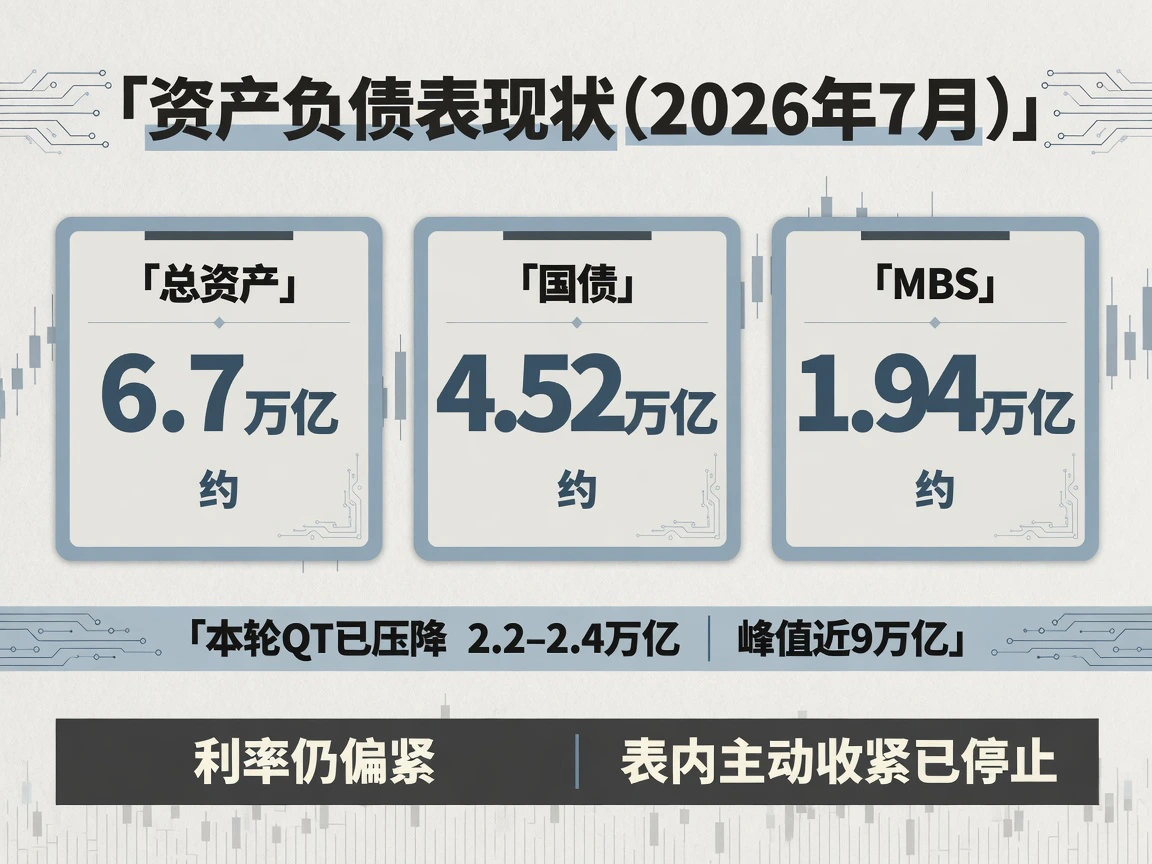
In December 2025, the Federal Reserve formally announced the end of this round of quantitative tightening, or QT. Reserves in the U.S. banking system stabilized at roughly $2.9 trillion, while the balance sheet settled at about $6.5 trillion. The Fed then moved to reserve-management purchases, chiefly of short-term Treasuries, to keep the ample-reserves regime operating smoothly. At the end of July 2026, total Fed assets were approximately $6.7 trillion on the H.4.1 weekly reporting basis. Securities held outright totaled about $6.46 trillion, comprising roughly $4.52 trillion of Treasuries and $1.94 trillion of agency mortgage-backed securities, or MBS.
Inflation, however, had not converged to the 2% target as expected. Both core and headline PCE inflation remained above target, and wages and labor costs showed no material easing. Persistent inflation left interest-rate policy carrying the entire burden of disinflation, even though active tightening through the balance sheet had already ended. From its record peak of nearly $9 trillion in 2022, the balance sheet had shrunk by approximately $2.2 trillion–$2.4 trillion during this QT cycle. Ending runoff before the inflation task was complete created a conspicuous gap in the policy framework: short-term policy tools remained under pressure to restrain demand, while the balance-sheet instrument had left the stage altogether.
After taking the helm at the Fed, Kevin Warsh quickly brought balance-sheet reform into the spotlight. He publicly advocated a material reduction in the central bank's financial footprint over the medium term and sought to restore the benchmark interest rate as the sole core policy instrument. Supporting a smaller balance sheet does not mean mechanically repeating the passive tightening of 2022, which aimed to raise liquidity constraints across the system. A proposal more consistent with his approach would reduce the balance sheet's size and portfolio duration in an orderly way, within the financial system's capacity to absorb the change, shifting the center of monetary control from asset expansion back to the interest-rate path. This raises increasingly detailed practical questions. How should the balance sheet and the benchmark rate divide their roles? What is the safe capacity, toolkit and pace for a second round of shrinkage? How much repricing would the long end of the yield curve face? And how would Warsh sequence his policies under the actual constraints of inflation and liquidity?
1. Dividing the tools' roles: What does trading a smaller balance sheet for lower rates mean?
The stance of monetary policy cannot be fully described by the federal funds rate alone. The tightness of macro-financial conditions is jointly shaped by expectations for the benchmark rate, the balance sheet's size and asset mix, duration allocation and policy communication.
The policy rate targets borrowing costs and demand for financing in the real economy. The balance sheet works more deeply, changing the allocation of duration risk between the private and public sectors, the banking system's excess-reserve cushion, and the relative level of MBS and credit risk premiums. Large-scale asset purchases, or QE, remove duration from the market to depress term premiums while injecting abundant liquidity. QT reverses that process, returning duration supply to private markets, exerting sustained upward pressure on medium- and long-term Treasury yields and mortgage spreads, and gradually consuming excess reserves.
Balance-sheet reduction is unquestionably restrictive, but its transmission mechanism differs fundamentally from that of rate hikes. Hikes directly raise short-term funding costs; QT reshapes the curve, mortgage spreads and the liquidity foundation of money markets. The tools can reinforce one another during a tightening cycle, or partly offset one another within a deliberately structured policy mix. Warsh repeatedly emphasized this point around his nomination: actively reducing the balance sheet's size and duration could create room to lower the benchmark rate in the future. Markets summarized the idea as trading balance-sheet reduction for rate cuts. Its purpose is not simply to layer one tightening measure on another, but to restore the respective responsibilities of the monetary instruments.
In the macroeconomic environment of mid-2026, however, this proposal could plainly not be implemented immediately. Growth remained resilient, AI-driven capital spending was strong, and month-on-month disinflation faced considerable resistance. Although the July FOMC meeting voted 9 to 3 to hold the federal funds target range at 3.50%–3.75%, 3 regional Fed presidents publicly dissented in favor of an immediate 25-basis-point hike. Rate derivatives at one point priced the probability of a September hike above 60%. Long-end Treasury yields continued rising in a classic bear steepener. Policymakers were fully occupied with anti-inflation credibility and rate guidance; there was no prospect of rushing out firm new balance-sheet reduction targets at that moment.
The interaction between QT, the economy and interest rates must be understood across 3 horizons:
- Near term: Anchoring inflation expectations remains heavily dependent on a materially restrictive policy rate.
- Medium term: Balance-sheet restructuring aims to remove persistent implicit easing through asset holdings, improve the maturity mix and establish transparent operating rules.
- Long term: Only after asset holdings and portfolio duration fall substantially can the flexibility and clarity of the interest-rate instrument truly return to the model Warsh envisages. Treating the 2026 balance-sheet debate as an immediate signal to trade rate cuts would be detached from persistent inflation data and would seriously underestimate the committee's internal consensus on restraint.
2. Capacity and operating limits: How much further, through which tools, and when?
Officials have not supplied a firm numerical floor for how much further the Fed can shrink its balance sheet, but the underlying constraints are clear.
The asset side of a central bank balance sheet must fully cover unavoidable demand for its liabilities, principally currency in circulation, bank reserve deposits and government balances such as the Treasury General Account, or TGA. Currency in circulation grows steadily with the nominal economy, creating a hard floor beneath passive balance-sheet shrinkage. The main scope for reduction lies in the reserve buffer above the ample level, excessive portfolio duration and policy-related holdings such as MBS. The overnight repo-market liquidity scramble in September 2019 was a warning: once reserves enter scarcity territory, short-term funding rates can surge uncontrollably and seriously damage financial stability. Maintaining an ample-reserves regime has since become an institutional boundary that Fed balance-sheet policy cannot cross.
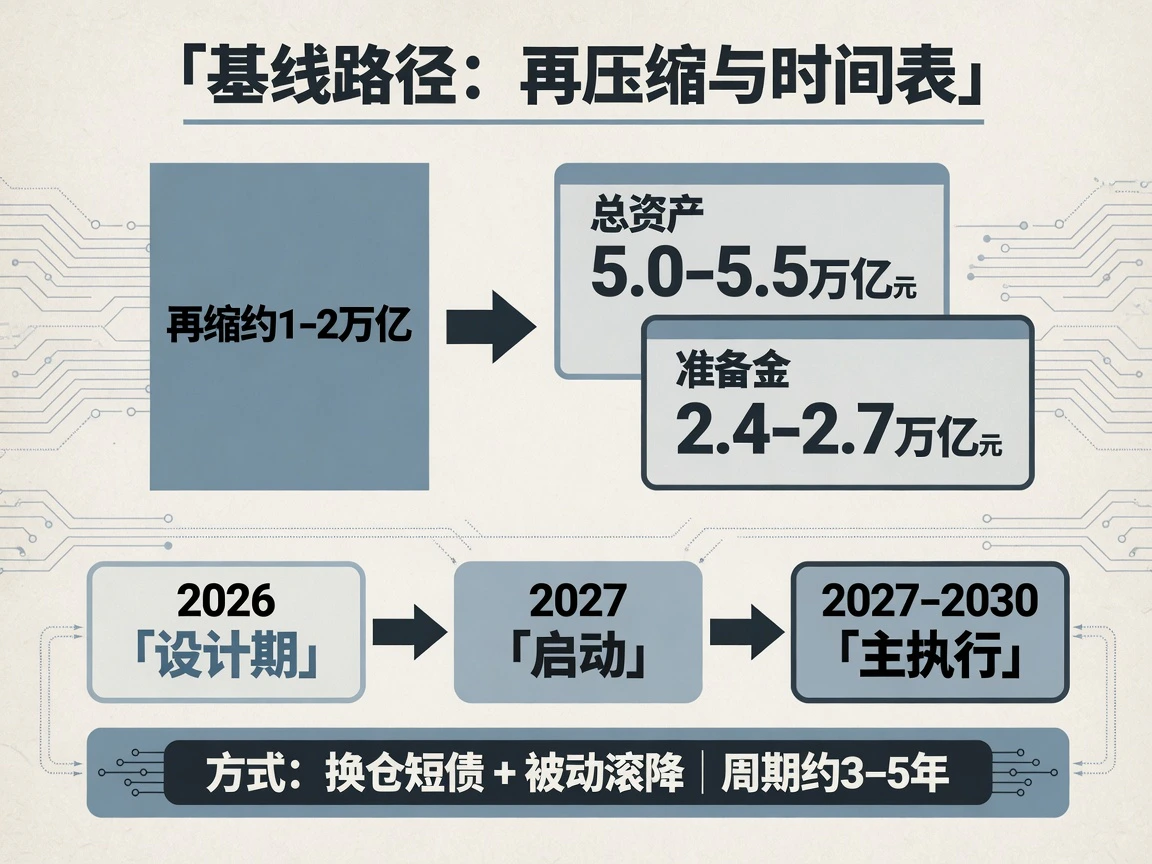
Within that framework, a cautious range-based assessment suggests that the Fed could realistically reduce its assets by a further $1 trillion–$2 trillion over the coming years without undermining the ample-reserves regime.
The resulting end state would be total assets of roughly $5.0 trillion–$5.5 trillion and financial-system reserves tending toward $2.4 trillion–$2.7 trillion. Although below the current reserve stock of nearly $3 trillion, this would still offer an adequate safety buffer. Aggressively pushing total assets below $4.5 trillion, or allowing reserves to fall through $2.2 trillion, would multiply overnight markets' sensitivity to Treasury issuance, tax-payment peaks and offshore liquidity fluctuations. Such a route would require intricate liquidity support and prudential rules to offset those risks, making it a lower-probability outcome. A complete return to the pre-2008 starting point of less than $1 trillion would be incompatible with the scale of modern banking regulation, payments and settlement, and would contradict Warsh's own recognition that the old regime cannot be restored overnight.
The implementation route will directly determine how financial assets come under pressure. Warsh's most likely approach is:
- Restructure the asset mix: Systematically increase the share of Treasury bills to shorten the portfolio's overall duration.
- Rely primarily on passive runoff: Maintain a moderate pace of shrinkage through non-reinvestment at maturity or slightly limited reinvestment.
- Calibrate reserves dynamically: Adjust the frequency of reserve-management purchases in response to key money-market borrowing rates and the depth of available liquidity.
Active sales of medium- and long-term Treasuries or MBS could reduce the balance sheet rapidly, but would convert large unrealized losses into realized losses and impose a substantial supply shock on medium- and long-term mortgage markets. They should therefore remain an exceptional tool in reserve rather than the baseline option. The Fed currently holds about $1.94 trillion of MBS, most acquired during the period of exceptionally low rates. Mortgage prepayments are very low and natural runoff is extremely slow. The most practicable approach is to retain the established rule of not reinvesting MBS repayments in MBS, instead directing them entirely into Treasuries, so that mortgage assets' share declines naturally.
The reform timetable broadly divides into 3 stages:
- Second half of 2026 to early 2027: Policy design. The external task force led by Karen Dynan, Raghuram Rajan and Jeremy Stein establishes the basic principles, estimates an appropriate reserve range and clarifies the order in which tools should be used.
- 2027: Transition and launch. Markets begin to see verifiable increases in the Treasury-bill allocation and changes to the reinvestment mix in actual operations.
- 2027 to around 2030: Routine implementation. Over 3–5 years, steadily complete a second cumulative reduction of $1 trillion–$2 trillion.
Thereafter, the balance sheet may resume slow organic growth alongside endogenous demand for money. Yet the Fed's footprint would be considerably smaller than today in absolute size, duration and MBS share. Whether the reform truly takes shape cannot be judged by one isolated dollar total. It requires structural tests: whether the scale of Fed market intervention visibly declines; whether interest rates again become the sole central instrument of routine policy; whether banking-system liquidity remains ample throughout; and whether the institutional threshold for crisis-driven balance-sheet expansion rises materially.
3. Yield-curve estimates: Higher term premiums, shadow tightening and repricing risk
Assessing how balance-sheet changes transmit to market rates requires a strict distinction between the short-term benchmark, medium- and long-term Treasuries, and mortgage spreads. Empirical estimates also contain meaningful uncertainty ranges. Academic and macro hedge-fund models generally offer orders of magnitude rather than linear formulas.
Historically, a reduction of roughly $2.5 trillion in assets over several years corresponds approximately to 50 basis points of equivalent policy-rate tightening. A common market rule of thumb suggests that each cumulative $1 trillion reduction over a multiyear period exerts upward pressure of around 10–25 basis points on the 10-year Treasury term premium. The upward effect on 30-year yields and MBS spreads is often greater when market structure deteriorates. Administered rates such as interest on reserve balances continue to anchor the federal funds rate. QT does not itself change the short-term target; it reshapes the structure of financial conditions and the steepness of the yield curve.
Under the baseline—a further $1 trillion–$2 trillion reduction over the next 3–5 years, chiefly through passive runoff and changes in portfolio composition—the cumulative upward impact on medium- and long-term yields and term premiums, once the cycle is complete and assuming neutral effects from other fundamentals, would lie in a broad 15–40-basis-point range. The corresponding shadow tightening of macro-financial conditions would be equivalent to approximately 25–50 basis points of rate tightening. Spreading implementation across several years would substantially dilute the marginal annual effect. In mortgages, relying on natural runoff rather than aggressive sales would smooth potentially sharp disruption to mortgage rates into a manageable range.

The eventual Treasury yield curve will depend on the combination of balance-sheet progress and short-term rate decisions:
- If balance-sheet reduction advances while the policy rate falls: Short-term rates decline rapidly, while long-end yields remain sticky at elevated levels as the market absorbs duration supply. The curve naturally steepens, and the decline in long-term Treasury yields and household mortgage costs lags well behind the reduction in the benchmark rate.
- If persistent inflation keeps rates high, or prompts further hikes, alongside steady balance-sheet shrinkage: Both the front and long ends face pressure, driving further bear steepening.
- If an economic slowdown first forces sharp benchmark-rate cuts while QT stalls: Long-end premiums unwind quickly, overturning and rebuilding the market's prior pricing of balance-sheet normalization.
The rise in medium- and long-term Treasury yields and the steepening curve in summer 2026 already reflected a combination of economic resilience, persistent inflation and heavy fiscal issuance. But a considerable share of the term premium also represented tentative advance pricing of the Fed eventually shedding very long-duration assets and MBS. If the task force ultimately confirms a gentle, transparent and gradual route, the scope for another jump in long-term rates should be relatively contained. An unexpected inclusion of active sales or aggressive acceleration targets, however, would expose long-duration assets to a second severe repricing.
4. Warsh's roadmap and indicators that can test it
Considering Warsh's policy strategy, the task force's institutional structure and the hard constraint of current inflation, implementation during his tenure is most likely to unfold in 3 successive stages:
Stage 1, through the end of 2026: Reinforce the anti-inflation stance through the benchmark rate. Maintain a restrictive rate range while preserving discretion for modest additional tightening as the data warrant. Before the expert task force reaches formal conclusions, the Fed will not blindly introduce aggressive new QT limits. Communication will emphasize the seriousness of the inflation target, define the boundaries of the tools and prepare expectations well in advance of balance-sheet operating changes. The balance sheet will not shrink abruptly during this stage; the focus will be internal framework design and contingency analysis.
Stage 2, around 2027: Formally introduce new operating rules. Drawing on the task force's policy conclusions, publish a quantitative operating manual defining a clear safe range for ample reserves, new non-reinvestment rules and a portfolio adjustment path. Highly likely measures include directing reinvestment toward Treasury bills, tightly restricting MBS reinvestment in favor of Treasuries, and setting appropriate Treasury-runoff caps according to reserve abundance. Active MBS sales remain a low-probability option. Markets will assess implementation directly through reserve positions, the Treasury-bill share and the pace of MBS reduction in the H.4.1 weekly release, rather than through verbal assurances.
Stage 3, around 2028–2030: Establish a balance between a smaller balance sheet and a lower benchmark rate. Once inflation clearly moves substantially closer to 2%, gradually deliver the combination of steady asset reduction and a return of the benchmark rate toward neutral. If inflation resurges, policy instead follows a dual track of restrictive benchmark rates and slow balance-sheet shrinkage, leaving the private sector to bear both high short-term funding costs and greater long-duration absorption. In a systemic crisis, unconventional balance-sheet expansion remains the final firewall, but its activation triggers and exit constraints will inevitably be stricter than during the previous decade.
Markets can track and challenge this scenario against 4 clear tests:
- Has the Fed issued clear quantitative reserve guidance or defined a safe range?
- Has MBS reinvestment materially tightened and shifted toward other assets?
- Does the 2027 balance sheet show a measurable acceleration in monthly runoff and a shortening of asset duration?
- Does the first policy-rate reduction proceed alongside routine balance-sheet shrinkage, rather than at its expense?
5. Conclusions and core judgments
The central judgments fall into 4 points:
First, Warsh's advocacy of a substantially smaller Fed balance sheet over the medium term aims to restore interest rates to the absolute center of routine policy and end the implicit financial-market backstop provided through asset holdings. It is not a simple reproduction of the previous mechanical QT cycle, whose sole orientation was tighter financial conditions.
Second, the immediate constraint is that inflation remains far from target while QT has already ended, leaving short-term restraint dependent on a restrictive policy rate. Reshaping the balance sheet is a structural project spanning years. It cannot replace the current inflation fight, and markets should not selectively treat it as permission for immediate rate cuts.
Third, the baseline for size and timing is capacity for another $1 trillion–$2 trillion asset reduction over 3–5 years, bringing total assets toward $5.0 trillion–$5.5 trillion while keeping reserves near $2.4 trillion–$2.7 trillion. Operations would chiefly rely on resetting portfolio duration and passive runoff. The ultimate goals are a more restrained asset base, shorter holdings duration, preservation of the ample-reserves floor and a higher threshold for crisis intervention.
Fourth, the impact on rates would chiefly concern medium- and long-term term premiums and mortgage spreads. Over the full cycle, the estimated effect is 25–50 basis points of equivalent shadow tightening and 15–40 basis points of cumulative upward pressure on long-end premiums. When a rate-cutting cycle eventually begins, the yield curve would naturally move toward normal steepening. Operationally, Warsh must first secure interest-rate restraint in the near term and steadily implement balance-sheet restructuring over the medium term. Only when the inflation constraint has fully eased can he comfortably move into the next phase of combining a smaller balance sheet with rate cuts.
The end of QT in December 2025 merely marked the close of the preceding operational phase. It did not end balance-sheet reform or signal a material easing of the monetary-policy stance. The real test during Warsh's chairmanship is whether the Fed can smoothly transform a roughly $6.7 trillion balance sheet into a more restrained framework with shorter duration and clearly defined boundaries relative to rate policy, while avoiding a repeat of the 2019 liquidity scramble. The estimates in this article derive from public data and academic-model analysis; they are not established official Fed targets. Actual implementation will still depend on the pace of disinflation, financial-stability constraints and the process of building committee consensus.
(Principal sources: the Federal Reserve's H.4.1 weekly releases, FOMC decisions and press-conference records, congressional hearings and task-force announcements, and published academic and market research on QT and term premiums.)