Note: This is the first article in the Warsh Fed Reform series. Later installments will cover the balance sheet, inflation framework, data sources and AI productivity, meeting frequency and committee governance.
Nature: Research on policy and market mechanisms; not investment advice.
Introduction: why a Fed that did nothing shook markets
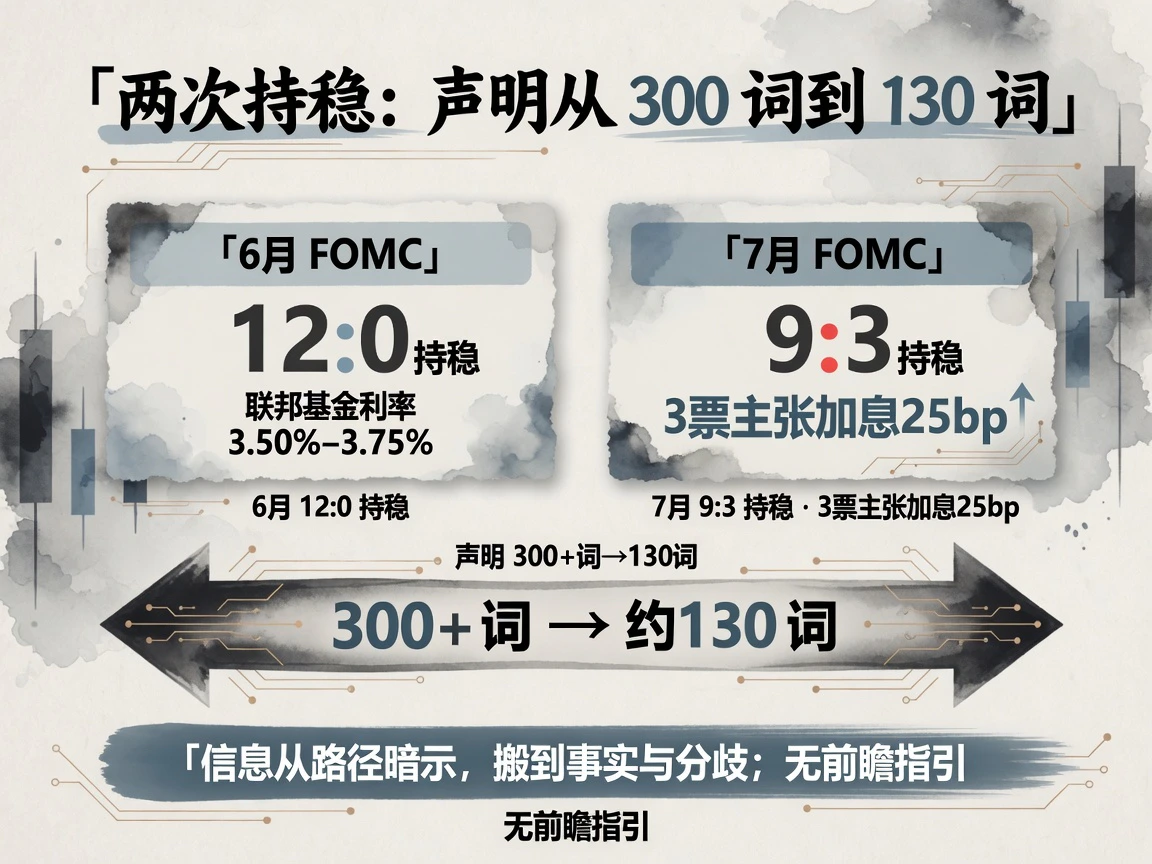
At the first two FOMC meetings of summer 2026, Kevin Warsh effectively held steady operationally: the federal funds target remained fixed at 3.50%–3.75%.
Yet rate futures and cash bonds behaved as though a substantial hike had occurred. At July's press conference, Warsh cited formidable figures: over the 42 days between meetings, nominal and real Treasury yields rose across the curve, with some maturity moves in the top 10% of comparable-period changes over twenty years. Policy rates were unchanged, but financial conditions had tightened materially.
Warsh showed no intention of calming the long-end rise and openly welcomed it:
Market participants are learning to play for themselves rather than looking to the referee every second. In his view, this was constructive, and only the beginning.
That apparently casual comment unlocks his communication revolution. Rather than changing the benchmark rate, the Fed withdrew its words and compelled markets to shoulder tightening. This was no accidental communication failure, but a deliberate institutional replacement: dismantle the Bernanke–Powell contract of close central-bank care and market obedience, and return to hard central-bank objectives with traders pricing at their own risk.
This article examines the experiment reshaping global finance: what scaffolding has Warsh removed, which load-bearing walls has he reinforced, what bets has he made between rates and the balance sheet, and what are the odds for this gamble on credibility?
1. What is removed: three privileges and habits taken away
1. Ending textual speculation: the statement's drastically reduced length
At the Powell era's peak, postmeeting statements had become modern scripture for high-frequency algorithms and macro funds, routinely over 300 words. Removing an adverb, moving an adjective or changing a clause's tense could trigger millisecond futures shocks and distort the curve.
Warsh's June 17 debut sharply curtailed that textual obsession. The statement contained only about 130 words, nearly 60% shorter. It resembled a terse wartime telegram: the rate range, routine ample-reserves implementation, objective growth and employment conditions, inflation still above 2%, and an uncompromising final pledge that the committee would deliver price stability.
The July 29 statement virtually replicated that template. Its only substantive addition was an exposed voting split: 9 in favor, 3 against. Cleveland's Hammack, Minneapolis's Kashkari and Dallas's Logan dissented, demanding an immediate 25-basis-point hike.
The philosophy is radical: few promises about future actions, but no concealment of current fractures. Information was not removed; it shifted from illusory path guidance into fundamentals and actual policymaker disagreement.
2. Removing path sedation: abolishing forward guidance
In June, Warsh cautiously said guidance no longer suited the policy environment. By July he was explicit: the central bank needed unfiltered first-order market signals from prices. Forward guidance acted as a low-pass filter with a high signal-to-noise ratio, smoothing short-term volatility while suffocating genuine discovery and risk warnings.
This repudiates an approach developed since the 2008 crisis. Since Bernanke's unconventional toolkit, guidance had been treated as a universal key near the zero lower bound: expectations management could supply imagined unlimited liquidity after short-rate tools were exhausted. Warsh instead viewed it as emergency intensive-care medicine that becomes addictive if routinely administered in normal times. Overfed markets lose independent pricing and risk-detection capacity; policymakers become trapped by past wording and lose discretion.
3. Refusing the commentator's role: the chair stops explaining everything
At July's press conference, Warsh perfected refusal, overturning the nurturing style in which chairs answered every question to prevent misunderstanding:
- Asked whether the swap-implied path was reasonable, he replied that market information was the market's own information;
- Asked whether the hold reflected softer June core CPI, he answered not much, then attacked data dependence: half its historical problem lay in data lags and revisions, and half in the unhealthy fixation on dependence itself.
- Asked to call current policy a pause, he refused: this was watchful thinking, not passive waiting.
- Asked about his Jackson Hole speech outline, he said it was a blank page.
Compared with Powell's carefully balanced wording, Warsh deliberately ceded macroeconomic interpretation to markets. Buy-side desks realized he would not reveal his hand in advance.
4. Dismantling routine: considering fewer regular meetings
Alongside shorter text came a possible institutional rhythm change. In late July, the New York Times and Wall Street Journal reported closed FOMC discussion of reducing annual meetings from 8 to 6 or fewer. Federal law requires at least 4, posing no statutory obstacle. Still an internal proposal, it followed the same logic:
More frequent stages create longer performances. Fewer meetings would remove the obligation to narrate the next plot development periodically and make markets price economic conditions independently during longer intervals without official commentary.
2. What remains and strengthens: four load-bearing walls
Focusing only on subtraction could suggest a disappearing Fed. Warsh was removing discretionary market guidance and reassurance, while preserving—and reinforcing—the institutional foundations of central-bank legitimacy and credibility.
1. Defending statutory boundaries: accountability is not reduced
At the July 14 semiannual House Financial Services Committee hearing, Warsh said regular monetary reports and public bipartisan questioning were not a personal favor or optional discretion, but the reciprocal statutory obligation attached to constitutionally and legislatively granted independence.
His distinction was sharp: legislators and the public must receive clear, complete answers. Speculators and arbitrage capital are not owed a protected policy roadmap.
2. Rebuilding the final anchor: reinforcing the 2% inflation objective
Even as guidance disappeared, Warsh strengthened the final objective. At July's press conference he delivered a particularly forceful statement:
Five years of high inflation had encouraged a dangerous belief that the Fed secretly tolerated more than 2%. He rejected any soft target or hidden tolerance band: the objective was an unequivocal 2%.
This is the framework's central pillar: replace false certainty about the route with absolute certainty about the destination. Powell offered a map with every waypoint; Warsh fixed a North Star. Navigators must find their own way through storms and reefs.
3. Opening the black box: expose conflict instead of smoothing it away
Powell-era governance largely relied on consensus. Dissents were treated as communication failures, and three at his final April meeting were regarded as unusual. Warsh reversed that standard, favoring concise staff memoranda and vigorous debate. He called internal policy conflict a family fight and a function of healthy democratic decision-making, not failed governance.
July's 9–3 split reflected that approach. On the third day afterward, the three dissenting presidents were allowed, even encouraged, to publish detailed independent explanations of their case for 25 basis points:
- Hammack said inflation had been high too long and the risk of unanchored expectations outweighed acting too soon; action was necessary now;
- Kashkari invoked the Great Inflation of the 1970s and urged no hesitation over gradual additional tightening;
- Logan argued that inflation appeared stuck near a secondary plateau of 2.5%, with upside tail risks substantially outweighing downside risks.
With less guidance, these statements were no longer glossed over as noise. They became a genuine probability distribution of possible rate paths, directly entering curve-tail pricing.
4. Building an independence firewall: five task forces bring in outside challengers
Proposed in early June and given named co-chairs July 9, five special groups signaled institutional outside scrutiny intended to force transformation. The communication group's composition was especially revealing:
| Task force | Co-chairs' backgrounds | Core issue |
|---|---|---|
| Communication review | Peter Fisher, University of Washington professor of practice and former New York Fed executive vice president; Arminio Fraga, former Brazilian central-bank governor and prominent hedge-fund manager; Mervyn King, former Bank of England governor | How to communicate deliberations and decisions amid fundamental uncertainty; whether to retain the dot plot and SEP |
| Balance sheet | Karen Dynan, Harvard professor and former Treasury assistant secretary; Raghuram Rajan, University of Chicago professor and former Reserve Bank of India governor; Jeremy Stein, Harvard professor and former Fed governor | Actual liquidity risks in ample reserves and long-run redesign of asset holdings |
| Data and timeliness | Raj Chetty, director of Harvard's Opportunity Insights; Doug McMillon, Walmart president and CEO; Kevin Murphy, University of Chicago professor and leading empirical labor economist | Sampling distortion and lags in government statistics, and how to incorporate high-frequency microdata |
| Productivity and employment | Marc Andreessen, a16z cofounder; Charles I. Jones, Stanford economics professor and endogenous-growth scholar; Asha Sharma, Microsoft executive vice president | Long-run effects of general-purpose technologies such as AI on potential-output elasticity, the natural rate r* and labor productivity |
| Inflation theory | Greg Mankiw, Harvard chaired professor; Thomas Sargent, Nobel laureate and rational-expectations pioneer; William White, former BIS chief economist | Post-pandemic Phillips-curve changes, rigid supply transmission and updated policy reaction-function theory |
The appointments carried formidable expertise. Mervyn King helped establish modern inflation reports and detailed central-bank press conferences. Asking a founder of modern communication practices to review the Fed suggested a serious academic and practical adversarial exercise, rather than anti-intellectual populism. Official principles required complete independence, empirical evidence and confidential reporting directly to the FOMC.
3. The underlying wager: what is Warsh betting against the market?
Combining his two press conferences, congressional testimony and more than a decade of speeches reveals four propositions:
Bet one: artificially suppressed volatility is a toxic illusion.
Guidance appears to calm markets, but economically supplies a free put on path variance to sell-side participants taking long-volatility positions. This free insurance encourages underpricing of macro premiums and accumulation of leverage and duration. When an external shock breaks guidance, deferred volatility returns with interest through liquidity shock or collapse.
Bet two: overprotected markets have lost their ability to scout for the central bank.
The Fed directly controls only an overnight rate, yet must rely on a Treasury market of tens of trillions of dollars to reveal the real economy. If curves price which verb Powell will use instead of inflation, capital returns and default risks, policymakers see only a distorting mirror of themselves.
Bet three: in a supply-shock era, freedom is more valuable than predictability.
Demand-led fluctuations in the 1980s–1990s Great Moderation suited guidance. Today's dense postwar supply shocks—energy transition strains, military blockades, tariff-fractured supply chains and AI spending crowding power and compute infrastructure—make promises for three future quarters worthless. Warsh listed these in July. Better to remove self-imposed commitments before the storm than lose credibility breaking them later.
Bet four: a sufficiently hard anchor lets markets find the route.
If repeated tightening despite political costs proves 2% inviolable, rational traders bearing their own losses can price appropriate conditions even without a map.
The odds: four potentially fatal objections
Reflexive markets do not spare confident reformers. Academic and Wall Street critics have systematic counterarguments:
- Real-economy costs of removing volatility control.
Classic theory from Bernanke to Michael Woodford stresses guidance's ability to remove unnecessary term premiums and reduce household mortgage and corporate investment costs. Bespoke models estimate that abolishing it could add about 25 basis points to end-user financing through a confusion premium. For refinancing-heavy businesses and Treasury, that is an expensive institutional tax. - No preset path is acceptable; no reaction function is not.
Former St. Louis Fed vice president David Andolfatto argues against a mysterious black box. State-contingent rules must explain the response when core PCE reaches X or unemployment exceeds Y. Merely promising to achieve 2% is not a modern framework but resembles premodern central-bank sorcery. - Many voices can turn silence into noise.
Attention does not leave a vacuum: the other 18 voting and nonvoting officials gain unprecedented prominence when the chair says less. One navigation system becomes nineteen divergent loudspeakers. Wall Street must hire more language models and lobbyists to navigate numerous daily regional speeches. - Silence's crisis vulnerability.
In a Lehman-style run or 2020 liquidity vacuum, the central bank's lifeline is an unconditional forward commitment and backing. Can a restrained observer switch within hours to an all-out liquidity rescuer? Success would vindicate normal restraint; delay could permanently mark it as cold, arrogant and damaging.
4. Redrawing financial transmission: reversing information flow and discovery
The traditional Powell framework transmitted signals linearly from the top:
Subtle FOMC statement language → Wall Street interprets the path → fed funds futures and Treasury curve align
      ↓
Financial conditions (credit spreads, equity discount rates) adjust passively → real-economy borrowing
Under Warsh, the decade-old mechanism becomes a dynamic feedback loop:
Macro data and exogenous shocks → dispersed traders price first (nominal/real yields, FX volatility)
      ↓                                                   ↑
Fed observes raw prices → adversarial committee analysis (public dissents) → endorse conditions or correct policy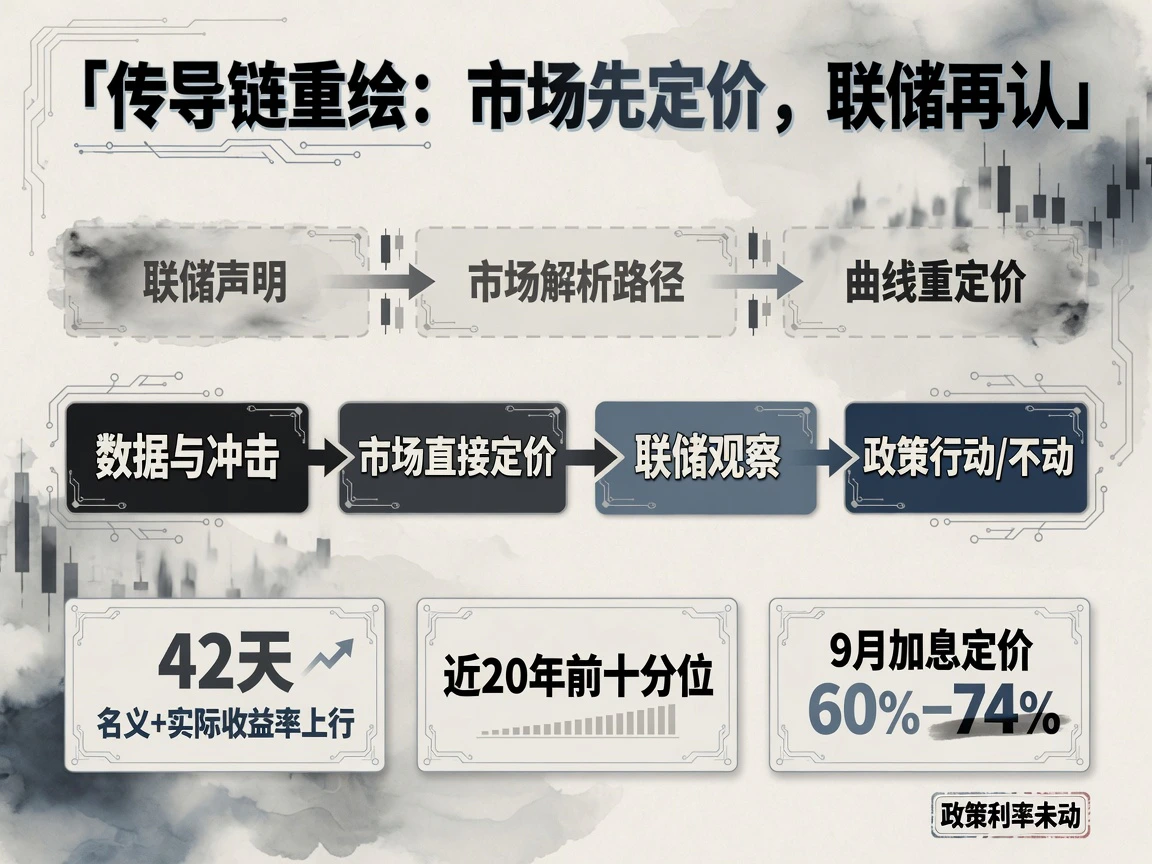
Three fundamental microeconomic changes distinguish them:
- Pricing order reverses: from central-bank signal and market response to market initiative and central-bank judgment.
Institutions previously followed a prescribed map; now buyers and sellers form the curve first and the Fed assesses its fit with disinflation. July exemplified this: unchanged policy but higher long yields, with Warsh endorsing market-generated tightening. - Information factors depreciate: text mining retreats as data and dissent rise.
Multimillion-dollar NLP datasets lose value. Powell-era codes such as gradual, patient and well-positioned become relics, replaced by CPI/PPI gap risk, genuinely dissenting hawks and task-force reports. - Volatility changes from unwanted noise to a governance component.
Previously, unannounced price moves signaled failed communication. Warsh sees moderate or elevated volatility as necessary self-cleansing and a check on speculation. Central banks have no reason to occupy the spotlight 365 days a year.
Reverse transmission is costly; when the Fed gives up micromanagement of short-end financial conditions, it becomes more irregular and more friction-prone. Communication reform was not the sole cause of summer 2026's long-yield jump. Resilient growth, sticky inflation, Treasury supply imbalance and Middle East oil premiums were primary drivers. Reform's catalytic role was to remove presumed central-bank stabilization, amplify transmission and change who must hedge first.
Cross-asset implications under low guidance diverge:
| Asset / core variable | Expected path under the new system | Underlying microeconomic logic |
|---|---|---|
| 2-year Treasury yield | Extreme sensitivity to frequent inflation data and dissenters' remarks | Loss of short-path anchoring raises intraday gap risk and baseline volatility |
| 10-year Treasuries and intermediate curve | An irreversibly higher volatility center; more weight on fundamentals and sticky inflation | Loss of the soft institutional put that Fed guidance will smooth long yields |
| Term premium | Strong endogenous upward pressure | Compensation for inability to read the chair's intentions |
| Federal funds futures | Flatter, more dispersed probabilities before meetings; larger decision gaps afterward | Without weeks of verbal preparation, each decision brings high-variance repricing |
| Dollar index | Greater responsiveness to international real-rate differentials and global risk aversion | Rate-parity expectations shift from passive adjustment to abrupt corrections |
| Spot gold | Opposing hedges: higher real rates cap upside while unpredictable central-bank behavior raises strategic holdings | From a simple inverse-rate instrument toward a hedge against sovereign-debt fractures and institutional repricing |
| Growth and long-duration equities | Higher discount-rate volatility imposes persistent valuation discounts | No fixed directional outcome, but unpredictable discounting removes room for high-valuation error |
| High-yield and investment-grade credit spreads | Calm in normal macro conditions; extremely violent widening under liquidity pressure | Without verbal barriers, rate volatility quickly reaches weak balance sheets |
5. Reordering the ecosystem: who loses ground and who gains value
Rewritten Fed communication inevitably creates stark winners and losers across Wall Street and global asset management:
| Market participant | Advantage under the old paradigm | Position under Warsh's new system |
|---|---|---|
| Text quants and semantic traders | Fast NLP crawlers parse wording differences for millisecond arbitrage | Core barriers collapse. A 130-word telegram leaves little to mine; text strategies lose effectiveness |
| Fundamental macro hedge-fund managers | Research was often overridden by sudden Fed comments or guidance, encouraging the view that research did not matter | Pricing power returns. Inflation transmission, commodity supply and technology spending regain importance as alpha sources |
| Rate-variance and volatility sellers | Harvested crowded gamma premiums under explicit policy guidance | Risk is exposed. Removed tail protection makes data-day extremes trigger repeated stop-outs |
| Curve relative-value arbitrageurs | A locked policy path made curve development predictable, limiting opportunities | Strategy space expands. Greater disagreement about r* and term premiums creates more cross-maturity trades |
| Regional-Fed and individual-voter research teams | The chair's voice represented the committee; other opinions were background noise | Importance surges. In a 9:3 or more divided committee, independent hawk/dove statements become primary path signals |
| Zombie firms dependent on forgiving liquidity | Benefited from guidance-suppressed borrowing costs and stable refinancing windows | Face prolonged asset clearing. Uncertainty premiums become permanently embedded in issuance costs and low-rated credit loses protection |
| Congressional oversight committees | Hearings often became exercises in evasive chairmanship | Standing strengthens. Under strict statutory accountability, Congress is among the few forums receiving his full reasoning |
6. The historical pendulum: correcting the myth of ever-greater transparency
A century of central banking can invite mechanical progressivism, as though communication must become ever longer, more fragmented, frequent and transparent. Its actual history is a swinging pendulum:
- 1990s: Greenspan's oracle and early transparency.
Greenspan perfected deliberate obscurity, famously suggesting that anyone who thought they understood him had misunderstood. Yet in his tenure the Fed first issued short postmeeting statements in 1994 and gradually regularized minutes, an early merger of mystique and transparency. - 2008–2021: the zero bound drives expansive communication.
After the crisis pinned rates at zero, emergency guidance became routine heavy machinery. Bernanke's SEP and dot plot, Yellen's detailed path discussion and Powell's press conference after every meeting elevated absolute transparency into a dogmatic standard for modern central banks. - 2026: Warsh shifts into reverse.
Deutsche Bank chief US economist Matthew Luzzetti likened the preceding twenty years to central banks trapped on a one-way express train toward excessive transparency and path hypnosis, with Warsh's first act an abrupt reverse gear.
The key insight is that this reversal is not mere nostalgia; its organizational mechanism is new.
Greenspan's ambiguity depended on individual mystique, with traders reading facial expressions and briefcase thickness. Warsh's restraint is institutional: shorter statements, independent interdisciplinary external groups and systematic exposure of dissent.
Greenspan required belief in an infallible monetary wizard. Warsh's institutional self-restraint seeks to show that rules and market rationality can sustain modern monetary order without a superhero. These are different governance philosophies.
7. Extreme stress tests: when does silence become disastrous?
The verdict cannot depend on a calm summer 2026 trial. The experiment's survival turns on three extreme tests:
Scenario one: renewed inflation forces the first contrary hike without guidance.
Earlier this year, multi-asset managers confidently positioned for cuts. By midyear, swaps priced at least one defensive 25-basis-point hike, with September odds fluctuating in a sensitive 60%–74% range. Warsh's first active move was very likely a hike against the wind rather than accommodation.
Without guidance, expectations cannot fully converge even in the final second before the decision. Gaps and liquidity frictions intensify. If markets interpret a hike as the Fed chasing lost control rather than honoring price stability, long-asset liquidation could overwhelm supposedly healthy volatility.
Scenario two: task forces fail to deliver, leaving a dangerous institutional vacuum.
Terse statements and refusals are still largely a personal stress-test pilot under the chair's authority. Durable rules require Fisher–Fraga–King to produce a blueprint accepted by most FOMC members and academics, including the dot plot, press-conference frequency relative to major payroll months, and SEP publication.
If veteran central bankers become trapped in prolonged factional disputes, old guidance could be destroyed without a new contingency reaction function. Markets would feel their way through several quarters of suspended rules, the vulnerability worrying Andolfatto and others.
Scenario three: nonlinear geopolitical or funding-system rupture.
A full Hormuz blockade, explosive great-power confrontation or sudden offshore dollar-credit freeze could require an immediate lender-of-last-resort response. The test is direct:
Can a central bank that treats peacetime restraint as sacred instantly return to unrestricted intervention and communication when the system fractures?
If yes, ordinary restraint will look farsighted. If not, global investors will condemn it as stubborn, negligent bureaucratic arrogance.
A hard boundary separates systematically higher volatility from market paralysis:
- Transition friction—the first one to two quarters of changing expectations are almost inevitably painful; this is the present stage;
- A normal high-variance equilibrium—data and geopolitical-shock days have systematically larger swings than the calm 2015–2021 period; the logic holds, while magnitude is still being explored;
- Functional breakdown—dealer spreads rupture, collateral liquidity gaps, cash/futures basis disorder and loss of basic trust in the central bank.
The destructive third stage requires three toxic conditions together: old tools eliminated without a transparent contingency reaction function; nineteen regional Fed officials' disorderly noise destroying central authority; and leadership refusing direct dialogue during a genuine liquidity crisis to preserve minimalist style.
8. A quantitative dashboard: five groups of hard measures
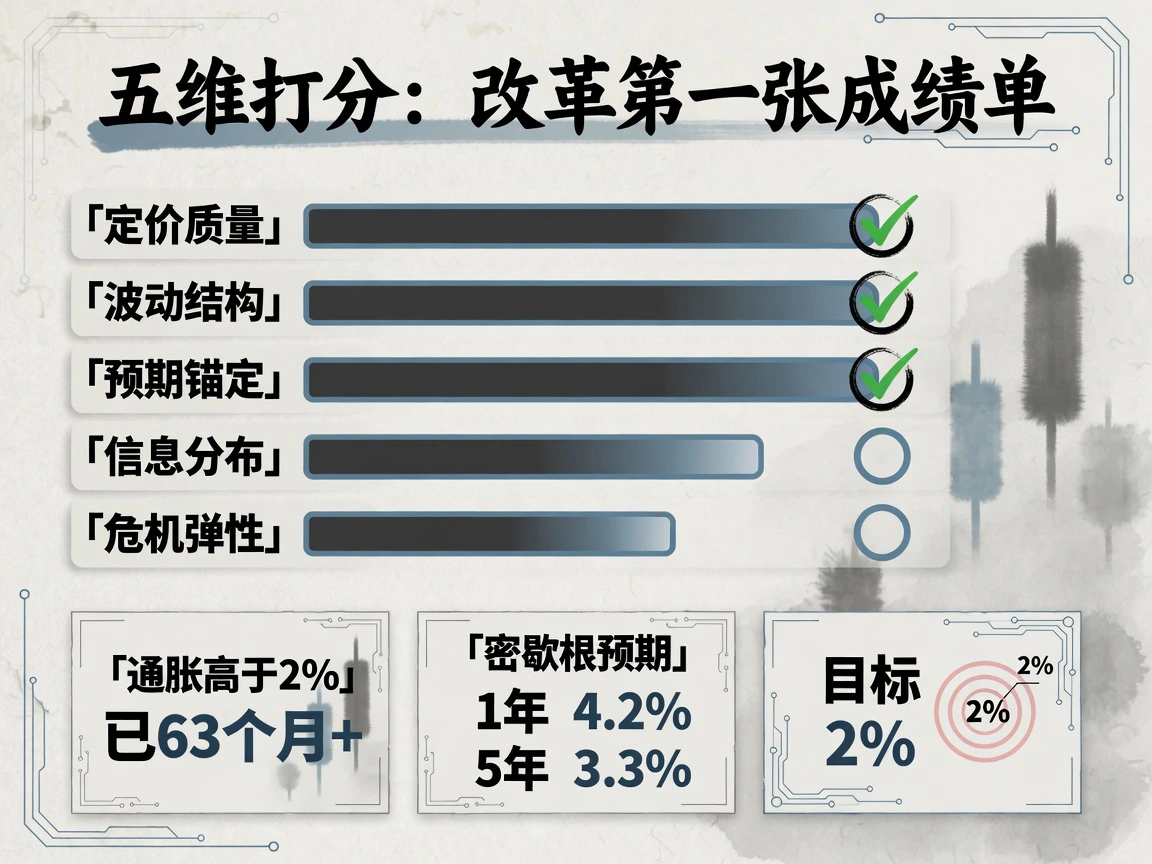
Judging a governance revolution by a few equity sessions or hawk–dove outcomes is inadequate. Five observable, frequently trackable groups provide a better standard:
| Assessment dimension | Core high-frequency measure | Signs of constructive reform |
|---|---|---|
| Pricing purity | Empirical explanatory power, R^2, of high-frequency real macro data for between-meeting curve changes | Prices mainly respond to payrolls, CPI and physical supply data, rather than second-order interpretation of officials' fragments |
| Volatility structure | Ratio of intraday Treasury ranges on macro-release days to FOMC-statement days | Data-day responsiveness rises and mechanical statement-day spikes ease without liquidity rupture |
| Final inflation anchor | Michigan 5–10-year expectations and 5-year/5-year forward inflation swaps (5y5y) | After years above target, expectations converge firmly near 2% without broad unanchoring |
| Internal fractures and information entropy | Changes in the number of FOMC dissenters and asymmetric curve-spread effects of independent regional-president remarks | Disagreement enters prices smoothly as probabilities rather than triggering panic |
| Black-swan resilience | Time taken to switch from minimal communication to emergency intervention after an unannounced nonlinear shock | Restrained and bounded in normal conditions; ready to break routine and speak decisively in systemic liquidity danger |
At the early-August 2026 cutoff, several interim benchmarks were revealing:
- US inflation had remained above the 2% statutory line for more than 63 consecutive months;
- Michigan one-year expectations had eased to 4.2%, but five-year expectations remained flat at 3.3%. Longer-term beliefs had neither collapsed nor returned to target;
- Direct pricing of real data was strengthening, evidenced by autonomous curve tightening over the 42 days between meetings;
- A shift of volatility from statement days toward data days was beginning.
The reform had barely secured its first pass toward adequacy, with a long way to proving institutional self-sufficiency.
Four unavoidable windows in the second half of 2026 would provide interim verdicts:
- Late-August Jackson Hole: what coherent blueprint Warsh would draw on his self-described blank page;
- The communication task force's report: whether Fisher, Fraga and King could reach a conclusive agreement on whether to retain or abolish the dot plot and SEP;
- Formal press-conference rule changes: whether regular meetings and press conferences would be institutionally separated;
- A historic hike: if the priced 60%–74% probability materialized later this year, global assets would face their first unprotected, direct pricing collision in the no-guidance ecosystem. That is the deeper territory for subsequent installments.
Conclusion: how far can a modern central bank step back?
The communication revolution goes beyond one new chair's personal preferences:
How much of society's attention economy should a central bank occupy in a leveraged, algorithmic financial system?
For fifteen years the answer had been ever more. Central banks evolved from emergency shelters into caretakers feeding paths and soothing every trading desk. Warsh is trying to pull the Fed surgically from center stage into the shadows:
Honor legal duties, define the final boundary, disclose disagreement, withdraw cheap roadmaps, let buyers and sellers discover real prices first, then let policy decide whether to validate them.
The experiment's deepest feature is its reflexive final test:
If Wall Street learns efficient, rational discovery without central-bank commentary and path protection, it would imply that twenty years of elaborate guidance were unnecessary bureaucratic overreach.
If removing guidance instead produces liquidity rupture and disorder, it would show the Fed cannot return to the sidelines: it is already the largest player inside the game, whose departure collapses the match.
Appendix: core event timeline
| Key date | Milestone and institutional action |
|---|---|
| 2026-05-22 | Kevin Warsh sworn in as the 17th Fed chair |
| 2026-06-16/17 | Debut FOMC: 3.50%–3.75% held unanimously, 12–0; statement cut to about 130 words and forward guidance removed; five independent review task forces announced |
| 2026-07-09 | External task-force co-chairs formally announced, with Fisher, Fraga and King leading communication |
| 2026-07-14 | Statutory semiannual House Financial Services testimony defines accountability versus market communication and fully discloses review agenda |
| 2026-07-28/29 | Second FOMC holds rates with 9–3 split; press conference rejects soft-target speculation, affirms 2% and welcomes autonomous long-end tightening |
| 2026-07-31 | Hammack, Kashkari and Logan publish unusually detailed independent hike statements; media report discussions of fewer annual meetings |
| 2026-08, planned | Jackson Hole speech; task forces enter confidential interim-research discussions |
Core arguments and primary-source references
- FOMC statement archives, Board of Governors: 2026-06-17 unanimous 12–0 decision; 2026-07-29 9–3 decision and dissenters.
- Official chair press-conference preliminary transcripts, Board of Governors: 2026-06-17 and 2026-07-29.
- Kevin Warsh's House Financial Services testimony: 2026-07-14.
- Five review task forces' charters, mandates and co-chair announcement: updated 2026-07-09.
- Policy and market reporting: AP research on real-economy credit friction from reduced guidance; CNBC on statement length and high-frequency text analysis; WSJ and NYT investigations of closed FOMC discussions about fewer meetings, June–August 2026 issues.
This study concerns macro-policy evolution and financial microstructure. Its factual basis is public information and inference from professional data; it is not direct investment advice.