On Monday August 3, 2026, cross-asset pricing had a clear focus: the White House's weekend messages of delayed strikes on Iran and imminent talks were read as a temporary removal of the tail risk of uncontrolled escalation. Oil-market fear receded, with prompt WTI settling at $80.3 a barrel, down about 5%. Treasuries recovered from the prior week's selling, with yields down three to five basis points in mild bull flattening. U.S. risk appetite improved and the Dow reached a record close of 53,178.41.
The catalyst was mainly weekend news. Trump said requests from Gulf allies had led Washington conditionally to shelve new strikes, and optimistically claimed talks began Monday and Hormuz could reopen the next day. Reality differed: Tehran promptly denied direct official U.S. contacts, while commercial strait traffic remained largely stalled. Oil's decline mainly removed an excessive fear premium; the physical bottleneck was unresolved. That mismatch—retreating narratives before supply recovery—was central to Monday's flows.
Equities: de-escalation and AI repricing lift indices to historic highs
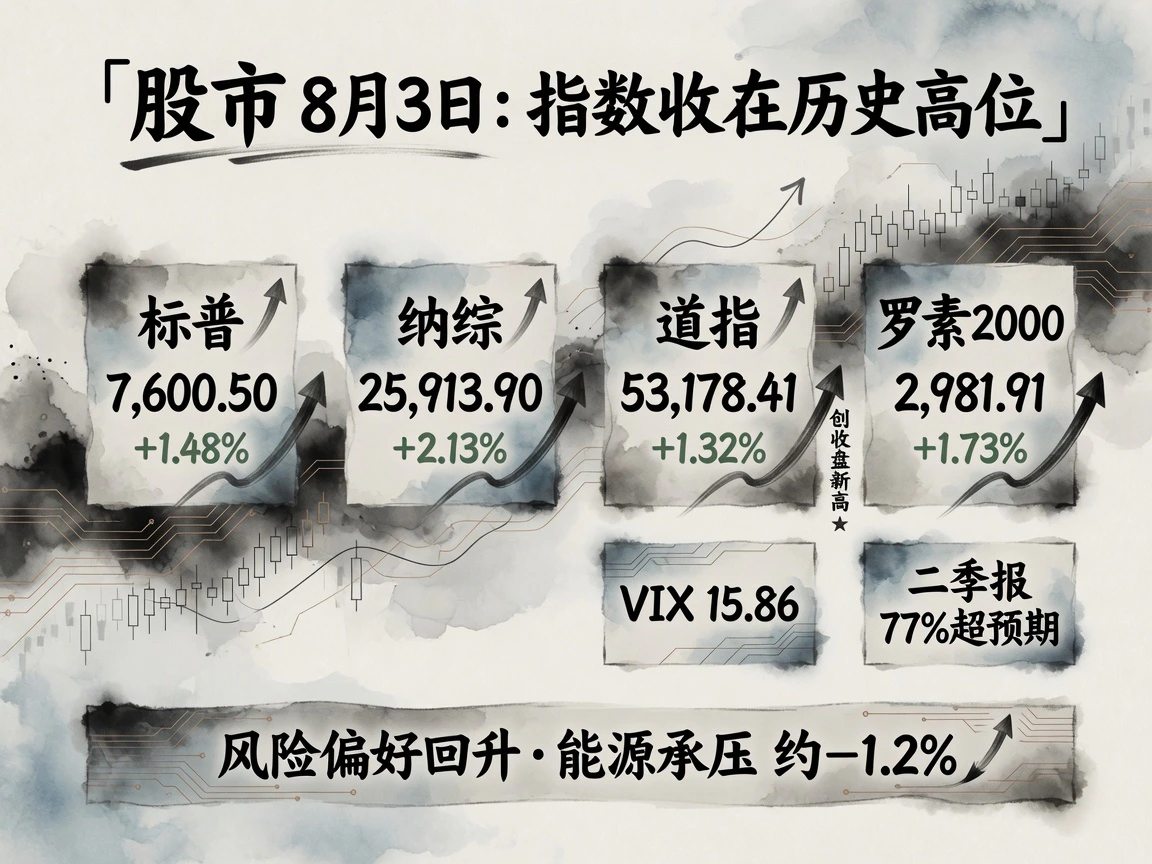
Major U.S. indices all closed near historical highs: S&P 500 +1.48% to 7,600.50, Nasdaq Composite +2.13% to 25,913.90, Dow +1.32% to its record 53,178.41 and Russell 2000 +1.73% to 2,981.91; VIX fell to 15.86. Internal differentiation was more revealing than the broad gains. Communication services and mega-cap technology regained leadership: Meta rose about 6%, Microsoft and Alphabet around 5% each, Amazon's intraday capitalization first exceeded $3 trillion and Nvidia gained about 3%. Apple instead lost roughly 0.8%, the only Mag7 decliner, with supply-chain bottlenecks and discounted guidance still constraining valuation.
Sectors reflected oil and policy transmission. Energy fell around 1.2% as crude plunged; lower fuel costs lifted American and United Airlines more than 5% intraday. Boeing gained roughly 7%, chiefly after FAA approval of 737 Max 7 certification. Earnings fundamentals also remained firm: about 77% of reporting S&P 500 companies beat expectations in the second-quarter season, the highest share since 2021. Aggregate second-quarter net profit grew about 27% year on year, supporting valuations.
Asia-Pacific markets did not mirror U.S. enthusiasm and followed local drivers. KOSPI plunged 5.12% to 6,257.45 after the previous session's record +17.91%, with Samsung Electronics and SK Hynix each down about 8.8%. The Nikkei 225 fell 0.94% to 63,754.90 after Japan's Finance Ministry confirmed joint yen-buying intervention with the U.S. Treasury the preceding Friday. USD/JPY's daily reading fell to 157.58, a 1.62% yen gain, pressuring exporters. Hong Kong's Hang Seng edged up 0.48% to 26,009. Alibaba's U.S. shares rose about 4%–6% intraday on the Qwen3.8-Max release. Leveraged memory-chip profit-taking, intervention adjustments and individual Chinese technology news created a very different Asian rhythm.
After hours, Palantir's results beat across the board: adjusted EPS $0.41, revenue $1.94 billion, up about 93%, and sharply raised full-year sales guidance of $8.15 billion–$8.16 billion. Shares initially surged 12%–15% after the close. U.S. futures remained firm; at 08:48 August 4 Beijing time, ES was near 7,633 and NQ 28,886. Early Tuesday Asia remained weak: the Nikkei was down about 1% to 63,124 at 08:43, and Korea's composite fell further to 6,179 at 08:38. Hong Kong had not opened.
Fixed income: yields fall 3–5 basis points in mild bull flattening
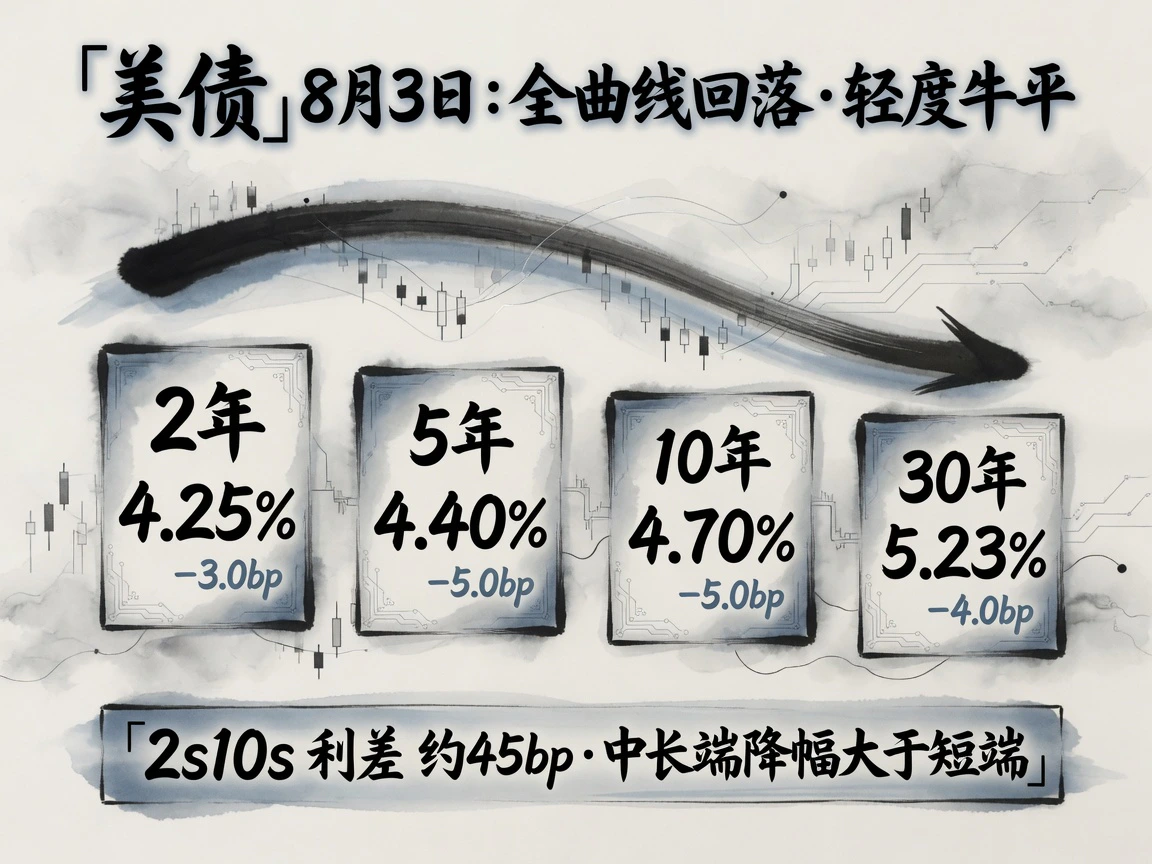
Treasuries technically recovered across the curve after deep selling the prior week. Official Treasury par closes showed two-year 4.25%, down 3.0 bp; five-year 4.40%, down 5.0 bp; ten-year 4.70%, down 5.0 bp; 30-year 5.23%, down 4.0 bp. The two-/ten-year spread narrowed from roughly+47 bp Friday to+45 bp. This reversed Friday's long-end-led mild bear steepening into mild bull flattening. The two-year still exceeded the mid-July 4.1%–4.2% plateau, showing no material easing turn or revived cutting narrative.
Cross-asset interaction made the mechanism clear. Lower oil first reduced the premium for a surge causing renewed inflation and forcing earlier Fed hikes. Ten-year breakeven inflation fell one bp to 2.27%, while five-year breakevens fell three bp to 2.23%, a larger decline. Broader risk recovery also helped: stocks and bonds rose together as VIX fell. This combined relief from inflation pressure with stronger risk appetite; describing the bond rally simply as safe-haven inflows was inconsistent.
Markets also absorbed two potential negatives. Manufacturing PMI at 55.6 would normally lift front nominal rates with steady oil, but crude's plunge overwhelmed it. Treasury raised third-quarter July–September net marketable borrowing guidance to about $739 billion,$68 billion above May's estimate, directly unfavorable to duration supply. Yet the 30-year yield fell four bp, showing extra supply was not that day's main trade.
The policy target remained 3.50%–3.75%, after July 29's 9:3 hold with three dissenters favoring 25 bp of tightening. At 19:45 Eastern on August 3, derivatives implied about 64% odds of a 25 bp September 16 hike versus 66% previously, and 36% unchanged. Hiking remained the priced baseline, with marginal pressure eased by oil. Traders removed a premium for extreme oil making a September hike unavoidable, without betting on cuts. Four-to-five-bp declines in intermediate/long benchmarks supported five-to-ten-year dollar investment-grade duration. Latest verifiable HY and IG spreads were 2.84% and 0.80%, July 30 readings; no precise live Monday spread data justified extrapolating further tightening.
Macro: strong PMI fails to stop falling yields as oil dominates pricing
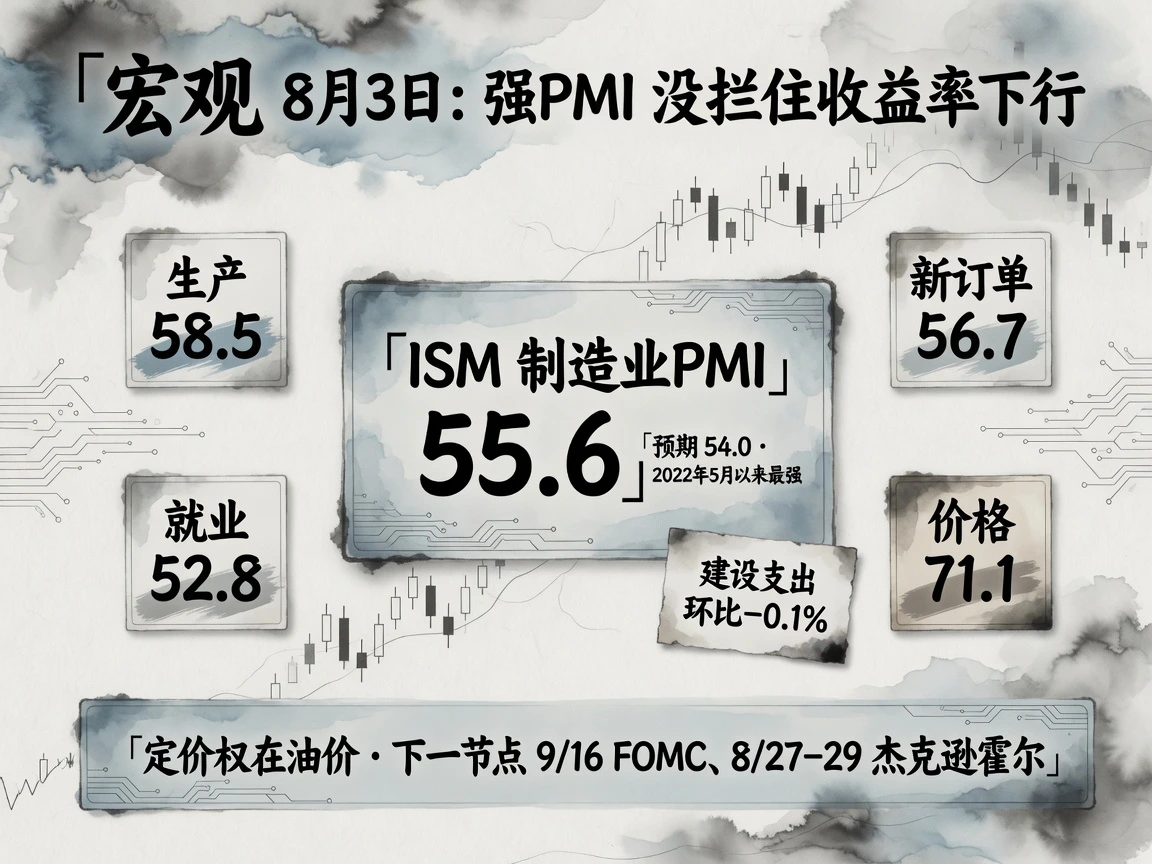
August 3 data diverged unusually from assets. July ISM manufacturing PMI reached 55.6, above 54.0 expected and 53.3 previously, the strongest since May 2022. Production rose to 58.5, highest since November 2021; new orders were 56.7, a seventh consecutive expansionary month; employment 52.8 ended 33 months of contraction; prices 71.1 fell 1.9 points from June but remained high. S&P Global's July manufacturing final was 53.9, unchanged from June and also expansionary, but its detail was more cautious: severe delivery delays, slower yet elevated input costs and fading forward confidence. June construction spending fell 0.1% versus+0.2% expected, and May was revised to 0%. Strong factories alongside weak rate-sensitive construction and property again showed internal divergence.
The July SLOOS released that day showed no systemic credit contraction. Large- and medium-business C&I standards were stable, demand edged up and spreads narrowed; most commercial-property categories saw net easing. Households differed: mortgage demand was weak and consumer-credit standards, including cards, tightened slightly. Improving businesses versus pressured housing and households corroborated manufacturing resilience and weakened the argument that autonomous financial tightening would force cuts.
No new official remarks appeared in the window. Key macro dates shifted to the August 27–29 Kansas City Fed Jackson Hole symposium, on implications of financial innovation for payments and monetary policy, and the September 16 FOMC decision. Strong ISM still coincided with slightly lower September hike odds as oil fell, showing commodities were treated as a more sensitive forward inflation signal than surveys. The logic was dynamic: renewed Middle Eastern friction and soaring crude could instantly make the same strong PMI evidence for hawkish action. That sentiment-switching point deserved close attention.
Commodities: oil falls about 5%, removing a narrative premium
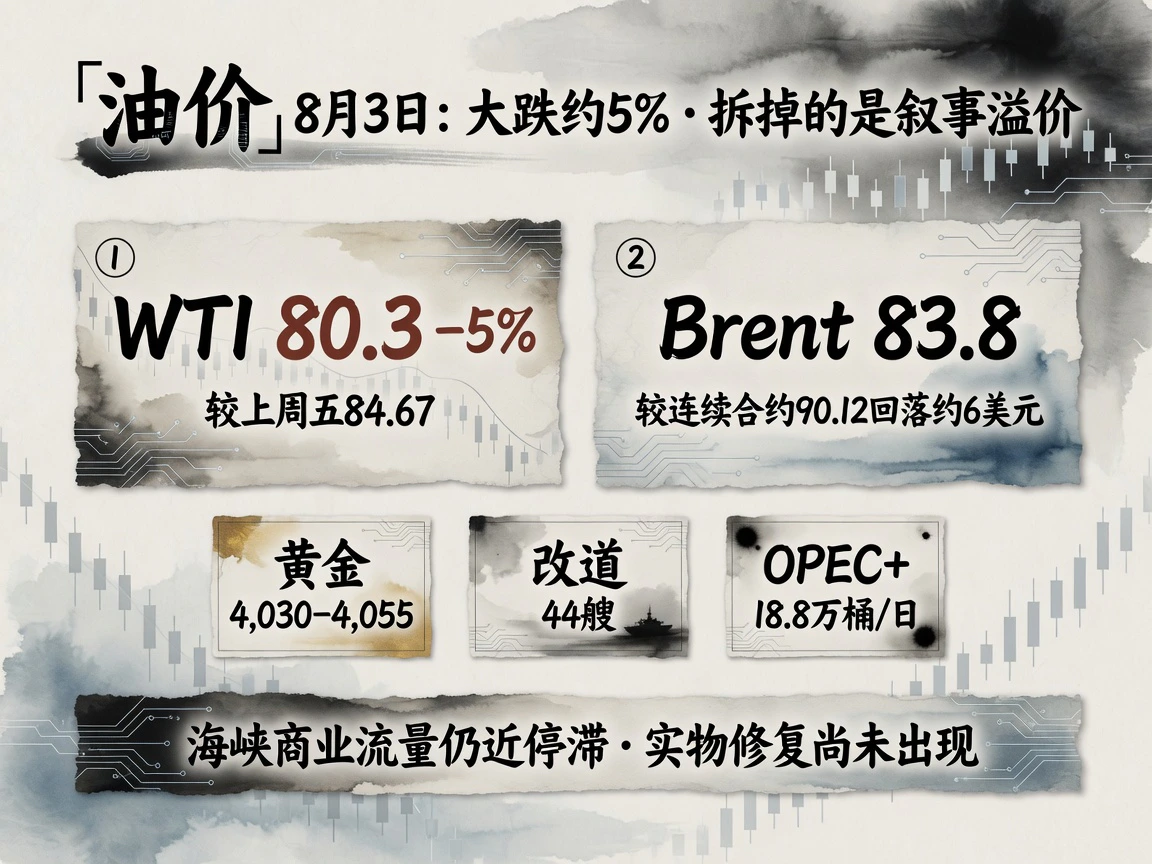
Monday's oil plunge priced a sharp decline in escalation risk, while physical supply chains were far from repaired. Prompt WTI settled $80.3/barrel versusFriday $84.67, down around 5%; Brent closed $83.8, about $6 belowFriday's continuous $90.12. Early weekend gaps and contract-roll bases produce differing percentage measures, so absolute declines are the reference. Commercial tanker passage remained stalled; Iran denied direct U.S. negotiations and described only Omani talks on temporary safe routes. CENTCOM had forced 44 merchant ships to divert, disabled two and boarded two by Monday. At least six Saudi-linked large tankers detoured around the Cape of Good Hope. Backwardation remained intact: the selloff trimmed extreme prompt premiums without turning the curve into surplus-driven contango.
Post-close developments confirmed unresolved risk. UKMTO said a cargo vessel was hit by an unidentified projectile about 20 nautical miles northeast of Al Khasab, Musandam, Oman, at 18:00 Eastern on August 3, 22:00 UTC, after the U.S. cash close. Responsibility remained under investigation. Such incidents and enforcement patrols showed that absent institutional air-defense and navigation guarantees, the asymmetric risk of a renewed premium over coming sessions remained high.
Gold moved sideways, decoupled from oil. Friday COMEX continuous gold settled near $4,049/ounce; major Monday sources showed consolidation at $4,030–$4,055, as dollar weakness offset loss of safe-haven premium. The 08:48 August 4 Beijing-time electronic quote near $4,112 differed markedly and should initially be treated as contract-roll and inactive-hours settlement noise, rather than proof of an Asian price jump. OPEC+'s planned September restoration of 188,000 barrels/day was an existing policy step, not Monday's catalyst. The next actual inventory test was the August 5 EIA weekly report.