Series note: This is the third installment in the series on Warsh's Federal Reserve reforms. Part One examined changes to communication; Part Two focused on quantitative tightening, the policy rate and the balance-sheet path. This installment takes a closer look at inflation measures and the evolution of the policy framework. Subsequent articles will explore data sources and AI productivity, the frequency of policy meetings, internal committee governance and other deeper issues.
Scope: Research on policy mechanisms and macroeconomic pricing logic; this article does not constitute investment advice.
Introduction: A new chair starts by changing the measuring stick

In a central bank's fight against inflation, the first consequential step is often to clarify two more fundamental questions before adjusting the policy rate: what exactly its measuring stick measures, and what logic governs its response when the reading changes. The first determines the size of its blind spots; the second defines the boundaries and pace of its actions.
At his Senate confirmation hearing on April 21, 2026, Kevin Warsh bluntly called for the Fed to establish a completely new inflation framework and expressed strong public interest in replacing its benchmark inflation measure. The target he seeks to dismantle and rebuild is the Fed's deeply embarrassing record of mistakes in 2021–2022. Before assessing his proposals in full, we must understand the misjudgment that so badly damaged central-bank credibility: where exactly did the Fed's defenses fail, and what hard lessons remain unresolved?
I. Background and lessons: The failures of 2021–2022
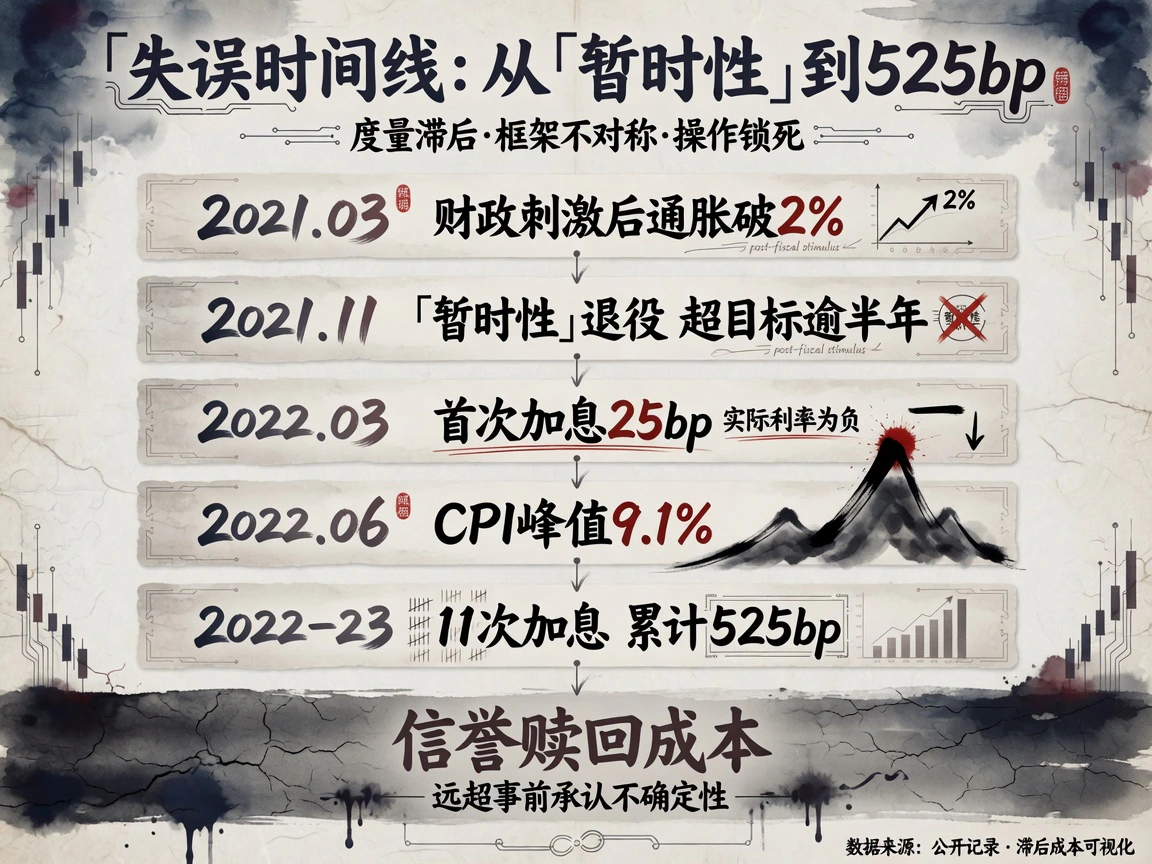
Looking back, policy failure was no isolated technical miscalculation. It was the inevitable result of structural flaws in statistical measurement, the policy framework and operational guidance reinforcing one another.
1. Systematic lags in measurement
When inflation returned in 2021, the first flare-ups appeared in specific areas including energy, food and used cars. Yet the Fed's longstanding benchmark, core PCE—the personal consumption expenditures price index excluding food and energy—was inherently designed to keep these early warning areas permanently outside its policy field of vision. Price surges caused by fractured supply chains were hastily dismissed as temporary noise, leaving official readings far behind the actual surge in prices.
In retrospect, once food and energy change from external sources of noise into sources of systemic shocks, a statistical method that excludes fixed categories will structurally understate inflation's breadth. By the second half of 2021, price increases had already spread rapidly from the initial bottlenecks into a wider range of goods and services. Core PCE nevertheless continued to send a false signal of safety: the problem was localized, isolated and manageable. At the crucial moment, policymakers' most trusted measuring stick had become the slowest thermometer in the room.
2. An asymmetric framework: Makeup logic became permission to delay
The framework's one-sided design turned professed policy prudence into a legitimate excuse for delay. Flexible average inflation targeting, or FAIT, introduced in August 2020, was a defensive system tailored to the threat of persistent deflation. It was highly alert to weak prices but gave overheating a green light. It even explicitly encouraged moderate inflation overshoots after an extended period of low inflation, seeking to meet the target on average over the cycle.
Within that elaborate design, however, moderate had no hard numerical ceiling, and some time had no defined duration. When inflation became the dominant macroeconomic risk, this catch-up logic effectively gave the Fed institutional permission to postpone tightening. From the spring of 2021, actual inflation repeatedly breached the 2% threshold, yet policymakers remained on hold for almost a year in the name of making up for earlier low inflation. Rules intended to constrain the cost of misjudgment instead became a refuge that legitimized inertia.
3. Commitments locked in inaction: Forecast models and forward guidance both failed
Alongside the framework's failure, rigid forward commitments tied policymakers' hands. Guidance was tightly bound to substantial further progress in employment and dogmatically required tapering of asset purchases to be completed in an orderly sequence before rate increases could begin. Months of a valuable policy window were squandered on formalities.
Meanwhile, the Fed's quarterly Summary of Economic Projections, or SEP, fell into the predicament of repeatedly raising its forecasts while continually lagging reality. The forecasting system placed excessive faith in a flattened Phillips curve and blindly assumed that long-term inflation expectations could remain strongly anchored on their own. Faced with a demand surge driven by $1.9 trillion in fiscal transfers and enormous liquidity injections, it lost its ability to provide advance warning.
Only in November 2021 was the transitory explanation finally abandoned, under intense pressure, after inflation had exceeded the policy target for more than half a year. By the time the first rate increase eventually arrived in March 2022, the real policy rate was deeply negative. What followed was an abrupt tightening campaign: 11 successive meetings with rate increases totaling 525 basis points over a year and a half, and the painful lesson of CPI inflation reaching a four-decade high of 9.1% year over year in June 2022.
4. Four lessons
This costly experience leaves four lessons with direct relevance today.
First, the measuring stick is itself a policy stance. Choosing what to exclude from a statistic determines in advance which shocks receive less attention. If the measure cannot reflect the distribution of price changes under real supply shocks, policy blind spots are unavoidable. This is the fundamental reason trimmed mean measures later emerged as a policy issue.
Second, policy frameworks need symmetric constraints. Rules designed solely to protect against downside risks often become catalysts for systematic mistakes when confronted with a storm from the opposite direction.
Third, during a macroeconomic rupture, observed data must decisively outweigh model projections. Econometric models often fail to warn of changes in the underlying regime. Reliance on linear extrapolation only detaches decisions from reality.
Fourth, central-bank credibility is the most expensive asset to maintain. The transitory misjudgment forced the Fed to pay an enormous price in aggressive tightening and financial turmoil, including the sudden regional banking crisis in the spring of 2023, to restore its credibility. The damage from retrospective repair far exceeded the risk of acknowledging uncertainty in advance.
II. Warsh's principal arguments
Warsh's diagnosis goes to the heart of that record: these were structural defects in measurement and analysis, rather than errors of judgment by individual officials. Small repairs will no longer suffice; the system must be rebuilt as a whole. His proposals can be distilled into five central pillars.
1. Redefining inflation's origins: Inflation is an institutional choice
The theoretical foundation of Warsh's framework is a fundamental reassessment of what causes price increases. In a November 2025 Wall Street Journal opinion piece on the failure of Fed leadership, he systematically set out his core position: inflation's true origins lie in unchecked government spending and excessive central-bank money creation, rather than overly rapid economic growth or rising worker pay. As he put it, Wall Street was awash in liquidity while credit to the real economy was being squeezed.
That attribution directly overturns the traditional chain of policy reasoning. On one hand, it sharply reduces the decision-making weight of the Phillips-curve transmission mechanism: the conventional belief that tight employment pushes up wages and therefore inevitably raises prices. Strong economic expansion and reasonable wage growth cease to be negative signals that must be extinguished through aggressive tightening. On the other hand, responsibility for controlling inflation is redefined. If inflation is a product of fiscal excess and expanding liquidity, the first remedies should be fiscal discipline and constraints on the central bank's balance sheet. Sacrificing employment in the real economy and suppressing aggregate demand must no longer be the habitual default cost. Inflation thus becomes a test of institutional macroeconomic discipline rather than a thermometer of economic overheating: a consequence of policy choices, rather than an irresistible macroeconomic fate.
2. Replacing the benchmark: Trimmed mean PCE instead of core PCE
Warsh concentrates his dissatisfaction with the existing system on its longstanding benchmark, core PCE, which excludes food and energy. He argues sharply that mechanically and permanently excluding those categories assumes their prices are always random noise. Yet under the new normal of tariff barriers, recurring geopolitical confrontation and global supply-chain restructuring, the excluded components often contain the most important changes in macroeconomic supply conditions. The resulting blindness to underlying trends was demonstrated by the major failure of 2021.
He advocates shifting to the Dallas Fed's Trimmed Mean PCE. This measure does not designate particular categories as noise in advance. Instead, it examines the full distribution of price changes each period, removes specified proportions of extreme increases and decreases from the two tails, and uses the middle of the distribution to capture the underlying inflation trend.
The philosophies behind the two measures differ sharply. Core PCE excludes by product category, while the trimmed mean removes observations by the magnitude of price changes. The former assumes shocks always have a fixed address; the latter takes the more pragmatic view that shocks occur at the extremes of the distribution. Since Warsh expressed a preference for the measure at his congressional confirmation hearing, Wall Street banks and macroeconomic institutions have rapidly built high-frequency forecasting models for it. Its policy standing has already risen materially.
3. Moving beyond model worship: From dependence on forecasts to dependence on reality
Warsh explicitly describes the loss of inflation control in 2021–2022 as a failure of the framework. The Fed's forecasting apparatus was trapped in its old reliance on the Phillips curve and extrapolation of historical trends, failing systematically when macroeconomic institutions and supply conditions broke from the past.
The resulting operational principle is to strip away excessive dependence on complex black-box models and decisively refocus policy on observed, verifiable data. It calls for fewer long-term path commitments that needlessly restrict policymakers and for preserving freedom to respond to changing circumstances. This is closely aligned with his forceful reform of Fed communication. The quarterly SEP and dot plot are products of model worship; substantial simplification and a reduction in their prominence have already been implemented first through the communication reforms.
4. Abolishing average inflation targeting: Ending retrospective makeup logic
Warsh's criticism of the 2020 FAIT framework goes straight to its central flaw. Making up for past shortfalls to achieve an average target over time may have theoretical merit in a low-inflation or deflation trap. In an environment of recurring inflation risk, however, it becomes institutional permission for slow decision-makers to conceal how far they have fallen behind the curve. In 2021, the Fed stood by as prices surged, invoking the need to compensate for earlier below-target inflation.
He calls for replacing this ambiguous average makeup system with an immediately effective, symmetric 2% point target. One distinction must be clear: in his public arguments, Warsh attacks the statistical measure, forecasting models and makeup logic, rather than the accepted absolute anchor of 2% itself.
5. Adding a consequential variable: AI productivity and the structural disinflation hypothesis
Artificial intelligence and advances at the technological frontier carry particular weight in Warsh's vision. He repeatedly advances a central hypothesis: AI is unleashing profound structural disinflation on the supply side, allowing high growth and low inflation to coexist beneficially.
If macroeconomic data validate that hypothesis, the Fed must stop using historical estimates of potential growth and conventional output gaps as automatic triggers for tightening. Otherwise, it risks unnecessarily suppressing healthy growth driven by improved supply-side efficiency. This extends his view that growth should not be treated as a fault. Objectively, however, it is also the part of his framework with the weakest empirical support and the greatest dependence on future macroeconomic verification.
III. Principal differences from the existing approach
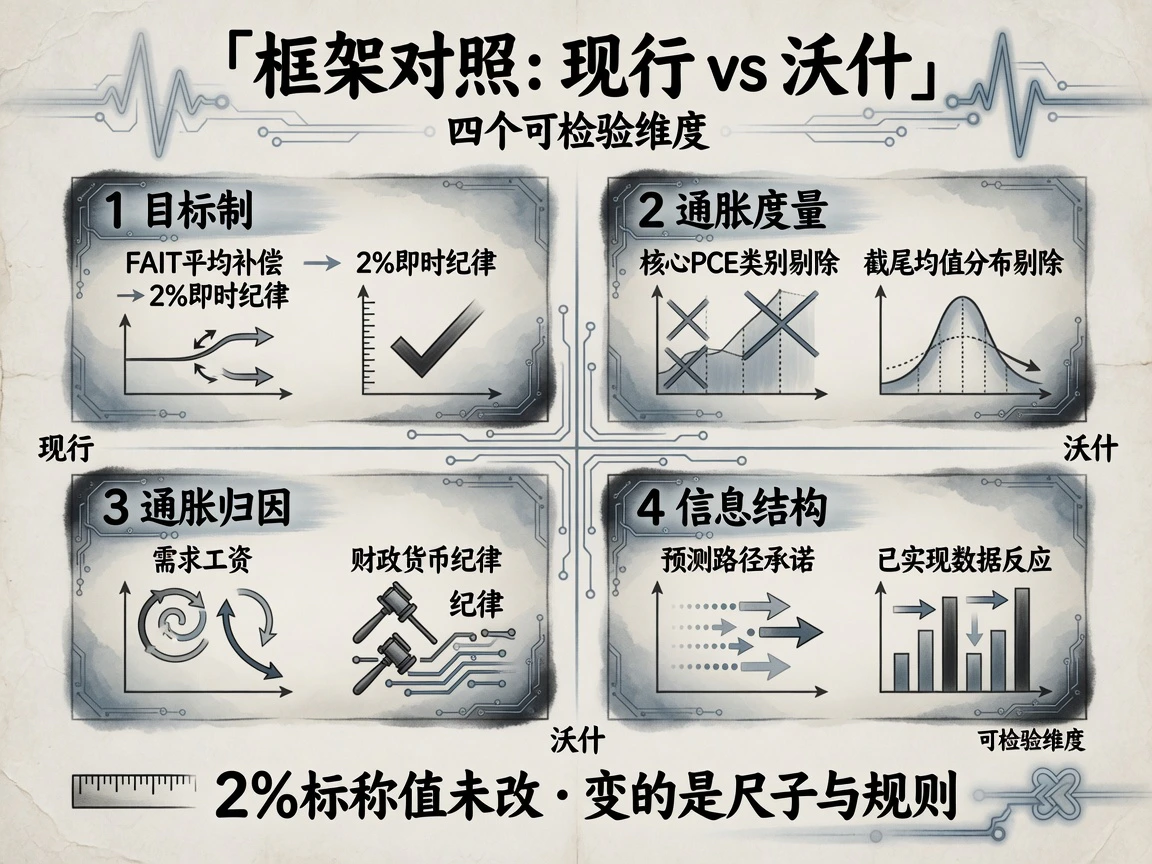
Compared with current central-bank practice, these proposals clash with the existing logic in four main dimensions.
-
The target regime: Average makeup or immediate discipline? FAIT anchors policy to average inflation over a period, with rules that permit or even encourage temporary overshoots. Warsh's framework instead stresses immediate correction when current readings depart from 2%. An overshoot is itself evidence of policy failure, rather than an allowance for additional accommodation. This seemingly small technical distinction determines how long a central bank can stand still after prices breach the threshold. In 2021 the existing system's answer was almost a year; Warsh seeks to reduce that tolerance period to zero.
-
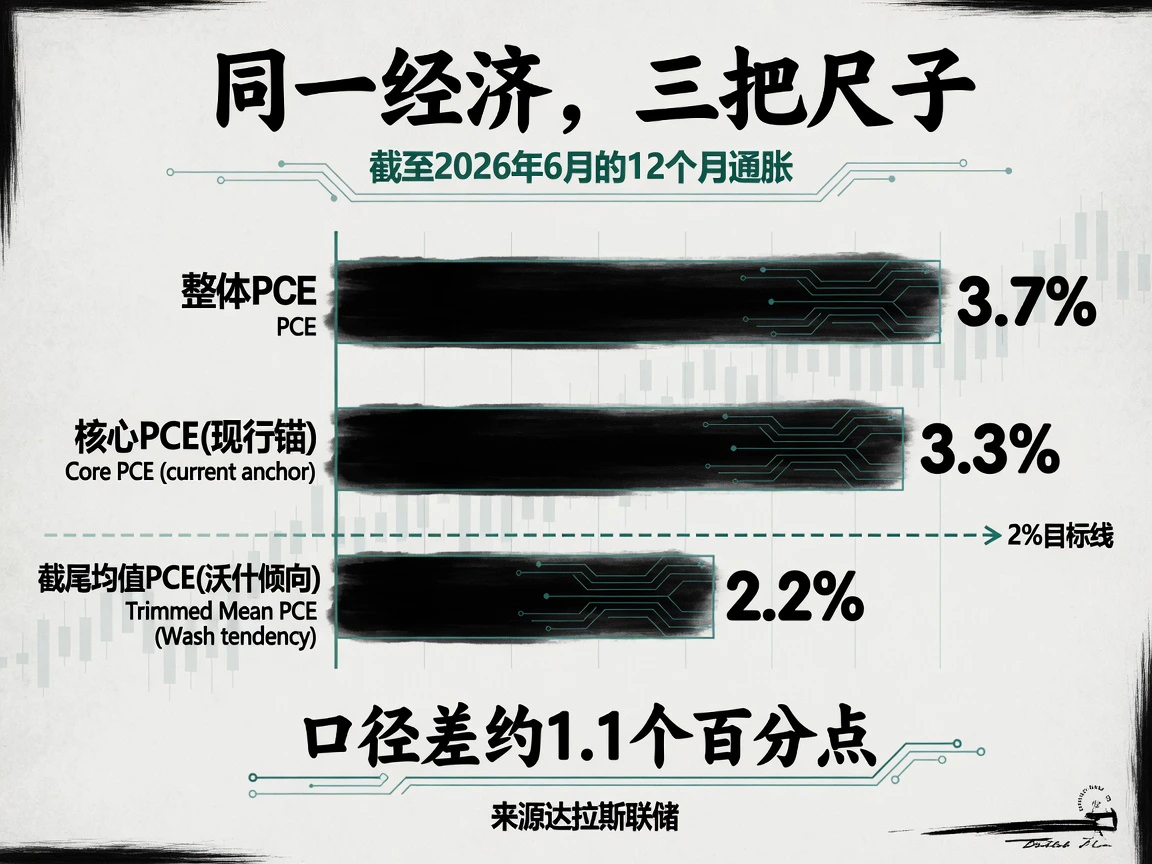
Measurement philosophy: Fixed category exclusions or distribution-based trimming, and the resulting divergence in readings. This is the most closely watched and practically consequential point of contention in today's market. Over the twelve months through June 2026, US headline PCE inflation was about 3.7% and core PCE 3.3%, while Dallas Fed trimmed mean PCE had declined to around 2.2%. Two measures of underlying inflation differed by fully 1.1 percentage points and, dramatically, lay on opposite sides of the critical 2% threshold. The divergence arises from skewness in the statistical distribution. US price increases currently have an extreme right skew: sharp goods-price increases caused by tariffs and individual supply-chain disruptions are concentrated in the long right tail, and trimming mechanically removes them as outliers. Dallas Fed researchers warned as early as April 2026 that under such an extremely right-skewed distribution, the trimmed mean would systematically understate the overall inflation trend. Nomura's skewness-adjusted estimate put trimmed mean inflation at about 2.8%, substantially narrowing the gap with core PCE. In other words, changing the measuring stick in the present macroeconomic environment has a highly asymmetric effect: it only lowers the reading. This is the central basis for critics' suspicion that the change is being tailored to justify rate cuts.
-
Attribution and the reaction function: Suppress aggregate demand or enforce fiscal discipline? Under the existing approach, the Fed traditionally fights inflation by tightening financial conditions and suppressing aggregate demand, leaving the labor market and real economy to bear the heavy cost of disinflation. Under Warsh's framework, if fiscal deficits and a loss of control over the central bank's balance sheet are identified as the principal causes, fiscal consolidation and balance-sheet reduction must be the first areas of tightening. The interest-rate response to supposed demand-driven overheating could consequently be more restrained. Having learned from 2021, the current system is reluctant to call external supply shocks, such as oil-price surges and tariff barriers, transitory. Warsh, by contrast, advocates looking through them again, because these supply impulses do not themselves demonstrate a breakdown in monetary discipline.
-
The information environment: Closely guiding expectations or leaving room for independent market pricing? The current system supplies markets with excessive policy-path guidance through the quarterly SEP and dot plot, and investors follow it step by step. Warsh rejects long-term path commitments, arguing that markets should price fundamentals independently while the central bank responds promptly to current actual data. The two approaches shape volatility in opposite ways. The former smooths ordinary fluctuations but quietly accumulates tail risk from systematic misjudgment. The latter disrupts comfortable expectations and releases short-term volatility, while fundamentally dispersing the systemic fragility of asset pricing.
IV. Implications for monetary policy
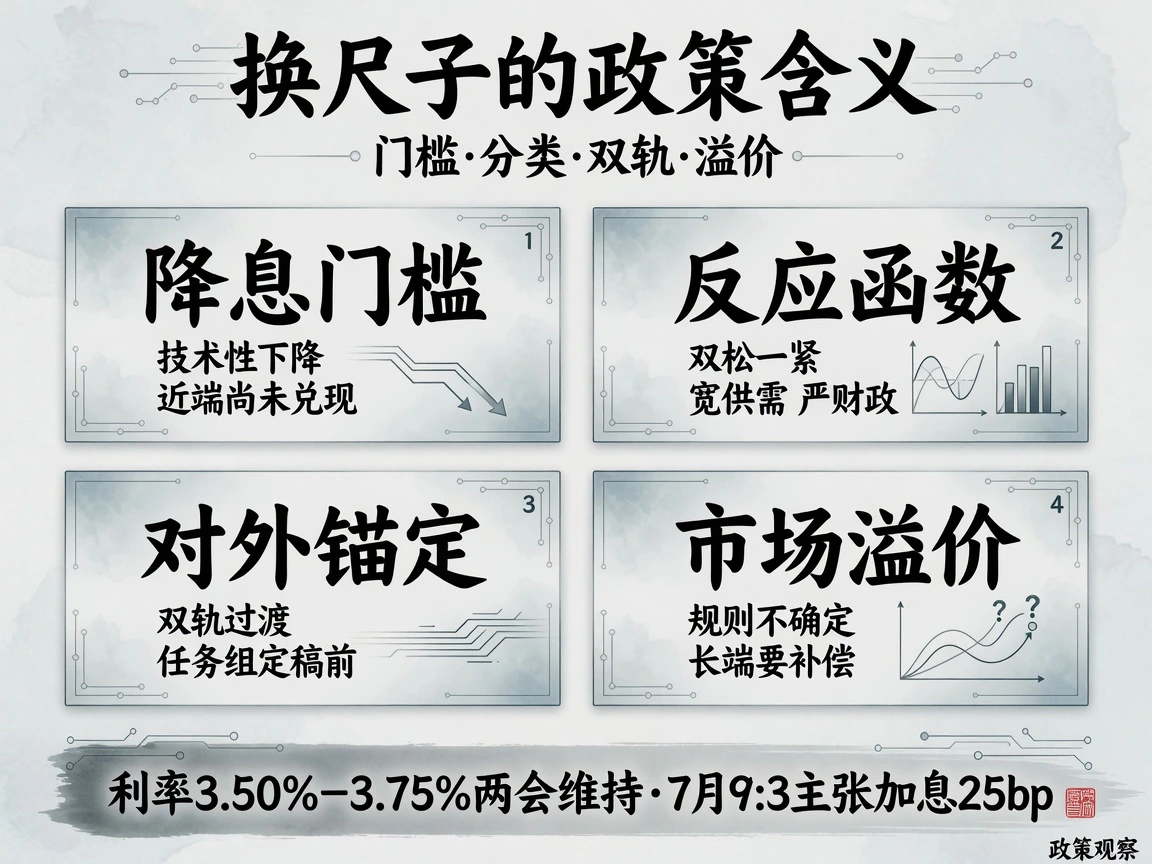
Following this logic, the deeper change in measurement and framework would transmit to monetary policy and cross-asset pricing on four levels.
First, the technical threshold for rate cuts falls materially, but hard real-world constraints prevent that opening from translating into action. If the benchmark shifts directly from core PCE to the trimmed mean, the inflation narrative instantly changes from significantly above target to essentially back near its boundary. At an unchanged nominal rate, the implied real policy rate suddenly appears excessively restrictive, opening the door to cuts. This is precisely why critics argue that the proposal is tailored to justify easing. Real-world policy bargaining is far more complicated than theoretical reasoning, however. At both the June 17 and July 29 meetings, the federal funds target range remained unchanged at 3.50%–3.75%. July even saw three regional Fed presidents join in a forceful dissent in favor of a rate increase. With core inflation still above 3% and geopolitics driving oil prices higher, a preference for a different indicator cannot force the near-term balance of actual rate policy to reverse.
Second, the entire central-bank reaction function shifts to the right, producing a subtle structure of two looser responses and one tighter response. The new framework substantially increases tolerance for supply shocks, favoring looking through temporary impulses from oil and tariffs. It also sharply reduces concern about a strong labor market and rising wages, rejecting the inevitability of a wage-price spiral. The hard trigger for tightening instead becomes empirical evidence of lost fiscal discipline and uncontrolled central-bank liquidity. This requires reassessing the trading-desk reflex, entrenched for decades, that a strong employment report must increase the probability of rate hikes. Fiscal deficit size, the pace of Treasury issuance and the intensity of Fed balance-sheet reduction would instead acquire unprecedented weight in asset-pricing models.
Third, the hidden contest between monetary and fiscal authorities becomes explicit, giving independence a new meaning. Publicly attributing inflation to fiscal policy effectively shifts the heavy adjustment burden from the labor market to Capitol Hill and the Treasury. Warsh's earlier proposal to exchange aggressive balance-sheet reduction for a lower policy rate essentially requires the Treasury to complement central-bank balance-sheet contraction with debt restraint. This reaches well beyond statistical technique and rewrites the rules of macroeconomic power. The debate over Fed independence would no longer be confined to whether the White House interferes in rate decisions. It would extend to the deeper question of whether the central bank can, at its own discretion, publicly assign a price to fiscal discipline.
Fourth, the transition cost of changing frameworks becomes the most immediate source of macroeconomic risk. Choosing the trimmed mean precisely when it diverges most from core inflation makes doubts about policy motives especially difficult to dispel. More ironically, a potential boomerang effect could emerge: if price pressures spread from tariff-affected goods to services and the distribution becomes symmetric again, trimmed mean inflation could exceed core inflation. The Fed would then have to use its own chosen measure to demonstrate worsening inflation, becoming trapped by its decision. Institutionally, FAIT in 2020 was a formal framework adopted by consensus of the full FOMC and endorsed before Congress. Any unilateral attempt to rewrite it would incur substantial costs in fractured internal agreement and congressional questioning. The five working groups Warsh established in June are a practical attempt to give the reform a formal process. For markets, however, the transition involved in rebuilding institutions itself means greater uncertainty. If investors demand compensation for rules that may be rewritten at any moment, that compensation will take the form of higher inflation risk premiums and Treasury term premiums, consistent with the pressure on long-term yields examined in Part Two of this series.
Conclusion
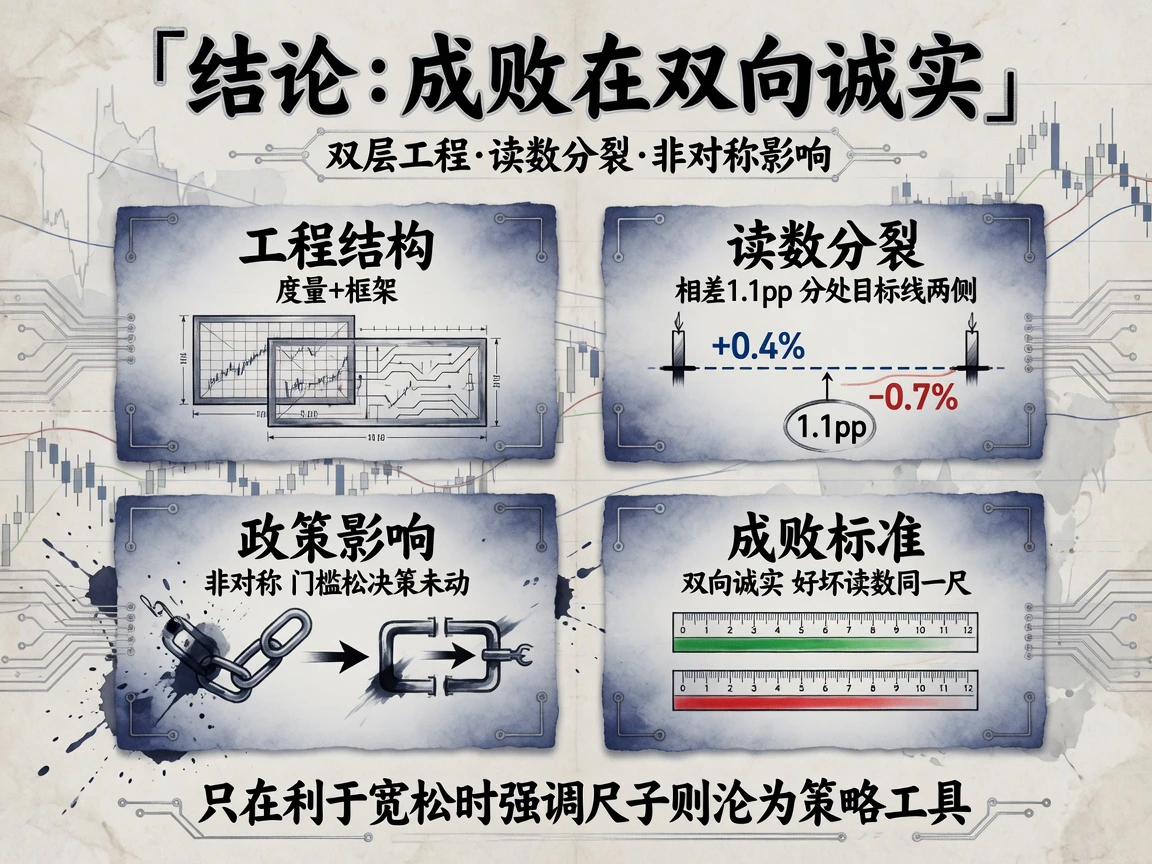
The central logic of this experiment in changing the measuring stick can be distilled into four substantive conclusions.
First, the Fed's failure in 2021–2022 was more than a single mistaken forecast. It was a systemic paralysis caused by failed measurement, a one-sided framework and rigid forward commitments reinforcing one another. This is the true target of Warsh's reforms. His proposal is a comprehensive reconstruction of causal attribution, measurement and rules: attributing inflation to fiscal and monetary discipline; replacing category-based core PCE exclusions with a distribution-based trimmed mean; replacing a discretionary average makeup regime with an immediate, symmetric 2% point target; and restoring respect for observed data.
Second, the most practically consequential clash with existing practice concerns measurement. The gap of more than one percentage point between core PCE at 3.3% and the trimmed mean at 2.2% means that two underlying inflation measures straddle the 2% policy benchmark. It also exposes the trimming algorithm's inherent weakness under extreme skewness: excessive removal of goods shocks such as tariffs. Changing the measuring stick now would objectively lower the official reading in one direction. Both supporters and critics must start from that reality.
Third, the policy effects are deeply asymmetric. Although the technical hurdle for cuts falls on paper, elevated core inflation and geopolitical oil shocks constrain near-term easing. The reaction function becomes more tolerant of supply and wage shocks and more sensitive to failures of fiscal discipline, fundamentally rewriting the contest between monetary and fiscal authorities.
Fourth, the greatest macroeconomic variable is never the relative merits of any single indicator's algorithm. It is the disruption of trust caused by changing institutions. Doubts about motives, the risk that the chosen measure later backfires and procedural resistance to overturning an existing consensus will ultimately be priced into inflation risk premiums and Treasury term premiums.
The key tests of whether the reforms can actually be implemented are whether the working groups formally propose changing the policy anchor before year-end; whether references to trimmed mean inflation gain materially greater weight in FOMC decisions and congressional hearings; and, when the Fed eventually delivers its first cut, which measuring stick the accompanying statement cites to justify it.
This article examines policy and market mechanisms and does not constitute investment advice. Principal sources: the transcript of Warsh's Senate confirmation hearing and his public comments; Dallas Fed statistical models and empirical research on Trimmed Mean PCE; FOMC statements and voting records; public inflation data for 2021–2023; and market estimates adjusting for price-distribution skewness. Macroeconomic cross-sectional data in the article are through the end of July 2026.