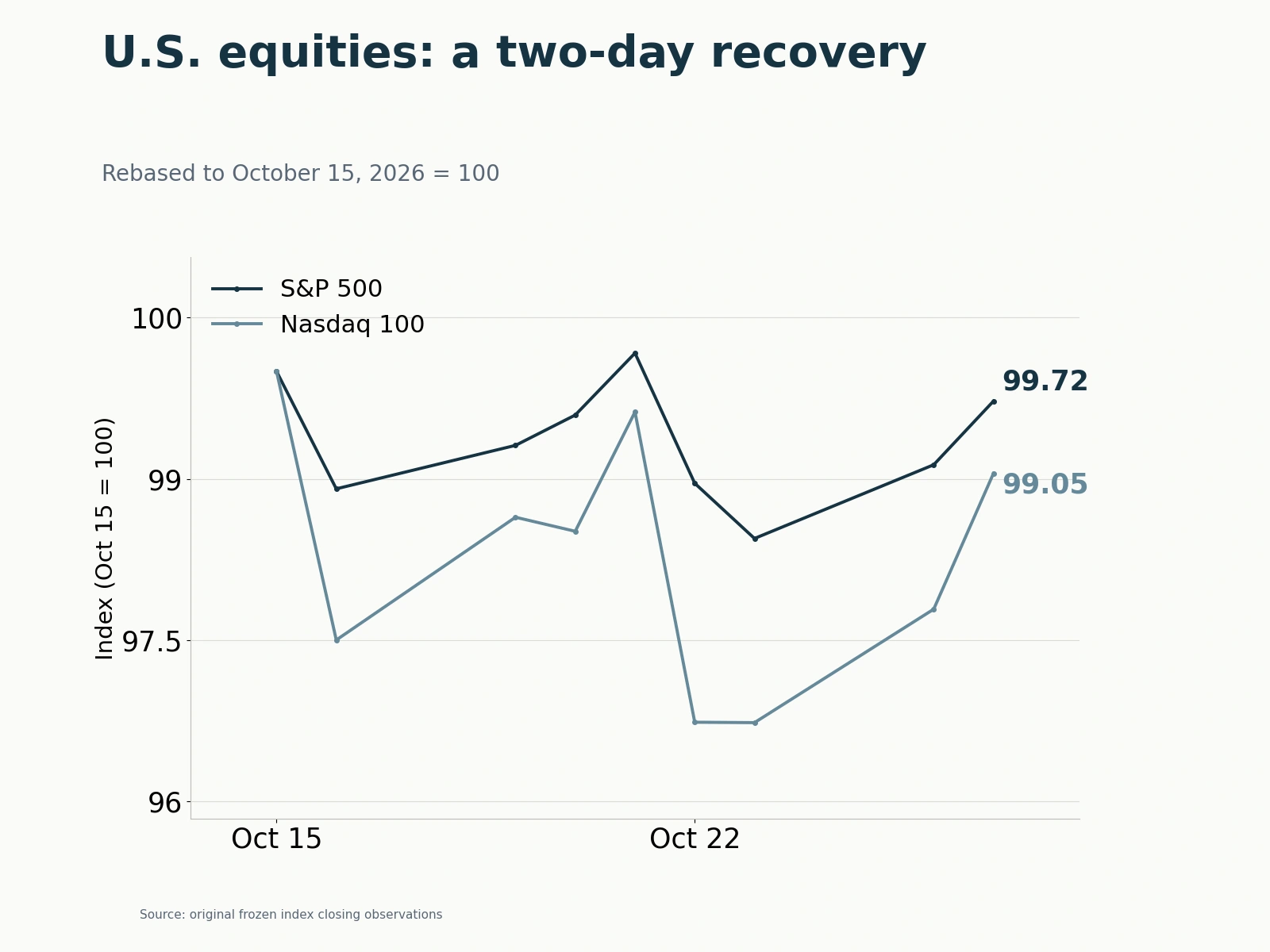
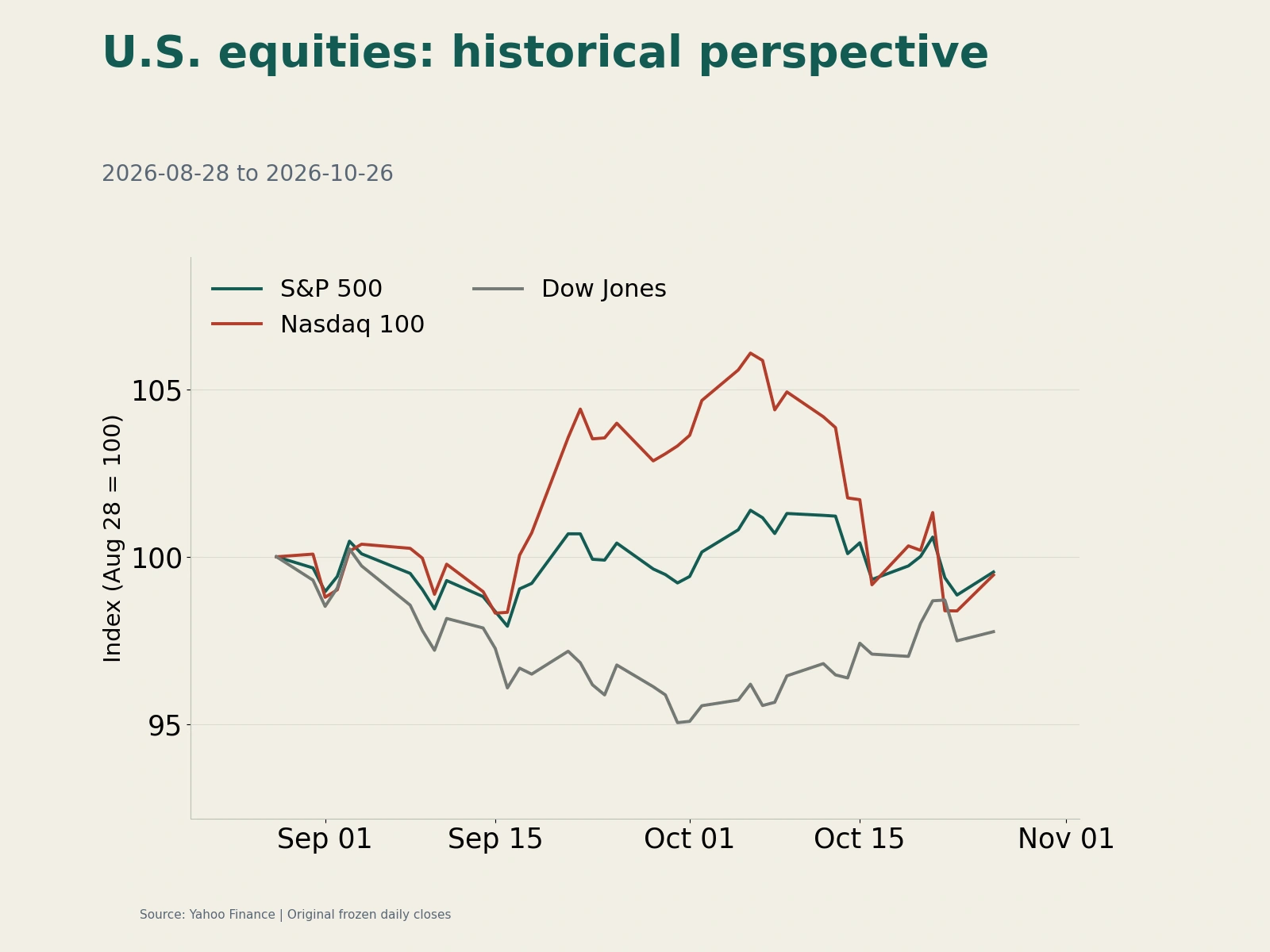
On August 7, 2026, the closely watched July payroll report delivered a broad downside surprise, quickly tilting global asset pricing toward a cooling labor market. Bureau of Labor Statistics data showed an unexpected 23,000 decline in nonfarm payrolls, against the market's prior consensus for an increase of roughly 80,000, alongside a substantial combined downward revision of 103,000 to May and June. The tightening premium rapidly unwound. Treasury yields fell across the curve, with the front end leading a classic bull steepener. A CME FedWatch snapshot taken at approximately 06:18 U.S. Central time on August 7 put the probability of the Fed holding its benchmark rate at 3.50%–3.75% in September at about 57%, with the probability of a hike retreating to roughly 43%—a clear reversal of the previous day's bias toward tightening. Equities rose broadly, and gold rallied sharply as real yields fell. Oil settlements extended their recovery by roughly 1.2%, largely a technical correction to the market's excessive conviction earlier in the week that an agreement was inevitable. Across the full August 3–7 week, front-end yields generally finished below the previous Friday's levels. The S&P 500 gained about 3.6% and the Nasdaq Composite about 5.2%, each recording one of its strongest weeks since mid-April. Commodities diverged dramatically: WTI fell approximately 7.7% over the week, while gold gained about 7.2%.
Fixed income: Front-end yields lead the decline in a bull steepener
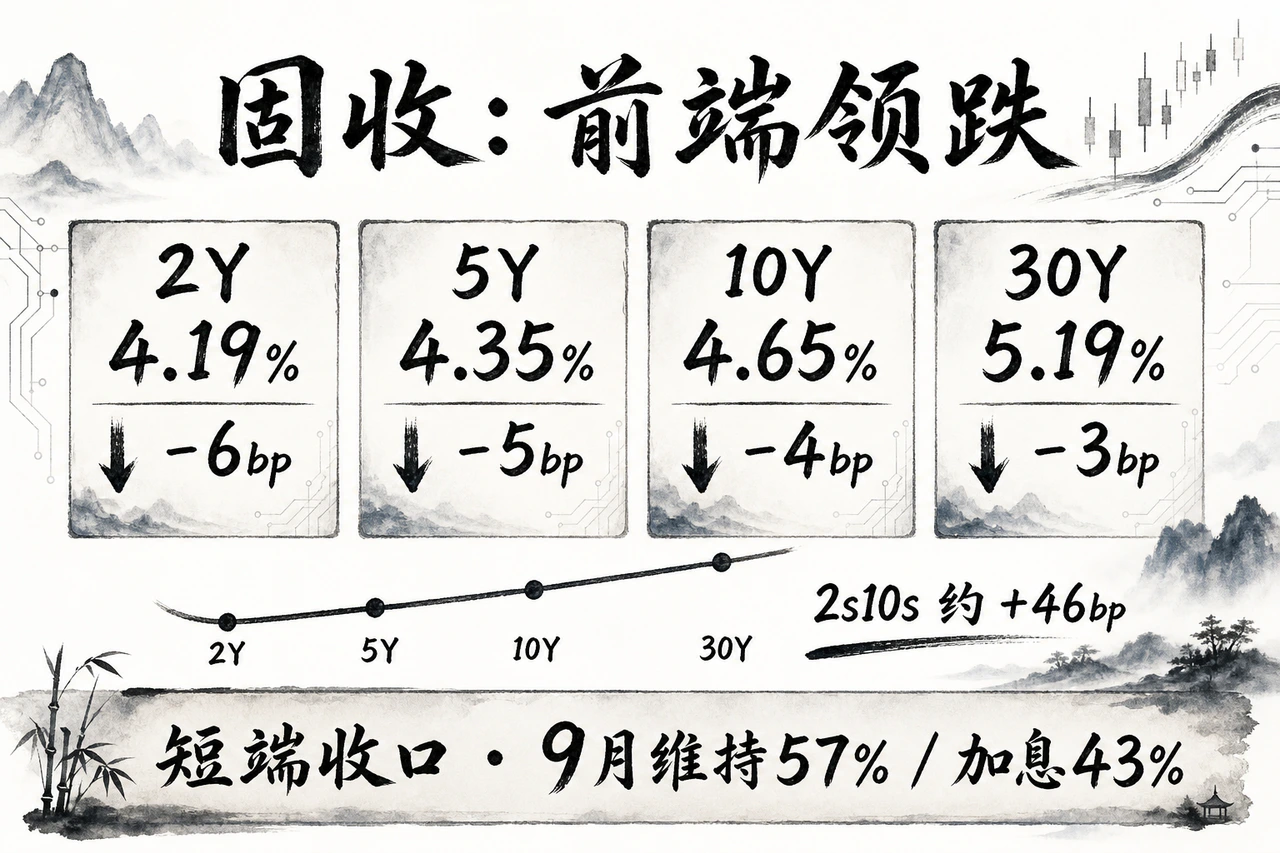
The U.S. Treasury's official daily par yield curve, measured close to close, showed the 2-year yield at 4.19%, down 6.0 basis points from the preceding session; the 5-year at 4.35%, down 5.0 basis points; the 10-year at 4.65%, down 4.0 basis points; and the 30-year at 5.19%, down 3.0 basis points. The 2s10s spread stood at roughly +46 basis points, about 2 basis points wider on the day, while 2s30s was around +100 basis points. This was a pronounced bull steepener: the front end, most sensitive to the September policy path, experienced the sharpest decline. Long-end yields followed, but by considerably less; fiscal issuance pressures and auction premiums had not meaningfully collapsed.
Relative to the official August 1 close, the 2-year, 5-year, 10-year and 30-year yields fell by approximately 9, 10, 10 and 8 basis points over the week. Short-dated Treasuries delivered one of their strongest weekly price gains since May. The 2s10s spread moved from about +47 basis points at the start of the week to roughly +46 basis points at its end, leaving the weekly slope broadly unchanged. The central development was a systematic downward shift in the entire yield curve, with Friday's payroll release bringing the week to a close through a steepening move. Markets were already looking ahead to the first test in the Treasury's quarterly refunding the following week: roughly $58 billion of 3-year notes, $42 billion of 10-year notes and $25 billion of 30-year bonds. The indicative 30-year yield hovered near 5.20%.
The federal funds target range remained 3.50%–3.75%. The July 29 FOMC meeting held rates steady, although 3 dissents favored a hike. The official FedWatch page showed a 57.0% probability of an unchanged rate in September and a 43.0% probability of a hike, compared with approximately 45% versus 55% the previous day and an even stronger tightening bias of 33% versus 67% a week earlier. The 2-year Treasury yield was about 44 basis points above the upper end of the policy range, consistent with a substantial unwinding of the option on one hike this year, without yet pricing in cuts. CNBC, citing CME data, reported that even as the probability of a September hold recovered to around 60%, the cumulative implied probability of a hike was still about 55% by October and 75% by December. Investors had deferred the next possible tightening move; they had not erased the option of tightening over the year. The 10-year breakeven inflation rate closed at 2.25%, down 1.0 basis point. Of the 4-basis-point decline in the nominal 10-year yield, approximately 3 basis points came from lower real yields, keeping the market's focus firmly on slower growth and a marginal reassessment of the Fed's reaction function.
In credit and offshore dollar bonds, no new official fixed-point readings for high-yield and investment-grade option-adjusted spreads were available for the review date; the latest readings, on August 6, were 2.71% and 0.78%. The Cbonds Hong Kong corporate dollar-bond T-spread was about 54.7 basis points on August 7, roughly 1 basis point wider on the day but still historically very tight. Lower benchmark yields over the week supported bond total returns, but the exceptionally thin credit spread offered little protection. If this week's CPI release runs hot again and revives the option of a hike, a valuation-driven price decline will probably precede any widening of credit spreads.
The futures snapshot at the reporting cutoff, around 08:35–08:38 Beijing time, was not a new cash-market close. The active Treasury futures contracts ZN, ZB and ZF, corresponding to the 10-year, 30-year and 5-year maturities, traded at 108.55, 109.19 and 106.35 respectively, slightly softer than Friday's settlements. This represented modest profit-taking in thin early Asian liquidity. Analysis of the cash yield curve continued to use the official August 7 end-of-day data.
Macro and policy: An unexpected payroll decline sharply eases the pressure for an immediate hike
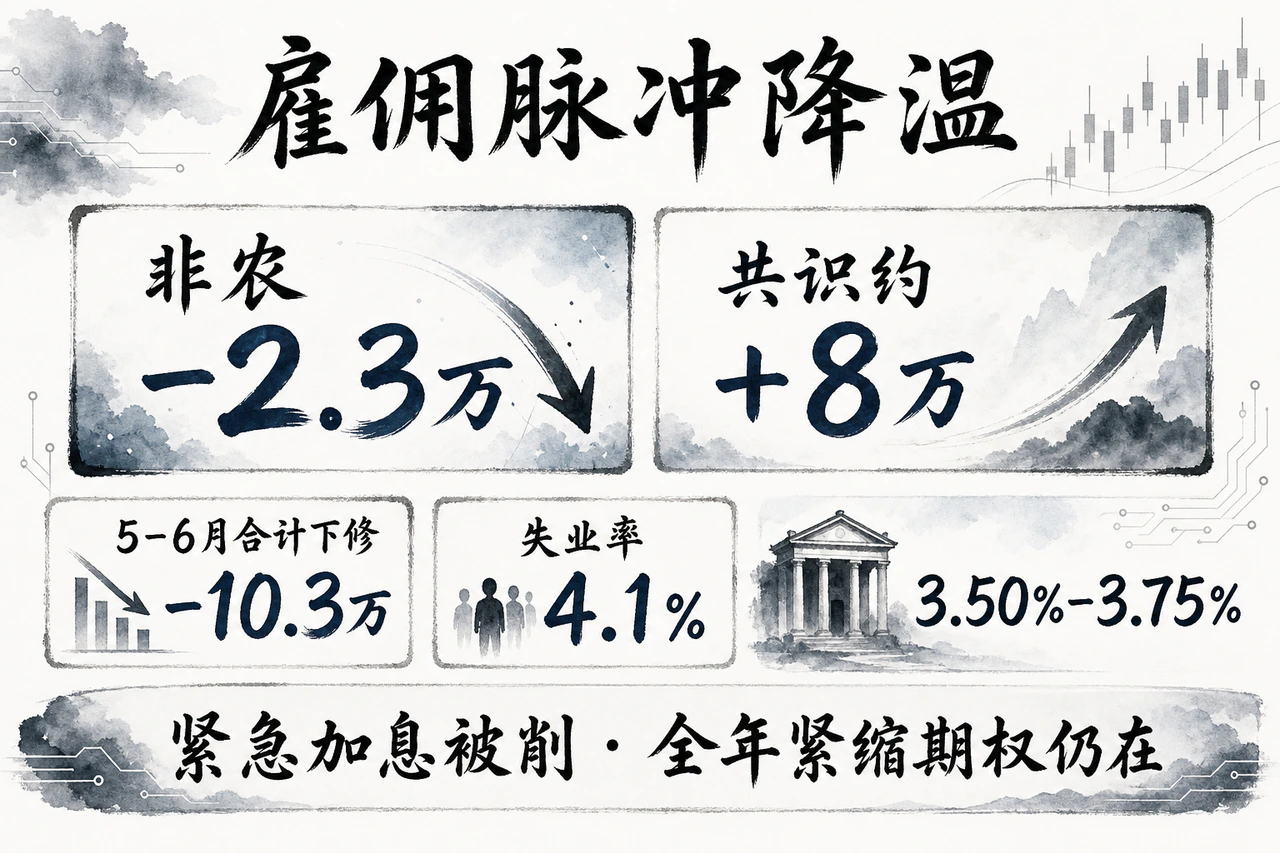
July nonfarm payrolls unexpectedly fell by 23,000, well below the consensus gain of roughly 80,000. May was revised from +129,000 to +63,000 and June from +57,000 to +20,000, removing a combined 103,000 jobs from the prior estimates. Although unemployment edged down to 4.1%, labor-force participation fell to 61.4% and the employment-to-population ratio to 58.9%. The decline in unemployment therefore reflected people withdrawing from the labor force more than buoyant labor demand. The sector breakdown was equally stark. Private payrolls barely managed a gain of 30,000, while government employment fell by 53,000, largely reflecting a seasonal decline of around 50,000 in local education. Weakness was also emerging within the private sector: leisure and hospitality lost 40,000 jobs and retail lost 19,000, pointing to a marked deterioration in hiring appetite along the domestic consumption chain. Average hourly earnings rose only about 0.1% on the month and held at 3.2% year on year. Both wage growth and employment momentum were soft.
The week's macro picture was marked by a persistent divergence between economic activity and hiring. The ISM manufacturing PMI released early in the week was 55.6, above expectations of around 54, with its prices component still elevated at 71.1; this initially reinforced tightening expectations. Subsequent releases, however, softened in succession. ADP private employment increased by just 44,000. The ISM services PMI was 54.1, but its employment component slipped back into contraction at 47.4, while JOLTS job openings fell to 7.359 million. Thursday's initial unemployment claims remained exceptionally low at 199,000, confirming a fragile labor-market equilibrium of very few layoffs alongside slower hiring. Orders and activity had not fallen off a cliff, but the cooling of recruitment and pay was evident. CPI on August 12 and PPI on August 13 would be the key switches for the rate outlook.
Other macro releases that day included the New York Fed's Survey of Consumer Expectations: 1-year inflation expectations edged down to 3.6% from 3.7%, while medium- and longer-term expectations remained stable. The Fed's G.19 report showed consumer credit growing at an annualized 3.3% in June, with revolving credit up 6.0%, suggesting defensive reliance on credit cards to bridge household cash needs as savings ran low. In Fed communication, Richmond Fed President Thomas Barkin said on August 7 that the payroll report was consistent with the recent assessment of a labor market that was neither loose nor particularly tight. The overall policy signal was clear: the case for an immediate additional hike in September had weakened materially, but the option of tightening later in the year remained. No other major official U.S. macro release arrived over the weekend before the reporting cutoff. China's National Bureau of Statistics reported on August 9 that July CPI rose 0.5% year on year and PPI 3.5%, providing evidence of moderate, manageable regional inflation in Asia without changing the core of the Fed's decision.
Commodities: Oil makes a subdued recovery after a steep weekly fall; lower yields lift gold sharply
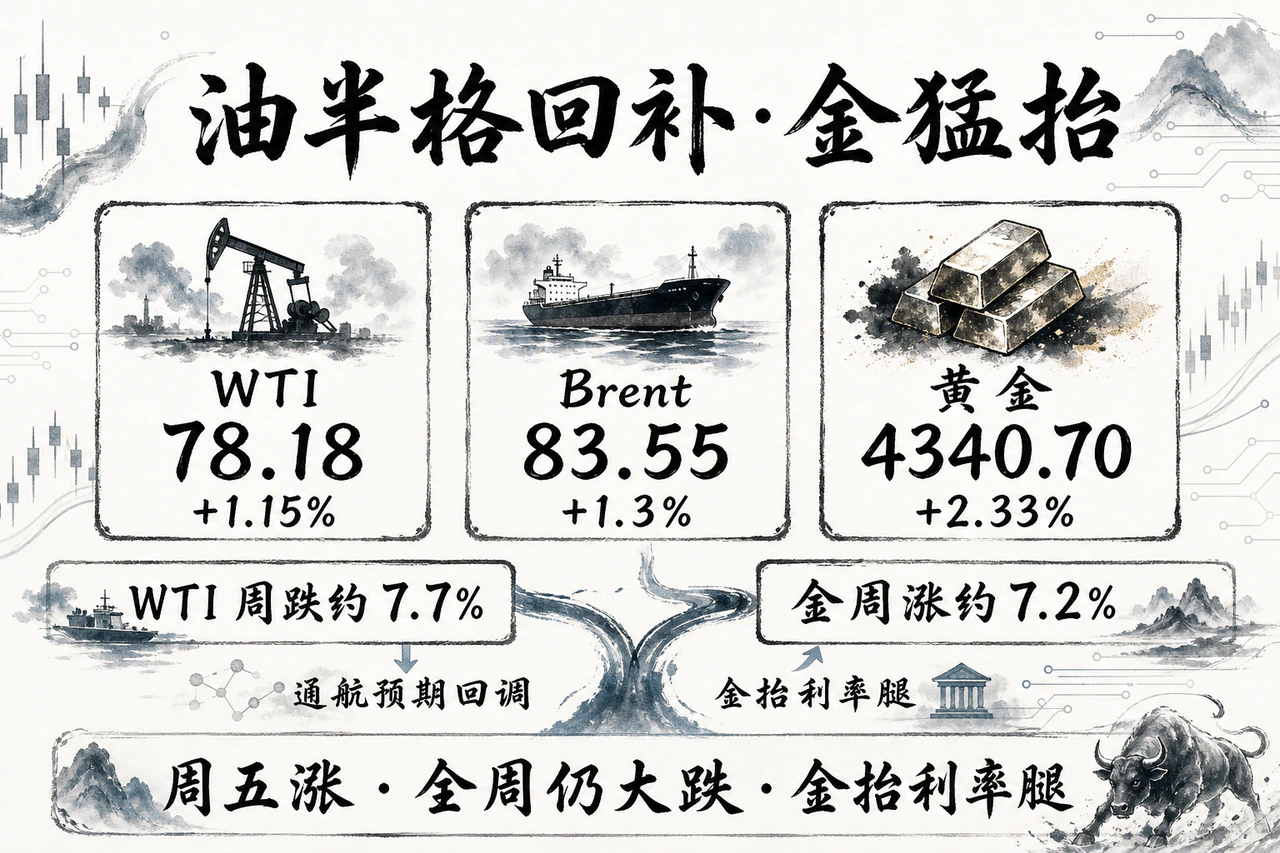
Oil and gold both rose on Friday, but their pricing mechanisms were quite different. September WTI settled at $78.18 a barrel, up $0.89 or 1.15%, while October Brent settled at $83.55, up $1.06 or 1.30%, leaving the Brent–WTI spread near $5.4. Oil's further rebound chiefly reflected a correction to optimism over completely free passage through the Strait of Hormuz. Iranian restrictions and demands for transit charges clashed with the U.S. insistence on zero fees, prompting a modest rebound from an oversold market that had priced in an agreement too aggressively in midweek. The weekly picture remained decidedly weak: WTI fell from roughly $84.67 the previous Friday to $78.18, a loss of about 7.7%. Bets on a navigation agreement stripped out geopolitical premiums from Monday through Wednesday, briefly pushing prices into the $75 range. Disputes over the draft produced a bounce on Thursday and Friday, but its limited strength left a clear contrast between Friday's modest recovery and the week's heavy loss.
Physical navigation remained close to a standstill. Industry tracker Kpler confirmed only about 8 vessels passing through the strait on Friday, with the week's daily average hovering around a dozen, far below normal pre-conflict traffic of roughly 130–140 vessels a day. The rebound in paper markets remained conspicuously out of step with the recovery of actual shipping capacity. For a detailed analysis of supply and demand balances, futures calendar spreads and tanker freight rates, see the companion oil article.
August COMEX gold settled at $4,340.70 an ounce, up $98.70 or 2.33%. The more actively traded December contract finished at $4,399.70, also up 2.33%; the daily change here uses the August settlement as its reference. Gold gained approximately 7.2%, or about $292, over the week, one of its strongest weekly performances since January. The principal catalyst was the weak payroll report's powerful suppression of hike bets, alongside a decline in the dollar index to a settlement of 99.60, down 0.37%. Sharply lower real yields enhanced the appeal of an asset that pays no interest. Geopolitical uncertainty was more a background influence on sentiment.
In electronic trading at around 08:38 Beijing time, crude futures CL and BZ traded near $78.78 and $84.39, while the active COMEX gold contract was around $4,395. These quotations were slightly above Friday's settlements and serve only as explicitly timed market snapshots. Iranian officials said over the weekend that the Iran–Oman navigation arrangement was very close to agreement, while continuing to attach additional U.S.-related conditions to reopening. This helps explain Monday morning's modest oil-price rise: markets were still trading marginal changes in the quality and enforceability of the negotiating terms.
Equities: Markets absorb the option of a Fed hold, with growth and small caps leading
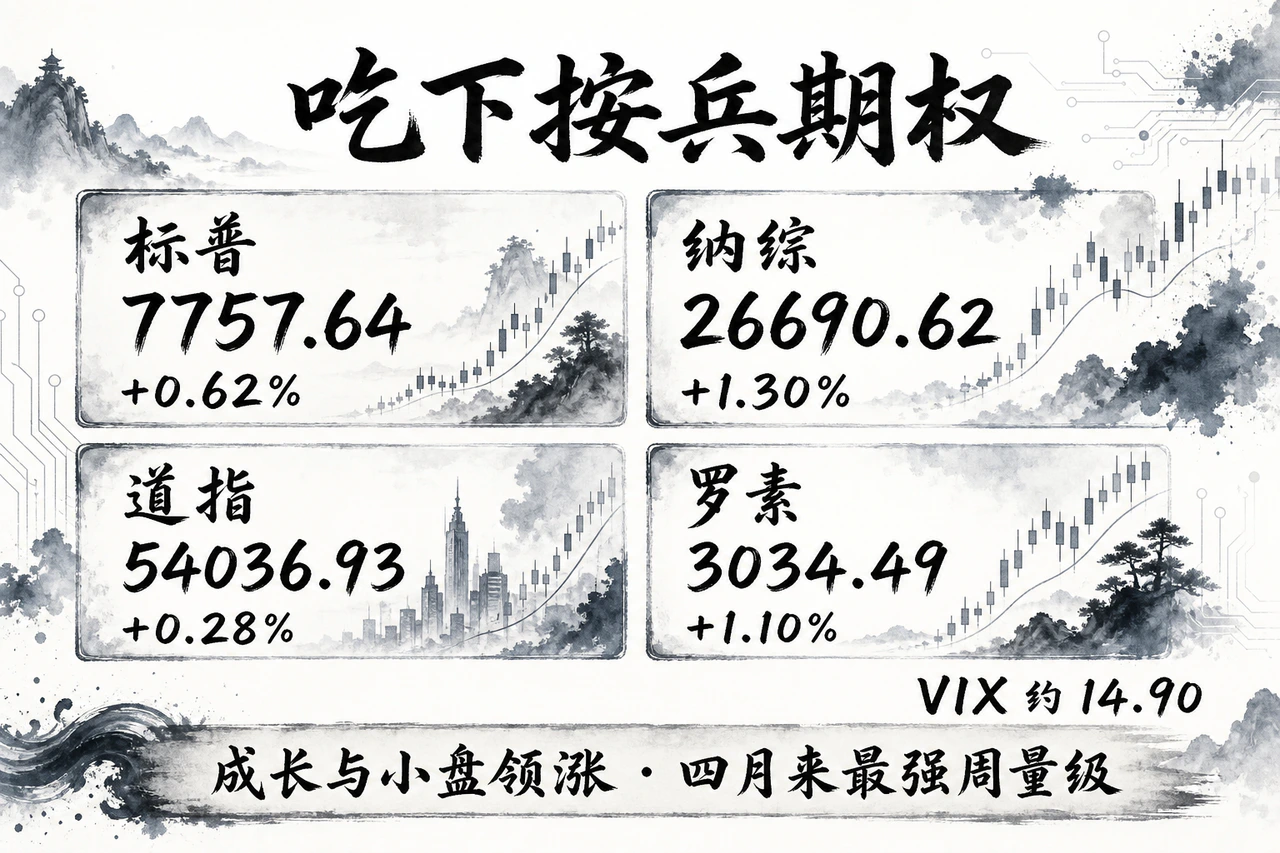
Equities fully absorbed the favorable prospect of a September Fed hold, and the major U.S. indexes rose across the board. The S&P 500 closed at 7,757.64, up 0.62% and near a record high. The Nasdaq Composite climbed 1.30% to 26,690.62; the Dow Jones Industrial Average rose 0.28% to 54,036.93; and the Russell 2000 small-cap index gained 1.10% to 3,034.49. The VIX fell further to 14.90, down 1.65%. Beneath the indexes, software stocks surged on strong earnings guidance: Atlassian gained about 35%, Twilio about 25% and Cloudflare about 9%. Storage stocks continued to undergo a valuation reset, with Seagate, Western Digital, Sandisk and SK Hynix ADRs each down roughly 3.7%–4.7%. The broadly positive index closes concealed exceptionally high sector dispersion. The Dow's muted performance reflected individual industrial and financial constituents weighing on its price-weighted construction. The marked outperformance of the Nasdaq and small caps was closely consistent with the revaluation of long-duration assets as 2-year and 10-year Treasury yields fell. SpaceX, ticker SPCX, also rose about 16%, amplifying sentiment after its lockup expiry.
Over the full week, the S&P 500 gained roughly 3.6%, the Dow 3%, the Nasdaq 5.2% and the Russell 2000 3.5%. All 3 major U.S. indexes posted their strongest weekly performances since mid-April, and the semiconductor ETF SOXX gained more than 7%. The underlying driver was a revaluation of growth stocks and a recovery in risk appetite as tightening expectations cooled. Major Asian markets diverged sharply over the week: the Nikkei 225 gained about 1.9%, South Korea's Kospi fell roughly 5.1% amid severe chip-sector volatility, and Hong Kong's Hang Seng slipped about 0.8%.
Because of the time difference, U.S. payroll data had not been released when the major Asian markets closed on August 7. The Nikkei 225 finished at 65,606.71, down 0.12%; the Kospi at 6,258.77, down 0.60%; and the Hang Seng at 25,668.03, up 0.54%. Their timing therefore reflected different information sets. By early Monday in Beijing, around 08:28–08:38, U.S. index futures ES and NQ were near 7,770 and 29,818. The Nikkei 225 had risen intraday to roughly 66,628, while the Kospi had recovered to about 6,339, with chip stocks leading a catch-up response to Friday's U.S. payroll rally. Regular Hong Kong trading begins at 09:30 and had not opened by the cutoff, so its reference level remained the August 7 close.
Geopolitics and markets: False-dawn risks rise as oil becomes more sensitive to substantive reopening terms

(For the complete 24-hour battlefield timeline, see the companion Middle East article. This section focuses on the link between restored navigation and financial-market pricing.)
The week's Middle East narrative moved from optimism over a rapid agreement toward a tug of war marked by the absence of a formal text and renewed hardening of demands. Optimistic statements early in the week repeatedly brought forward the expected deal date, stripping out substantial geopolitical premiums from nearby crude. In midweek, multiple sources said an interim framework combining zero transit fees and separate navigation lanes was close, but no formal text emerged. On Friday, the U.S. imposed further sanctions on shadow financial networks, and the number of ships diverted under U.S. Central Command escort instructions rose to 51. Most of the weekly oil-price decline occurred during the reversal in sentiment from Monday through Wednesday. The week cannot simply be characterized as a systemic flight to safety: U.S. stocks rose strongly, the VIX fell sharply over the week, and gold's advance was chiefly driven by rates. Overall risk appetite toward risk assets actually expanded.
In the latest daily and weekend developments, an unnamed U.S. official said on Friday that the strait navigation arrangement was progressing and expected soon, and that compliance could lead the U.S. to consider lifting its blockade of Iranian ports. Treasury Secretary Scott Bessent even suggested a ceasefire might come today or tomorrow. Alongside this diplomacy, however, the Treasury's Office of Foreign Assets Control imposed another round of sanctions on shadow financial networks, while shipping and insurance institutions delivered a sobering assessment. Maritime experts said unilateral Iranian transit fees would be extremely difficult to implement compliantly because they would encounter sanctions restrictions and war-risk exclusions. The risk of a false dawn rose further over the weekend. Although Iran's foreign minister said the Iran–Oman arrangement was very close, he immediately tied reopening to preconditions including U.S. compensation. Iran's Supreme National Security Council set out 6 stringent conditions; the Islamic Revolutionary Guard Corps insisted reopening was unrelated to the Iran–Oman negotiations; and Foreign Minister Abbas Araghchi publicly confirmed on Sunday that there were no direct talks with the U.S. Meanwhile, the number of diverted vessels rose to 53. The UAE confirmed that a tanker associated with ADNOC had been struck by a missile in the Strait of Hormuz early on Saturday, with no casualties. In the Red Sea theater, the Houthis again attacked Saudi refining facilities in Jizan; Saudi officials said the fire had been extinguished.
Friday's combination of rising oil, falling Treasury yields, stronger U.S. equities and a lower VIX looked like a convergence of residual hopes for an agreement and renewed speculation about cuts after weaker payrolls. The weekend's harder positions and actual attack on a merchant vessel threatened to disprove the supposed reopening breakthrough. Nearby oil prices are highly sensitive to substantive reopening that is both fee-free and insurable, while their response to verbal assurances of progress in Iran–Oman talks has clearly diminished. Until a formally signed, legally binding text appears, markets should not trade as though an agreement has already been reached.
In the near term, global markets remain focused on 2 central questions. First, can this week's July CPI and PPI releases resolve the tension between weaker employment momentum and sticky energy inflation? Second, can a genuinely executable joint statement on the Strait of Hormuz emerge? The key indicators are whether daily vessel transits can climb out of their single-digit deep freeze, and whether the transit-fee dispute and the U.S. conditions for lifting restrictions can be resolved reciprocally within the same window.