Note: This is the fifth installment in the series on Warsh's Federal Reserve reform. The first four examined changes to communication, quantitative tightening and balance-sheet restructuring, a redesign of the inflation measurement framework, and the effects of AI productivity on potential output and the natural unemployment rate. This installment focuses on the unusual macroeconomic setting of 2026: when the midterm election cycle coincides with the arrival of a new Fed chair, how does political bargaining become an additional monetary policy variable? Behind the political noise, where do the policy rate's deeper economic anchors lie?
Scope: Research on macroeconomic policy and bond-market mechanisms; this article does not constitute investment advice.
Introduction: This year's political variables cannot be dismissed as noise

In 2026, the Federal Reserve has entered an exceptionally rare and complex period in which political and macroeconomic forces resonate with one another.
Several opposing forces are tightening their grip at once. The White House's policy agenda has become more aggressive and politically contested. The unresolved Iran war intertwines energy shocks, fiscal deficits and geopolitical risk. The United States has entered the countdown to its midterm elections. Kevin Warsh formally took the helm of the Federal Reserve on May 22. At the July 29 FOMC meeting, the federal funds target range remained at 3.50%–3.75%, but a 9–3 vote exposed the committee's internal policy divisions.
This is no routine change of chair, nor an ordinary midterm election. Warsh arrived with Trump's public endorsement and an unavoidable political label, while the White House faces intense pressure as voters judge its record. With war, oil prices, supply pressures and the contest for congressional seats compressed into the same narrow window, trading desks are no longer primarily worried about whether the next meeting delivers a hold or a 25-basis-point cut. They are asking a question that reaches the foundations of their confidence:
Does the Fed's policy rate still follow the objective logic of the macroeconomy, or is it being made to serve the political cycle?
The issue has two levels.
The political question is how presidential elections, midterm elections and changes of central-bank leadership interfere with monetary policy.
The macroeconomic question is which economic constraints ultimately anchor the policy rate, even under overwhelming political pressure.
The answer goes well beyond the empty invocation of a 2% inflation target. It lies in the combined gravitational pull of economic growth, potential output, the natural real interest rate, inflation expectations and the output gap.
1. How presidential election years usually affect monetary policy
In conventional political economy, the incumbent party's wishes before an election are clear: strong job growth, rising real disposable income, steadily appreciating financial assets, easy credit and, above all, no recession. The administration's instinctive preference is therefore always for low interest rates, a weak dollar and expansionary fiscal policy.
Monetary policy, however, works with what Friedman called long and variable lags. A benchmark rate cut must pass through borrowing costs, household mortgages and auto loans, corporate capital expenditure and aggregate demand before it produces additional payroll jobs and better wage growth. Even if a president forces the Fed to cut a few months before an election, the real economy often cannot respond before polling day. The result may instead be resurgent inflation and asset bubbles after the election. A rational government would prefer to establish easier conditions one or two years in advance, rather than apply last-minute pressure.
History offers little support for the crude assumption that the Fed must cut rates in a presidential election year.
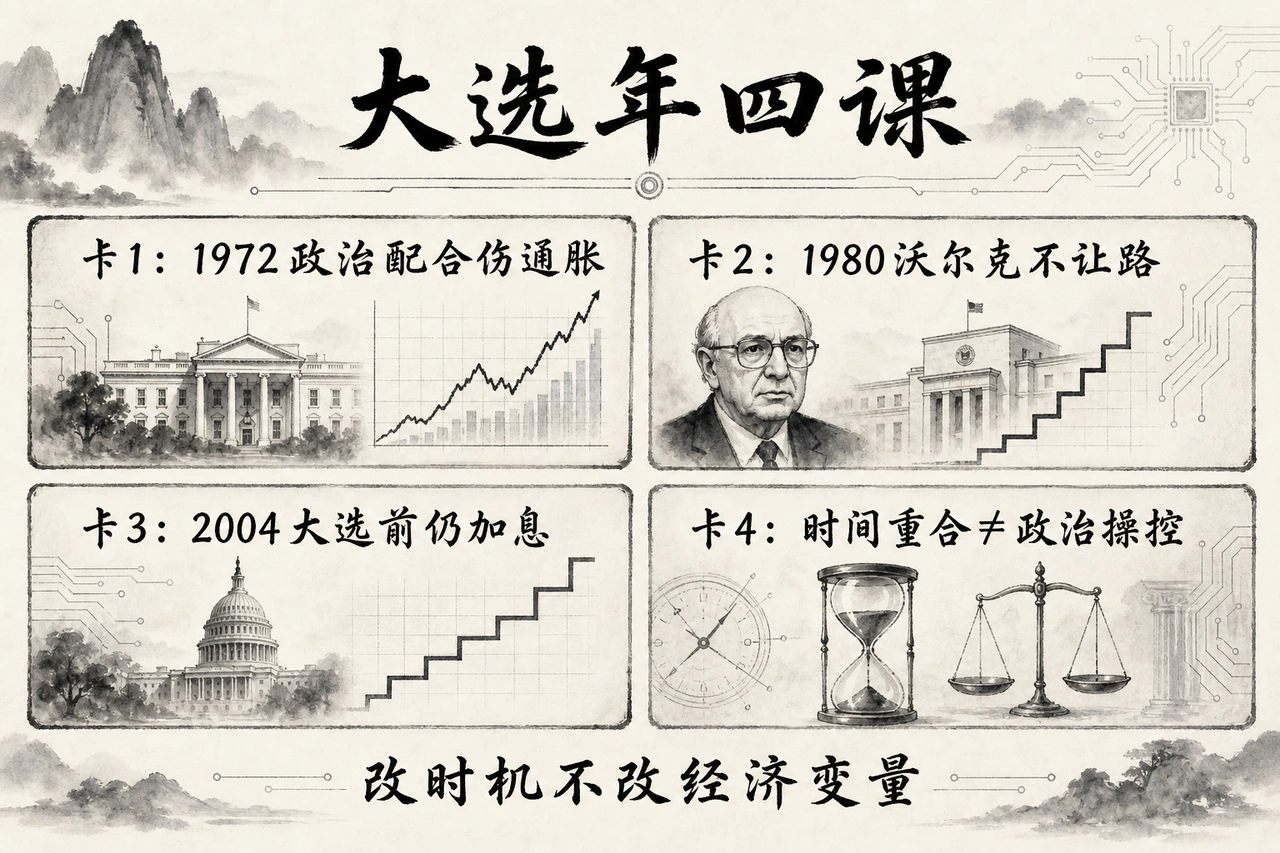
In 1972, Nixon sought reelection and the White House applied unusually blatant political pressure. Fed Chair Arthur Burns accommodated it, maintaining exceptionally abundant liquidity. The U.S. economy initially appeared to boom, but the first oil crisis and the breakdown of price controls subsequently turned inflation into an uncontrolled stagflationary spiral. The lesson was painful: a central bank may bow to politics briefly, but votes cannot buy off economic constraints. The eventual reckoning comes through even more destructive interest rates and a deep recession.
In 1980, Paul Volcker confronted entrenched double-digit inflation and pursued forceful tightening despite the election. Real interest rates surged, unemployment jumped and the economy fell into a double-dip recession; the Carter administration suffered a crushing electoral defeat. Volcker did not yield to the president's reelection needs. That illustrates the substance of central-bank independence: it is not opposition to government, but the institutional ability to make correct decisions that cause severe short-term pain in the interests of long-term price stability.
In 2004, Greenspan's Fed began a measured tightening cycle before the election, yet George W. Bush won reelection. The direction of interest rates alone does not determine how voters cast their ballots.
QE3 before the 2012 election and the Fed's precautionary cuts in autumn 2024 likewise attracted political criticism because of their timing. Yet their underlying policy shifts had been driven months earlier by disinflation or a cooling labor market, and financial markets had already priced them in. To judge whether politics has contaminated a decision, examine whether the data logic is coherent, the framework consistent and the FOMC's reasoning defensible. Proximity to polling day alone is no basis for conviction.
Ultimately, election years usually affect the caution of central-bank communication and the precise timing of a new policy cycle. They rarely rewrite the economic variables that determine interest rates.
2. What makes a midterm election year different
Midterms have a fundamentally different political structure from presidential elections. Presidential elections determine control of the executive; midterms center on control of the House and Senate. Their direct influence on monetary policy is therefore weaker, but their effect on fiscal room and congressional oversight is greatly magnified. This is the additional variable: Congress does not cast the FOMC's votes, but the election reshapes the fiscal supply, scrutiny and market expectations surrounding the Fed's decisions.
The midterm cycle also tends to coincide awkwardly with policy lags. In the second year of a four-year presidency, major tax cuts, tariffs and industrial legislation introduced early in the term are taking full effect. Earlier monetary tightening or easing is also completing its 12- to 24-month transmission. That mismatch can create sharp conflict: the White House urgently wants immediate evidence of prosperity to support its party, while the Fed may be facing sticky inflation and debt-supply pressures left by earlier aggressive fiscal policy.
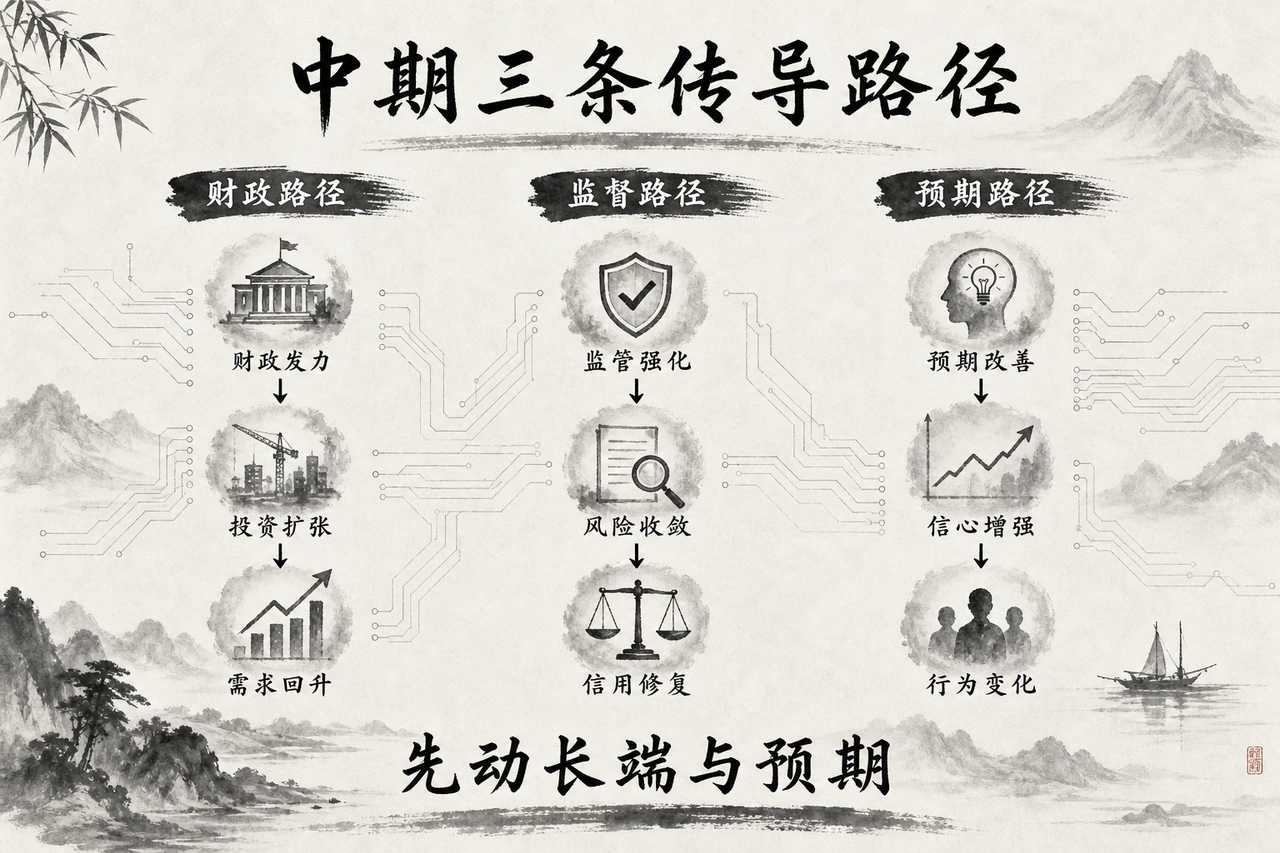
Midterm disturbances spread through three main channels:
The first is the fiscal channel. Congressional control directly determines future tax legislation, deficit limits, military appropriations and geopolitical aid. Unified party control of the White House and Congress usually makes deficit expansion easier, lifting aggregate demand while swelling Treasury issuance and pushing long-term yields higher. Divided government blocks additional stimulus, but increases the tail risks of shutdowns and debt-ceiling confrontations.
The second is the oversight channel. A change in congressional committee leadership transfers control of the Senate Banking Committee and House Financial Services Committee. Semiannual hearings chaired by the opposition, public questioning about Fed losses and its balance sheet, and political obstruction of governor nominations can sharply increase communication costs for Warsh and the Fed. None of this directly changes an individual meeting's rate vote, but it creates a powerful field of political noise.
The third is the expectations and asset-pricing channel. Wall Street does not wait for the votes to be counted. Markets reprice anticipated taxes, issuance, deregulation and tariffs in advance. Well before polling day, the 10-year Treasury yield, term premium, dollar index and five-year inflation swaps (5y5y breakeven) may already have shifted substantially. Midterms therefore affect long-term rates and financial conditions first, which in turn puts pressure on short-term policy rates to respond.
3. Why 2026 may be more unusual still
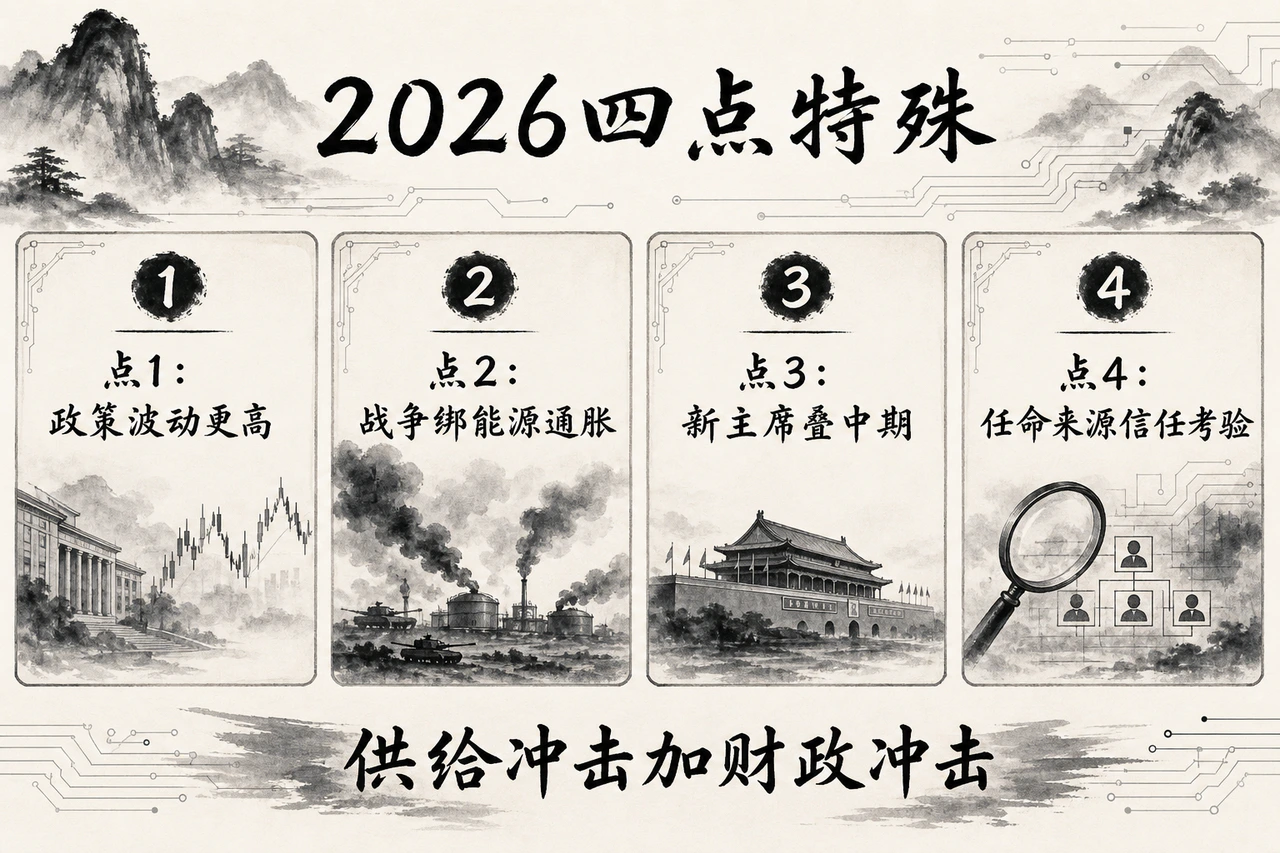
The 2026 macroeconomic setting is more than a replay of history. Four unprecedented features are interacting.
First, spillover volatility from the Trump administration's macroeconomic policies has increased markedly. Its agenda combines broad tariff increases, tighter border and immigration controls, deregulation of energy extraction, routine public pressure on the Fed and a restructuring of the federal bureaucracy. This is neither simple expansion nor simple restraint. It combines a negative supply shock with expansionary fiscal impulses. Tariffs and immigration restrictions raise intermediate-input and structural labor costs; tax cuts and infrastructure sustain demand but intensify the crowding of Treasury supply. These crosscurrents deprive the Fed of the comfort of making decisions within a conventional aggregate-demand model.
Second, the Iran war has brought the geopolitical and energy-supply cycles into close alignment. The Strait of Hormuz crisis remains unresolved. Rising military spending widens the federal deficit, while marine insurance costs and the risk of oil-supply disruption keep energy premiums elevated. Unlike a straightforward demand slowdown, this creates a stagflationary dilemma: higher commodity prices make inflation sticky, while expensive oil erodes household consumption and corporate profits. The Fed cannot mechanically equate slower growth with an immediate rate cut. It must distinguish rigorously between a one-off oil supply shock and a shock spreading into core inflation and wages, and assess whether inflation expectations risk becoming unanchored.
Third, Warsh's arrival and midterm pressure create a doubly sensitive window. Markets are trying to identify the reaction function of his Fed. If the change means only shorter forward guidance and a different communication style, assets can absorb it smoothly. If investors instead conclude that Warsh is more willing to satisfy political demands, tolerate a higher inflation center and turn dovish early to accommodate enormous fiscal borrowing, they will no longer be trading an ordinary cutting cycle. They will be confronting the prospect of a profound loss of central-bank credibility and a complete drift in policy anchors.
Fourth, Warsh's own political background creates an immediate test of trust in central-bank independence. Credibility comes from difficult decisions, not inaugural promises. When core PCE inflation remains stubbornly above target, can he withstand public anger from the White House and reject politically motivated cuts? As electoral pressure and partisan attacks intensify, can he protect intellectual freedom and professional dissent within the FOMC? If deficit premiums trigger a sharp selloff in long Treasuries, can he defend the limits of the balance sheet and refuse to revive Operation Twist or politically motivated market support? Rules and data can build trust. Claims of independence coupled with actions that suit politicians will convince markets that the political cycle has captured rate decisions.
4. The true interest-rate anchor is more than 2%

Markets often treat 2% as the ultimate formula for every monetary decision. It is only the visible surface target. Understanding why rates must be anchored within a particular range requires looking at the deeper logic of macroeconomics and finance.
In long-run equilibrium, the nominal policy rate is constrained by the classic Fisher equation:
Nominal short-term neutral rate ≈ natural real rate (r*) + long-term expected inflation.
If the U.S. natural real rate is currently around 0.75%–1.0%, adding the statutory 2.0% inflation target puts the lower bound of the long-run nominal neutral rate in the narrow 2.75%–3.0% range. That neutral level is shaped by economy-wide saving and investment, demographic aging, total factor productivity, including AI adoption, global capital flows and the structure of fiscal deficits. It is rooted in the real economy. It follows neither executive instructions from the Oval Office nor the personal wishes of a Fed chair.
Real GDP growth and the natural real rate (r*) must not be confused. Output growth measures the pace at which the economic pie expands. The natural real rate is the risk-free real cost that balances the supply of and demand for capital when the economy is at full employment, output matches potential and inflation is stable. Their directions are closely related, but the relationship is not one-to-one. GDP growth of 3% does not mean the benchmark rate should automatically be 3%. The actual chain is that higher productivity and improved real investment returns lift the natural real rate; adding expected inflation then establishes the nominal neutral benchmark.
In practice, the foundation of FOMC decisions closely follows a generalized Taylor rule:
Nominal policy rate ≈ natural real rate + current inflation + α × inflation gap + β × output gap.
The four pillars are clear: the natural real-rate base, current inflation, its distance from the 2% target, and whether the real economy is operating above or below potential. High inflation and an excessively tight labor market require rates above neutral to restrain activity. If employment falls clearly below full employment, rates should move below neutral to provide support.
In July 2026, for example, the federal funds target-range midpoint stood at 3.625%. That does not mean the Fed forecasts GDP growth of 3.625%, or expects inflation to settle at 3.625%. It reflects a composite pricing of:
- A 2.0% long-run inflation anchor;
- A natural real-rate center of 0.75%–1.0%;
- Additional restraint to compensate for sticky core services inflation;
- A precautionary risk premium for potential spillovers from Middle East geopolitics, high oil prices and fiscal deficits;
- An assessment of the continuing resilience of employment and productivity.
This reveals a crucial macroeconomic point: nominal rates are the shadow; real restrictiveness, after subtracting expected inflation, is the substance. If expected inflation over the next year remains at 2.5%, a nominal policy rate of 3.625% implies a real short-term rate of about 1.125%, still meaningfully restrictive for the real economy. But if war spillovers and tariffs push expected inflation to 3.2%, the real restraint delivered by an unchanged 3.625% nominal rate falls to less than 0.425%. Inflation can quietly dilute an apparently restrictive stance into effective easing. That is why professional analysis must examine core PCE, medium- and long-term inflation expectations, unit labor costs, TIPS real yields and financial conditions together, rather than focus on a nominal rate alone.
5. What political pressure can and cannot change

Identifying the limits of the political cycle requires distinguishing flexibility in the short-term policy contest from hard long-run constraints.
Political pressure can distort the fine detail of the policy path.
It can push the central bank to favor employment within its dual mandate of price stability and full employment, increasing tolerance for inflation deviations. It can encourage softer, more dovish statements and earlier guidance toward cuts. It can also produce balance-sheet compromises, slowing quantitative tightening (QT) to ease liquidity pressure. More profoundly, it can contaminate expectations of the Fed's reaction function. Once bond investors believe the Fed accepts a higher inflation tolerance, long Treasury yields and term premiums will break higher immediately. Even if the short-term benchmark does not move, 10-year and 30-year yields will rise sharply as investors demand inflation compensation, increasing rather than reducing the economy's real financing burden.
Political intervention cannot overturn the economy's underlying constraints.
White House tweets and congressional hearings cannot create working-age labor, raise industrial total factor productivity overnight or command global capital to buy enormous volumes of Treasuries at yields that disregard risk. If political force pins rates below their natural equilibrium, it will not deliver lasting prosperity. It will produce a textbook disaster: unanchored inflation expectations, sharp currency depreciation, a commodity surge and a relentless long-bond selloff by bond vigilantes. Eventually the Fed will be forced into even more punishing rate hikes.
Conclusion: Watch whether the anchors move

The Fed in 2026 cannot be understood by mechanically applying superficial analogies from past presidential or midterm election years.
Aggressive executive intervention, the struggle for congressional seats, supply-chain and energy disruption from the Iran war, imbalances created by enormous fiscal issuance, a new governance framework after a leadership change, and global scrutiny of Fed independence are colliding at the same historical moment. The central question is not how many 25-basis-point cuts appear in the next dot plot. It is whether the underlying force governing decisions has changed structurally:
Is the Fed adjusting rates in response to data within its existing macroeconomic framework, or is politics eroding the policy reaction function itself?
If Warsh remains rigorously data-driven and alert to supply shocks, rates will still be anchored by the natural rate, the output gap and inflation premiums. But if markets sense that the Fed is surrendering price stability to deficit monetization, or making unprincipled concessions to election-year demands, the change will extend far beyond the outcome of one or two meetings. It will force an entire generation to reassess inflation risk premiums, the marginal creditworthiness of Treasuries and the foundations of pricing for core dollar assets.
Politics can disturb the short-term wavelength of rates, but cannot reverse the tides determined by economic constraints. For capital markets, even a 25-basis-point cut just before an election is a tactical fluctuation. The real danger begins when investors believe the Fed is willing to pay for immediate political gains with a future loss of long-term inflation control.
(Principal sources: the Federal Reserve's About the FOMC and Board Members pages; the July 29, 2026 FOMC statement; public historical materials; and the series research paper, policy-rate-anchor-election-warsh-midterm-20260810.)