Focus: The Fed in the 2026 midterm window: how politics disturbs policy paths and the deeper macroeconomic anchor for federal funds rates.
Nature: Policy and market-mechanism research.
Two clocks collide: politics cannot be ignored
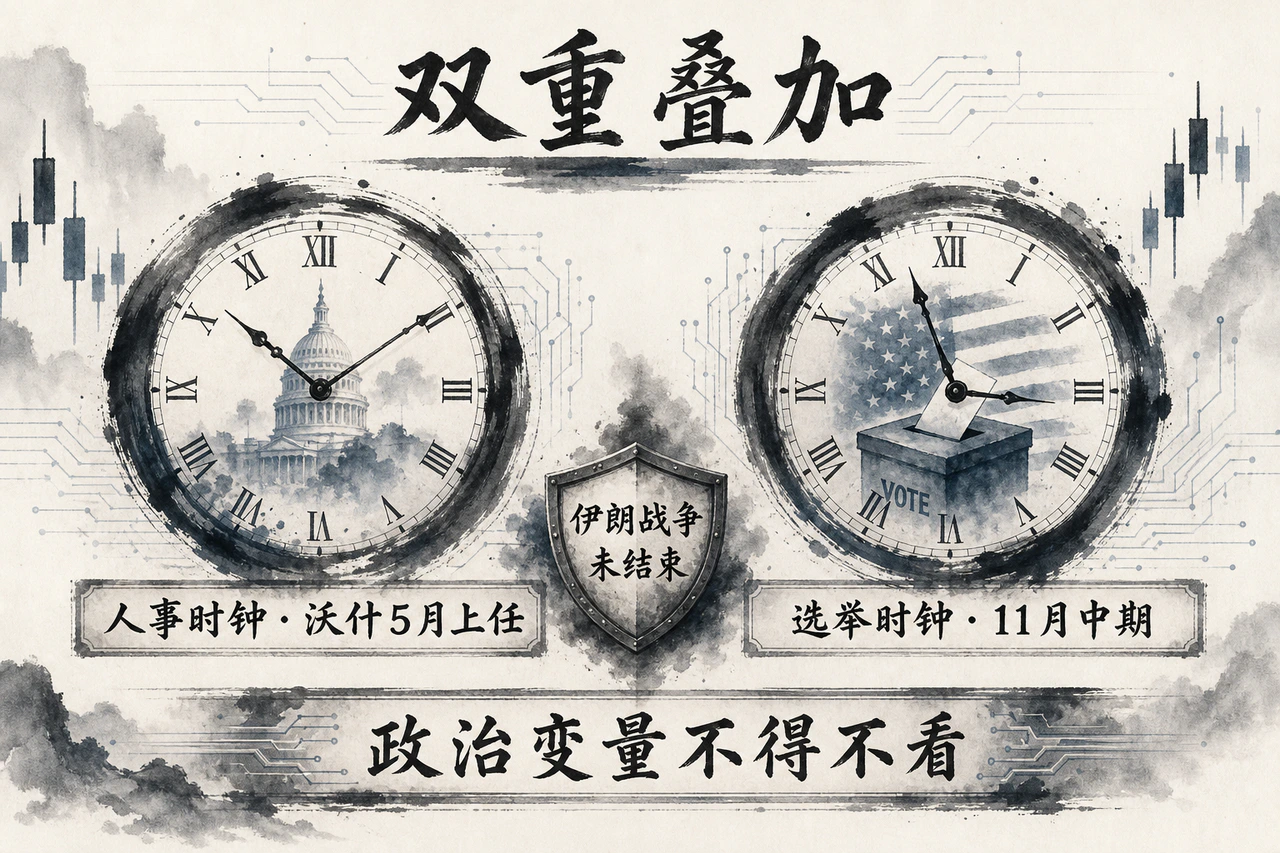
In 2026 the Fed faces an unusually narrow gap between leadership transition and electoral pressure.
Kevin Warsh became chair in May and his honeymoon passed quickly, while November's congressional midterms approached. Usually markets have time to absorb succession and elections separately. Their overlap transmits White House pressure directly to the FOMC table.
Geopolitics adds strain: prolonged Middle Eastern war raises energy and living costs. The Trump administration publicly and repeatedly demands early cuts. Three desires conflict: easier financial conditions and better economic readings for the White House, lower fuel and bills for voters, and the Fed's duty to restore 2% inflation. Politics becomes a hard constraint in rate analysis rather than fleeting market noise.
The central question is therefore not simply whether the White House can force cuts, but what fundamentally anchors federal funds rates when political interference peaks.
Election years: lessons from history
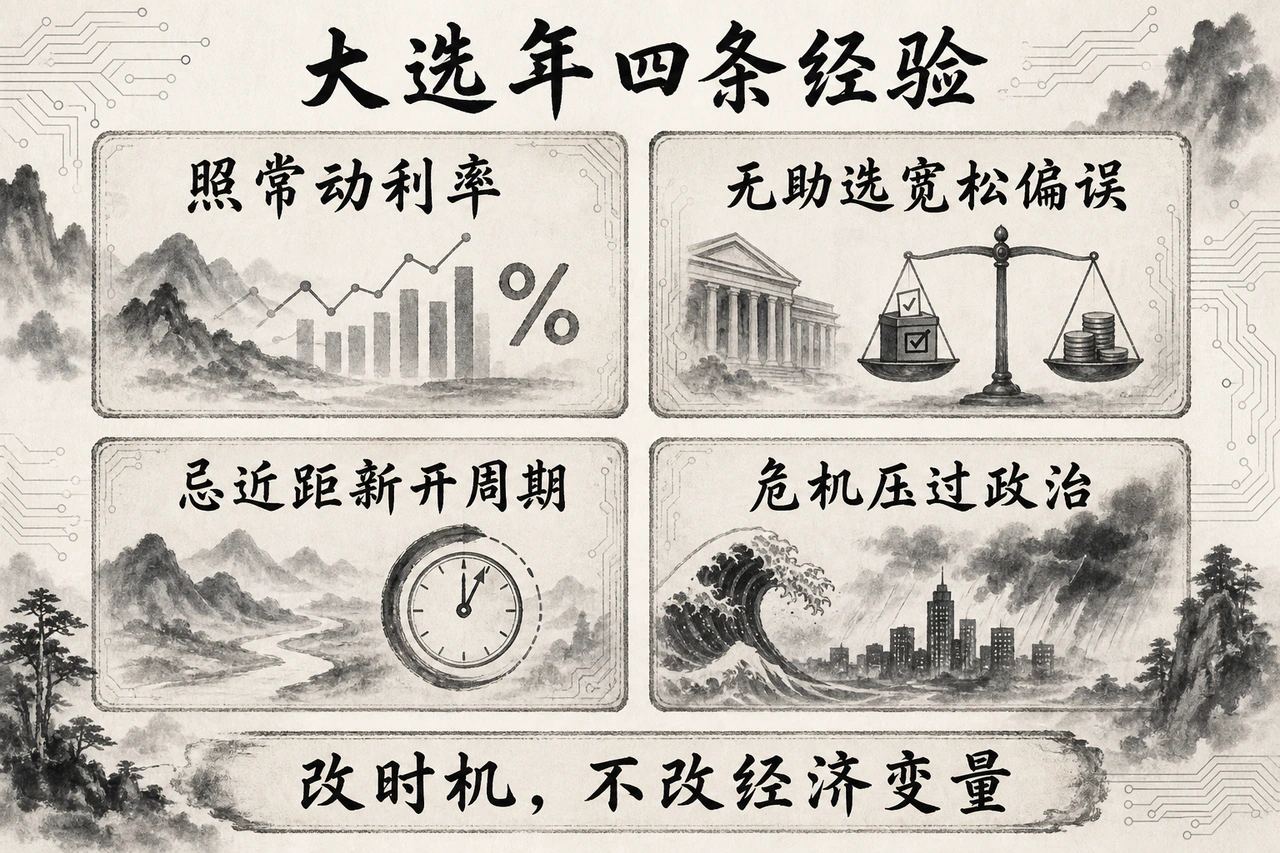
The usual election-year comparison strictly concerns presidential contests every four years. Evidence since the 1970s shows consistent patterns:
First, the Fed does move rates in election years; full-year freezes are rare. Most moves extend existing macro cycles rather than launch new ones hurriedly for electoral reasons.
Second, data do not support an automatic pre-election easing theory. Hikes and cuts occur with roughly equal frequency, and adjustment sizes do not differ significantly from nonelection years. An always-cut rule has no historical basis.
Third, the Fed particularly avoids appearing politically aligned. It dislikes abrupt reversals or new easing or tightening cycles immediately before voting, but tends to complete existing adjustments according to data.
Fourth, major macro crises outrank politics. The 2008 subprime crisis and 2020 pandemic showed that systemic financial risk or collapsing activity overrides electoral calendars and prompts decisive, extreme action.
White House pressure is longstanding: Nixon pressured Burns, Reagan aides challenged Volcker, George H. W. Bush complained about Greenspan's slow cuts, and Trump targeted Powell in his first term. Interference exists, but normal Fed operations do not set rates by votes. The disastrous example is the 1972 electoral capture of monetary policy, ultimately unanchoring long inflation expectations and helping bring the Great Inflation.
Elections mainly affect communication and the threshold and timing for new cycles, rather than overturning the fundamental economic core of rates.
Midterms differ, and this year differs further
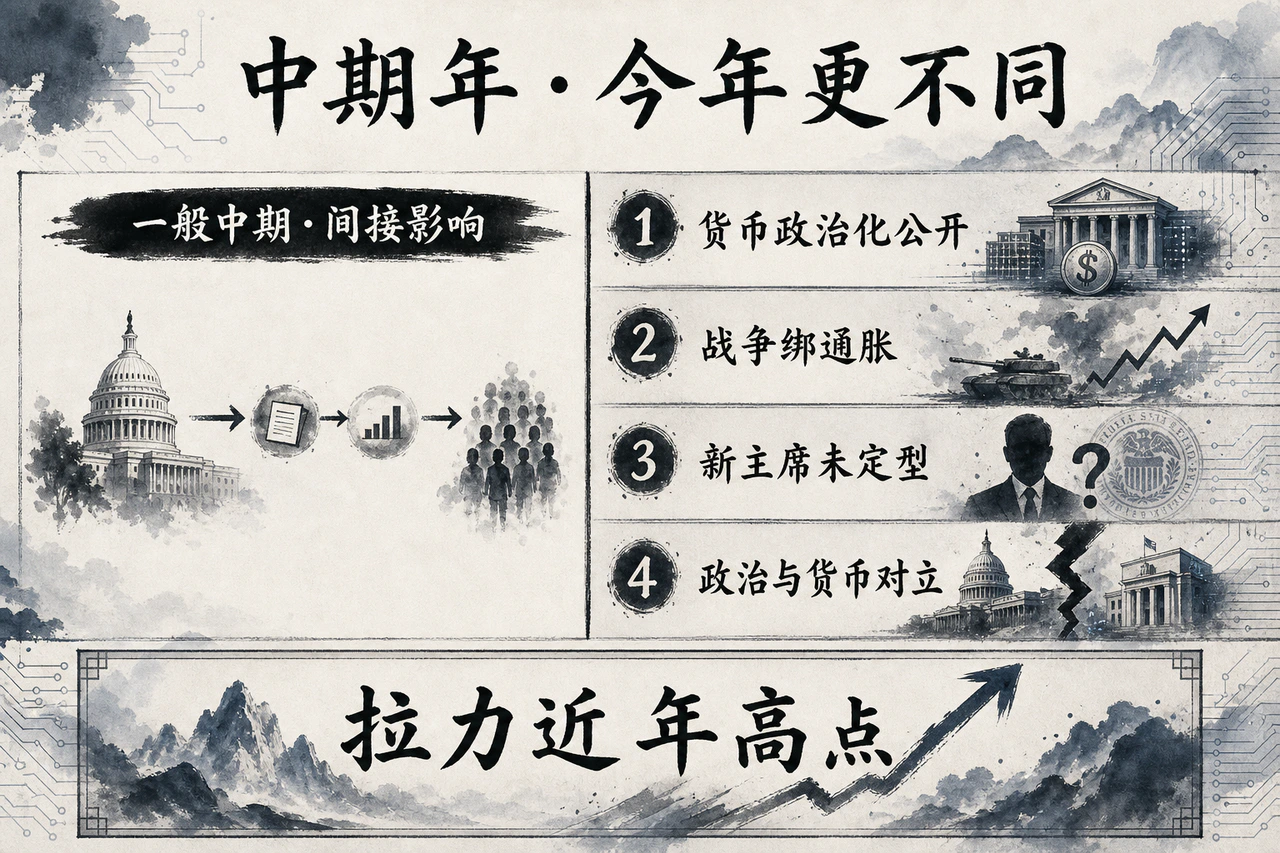
The 2026 election reallocates congressional seats rather than the presidency. Its political mechanics and monetary transmission differ substantially from a presidential election.
The governing party historically tends to lose midterm seats. Markets price divided-government probabilities and reassess fiscal expansion, regulation and trade. The Fed has no established midterm-support script; inflation, jobs and financial restraint remain its focus. Effects are often indirect: electoral anxiety changes fiscal or geopolitical strategy, which then feeds inflation expectations.
Within that familiar pattern, 2026 shows several extraordinary departures:
First, public White House monetary pressure is unprecedented in intensity. Trump abandons the political convention since the 1990s against presidential direction of Fed decisions, demanding cuts frequently and explicitly. This raises independence-risk premiums. Even if the Fed resists, discount-rate volatility and risk discounts have already increased.
Second, electoral anxiety is intertwined with war-driven supply inflation. Iran's stalemate raises crude costs and household bills, eroding support through inflation and geopolitical entanglement. The demand for broad cuts to improve perceived economic conditions is stronger than in ordinary midterms.
Third, the FOMC is early in a transfer of authority, without settled expectations. Previous midterms usually featured an established chair whose reaction function and style were well understood. This is a new chair's first major test; communication and interpretation of the 2% target are still being recalibrated. Intense pressure on an unsettled reaction function multiplies fragility.
Finally, political desires and monetary logic point in opposite directions. The White House wants liquidity from cuts, while war creates supply inflation. Cutting into rising prices effectively pays for the war premium with monetary expansion, close to an untouchable red line since Volcker established modern credibility. Political and monetary-stability optima collide directly.
The issue is not that midterms inherently favor cuts. It is the rare collision of an extremely forceful White House, unresolved war and newly installed Fed leadership, pushing political pull on policy to a multidecade high.
Warsh: independence declarations versus the source of appointment
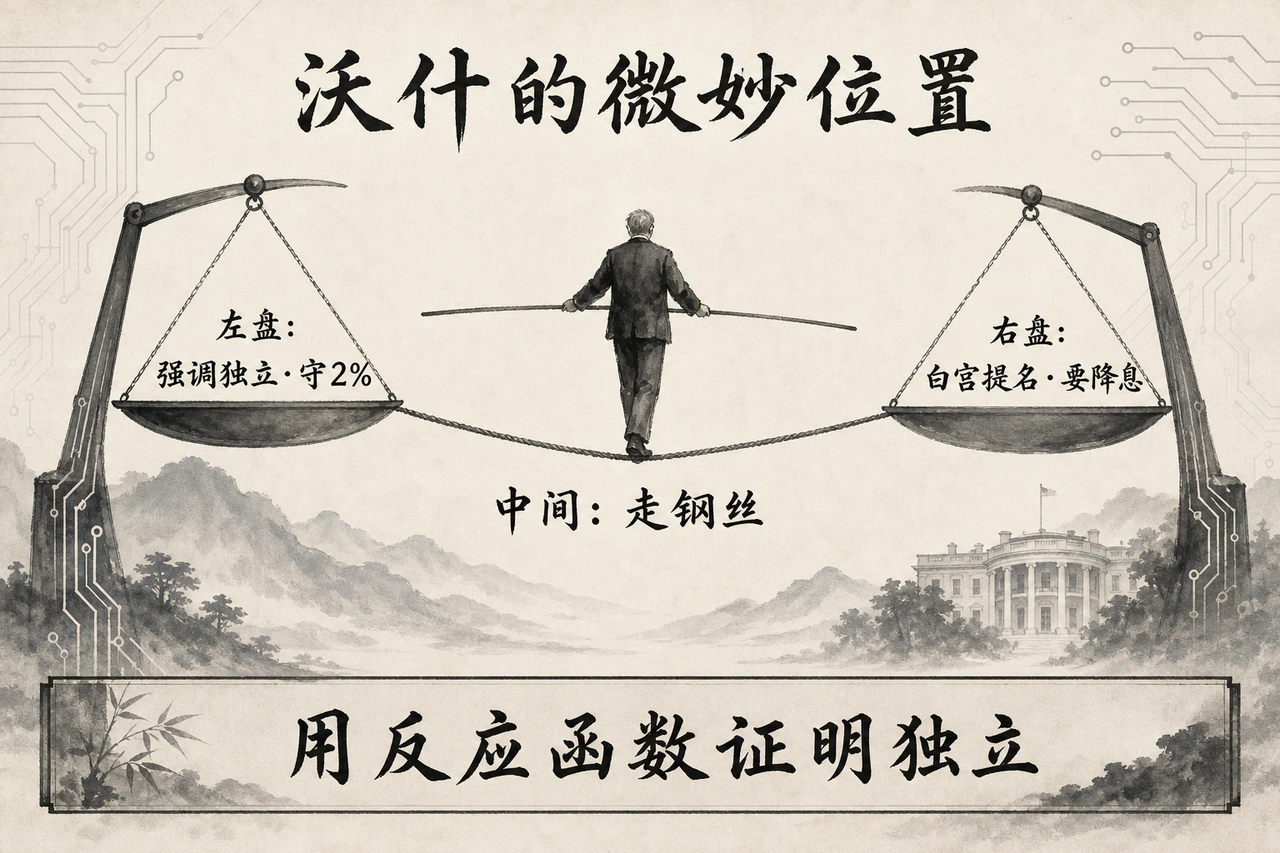
Warsh repeatedly emphasizes institutional independence and the firm 2% target. Rather than deliver early easing to please the White House as pessimists feared, he held at successive meetings and deliberately restrained forward guidance. These words and actions seek to establish a tough inflation-fighting reputation quickly.
The tension cannot disappear: nominated by Trump and confirmed by the Senate, he will be tested on which side he chooses under genuine pressure. White House demands for cheap funding and liquidity will intensify toward the vote. The FOMC is not a one-person institution; voting arrangements and dissent constrain unilateral pivots. Less guidance preserves flexibility but leaves a larger expectations vacuum that political noise can readily fill.
His hardest task is a tightrope between two disasters. Premature easing on command would destroy a half-century inflation anchor; a public institutional confrontation could collapse trust and produce uncontrollable asset volatility. History suggests independence is demonstrated by consistently executing a credible inflation reaction function in a storm, rather than press-conference declarations.
The deeper anchor: rates ultimately rest on growth and inflation

Analyzing politics identifies the source of sentiment disturbances. Beyond it, federal funds remain constrained by macro identities and monetary rules. Political rhetoric cannot arbitrarily reshape the long-run center.
Under the Fisher relation, nominal rates reflect real capital returns plus inflation compensation:
Nominal interest rate ≈ real interest rate + expected inflation.
Any nominal policy rate separates into the real borrowing price and compensation for lost future purchasing power.
Effective federal funds are around 3.6%, with a 3.50%–3.75% target. Using 5- and 10-year TIPS breakevens of about 2.2%–2.3% as a medium- to long-term expectations anchor implies a real policy rate around 1.3%–1.4%. Using realized CPI still well above 2% produces a lower ex-post real rate, near neutral or mildly accommodative, showing nominal rates' apparent height overstates intuitive restraint. Political pressure can lower nominal rates temporarily, but without lower expectations this sharply reduces real rates and artificially cheapens capital. Demand can reignite, expectations unanchor and long Treasuries demand larger term premiums. Elections do not suspend the arithmetic.
A dynamic Taylor-type rule adds systematic responses to inflation and output deviations:
Nominal policy rate = neutral real rate + current inflation + 0.5 × inflation gap + 0.5 × output gap.
It shows that a policy rate around 3% prices four variables rather than serving as an arbitrary political instrument: neutral real rates at full employment and target inflation, current inflation, excess inflation above 2%, and output relative to potential.
A rough decomposition of 3.50%–3.75% assigns about 2 percentage points to the long-run inflation base and approximately 1–1.5 percentage points to steady-state real neutral, with FOMC long-run medians usually implying around 1% real. The remaining cyclical term restrains excess inflation or offsets recession. War-driven energy inflation calls for a positive tightening term, while electoral demands seek a negative easing term. Forcing the sign can provoke retaliatory inflation expectations and require repayment through harsher policy next cycle.
Ultimately the ceiling on neutral real rates reflects potential growth: demographics, workforce quality, capital deepening and productivity, particularly whether large AI expenditure yields durable gains. Stronger potential and returns support a higher equilibrium real rate; weak growth and excess saving lower it. Policy is therefore not simply Fed preference. With expectations anchored, nominal rates must keep the real capital price consistent with productivity and returns.
Cuts for votes cannot be a durable solution. Politics may distort a quarterly nominal figure but cannot keep costs permanently apart from growth and inflation equilibrium. Forced easing yields destructive inflation rather than healthy growth, ultimately requiring larger, more damaging increases—the harsh lesson of the 1970s Great Inflation.
Within this framework, Middle Eastern war raises supply inflation and external risk premiums without improving U.S. potential productivity. Midterm pressure magnifies demands for short-cycle liquidity. Warsh's task is to preserve 2% credibility and genuine responses to inflation and output gaps. Elections and succession shape noise and operating windows; growth potential and expectations govern the ultimate rate center. Compromise or testing may shift funds rates by tens of basis points, but abandoning the anchor of real neutral plus inflation compensation plus cyclical response risks destroying the system's most valuable intangible asset: anchored expectations. The Fed may endure political embarrassment; no one can cheat macro arithmetic indefinitely.
Main references: Fed website material on Warsh's congressional testimony and policy statements; FRED breakevens; New York and St. Louis Fed discussions of neutral real rates; Pictet, Reuters and others' historical election-year policy evidence; public polling and reports on geopolitical inflation transmission.