Reporting period: August 10–16, 2026
The Treasury curve bear-steepened last week. Mild July CPI and core inflation plus weak retail sales reduced front-end hike pricing and slightly lowered 2-year yields. At the long end, a 30-year auction cleared at a yield rarely seen in more than two decades, with fiscal deficits and duration premiums lifting ultralong rates. Credit spreads stayed near historically tight levels while technology leaders and AI infrastructure rushed into primary issuance. Stocks consolidated near highs with low volatility, while Hormuz disruption and sanctions expectations restored oil's geopolitical premium.
Weekly pricing: Bear steepening and narrow credit-spread movements
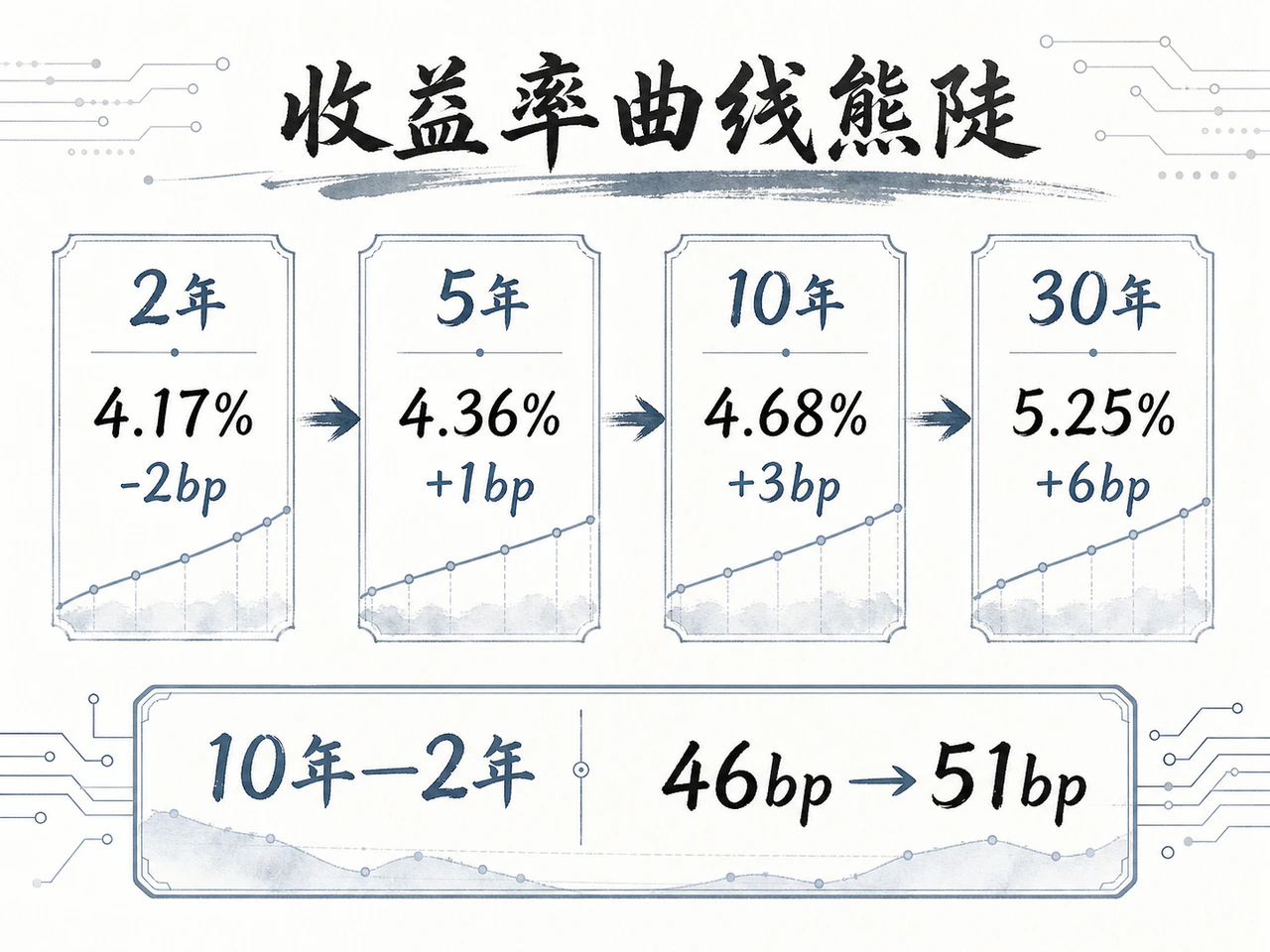
Treasury par yields from August 7–14 showed a clear split: 2-year −2bp to 4.17%, 5-year +1bp to 4.36%, 10-year +3bp to 4.68% and 30-year +6bp to 5.25%. The 10-year/2-year spread widened 5bp from 46bp to 51bp, showing different drivers at long and short/intermediate maturities.
| Maturity | August 7 | August 14 | Weekly change |
|---|---|---|---|
| 2-year | 4.19% | 4.17% | -2bp |
| 5-year | 4.35% | 4.36% | +1bp |
| 10-year | 4.65% | 4.68% | +3bp |
| 30-year | 5.19% | 5.25% | +6bp |
| 10-year minus 2-year spread | 46bp | 51bp | +5bp |
Intraday moves showed the contest. Early geopolitical escalation lifted oil and pushed the 10-year to 4.72%; weaker-than-expected PPI then lowered it to 4.63% Thursday; Friday's weak-auction aftereffects and oil premium returned it to 4.68%. The policy-sensitive front end watched cooling fundamentals, while fiscal supply and term premiums left ultralong rates easier to raise than lower.
Credit spreads did not widen in panic with long benchmarks. By August 13, ICE BofA investment-grade OAS edged 1bp from 78bp to 79bp and high yield 1bp to 271bp. Effective IG yields fell from 5.36% to 5.35% and HY from 7.05% to 7.02%. Historically tight spreads leave little compression room, making weekly returns more reliant on carry and capital gains more sensitive to Treasury volatility.
Treasuries: Inflation relieves front-end pressure as auctions raise long-end clearing yields
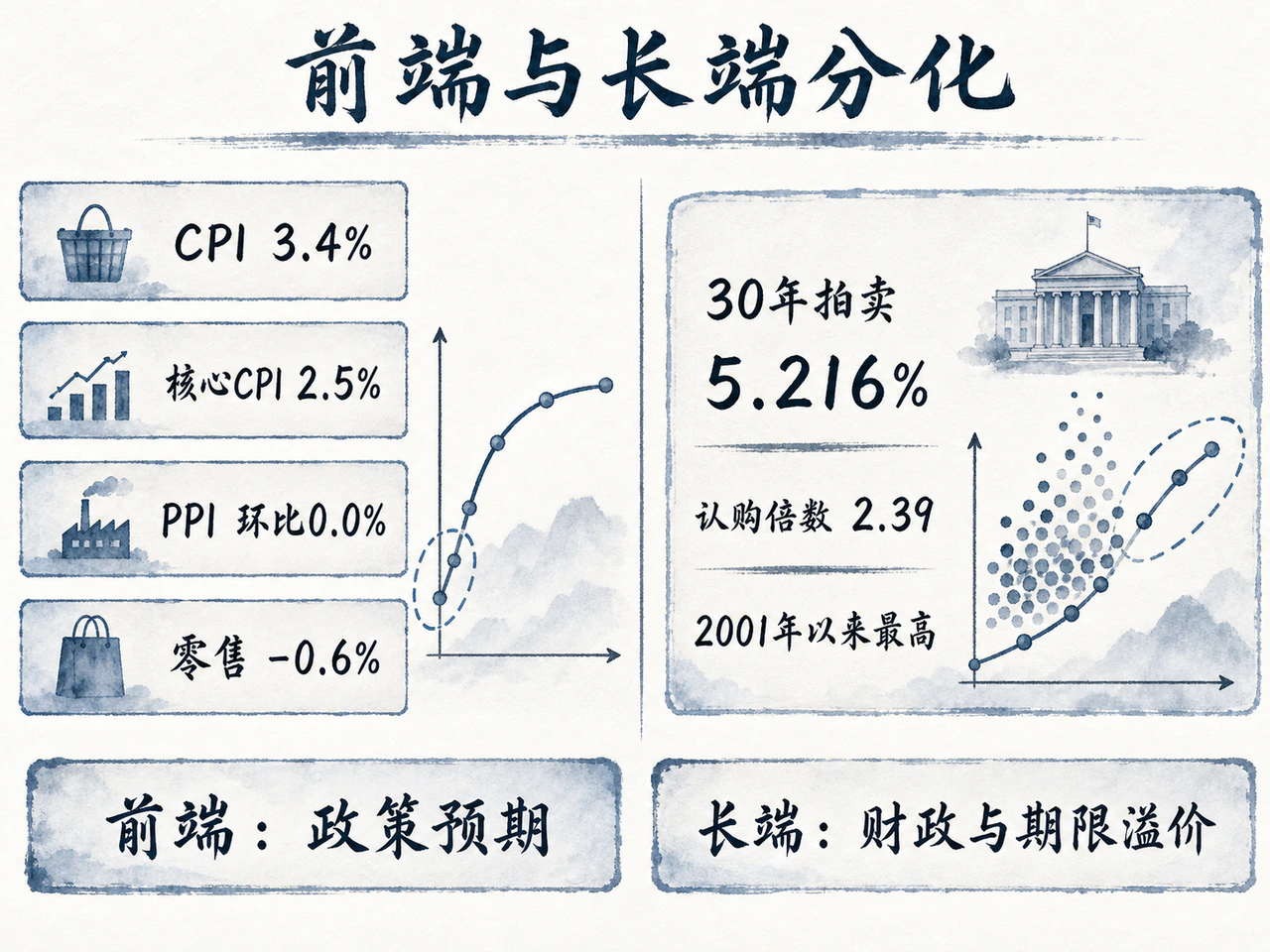
July indicators supported removal of excess tightening premium. CPI rose only 0.1% monthly and 3.4% annually; core rose 0.2% monthly and 2.5% annually, the slowest since February. PPI was flat versus 0.2% expected and 4.7% annually, with energy down 3.1% monthly. Retail sales fell 0.6% and the control group 0.4%. Labor showed slower hiring without more layoffs: July payrolls fell 23,000 and prior two months were revised down 103,000; unemployment fell 0.1 percentage point to 4.1%, with claims a low 209,000.
Cooling data rapidly reduced September hike bets. By August 14, differing instruments consistently priced a 65%–69% hold probability and 31%–35% hike odds. Front-end declines remained restrained because unemployment had not deteriorated sharply and July prices did not fully capture early-August oil's lagged impact.
Fiscal supply and absorption dominated the long end. The August 12 $32 billion 10-year reopening met generally steady demand. The August 13 $25 billion 30-year auction was cooler, clearing at 5.216%, highest since 2001, with bid-to-cover only 2.39. Secondary yields quickly approached 5.25%, near July 31's 5.27% high.
The two-decade-plus auction high was not a technical issuance failure but higher compensation required amid supply and duration risk. Federal debt approached $39.89 trillion and fiscal 2026 net interest expense about $1 trillion. Large refinancing, continued long supply and Fed balance-sheet runoff kept term premiums high, breaking the link to mild near-term inflation.
Policy expectations: Lower September action odds; framework signals still pending
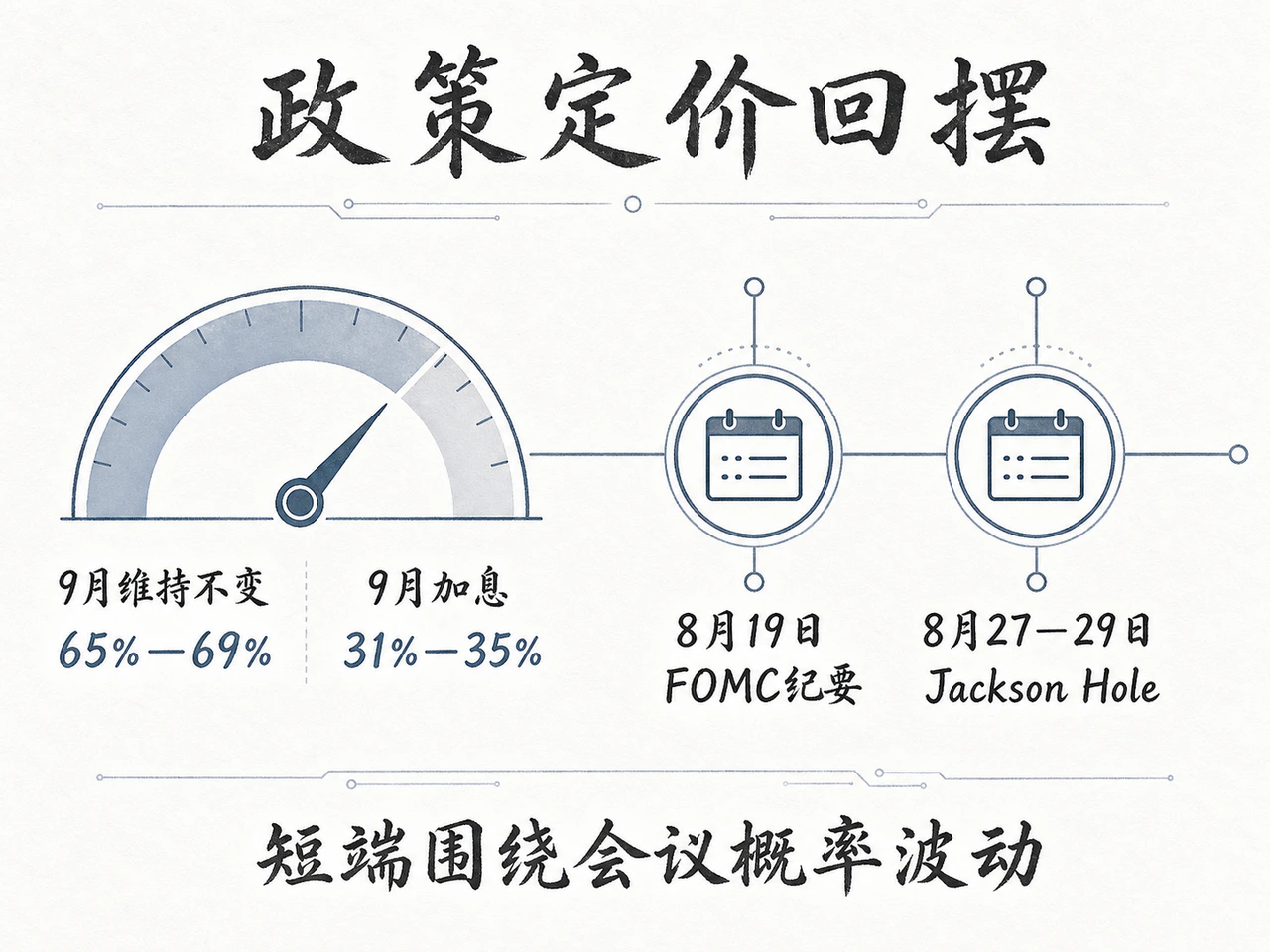
On July 29 the Fed held 3.50%–3.75% for a fifth meeting, with an unusual 9–3 split and 3 voters favoring +25bp, exposing differences on inflation and tightening limits. July inflation, PPI and retail cut September hike bets, without agreement on later this year or early next year.
Two events mattered: July minutes on August 19, revealing the 3 dissenters' thresholds, inflation disagreements and QT/liquidity discussions; and Jackson Hole August 27–29, potentially clarifying flexibility around 2%, guidance and QT pace.
The front end prices coming meetings, while the long end absorbs fundamentals plus growth, fiscal supply and duration repricing. Their diverging drivers underpinned the week's bear steepening.
Credit: Low spreads and significantly greater primary supply
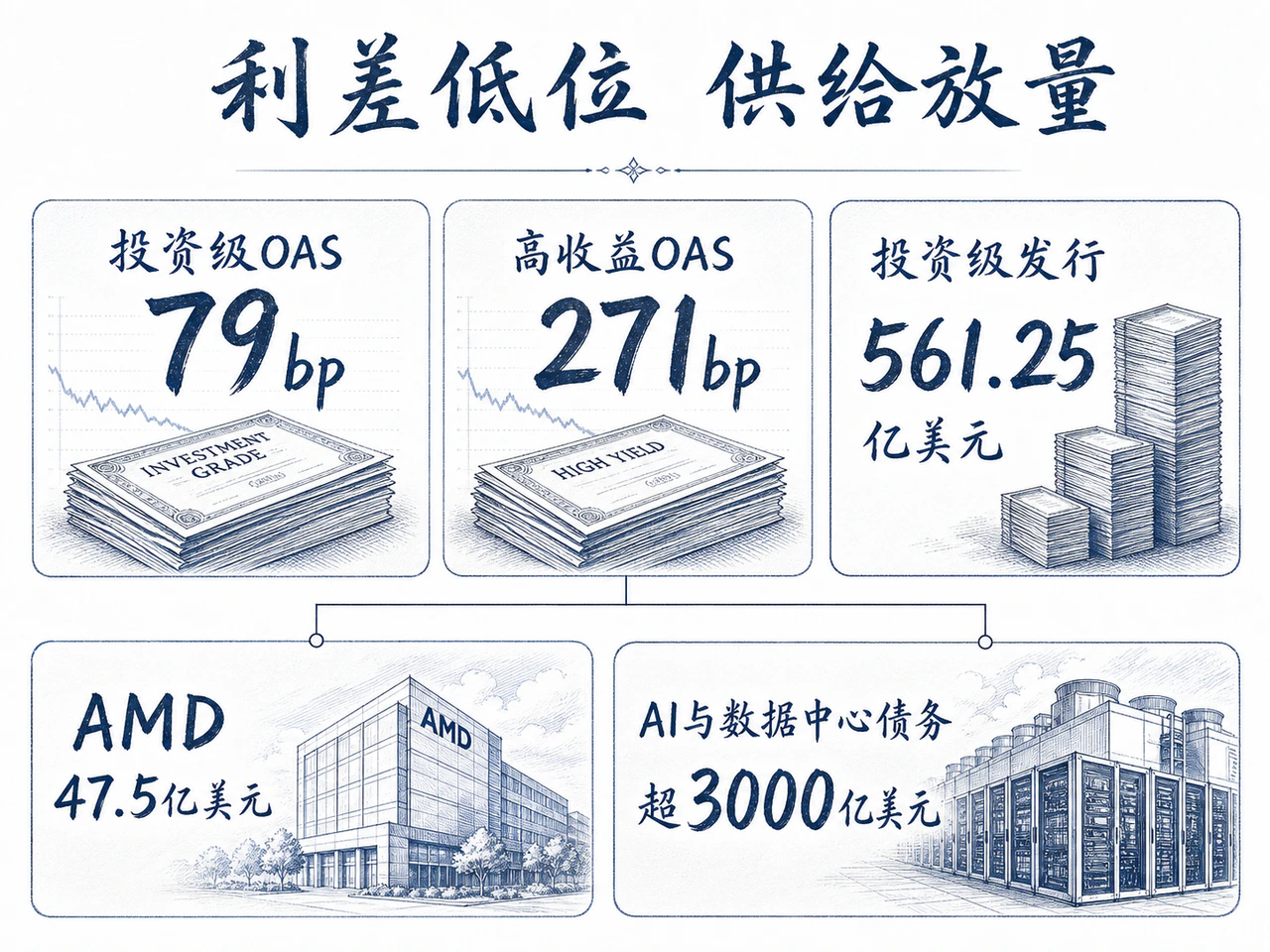
Primary markets heated up despite quiet secondary spreads. Weekly US IG issuance was about $56.125 billion, including $5.85 billion on August 13. AMD issued $4.75 billion across 3-, 5-, 7- and 10-year tranches at T+43, T+70, T+80 and T+90. July IG issuance near $132 billion and Alphabet's $25 billion August 6 deal showed blue chips locking funding before September's Fed window and autumn.
High-yield issuance also exceeded $7 billion. Gainwell sold $1.775 billion of 5-year noncall-3 bonds at a 9.00% coupon and T+468. Data-center operator Zenith Arc priced $2.25 billion of ABS only after investors demanded higher returns. Liquidity remained abundant, but lower ratings, heavy capex and complex new structures faced higher compensation requirements.
AI and data-center financing was reshaping credit. Institutions estimated associated 2026 debt could exceed $300 billion against projected total US corporate issuance of $2.46 trillion. Long-lived assets came with high capex, persistently declining free cash flow, refinancing gaps and uncertain collateral cash-flow durability. Zenith Arc concessions and quiet widening in some technology CDS showed rapid differentiation among AI issuers' quality and repayment terms.
Asian dollar debt showed similar patterns. In August 3–7, the Chinese dollar-bond composite gained 0.38%, IG 0.33%, HY 0.86% and property 1.42%. Asian primary markets completed 22 deals totaling $2.26 billion. Some distressed restructuring bonds recovered moderately; offshore dim sum and quality financial issuance stayed active, but returns still depended heavily on carry and individual events.
Cross-asset transmission: Equities high, oil reprices geopolitics
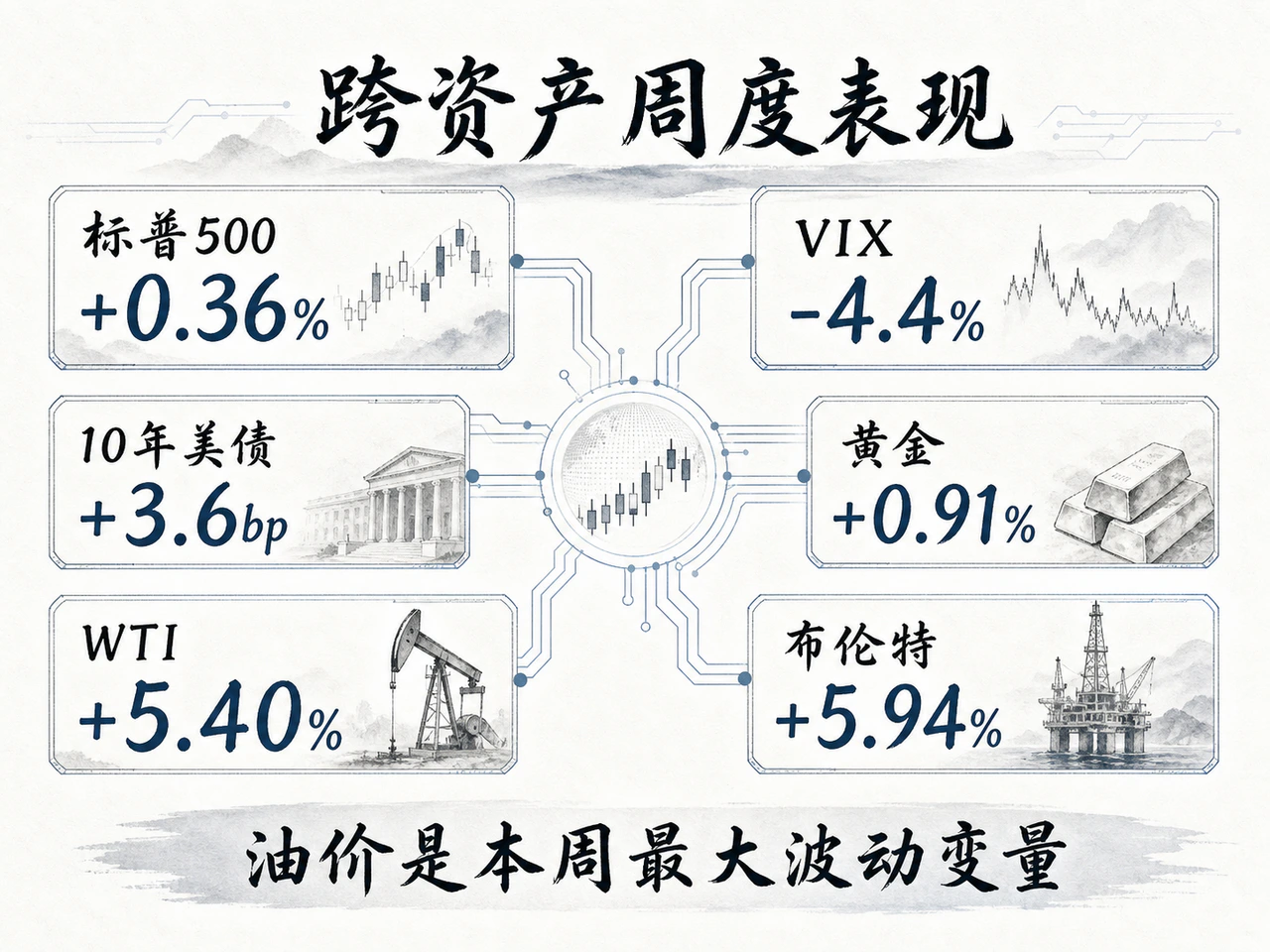
US stocks consolidated near record highs. Through August 14, S&P 500 gained 0.36% weekly, Nasdaq 0.14% and Dow fell 0.56%. VIX declined for a fourth week from 14.90 to 14.25. Breadth improved: midcaps +2.09%, value +1.46%, with modest cyclical diffusion. Low equity volatility echoed tight credit, while higher long yields continued pressuring distant discount rates for expensive assets.
| Asset | August 7 | August 14 | Weekly change |
|---|---|---|---|
| S&P 500 | 7,757.64 | 7,785.76 | +0.36% |
| VIX | 14.90 | 14.25 | -4.4% |
| 10-year Treasury | 4.660% | 4.696% | +3.6bp |
| Dollar index | 99.60 | 99.67 | Broadly unchanged |
| Gold | 4,340.7 | 4,380.4 | +0.91% |
| WTI crude | 78.18 | 82.40 | +5.40% |
| Brent crude | 83.55 | 88.52 | +5.94% |
Oil was the week's most volatile macro asset. WTI rose 5.40% to $82.40 and Brent 5.94% to $88.52. Hormuz tanker attacks, restricted passage and possible sanctions escalation lifted risk premiums. Energy Department data showed commercial crude stocks up 17.4 million barrels to 424.4 million in the week ending August 7, while SPR fell 6.1 million to 298.7 million. Commercial builds eased short-term refinery gaps, but very low strategic reserves weakened the buffer against sudden disruption.
Oil affects dollar debt through two channels: higher inflation expectations limit front-end cut room and lift long term premiums; sector divergence improves upstream cash flow but pressures cost-sensitive chemicals, transport and aviation spreads. July PPI's falling energy was backward-looking; August would better capture renewed pass-through.
Next week: Minutes, energy and the primary window
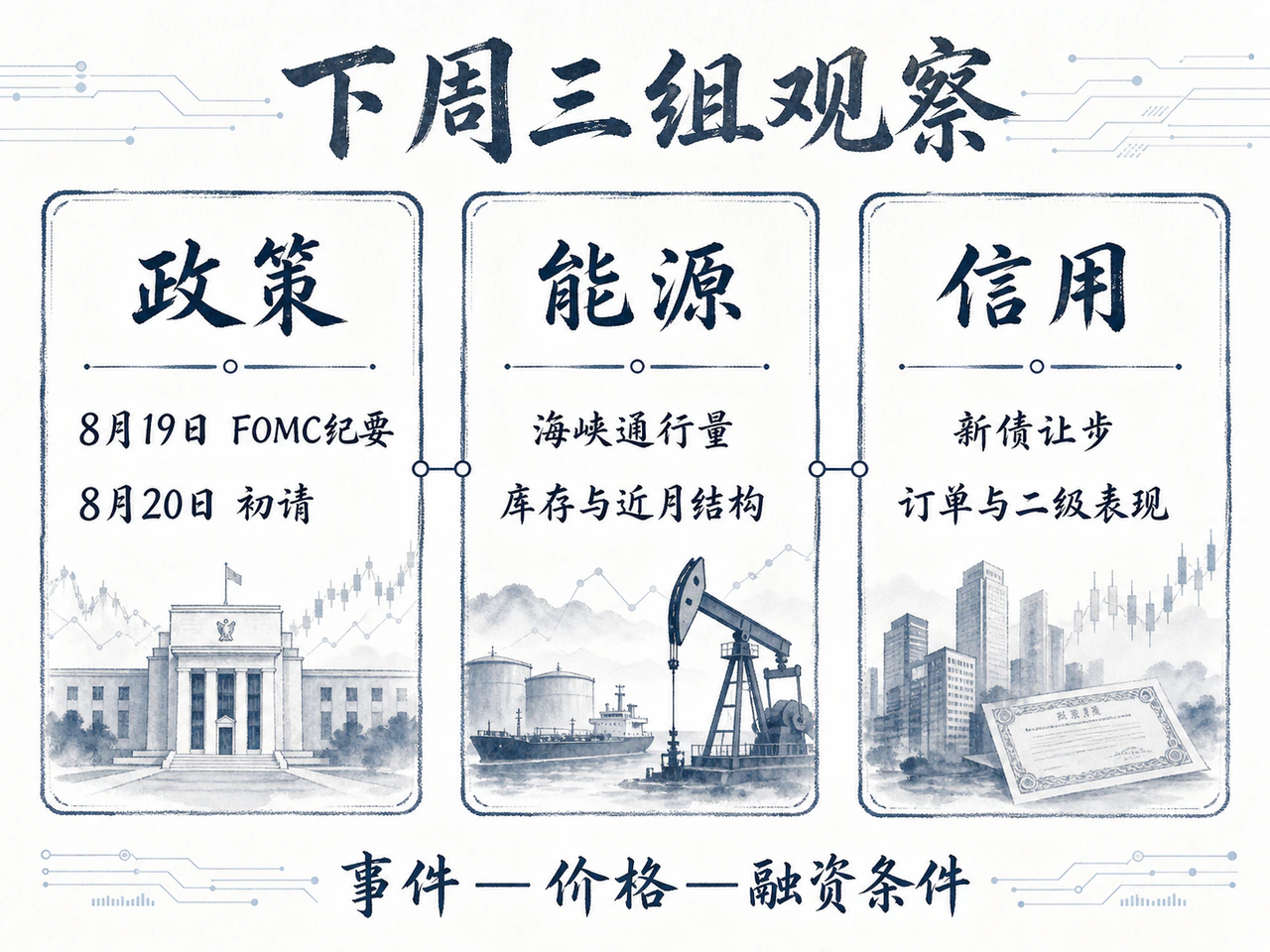
Three variables deserve attention:
First, July minutes on August 19. Low hike thresholds among the 3 dissenters could reprice a tighter front-end path; majority emphasis on slower jobs and weak spending would reinforce a September hold. August 20 claims would test the low-hiring, low-layoff pattern.
Second, energy geopolitics. Better escorts could quickly lower oil premiums, stabilize inflation expectations and energy spreads; tighter transport or sanctions would transmit gains into August prices and costs. Watch transits, commercial stocks, strategic reserves and nearby structure.
Third, primary-market clearing under concentrated supply. With IG spreads at 79bp and HY at 271bp, secondary resilience depends on new allocation absorbing supply and required new-issue concessions. Computing infrastructure and AI-heavy issuers' coverage, concessions and secondary performance will test discrimination among new capex credit risks.