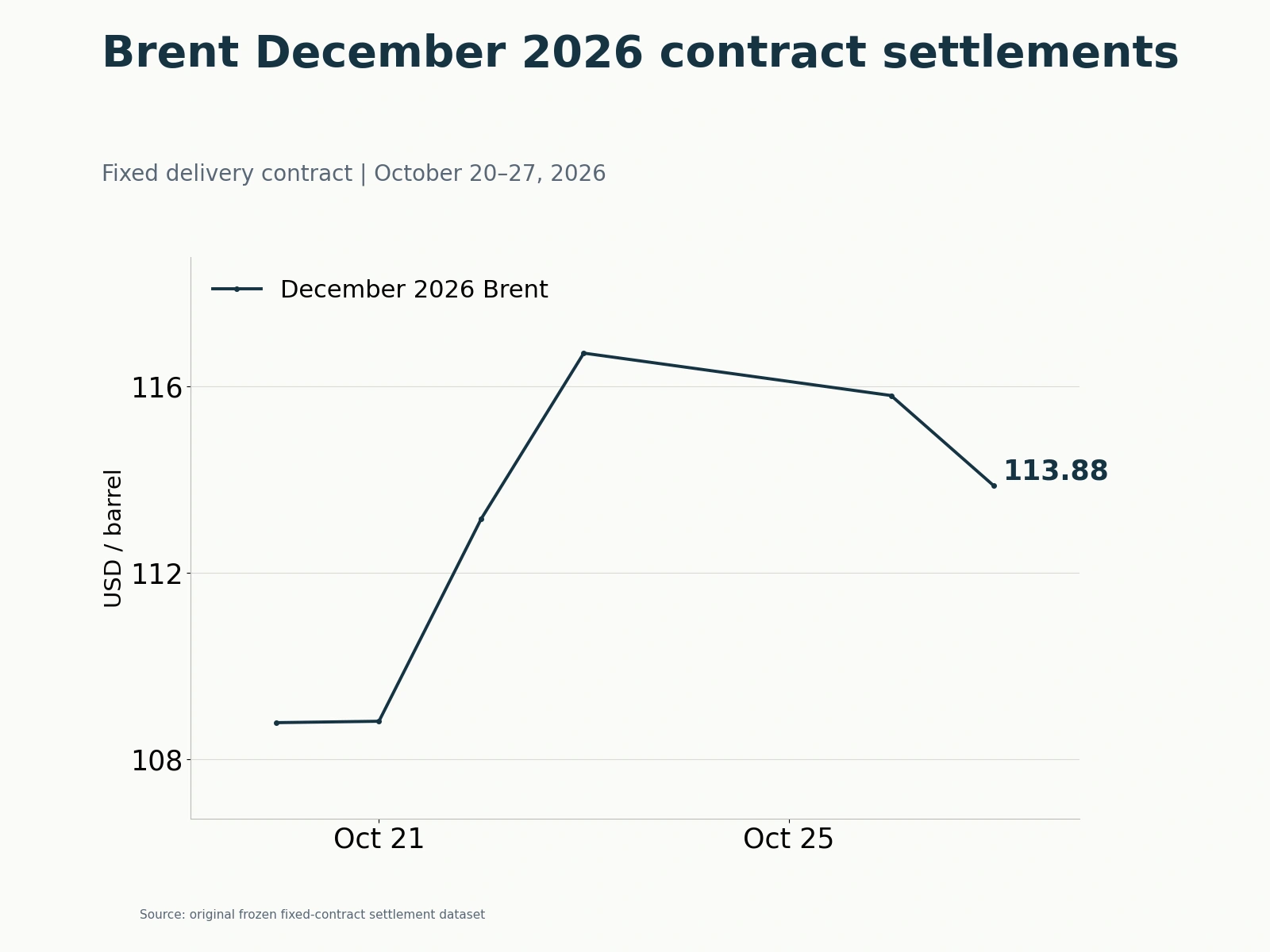
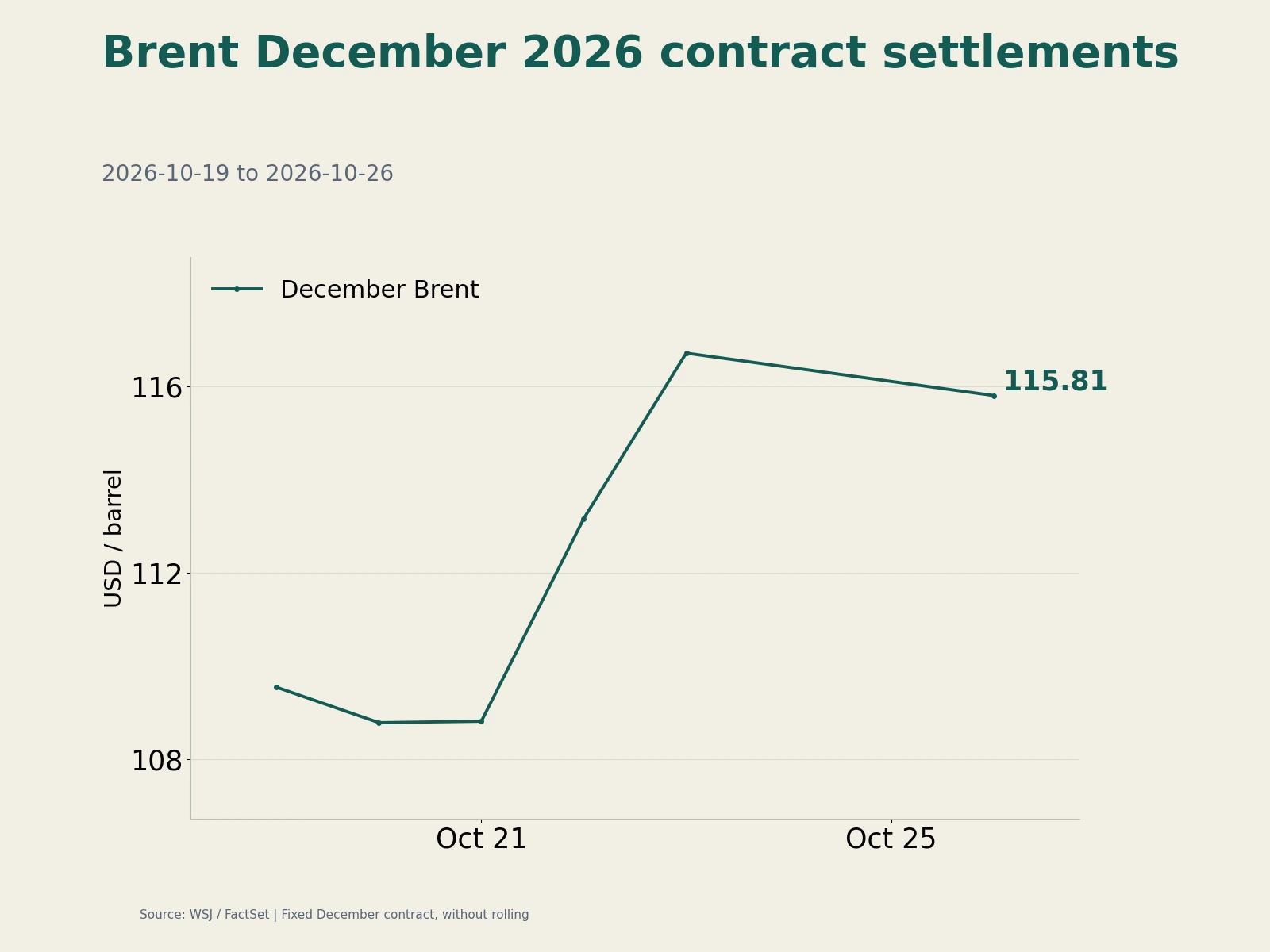
Another tanker attack in Hormuz on August 14, followed by US assertions of an indefinite blockade capability, quickly raised nearby crude risk premiums. September WTI settled Friday at $82.40/barrel, up $1.15 or 1.42% from August 13's $81.25. October Brent settled at $88.52, up $1.45 or 1.67% from $87.07. Reuters put weekly gains at about 6.0% for Brent and 5.4% for WTI.
Although observed commercial transits nearly stopped over the weekend, Monday's Asia-Pacific electronic open brought no expected explosive jump. Prices remained near Friday's platform. The logic was clear: nearby contracts paid heavily for immediate route disruption, while a surprise 17.4 million-barrel US commercial build and IEA/OPEC demand downgrades imposed a ceiling on further advances.
Friday restores weekly gains, with the curve still higher nearby
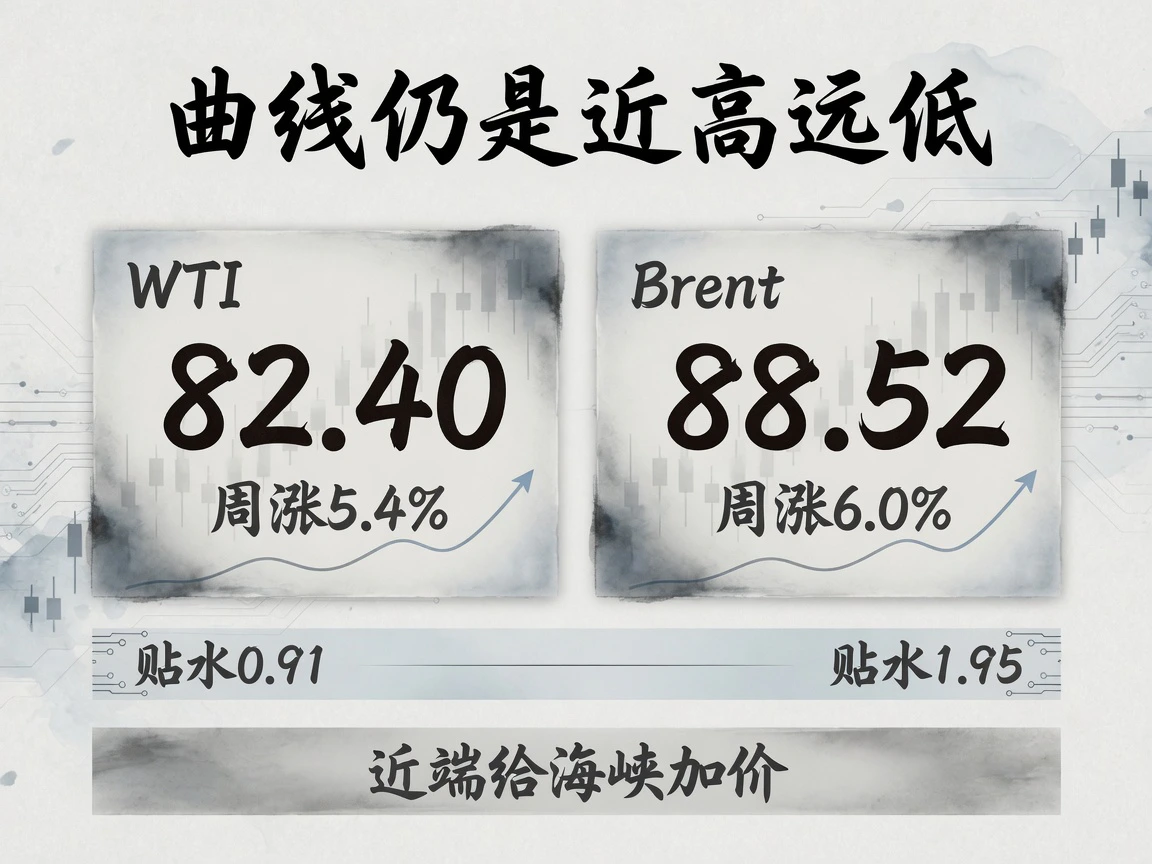
WTI opened the week gapping from around $78 to $82.13, reached a local intraday high near $83.2 on August 11–12, took profits to $81.25 on August 13 and rebounded Friday on geopolitical news. Brent moved similarly. Against August 7 closes of $78.18 and $83.55, weekly gains were about 5.4% and 6.0%. Brent's spread over WTI widened from around $5.82 on August 13 to $6.12 on August 14, increasing the gap between the benchmark exposed to Middle Eastern shipping and inland US crude.
The forward curve retained steep backwardation. October WTI settled at $81.49, $0.91 below September; November Brent at $86.57, $1.95 below October. Investors paid a high immediate channel-risk premium for barrels that might be disrupted at any moment, but deferred positions still discounted the baseline of tensions easing and routes reopening within months.
Monday electronic trading mainly changed quotation levels. Reuters Singapore recorded Brent at $88.72 and WTI $82.35 at 23:50 GMT, around 07:50 Beijing time. At 08:54 Beijing, commodity snapshots showed $88.49 and $82.06. A Reuters update after the cutoff at 08:06 GMT, about 16:06 Beijing, put Brent at $88.79, with an intraday high of $89.40, and WTI at $82.16. Quotations clung to Friday's $82/$88 platform, without blindly chasing the weekend's observed shutdown.
17.4 million barrels accumulate on the Gulf Coast, but products remain tight

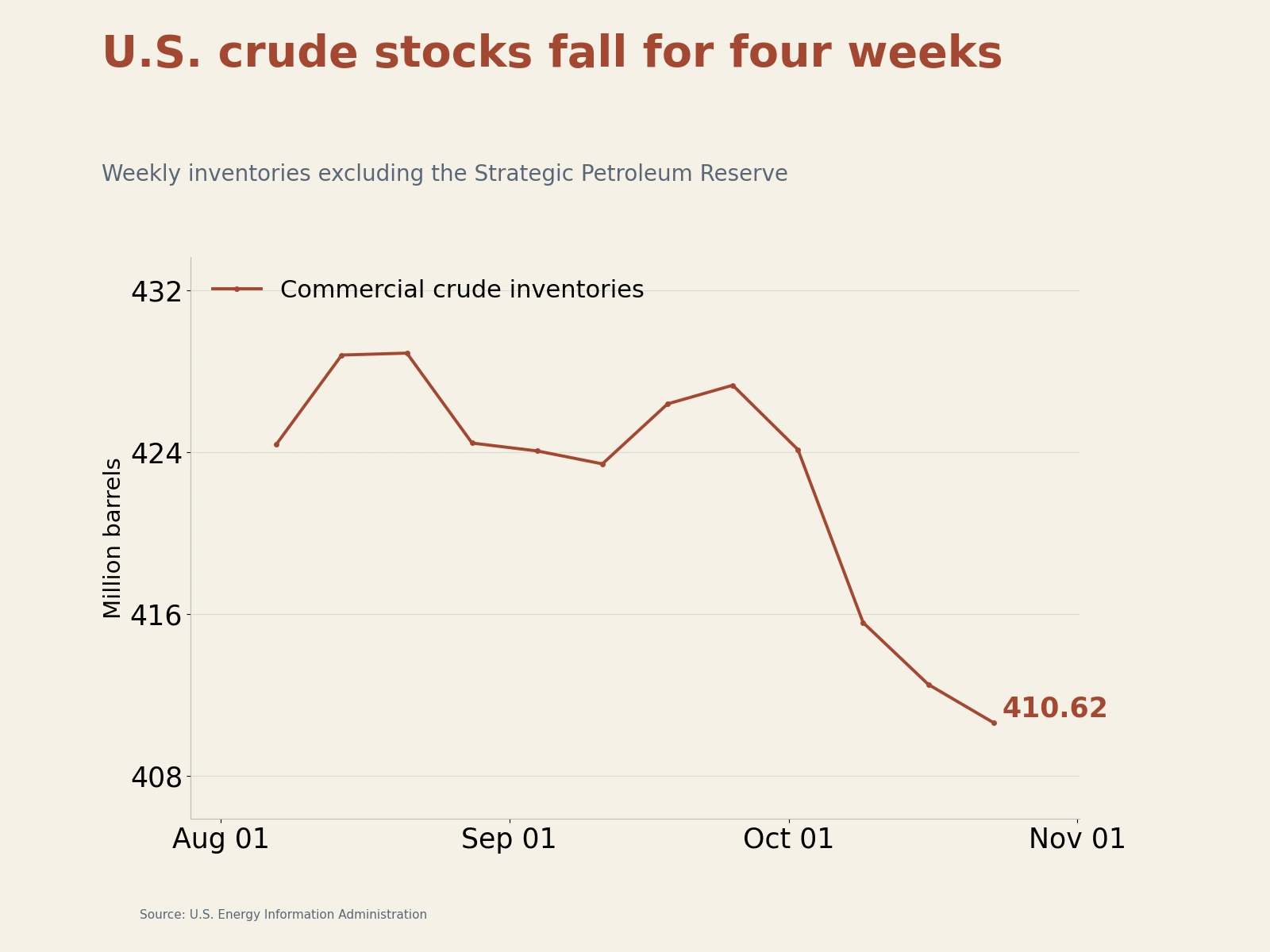
The EIA's August 12 report for the week ended August 7 surprised bulls: US commercial crude excluding the SPR jumped 17.4 million barrels to 424.4 million. Still around 2% below the five-year seasonal average, the build was the largest since January 2023 and overturned Reuters expectations of a 1.4 million-barrel draw.
This looked more like logistical backflow than a sudden domestic-demand collapse. Crude exports fell to 3.06 million barrels/day, the lowest since November 2025 and in the current conflict, while net imports surged 1.77 million barrels/day to their highest since June 2025. Cushing stocks rose 1.6 million. Reuters cited Kpler as locating most of the build on the Gulf Coast, driven by reduced exports and incoming offshore supply. If shipping recovered the following week, the 17.4 million barrels would probably prove temporary congestion rather than a fundamental turning point.
SPR stocks meanwhile fell another roughly 6.1 million barrels to 298.7 million, below the psychological 300 million threshold and the lowest since January 1983. Temporary commercial abundance did not remove the vulnerability of a depleted strategic cushion.
Products stayed tight. Gasoline fell 1 million barrels to 208.7 million, about 6% below the five-year average; distillates slipped around 10,000 to 107.1 million, 12% below. Refinery utilization remained extremely high at 96.2%, while products supplied edged down to 20.64 million barrels/day. The IEA said light- and middle-distillate scarcity had pushed Atlantic cracks and refining margins to historic highs, with European August margins still making records. Baker Hughes reported only one additional US oil rig on August 14, taking the count to 455. Quiet upstream investment offered no physical basis for expecting rapid shale growth to fill the Gulf gap.
The shortfall deepens while demand forecasts shrink

Official forecasts displayed conflicting bullish and bearish pressures. The IEA's August 12 report projected extreme near-term tightness followed by a broad reversal: 2026 global oil supply down 4.3 million barrels/day, demand down 1.6 million, a further 510,000 reduction from July's forecast. The Q3 deficit consequently rose to 1.8 million barrels/day from around 800,000, more than doubling.
Observable global oil stocks fell 69 million barrels in July to below 7.9 billion, with cumulative conflict-era depletion near 410 million. Persian Gulf July production was only 23.9 million barrels/day, 8.3 million below prewar, while exports including bypass pipelines were around 15 million. Loadings declined from near 20 million early in the month to around 12 million late in it. Yet the IEA assumed easing war would restore surplus by year-end; Reuters cited a 2027 surplus projection as high as 4.6 million barrels/day. Deep deferred discounts reflected that assumption.
The EIA's August outlook used a different basis: Q2 Hormuz flow at 4.9 million barrels/day versus 21.6 million in the prewar fourth quarter, and July regional shut-ins at 5.5 million, versus the IEA's 8.3 million. It raised Q3 Brent spot to around $85, projected $78 for Q4 and $69 in 2027, likewise assuming disruption concentrated in August with export flows recovering after September.
OPEC cut its 2026 demand-growth forecast for a fourth time to 580,000 barrels/day from 780,000, while raising 2027 growth to 2.16 million. The IEA saw contraction this year, OPEC continued expansion. On August 2, core OPEC+ members agreed a symbolic September quota increase near 188,000 barrels/day, completing the unwinding of earlier 1.65 million voluntary cuts, without addressing Q4. The next seven-country online review was September 6. Reuters had noted that many quota changes remained on paper: against Gulf loadings falling from around 20 million to 12 million, 188,000 monthly incremental quota was a different order of magnitude.
Weekend passage nearly stops; vessel data contradict official reassurance

Physical risk escalated sharply. UAE officials said Thursday night that two ADNOC-linked merchant vessels were struck near Hormuz, then confirmed Saturday a third tanker encounter on Friday. Kpler tracked five Saturday passages and none Sunday, versus 31 the previous weekend and a precrisis daily average above 130. The few Saturday vessels included an empty VLCC with AIS off and an Indian very large gas carrier close to Iranian territorial waters. Dark vessels may cause omissions, but the scale indicated de facto paralysis.
Official reassurance differed sharply. Energy Secretary Wright said August 12 that seven-day strait flows remained near 9 million barrels/day, or around 15 million of regional exports including land bypasses. Commercial tracking instead showed actual seaborne flow struggling around 5 million–7 million. The weekend collapse exposed the gap. Prompt traders follow actual loadings and port data rather than policy messaging.
Diplomatic positions hardened. Washington claimed the military and logistical ability to maintain an indefinite comprehensive naval blockade; Treasury Secretary Bessent promised unprecedented isolation and secondary restrictions the next week. Duration threats were clear, but implementable rules remained contested. Araghchi said normal shipping would not resume unless Washington accepted all Iranian demands and that restarting mediation was not under consideration.
Alternatives outside the Gulf were also hazardous. Bab el-Mandeb weekend traffic fell to 49 from 55, with Kpler observing no Saudi-flagged tanker. On Friday, a suicide-drone attack closed Novorossiysk's Sheskharis terminal, normally handling around 700,000 barrels/day. Simultaneous Red Sea and Black Sea bottlenecks meant nearby premiums depended on more than Hormuz alone.
$82 and $88 already include a layer of blockade pricing
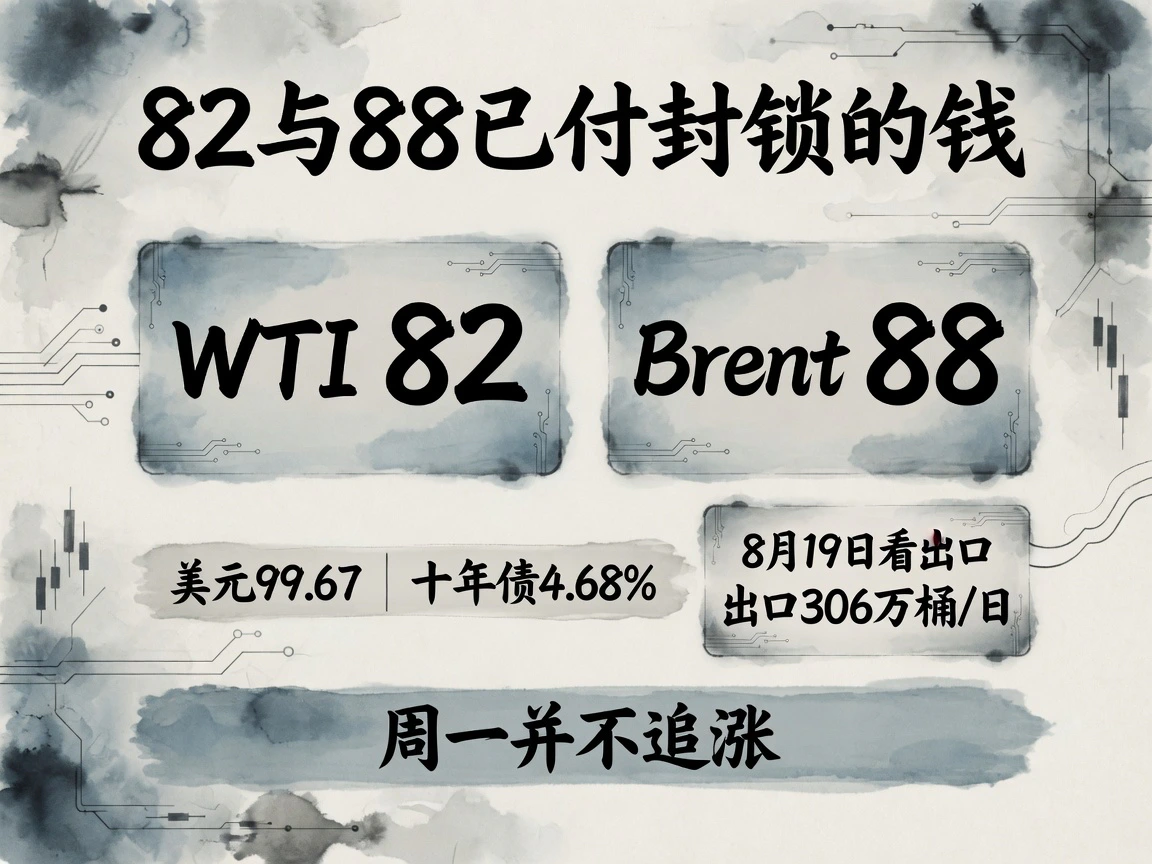
Macro offered no one-way bullish tailwind. On August 14 the dollar index fell 0.29% to 99.67, providing modest support, but Treasury yields rose: 10-year 4.68%, +5 basis points; 2-year 4.17%, +2. S&P 500 fell 0.17% and gold edged up 0.39%. Higher rates and weaker equities showed continuing macro liquidity pressure on risk assets.
Damage was appearing in importing economies. Japan's Q2 GDP, released Monday, grew just 1.1% annualized versus Reuters consensus 2.0%; private consumption was flat and business investment fell 1.2% quarter on quarter. Reuters said Middle Eastern supply disruption and surging import costs were substantively weakening final demand. Friday's oil rally was a supply premium from blockade and attacks, while macro fundamentals opposed it.
Nearby trading assumed no rapid normalization of Hormuz. Yet the US commercial build and both agencies' demand downgrades anchored the core WTI $82/Brent $88 range. Low product stocks supported steep backwardation: nearby contracts priced immediate blockade, deferred contracts postwar surplus. Phillip Nova told Reuters that without irreversible physical destruction of core pipelines, storage or ports, speculative nearby buying lacked confidence for another breakout.
The lack of a Monday chase despite near-frozen weekend passage showed Friday's $82/$88 already incorporated indefinite US blockade and normalized shipping restrictions. The decisive early-week test was whether the first commercial tracks reappeared, rather than another severe White House slogan. The August 19 EIA report would test recovery from exports of only 3.06 million barrels/day. Only sanctions extending substantively into financial settlement or reinsurance deprivation would give risk premiums room for another layer.