On August 17, 2026, the previous week's new 3-, 10- and 30-year Treasuries settled and entered secondary trading. The cash curve bear-steepened: the 2-year rose only 2 basis points to 4.19%, the 10-year 4 to 4.72%, and the 30-year 6 to 5.31%. Short rates remained anchored to a September Fed hold, while longer maturities repriced supply absorption, higher real rates and energy-geopolitical premiums. Macro divergence was stark: New York manufacturing sentiment reached a four-year high, while builder confidence edged only from 34 to 35, below the 40 threshold for a 16th month. Higher long discount rates pulled the S&P 500 about half a percent from recent records, with energy the only positive sector among eleven.
Fixed income: short rates wait; newly settled long bonds begin with a secondary-market discount
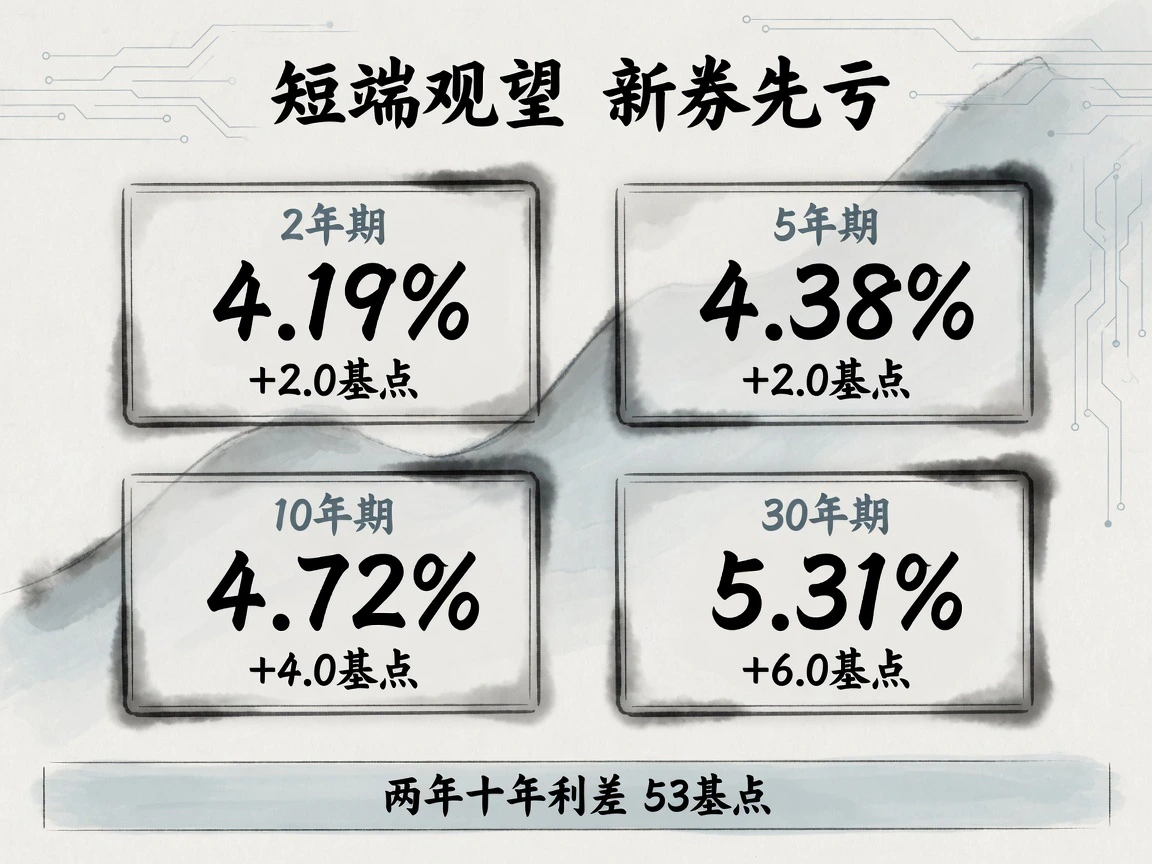
Treasury's official end-of-day par curve, close to close, August 17 versus August 14:
| Maturity | Close | Daily change |
|---|---|---|
| 2-year | 4.19% | +2.0 basis points |
| 5-year | 4.38% | +2.0 basis points |
| 10-year | 4.72% | +4.0 basis points |
| 30-year | 5.31% | +6.0 basis points |
Bear steepening widened key spreads: the 2-year/10-year spread (2s10s) from 51 to 53 basis points and the 5-year/30-year spread (5s30s) from 89 to 93. The 3-month bill was 3.87%, up 1 basis point; 7-year 4.54%, up 3; 20-year 5.30%, up 5. Cash-management and liquid short assets barely moved; upward pressure increased from seven years and peaked at thirty.
Of the 10-year nominal rise of 4 basis points, about 3 came from real rates and only 1 from inflation compensation. Ten-year TIPS closed at 2.44%, with breakevens 2.28%; 5-year real yield was 2.13% and 30-year 3.06%. Even with oil up more than 2%, the 10-year breakeven rose only 1 basis point. Investors were not extrapolating oil into systemic reflation; long yields reflected real borrowing costs and term premiums.
Some intraday reports called 30-year market quotes the highest since 2007. On the official par curve the close was 5.31%, up exactly 6.0 basis points. Institutional summaries put the on-the-run 10-year around 4.724%, up about 2.8 basis points. Levels were close, with differences chiefly from par-curve interpolation versus active cash securities; daily changes should use the Treasury curve consistently.
Large new issues settled Monday. The 10-year auction cleared at 4.683%, coupon 4.625%; the 30-year at 5.216%, coupon 5.125%. Monday's official yields were above both, marking the secondary 10-year roughly 4 basis points and the 30-year about 9 higher. Primary holders therefore began settlement-day secondary pricing with paper losses. In contrast, that day's 13-week and 26-week bill auctions cleared at 3.715% and 3.780%, both below prior auctions, consistent with the 2-year's modest 2-basis-point move.
After-hours June Treasury International Capital (TIC) data revealed cross-border buying. Securities, bills and banking flows together recorded $133.5 billion net inflows. Overseas investors still added long U.S. assets, but Treasury detail was weak: private foreign purchases of notes and bonds were $16.6 billion, sharply below May's $53.6 billion, while official institutions, sovereign funds and central banks sold $9.8 billion. Net long-Treasury purchases were only about $6.8 billion, with equities the main inflow destination. Foreign preference was shifting toward risk assets rather than providing an uninterrupted long-money bid for ultra-long debt. The roughly two-month lag makes TIC chiefly background on buyer holdings.
During cash trading, futures kept the probability of a September 15-16 hold at 3.50%-3.75% around 70%; FedWatch at 10:25 Eastern showed about 68.4%. After the equity close, higher oil and long yields reduced it to roughly 65%, returning a 25-basis-point hike near one-third. Markets removed the urgency of an immediate September increase, while retaining an option for one by year-end. A Reuters August 12-17 survey found 94 of 104 economists expecting a September hold. No voting Fed official spoke publicly that day. Credit remained calm: August 14 high-yield and investment-grade spreads of 267 and 80 basis points remained historically very tight.
No new official Treasury close was available overnight after Monday's cash settlement. Around 20:33 Eastern, live quotes were 2-year 4.186%, 10-year 4.732% and 30-year 5.318%. In Beijing's August 18 morning, futures remained pressured by higher yields. These were overnight liquidity snapshots, not formal cash closes.
Macro: New York manufacturing reaches a four-year high while housing remains below the threshold
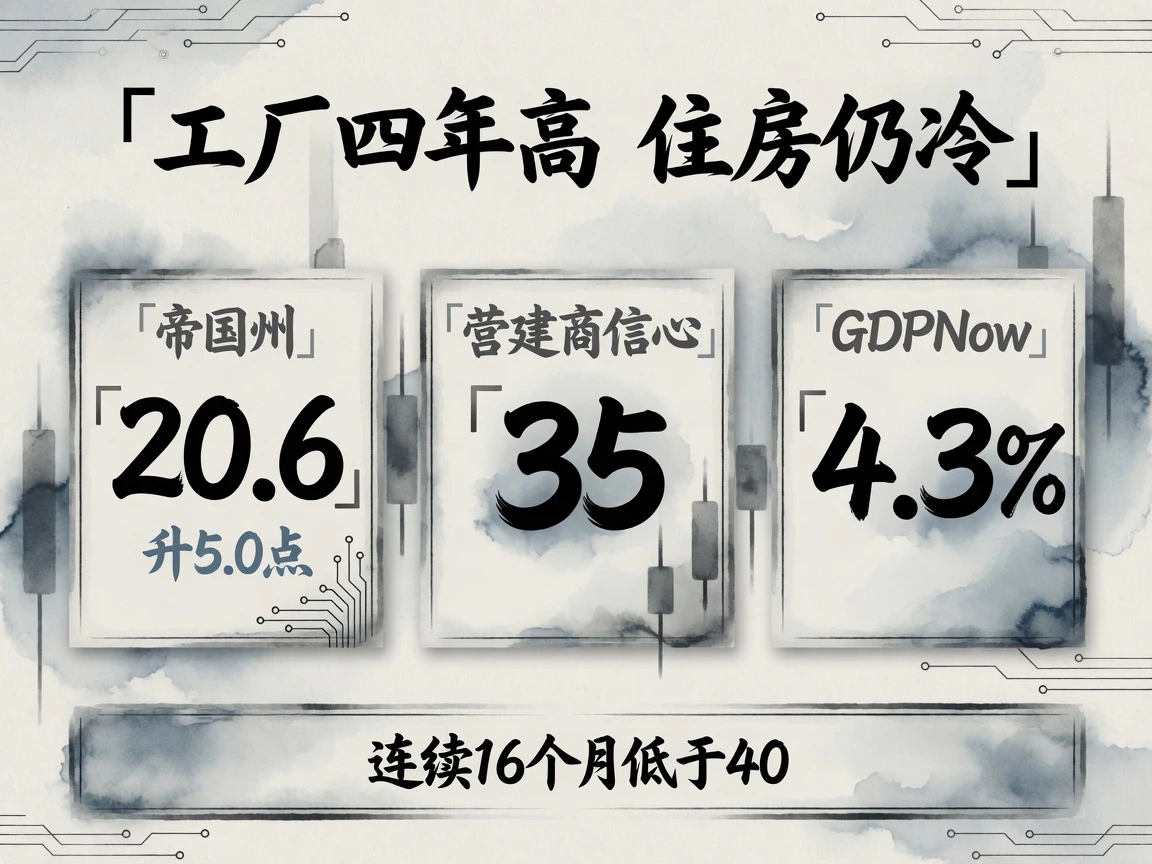
Monday's data showed extreme divergence: New York manufacturing sentiment unexpectedly reached a four-year high while nationwide builder confidence remained stuck below the dividing line.
The August Empire State survey's general business index jumped 5.0 points to 20.6, well above consensus around 10-12. Responses were collected August 3-10, before Friday's weak retail release. Strength was not universal: new orders 17.3 versus July 22.2; shipments 11.7 versus 24.4, still expansionary but slowing. Backlogs rose to 15.5, delivery times 20.6, input prices stayed high at 58.6, and selling prices fell to 22.7. The headline high was supported by backlogs and longer deliveries: factories were fulfilling old orders amid renewed bottlenecks, not necessarily a sudden household ordering boom. This supported hawks' supply-constraint case but left moderates without evidence of broad demand overheating for a September hike.
Housing was colder. NAHB/Wells Fargo's August HMI was just 35, versus an unrevised July 34, its 16th month below 40. Current sales were 39, six-month expectations 43 and buyer traffic 23. Some 35% of builders cut prices, by an average 6%, and 63% offered incentives including mortgage-rate buydowns. MBA's 30-year mortgage contract rate was 6.77%, its first small decline since mid-June but near a one-year high. Gasoline above $4/gallon and diesel around $5.45 compounded the squeeze: weak affordability constrained demand while repriced inputs raised construction costs. July starts and permits due August 18 would test whether weak sentiment meant stalled sites.
Top-level Fed guidance was in an observation vacuum. July 28-29 held 3.50%-3.75% by 9-3; Hammack, Kashkari and Logan dissented for 25 basis points. Atlanta GDPNow's August 14 Q3 annualized estimate stayed 4.3%. Cleveland nowcasts projected July PCE at 3.65% annually and August CPI at 3.36%. These were not official final figures; July PCE awaited August 26.
Friday retail sales' first monthly decline in nine months could be overread as consumption stalling. It need not conflict with manufacturing: regional factories worked through backlogs while housing sentiment and intentions showed no real recovery. Two different speeds gave policymakers room to wait another round. July PCE on August 26, August payrolls in early September and whether rebounding oil reignited August CPI could overturn the voting balance. August 19 minutes would reveal Kevin Warsh's July deliberations in full for the first time, but contain no new dots.
Commodities: oil prices the longer waiting period; gold prices obstacles in the rate path
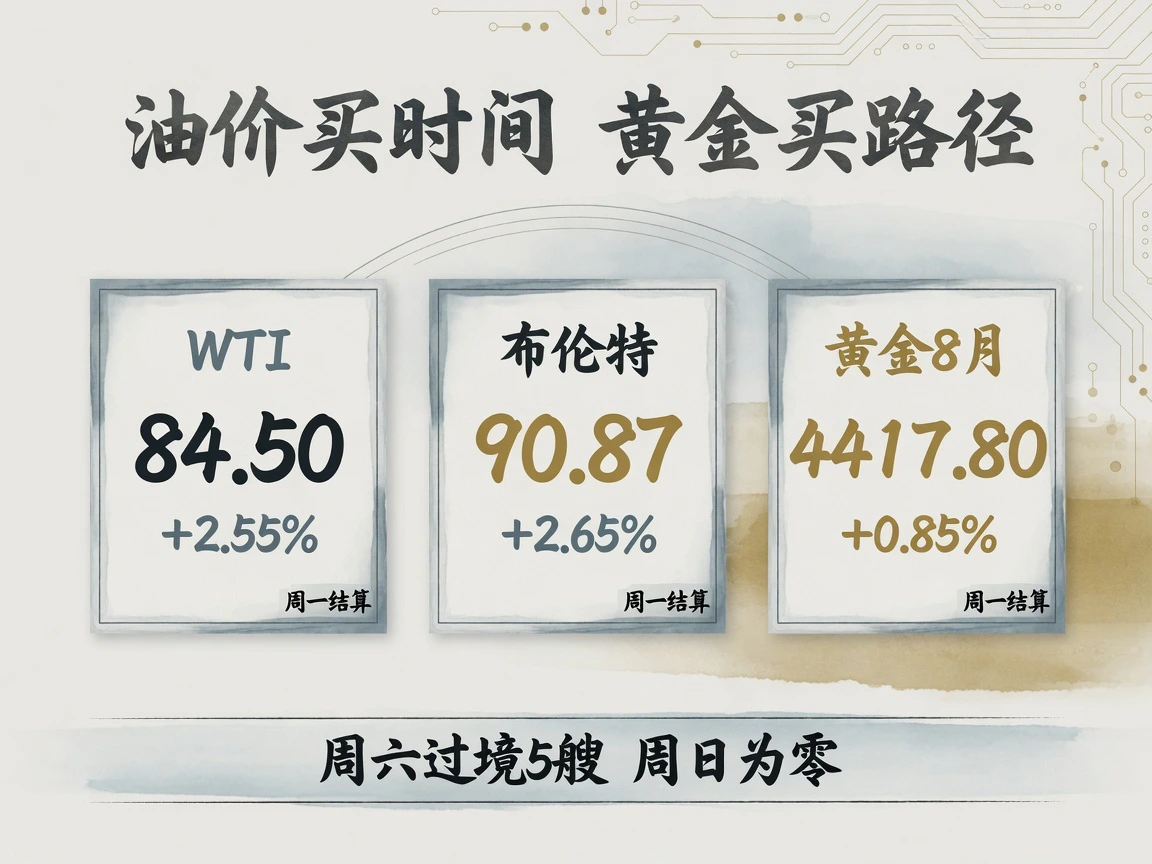
Monday combined higher oil and gold, lower stocks and renewed volatility. Commodity investors priced a lengthening negotiation window and supply obstacles that complicated the Fed's task and immediate hiking, without translating that premium into broad procyclical buying.
September WTI settled at $84.50/barrel, +2.55%; main October Brent $90.87, about +2.65%. August COMEX gold settled $4,417.80/ounce, +0.85%, and main December $4,473.70. Different delivery months mean the gold prices cannot simply be subtracted. Brent-WTI widened from Friday's $6.12 to about $6.37. Oil was nearly flat early before afternoon geopolitical repricing lifted both to roughly three-week highs, with Brent firmly above $90. Deep backwardation remained: traders paid for tight immediately deliverable barrels, without pricing Middle Eastern turmoil as permanent global energy scarcity.
Oil was paying for an extended timetable. June's text set August 17 for a final agreement, but the deadline passed without workable reopening details. Kpler data relayed by media showed five commodity vessels Saturday and none Sunday, versus 31 the previous weekend and more than 130 normally per day prewar. Opaque trades and detours sustained some supply: ADNOC sold at least 14 million barrels to Asian refiners for October-November delivery, avoiding their need to send tankers into the Gulf. Products were tighter still: September RBOB rose 2.70% and regular gasoline exceeded $4.06/gallon. Demand added little offensive support. China's NBS said July crude processing was 53.11 million tonnes, about 12.5 million barrels/day, down 15.8% annually and up only 0.3% monthly, far below prewar norms. A daily oil gain above $2 had not accumulated enough momentum to retest late-July's $100.
Gold depended heavily on rate-path expectations. August COMEX made its highest close since June 4, up $54.20 in two sessions. It held firm despite a 4-basis-point rise in the official 10-year yield because the dollar remained weak and September hiking odds were contained near one-third. VIX only moved modestly above 15; gold did not show a typical irrational one-day geopolitical panic spike.
Before cutoff, overnight quotes put WTI around $85.00 and Brent near $91.12, liquidity snapshots only. Bessent's promised response package the previous week produced only routine June TIC disclosure Monday; substantive measures remained announced rather than implemented.
Equities: another half-percent retreat from records; chips cannot offset software repricing
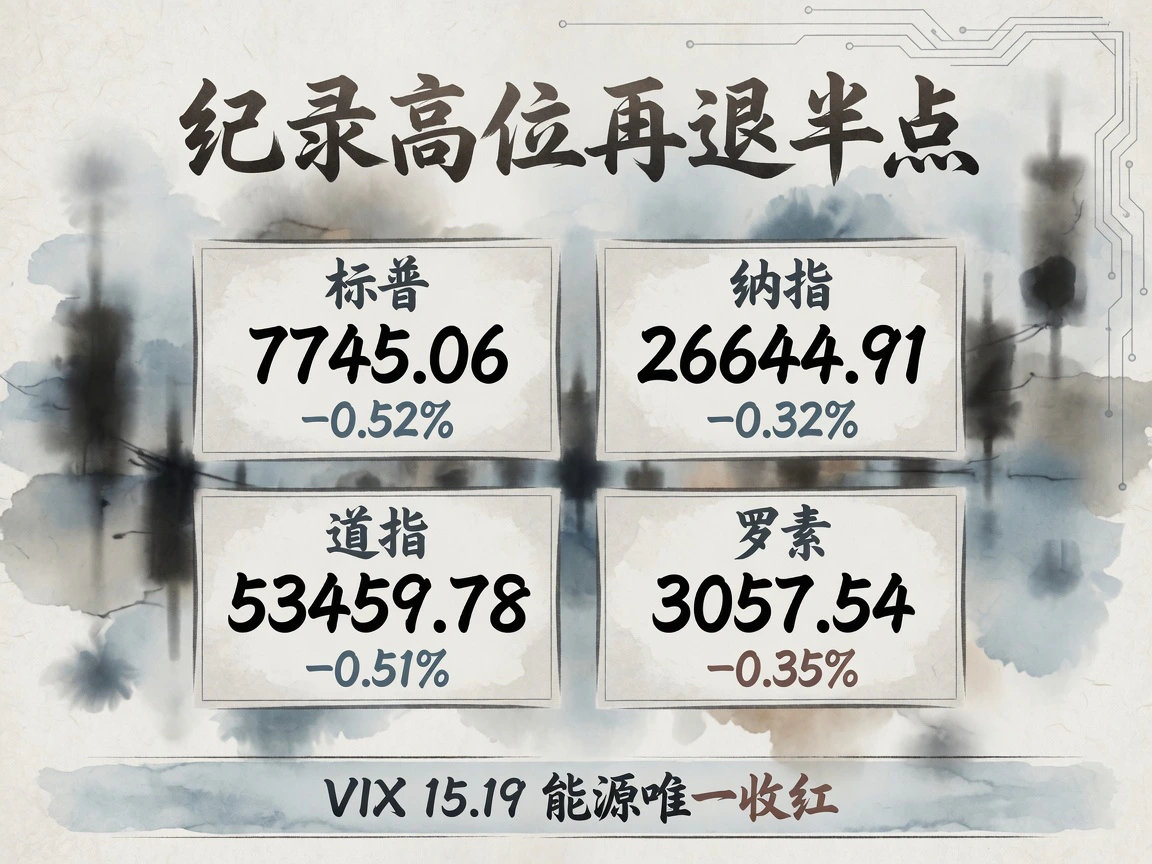
Rising oil pushed long yields higher, pulling the S&P 500 about half a percent further from Thursday's record. Hardware and memory held up, while software and the Magnificent Seven weighed. Investors waited for retail giants' results to assess real consumption; the modest daily decline was not yet market-wide derisking.
At the New York close, S&P 500 fell 40.70 points to 7,745.06 (-0.52%), about 0.69% below its August 13 record close of 7,798.99. Nasdaq Composite was 26,644.91, about -0.32%; Dow 53,459.78, -0.51%; Russell 2000 3,057.54, -0.35%, unable to retain Friday's record. VIX rose 6.60% to 15.19. Selling momentum solidified as afternoon oil accelerated. Despite S&P 500 constituents' Q2 annual earnings growth near 50%, Brent above $90 and the official 30-year at 5.31% forced valuation discounts for higher long risk-free rates.
Only the S&P 500 Energy Select Sector among eleven sectors rose, +0.87%. Communications and staples each lost about 1.5%; financials and discretionary more than 1%. Philadelphia Semiconductor gained 1.6% while S&P 500 software and services plunged 2.8%. All Magnificent Seven fell, notably Microsoft -3.04% to $480.35 and Meta -3.54% to $568.97, the S&P 500's largest point drags. Hardware limited losses: Micron about +4%, Applied Materials +5.5%, recovering Friday's 5.1% event-driven drop. Buyers still bet on advanced-process shortages, aggressive AI cloud spending and a memory supercycle. Sellers questioned when downstream SaaS and applications would monetize infrastructure capital into stronger balance sheets and earnings. NYSE decliners outnumbered advancers about 1.76:1; U.S. volume was 14.74 billion shares versus a 20-day average of 16.95 billion, weak breadth without disorderly volume.
No new official consumption data arrived Monday. Friday retail had sounded the first monthly-decline warning in nine months. Home Depot before Tuesday's open, Target and Lowe's Wednesday, and Walmart Thursday would provide company-level evidence. Rate-sensitive domestic-demand investors were unwilling to add leverage blindly before the calls.
Asian sessions generally preceded U.S. cash trading. Nikkei 225 rose 0.74% to 69,220.25, above 69,000 after about six weeks, driven by a few AI heavyweights. Japan's preliminary Q2 GDP grew 1.1% annualized, but private consumption fell about 0.02% quarterly and business equipment investment 1.2%. Markets absorbed weak domestic demand while overseas funds bought semiconductor leaders tied to global computing. Korea was closed Monday; its latest Kospi was Friday's 6,977.94. Greater China rebounded: Hang Seng 25,453.23 (+1.34%), ending four declines; Shanghai 3,982.65 (+1.41%); CSI 300 4,741.10 (+1.61%). Hong Kong hardware and AI-software leaders rose together, contrasting with later U.S. software selling and showing the trading-time difference.
Before cutoff, the main E-mini S&P 500 futures contract was around 7,769.5, about 24 points above Monday cash, mainly a carrying-cost basis. The next Asian day had begun: Nikkei near 68,803, reversing AI-heavyweight-led gains; Korea reopened about 2.3% higher; regular Hong Kong trading had not begun. With Nvidia's results not due until the following week, the chips-up/software-down split was expected to persist for some time.