On August 17, the 60-day deadline for a final arrangement under the June 17 U.S.–Iran temporary-ceasefire memorandum expired. Al Jazeera said neither side intended an extension; Araghchi said over the weekend no decision had been made to resume talks, and U.S. Energy Secretary Wright said Washington was ready for a long war. Without replacement diplomatic text or early normal passage, nearby contracts repriced Hormuz risk to roughly three-week highs: September WTI settled $84.50 a barrel and October Brent $90.87. Dark vessels with transponders off continued leaving the Gulf, however, while the prior week's huge U.S. commercial build prevented one-way panic and a direct return to triple-digit oil.
Nearby contracts reach three-week highs while deferred prices retain deep discounts
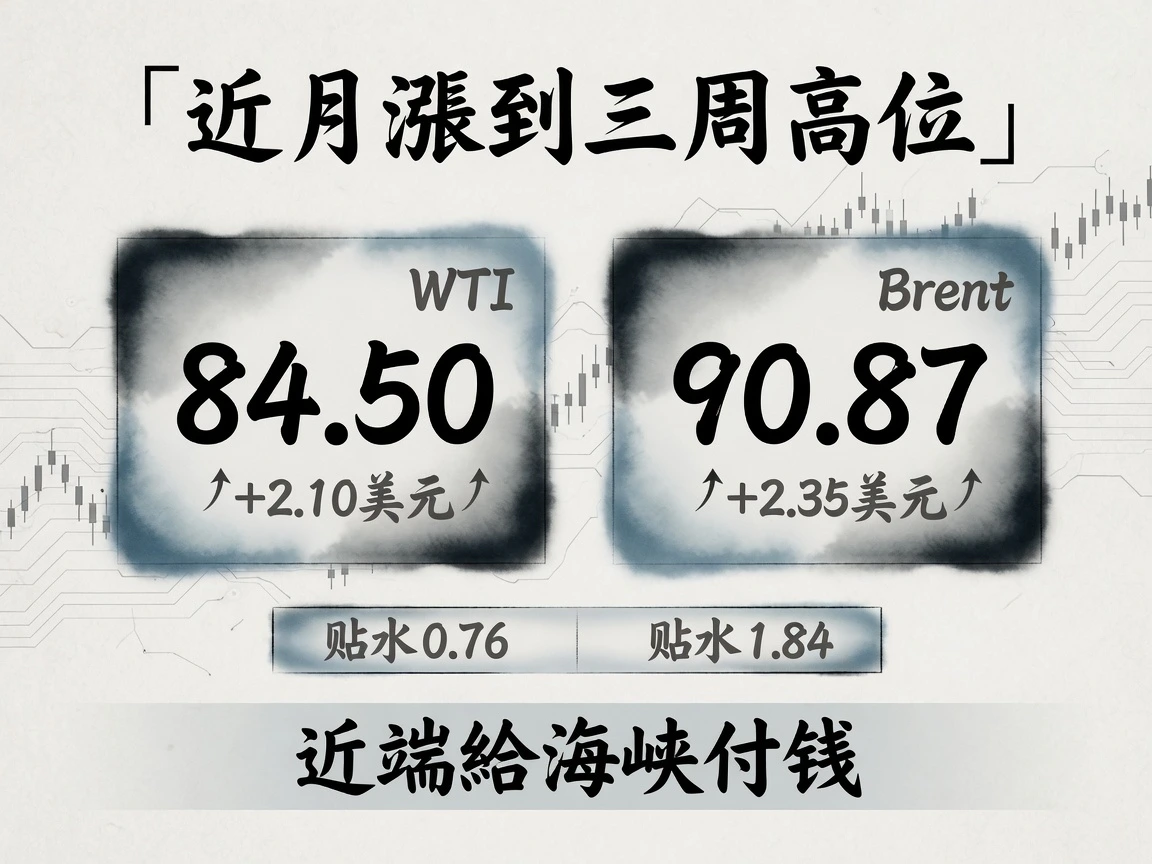
August 17 settlements were September WTI $84.50, up $2.10 or 2.55% from August 14's $82.40, and main October Brent $90.87, up $2.35 or 2.65% from $88.52. Barchart said both reached nearly three-week highs. Brent–WTI widened from about $6.12 to $6.37. August 14 prices already reflected Red Sea and Gulf tanker attacks; Monday added a further institutional premium for expiry without renewal and U.S. long-war rhetoric.
Intraday trading was quiet early and stronger later. Reuters initially recorded Brent near $88.58 and WTI $82.22. As the long-war comments and diplomatic vacuum gained attention, defensive buying pushed Brent to an intraday $91.02 around 13:57 Eastern.
The forward curve remained steeply backwardated. Oilprice listed October and November WTI at $83.74 and $82.41; October was about $0.76 below September. The Wall Street Journal recorded November Brent at $89.03, about $1.84 below October. Nearby contracts paid for current Hormuz obstruction, while deferred prices retained discounts on eventual route normalization.
Asian electronic trading remained high at publication and represents snapshots, not daily settlement changes. At 08:20–08:24 Beijing time, WTI was $85.00 and Brent $91.12. Oilprice front-month quotes were about $85.00/$91.17 and next-month $84.16/$89.35. Some third-party platforms, including Investing.com, recorded August 17 closes of $84.24/$89.04, closer to prices around the U.S. equity close and different from official weighted settlements.
Huge commercial crude build contrasts with tight downstream products

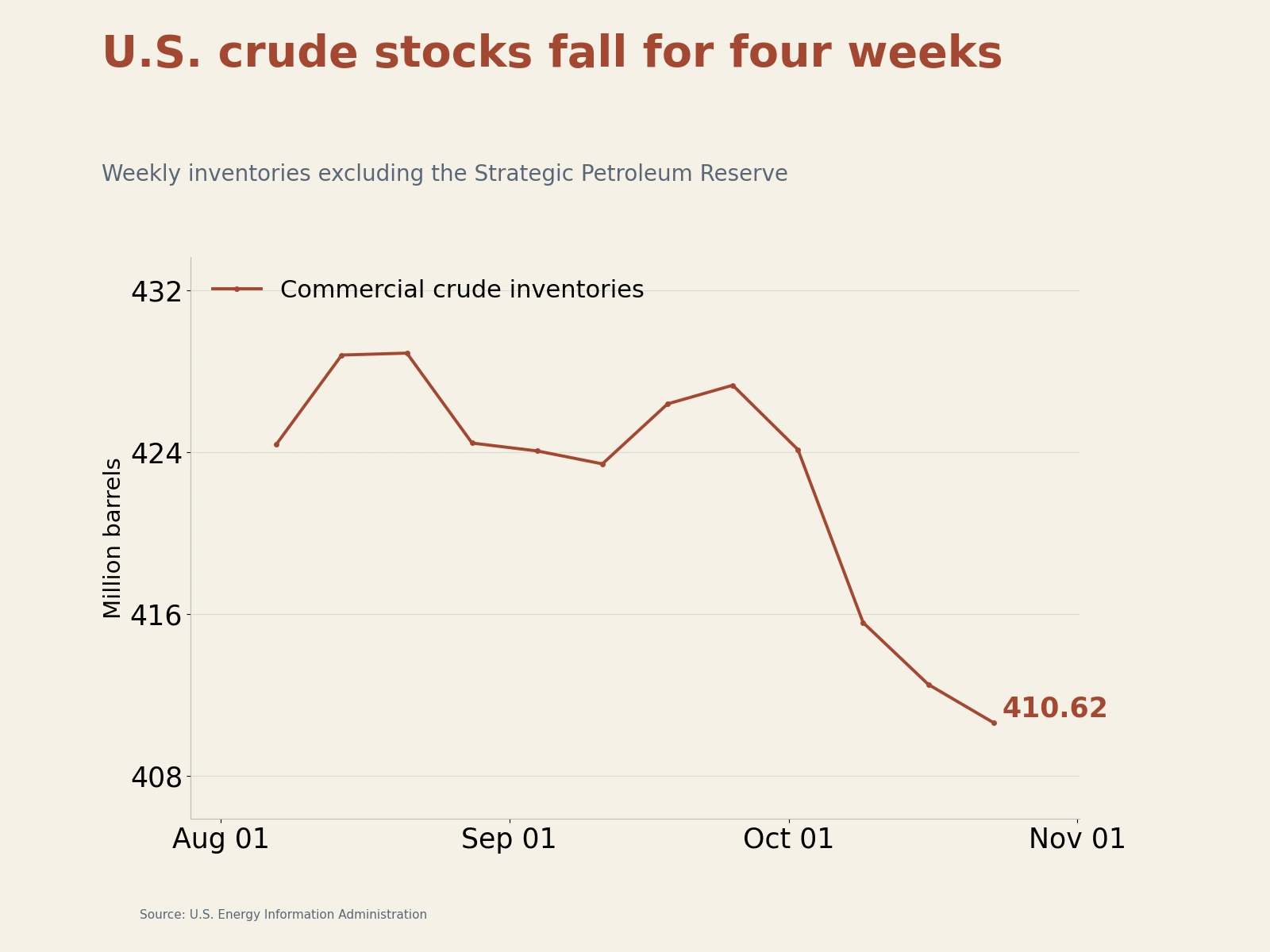
EIA had not yet released this week's report; markets used August 12's week-ended-August-7 data. Commercial crude excluding SPR rose 17.42 million barrels to 424.4 million, the largest weekly build in over three years. Stocks remained about 2% below the five-year seasonal average and 0.5% lower year on year. Reuters and Wall Street Journal surveys had expected draws of 1.4 million and 600,000. Trade timing drove the surprise: exports plunged to 3.06 million barrels daily while imports jumped to 7.34 million, raising net imports 1.77 million daily in a week. A subsequent export recovery would mean this exceptional build cannot directly establish a supply-demand turning point.
SPR meanwhile fell 6.11 million barrels to 298.7 million, showing price-management releases consuming the policy buffer: commercial tanks rose passively as strategic protection thinned.
Products showed no easing. Gasoline fell 970,000 barrels to 208.7 million, about 6% below the five-year average. Distillates were nearly unchanged at 107.1 million, still roughly 12% below average, and jet stocks fell 1.69 million. Products supplied reached a seasonal 20.64 million barrels daily. Domestic crude output rose only 1,000 to 13.805 million daily. Baker Hughes August 14 showed oil rigs up one to 455 and total rigs up five to 593. Vortexa's week-ended-August-14 floating stocks on tankers stationary at least seven days fell 5.8% to 108.0 million barrels. Crude builds alongside tight products and prompt floating supply supported cracks and crude prices.
The third-quarter deficit persists; paper OPEC+ quotas cannot replace physical supply
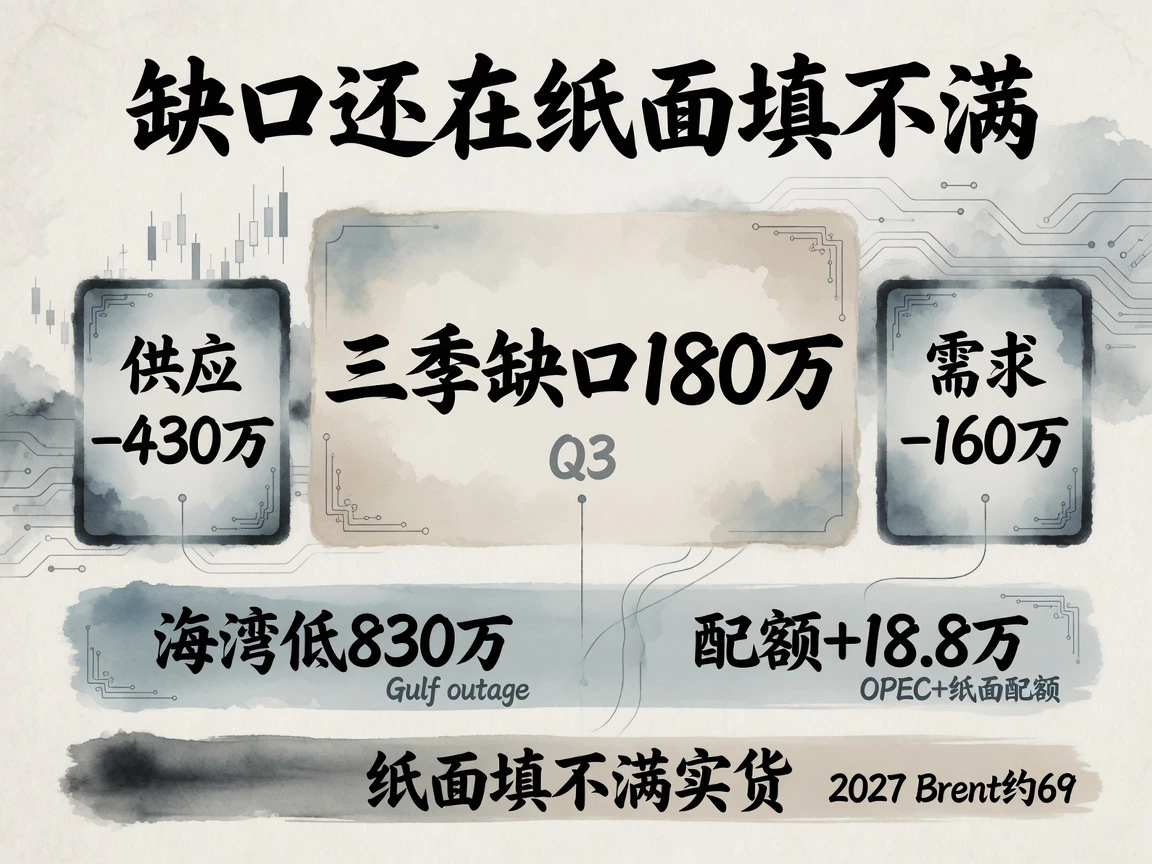
IEA's August 12 report forecast 2026 global crude supply falling 4.3 million barrels daily. High prices were expected to reduce demand by 1.6 million, but the third-quarter supply gap was still forecast at 1.8 million daily. Observable stocks fell 69 million barrels in July and about 410 million since the conflict began. Core Gulf producers' July output was 23.9 million daily, still 8.3 million below prewar normal. Regional exports including pipeline bypasses remained around 15 million daily.
EIA's August STEO anchored third-quarter Brent spot at about $85 and 2027 at $69, assuming Hormuz restrictions throughout August. OPEC+'s August 2 meeting raised September quotas about 188,000 barrels daily before pausing further increases; ministers next meet September 6. That nominal addition is tiny beside Gulf crude loading falling from a normal roughly 20 million to about 12 million daily. Paper quotas cannot close the physical gap.
Demand elasticity and buffers constrain upside. A Reuters August 17 column calculated from Chinese customs and refinery data that July imports recovered to 8.41 million barrels daily and processing was 12.51 million, implying about 210,000 daily entering storage. Commercial and strategic inventories remained near 1.2 billion barrels. This is an industry balance model, not an official absolute-stock release. It indicates the largest importer retains ample buffers to adjust against high prices, weakening the physical impetus for another rapid move above $100.
Public tracking nearly stops while dark ships keep leaving the Gulf

The original memorandum allowed fee-free Hormuz transit for 60 days, with subsequent management agreed by Iran and Oman. Ambiguous language left routes and jurisdiction disputed throughout. With Monday's deadline passed, no multilateral replacement providing stable expectations had emerged.
U.S. comments further reduced near-term de-escalation hopes. Traders read Wright's long-war stance as no early compromise on Strait control. Trump demanded full Iranian surrender and threatened strikes if Oman interfered with U.S. port blockades, still only verbal pressure. Bessent's prior-Friday promise of the toughest-ever economic isolation had not produced an enforcement text or entity list.
Public traffic and official flow estimates differed enormously. Reuters cited Kpler showing only five commodity vessels Saturday and zero Sunday, versus 31 the preceding weekend. Those records cover AIS-visible ships and omit dark transport. Barchart cross-cited Bloomberg, Kpler and Vortexa showing numerous UAE, Qatari, Iraqi and Kuwaiti tankers still leaving with AIS off. Reports that actual oil outflows exceeded a few radar-visible ships prompted a modest intraday retreat Monday. Wright had said seven-day average Strait flow remained near 9 million barrels daily, or about 15 million including pipeline bypasses, explicitly incorporating dark vessels.
Iran and Oman were privately drafting a regional shipping roadmap, but the U.S. was not involved and would not accept an arrangement failing to guarantee commercial navigation freedom. Security worsened: Houthis claimed an attack on Saudi Jizan refinery and continued Red Sea harassment, while Israeli operations against Hezbollah and Hamas advanced. Immediate full reopening narratives therefore lacked credibility. At publication, Gulf–Far East VLCC routes lacked normal quoted deals and no generally accepted authoritative daily-charter benchmark had formed.
Nearby contracts pay for delay, focusing on physical flows and sanction details
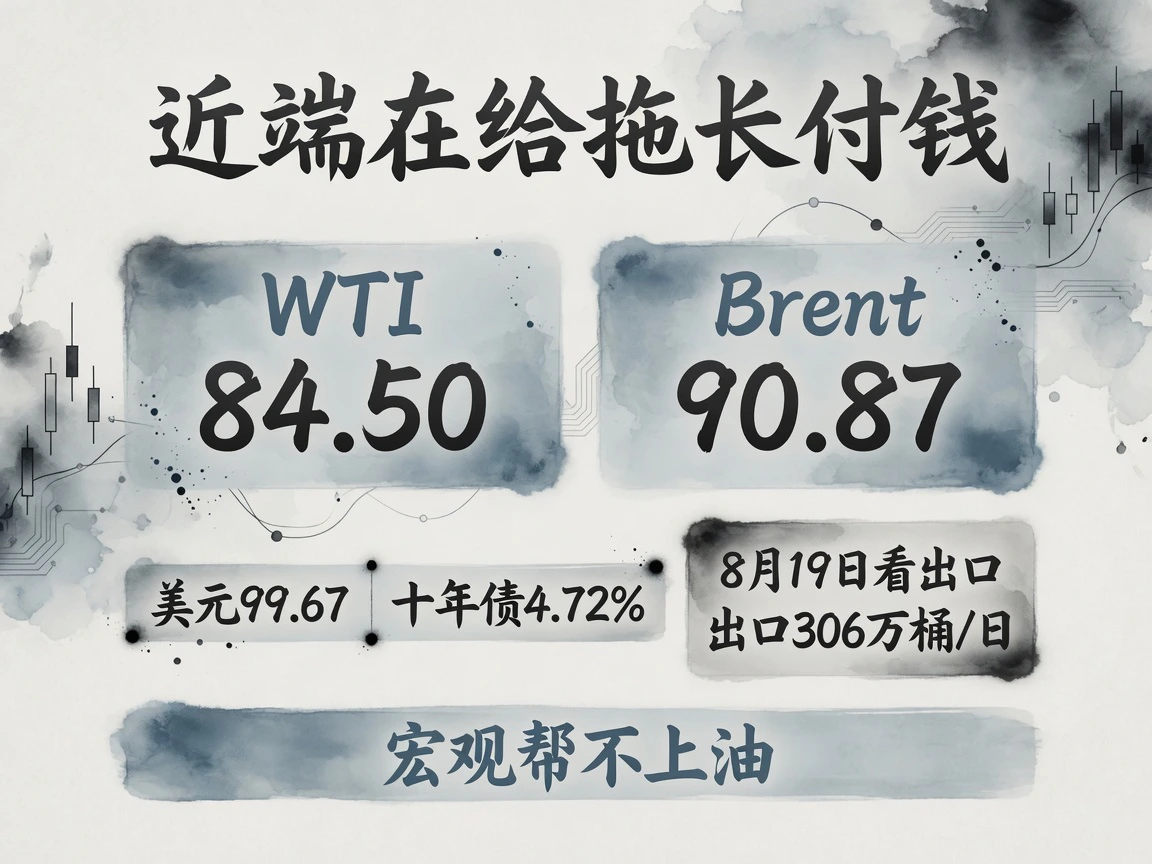
Tighter financial conditions provided no additional commodity liquidity. On August 17, ten-year yields rose four basis points to 4.72%, two-year two to 4.19%, and 30-year six to 5.31%; S&P 500 fell 0.52% and VIX rose 6.60%. The dollar index edged from August 14's 99.67 to a publication snapshot of 99.55; Barchart said Monday reached a roughly two-and-a-half-month low, offering slight oil support. London spot gold rose from August 14's $4,380 to about $4,487 an ounce. Higher yields and weaker stocks showed defensive macro conditions; oil's contrary strength was geopolitically driven by expiry without renewal and long-war language, with liquidity secondary.
Nearby contracts balance opposing narratives. The institutional vacuum means no short-term return to prewar passage, requiring continuing compensation for obstruction. But dark shipping and pipelines maintain flows on the order of ten million barrels daily, preventing confirmation of total cutoff. SEB commodities chief Bjarne Schieldrop told Reuters benchmarks would struggle to rise another level unless nocturnal dark exits were cut or Bab el-Mandeb faced greater closure. Investors pay for deeper-disruption tail risk while retaining protection against a sudden price collapse if the Strait unexpectedly reopens through reconciliation.
This explains limited downside without a surge. The huge commercial build and IEA's demand-destruction assessment constrain a rapid triple-digit move, but product stocks below five-year seasonal averages prevent labeling it broad final-demand surplus. Strong nearby premiums and deep forward discounts match EIA's $69 Brent expectation for 2027 normalization. Investors are willing to pay rent only for present delay.
Three tests dominate the next week: August 19 EIA data, especially whether exports recover from 3.06 million daily; commercial-radar passage recovering from the weekend's near standstill, with physical flows more decisive than verbal blockade threats; and Bessent's unprecedented measures becoming actual secondary sanctions on third-party settlement, insurance or purchases. Only implementation of those threats would bring another nearby-premium jump.