Understanding the Federal Reserve, Article 15 of 20
Weaker car sales never stop at the dealership. Inventory accumulation first forces parts-order cuts, then affects assembly schedules, steel and logistics turnover, and finally regional banks' lending demand. Meanwhile, Chicago's role as a global derivatives and commodity-pricing hub gives financial and professional-service firms another set of real-time signals. The Seventh District combines the industrial heartland with a core financial center, making it a valuable case of how real-economy cycles and financial conditions reinforce and amplify one another.
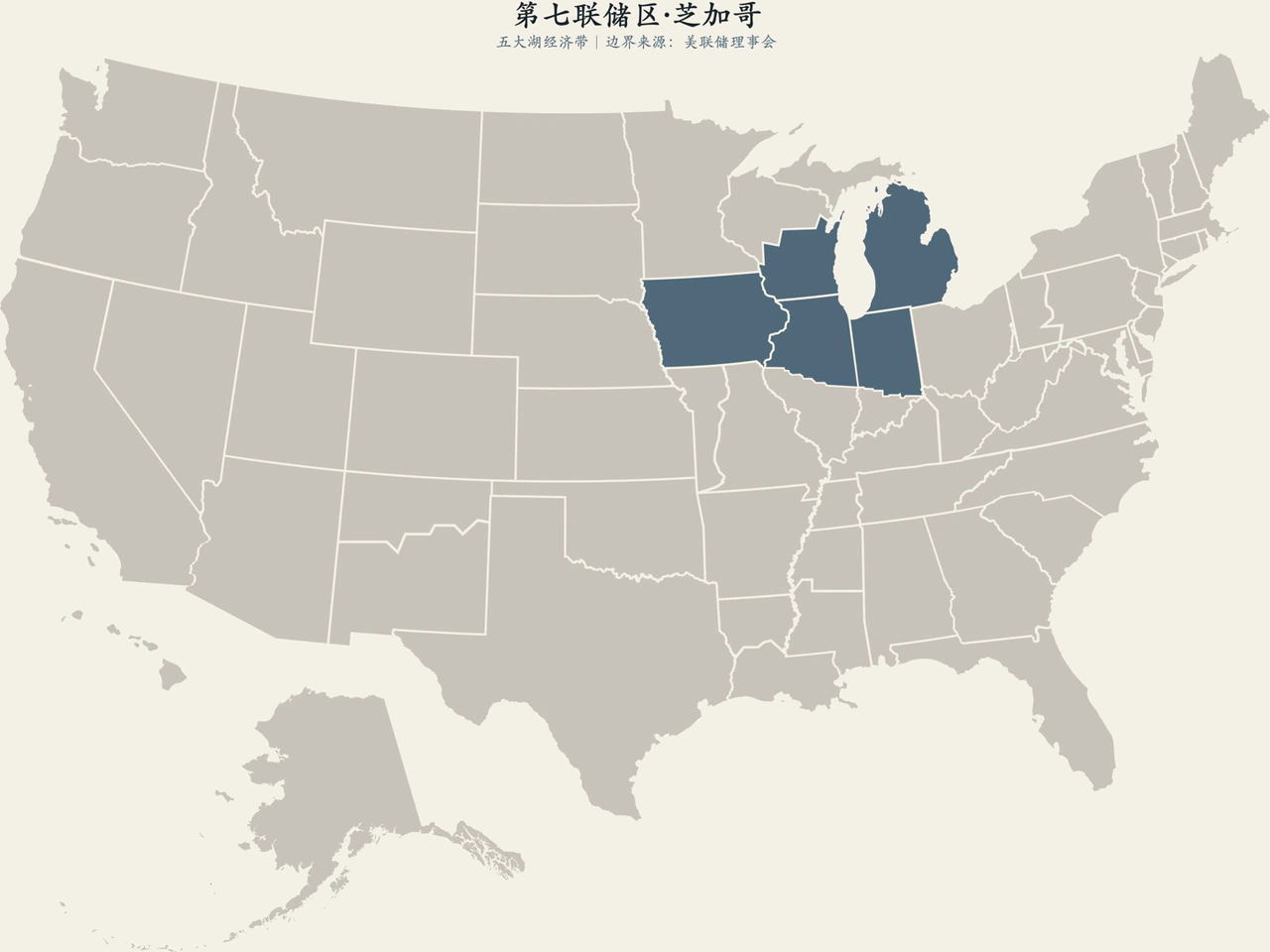
The district covers all of Iowa and parts of Illinois, Indiana, Michigan and Wisconsin, with a branch in Detroit. Its boundaries follow economic hinterlands rather than state borders. Autos, heavy machinery, modern agriculture and food, and Chicago-area financial services create a diverse, interconnected economy.
1. Automotive Supply Chains and the Agricultural Hinterland: Deep Transmission of Real-Economy Cycles
How Weaker Final Demand Reaches Industry and Employment
Autos encompass far more than assembly: chips, specialty steel, chemicals, glass, logistics, distribution and large consumer loans. Weaker end demand sends inventory pressure upstream through purchasing orders. Conversely, disrupted key supplies can raise vehicle prices through scarcity even while deliveries are constrained. Electrification and automation have also reshaped capital spending, producing deep differences in industrial geography, skill requirements and investment cycles across manufacturing centers.
Southern Michigan and Detroit are tied directly to autos; metropolitan Chicago depends on modern finance, derivatives and professional services; Iowa's agricultural and forestry economy depends heavily on crop prices and farmland values. Thus, even steady national manufacturing totals may conceal profound changes inside the district's supply chains.
The district's key policy lesson is that slower employment and higher prices need not come from overheated aggregate demand. Supply bottlenecks and shortages of critical parts often produce falling output alongside rising final prices. Rate hikes can restrain consumption at the margin but cannot quickly supply missing components. Mechanically controlling demand while ignoring these constraints risks policy overshoot.
Farm Machinery and Agricultural Capital Spending Reinforce the Credit Cycle
Farm commodity prices, financing costs and land values directly shape farmers' cash flows and willingness to buy machinery, feeding back into Midwestern heavy-equipment orders. A stronger dollar reduces agricultural export competitiveness while lowering some imported-input costs. Local small and midsize banks' lending thresholds and liquidity directly determine whether farms and smaller manufacturers can survive a commodity downturn.
Calling the Seventh District simply the Rust Belt misjudges its resilience. Modern agriculture, precision manufacturing, logistics and credit are closely linked within one geography. Looking at one sector alone can underestimate how widely a real-economy shock develops into second-round systemic volatility.
2. Chicago Fed Quantitative Tools: CFNAI, NFCI and MEI
CFNAI Measures National Activity, Not Just Midwestern Conditions
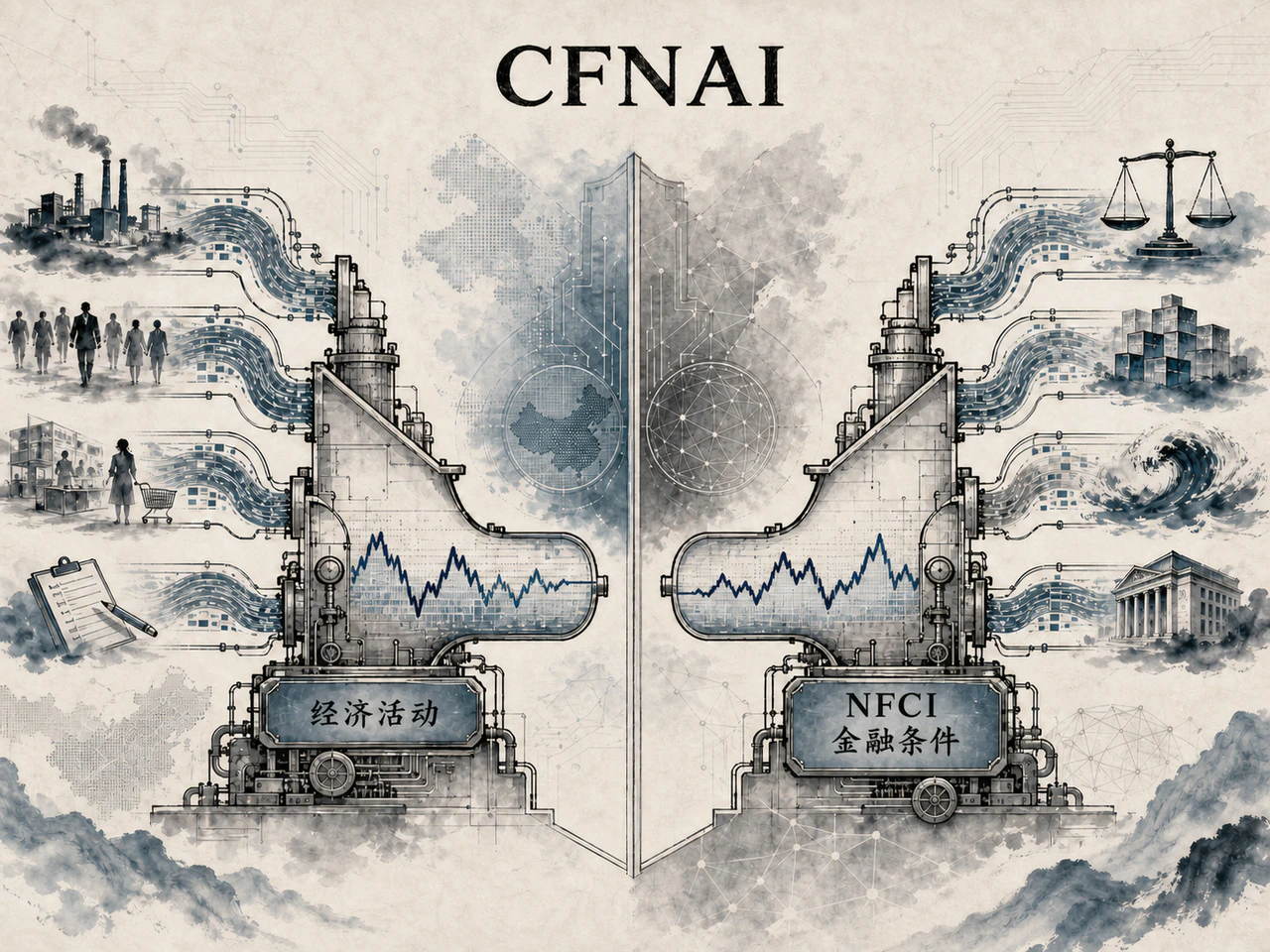
The Chicago Fed National Activity Index (CFNAI) uses a dynamic-factor model to combine 85 monthly indicators covering production and income; employment and unemployment; personal consumption and housing; and sales, orders and inventories. Zero represents the economy on its historical potential-growth path; positive readings mean faster-than-historical-average expansion and negative readings weaker momentum. Analysts typically emphasize its three-month moving average, CFNAI-MA3, to smooth monthly noise.
CFNAI is not static: revisions to underlying data can reshape its history. It captures the breadth and turning points of activity, not a direct linear equivalent of quarterly GDP growth. A negative reading does not mechanically confirm recession. Contributions from the four categories are needed to distinguish production-led strength from labor-market weakness.
NFCI Measures Systemic Financial Conditions, Not the Policy Rate
The National Financial Conditions Index (NFCI) combines more than 100 indicators from money, fixed-income and credit, and equity markets, commercial banks and shadow banking. It assesses conditions through risk appetite, credit supply and leverage. This differs fundamentally from the federal funds target. Even with no FOMC move, rising risk assets, narrower spreads or abundant liquidity can ease conditions spontaneously. Conversely, rate cuts can coexist with tight conditions felt by the real economy if banks raise lending standards and risk premiums.
The adjusted ANFCI seeks to remove financial fluctuations endogenous to the macroeconomic cycle and isolate conditions independent of fundamentals. This adjustment depends heavily on historical statistical covariance. It is useful, but is not a statutory Fed policy anchor.
The Midwest Economy Index (MEI) specifically extracts nonfarm output performance within the Seventh District. CFNAI for the national real economy, NFCI for national finance and MEI for the regional real economy together provide a three-dimensional view of aggregate activity, financial leverage and regional detail. Their distinct functions should not be confused.
3. The Policymaker's View: Transmission Chains and Goolsbee's Considerations
Austan Goolsbee Is an Alternate in 2026
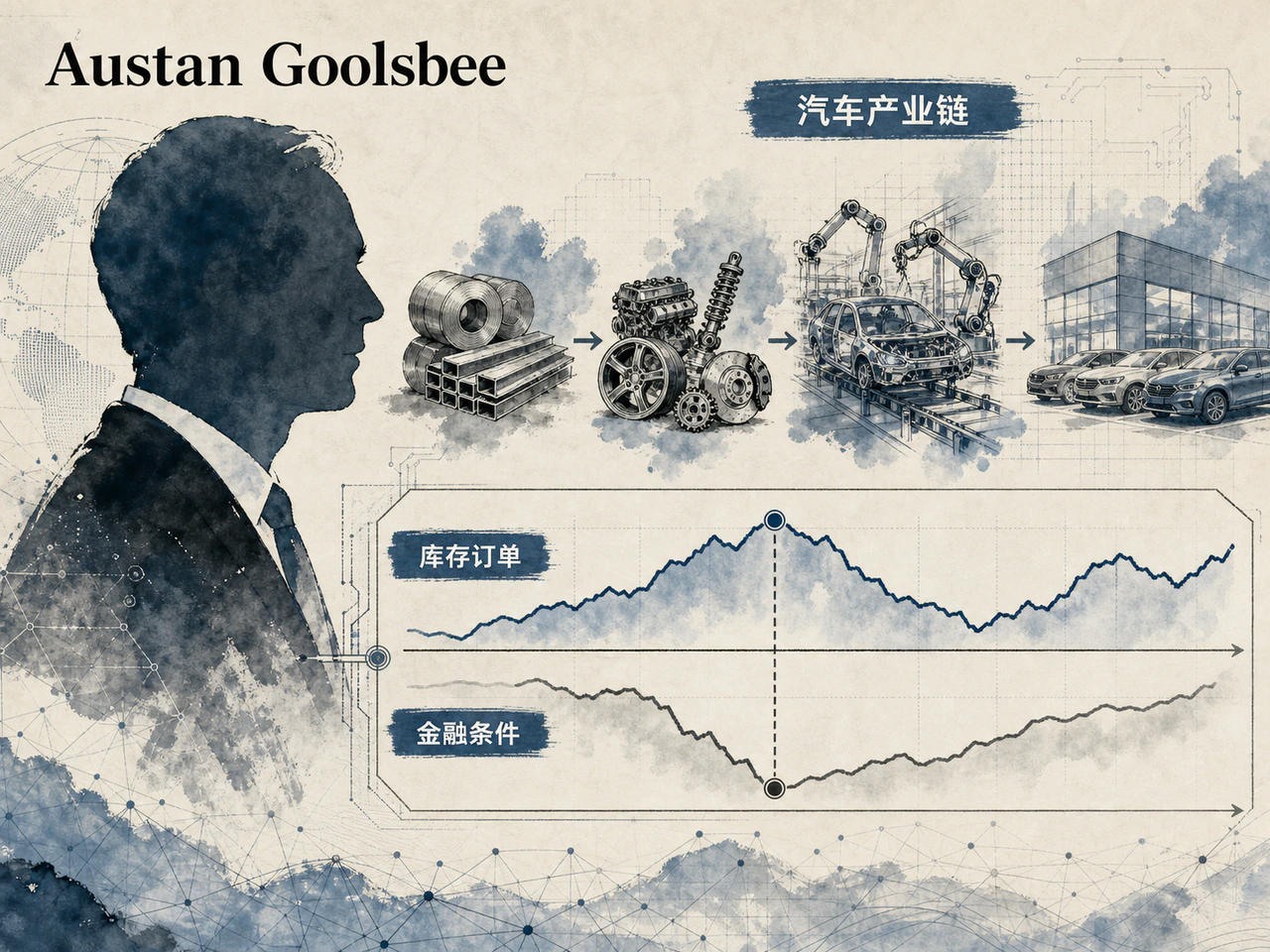
Austan D. Goolsbee has led the Chicago Fed since early 2023. In the 2026 rotation he is a nonvoting alternate, while participating fully in policy debate and submitting quarterly SEP forecasts. His communication focuses on disinflation, emerging labor slack and possible total-factor-productivity recovery, particularly whether sticky prices reflect slow supply-side normalization or persistently excessive demand.
The district's automotive and machinery experience encourages close attention to inflation's causes. Individual interviews should not determine a permanent hawk or dove label. Analysis should examine how he connects rent inflation, supply-chain repair, labor-supply elasticity and financial conditions over time.
Cross-Check the Three Indexes to Avoid the Fallacy of Composition
A single composite index is easy to misread. Weaker CFNAI, tighter NFCI and an even deeper MEI decline often indicate a negative feedback loop between slowing activity and contracting credit in the manufacturing heartland. CFNAI above average alongside persistently easy NFCI may mean strong financial-market momentum is offsetting restrictive official rates. Stable national indicators but an early MEI decline warrant attention to whether headwinds in autos or agriculture could spread nationally.
Composite indexes reduce dimensionality and improve reading efficiency, but necessarily smooth away heterogeneous components. A turning signal should lead first to investigation of contributions, revisions and cross-sectional distributions, rather than binary trades based on which side of zero the index occupies.
The Chicago Fed reveals a complete transmission chain: policy rates change car-credit costs; credit conditions influence sales; dealer inventory affects assembly and parts orders; orders determine shifts, hours and hiring; industrial output feeds into regional bank asset quality; and systemic financial conditions then support or restrain consumption and investment. Understanding this connected chain is closer to monetary policy's actual operation than memorizing monthly index moves.
The chain also has substantial lags. Higher auto-loan rates first raise monthly payments and restrain new-vehicle contracts. Dealers initially offer larger discounts to clear inventory, cutting manufacturer orders only when stock reduction falls short. Assemblers and suppliers then reduce shifts and capital spending. By the time layoffs and unemployment fully appear in official reports, the original tightening has often been passing through activity for months. The district's frequent business contacts and multidimensional indexes provide a forward-looking window into those otherwise opaque lags.