Understanding the Fed, article 3/20
When the Fed was founded in 1913, Congress assigned a clear core task: provide an elastic currency, address seasonal cash shortages as money moved into farming regions at harvest and act as a firefighter during bank runs. More than a century later, it manages the world's most important short-rate benchmark, a multitrillion-dollar balance sheet, systemically important banks and even direct support for key asset trading when market liquidity evaporates.
The institution's name has endured for more than 110 years, but its operating machinery and policy tools have changed beyond recognition.
This is not simply a history of linear power expansion. Crisis repeatedly transformed the institution: the Depression, wartime finance, stagflation, subprime crisis and pandemic each pushed existing rules into a corner, forcing unconventional tools. Congress then redrew powers and accountability during reconstruction. From regional autonomy to central control, fiscal subordination to independence, and rate setting to market making, each normal tool today began as an answer to a particular institutional failure.
1. Failure pushes a decentralized system toward central coordination
The Fed of 1913 mainly addressed cash shortages
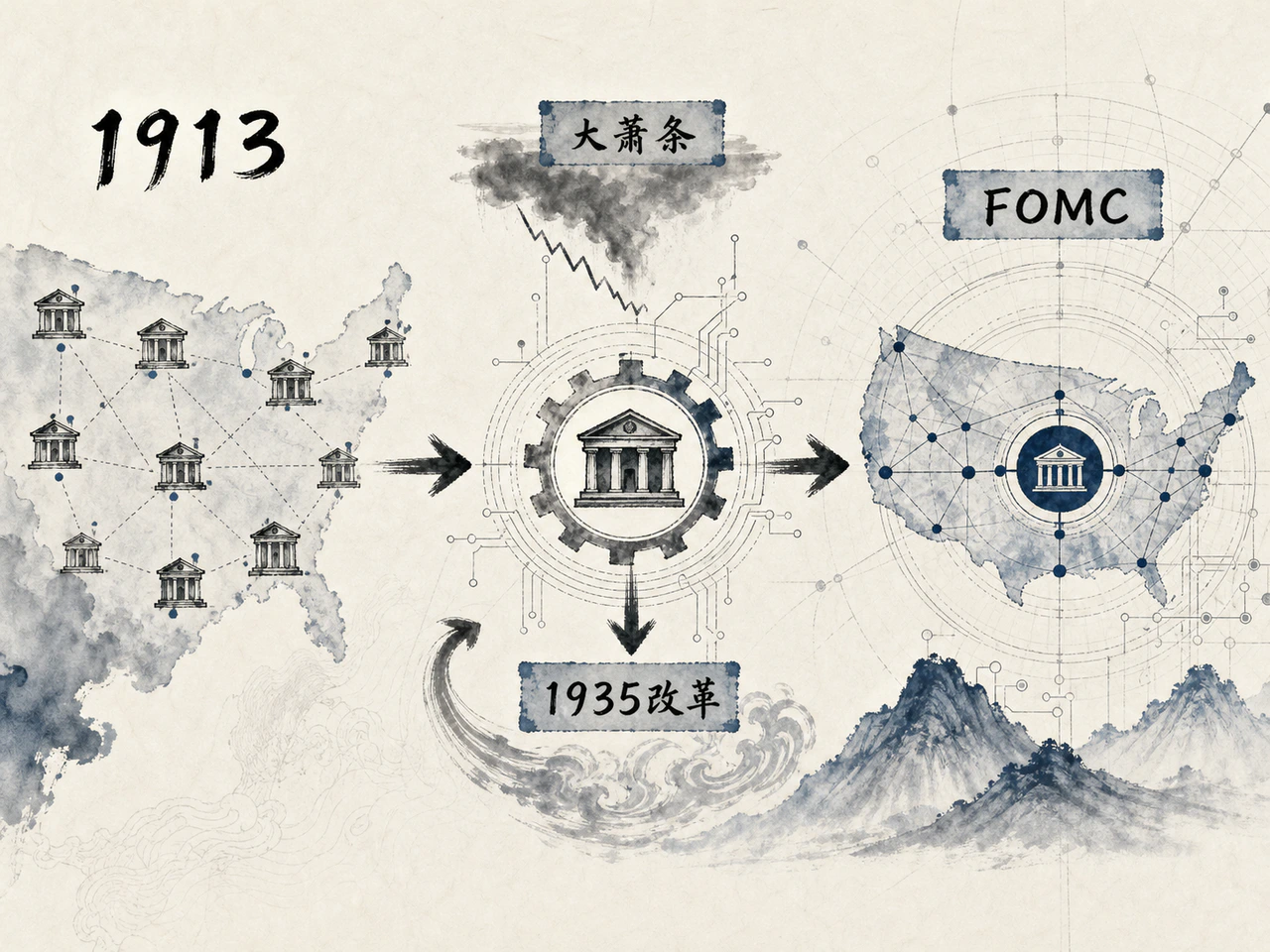
The early Fed was not today's Washington-led centralized institution but a loose regional discount network.
Commercial banks short of liquidity could pledge eligible short-term commercial bills at the local Reserve Bank discount window for reserves or Federal Reserve notes. The prevailing real bills doctrine held that issuance matched to real trade and goods circulation would avoid excessive inflation or speculation. There was no public federal funds target or aggregate-demand reaction function based on unemployment and prices. The 12 banks resembled local mutual liquidity reservoirs.
That arrangement changed almost accidentally in the 1920s. Reserve Banks bought and sold government securities to employ idle funds and cover expenses. New York president Benjamin Strong and others recognized that this was more than investment: purchases changed banking reserves, short rates and credit conditions. Open market operations emerged and quickly became a national macroeconomic lever rather than an auxiliary proprietary activity.
New powers brought coordination problems. Districts disagreed on conditions; New York's Wall Street location and expertise gave it operational dominance, while Washington's Federal Reserve Board retained oversight. Friction over pace and control left no unified decision center.
The Great Depression exposes the institutional gap
After the 1929 crash, unprecedented bank failures caused catastrophic monetary and credit contraction.
Later economists offered classic explanations. Friedman and Schwartz accused the Fed of serious failure through inaction as liquidity contracted. Others stressed the gold standard's constraints, the real bills doctrine and liquidationism, which mistook weak credit demand for abundant liquidity and even viewed failures as necessary selection. At the governance level, fragmented authority was fatal: Washington and the districts acted separately and no one could decisively speak for the system during panic.
The decentralized network created to eliminate banking panics collapsed before the genuine systemic disaster.
Congress rebuilt the Fed through the Banking Acts of 1933 and 1935. Beyond creating FDIC to interrupt runs, the laws centralized authority: the Federal Reserve Board became the independent Board of Governors and the FOMC received formal legal status. Washington's 7 governors held a statutory majority, while district presidents had minority rotating votes. Coordination of open market operations shifted decisively to Washington.
Central coordination replaced local autonomy, giving the Fed the form of a modern national central bank.
2. Independence and the dual mandate both emerge from conflict
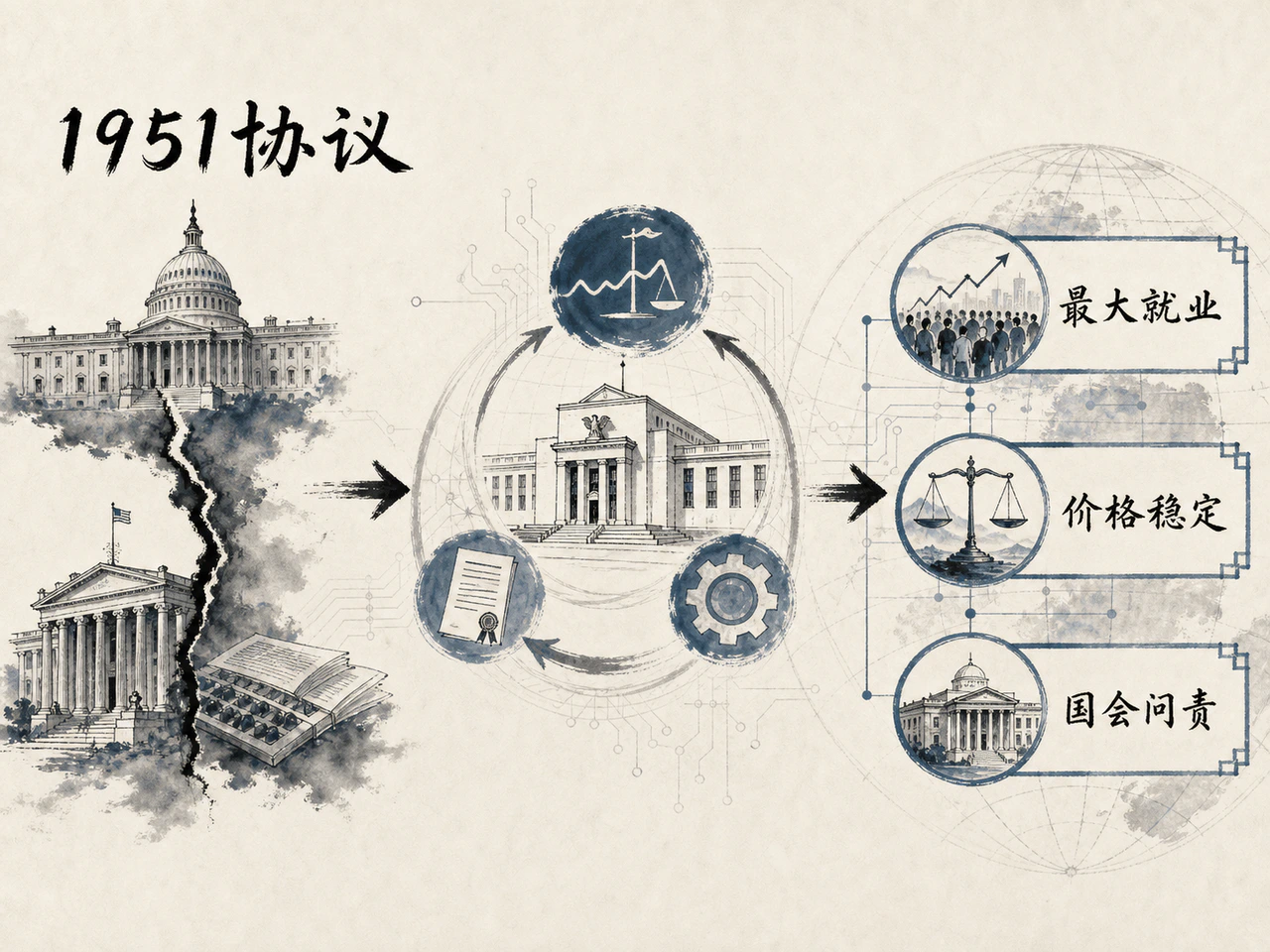
After World War II, should low rates still serve the Treasury?
War interrupted independent evolution. Financing enormous military spending turned the Fed into a Treasury funding toolkit.
From 1942, the Fed and Treasury pegged yields, capping long bonds at 2.5% and fixing bills at 0.375%. The Fed bought whatever selling threatened higher yields. Wartime controls and patriotic saving temporarily concealed excessive issuance. Afterward, decontrol, released wartime savings and continuing deficits collided, unleashing inflation.
The Treasury wanted low rates to reduce interest on its huge debt. The Fed recognized that compulsory bond buying made it a passive source of base money and inflation, unable to tighten credit.
After intense political conflict, the 1951 Treasury-Fed Accord formally ended the Fed's obligation to maintain Treasury price ceilings and broke wartime fiscal dominance. The compromise established operational independence: policy could pursue macroeconomic goals without underwriting deficits.
Independence was never above institutions. Congress granted its legal status and could amend it; presidents nominate governors, the Senate confirms them and the chair testifies regularly. Independence means choosing tools within statutory goals, not an unaccountable realm.
The Great Inflation makes central-bank credibility costly
After operational autonomy, the next two decades brought a less visible trap.
In the late 1960s and 1970s, mainstream faith in a simple Keynesian Phillips curve suggested a stable inflation-unemployment trade-off and lasting low unemployment for moderate inflation. Policymakers overestimated potential productivity. Vietnam and Great Society fiscal excess, two oil shocks and White House pressure—especially Nixon on Burns—helped unanchor expectations and produce severe stagflation.
The experience shattered the long-run Phillips-curve promise. Congress amended the Federal Reserve Act in 1977 to specify maximum employment, stable prices and moderate long-term rates. The 1978 Full Employment and Balanced Growth Act, or Humphrey-Hawkins Act, legally entrenched the dual mandate and required semiannual reports and testimony.
Paul Volcker took office in 1979 and drove fed funds above 20%. Accepting two deep recessions and double-digit unemployment, the Fed broke the inflation-expectations cycle and regained credibility.
Volcker established credibility as a scarce anchor of stability. Once people doubt anti-inflation resolve, restoring expectations demands vastly greater growth and unemployment costs. Greenspan's subsequent Great Moderation brought low inflation and steady growth, while ultralow rates and permissive derivatives oversight quietly fostered larger imbalances.
3. From rates to balance sheets: The central bank moves deeper into markets
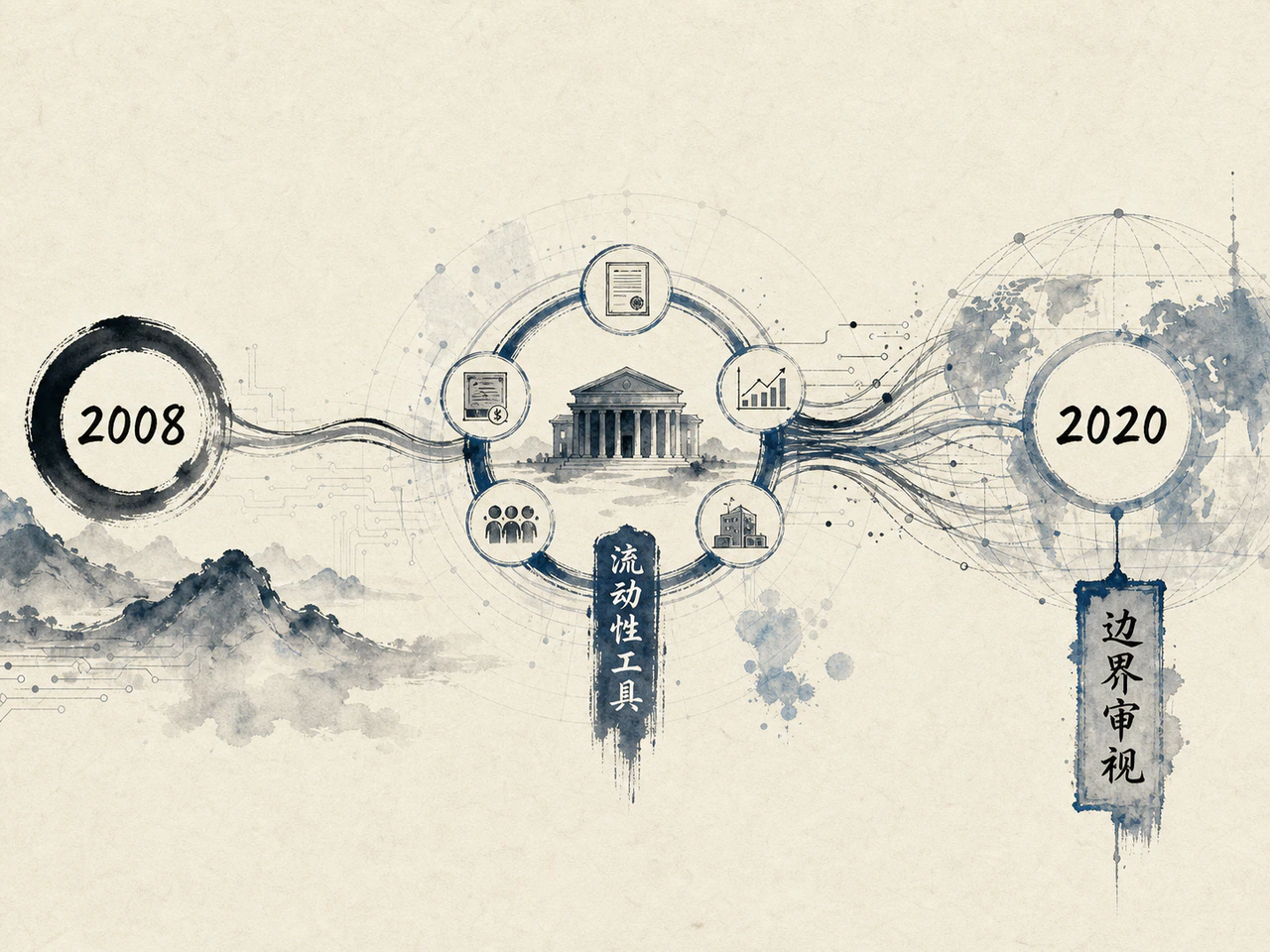
In 2008, the Fed starts repairing funding chains directly
The global subprime crisis of 2008 broke traditional monetary transmission.
The epicenter was shadow banking rather than depositors queuing at counters. Commercial paper, asset-backed securities and unsecured interbank funding froze almost overnight. Good assets lacked buyers and institutions hoarded cash through distrust. The Fed cut the target to the effective lower bound of 0%–0.25%, but cuts could not transmit funds to the economy and nonbanks.
The Fed invoked Section 13(3)'s unusual-and-exigent-circumstances lending powers to inject liquidity beyond banks. CPFF, PDCF, TALF and other facilities made it a backstop across markets. Successive QE rounds then bought massive long Treasuries and agency MBS issued by Fannie Mae and Freddie Mac in secondary markets to lower longer rates and restore collateral values.
The balance-sheet era had arrived. The Fed controlled not only the price of benchmark rates but directly influenced financial quantities and structure.
Extraordinary measures provoked pushback. The 2010 Dodd-Frank Act strengthened capital and stress testing while narrowing power: it prohibited Section 13(3) rescues aimed at individual troubled firms, closing the path to another AIG-style case. Emergency facilities had to be broad-based, receive prior written Treasury-secretary approval and disclose recipient details to Congress.
In 2020, lender of last resort becomes market maker of last resort
If 2008 involved repairing funding, the 2020 pandemic made the Fed the ultimate counterparty for the financial system.
In March 2020, lockdowns abruptly halted activity and triggered a dash for cash. Investors sold not just stocks and high yield but even Treasuries, the deepest safe haven, where leveraged basis unwinds and foreign official selling crippled buying. Dealer balance sheets were overwhelmed and bid-ask spreads multiplied.
Facing collapse of the capital market's foundational collateral, the Fed broke precedent. It cut rates to zero within days, began unlimited asset purchases and, with CARES Act fiscal credit backing, created primary and secondary corporate credit facilities, the Municipal Liquidity Facility and Main Street Lending Program for businesses.
Its role transformed from a lender of last resort supplying reserves backstage into a market maker of last resort at the trading desk, prepared to buy across assets when supply and demand fractured.
The crisis was rapidly suppressed, leaving deep macroeconomic consequences:
First, moral hazard became entrenched. Belief in protection from extreme tails—the Fed put—encourages unconstrained bull-market leverage.
Second, monetary and fiscal boundaries blurred. Joint support for businesses and local governments and large bond purchases created a cheap absorber for deficits, while rising asset prices widened inequality.
Third, normalization became arduous. Enormous expansion and pandemic fiscal stimulus ignited the worst inflation in 40 years. Rapid subsequent hikes and QT produced large Fed financial losses from inverted interest income and expense while continually testing the safe lower bound for banking reserves.
Over more than a century, a loose discount association solving agricultural settlement cash shortages became a powerful center managing trillions in assets, supervising systemically important banks and backstopping global liquidity at critical moments.
Four fundamental tensions have persisted through this crisis-driven reinvention:
- Centralized coordination versus regional economic knowledge;
- Operational independence versus democratic accountability;
- Full employment versus stable prices;
- Preventing systemic collapse versus encouraging moral hazard.
The Fed was never a precision machine designed in a vacuum. The most effective way to understand any tool, framework or communication is to return to its historical setting and ask which painful failure it was created to repair.