Understanding the Federal Reserve: Article 1 of 20
Global markets often treat the Fed as the master switch for asset prices, as if watching a few basis points in a rate decision could reveal the direction of global liquidity. Institutionally, however, it has never been a single, uniformly acting central bank. It is a composite system of carefully balanced powers and complex responsibilities.
Managing liquidity is not as simple as one person pressing a hike or cut button one morning. Governors and regional presidents debate the direction of open-market policy in the FOMC. Once a decision is announced, the New York Fed's trading desk implements market intervention. Day-to-day supervision, extraordinary liquidity tools, currency issuance and withdrawal, and underlying interbank clearing are distributed across the Washington Board and 12 Reserve Banks. Decision-making, execution, supervision and public services each follow statutory authority. Mapping these powers is the first step toward understanding how policies are formed and negotiated.
1. Unpacking the Name Federal Reserve
Three Interlocking Layers
The common shorthand Fed can suggest one centralized institution. The full name, Federal Reserve System, emphasizes System: from its origins, this has been a composite structure of shared governance.
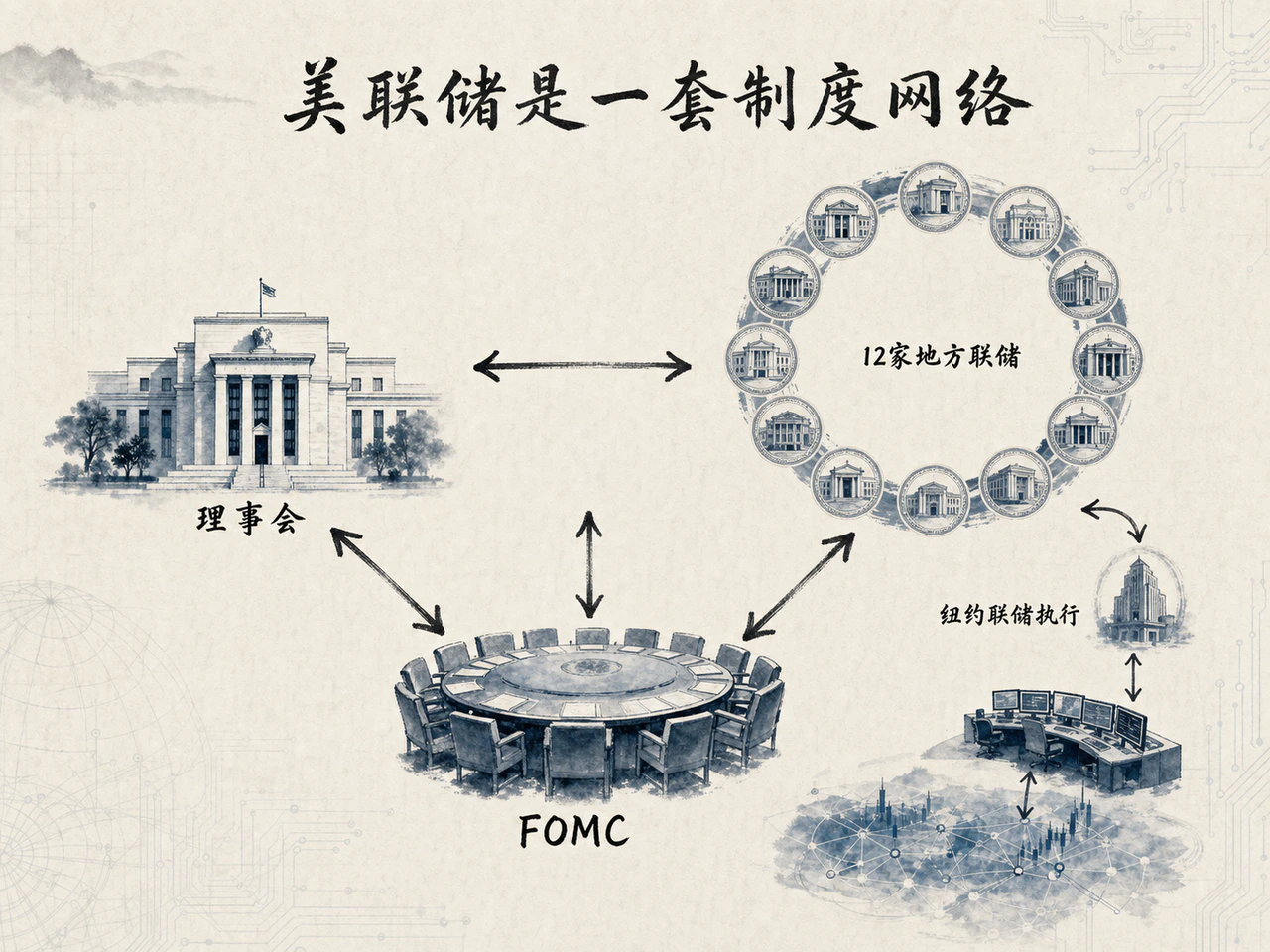
When the Federal Reserve Act passed in 1913, America urgently needed a lender of last resort for bank runs but deeply distrusted concentrated financial power. It wanted neither national credit handed to private Wall Street bankers nor monetary authority monopolized by federal politicians in Washington. The compromise produced three interlocking, counterbalancing entities: the Washington-based Board of Governors, 12 regional Reserve Banks, and the FOMC, formally developed later as the institution evolved.
The Board of Governors is a permanent federal agency in Washington, with a statutory full complement of 7 governors, all nominated by the president and confirmed through the Senate process. It oversees systemwide macro-regulatory arrangements, some financial-supervision rules and final approval of certain monetary tools. Staggered 14-year terms insulate it from short electoral cycles and prevent one administration from replacing the entire decision-making body at once.
The 12 Federal Reserve Banks perform extensive local operations. Rooted in major economic regions, each has its own board, management, legal personality and balance sheet, while carrying out statutory public functions under Board supervision. They are peers, not branches of New York, and do not set separate regional benchmark rates. Their routine work includes local data and industry research, prudential examinations, large-scale clearing and physical cash logistics.
The FOMC is the globally watched decision center for open-market operations and the overall monetary stance. It has 12 statutory votes: 7 governors, New York's permanently voting president and 4 seats rotating annually among the other 11 presidents. Nonvoting presidents still customarily attend throughout, describe local conditions, submit growth and rate forecasts—the dot-plot data—and debate. Attendance, submitting projections and casting formal votes represent three distinct dimensions of influence.
The Responsibility Chain Behind a Policy Decision
When the FOMC changes the funds target, it announces a policy objective and matching Implementation Note. The New York Fed's Open Market Trading Desk translates that objective into actual money-market rates. Under committee authorization, it uses overnight reverse repos, ordinary repos and Treasury transactions to manage reserve supply and demand and bring overnight rates toward the target. New York's operational role reflects its position at the center of Treasury, interbank, foreign-exchange and cross-border dollar liquidity. It is a specialized implementing agent, not administratively or legally superior to other Reserve Banks.
Other tools follow different statutory procedures. Changes to the discount-window primary credit rate are normally proposed by Reserve Bank boards and reviewed and approved in Washington. Interest on reserve balances, IORB, reserve-requirement rules and core supervisory policy primarily fall to the Board itself. Labeling all these mechanisms FOMC decisions obscures their separate chains of legal authority.
2. Four Other Institutional Engines Operate Behind Rate Headlines

Five Functions, Each With Its Own Tools
Financial reporting focuses on rates, but monetary policy is only one of the Fed's five core statutory functions. The other four institutional engines operate continuously:
- Monetary policy: pursue maximum employment and price stability through benchmark rates and balance-sheet size, shaping economywide financial conditions;
- Financial stability: monitor the system's overall resilience from a macroprudential perspective, including leverage, maturity mismatch, wholesale-funding liquidity and systemic vulnerabilities in trading infrastructure;
- Institutional supervision and prudential regulation: examine designated banks, holding companies and important financial infrastructure, and establish and enforce capital, liquidity-coverage, governance and compliance rules;
- Payment and clearing infrastructure: provide the underlying public networks sustaining modern finance, from Fedwire large-value real-time transfers to ACH batch payments and the newer FedNow instant-payment system, together with currency and coin ordering, regional storage, distribution to bank branches and return flows;
- Consumer protection and community development: implement fair-credit laws, promote financial literacy and support small community-finance projects, retaining grassroots contact with households and small businesses.
These functions overlap but retain distinct boundaries. Rate changes are macroeconomic countercyclical policy; bank capital stress tests address institution-level risk; keeping large-value settlement uninterrupted safeguards infrastructure. When Treasury issues debt, the Fed can provide technical accounting and settlement as fiscal agent. Treasury and Congress alone decide borrowing volume, deficits and use of proceeds. The central bank cannot intervene in those choices or become an unlimited government cash machine.
Four Questions Reveal Responsibility
To understand the Fed amid rumors and macroeconomic noise, there is no need for vague speculation about secret rulers of finance. Follow the institutional design with four questions:
First, which statute authorizes the measure?
Second, which statutory committee or regulator adopted it, and through what voting procedure?
Third, who implements it in markets, using which tools?
Fourth, to whom must it be disclosed, and which institution provides oversight?
These questions clarify accountability. The FOMC sets the overall stance; New York's desk trades and offsets positions in markets; the Board and Reserve Banks examine designated institutions under their assigned responsibilities; regional banks operate cash and clearing infrastructure; Congress exercises ultimate oversight through hearings, statutory reporting and legislation. Under current law, no single actor can monopolize or fully represent the entire system.
3. Five Misconceptions About the Boundaries of Power

Why the Public-or-Private Question Misses the Structure
Misconception 1: Is the Fed a private bank or a government agency?
This either-or question misses the institutional design. At the top, it is a federal public institution: Washington governors are public officials accountable to Congress. The 12 regional banks retain a corporate legal form, and member commercial banks must subscribe capital. But this is not ordinary corporate equity. The stock cannot be publicly listed or transferred, carries neither controlling votes nor residual-profit claims, and statutory dividend rates are tightly limited. Member banks cannot use it to influence monetary policy or choose Washington governors. Even on regional boards, commercial-bank representatives are legally excluded from key personnel decisions such as selecting Reserve Bank presidents. It is a hybrid design using a private organizational form to perform statutory public functions.
Misconception 2: The chair decides everything alone.
The chair has substantial authority over agendas, debate and unified external communication, with much more influence than ordinary members. Legally, however, major monetary decisions require committee votes on a one-person, one-vote basis. Deep disagreement must be bridged through judgment and compromise to build consensus; personal will cannot override majority voting.
Misconception 3: Each of the 12 Reserve Banks sets its own rate.
The United States is an integrated market, incompatible with 12 parallel benchmarks. Regional banks bring local economic and industry evidence to Washington, help form the national stance and ultimately implement one monetary policy.
Misconception 4: A Fed cut lowers every market rate equally and immediately.
The FOMC directly controls only the overnight unsecured interbank cost, the federal funds rate. Ten-year Treasury yields, 30-year mortgages and longer-term corporate funding depend not just on the short-rate anchor but on long-run inflation expectations, potential growth, fiscal Treasury supply, credit compensation and term premiums. Policy quickly affects the short end, but transmission to long yields is never a simple linear mapping.
Misconception 5: The Fed can solve every economic problem.
Its tools manage liquidity and economywide borrowing costs. Tax reform, deficit budgets, industrial subsidies, welfare and structural housing-land supply remain decisions for Congress and the White House, outside monetary authority.
This 20-part Understanding the Federal Reserve series uses institutional analysis to cut through market noise. The first 4 articles examine origins, crisis-driven changes, independence and legal ownership boundaries. Articles 5–8 address FOMC deliberation, core data, modern tools, supervision and clearing. The final 12 visit each regional Reserve Bank, revealing local economic conditions and how they arrive at the same policy table.